
California’s $100 Billion Surplus: What to Know About Newsom’s Spending Plan
Ben Christopher / Friday, May 13, 2022 @ 12:57 p.m. / Sacramento
“Simply without precedent.”
Gov. Gavin Newsom is a man of many superlatives, but even he seemed to struggle today to adequately describe just how much extra cash the state of California will have to spend in the coming year’s budget: $97.5 billion.
Speaking for more than two hours in a press conference in Sacramento, Newsom unveiled his latest record spending proposal for the coming fiscal year. Riding a superheating economy and drawing disproportionately from the state’s highest earners, the state is now projected to have a surplus bigger than California — or any state — has ever had, and significantly more than the $76 billion that the governor predicted in January.
Roughly half of the surplus is required by law to be spent on education. That leaves “only” roughly $49 billion in discretionary money, and the governor wants to reserve 99% of that for one-time spending: $18.1 billion to provide financial relief for Californians buffeted by inflation, plus $37 billion for infrastructure investments, including $5.6 billion for education facility upgrades, and an extra $2.3 billion for the ongoing fight against COVID-19.
A few of the other big numbers that Newsom mentioned today:
- $128.3 billion in education spending, from transitional kindergarten through high school, a record-breaking sum that works out to $22,850 per student.
- Another $23 billion will be parked into the state’s rainy day fund, to be drawn upon the next time the economy slows
- $2.5 billion for housing, including $500 million to fund the conversion of vacant malls and storefronts into homes
- An extra $3.4 billion to pay down state employee retirement debt
The massive windfall that the state is sitting on, coupled with the state’s progressive tax system is a sign of “the concentration of wealth and success in the hands of a few that are enjoying abundance in historic and unprecedented ways,” Newsom said. “I am proud of California’s progressive tax system…and we’re the beneficiary of that.”
Now the ball is in the state Legislature’s court as lawmakers decide where they agree with the governor and which priorities they want to haggle over before the June 15 deadline to pass a final, balanced budget for the fiscal year that starts July 1.
Today’s “May revise” rollout is part of the annual call-and-response between the governor’s office and the Legislature over how to spend your tax dollars. Each year, the governor sets the negotiations in motion in January with a preliminary budget proposal. This year, Newsom’s proffer included a record surge in K-12 education spending, along with multi-billion dollar proposals to ramp up the state’s wildfire prevention projects, convert more vacant hotels into housing for the homeless and open up Medi-Cal, the state’s health insurance program for the poor, to all undocumented immigrants.
What Newsom unveiled today is a retake on that earlier budget blueprint, but freshened up with new estimates of the state’s fiscal future. Tack on the extra surplus money and you end up with a new record-high total: $300.7 billion.
When discussing money on the scale of the California state budget, it’s easy to lose perspective. But to be clear, even by Golden State standards, that is an astounding amount of money.
What a difference two years makes. In May 2020, with the state still weathering the first surge of COVID-19, the governor’s Department of Finance projected a $54 billion deficit and a year of Great Depression-level unemployment rates. Neither came to pass, just the opposite: Boosted by rosy economic conditions for the state’s highest earners and a massive influx of cash from the federal government, state coffers have been overflowing for the last two years.
For the governor and Democratic leadership in the Assembly and Senate, having to divvy up billions of new dollars during an election year is a good problem to have. But on financial aid to struggling families, the scale of the state’s drought response, what to do about the sky-high price of gasoline and other pressing policy conundrums, not everyone is on the same page.
Assembly Speaker Anthony Rendon kept his cards close to his chest in a statement, simply heralding his Democratic “teammates” in the Senate. “We know how to work together to present Governor Gavin Newsom with a budget he can be proud to sign by the constitutional deadline,” he said.
The Republican minority in the Legislature is so diminished that Democrats don’t need their support to pass a budget. But that isn’t stopping GOP lawmakers from weighing in, if only to provide voters with a clear contrast as Election Day approaches.
“Newsom specializes in grand announcements and flashy sounding proposals, but he rarely follows through with effective solutions that actually help California families,” GOP Assembly leader James Gallagher from Chico said in a statement. “The Governor may not want to acknowledge it, but California is in crisis and his budget is unsustainable.”
Here are other highlights from the governor’s latest spending plan:
Cash for Californians
If the average Californian hears anything about today’s announcement it’s probably this: The governor wants to send $400 to most of the state’s car owners.
That’s been the governor’s idea to help drivers bear the cost of historically elevated gas prices. In the face of pushback from environmentalists, he also wants to throw in $750 million to entice transit agencies to make bus and rail travel free for three months. And lest he be accused to throwing money at those who don’t need it, the proposal is limited to drivers whose car are worth under an as-yet unspecified cap.
Despite all that, there’s some distance between this proposal and the Legislature’s, where Democratic leaders want to send cash rebates to Californians making less than $250,000, car owners or not. And it’s even further still from the GOP plan, which is simply to suspend the state gas tax.
“I have all the confidence in the world we’ll be able to square those modest differences and we’ll come around to a number and a strategy that’s in the best interests of Californians,” Newsom said.
Today’s announcement also answered another big question left unaddressed by the January proposal: Will an obscure amendment inserted into the California Constitution in 1979 compel the state to reroute some of the state’s extra cash back to taxpayers?
The answer, at least for now, appears to be no.
The constitutional provision in question, the Gann Limit, was approved by voters during the heyday of the state’s conservative “tax revolt” and capped per-person state spending to its 1978 level, after adjusting for inflation. Anything left over has to be sent back to taxpayers and school districts. With the state’s coffers as full as they are, the January budget blueprint projected that the state would breach the cap.
But with more spending on exempt types of expenditure, including infrastructure, the current plan is now $2.6 billion below that ceiling. Newsom noted that he would support a proposal to put an amendment to voters to tweak or perhaps outright eliminate the Gann Limit, which he said is “long overdue.”
‘Eat your heart out, Texas’
Budgets, as the cliche goes, are statements of values. Newsom clearly values decrying the state of Texas and its right-wing government.
Among the policies-cum-anti-Texas-digs that Newsom rolled out today were a revision of the state’s business relocation tax credit program to provide “additional consideration” for businesses relocating from states with anti-abortion and “anti-LGBTQ+” laws.
Newsom encouraged companies to come to the Golden State, where the “values that you express in your public documents are actually reflected in terms of the work we do as a state.”
The context, only barely unspoken, is that Texas has recently passed a law that effectively bans most abortions and introduced a policy that treats gender-confirming care for transgender kids as child abuse.
Newsom’s budget plan also include an additional $125 million to expand access to abortions and fund research into reproductive health.
“I do want to make a deep point here: California is a pro-life state,” Newsom said, appropriating a term used by the anti-abortion movement to tout his proposed spending on expanded preschool, health insurance access and gun-violence reduction programs.
He also chided Arizona, Florida and Texas for having COVID death rates higher than California’s: “There are a lot of folks out there that are pro- conception to birth but that fall wholly short of being pro-life.”
Whither retail theft?
In January, when Newsom rolled out his first budget proposal, a spate of holiday season smash-and-grab thefts were still dominating the headlines. He responded by asking the Legislature for an extra $350 million to combat “organized retail theft” rings.
Now that voter anxiety seems to have moved on to other issues, the governor appears to have taken the advice of the Legislative Analyst’s Office, which criticized the proposal for lacking “ clear and specific objectives” and focused his public safety spending elsewhere.
Instead, Newsom is prioritizing areas such as “wellness” grants for police by creating a one-time $50 million grant for counties and cities to improve officers’ health and well-being. He’s also looking to fund mobile probation centers and to provide more resources to help California tribes find missing Indigenous people.
Following a years-long trend, the governor also hints at the possibility of shuttering more state prisons. Though the state prison population has ticked up slightly since the early days of the pandemic, it still sits at a decade-long trough and is expected to continue trending down. Today’s budget proposal notes that the state may be able to “close three additional state prisons by 2024-25.”
Fire, drought and cow-watching satellites
With the state bracing for yet another season of extreme heat, wildfire and drought, Newsom’s revised budget includes an additional $8 billion to increase the reliability of the state’s power grid and hasten the development of clean energy projects.
One notable new investment: $100 million towards carbon removal technologies — trapping carbon dioxide emitted by smokestacks and injecting it into the ground for long-term storage.
Newsom also acknowledged the stress that the state’s never-ending wildfire season takes on fire crews by asking for $233 million to bolster Cal Fire. The proposed budget adds an additional $104 million to add 270 positions over four years, something the agency has been seeking for some time.
As drought deepens and spring brings increased water use in cities and towns, Newsom is asking for additional $1.3 billion in drought and water resilience spending, up from $750 million in his January plan. The total would add to last year’s water and drought budget of $5.2 billion over three years.
Newsom also proposed spending $44 million to modernize California’s byzantine water rights system and bolster enforcement. Funding for water resiliency and drought relief for urban and small water systems more than doubled in the latest budget proposal, a sign of the dry, difficult conditions the administration anticipates in the summer ahead.
And following through on a vow by his predecessor for California to “launch its own damn satellite,” the governor is proposing to spend another $100 million to send up methane-monitoring satellites to monitor climate-warming emissions from livestock.
###
CalMatters reporters Rachel Becker, Julie Cart, Grace Gedye, Byrhonda Lyons and Nadia Lopez contributed to this story. CalMatters.org is a nonprofit, nonpartisan media venture explaining California policies and politics.
BOOKED
Today: 7 felonies, 6 misdemeanors, 0 infractions
JUDGED
Humboldt County Superior Court Calendar: Today
CHP REPORTS
0 Us199 (HM office): Traffic Hazard
10000 MM1 N MEN 100.00 (HM office): Trfc Collision-Unkn Inj
2700 MM199 N DN 27.00 (HM office): Trfc Collision-No Inj
ELSEWHERE
KINS’s Talk Shop: Talkshop September 4th, 2026 – Pam Powell
Governor’s Office: California’s public safety strategy works: Governor Newsom’s commitment helps lower crime as new study shows violence prevention saves lives
Humboldt Last Week: 394: Dorm sex-assault arrest twice, Hoopa homicide teens, trafficking bust, 6-victim abuse case, Miranda suspended, more
Yurok Tribe Petitions Federal Government to Change Local Mountain’s Offensive Name
LoCO Staff / Friday, May 13, 2022 @ 11:18 a.m. / News

From Google Earth.
Press release from the Yurok Tribe:
The Yurok Tribal Council is petitioning the federal government to revise the exceedingly inflammatory name of a mountain peak within Yurok ancestral territory.
Located in the coastal mountains, the peak is currently called Sq–Tit. The Tribe is asking the U.S. Derogatory Geographic Names Task Force to amend the name to pkwo’-o-lo’ ‘ue-merkw (Maple Peak). In November of 2021, US Secretary of the Interior Deb Haaland created a formal procedure to review and replace disparaging names of geographic features. The Secretary also ordered the Board on Geographic Names to remove the word Sq– from the federal lexicon.
How to pronounce “pkwo’-o-lo’ ‘ue-merkw”
Recording from the Yurok Language Program
“This term is extremely offensive to every Native American in the US and it needs to be changed. Our people deserve to live in a world without racist place names,” said Joseph L. James, the Chairman of the Yurok Tribe. “I think the federal government will approve our request to change the name to pkwo’-o-lo’ ‘ue-merkw. On behalf of the Yurok Tribe, I would like to thank Secretary Deb Haaland for establishing a path to remove hateful place names from the landscape and correct these longstanding injustices.”
On April 19, the Yurok Tribal Council passed a formal resolution regarding the peak name. “The “sq–” word is a derogatory slur that has been used against Native people and is a type of colonial violence,” states the resolution.
The Tribe’s proposal to replace the peak name is part of a national movement to remove racist place titles from public spaces. Across the US, numerous tribes are currently seeking to replace repugnant designations for geographic locations with tribal descriptors. The Yurok Tribe fully supports the tribal nations that are working to correct these historic violations.
Last year, the Tribe worked with California State Parks to successfully alter the name of “Patrick’s Point State Park” to reflect the name of the Yurok village it occupies. The park is now officially designated Sue-meg State Park. The park was previously named after Patrick Beegan, a colonist who committed acts of violence against Yurok people. During the public comment session for the Tribe’s proposal to change the park name, hundreds of local residents from all sectors of the community voiced overwhelming support.
California Governor Gavin Newsom’s Tribal Advisor and the California Natural Resources Agency signed on to a formal letter of support to the U.S. Derogatory Geographic Names Task Force endorsing the Tribe’s effort to replace the name Sq–Tit with the Yurok term pkwo’-o-lo’ ‘ue-merkw. Additionally, there is broad local support for the renaming of the peak. To formally request the name change, Yurok Chairman Joseph L. James sent a letter to the Task Force. “We believe that there is strong support for changing names that memorialize violence against Yurok people and Indian people. Changing the offensive names designated for geographic features within Yurok Ancestral Territory to the name recommended by the Yurok Tribe will provide some healing for our community and will continue the process of addressing historical wrongs,” Chairman James wrote.
Students Lobby for Bill to Ease University Housing Crunch — but Would It Work?
Ryan Loyola / Friday, May 13, 2022 @ 8:58 a.m. / Sacramento
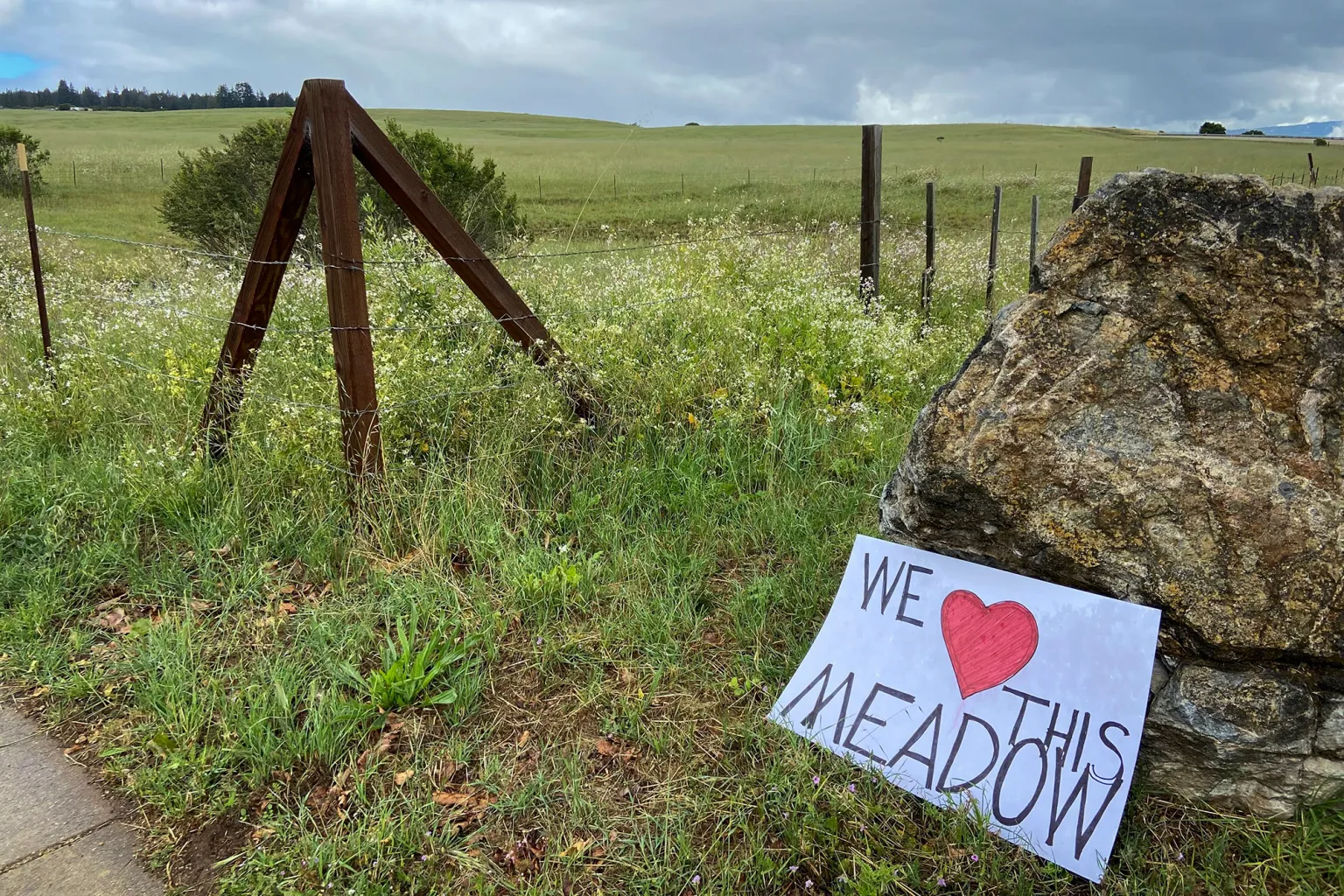
The location Student Housing West, a proposed UC Santa Cruz project. Photo by Ryan Loyola for CalMatters.
After studying at home during the pandemic, University of California Davis junior Michelle Andrews tried to find housing in the city of Davis when in-person classes resumed last fall.
On-campus housing was scarce; UC Davis only guarantees dorms for freshmen. Off-campus houses listed on Zillow received mountains of applications within days, with rooms close to campus going for as much as $1,800 per month.
So she ended up living with family in Woodland, 11 miles away. That distance made her miss out on spontaneous meetups with friends, she said, and made college feel a lot more like a job than it should.
The disappointment inspired Andrews, the legislative director for UC Davis’s student government, to advocate for new legislation that would fast-track university housing developments at UC, California State University and community colleges by getting rid of a secondary review currently required under the California Environmental Quality Act.
“It’s more about getting students housed than anything. Any legislator who wants to get students housed will need to get on board with this bill,” Andrews said.
Student activists supporting Senate Bill 886, authored by San Francisco Democratic Sen. Scott Wiener, want faster action on housing projects, which can get tangled in lawsuits and lengthy review processes. Critics, however, say this bill won’t actually solve the core problem: a lack of funding for housing.
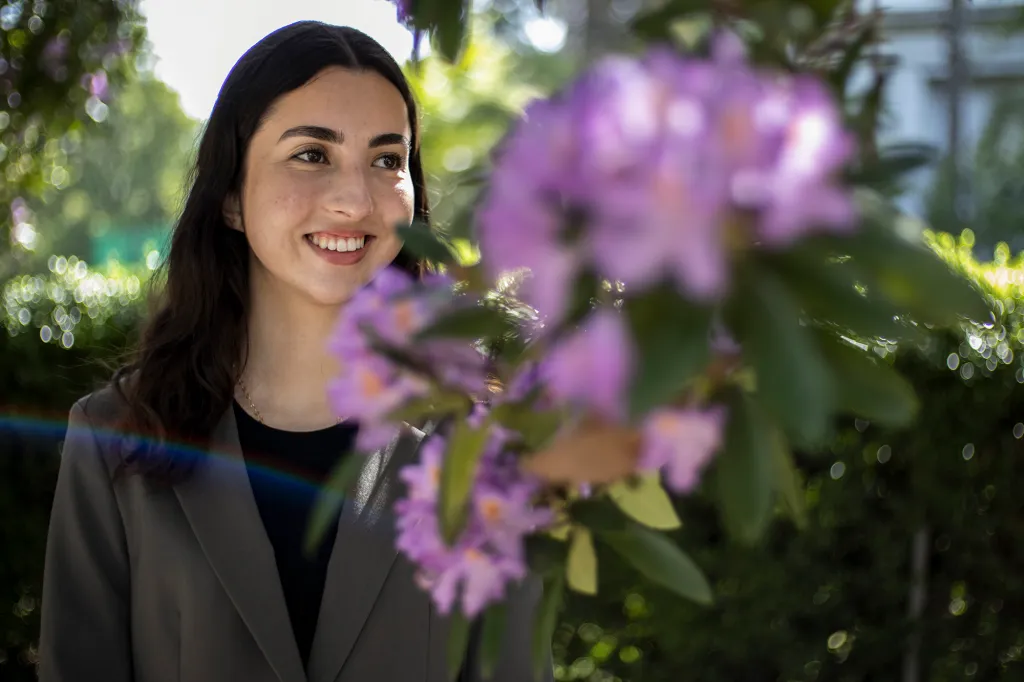
Michelle Andrews, an environmental science and management major at UC Davis, spoke in support of SB 886 at the state Capitol in Sacramento on April 27, 2022. Photo by Rahul Lal for CalMatters
The bill comes as California is facing a massive campus housing shortage, forcing some students into long commutes from home or living in hotels. Five percent of UC students, 10% of CSU students, and 19% of California community college students reported experiencing homelessness in recent surveys.
Universities trying to build more housing have run into pushback from residents and environmentalists concerned about the impact on surrounding communities.
Often, opponents invoke the California Environmental Quality Act, which was signed in 1970 by then-Gov. Ronald Reagan and requires state agencies to analyze the environmental impact of proposed projects and mitigate potential damage.
CEQA lawsuits against UC Davis claim that its Aggie Square development, which would include four academic buildings and at least 200 beds, would bring gentrification throughout Sacramento’s Oak Park neighborhood. Lawsuits against UC San Diego allege that the Theatre District Living and Learning Neighborhood, which could add 2,000 new beds, would increase vehicle traffic in the area. UC Santa Cruz’s 3,000-bed Student Housing West project has faced charges that it would decrease the natural beauty of the campus and impact critical species such as the California red-legged frog.
“This has been a longstanding tool, this use of CEQA, to engage in battles to try to restrict campus growth,” said Jennifer Hernandez, an environmental and land-use lawyer of more than 30 years based in San Francisco and Los Angeles.
Student government representatives and other student housing activists are increasingly working with organizations such as California YIMBY to push lawmakers and universities to speed up housing developments.
“It’s good that more students are being part of our higher education system, but we have to make sure that we have housing for them,” Sen. Wiener said of the bill, which the Senate Environmental Quality Committee passed unanimously last month.
But advocacy groups opposing the measure call it a blow to vital environmental regulation that fails to address the fundamental causes of the student housing crisis — poor planning by universities and insufficient investment.
“Students need safe, affordable and healthy housing, but (weakening) CEQA is not a magic bullet and will instead further deteriorate protections for our most vulnerable communities,” warns a joint letter from the California Environmental Justice Alliance and the Leadership Counsel for Justice & Accountability.
If universities don’t have to disclose details of student housing projects, as CEQA currently requires, their reputations will ultimately suffer, said Paul Schoellhamer of the East Meadow Action Committee, a group that opposes the Student Housing West development at UC Santa Cruz and has sued it for allegedly violating CEQA.
“The party harmed here will be the general public,” Schoellhamer said. “Over time, the result of that will be greater public animosity toward the university.”
Under current law, a campus Long Range Development Plan, which contains a multitude of infrastructure projects, has to go through an environmental review. Once the long-term plan is approved, individual housing projects must undergo a second review — the stage where housing projects are more likely to encounter lawsuits.
If SB 886 passes, that second review would be eliminated. Universities would still need to prove their developments meet certain environmental standards, such as not being located in flood hazard areas and high-risk fire zones.
The students behind the legislative push
Senate Bill 886 is co-sponsored by the student governments of UC and the California Community Colleges, California YIMBY, the California Faculty Association and the State Building and Construction Trades Council. The Student Housing Coalition, a new organization that sprung up at UC Santa Cruz in 2021 in the hopes of finding solutions to the campus’s housing crisis, is also a co-sponsor.
The coalition’s president, freshman Zennon Ulyate-Crow, has two years of guaranteed on-campus housing. Theoretically, he has some time before fretting about finding an apartment.
But that’s not how looking for housing in Santa Cruz works. From his first moments on campus, he’s been hearing horror stories from people who don’t have access to on-campus housing.
“I remember my first day of class, one kid was talking about how he wasn’t able to sign a lease on time. And he was a junior, so he couldn’t get housing on campus, and that meant he had to commute over two hours each way just to come to this one discussion session because he was living with his parents in Redwood City,” Ulyate-Crow recalled.

Zennon Ulyate-Crow, a freshman at UC Santa Cruz, is president of the Student Housing Coalition, which sprung up in 2021 with the aim of finding solutions to the campus’s housing crisis. Photo by Lucy Wald for CalMatters
Ulyate-Crow and other student housing advocates say the current environmental review process is duplicative. And while some lawsuits are unsuccessful and projects can move forward, they say, delays still reduce the amount of available student housing.
“Delays on those sorts of projects would mean that there’s a longer interim period where we’re not getting our new and improved and increased number of beds,” said UC San Diego sophomore Ian Fosth.
Ire over CEQA among housing advocates came to a boiling point after UC Berkeley announced earlier this year that it would potentially be forced to reduce the number of students it enrolls by 2,600 due to a lawsuit. Local neighborhood group Save Berkeley’s Neighborhoods argued that the university did not address how additional enrollment would take a toll on the city’s services, noise and housing scarcity.
A judge sided with the neighborhood group and ordered Berkeley to cap its enrollment for the coming year. But the Legislature quickly moved to pass a bill barring the use of enrollment as a basis for lawsuits under CEQA. As a result, UC Berkeley went ahead in offering its intended number of admission letters.
The outrage from the UC Berkeley lawsuit is causing a shift in the California political landscape and getting people to understand the ways CEQA can be problematic, said Brandon Yung, a UC Berkeley senior and chair of the ASUC Housing Commission.
That opens up the space to achieve “forward-thinking, incremental benefits to student housing production,” Yung said.
A groundbreaking ability to expedite housing? It’s complicated
But it’s unclear how helpful SB 886 will be in expediting student housing projects currently underway, since the exemption can only be applied at the start of the planning process.
Richard Flacks, chairperson for Sustainable University Now in Santa Barbara, said he’s not sure what problem the bill is trying to solve and is wary about the motivations behind it.
“Is the purpose of the bill really to improve UC performance on housing?” he said. “Or is it to water down CEQA on a more general level?”
Flacks added that his group was initially concerned that the bill would provide a loophole to expedite Munger Hall, the controversial 11-story mega-dorm where 94% of residents would not have windows. But he said the argument against that project is that it doesn’t conform with the university’s original long-range plan — so he says it wouldn’t qualify.
At UC Santa Cruz, the proposed Student Housing West was initially scheduled to open in 2020 but is bogged down in lawsuits and has yet to break ground. The project may not qualify for an exemption since some of the legal challenges stem from the university’s long-range plan, said Santa Cruz County Supervisor Ryan Coonerty, whose district includes the campus.
Coonerty also said that SB 886 is missing actual solutions to the student housing crisis, such as allocating more state money and requiring universities to build housing before growing enrollment.
“If they’re serious, put the money up and build the housing,” Coonerty said.
Lawmakers have recently moved to provide more funding for student housing. The Senate’s budget proposals for the 2022-23 year include $1.5 billion to expand student housing and Assemblymember Kevin McCarty has proposed a $5 billion revolving loan fund that universities can use for building. Meanwhile, the legislature has already approved up to $2 billion over three years toward affordable student housing.
Wiener said he doesn’t think that CEQA is the main inhibitor to building housing, but one of a plethora of forces that prevent construction. Still, he says SB 886 is one tool that public universities and colleges across the state can use.
The next steps
State senators at the April 27 committee hearing added more restrictions on which student housing projects could qualify for exemptions under the bill: They must have no more than 33% of the square footage used for dining, academic or student support spaces, be within half a mile of a major transit stop or the campus boundary and must conform to their university’s overarching long-term development plan.
The bill is scheduled to be heard by the Senate Appropriations Committee on May 16. It would need to pass both houses of the Legislature and be signed by Gov. Gavin Newsom to become law.
While lawmakers on the environmental committee voted to advance the bill, they also had their reservations. Some pointed out that simply putting the fault on CEQA takes away blame from individual universities. They argue that they aren’t against student housing, but are trying to hold universities accountable for failed promises of building more dorms.
“I don’t want to be here in seven years after this bill expires and have no student housing because the UCs and CSUs haven’t gotten their act together on doing it,” said state Sen. Bob Wieckowski, a Democrat from Fremont. “So please, UC and CSUs, spend some work on your long-term plans.”
###
CalMatters.org is a nonprofit, nonpartisan media venture explaining California policies and politics.
Five Things to Know About Nuclear Power in California
Nadia Lopez / Friday, May 13, 2022 @ 8:41 a.m. / Sacramento
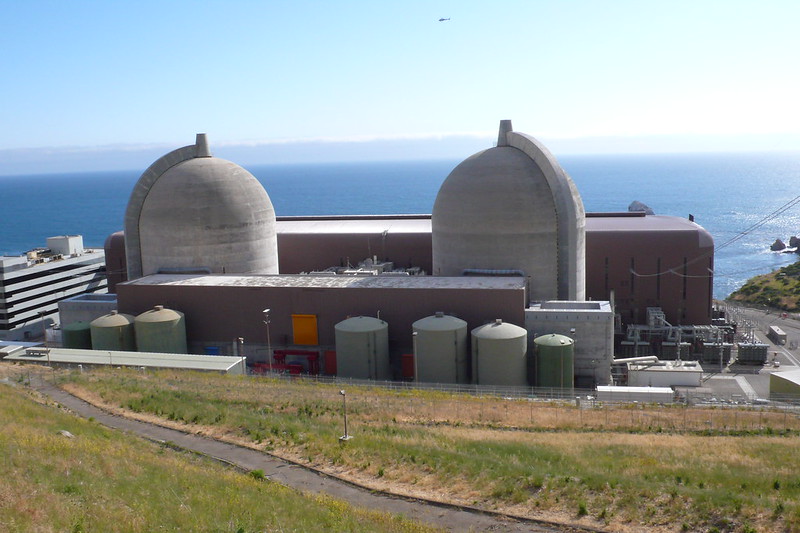
Photo: Tracey Adams, via Flickr. Creative Commons license.
As California makes progress toward meeting its ambitious climate goals, one concern has gone unanswered: How can it stop burning fossil fuels while ensuring the power grid remains reliable?
That question is at the center of a debate over the state’s use of nuclear power.
Nuclear power does not rely on fossil fuels, so it doesn’t produce large volumes of planet-warming pollutants as other energy sources do. While it’s seen as a climate-friendly alternative, opponents cite safety threats and problems storing radioactive waste.
Now, nearly six years after the decision to close California’s last nuclear power plant — the 2,240-megawatt Diablo Canyon facility — Gov. Gavin Newsom says he is considering applying for federal funding that would keep it open past its scheduled 2025 closure. It’s a move, he said, that could avoid rolling blackouts and power shortages as the state transitions to renewables and braces for more extreme heat, wildfires, drought and floods.
Newsom has until May 19 to apply for the funding and would need the facility’s owner, Pacific Gas & Electric, to get on board, too. Some experts say if Diablo Canyon is shut down, there’s a good chance state officials will be scrambling to replace the lost megawatts.
So what should Californians know about the state’s reliance on nuclear power? Here are five key takeaways:
Diablo Canyon supplies enough power for 3 million people
Perched on California’s gusty Central Coast, Diablo Canyon has been supplying power to the state’s electric grid since 1985. But the plant near San Luis Obispo has been battered by controversy the entire time.
Just a few years into construction, PG&E found the site was near several seismic fault lines. That spurred lawsuits and massive, statewide protests, culminating in the largest arrest in the history of the country’s anti-nuclear movement. Despite the opposition, the plant was completed.
Today, the facility employs about 1,500 workers. Its 2,240 megawatts of electricity generation is roughly enough to support the needs of more than 3 million people, according to PG&E.
Nuclear power accounted for 9.3% of California’s electricity in 2020; natural gas was by far the primary source at about 37%, according to the California Energy Commission.
California gets nuclear power from out of state, too
Most of California’s nuclear energy is generated by Diablo Canyon, but it also imports nuclear-powered electricity from Arizona and Washington state, according to the California Energy Commission.
Twenty-eight states have at least one commercial nuclear reactor. But some also are facing possible closure in the decades to come.
Arizona’s Palo Verde Generating Station is the country’s largest power plant, with three nuclear reactors built in the late 1980s. The Nuclear Regulatory Commission in 2011 granted the plant a license to continue operating until 2047.
Twelve commercial reactors have closed in the past decade, including in New York, Massachusetts, Nebraska and Iowa. Yet Oregon-based NuScale Power recently gained approval to build test reactors in Idaho in 2029 and 2030.
California imports more electricity than any other state — about 30% of its supply in 2020, including some from coal-fired plants that are larges sources of greenhouse gases, according to the California Energy Commission.
Hurdles remain to keeping the plant open
In 2016 PG&E announced plans to permanently shutter Diablo Canyon, noting that the transition to renewable energy would make continued operations too costly. The California Public Utilities Commission approved the closure in 2018, after the utility reached a settlement agreement with advocacy groups and environmentalists. One reactor is slated to close in 2024, followed by the second in 2025.
Faced with a potential power crunch as climate change ravages the state, Newsom said PG&E should consider applying for $6 billion in federal funds that the Biden administration set aside to rescue nuclear plants from closing.
But the prospect of keeping it open could face numerous technical, financial and logistical hurdles.
PG&E and the Nuclear Regulatory Commision, which issues the licenses to keep the plant operating, would have to expedite the renewal process in time for the quickly-approaching shutdown.
PG&E did not respond to multiple requests for comment. In a statement to CalMatters, the CPUC said “all options are on the table.”
“Electricity reliability for California is a main priority,” said spokesperson Terrie Prosper. “Extending the operation of Diablo Canyon will require examination by the CPUC.”
PG&E also would have to address aging infrastructure problems and make investments to comply with the state’s water-cooling regulations, according to Matthew Freedman, a staff attorney with The Utility Reform Network, a consumer advocacy organization.
Delaying the closure could potentially be more expensive for ratepayers. A better alternative would be to improve the state’s energy storage capacity for renewable energy, he said.
“Since the continued operation of Diablo Canyon could prove to be very expensive, any proposal to keep the plant alive must be accompanied by binding cost containment and protections for ratepayers,” Freedman said. “PG&E’s rates have already been skyrocketing and we want to do everything we can to bring it down. So we’re definitely against any proposal that would give PG&E a blank check.”
Nuclear power comes at an environmental cost
Nuclear energy is generated from splitting uranium atoms in a reactor. This process, called fission, produces steam that is then used by turbines to create electricity. The result is a reliable, 24/7 energy supply. But operating the plant still has consequences for communities and the environment.
Nuclear plants require water as a cooling mechanism to prevent them from overheating. That water is often released back into the ocean at a much higher temperature that could damage marine habitats.
And while power plants don’t produce greenhouse gases, they do produce a toxic byproduct: spent nuclear fuel, which must be disposed of safely.
Opponents of nuclear energy argue that people of color, including Black, Latino and Native American communities, are especially vulnerable to harm from mining uranium as well as the disposal and storage of radioactive waste. Companies that operate these plants have long used ancestral native lands and other areas near disadvantaged communities to source materials and store spent fuel, said Shaun Burnie, a senior nuclear specialist with Greenpeace.
Critics of Diablo Canyon also say the facility’s infrastructure is outdated and flawed. Burnie said the threat of earthquakes is a top concern. The 2011 nuclear disaster in Fukushima was caused by an earthquake and subsequent tsunami.
“It’s a complete distraction, it’s infuriating. This is about saving an embattled nuclear industry — it’s not about saving the climate.”
— Shaun Burnie, Greenpeace
Instead, he said the state should abandon the idea of keeping the plant open, focusing solely on renewable energy projects and decentralizing the power grid.
“It’s a complete distraction, it’s infuriating,” Burnie said. “This is about saving an embattled nuclear industry — it’s not about saving the climate.”
Still, the state’s plan to reduce its reliance on nuclear energy has not been an easy transition. Renewable energy projects have faced delays due to the pandemic and worsening drought could drive declines in hydropower energy production. Heat waves have triggered rolling blackouts and brownouts as demand for electricity soars.
“Our view is that zero-carbon resources are the replacement for Diablo Canyon and we don’t think more fossil fuel generation is needed,” Freedman said. “That being said, we understand that there are challenges with reliability that policymakers are trying to address.”
Proponents laud nuclear power as zero-carbon, lower-cost
Diablo Canyon has played a crucial role in providing carbon-free energy and maintaining the reliability of California’s power grid, said Jacopo Buongiorno, a professor at MIT’s department of nuclear science and engineering. Without it, Buongiorno said, it will be difficult to meet demand as intensifying weather patterns increasingly strain the grid. He said the state needs to rely on all kinds of renewable and carbon-free sources, including nuclear energy, to achieve carbon-neutrality by 2045.
“Given the magnitude of the challenge that we’re facing in terms of decarbonizing and mitigating climate change, I would argue that we should use more nuclear energy, we should use more solar and more wind,” he said. “Everything that does not emit carbon dioxide should be on the table.”
Buongiorno acknowledged safety and nuclear waste concerns, but described the risks as minimal compared to the detrimental effects that fossil fuel emissions have on the environment and heavily-polluted communities. He said the storage of nuclear fuel is also highly regulated and handled in a “safe, effective manner” with the use of dry cast storage.
“Given the magnitude of the (climate change) challenge that we’re facing, I would argue that we should use more nuclear energy, we should use more solar and more wind.”
— Jacopo Buongiorno, MIT’s department of nuclear science and engineering
If Diablo Canyon were to close, maintaining a carbon-neutral grid by 2045 would require more energy storage — at least 18 gigawatts of solar power, according to a joint 2021 Stanford and MIT study co-led by Buongiorno. To build those solar facilities, the state would need about 90,000 acres of land compared to the 900-acre Diablo Canyon site. Finding that available space could be a challenge due to an executive order requiring the state to preserve 30% of its natural and coastal lands by 2030.
The study found that keeping Diablo Canyon open could save an estimated $2.6 billion in power system costs from 2025 to 2035. The price of natural gas has risen recently, so existing nuclear power plants tend to be more competitive, Buongiorno said.
The cost of electricity from solar and battery storage is higher than the cost of Diablo Canyon alone, “so there are savings simply from operating a cheaper asset,” he said.
Excluding the price of nuclear fuel, PG&E spent $1.2 billion in 2021 to operate Diablo Canyon.
Steven Chu, a Stanford University physics professor and the energy secretary during the Obama administration, said the state should be making every effort to reduce its reliance on fossil fuels. Closing Diablo Canyon would only slow that transition, he said.
“Nuclear power may be certainly the lesser of two evils compared to keeping oil and natural gas plants,” he said. “You can’t wave a magic wand and say we go 100% wind and solar because they are intermittent. It’s easy to go from zero to 50%. It’s much harder to go from 50 to 75% and nearly impossible to get to 100%.”
###
CalMatters.org is a nonprofit, nonpartisan media venture explaining California policies and politics.
OBITUARY: Jean Carol Ziesak, 1938-2022
LoCO Staff / Friday, May 13, 2022 @ 6:56 a.m. / Obits

Jean Carol Ziesak, 83, of Eureka, passed away on April 28, 2022.
Jean was born on August 29, 1938 to Glenn and Margaret Humrich in Lincoln, Nebraska. The family moved to Sacramento, two years later where Jean grew up and attended local schools, including El Camino High School. She went on to attend and graduate from Sacramento State College with a Bachelor of Arts degree in Parks and Recreation Management. During her college years, Jeanie worked a plethora of jobs including camp counselor, the California State Fair, and park ranger at Yosemite National Park.
In 1959, Jeanie met Hardy Ziesak at Arcade Baptist Church and they were married there on April 7, 1962. In 1963, Jean and Hardy moved to Eureka so that Jean could run the Eureka Parks and Recreation Department, where she developed many lifelong friends. She was also a long time member of First Covenant Church, where she taught Sunday School and sang in the choir. In 1968, Jean and Hardy welcomed a son, Matthew to their family followed by their daughter, Tammi, in 1971. Shortly thereafter, Jean became a full-time mom but remained active in the local Recreation Department serving as an umpire for softball, volleyball referee, and working many aspects of the basketball program. In 1979, Jean began her career in Eureka City Schools serving as an instructional assistant at Worthington Elementary, Winship Jr. High, and Zane Jr. High where she retired in 2005. She continued to volunteer for many years in local schools and with her church. She was a fanatical San Francisco Giants and 49ers fan and enjoyed spending time with family and friends as well as tending to her many roses.
Jean is survived by her husband of 60 years Hardy Ziesak, son Matt (Lisa) Ziesak, daughter Tammi (Rod) Wagner, grandchildren Cameron, Abby, and Bridget Ziesak; Lily, Jackson, and Gabe Wagner, great-grandchild Lucy Wagner, sister Joanne (Larry) Cribbs, nephew Eric (Heidi) Cribbs, and many other family members and close friends. She was preceded in death by her parents Glenn and Margaret Humrich, mother-in-law Frida Klemm, and nephew Jered Cribbs.
A celebration of life will be held at First Covenant Church in Eureka on Thursday, May 19th at 11:00 am. In lieu of flowers, the family requests donations be made to Triumphant Life Camp ℅ First Covenant Church, Eureka.
The family would like to thank the ICU nurses of Providence St. Joseph’s Hospital and Dr. Arcidi for the compassionate care of Jeanie.
###
The obituary above was submitted by Jean Ziesak’s loved ones. The Lost Coast Outpost runs obituaries of Humboldt County residents at no charge. See guidelines here. Email news@lostcoastoutpost.com.
NEXT UP at EUREKA CITY COUNCIL: City Considers Purchase of Former Jacobs Campus and Local Business Owners Air Concerns Over Arts Alive Street Closure
Isabella Vanderheiden / Thursday, May 12, 2022 @ 4:54 p.m. / Local Government
Eureka City Hall | Photo: Andrew Goff
###
During next week’s meeting, the Eureka City Council will discuss an array of important issues on a jam-packed agenda, including the possible purchase of some property, a funding request, street closures and much more. Let’s get to it, shall we?
Purchase of Former Jacobs Campus
The council will meet with negotiators from Real Property during closed session to discuss the purchase of the former Jacobs Junior High School campus in Eureka’s Highland Park neighborhood.
The school was built in 1956 around the peak of the timber industry but was shuttered in 1982 due to declining enrollment. After the school’s closure, the school district continued to use the facility into the early 2000s for various functions such as adult education and a continuation high school. The district declared the property as a surplus in 2008 and with the exception of the soccer fields and storage, the campus has gone unused.
The Eureka City Schools Board of Education unanimously voted to sell the property back in May 2019 and the building was demolished in January 2021. The California Highway Patrol expressed interest in purchasing the property for use as a new headquarters but now it seems the City is the primary contender.
What would the City do with the site? Who knows! Eureka City Manager Miles Slattery told the Outpost this is the first time the matter has been considered by the council. “We will need to see if there is any interest before we can discuss.”
###
Film Commission Funding Request
The council will also consider a request from the Humboldt-Del Norte Film Commission for $10,000 in additional funding from the City to help support the efforts of hosting two major studio filmings in Humboldt County this year.
“Due to a staff of two (we are short-staffed) and a tight budget (we are underbudgeted), we are concerned,” Film Commissioner Cassandra Hesseltine wrote in a letter to the council. “We are hopeful that if we can remedy the situation, then we will be able to perform at high capacity for these projects that stimulate the economy with outside dollars.”
One of the projects is projected to bring in “more dollars than the past decade of filming history in the county in less than six months,” she added. The details of the second project have yet to be worked out but Hesseltine said it has “huge potential.”
“We have been courting both studio feature films for three years, finally have received the green light, and are honored to host them,” the letter continued. “We humbly ask for additional funding (outside of our average annual funding) so that we may have the proper tools in our toolbox and do the City of Eureka proud.”
What is the production, you ask? Unfortunately, we don’t know.
###
Arts Alive Street Closure
If you attended Arts Alive last weekend you may have noticed something a little different. The City went out on a limb and decided to implement a trial street closure in the heart of Old Town to enhance walkability during the evening’s festivities.
How did it go? Well, it could’ve gone better. Some business owners complained about parking being impacted by the closure while others reported lost revenue.
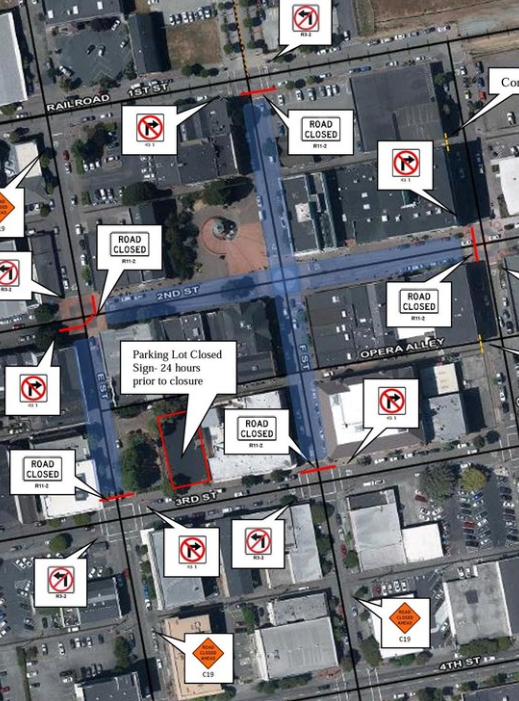
“One business within the closure experienced a 30% reduction in sales than the [Arts Alive] in April,” the staff report noted. “…It was difficult to compare business impacts as COVID and the economy continue to impact business in the district.” The concrete blocks used for the closure were also criticized for not being “visually attractive” and the timing and mechanics of the closure were said to be “confusing and not communicated well.”
The idea to give the street closure a whirl came before the council last month. The Eureka Main Street Board of Directors sent a letter of opposition to the council on April 20 and asked the City to reconsider, citing fears that the closure would “greatly limit accessibility for employees, customers, and residents to reach businesses or their homes with reasonable ease.”
“The Board does not see the need for a trial run of the suggested street closure on Second Street or F Street because it has been closed for First Saturday Night Arts Alive on occasion in the past,” the letter stated. “The experience of Board members who own businesses within the footprint of the closure is that pedestrians do not utilize the street when the street closure is in place. Pedestrians continue to use the sidewalks and congregate in front of shop entrances. The added strain on the already limited parking is not good for businesses because people will decide to avoid the area overall, and businesses that typically benefit from the additional foot traffic of customers generated by First Saturday Night Arts Alive experience a decrease in sales when street closures are in place.”
Eureka Main Street sent a survey to business owners impacted by the closure. The results of the survey will be presented to the council during Tuesday’s discussion.
###
Those are the big-ticket items. The council will also discuss its Climate Action Plan, unpaid garbage and recycling collection fees, Eureka City Schools development fees and a budget proposal for 2022-23. Mayor Susan Seaman will also proclaim May as “Older Americans Month.” You won’t want to miss it.
The Eureka City Council meets on Tuesday, May 17 at 6:00 p.m. at Eureka City Hall — 531 K Street. You can also watch the meeting online here.
Native Runners Kick Off Annual 340-Mile Klamath Salmon Run This Morning, Bringing Awareness to the Plight of the River
LoCO Staff / Thursday, May 12, 2022 @ 1:37 p.m. / Klamath

Photos: Yurok Tribe.
Press release from the Yurok Tribe:
To kick off the Annual Klamath Salmon Run in a good way, several Yurok families shared traditional prayers of gratitude this morning before dipping hand-carved salmon into the Pacific Ocean and taking the first steps of the 340-mile relay from the mouth of the Klamath River to its headwaters. “For millennia, the Klamath salmon supported our communities from the headwaters to the coast. As Tribes recover our roles as the caretakers of the Klamath and the dams are removed, I am optimistic about the future of the river and all of the people who depend on it,” said Yurok Vice Chairman Frankie Myers.
“Actions taken today will affect the future of our people for many generations to come as it relates to our ability to maintain our way of life and identity so what better way to bring awareness to these important issues than to carry the torch during the annual salmon run using the energy, enthusiasm, and heart that our people have always shown in defending our rights and way of life. It’s very good to see,” added Joe Davis, the Hoopa Valley Tribe’s Chairman.
“The salmon have been the main food source for the Karuk People since time immemorial. I tip my cap to all, young and old, who are participating in the Klamath River Salmon Run to bring awareness to a river sick with pollution. I look forward to telling our Elders we will have salmon again, I look forward to telling our Youth we will have salmon for generations to come.,” said Karuk Chairman Russel “Buster” Attebery.
“The Klamath Salmon Run is always extremely empowering, but this year’s event is extra special because it is a celebration of our collective efforts to heal the river and our communities,” said Yurok citizen and event organizer Annelia Hillman. “There is finally hope that we will soon see wild salmon return the upper basin.”
Extending from Northern California to southeastern Oregon, the tribally organized four-day relay traces the pre-dam migratory path of adult Klamath salmon. From the river’s terminal end on the Yurok Reservation, the Salmon Run route travels through Hoopa and Karuk lands before it concludes at the headwater springs of the high mountain desert in Klamath Tribes of Oregon territory. The annual event draws hundreds of runners, including whole families, who complete specific sections of the relay. Throughout the four-day journey, tribal participants pray together, strengthen relationships and advocate for the river.
Tribal youth organized the first Klamath Salmon Run after the catastrophic fish kill in 2002 when poor water management decisions, coupled with the dams’ negative influence on river conditions, led to a disease outbreak which killed more than 60,000 adult salmon. Following the devastating fish kill, members of the four tribes launched a far-reaching campaign to remove the lower four Klamath River dams and solve the river’s water allocation issues. After 20 years of tireless advocacy and direct actions, the intertribal coalition is about to achieve its most ambitious objective. The Draft Environmental Impact Statement on the decommissioning of the four dams is nearly complete, which represents the last big step before removal can begin. Construction crews are prepared to start work when regulators give the greenlight later this year.