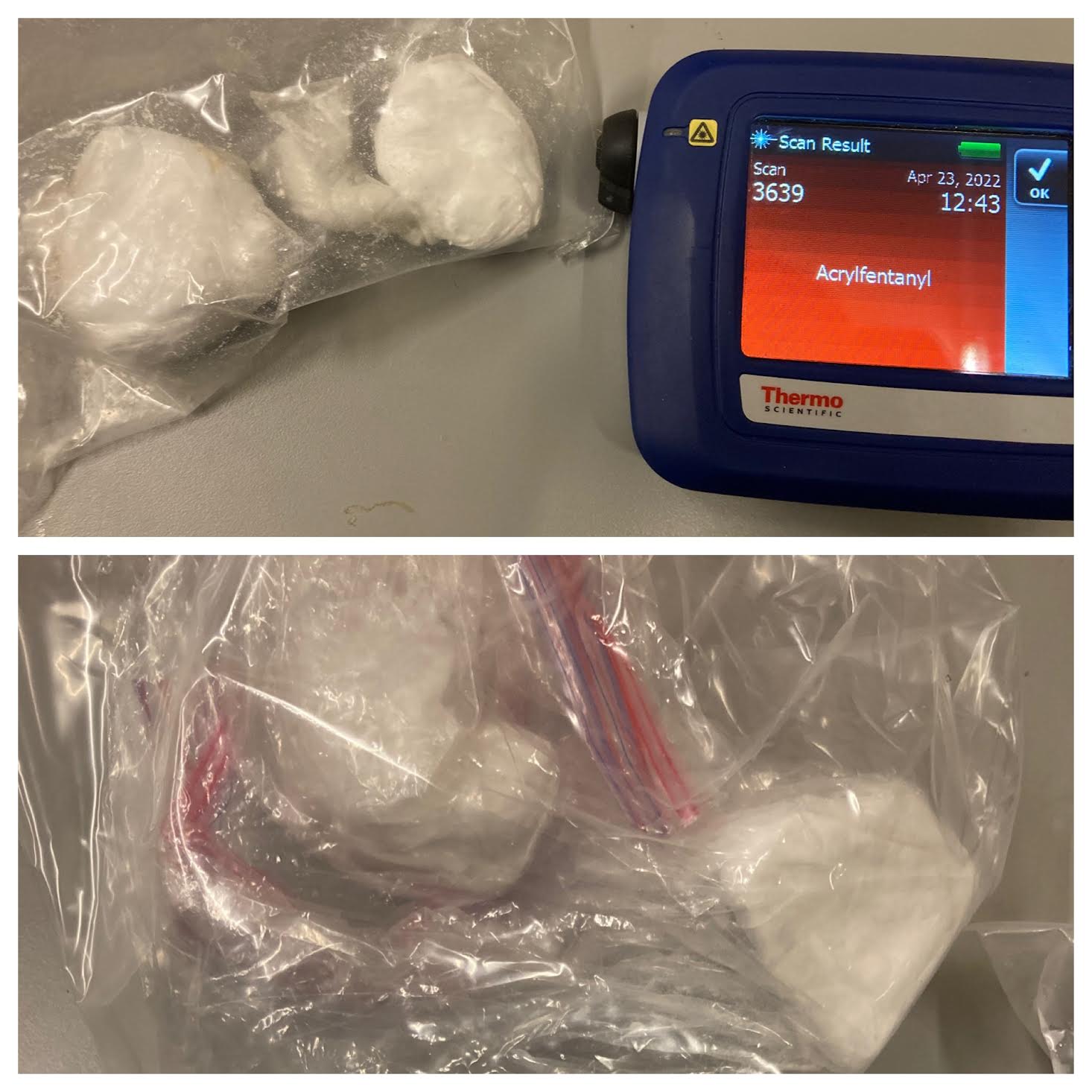
Levi Jone, Joshua Gensaw-Crum, Mariah Smith and Crystal Landry | HCDTF
Humboldt County Drug Task Force press release:
Since early April the Humboldt County Drug Task Force (HCDTF) has been conducting an investigation
into Levi Jones (30 years old from Eureka) for trafficking fentanyl into Humboldt County. On Friday
April 22nd , 2022 HCDTF Agents conducted surveillance on Jones as he travelled down to the Tenderloin
District in San Francisco to pick up more fentanyl. Agents obtained a search warrant for Jones, his vehicle,
and any co-conspirators.
On Saturday April 23rd , 2022 HCDTF Agents conducted surveillance of Jones as he entered Humboldt
County. The HCDTF requested assistance from the Fortuna Police Department in detaining Jones and
three other passengers in his vehicle. The Fortuna Police Department detained Jones without incident as
well as Joshua Gensaw-Crum (32 years old from Eureka), Mariah Smith (28 years old from Eureka),
and Crystal Landry (36 years old from Eureka).
HCDTF Agents conducted a search of the four subjects and located approx. 5 ounces of fentanyl. All four
subjects were placed under arrest. Jones, Gensaw-Crum, and Smith were transported to the Humboldt
County Jail where they were booked for the following charges:
11351 H&S Possession of fentanyl for sale
11352 H&S Transportation of fentanyl for sale
182 PC Conspiracy
Crystal Landry was issued a felony citation and court date to appear for the same charges.
HCDTF would like to thank the Fortuna Police Department for their assistance with this investigation.
Anyone with information related to this investigation or other narcotics related crimes are encouraged to
call the Humboldt County Drug Task Force at 707-267-9976.
House Minority Leader Kevin McCarthy speaks during the California Republican Party convention in Anaheim on April 23, 2022. Photo by Alisha Jucevic for CalMatters
Not many were fooling themselves at the California Republican Party convention: The state GOP is in dire straits.
“In case you haven’t noticed out there, we’re 0 for 8 in over 20 years,” Shawn Steel, former party chairman, told delegates Sunday. “It’s time we won statewide offices.”
But just how the party can pull itself out of its rut is less clear.
It probably didn’t help to have the distraction of U.S. House Minority Leader Kevin McCarthy of Bakersfield, the subject of a bombshell report just days before the convention: He was caught on tape talking to fellow Republicans about urging then-President Donald Trump to resign after the Jan. 6, 2021, storming of the Capitol.
Tea Party California Caucus leader Randall Jordan said the audio showed McCarthy’s true colors: “We’ve never been a friend of Kevin McCarthy’s. He basically stands for everything Donald Trump tried to weed out of our party.”
But others including state party Chairperson Jessica Millan Patterson, a McCarthy ally, rallied behind him. “When Republicans take the House, I have no doubt that he will be the next Speaker of the House,” she told reporters.
And when McCarthy took the stage Saturday night for the convention’s keynote speech, it was to a standing ovation from about 500 delegates gathered in an Anaheim hotel ballroom. He praised Trump, blasted Democrats and the media and called for party unity.
Still, the state GOP has much bigger things to worry about than the kerfuffle of the moment. To become more relevant, California Republicans must present the right identity to voters.
Jenny Rae Le Roux, who is running for governor, said the party needs to have the message, the messenger and the money — and offer hope, not just call out Gov. Gavin Newsom for failures.Party officials and delegates also sought to preach a message of unity, in particular: “Don’t trash other Republicans.” But divisions surfaced during the voting for official party endorsements.
Jenny Rae Le Roux, candidate for governor, speaks during the California Republican Party convention in Anaheim on April 23, 2022. Photo by Alisha Jucevic for CalMatters
In the end, Le Roux didn’t even make it past the first round of balloting for the party endorsement for governor. On the fourth ballot, Dahle eked out the nod over Anthony Trimino, who had the support of party activists and who set up a boxing ring at the convention, with posters advertising his fight against Newsom. (The party did not endorse in the unsuccessful recall campaign against Newsom last September, or before the primary in 2014 or 2018, either.)
It also took multiple ballots to settle the attorney general endorsement between party factions to take on Rob Bonta, the Democrat and Newsom appointee. In the second round, Nathan Hochman passed the 60% threshold against Eric Early, who said it’s California Republicans’ destiny “to fight the evil woke.”
Most bang for the buck: The state party’s focus at the moment isn’t on bridging divides between far right and moderate or centrist Republicans. It’s on doling out campaign cash with the most impact. That means the focus will be on congressional seats, where Republicans see an opportunity to take back control of the House.
California Republicans hope that voters won’t ignore sky-high gas prices, rising inflation, or concerns about crime and homelessness — and will blame Democrats as the party in power for not doing better. That may be their best hope of finally breaking their long statewide losing streak.
A long road back
California Republicans have been on a steep downward slide for nearly two decades, since they triumphantly recalled Gov. Gray Davis in 2003.
The last GOP candidates to win statewide came just a few years later — Gov. Arnold Schwarzenegger and Insurance Commissioner Steve Poizner in 2006 — and efforts to attract major candidates who can turn around the party’s fortunes have become increasingly dire. In the past two U.S. Senate races, in 2016 and 2018, Republicans finished outside the top two in the all-party June primary and did not even make it to the November general election, while gubernatorial hopefuls now routinely lose to Democrats by 20 percentage points or more.
After the push to recall Newsom fizzled last fall, all of the leading Republicans who ran to replace him — including talk radio host Larry Elder, former San Diego Mayor Kevin Faulconer and 2018 gubernatorial candidate John Cox — passed on challenging him again this year, forcing the party to start from scratch. Those who are running have little name recognition or money.
The debate continues over the best path forward — moderate their positions and appeal to disaffected voters turned off by Democratic excesses, or double down to whip up enthusiasm among the conservative base — though neither has managed so far to staunch or turn around the California Republicans’ long-term losses.
The question now is whether the state party will be able to capitalize on what is expected to be a strong year for Republicans across the country amid sagging approval of Democratic President Joe Biden.
Conservatives sense opportunities to defeat Bonta, as voters grow increasingly wary of crime, and win the race for controller, in which Chen, who has raised more money than any other Republican statewide candidate, is making the case that he would be an independent fiscal watchdog for the state.
Yet even those are long shots in an era where partisan affiliation has become more important to voters than ever. While the GOP is no longer trailing no party preference in voter registration, as it briefly did a few years ago, fewer than 24% of California voters are signed up with the Republican Party, compared to nearly 47% who identify as Democrats.
Jim Brulte, a former Republican legislator and party chairperson, said focusing on the GOP’s weakness in the most high-profile races overlooks a solid foundation it has built elsewhere. The party has been in a strategic retreat for nearly a decade, directing its more limited resources into key congressional and legislative districts, he said.
He compared the political environment to 2014, the last time a Democrat was in the White House and “we didn’t have a super-strong top of the ticket” — little-known Neel Kashkari ran unsuccessfully for governor against incumbent Jerry Brown.
“It was a pretty good year for Republicans in California,” Brulte said.
In 2014, the GOP flipped three seats in the Assembly and another in the state Senate, temporarily breaking Democratic supermajorities, though it made no gains in Congress and lost all statewide offices.
“We have something at the top of the ticket to drive turnout and his name is Joe Biden,” Brulte said. “Voters want a change, and Republicans are that change.”
###
CalMatters.org is a nonprofit, nonpartisan media venture explaining California policies and politics.
California abortion clinics are building new facilities closer to transit hubs and training more staff. A package of a dozen abortion rights bills moving through the Legislature could expand the number of providers, provide financial assistance to women traveling to California to terminate their pregnancies, and legally protect the doctors who treat them.
As new restrictions rapidly sweep the country in anticipation of a U.S. Supreme Court ruling this summer that may dramatically scale back or even end the constitutional right to abortion, California is preparing to step into the void — and welcome a possible surge of patients losing access in dozens of other states.
“People from across the country are already looking to California as a haven state, as a beacon to provide them the care they need,” Jodi Hicks, president and CEO of Planned Parenthood Affiliates of California, said during a recent online program. “It is our moral imperative that we continue to provide the leadership that people are looking for.”
Planned Parenthood, which operates about half of the 165 abortion clinics in California, reports that it has treated at least 80 out-of-state patients per month on average since September, when Texas adopted a law allowing residents to seek civil damages against anyone who aids an abortion after six weeks of pregnancy
That move turbocharged a political and cultural battle that has all but cut off abortion access in the most conservative parts of the country in recent years and sent advocates in liberal states scrambling to build a bulwark for reproductive rights.
Unable to secure an injunction against the Texas law while courts consider the legality of the novel attempt to circumvent Roe v. Wade — the landmark 1973 Supreme Court decision that protected the right to an abortion without excessive government restriction — clinics in the state shut down to avoid a deluge of lawsuits. Thousands of patients are now seeking abortions elsewhere, overwhelming neighboring Oklahoma and New Mexico and pushing some women further afield to more friendly states including California.
“The need right now of expanding access is pretty clear to all of us,” state Senate President Pro Tem Toni Atkins told reporters last month. The San Diego Democrat is carrying Senate Bill 1375, which would allow some nurse practitioners to independently perform first-trimester abortions without a doctor’s supervision.
Getting ready for more patients
Sue Dunlap, president and CEO of Planned Parenthood Los Angeles, said she has been preparing for years for the moment when the organization would have to become a haven for patients from all over the country who have nowhere else to turn for an abortion.
That has included expanding and reorganizing its network of facilities to be near airports, bus and train stations, and supportive emergency rooms and medical providers. Dunlap said she worked with UCLA’s law school to establish a new center for the study of reproductive health law and policy. Planned Parenthood Los Angeles also collaborates with medical schools across the country on abortion training, particularly in states where those opportunities might not otherwise exist.
Dunlap declined to provide data on how many out-of-state patients the organization serves, arguing that the numbers would not fully reflect the situation because of the secrecy and fear surrounding abortion. But she noted that Los Angeles, as a center of tourism and commerce, has long been a destination for women seeking abortions — even before it was legal, when patients often then crossed the border to Mexico for the procedure.
“Los Angeles is a place that people identify with ideas of freedoms,” Dunlap said. “Los Angeles is also a place that, when you don’t know where to go, you come here.”
The people who do come “are almost always in incredibly desperate situations,” she added, and many have more challenging circumstances and complications than in the past.
Dunlap mentioned a pregnant woman from Texas who was diagnosed with breast cancer, necessitating a double mastectomy. Though the woman did not want to terminate her pregnancy, Dunlap said, she had to travel to one of Planned Parenthood Los Angeles’ clinics in recent months because she could not get an abortion in her own state.
Planned Parenthood Mar Monte, which covers Northern and Central California and Northern Nevada, said it treated 66 out-of-state patients at its California clinics between September and March, including 22 patients from Texas. One of them was a college student who was prepared to use her scholarship money to fly to California until it provided her with a voucher, according to an anonymous patient testimony shared by the organization.
With Oklahoma and other states on the verge of shutting down abortion access as well, president and CEO Stacy Cross said the organization is preparing to take on between 250 and 500 more patients per week in its network of facilities.
Medication abortion is now available at all of its sites. Clinics are hiring more staff and making sure any medical providers who is licensed to perform abortions has the necessary training, even if they specialize in one of the other services that Planned Parenthood offers, so that they can schedule more appointments.
Next month, Planned Parenthood Mar Monte plans to break ground on a new, larger facility in Reno that is closer to the airport. Cross wants to add a second site in northern Nevada for what she anticipates will soon be more patients coming from Utah.
The work is personal for Cross: Both of her grandmothers died from a lack of access to reproductive care — one from an illegal abortion and the other in childbirth, delivering her ninth child at age 47, she said. She worries that Californians don’t fully understand how quickly and fully abortion access could shut down across the country if the Supreme Court reverses the Roe decision.
“Every time I even say those words out loud, it sends a chill down my back. It’s horrific to think about,” Cross said. But California has done an amazing job preparing: “We fill the gaps.”
Divide deepens between red and blue states
Those gaps are almost certain to widen in the months to come. Spurred on by the success of the Texas law, anti-abortion legislators across America are racing to advance new restrictions.
In just a one-week stretch this month, Republican Florida Gov. Ron DeSantis signed into law a ban on most abortions after 15 weeks of pregnancy; GOP Gov. Kevin Stitt of Oklahoma signed a bill making it a felony to perform an abortion in the state, punishable by up to 10 years in prison; and Republican legislators in Kentucky overrode a governor’s veto on a measure to impose broad new requirements on abortion providers that they say make it impossible for them to continue operating. A federal judge temporarily blocked the Kentucky law on Thursday.
Though many of the policies are currently unconstitutional, conservative states are laying the groundwork in anticipation that the Supreme Court will soon uphold a Mississippi law that bans abortion after 15 weeks of pregnancy. A decision on that case is expected by June, and some experts believe the justices will take the opportunity to overturn the Roe ruling altogether, which would trigger near or complete bans on abortion in about half of states, including Arizona.
Liberal states are responding with their own measures to protect the right to abortion in law, and to increase access to accommodate a potential influx of patients from beyond their borders.
In November, Vermont voters will decide whether to amend the state constitution to enshrine reproductive autonomy, while Democratic Michigan Gov. Gretchen Whitmer is trying to circumvent her state’s Republican-controlled Legislature by asking the state Supreme Court to overturn a pre-Roe abortion ban that is still on the books.
Oregon recently approved a $15 million fund that could provide financial assistance to patients, including those from outside the state, who need help paying for abortion fees and other costs. Washington adopted legal protections against prosecuting people who aid an abortion or women who experience pregnancy losses. Democratic legislators in Maryland overrode a veto by the Republican governor to pass a bill that would require health insurance plans to cover abortions and put $3.5 million toward training providers.
Several states have adopted or are pursuing measures to expand who is authorized to perform an abortion to include other advanced medical professionals beyond doctors, such as nurse practitioners and physician assistants, following a move that California made more than a decade ago.
“California has been on the forefront for a long time,” said Elizabeth Nash, a state policy analyst for the Guttmacher Institute, which researches and promotes reproductive rights. “It has helped other states see what’s possible.”
Making California an abortion ‘sanctuary’
California is pushing further still. In September, after the Texas law took effect, Gov. Gavin Newsom convened the Future of Abortion Council, a coalition of reproductive rights, health and justice groups, to explore how to make the state a “sanctuary” for abortion. More than 40 policy recommendations, released in December, formed the basis for the sweeping legislative package now advancing at the Capitol.
If approved by the end of session in August and signed by Newsom, the measures would become law next year, though supporters hope some pieces might be incorporated into the state budget that must be approved by June 15. Those could kick in immediately this summer, when the Supreme Court decision on abortion is expected.
“There is definitely an urgency to get some of these things in place and get prepared, because this is happening regardless of whatever timeline our Legislature is on,” said Lisa Matsubara, general counsel and vice president of policy for Planned Parenthood Affiliates of California, which is sponsoring or co-sponsoring most of the bills in the package. “We are doing everything we can to make sure we are as ready as we can be.”
The centerpiece is SB 1142, by Democratic Sens. Anna Caballero of Salinas and Nancy Skinner of Berkeley, which would create a state-administered fund to assist patients who face financial barriers to obtaining an abortion and support public research into improving access. Advocates are seeking $20 million from the state to launch the fund.
There is alsoAssembly Bill 2134 by Assemblymember Akilah Weber, a San Diego Democrat, which would set aside money for clinics that provide uncompensated care to low-income patients whose insurance does not cover abortion and contraceptive services. Supporters argue the funding is crucial to ensure that not only wealthy women are able to travel to California for abortions.
Jessica Pinckney, executive director of ACCESS REPRODUCTIVE JUSTICE, the only statewide abortion fund in California, says the bill could expand its grants to women who need help paying for their abortion, travel and lodging, lost wages, a doula or other expenses.
Last year, the Oakland-based fund supported 551 patients with an average of about $300, Pinckney said, not enough to meet anybody’s full need. She would also like to do more outreach to let women know the fund exists.
About 80 people the fund served were from 18 different states Pinckney added, but most are low-income or patients from one of the dozens of mostly rural counties without an abortion provider, who may need to travel hours and stay overnight for a multi-day abortion procedure in their second trimester.
“Even in the state of California, there are quite a few barriers,” Pinckney said. “This is an unmet need for Californians already.”
In recognition that conservative states may continue to ramp up legal and financial penalties for abortions, another collection of bills aims to protect doctors who travel to other states to perform the procedure or who treat out-of-state patients: AB 1666 by Assemblymember Rebecca Bauer-Kahan, an Orinda Democrat, would nullify civil judgments from other states related to reproductive care. AB 2091 by Assemblymember Mia Bonta, an Alameda Democrat, would prohibit medical providers and health insurers from sharing information in cases that seek to penalize abortion. AB 2626 by Assemblymember Lisa Calderon, a Whittier Democrat, would prevent the state medical board from suspending or revoking the license of a physician who is punished in another state for performing an abortion in accordance with California law.
Other major legislative efforts include Atkins’ bill to allow abortions by independent nurse practitioners and AB 1918 by Assemblymember Cottie Petrie-Norris, which would create a “reproductive health service corps” for underserved parts of the state.
“It’s about strengthening our foundation, our health care foundation, to expand the pool of health care professionals who can provide abortions,” Atkins said.
Last stand for anti-abortion activists?
The measures are moving through the legislative process so far with widespread support from the overwhelmingly Democratic lawmakers, and seem likely to be approved if they reach the governor’s desk. Newsom already signed a law last month that prohibits health insurers from charging a co-pay or deductible for abortions, thus eliminating out-of-pocket costs for covered patients. He pledged that California would continue to “protect and advance reproductive freedom for all.”
Yet the bills have not been entirely without controversy. Hundreds of protesters gathered at the Capitol last week to oppose AB 2223 by Assemblymember Buffy Wicks, an Oakland Democrat, which would end a requirement that coroners investigate the cause of fetal deaths resulting from suspected self-induced abortions, clarify that women cannot be held criminally or civilly liable for pregnancy loss or abortion, and create an ability to sue prosecutors and others who violate that protection.
Supporters say the measure is necessary to protect Californians from overzealous law enforcement and district attorneys who may be hostile to abortion rights. They point to two Kings County women who were charged with murder and imprisoned in the past five years after delivering stillbirths and testing positive for methamphetamine, in what Attorney General Rob Bonta has called a misapplication of the state criminal code. Advocates argue that fear of prosecution may deter some women from seeking necessary care.
Protestors gather to rally against Assembly Bill 2223 at the state Capitol in Sacramento on April 19, 2022. Photo by Rahul Lal for CalMatters
But critics of the Wicks bill highlight a provision that states women cannot be penalized for “perinatal death due to a pregnancy-related cause,” referring to a baby who dies in an undefined period immediately after birth, which they contend is so vague as to legalize infanticide.
“It is trying to really tear down one of the few restrictions that California does have when it comes to terminating pregnancies, and that is the actual point of delivery,” Jonathan Keller, president of the religious advocacy group California Family Council, said following the Capitol rally.
While Wicks has vehemently denied that’s what the measure would or is intended to do, Keller said, “Intentions don’t matter. It’s actual legislative text that matters.” He added that the outrage has helped his group organize broader and more fervent opposition to the abortion legislation than it has managed in the past.
“We do think that many of the bills in this package are actually out of step with the state of California,” Keller said, including the fund to help out-of-state women travel to California for abortion care. He calls it “abortion tourism.”
His claims have been picked up by the Republican National Committee, which issued a statement denouncing Wicks’ bill and calling abortion “murder,” but seem unlikely to gain much traction in the Democrat-dominated Legislature.
At the first committee hearing for the bill, following the rally, only one legislator questioned Wicks, who slammed her opponents’ tactics: “These same groups that are trying to ban abortion across this country and imprison people for stillbirths have manufactured a disinformation campaign using disturbing and violent imagery that is not grounded in medical science or the text of the bill,” she said.
Despite nearly an hour of testimony from opponents, the bill sailed through on an 11-3 vote.
###
CalMatters.org is a nonprofit, nonpartisan media venture explaining California policies and politics.
On Sunday, April 24, 2022 at approximately 3:39 a.m., the Arcata Police Department received a call of a body inside a room at a local hotel and that the reporting party needed “police now.”
APD Officers located an approximately 45-year-old female inside a room. The female was not breathing and had no pulse. Officers performed CPR however, the female was pronounced deceased at the scene.
This is the fourth death in Arcata in the last several days in which there were indications that drugs could have been ingested. On Wednesday, April 20, 2022 at approximately 4:01 pm, the Arcata Police Department received a call of two people inside a tent in Carlson Park who were possibly deceased.
APD Officers located the tent and inside were a male, approximately 45 years old and a female, approximately 64 years old, who were both deceased. On the same day at 4:11 p.m., the Arcata Police Department received a call of a 54-year-old male who was overdosing at 1680 Samoa Blvd. Despite life-saving measures the male died at a local hospital.
In all four deaths there were no obvious signs of trauma, no signs of a struggle and no indications of foul play. Toxicology results are pending and could take several weeks. The Humboldt County Coroner’s Office responded to each scene and took custody of all four decedents.
The release of this information is intended to inform community members of recent deaths in Arcata that could be related to the ingestion of dangerous drugs to include fentanyl. This investigation, the scope of which could change with new information, is ongoing.
Anyone with information related to this investigation is asked to contact Detective Sergeant Chris Ortega at cortega@arcatapd.org or (707) 822-2428 x1142.
Wild goose,
brother goose, which is best? A wanderin’ foot or a heart at rest?
(The
Cry of the Wild Goose, Terry Gilkyson, 1950)
###
I love that song,
from my childhood, sung by Frankie Laine, vinyl 78, when music was
music. Lotsa big brass in the back. And anyway, which is
better, to be wanderin’ or to be at rest? I used to give a
presentation called, “Nothing Happens Until You Leave Home.” I
cribbed the title from one of Paul Theroux’
insightful-caustic-funny travel books. (If you haven’t read The
Old Patagonian Express, and have any interest whatever in trains
and/or South America, do so.)
In that talk, I
explained that I had caught the wanderlust bug early on: at 14, my
Boy Scout troop took a summer trip to Iceland (back then, three days
of sea-sickness from Leith, Edinburgh’s port). I was hooked, and
still love traveling many (many) years on. Louisa and I competitively
hoard out airline frequent flyer miles so we can fly for free to
Europe or beyond — one of the perks of volunteering overseas is that
you end up with a slew of them. (Careful choice of credit cards also
helps.) With airfare taken care of, the way we travel, we usually end
up spending less when we’re abroad than we would have if we’d
stayed home. And I’m still ahead of my Life Goal, to die with more
countries visited than my age. (Changing planes in another country
doesn’t count — rules are rules.)
But damn, coming
home is more and more of a pleasure as age catches up. I love Old
Town, I love our apartment, I love not having to drive — everything
is so handy where we are. I love the familiar: sofa, PC + printer,
kayak (which I can easily wheel down to the C Street dock), coffee
shops, great clam chowder nearby, Vista del Mar fish tacos, my
beloved’s home-cooked stews, my books, our bed…the familiar,
tried and true.
This ramble was
inspired by “Routine Maintenance,” an essay in last January’s
Harper’s by one Meghan O’Gieblyn who, in several thousand
words, justifies to herself (if not to her readers) her habit-ruled,
routine existence. “I live a monotonous life, which is not to say a
tedious one.” Much of her anxiety — shouldn’t she be lusting after
something new? — derives from the internet, “…not a place of
order but a boundless abyss that erases the contours of individual
hours, swallows entire days, and inundates our lives with a vague
sense of possibility never quite realized…the never-ending hunger
for novelty…”
And that’s it,
isn’t it? When the thirst for the new becomes routine in itself? Bill
Murray’s Groundhog Day breakthrough came when he came to see
the time loop he was stuck in, not as boring, but full of
possibilities, “…learning new skills, perfecting his
self-discipline, and honing his moral responses—until he has become
the best possible version of himself.” (Quoting again from
O’Gieblyn.)
St. Benedict of Nursia writing the Benedictine rule. Herman Nigg, 1849-1928. (Georges Jansoone, Public Domain via Wikipedia)
I recently wrote in
this space, “What we can do is to keep the novelty alive
by filling our lives with new experiences, spinning out our days with
events to make time seem to pass more slowly and deliberately.”
Now, a few months later, I’m not so sure. Perhaps Saint Benedict
had it figured out when he instituted his monastic rules, whose
centerpiece was abiding by a routine of prayerful “hours,” from 2
a.m. Matins to 7 p.m. Compline. In his view, a strict schedule wasn’t
antithetical to freedom; rather, it was the gateway into it.
So yeah, now I’m
not so sure about nothing happening until I leave home. Maybe there’s
more to this “nothing” than I realized.
The other evening my wife and I took our son
Leo out for a walk. We were both tired, having worked all day (Ozge’s
parents, thankfully, are staying with us and look after Leo while
we’re at work), but Leo insisted on going outside.
At
the bottom of the hill, we reached the center square of Uskudar. The
sun was going down over the Bosphorus, bathing the whole city in gold
and purple, and the distant skyscrapers were all in attractive
silhouette. During Ramazan, and especially on these fine spring
evenings, it is common to see lots of people out in the evening.
Having fasted all day, they are eager to not only enjoy their iftar,
but also to sit in the nearby park and chat while
the ships in
the Bosphorus pass.
We noticed this year something different. The
municipalities have been offering free meals (usually rice, bread,
tea or water). That in itself is not particularly striking, for the
month of prayer is also about giving charity the poor. What is
different this year is how many poor there seem to be, at least where
we live.
“Look
at all those people!” I exclaimed, as we neared the area where the
free meals were being dished out in foil containers. The line of
people, of all ages, stretched down nearly 100 meters. There appeared
to be several queues, or the same long queue wrapped around itself,
it was hard to tell. A rough head count could have easily produced
several hundred, if not more.
We were on our way to the nearby park, so we
just politely cut through the line, past the hungry people and
crossed at the light.
The sight of all those people really drives
home the reality of the country’s soaring inflation, which some say
is as high as 60 percent in recent months. All I will say is that
everything costs more, a lot more in some cases. Even a loaf of pide
bread in our local bakery, specially baked during the holy month,
costs 7.5 lira this year, at least twice what it would normally cost.
The soaring costs are mostly attributed here to
the country’s debt, which comes mostly from all of the big projects
in recent years, like the new international airport, the third span
bridge, the Marmaray, and other massive infrastructure projects. This
debt, combined with other economic woes, have driven the lira to
historic lows against the dollar (the exchange rate is currently
about 14-1; when I arrived in 2009, the rate was about 2-1 to give
you an idea).
And of course, one wonders how the war to the
north, just over the Black Sea, is also affecting the economy, given
Turkey’s strong economic ties to both Ukraine and Russia. Thousands
of refugees have also recently arrived, mostly Ukrainian, and some or
many of these arrivals will no doubt be in those free meal lines
around the city.
With this inflation, people are seeing their
landlords abruptly and unceremoniously jack up rent prices. One of
the American teachers at my school told me his landlord increased his
monthly rent by 60 percent (“İs that even legal?” I wondered
aloud. “Well, it is if it’s the inflation rate,” a colleague
replied, with a rueful shake of the head). Of course, I don’t feel
too badly for my American colleague. He lives in a one-bedroom
furnished flat near Taksim Square, in the heart of the city’s
cultural center, and was paying far below what you would expect. Even
with this recent increase, it’s still a steal.
Plus, those of us with university teaching jobs
can’t really complain all that much (although as a rule, all
teachers love to complain, especially about pay). With our recent
raise, we are doing comparatively well in this era of hyperinflation.
But what about all those people standing outside on the sidewalk,
patiently waiting (and many of them have been fasting since sunrise)
for a free plate of dinner? It reminds you of how desperate some –
many – people are in the city, the country, these days. It reminds
you that the poor, the working poor especially, are hit hardest in
tough times, and that my wife and I are relatively fortunate in that
we aren’t forced to wait in that long line.
“Not
everybody who is in the line is there only for the free food,” says
one of my Turkish colleagues, when I told him about it later. “Some
also go for the social atmosphere, to experience the collective
feeling of having iftar together. I myself have stood in line for one
of these meals (a few years ago). Of course, I had money to buy a
meal, but I wanted me and my family to have that experience.”
###
Indeed, we saw some of this social atmosphere
when we arrived in the park. Lots of people, mostly younger people
sat in the grass, in circles and groups. Some of them had the free
meals, while others had bought fast food (one group had McDonald’s,
we noticed. That’s something of a luxury nowadays, believe it or
not. A Big Mac menu will cost you about 50 lira, when it used to cost
about 20 not so long ago).
Others, more sensibly perhaps, brought prepared
food from home. All around, the meals lay untouched in front of the
faithful, as they were waiting for the evening call to prayer. That
must be the hardest part, I often thought, the last few minutes of
the fast, with the meal and refreshments spread out in front of you,
mouth-wateringly near. But as tradition dictates, everyone must start
eating at the same time, so I suppose that is why the line was so
long – people had to arrive early and start getting their meals so
that all could be served in time for the call to prayer.
We let Leo out of his stroller and he ran to
one of the swings, demanding we swing him as high as possible. You
could tell he missed us during the day, now that both of us are
working. As working parents, it’s sometimes hard to muster the
energy and enthusiasm to keep a fast-growing 2-year-old happy, but we
did our best, taking turns with swing duty.
I watched as the boats passed in the Bosphorus,
the waters a dark wine color as the sun went down more and as the
skies faded into evening, the sound of the call of prayer came loud
from the nearby mosques.
The people in the park, taking their cue, began
to eat, enjoying their long-awaited repast and sitting closely
together in the gathering evening. As always this time of year, I
marveled at the resilience of these faithful, to go without food or
even water all day long, and as they went about breaking their fasts
all around us in the park, I wished them “afiyet olsun,” or bon
apetit.
For the millionth time, I forced myself to be
thankful for the life, for the relative comfort, that my wife and I
enjoy, and that we are able to give our son, despite the costs going
up every day. And that, unlike many of the city’s most recent
arrivals, we have a place to call home.
###
James Tressler, a former Lost Coast
resident, is a writer and teacher living in Istanbul.
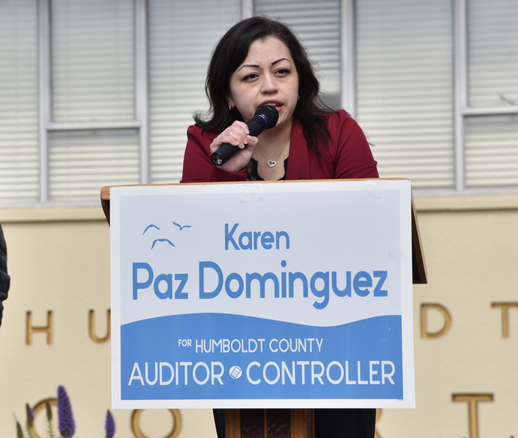
Humboldt County Auditor-Controller Karen Paz Dominguez at a March 15 re-election campaign kickoff speech. | File photo by Isabella Vanderheiden
###
The Humboldt County Board of Supervisors will consider two items to address the ongoing financial turmoil associated with the Auditor-Controller’s Office during the board’s regular meeting on Tuesday.
The board will discuss a letter signed by 13 of the county’s 19 department heads who assert that Auditor-Controller Karen Paz Dominguez “has failed to fulfill the duties and responsibilities of her position.” According to a staff report, the board will then consider taking additional action against Paz Dominguez, including referring the county’s fiscal reporting shortfalls to various state agencies.
The staff report states:
A memo signed by department heads representing more than 90% of county employees was submitted to the Board on April 4, 2022, stating that, despite department heads’ efforts to support the Auditor-Controller, she has failed to fulfill the duties and responsibilities of her position and as a result has put the county in a financial crisis.
While the Board has received similar letters from outside agencies in education, local municipal government, workforce development, public safety and the private sector, as well as letters from individuals within the county, the attached memo is the first time that a majority of department heads have submitted such documentation to the Board.
The memo is sent from department leadership, both elected and appointed, expressing that their departments cannot collaborate with the one department through which all financial transactions must be recorded, and as a result they are facing dangerous financial challenges which must be fixed.
The board packet includes a fact sheet that lists upwards of 40 existing deficiencies associated with the Auditor-Controller’s Office, including past-due fiscal reports, communication failures and more.
The staff report notes that the county Workforce Development Board has recommended that “the matter be referred to the California Fair Political Practices Commission, Office of the State of California Attorney General and the State of California Department of Justice for appropriate action.”
Last month, the board directed staff to look into moving payroll services back out of the Auditor-Controller’s Office. “Specifically, your Board directed the Interim Director of Human Resources (HR), the County Administrative Officer, and the Auditor-Controller to engage in discussions concerning the collective goal with respect to payroll operations, evaluate previously collected data regarding payroll operations, provide your Board with updated findings, and present your Board with refined options related to the placement of the payroll function,” the staff report says.
The board will consider three options:
Maintain payroll functions in the Office of the Auditor-Controller, which would be “the least disruptive to the current payroll process,” but would likely result in “additional resource requests, existing communication challenges, and challenges related to service delivery.”
Shift payroll to the County Administrative Office, which could provide an opportunity to stabilize payroll operations “through increased stakeholder engagement and interdepartmental collaboration, increased communication and responsiveness, and dedication to service delivery.” However, there is no precedent for such a shift and it would only be temporary.
Or, to allow the payroll function to remain in the Auditor-Controller’s Office “for additional time.” This option appears to be nearly identical to the first option but specifies that payroll would “remain with the [Auditor-Controller’s Office] for the near future” and includes a list of additional recommendations if the item were to be selected, including the continued assistance of financial consultant KOA Hills.
The staff report also recommends that the county retain services from CliftonLarsonAllen (at a cost of $259,000) to conduct an audit of payroll services to identify deficiencies.
“[CliftonLarsonAllen] will assess the county’s processes surrounding one test payroll period,” the staff report states. “…[CliftonLarsonAllen] will provide results with an executive summary describing the scope, objectives, approach, and overall conclusion of the internal audit assessment. In addition, [CliftonLarsonAllen] will describe internal control deficiencies identified along with process improvement recommendations.”
TOT Workgroup
The board will also consider the formation of a transient occupancy tax (TOT) workgroup comprising stakeholders who would oversee and review TOT revenue and work with county staff to develop recommendations for the Board of Supervisors as to how the funds should be spent.
Members of the Humboldt Lodging Alliance (HLA) have criticized the county — especially the County Administrative Office — for failing to include industry representatives in initial conversations on the subject. The organization has also raised concerns about the timing of the ballot initiative and called its wording “misleading.”
“The timing of the measure to local hoteliers could threaten the fragile gains made by the industry in recent months as the economy recovers from Covid-related measures,” the alliance says in an April 22 letter. “…Moreover, while County Staff and elected officials have said that the money would go to specific purposes, such as rural fire departments, homeless support and the arts, it would nevertheless go into the unrestricted general fund, which means the TOT funds could be used for any purposes related to the operations of the County Government. There are simply no laws or ordinances to ensure best use of the TOT funds.”
The HLA is calling for a “no” vote on Measure J, but if it were to pass, the organization said it “would want to be an active participant” in the proposed workgroup.
The Board of Supervisors meeting will take place at 9 a.m. on Tuesday, April 26. The agenda can be found here.