Press release from the Humboldt County Sheriff’s Office:
On March 28, 2022, at about 11:45 a.m., Humboldt County Sheriff’s deputies were dispatched to a residence on the 7100 block of Humboldt Hill Road near Eureka for the report of a possible residential burglary.
Deputies arrived at the residence and learned that multiple unknown suspects were reportedly observed accessing the home without the owner’s permission. The suspects reportedly stole numerous items of value, including a vehicle which had been parked at the home.
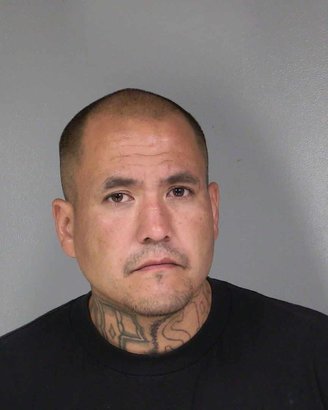
Later that evening, at approximately 5:58 p.m., a sheriff’s deputy on patrol in the Eureka area observed the stolen vehicle traveling on Broadway Street. Deputies conducted a traffic stop on the vehicle and detained two occupants, 33-year-old Anthony David Maillelle and an adult female. During a search of the vehicle, deputies located multiple items that had been reported stolen from the Humboldt Hill residence.
Maillelle was arrested and booked into the Humboldt County Correctional Facility on charges of vehicle theft (VC 10851(a)), possession of a stolen vehicle (PC 496d(A)), driving with a suspended/revoked license (VC 14601.1(a)) and violation of probation (PC 1203.2(A)(2)).
The female was determined to be uninvolved and was released at the scene pending further investigation.
This case is still under investigation. Anyone with information about this case or additional involved suspects should contact the Humboldt County Sheriff’s Office at (707) 445-7251 or the Sheriff’s Office Crime Tip line at (707) 268-2539.
Press release from the Humboldt County Sheriff’s Office:
On March 25 and 26, 2022, Humboldt County Sheriff’s Office investigators and representatives from CDCR Parole and the Humboldt County District Attorney’s Office conducted a sex offender registration compliance sweep throughout the County of Humboldt.
During this sweep, law enforcement attempted to contact approximately 100 registered sex offenders to ensure each offender was in compliance with state requirements. Pursuant to California Penal Code 290, sex offender registrants are required to register in person with the law enforcement agency that has jurisdiction where they reside. The registrants must also comply with several registration requirements, such as updating their registration annually and informing law enforcement when any changes have been made to their address or registration information. Failure by a sex registrant to keep law enforcement notified of an address change or registration information is a crime and can be punished as a felony or misdemeanor.
During the compliance sweep, 11 registrants were found to be out of compliance. Two registrants were arrested, and one registrant was cited as a result of this operation. Additionally, four registrants were determined to have absconded, and warrants will be requested for their arrest.
Detectives are completing follow up investigations into the remaining individuals found to be out of compliance and anticipate cases to be submitted to the District Attorney’s Office for review.
This month’s operation is part of an ongoing effort to do smaller, more frequent 290 sweeps to reduce violent sexual offenses in the county through proactive surveillance and arrest of habitual sexual offenders, and strict enforcement of state registration requirements. The Humboldt County Sheriff’s Office involvement in this enforcement effort is funded through the Sexual Assault Felony Enforcement (SAFE) grant.
The Humboldt County Sheriff's Office would like to thank participating agencies for their assistance in this operation.
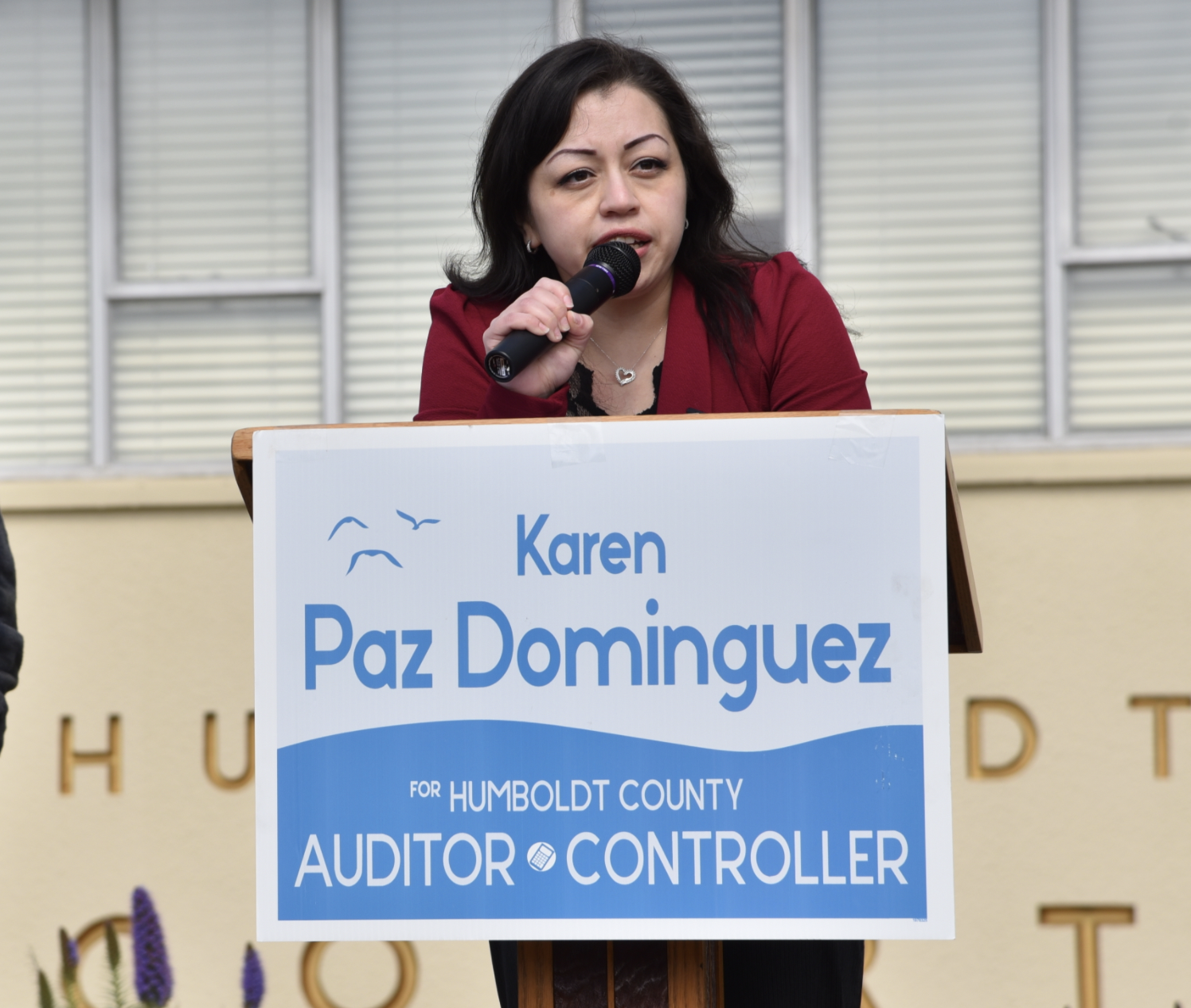
Humboldt County Auditor-Controller Karen Paz Dominguez at a March 15 re-election campaign kickoff speech. | File photo by Isabella Vanderheiden.
###
Late last month, shortly after receiving a final demand letter from the California Attorney General’s Office for a long-overdue fiscal report, the county’s auditor-controller, Karen Paz Dominguez, issued a message to taxpayers. She alleged, among other things, that by decentralizing financial operations, the county had paved the way for decades of financial mismanagement, leading to “confirmed cases of error and fraud.”
A few days later, at the March 1 Board of Supervisors meeting, she elaborated in an oral report, leveling a series of allegations — or “findings” — against several county departments.
The Outpost is investigating some of those allegations, and today we’re looking into arguably the most serious charge — namely, that the County Administrative Office (CAO) forged a report and submitted it to the State Controller’s Office.
Like many of Paz Dominguez’s recent accusations, this one involves some jargon and acronyms that won’t be familiar to most folks. We’ll explain the relevant terms below, but for now, let’s revisit what she said at the March 1 meeting.
About 11 minutes into her report, Paz Dominguez told the board that when representatives from the State Controller’s Office were in town auditing the county’s cost allocation plan, they had some questions about the county’s PARS account. She said the agency later required the county to submit an actuarial report to justify charges it had been levying on individual departments.
If you’re not a government accountant, that’s likely a confusing glut of information. You may not have heard of cost allocation plans, PARS accounts or actuarial reports.
A cost allocation plan, in this context, is a report that calculates indirect costs to the various county departments for services from other departments. Specifically, here, county departments were being charged for contributions to a type of pension account known as a PARS fund.
PARS, or Public Agency Retirement Services, is an organization that serves a variety of California government agencies, such as school districts, community colleges, cities, counties and other special districts. As a financial service firm, it offers a variety of retirement-related services, including a Pension Rate Stabilization Program, which the county has participated in since 2015. The idea is to reduce the county’s ballooning unfunded pension liability.
Each county department was chipping in state and federal grant dollars, contributing two percent of its payroll costs every two weeks. The money went into something called a Section 115 Trust, a federally authorized type of account that allows governments to set aside funds to be invested. Such accounts typically yield higher returns than the money that sits in the county treasury.
The incidents Paz Dominguez was describing to the board occurred in late 2019. In September of that year, the State Controller’s Office requested an actuarial report to justify those PARS charges — an actuarial report being an analysis of the fund’s assets and liabilities, prepared by a licensed actuary.
“The CAO’s Office confirmed to the State Controller’s Office that there was an actuarial report,” Paz Dominguez said at the March 1 meeting. “The State Controller’s Office requested a copy of that report.”
After a dramatic pause she added, “There was no actuarial report. And the CAO’s Office purchased the software and forged one and submitted it to the State Controller’s Office.”
At that point, Supervisor Virginia Bass interjected. “Excuse me,” she said. “I’m hearing threats in there, so do you have proof that there was [a] forged [report]?”
Paz Dominguez assured Bass that she did indeed have proof. However, two subsequent opportunities for Paz Dominguez to present her evidence at a public meeting were canceled after she failed to meet the county’s agenda-scheduling deadlines.
Instead, during her March 15 re-election campaign announcement, Paz Dominguez encouraged the public to search for the evidence in a large trove of documents (mostly internal county email communications) that a supporter had posted online. And in a speech from the courthouse steps, she elaborated on her accusations.
“Retirement is not as secure as it should be,” she told the group who’d gathered. “You’ve heard our county has an unfunded pension liability nearing $500 million. What you might not have known is that in 2015, per the County Administrative Office’s recommendations, the board authorized the creation of an external investment account referred to as PARS that, according to the County Administrative Office, would be used to offset the county’s unfunded pension liability.”
She glanced up at the audience and continued. “Well,” she said, “I’m sorry to be the one to tell you that that is not what is happening. That external investment account was set up outside the county’s treasury and outside of the county’s books. Departments were charged, and that money was wired to an external bank account where it is being used to purchase and sell investments.”
None of the more than $6 million that’s accumulated in the county’s PARS account has been used to pay down the unfunded pension liability, she said, and she repeated her accusation about the “forged” actuarial report, saying that in the absence of a real one, “the County Administrative Office made one up and sent it.”
Paz Dominguez makes this same allegation in some of the emails from the online document dump early this month. In an Oct. 3, 2019, email to all five county supervisors, for example, she said she believed the county was in danger of losing significant federal and state funding due to its investments with PARS. She objected to the county’s use of this firm in part because it’s a corporation, not an agency of the state. She also argued in emails that taxpayers’ money is safer when placed directly with the California Public Employees’ Retirement System (CalPERS) because the latter backed by the state.
This is the document she alleges is a forgery. It’s a pension analysis report produced with proprietary software from a company called GovInvest. In her Oct. 3 email Paz Dominguez characterized it as “obviously a last-minute attempt to forge a report using a purchased software program.”
‘Political stunt’
County Administrative Officer Elishia Hayes disputed this interpretation of events and suggested that Paz Dominguez’s recent accusations were designed to distract from her failure to submit the overdue Financial Transactions Report. (That report was finally turned in late on March 16, just ahead of the Attorney General’s deadline to avoid legal repercussions and a $5,000 fine.)
“Dropping headline-grabbing accusations without proof and without action is an obvious political stunt and our employees do not deserve to be put in the middle of that,” Hayes said in an emailed statement.
She offered a different account of what occurred back in 2019: Paz Dominguez, she said, had given the CAO’s Office very short notice about the state’s request for an actuarial report. “[E]ven back then,” Hayes said, “[Paz Dominguez] was either unavailable or would not communicate with the CAO’s Office.”
The consequences for missing the state’s deadline were “characterized in terms that made failure seem unacceptable,” Hayes continued.
So she and her staff rushed to produce the above-linked report using GovInvest, a company that was working with 48 of the state’s 58 counties at the time. “That report was itself not a certified actuarial report,” Hayes acknowledged, “but it was reviewed by a certified actuary on their staff, and it stated so.”
Hayes emailed the GovInvest report to the State Controller’s Office on Sept. 18, 2019. On Dec. 2, a supervisor from the State Controller’s Office wrote back, informing county staff that they would need to produce a full actuarial report to show that the county’s PARS contribution methods complied with the Actuarial Standards of Practice.
A lot was at stake here. If the state and feds concluded that the county’s PARS charges were not supported by accepted actuarial standards, it would mean returning all those payments — nearly $2.5 million — to the individual county departments that contributed them.
‘A positive step’
Hayes, unlike Paz Dominguez, believes that the county’s contributions to a PARS-managed Section 115 Trust were a wise fiscal investment, one with advantages the county wouldn’t realize by making direct contributions to CalPERS or by leaving that money in the county coffers.
“Long-term is the key here,” she said. “These funds are intended to grow over not just years but decades.”
Investing in a PARS-managed Section 115 Trust “basically allows us to invest our money in more aggressive money market accounts so that we put those dollars to better use than if they were in our own treasury,” Hayes said. By law, the money placed into 115 trusts can only be used to pay down pension liability, but because they remain in the trust for years or decades, it allows the investments to grow and be used on a rainy day.
“We stick that money aside so that when our [pension] costs hit a mark where we’re like, ‘Whoa, we can’t afford these increases anymore,’ then we have those dollars that we can pull over [to] help to stabilize our pension accounts,” Hayes said.
As Paz Dominguez said at her campaign event, the Board of Supervisors decided to invest with PARS back in 2015 based on a recommendation from then-County Administrative Officer Phillip Smith-Hanes.
About a year later, the Humboldt County Civil Grand Jury [HCCGJ] set out to investigate the county’s unfunded pension liability, which was then estimated to be about $232 million. The Grand Jury’s ensuing report, titled “Will Unfunded Pension Liability Un-fund Our Future?” commended the county on its decision.
“The HCCGJ supports the [board’s] September 2015 decision to create the PARS Trust fund,” the report says. “We see this as a positive step to provide more local control of our pension liability. The true value of the PARS Trust lies in securing funding today in order to offset future variations in the County’s contribution to CalPERS during times of poor market performance.”
Hayes said the investment has indeed paid dividends well above what they’d have earned in the county treasury.
“As of March 2022, we have contributed $5.4M to this fund, and earnings on that investment total more than $1.4M … ,” she said. “This represents a rate of return of 5.8 percent.” The county treasury, by comparison, averages a return rate of 0.89 percent, according to Treasurer-Tax Collector John Bartholomew.
Substantiated
When the CAO’s Office staff learned in December 2019 that the state was still requiring a full actuarial report, they went back to the most recent one they’d commissioned, a 2016 report prepared by Bartel Associates, LLC, a firm that specializes in providing actuarial services to public agencies.
They submitted that report, along with a letter signed by a certified actuary,to the state and waited to hear back. On Jan. 7, an analyst with State Controller’s Office emailed Paz Dominguez, cc’ing other county personnel, with the verdict.
“Based on our analysis, the previous charges for the PARS Section 115 Trust are substantiated,” the email said. “The County was able to provide a letter signed by a certified actuary that the report was prepared using generally accepted actuarial principles and practices.”
Amy Nilsen, the county administrative officer at the time, was ecstatic. In an email to office colleagues she said, “The SCO has substantiated our PARS charges. … Today is a great day!!!!!”
The Outpost recently contacted the State Controller’s Office to ask about this situation. We asked whether the agency considered the GovInvest report to be a forgery, as Paz Dominguez alleges.
Jennifer Hanson, press secretary for the State Controller’s Office, replied via email, saying her agency’s staff and their federal counterparts reviewed the GovInvest document and together determined that it did not meet federal requirements to substantiate the county’sPARS Section 115 Trust charges.
“Subsequently,” she continued, “the county CAO provided an actuarial report prepared by Bartel Associates and an actuarial certification that the report was prepared in accordance with the appropriate standards. SCO [the State Controller’s Office] and our federal counterparts determined this report was sufficient to substantiate the charges.”
We wrote back. Given the gravity of the accusation, we asked for clarification: Did the the State Controller’s Office consider the GovInvest report a forgery?
Hanson declined to elaborate. “The first response provided accurately reflects SCO’s position on the report submitted,” she wrote.
The Outpost emailed Paz Dominguez on March 17 to request any further evidence she may have to support the forgery allegation, and in a follow-up email we asked whether she believes a crime was committed. She has yet to respond.
The county’s unfunded pension liability remains a serious concern. It had grown to $331 million as of the the county’s latest budget brief, this past June. Deputy County Administrative Officer Sean Quincey said that when Paz Dominguez began questioning the validity of the county’s PARS contributions, those contributions were paused to allow time for investigation and reconsideration.
Since then, the State Controller’s Office informed the county that it would need to submit yet another actuarial valuation before resuming those charges. The county has now done that, according to Hayes.
Last April, the Board of Supervisors adopted an updated pension funding policy. Hayes said the county plans to resume its PARS contributions in the 2022-23 fiscal year.
Earlier today, James Tressler, the former Times-Standard reporter who writes the “Letter From Istanbul” column for the Lost Coast Outpost most Sundays, took a ferry over to Dolmabahçe Palace, where the talks are being held. He sends along this video report from the scene.
An empty classroom for pre-K and kindergarten students in Burnt Ranch on December 13, 2019. Photo by Dave Woody for CalMatters
California wants to lure all 4-year-olds to public schools within the next four years. But will there be enough teachers there to meet them?
School districts across the state are scrambling to hire an estimated 11,000 teachers and 25,000 teacher assistants to expand transitional kindergarten. It’s a tall order for school district officials already in the midst of a daunting educator shortage and coming out of the pandemic.
“If we can’t find staffing, we just flat can’t do it,” said Mike Martin, superintendent of the County Office of Education in Modoc County. “It’s not like we have a pool of folks lined up asking to come to work in our districts. We are competing with everybody else out there for these same folks.”
The main potential source for these thousands of public school teachers are already teaching pint-sized kids in early childhood education. So now private and nonprofit preschool and child care providers are worried about losing not just 4-year-olds, but also their qualified teachers and staff members to the higher wages and free summers that public schools offer.
Their solution: A bill in the Legislature that would extend the state-funded expansion to their childcare centers and preschools for all 4-year-olds.
Gov. Gavin Newsom touts the expansion as a way to close the achievement gap and included $600 million in the 2020-21 budget, growing to $2.7 billion in the general fund by 2025-26. The budget also includes $130 million for student access and $300 million for planning and teacher training in one-time Proposition 98 money. A related policy bill flew through the Legislature and Newsom signed it.
The roll-out begins this fall for kids turning 5 between Sept. 2 and Feb. 2. Each year, more children will be able to enroll based on their birthdates until 2025-26, when the program will be available to all 4-year-olds.
California is home to about 500,000 4-years-olds. One in five of those children are already in transitional kindergarten, known as TK. It began in 2012 for kids who turn five between Sept. 2 and Dec. 2. Previously, those children had been able to enroll in kindergarten at age 4, but then the rules changed limiting enrollment in kindergarten to mainly 5-year-olds.
Transitional kindergarten is optional; parents can still choose to stay in their private pay program or subsidized state preschool.
Advocates say the benefits of the expansion are two-fold.
Access to free transitional kindergarten will benefit children who qualified for subsidized child care but could not find a slot, and those who do not qualify for help but whose families can’t afford to pay for child care or preschool, said Patricia Lozano, executive director of Early Edge, a nonprofit advocacy group that supported the new law.
Also, moving 4-year-olds out of early childhood education — such as state preschool, childcare centers or private preschools — and into public school is designed to open up seats for younger children, especially in state-run preschool and federally-funded Head Start programs.
Now, state preschool serves only 32% of eligible 4-year-olds and 13% of eligible 3-year-olds, Sarah Neville-Morgan, deputy superintendent of the state Department of Education.
The participation rate for transitional kindergarten is expected to be 75% to 80% of all 4-year-olds, Neville-Morgan said. That is roughly an additional 345,000 children once the program is fully implemented.
“We are leaning in,” Neville-Morgan said. “Having universal transitional kindergarten for all 4-year-olds opens up opportunities for all 3-year-olds.”
Lofty goals indeed, but these do not help solve the labor shortage facing school districts that is so dire that schools needed to start hiring 300,000 teachers a year since 2018 to get caught up.
Ultimately, California school districts will need to hire an additional 11,000 new credentialed teachers for transitional kindergarten classrooms and 25,000 to 26,000 teaching assistants, according to Berkeley Children’s Forum.
Minimally, this year the state will need at least 2,400 teachers to be able to serve the 58,000 new children expected to enroll in transitional kindergarten in the fall. The following year another 3,600 credentialed teachers will be needed, said Bruce Fuller, professor of education and public policy at UC Berkeley who heads the Children’s Forum.
“It’s a huge and hopeful experiment, and I think a lot rests on how school districts will respond,” Fuller said. “And, secondly, can the nonprofit sector turn on a dime and re-equip and adjust to this new market reality?”
Now, the state is allowing teachers with bachelor’s degrees and multi-subject credentials to teach transitional kindergarten. By August, those teachers will also need to have completed 24 units of early childhood education classes, or they will need to have a child development permit.
In addition to the teachers and aides already working in early childhood centers, this also creates an opportunity for paraprofessionals, such as teacher assistants, to consider moving into teaching, said Xong Lor, legislative advocate for the California School Employees Association, which sponsored the expansion law.
She said declining enrollment in schools, equal access for all 4-year-olds to access transitional kindergarten and the opportunity for career growth drove the union to back the proposal.
“Our members are being paid so low, so having that opportunity to advance themselves that is something that we are supportive of,” Lor said. “When you take a para out and they become a teacher, now you’ve created this vacancy. So we need assistance to make sure these positions are being filled.”
Will private preschools get raided?
While some school districts will see some teachers moving from other grades into transitional kindergarten, the main source of new recruits may come from California’s early childhood education world. There are an estimated 31,000 teachers with bachelor’s degrees working with the under 5 set, said Hanna Melnick, senior policy advisor at the Learning Project Institute.
The Center for the Study of Child Care Employment at UC Berkeley published a study in August that found that early childhood educators are well-equipped to teach transitional kindergarten. It found that 49% of early childhood teachers have a bachelor’s degree or higher and among those 76% also have a child development permit at the teacher level or higher.
“It seems like a no-brainer that these people should absolutely be eligible to teach TK,” said Elena Montoya, senior research and policy associate at the UC Berkeley center. “We are hoping and encouraging that these pathways be made available to early educators that have the most experience working with 4-year-olds.”
The potential exodus, however, will impact early childhood education, where it’s already difficult to find teachers and assistants. It may also leave behind those, especially women of color who stack the sector, without the formal schooling required to transition over, according to research from the Berkeley Center.
“The message for the rest of the sector and the workforce seems to be that California is focusing on TK and centering resources even if it disrupts the rest of the system,” Montoya said. “They talk about it as a package, but is it really a package if these are the consequences, destabilizing the rest of the system?”
That is why the center supports including current child care providers and preschool centers to reach the goal of expanded transitional kindergarten. It also recommends creating an alternative pathway to qualify as a TK teacher so early childhood education experience can be recognized and count toward a credential.
“We don’t just want public schools to decide what quality pre-K looks like. We want to have a diversity of organizations.” — Bruce Fuller, head of the Berkeley Children’s Forum
The new bill, SB 976, would require that private and nonprofit providers be included in the expansion to give parents choice and to ease the staffing burden, said Dave Esbin, executive director of California Quality Early Learning, an organization that advocates for private child care providers.
Incorporating non-profit and private preschools would create better quality, Fuller agrees.
“We don’t just want public schools to decide what quality pre-K looks like. We want to have a diversity of organizations,” he said. “That’s good for parents because they can find a Montessori pre-K or a heavily disciplined pre-K, a hippy-dippy learning through play pre-K. Parents can find whatever they want if we continue to fund a diverse array of pre-K organizations.”
State Deputy Supt. Neville-Morgan, however, said transitional kindergarten is focused in public schools because much of the money for the expansion is from Prop. 98 funds, which must go to public schools.
“One of the things we hope is that California gets to a place where we are not saying, ‘You are stealing or taking (teachers),’ but that we are all in this together in a shared way,” she said. “We know that teachers are the most important thing for our little kids.”
School districts prepare
School districts have been providing transitional kindergarten for nearly a decade. Some have been providing it for even longer under different names. Long Beach Unified School District was offering what it called “Preppy K” before the state created transitional kindergarten, said Brian Moskovitz, assistant superintendent of early learning and elementary education.
Now, the district runs transitional kindergarten classes, as well as state preschool and federal Head Start programs. In addition to recruiting more teachers for next year, the district is also leveraging existing staff to make the expansion work.
In one transitional kindergarten classroom, students who are in state preschool are combined with other transitional kindergarteners with the same teacher. The children are simply paid for by different pots of money.
In Humboldt County, officials are relying on a grant-funded residency program to train teachers on the job, but it’s going to take time, said Colby Smart, assistant superintendent of the Humboldt County Office of Education.
“We don’t have the level of qualified teachers to fill those positions,” he said. “This residency capacity grant is designed to plan and also to build the pipeline to get those teachers.”
The county will need 70 transitional kindergarten teachers. Currently, the county has 30 residents in training who should be fully credentialed by 2023.
San Diego Unified is a bit ahead of the curve. The district tested transitional kindergarten for all 4-year-olds this school year in 70 classrooms in its lowest-income schools, said Stephanie Ceminsky, who oversees early learning for the district.
“It’s such a special place. It’s not TK and it isn’t K and it’s not a 3-year-old,” she said. “4-year-olds are a special niche that early childhood educators do know.”
Next year, the district is rolling out the program across all campuses for all 4-year-olds regardless of birthday. Ceminsky estimates a need of 40 to 60 teachers for the incoming 3,200 students.
The district has most of its staff already because of the pilot program and plans a career fair in May.
“We don’t have the level of qualified teachers to fill those positions.” — Colby Smart, assistant superintendent of the Humboldt County Office of Education
In Modoc County, in the northeastern corner of the state, the three school districts serve a total of only 1,300 students. So combo classes with kindergarteners and even first-graders are the norm for 4-year-olds.
“We don’t have big enough number of students to justify the single classroom,” Supt. Martin said.
But Deputy Superintendent Misti Norby calls the combo classes “developmentally not appropriate.” So Martin and Norby will work closely with families to select the right placement, which may be staying in their current preschool setting.
Meanwhile, child care and preschool providers say they fear that they will lose staff and potential staff members, who will opt to go to school districts instead.
One preschool director called it “a slap in the face” after struggling to stay open during the pandemic to ensure little children got the care and learning they needed while public schools closed.
Many early childhood educators want to know: If the governor was going to dedicate money to kids under 5, why didn’t he bolster the early childhood system that already exists?
“All the statistics of the success of child care or preschool are based on our programs, Preschool is a cozy place with little child furniture and a teacher and a director,” said Holly Gold, who owns Rockridge Little School in Berkeley and two other locations that cater to 2 to 5 year-olds. “Now, they take all of that and they use it to jack all of the funds and divert them to public school systems because public school enrollment is down.”
At the Old Firehouse School in Lafayette, program director Alexandra Dutton said she doesn’t blame preschool teachers who may want to earn more money in public schools, but it worries her.
“They are going to get paid more, they are going to get vacation, they are going to have a union,” Dutton said. “I can’t compete with that. Most (private and nonprofit) schools won’t be able to compete with that, and that will directly impact the quality of early childhood centers because a lot of educated teachers are going to think about going.”
One of Dutton’s teachers is attending classes at night.
“She sees the writing on the wall,” Dutton said. “She is trying to get her bachelor’s because she’s realizing that things might change.”
###
CalMatters reporter Joe Hong contributed to this story. CALmatters.org is a nonprofit, nonpartisan media venture explaining California policies and politics.
Amid rising concerns about crime and recent criminal justice reforms, California’s law enforcement groups are spending big this year in several high-profile races.
So far in the 2022 election cycle, these groups have contributed more than $1 million to campaigns for the state Legislature and several statewide offices, slightly less than the $1.2 million contributed at the same point in 2020 and significantly more than the roughly $305,000 in 2018, according to a CalMatters analysis.
As of Monday, nearly $1 out of every $6 donated by law enforcement groups has gone into the attorney general’s race, specifically to Sacramento District Attorney Anne Marie Schubert. The $176,900 in cop cash given to Schubert is about 10% of her total contributions.
Shubert campaign photo.
She is a Republican turned independent who is the preferred pick of these groups looking to unseat Attorney General Rob Bonta, a Democrat who was appointed by Gov. Gavin Newsom in 2021.
Schubert is endorsed by one of the largest contributors: the Peace Officers Research Association of California, an advocacy and lobbyinggroup. The organization has given Schubert $16,200, the maximum allowed for the June 7 primary, while none of her opponents have reported any law enforcement contributions so far – not Bonta, whohas raised $6.4 million total so far, and not Republican challengers Nathan Hochman or Eric Early.
This is the first time since at least 1999 the organization has not contributed to the coffers of the incumbent in the attorney general’s race, according to Secretary of State records. The Peace Officers Research Association sees it differently. Brian Marvel, president of the association, told CalMatters that “PORAC doesn’t consider there to be an incumbent in this race” because Bonta was appointed and not elected.
The other major sources of law enforcement cash are unions: the California Association of Highway Patrolmen and the L.A. Police Protective League. The CHP union has contributed $112,800 in 38 races so far, with $11,000 going to Schubert’s campaign, its first donation to a candidate for attorney general since 2007. The protective league has donated $146,600 in 25 races so far, but nothing to Schubert.
As the attorney general is the state’s top law enforcement officer, agencies can be directly impacted by decisions, including investigations of police officers.Bonta and Schubert have different priorities about what they would do in office. Though both their campaigns discuss gun violence and prosecuting polluters, Bonta’s website highlights “fighting hate and protecting civil rights” and Schubert’s promises to “aggressively [prosecute] violent criminals.” Both candidates support the law Bonta wrote while he was a legislator that directs the attorney general’s office to investigate when law enforcement officers kill unarmed civilians.
The attorney general’s race isn’t the only statewide election where law enforcement groups are giving money. For the primary, they are limited to giving $16,200 for statewide offices, other than governor ($32,400), and $9,700 in legislative races.
Fiona Ma, who is running for reelection as state treasurer, has received the second most so far. Why do law enforcement officers care who is treasurer? The treasurer can affect their pensions as a board member of the California Public Employees’ Retirement System.
Ma’s campaign has taken in $55,200, with $47,100 coming from two of the three big police groups: the Peace Officers Research Association and the Los Angeles Police Protective League. Ma’s relationship with law enforcement unions isn’t new. According to campaign finance watchdog OpenSecrets, the Peace Officers Research Association is the fifth largest contributor to Ma over her career.
So far in the 2022 election, law enforcement groups have also placed bets in 42 of the 80 Assembly races and in seven of the 20 state Senate campaigns, after redistricting dramatically changed many of the legislative districts and after a rash of resignations and decisions not to seek reelection created open seats.
Assemblymember Phillip Chen, a Republican who is running in the 59th District near Los Angeles, has raised the most from law enforcement groups of all legislative candidates, $47,400 so far, even though he’s unopposed.
While accepting cop cash might be a contentious issue within the California Democratic Party, some Democratic candidates for Assembly aren’t shy. Assemblymember James Ramos from Rancho Cucamonga has taken $37,200, while his foe in the 45th District, Republican Joe Martinez, has received no cop money.
Assemblymember Cottie Petrie-Norris of Laguna Beach has raised $27,100, while her opponent, Republican Assemblymember Steven Choi, hasn’t taken any as they compete to represent the new 73rd District centered around Irvine. And Democratic Assemblymember Evan Low of Cupertino has received $26,900, while his opponents in the 26th District, Democrat Long Jiao and Republican Tim Gorsulowsky, haven’t reported any law enforcement contributions.
In the state Senate, the top four recipients of law enforcement money are also Democrats, including three sitting senators: Tom Umberg from Garden Grove who got $26,200, Bob Archuleta from Pico Rivera took $22,700, and Anna Caballero from Salinas accepted $16,700.
Democrat Angelique Ashby, a Sacramento City Council member, is one of the few top recipients of law enforcement money who isn’t already in the Legislature. She has taken $14,900 while Democrat Dave Jones – her most prominent opponent, a former legislator and state insurance commissioner – hasn’t reported any contributions from law enforcement. The fifth largest recipient so far is Republican Sen. Brian Jones of El Cajon, who has pulled in $6,000 in his campaign for the 40th District, while his opponents have reported no police donations.
Law enforcement unions invested about $2.7 million during the 2019-20 election cycle and more than $2.1 million in 2021 when Newsom faced a recall. With $1 million already contributed more than two months before the June 7 primary, it’s possible law enforcement groups will be even more generous in 2022.
###
CALmatters.org is a nonprofit, nonpartisan media venture explaining California policies and politics.
As a
dry summer looms, California Gov. Gavin Newsom ordered water
suppliers across California to step up their local drought responses,
but fell short of requiring water rationing or setting a statewide
conservation target.
Despite pressure
from experts urging a strong mandate, the order
leaves the exact conservation measures up to the urban water
providers and major water wholesalers that supply the vast majority
of Californians. It does not affect agricultural water providers, or
the small water systems that are especially vulnerable to drought.
Newsom also ordered state water regulators to consider banning
irrigation of decorative lawns at businesses and other institutions.
California’s water watchers said that the order wasn’t enough.
“I would have liked to see a more directed statewide mandate
that would have taken into consideration regional per capita
water-use levels,” said Newsha Ajami, chief strategy officer for
research at Lawrence Berkeley National Laboratory. “However, I am
glad to see he is initiating efforts to curb outdoor water use and
banning non-functional turf.”
Water systems, however, applauded Newsom for leaving water
conservation up to local agencies.
“The Governor’s Order today recognizes the diversity of
California communities and their water supply conditions,” Jennifer
Pierre, general manager of the State Water Contractors association of
public water agencies, said in a statement. “Ordering agencies to
exercise their specific plans strikes that important balance of
statewide needs and local action.”
Under the order, which will require emergency regulations that are
expected to take effect mid-June, local water suppliers must act as
if their water supplies have dipped by at least 10 to 20%.
“Our
current restrictions are already more restrictive than what the
governor announced.” --Liann Walborsky, San Jose Water
Each agency has spelled out what actions this degree of reduction
— called a stage two water shortage — will trigger in their
required Water Shortage Contingency Plans. This could include cutting
the number of days when outdoor irrigation is permitted.
“That’s what we’re aiming towards: That everyone has a clear
message of the need to conserve, but tailored locally based on the
experiences of those suppliers,” said Jared
Blumenfeld, California’s secretary for
environmental protection.
Already, 41% of 385 water suppliers have reached or surpassed this
level of shortage, administration officials said.
That includes San Jose Water, which
supplies thousands of customers in the heart of
Silicon Valley. Under a stage two water shortage, it would cut
irrigation to three days a week — but it’s already reached stage
three and cut customers back to two days of outdoor watering a week.
“Our current restrictions are already more restrictive than what
the governor announced,” said Liann Walborsky, director of
corporate communications for San Jose Water.
State officials tally 55 water providers — or about 14% of the
water systems reporting their conservation efforts to the state —
that have not yet activated their water shortage contingency plans.
Many are in Southern California, according to state data,
including the Yorba Linda Water District in Orange County. Stepping
up local conservation to the level Newsom called for will require
increased customer outreach and education, expanded rebate programs,
and a requirement for customers to promptly repair leaks. It does not
include mandatory conservation measures.
“A mandate to conserve would need to come from the state. Then,
(Yorba Linda Water District) would enact the level of the plan that
matches the mandate,” said Alison Martin, the water district’s
public affairs manager — who noted it’s currently raining in
Yorba Linda.
Asking
nicely isn’t working
Many residents, particularly in cities and towns, appear to be
ignoring the state’s pleas to take the drought seriously and cut
back: In January, Californians used nearly 3% more
water statewide compared to before the drought
emergency was declared.
Overall, from July through January, Californians cut back by less
than 7% statewide compared to 2020, according to state data.
The tour appears to have been laying the groundwork for a water
conservation mandate, but one far more complicated than the mandate
former Gov. Jerry Brown issued during the last drought, which called
for water suppliers to cut
back by an average of 25% statewide.
“A mandate that identifies a reduction target I think is an
easier message for people to understand,” said Heather
Cooley, research director with the Pacific
Institute, a global water think tank.
Still, she said, there are benefits to tying Newsom’s
conservation order to water providers’ existing plans for
weathering dry spells: “They should be able to get started on it
immediately.”
Though rain and snow
quenched the
parched stateSunday
and Monday,
severe drought nevertheless continues to clutch nearly all of
California. Across the San Joaquin Valley, North Coast, and the
deserts of California’s southeast, extreme drought remains
entrenched.
Under Brown’s mandate, water suppliers were required to
conserve 25% statewide, with each assigned a
specific conservation target depending on their existing use. Those
that failed to conserve enough faced escalating consequences that
could
include fines.
This time,
Newsom has taken a more localized approach, instead ordering water
providers to activate stage two of their water shortage contingency
plans.
Water systems step up their planned responses in six stages,
depending on the severity of the water shortage. A stage one shortage
reflects a 10% hit to the system’s water supply, and could trigger
a range of actions including calls
for voluntary conservation. A stage six
shortage reflects a catastrophic cut to 50% of the system’s supply,
and could trigger requirements to reduce water use by half including
bans
on landscape irrigation.
Felicia Marcus, a former chair of the State Water Resources
Control Board, called the step welcome, yet “the least we can do…We
need to put all of this on speed and change the expectation that this
is a short-term moment to get through. I hope the water board and
other agencies think big (versus) tinkering at the margins.”
###
CalMatters data reporters Jeremia Kimelman and Erica Yee
contributed reporting.