

GROWING OLD UNGRACEFULLY: Turtle Doves 2, Kings 3
Barry Evans / Sunday, Dec. 26, 2021 @ 7 a.m. / Growing Old Ungracefully
“We three kings
of Orient are
Bearing
gifts we traverse afar…”
— Christmas carol written in 1857 by John Henry Hopkins, Jr., rector of Christ Episcopal Church, Williamsburg, Penn.
###
They arrived in Bethlehem on January 6, Epiphany, having faithfully followed the “star of wonder, star of night,” to pay tribute to the 12-day old Jesus (hence the 12 Days of Christmas). Not that the Bible gives us much information about their visit — less, even, than the carol. The tale is only reported in the Gospel of Matthew (part of the 20 percent of Matthew not found in the other three canonical gospels): “…behold, there came wise men [Greek magi] from the east to Jerusalem…” When they arrived in Bethlehem, the star “stood over where the young child was,” at which point they were able to present their gifts: gold, frankincense and myrrh.
Which leaves a bunch of questions on the table.
How did “magi” get switched to “kings”?
Matthew, written in Greek by an anonymous author in about 85 AD, uses the word magoi (μάγοι), derived via Old Persian from Avestan magâunô, the priestly caste into which the mystic Zoroaster was born. Astrology features heavily in Zoroastrianism; according to Wikipedia, “Their religious practices and use of astrology caused derivatives of the term Magi to be applied to the occult in general and led to the English term magic.” The popular association of magi with kings may derive from a prophecy in the Old Testament Book of Isaiah (60: 1-6) in which kings “shall come to the brightness of thy rising” bringing “gold and incense.”
Why gold, frankincense and myrrh?
Many theories, but the one that makes most sense to me is the precedent set nearly 300 years earlier by the Syrian King Seleucus I Nicator. He is on record as presenting these three items as offerings at a shrine to the Greek god Apollo. We know this from a letter sent by the king to Miletus, where the shrine was located, listing, in TMI detail, all his offerings.
Gold doesn’t need any explanation — one tradition is that Mary and Joseph used it to finance their journey to Egypt to escape Herod. Frankincense is associated with a deity, and myrrh (as an embalming oil) with death, foreshadowing the Biblical events 33 years later. These latter two explanations were explicitly mentioned by the church father Origen of Alexandra, writing in the third century.
Why three?
No number is mentioned in the gospel, but three gifts, so it makes sense that there were three gift-givers.

Byzantine mosaic in Ravenna, Italy, dated to around 565. Photo: Nina Aldin Thune, via Wikimedia. Creative Commons license.
Where does “from the east” refer to?
The tradition is that three magi — whether astrologers, wise men or kings — came from Persia. For instance, see the old mosaic showing Persian clothing with Phrygian caps. (Their names came later: Melchior, Persian scholar; Caspar, Parthian king, who perhaps gave his name to the Afghan city of Kandahar and is sometimes depicted as black; and Balthazar, Babylonian scholar.)
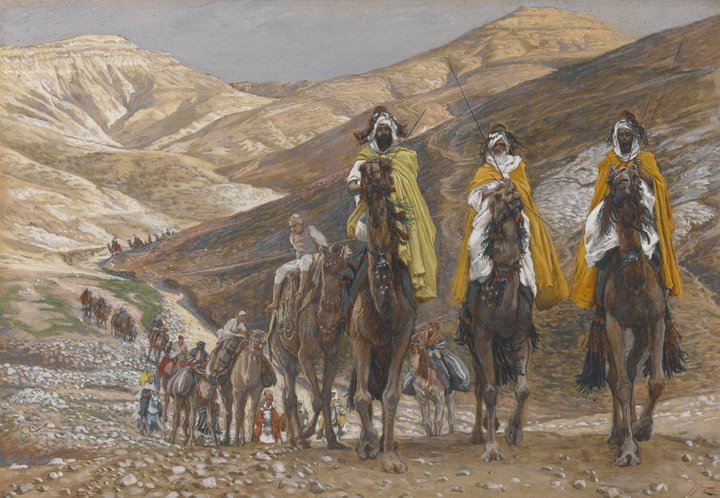
En route from “the east.” James Tissot, 1890, via Wikimedia. Public domain.
Isn’t the timing all wrong for a January 6 arrival?
Matthew is silent on when they arrived, but it surely would take more than 12 days to come on camelback from “the east” to Bethlehem via Jerusalem. There are too many theories about the date to summarize here — Dr. Google will enlighten you if you have the time and inclination.
I’ll just mention that, whereas Santa Claus arrives with his sack of presents on the night of December 24-25 in many western traditions (“…when all through the house/Not a creature was stirring, not even a mouse”), the Three Kings drop off the gifts on Twelfth Night (January 5-6) in many Catholic countries, including Mexico, Argentina, Paraguay and Uruguay. (Unless you’re awake, in which case you’re SOL.) The kids wake up on El Dia de los Tres Reyes to boatloads of prezzies if they’re lucky.
Presents or not, January 6, Epiphany (when Jesus’ divinity was revealed to Gentiles) is a major feast day in most Christian traditions. Even in my vaguely-agnostic Welsh-English household, we took down the Christmas decorations on January 6. No sooner, no later.
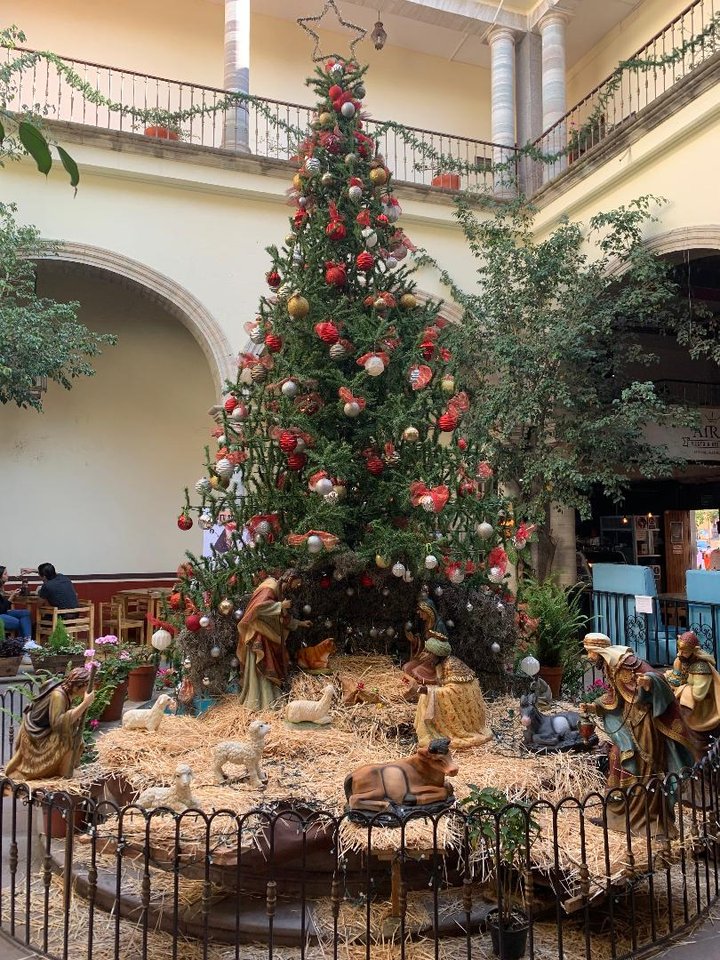
Photo: Barry Evans.
###
If you’re reading this on Sunday, happy “Second Day of Christmas.” May you enjoy those two turtle doves from your true love; I know I will.
BOOKED
Today: 12 felonies, 16 misdemeanors, 0 infractions
JUDGED
Humboldt County Superior Court Calendar: Friday, Sept. 4
CHP REPORTS
Us101 N / Myers Flat Ofr (HM office): Traffic Hazard
E Washington Blvd / Summer Ln (HM office): Defective Traffic Signals
ELSEWHERE
RHBB: CDPH Issues Immunization Recommendations for 2026-27 Respiratory Virus Season
RHBB: Redway Transfer Station to Close an Extra Day for Construction
RHBB: Dows Prairie Road to Close for Two Months for Culvert Repair
LETTER FROM ISTANBUL: Being Here (and There)
James Tressler / Sunday, Dec. 26, 2021 @ 7 a.m. / Letter From Istanbul

Photo: James Tressler.
Atop
Galata Bridge, crossing over the Bosphorus, you are either on your
way to Asia or to Europe, east or west. High over the city, you feel
this sensation of being in two places at once. Which makes its own
kind of sense, when you recall the old saying that all Istanbullus
have two throats (Bosphorus and throat are the same word, boğaz,
in Turkish). For we all belong to ourselves, and to where we live.
It is a dual city where the past and present, where East and West, ancient and modern, exist side by side. All of these elements, and its people, are connected by that thin, esophagus-like strand of waterway that you pass over on the Galata Bridge, that gives breath and life to the city.
My whole life has been a case study in dualism, a battle between being “here” and being “there,” the physical present versus off in my head somewhere. Perhaps the reason I’ve always felt at home in Istanbul is because the city seems to be in sync with that essential part of me. For me, being here means being present, in the moment. İt means being a husband and father, it means being fifty. Being there means off in the world of my imagination, in dreams, in Prague, in California, in the past. A philosopher could posit that both worlds exist, but such discussions, while valid for coffee shop chats, usually make for exasperated spouses, I find.
###
Just like the city, these forces usually coexist amiably, at times symbiotic at other times commensal. In other words, in a single day I can write a story about Prague in my office on the European side of Istanbul in the morning, teach classes in the afternoon and in the evenings, go back across the bridge to our flat on the Asian side, home to my wife and son. All goes well if it’s a good day. I can be “here” and “there” at once.
In fact, you could say that being a father and husband makes me a better teacher, and vice versa, and that being all of these things affect my writing, whenever I have time for it.
But those are the good days.
Then you have the times like last week, when our son Leo got ill. He came down with a fever and persistent cough. He had difficulty breathing. We took him to a nearby hospital. It wasn’t Covid, thankfully, but rather a respiratory viral infection common in babies and young children. Still, the doctors wanted him to stay in the hospital for a few days so that his condition could be monitored.
For inexperienced parents, it is a frightening situation, to see your healthy, buoyant child suddenly so fragile, to see him breathing through a respirator. It really knocks you over. It makes you “here,” alright. Suddenly everything else is remote, far away. My wife naturally was distraught, blaming herself, and I could tell she felt really alone. I tried to reassure her, that everything was going to be OK. But of course, how could I know that? In those moments, you feel really inadequate, and I found myself wishing my wife had someone “here” who was better and stronger than myself. In those moments, the world of “there,” (being a writer, teacher, Prague, California, etc) doesn’t seem to be of any value or help at all. There is only “here,” the white, cold corridors of the hospital, the sound of medical staff busy with their routine work (for them, all of this sickness and pain and worry is just another day at work, you realize), the sight of your wife’s tired, sleepless face and your son’s little body covered in a rash that the doctors say is a sign of his still-developing immune system fighting the virus.
“Why don’t you ask the doctor?” my wife chided, more than once when I asked her about this or that related to Leo’s condition. “You need to ask questions, too! I can’t think of everything!”
I called in to work to arrange a substitute, and stayed with my wife and son at the hospital that first night and the next day. Özge’s mother heroically arranged for an overnight bus and arrived early that next morning ready to assist. Talk about a godsend. Her mother immediately took hold of the situation, assisted Özge a lot more assuredly and practically than I had (having raised two daughters, I guess she has the experience, bless her).
By Sunday, Leo had improved enough that the doctor said we could take him home. At home, he was fine the first couple days, but by the weekend, the fevers and coughing were back, even worse than before. Özge’s mother was still with us, so in the middle of the night on Saturday we bundled Leo into a taxi and rushed back to the same hospital. It was like a nightmare, like being back in prison a week after you’d been let out on parole. You just didn’t think (or hope) you would see the inside of this place again anytime soon. And yet there we were. There our son was in the hospital bed, there I was holding the respirator tube to his face so that he could get adequate levels of oxygen.
It was another virus, the doctor (a different one this time) announced the following morning, after tests were taken. He had beaten the first virus, but most likely picked up the second virus at the hospital during his previous stay the week before. It was rather dispiriting to hear that. Aren’t hospitals supposed to be places where you go to get well, not sicker? Again, the analogy of prisons crept into our battered heads (the idea that prisons often turn out to be places where people get worse rather than better, I mean).
Fortunately, it was yet another routine viral infection, treatable with antibiotics and the respirator. We were at the hospital about five days. At the university we were on term break, so there was no need to worry about work. The rest of normal life, the world of “there,” was on hold. “Here” consisted once again of the hospital, with which you find yourself becoming depressingly familiar. You know where everything is, the café, the restrooms, the whole layout of the place. You do not wish to be overly familiar with hospitals. Going out to the parking lot for some fresh air, you pass some orderlies bringing in a man on a stretcher. He is still wearing his street clothes and looks shattered, a broken leg perhaps. As you pass, your eyes meet for a second and you see a glint, a flicker in the man’s eye, and it occurs to you that he wishes very much to be you, standing and walking around, and you realize you are very lucky not to be him laid out on that gurney. The difference between the sick and the well is sudden, revealing and profound indeed, and I thought again about our little boy upstairs.
Outside, out “there,” the city looks grey and dreary, wind-lashed by the first winter storms of the year. You look out the hermetically sealed windows of the hospital (Geez, would it really hurt to be able to open the windows? To let in a bit of fresh air now and again? No wonder our son picked up a second virus!) and wonder when all of this will be over. In the wet streets, cars, taxis, buses whisked by. People, clutching umbrellas, their coats pulled to against the rain and cold biting winds, trudged wearily to the metro, their thoughts clouded no doubt by feelings of “there,” wishing it was summer and they were at the beaches of Bodrum or Marmaris. The country’s inflation rate rose up and up, as impersonal as the medical machines that monitor breathing and heart rate … the mechanized forces at work in and around our lives beating on endlessly.
By Thursday morning, Leo was much better. He had not had any fevers for two or three days, the rash was gone and the cough was much less frequent. He was again free to go. “Home!” he said, one of the English words he has learned. “Home! Home!” The poor little guy. He was tired of the hospital too, and missed his toys, his regular routine. My wife looked much better too, for with Leo’s improving condition she had been able to sleep more and with less worry.
Back home, we kept Leo on his prescribed medication and he is pretty much back to normal, just in time for his second birthday. Alas, Özge’s mother got sick and was bed-ridden for a day or two, some bug she had picked up from the hospital (what a surprise!), but fortunately she is fine now.
###
And here we are, back at the office. The second term has begun, new students, new classes. Life goes on. Writing this, I chuckle as I realize that I am not “here,” (at the school, preparing for classes) but rather once again, “there,” back at the hospital, keeping an anxious vigil over our son. I am on the metro bus crossing the Galata Bridge, looking out at the shining waters of the Bosphorus, pondering the predicament of the lira, plunging further against the dollar. I am thinking of Leo’s birthday, which is today. He is two. When he woke up, I wished him happy birthday and he just said, “A wok dok dee!” in his Leo language. What a beautiful boy he is, both here and there, and everywhere. And my wife, and her mother – they are my heroes.
###
James Tressler, a former Lost Coast resident, is a writer and teacher in Istanbul, or somewhere.
Woman Found Dead in Trinidad Rancheria Trailer Fire; Sheriff’s Office, Calfire Investigating
LoCO Staff / Friday, Dec. 24, 2021 @ 11:40 a.m. / Crime
Press release from the Humboldt County Sheriff’s Office:
On Dec. 23, 2021, at about 9:14 p.m., Humboldt County Sheriff’s deputies were dispatched to a residence on Teh-Pah Lane, on the Trinidad Rancheria, for a death investigation.
According to fire personnel, a travel trailer behind the main residence of the property had reportedly become engulfed in flames. While working to suppress the fire, fire crews located a deceased adult female inside.
The Humboldt County Sheriff’s Office Major Crimes Division was dispatched to investigate. Sheriff’s Investigators are working in coordination with CAL FIRE to investigate this incident. The cause and circumstances of the fire are undetermined at this time.
An autopsy of the victim to determine cause of death is in the process of being scheduled. The identity of the victim is being withheld pending next of kin notification.
Anyone with information about this case or related criminal activity is encouraged to call the Humboldt County Sheriff’s Office at (707) 445-7251 or the Sheriff’s Office Crime Tip line at (707) 268-2539.

THE CANNABIS CONVERSATION: Cannabis Taxes and the Illicit Market
Jesse Duncan / Friday, Dec. 24, 2021 @ 7:30 a.m. / Cannabis
For years now, the California commercial cannabis community has argued that taxes are too high. With declining pot prices, slackening consumer sales at the retail level, an impending tax hike, and ever-expanding illicit market production, things have come to a fever pitch recently. Industry insiders are lobbying Governor Newsom for tax reform, and he is listening. Newsom has publicly stated that he supports reform, and his spokeswoman, Erin Mellon, recently stated that the “current tax construct is presenting unintended but serious consequences” in reference to the continued strength of the underground market.
Given higher regulatory costs and a heavy tax burden, legal companies have a hard time competing with illicit market operators not burdened with the same cost structure. Despite more cannabis tax dollars being directed toward enforcement, the underground or unregulated market continues to thrive. As mentioned last week, the sheriff’s office estimates approximately 4,000 illegal farms in Humboldt alone. Across the state, reports are the same. For example, Southern California has seen a massive influx of illegal operators launching huge scenes in the California desert around areas like Palmdale and others.
With millions of pounds produced, in many cases, with cheap or forced migrant labor, illicit operators are flooding the market and putting downward pressure on prices. Unfortunately, when given the opportunity to purchase more expensive products through legal channels or much cheaper ones on the street, many consumers opt for the latter.
Both retailers and cultivators are feeling the pain. A recent report from California’s Legislative Analyst’s Office notes that on average, retail pot shops pay a tax rate of 27 percent based on the state excise tax and tax on price markups alone. Add to that business operating costs, payroll taxes, workers comp and local taxes, and it’s clear to see the legal market is facing an uphill battle with respect to competing with the black market, where zero taxes are paid. In fact, it’s estimated that regulated storefront price tags are 50 percent higher than street prices.
Cultivators face an even more challenging scenario. Here in Humboldt, cultivators pay from one to three dollars a square foot of cultivation area depending on whether they grow outdoor, mixed-light or indoor. In addition, the state charges cultivators approximately $154 per pound and around $46 a pound for trim. These rates are set to increase nearly 5 percent on the first of the year, as the law ties cultivation tax rates to the rate of inflation. Given wholesale or bulk flower prices of around $400 currently, taxes for sun-grown or outdoor cannabis farmers are enormously high and make competing with illicit operators nearly impossible.
Many conscientious consumers prefer to buy lab-tested, pesticide- and pathogen-free products from a permitted dispensing facility and are willing to pay more for them. Others, however, shop on price and purchase in the underground market, even though illicit products are often laden with harmful pesticides and fungicides. When growing organically, keeping plants free from pests and pathogens like mildew can take considerable effort. Many growers, especially those farming in regions with high nighttime humidity levels, often spray plants once a week with approved pesticides such as oils, insecticidal soaps or citric acid-based products. Not only is this expensive, but time-consuming. Those using dangerous chemicals can spray once or twice an entire cycle and be done with it. Some of those poisons remain in the plant for months and are incredibly bad for your health when combusted.
It gets worse. The Connecticut Forensic Science Laboratory states that over the past four months, some 39 individuals claiming to have consumed cannabis have experienced differing levels of overdose. The culprit: Fentanyl-laced flower. Fentanyl is an incredibly powerful, highly addictive narcotic that’s estimated to be some 50 times stronger than heroin. So not only is illicitly grown and sold product often tainted with harmful toxins, cannabis is now being laced with deadly and addictive compounds … scary stuff indeed. While not everyone selling cannabis in the unregulated market poisons their products, generally speaking, stuff off the street is far more likely to be toxic. Additionally, unregulated grows tend to have far more egregious environmental violations, and many use forced labor, subjecting employees to terrible living conditions and inhumane treatment.
By reducing tax rates, cultivators and retailers can become more price competitive and can begin to compete more effectively with non-licensed operators. Prices for consumers can be reduced and, in all likelihood, more operators would enter into the regulated space. With greater participation in legal channels, the state would have a broader, more sustainable tax base, and receipts would likely meet or exceed those received currently. Interestingly the Legislative Analysts Office previously mentioned articulates the same argument – that reducing tax rates for legal operators will help curb illicit activity and contribute to a more functional industry.
As someone who cultivates commercially, I obviously have an ax to grind in this matter and would like to see lower taxes and greater participation in the legal marketplace. That said, I am also sensitive to arguments that we ganja farmers are a bunch of tax-evading lawbreakers. I remind colleagues that when we originally lobbied the county and the state of California to allow commercial cultivation several years back, many of us stated a desire to support our communities by paying taxes. In fact, tax revenue for localities and the state was one of the major selling points in legitimizing the industry. When Humboldt County ultimately proposed cultivation tax rates that were two times higher than the $1-3 range landed upon, a host of growers showed up in front of the Board of Supervisors arguing rates were too high. I feel the cultivation community and the California cannabis industry more broadly suffered a reputational hit as a result. Some leaders within the county agreed. The County Treasurer, Mr. Bartholomew, called out the cultivation community during that meeting and noted that many had been avoiding taxes for 20 years. It was on camera, and gave me a real sense that our industry had a lot of bridges to build and a lot of ground to cover in terms of professionalizing and legitimizing ourselves.
Fast forward a few years to the current time and there are now calls from across the industry for a complete repeal of state cultivation taxes and a few years’ pause to the 15 percent excise tax on products. To be clear, I fully support my colleagues in the area of tax reform and reduction but understand how some community members will roll their eyes when hearing this.
I would remind folks of three simple truths. First, cannabis is here to stay and will soon be produced and distributed legally around the world. Despite your personal views, acceptance of cannabis as medicine and as an honorable profession is growing worldwide and the train has already left the station. Second, without cannabis, the economic prospects for Humboldt look bleak, at least over short and intermediate horizons. Finally, if legal operators can’t become more competitive, the illicit marketplace will continue to dominate the industry and continue to harm the environment, workers and consumers alike.
###
Jesse Duncan is a lifelong Humboldt County resident, a father of six, a retired financial advisor, and a full-time commercial cannabis grower. He is also the creator of NorCal Financial and Cannabis Consulting, a no-cost platform that helps small farmers improve their cultivation, business, and financial skills. Please check out his blog at, his Instagram at jesse_duncann, and connect with him on Linkedin.
OBITUARY: Kenneth J. Hinman, 1936-2021
LoCO Staff / Thursday, Dec. 23, 2021 @ 6:56 a.m. / Obits
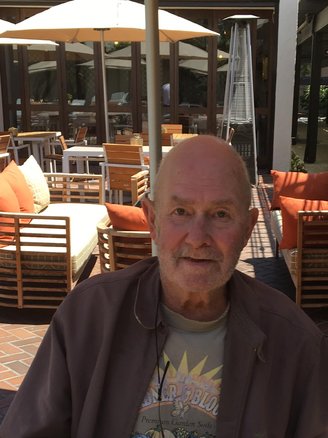
Kenneth J. Hinman
February 7, 1936 –
October 20, 2021
Ken was a Humboldt County native who taught elementary school for 32 years. He was a natural born and beloved teacher whose students fondly referred to him as “Mr. H.” He found a way to weave his love of music into his curriculum and could often be found playing John Denver tunes on his guitar for his students. He especially enjoyed his colleague Lannie Nelsen and the collaboration they shared between their classrooms. Prior to his teaching career he spent four years in the United States Air Force as a court stenographer. He was stationed in Albuquerque, New Mexico.
One of Ken’s favorite hobbies was gardening, and his is specialty was growing flowers and vegetables. After he retired from teaching, Ken helped to manage Pierson’s Garden Shop for 20 years. His depth of knowledge and love for gardening helped him to win many gardening awards from the city of Eureka throughout his years. Another favorite hobby was music. His love of music included both classical and rock genres. Ken went to see music as much as he could, and was able to see both Neil Diamond and Elton John live in concert.
Ken was fond of good food and was referred to as a “foodie.” He enjoyed visiting the San Francisco Farmer’s Market at the Ferry Building. His all-time favorite food was Italian, and he was often found covering everything with parmesan cheese.
Ken’s favorite place to travel was the Caribbean. He loved to feel the wind on his cute bald head. His sense of adventure made him an exciting and very fun travel partner. He was a bit of a daredevil and was always up for a zip line adventure, a rollercoaster ride or a parasailing adventure.
Ken was a runner and loved to participate in organized runs. He participated in all the local events he could, including the annual Foggy Bottoms and Clam Beach runs. He also enjoyed several Bay to Breaker runs. Ken met his longtime partner Steve in July of 1993 while on a Clam Beach run.
Ken leaves behind the fondest of memories for his beloved dogs. Most recently Maddie, a rescue dog and cute little bundle of joy, stole Ken’s heart. Codie, a “cotton-ball with an attitude” was another favorite who was very active and loved to play, and finally, Rhandi, who was Ken’s princess.
Ken is survived by his partner of 31 years, Steve Frizzell. He also leaves behind his daughter Tami, son Todd and wife Ireta; three grandchildren, Mitch, Brendon and Shalisa, and one great-grandchild, Oliver. Ken also leaves behind his sister Lucille Huddleson from Fortuna and his brother Norman Hinman of Yuba City. Ken remained good friends with his ex-wife Jean Hinman until her death in 2009.
Ken was a kind and gentle man with an incredible sense of humor. He will be missed dearly by all who loved him.
In lieu of flowers, please make donations in Ken’s name to Miranda’s Rescue.
###
The obituary above was submitted on behalf of Ken Hinman’s loved ones. The Lost Coast Outpost runs obituaries of Humboldt County residents at no charge. See guidelines here.
OBITUARY: James ‘Jay’ DuWayne Simmons, 1962-2021
LoCO Staff / Thursday, Dec. 23, 2021 @ 6:56 a.m. / Obits
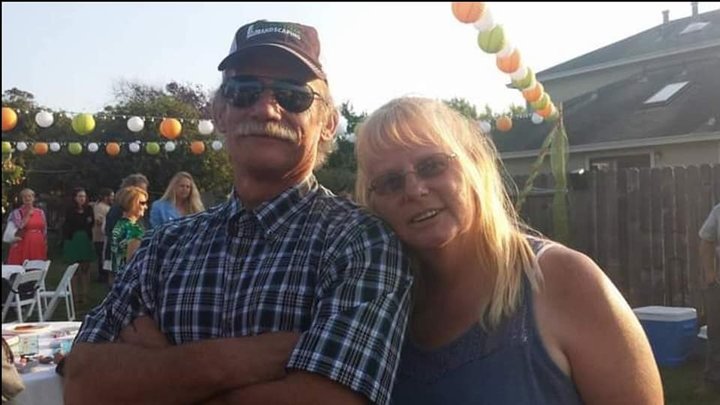
James “Jay” DuWayne Simmons, born October 22, 1962, to Jim and Elaine Simmons in San Diego, has passed at the age of 59, peacefully in his home in Eureka, after a hard fought battle with cancer, on December 16, 2021.
Jay spent most of his early childhood in Humboldt County and graduated from Eureka Senior High School in 1980. Soon after, Jay married the love of his life, Theresa Liles, and began his family, adding four beautiful children. When he wasn’t hunting or fishing with his friends and family, he was working and providing for his family. Jay prided himself in hard work. His parents instilled a work ethic like no other, as well as his mentors Louie Holcomb and Eddie Kirkpatrick, who taught him everything about landscaping, loyalty and love.
Jay spent his entire working life shaping the earth and providing many people in Humboldt County with beautiful landscapes. Throughout his dedicated years of work, Jay mentored many young men, often becoming a father figure in their lives. This is one of Jay’s most proud accomplishments. He loved to brag about his “boys.” Some of them include, Jay Real, Jared Vest, Matthew Warner, Steven Mitchell, Jake Gibbons, Wyatt Nylander, Randy Strenciwilk, Kacy Cook, Austin Morris, Cameron and Victorio Rodriquez.
Jay devoted many years developing his company, Luscious Landscaping, that his children ultimately ran when he retired. In his later years, he enjoyed spending time with his wife at Trinity Lake soaking up the sun as well as creating some beautiful art through painting, stained glass work and drawing.
Jay is preceded in death by his grandparents, Paul and Vina Simmons, and Edward and Margaret Webster, as well as his younger brother and sister-in-law, Michael and Traci Simmons.
Jay is survived by his parents, Jim Simmons and Elaine Reed and step father Terry Reed, Theresa Simmons, his wife of 40 years, his four children Jason (Susan) Simmons, Kelly Simmons, Timothy Simmons, and Ethan Simmons. His grandchildren, Kenneth Goldman, and Ashlynne Simmons. His siblings, Valerie Reed, Kris (Kris) Mobley, Allen (Amanda) Reed, Lori (Jimmy) Arnold, Steven Dorfman, Holly (Heath) Higgins, and Shelly (AJ) Allen. He is survived by many foster siblings, aunts, uncles, cousins, nieces, and nephews, too many to name but equally loved.
Rain or shine there will be a potluck memorial service at Sequoia Park on Saturday, January 29, 2022 at 1 p.m. Please come celebrate a beautiful life and eat with us. In lieu of flowers please make a monetary donation to Resolution Care at Resolution Care Institute C/O Cheyenne Balsley, 517 3rd St Ste. 2, Eureka, CA 95501. Resolution Care supported the family for the past few years in caring for Jay during his fight.
Jay’s family would like to thank everyone who has reached out during this time. Jay will be missed more than is measurable. We love you, Daddy.
###
The obituary above was submitted on behalf of Jay Simmons’ loved ones. The Lost Coast Outpost runs obituaries of Humboldt County residents at no charge. See guidelines here.
OBITUARY: Verna Ferrari, 1932-2021
LoCO Staff / Thursday, Dec. 23, 2021 @ 6:56 a.m. / Obits
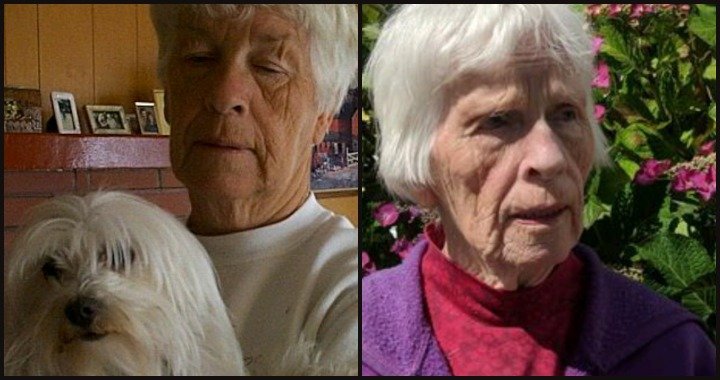
Verna Ferrari passed away unexpectedly on November 20, 2021.
Mom was born on January 6, 1932 to Patrick and Verna O’Keefe.
Being full Irish, when Dad and Mom married in 1957, Dad gave Mom the nickname “Irish.” Dad and Mom made their home in Fortuna and were happily married for 55 years.
Mom always enjoyed her time as a stay-at-home mom. Mom would be a constant source in the neighborhood for the latest news. Often, the neighborhood kids would want to come over and talk with Mom instead of us. Known to many as Mrs. Ferrari, Mom could often be seen walking down the boulevard to the grocery store. Thank you to those who would stop to ask if Mom needed a ride, most often she would say “no thank you.”
Mom always had a special place in her heart for a stray cat. Even though Mom was more of a “cat person”, she always loved the companionship of her dog “Tiffy.” Mom could often be seen working in her yard, always enjoying the time of year when her roses and hydrangeas were in full bloom.
Verna is survived by her children Julie DeSantis (Larry); Thomas Ferrari (Bunny); grandchildren Lene Ferrari and Rocco Ferrari.
Preceeded in death by her parents Patrick and Verna O’Keefe; brothers Tommy O’Keefe, Eddie O’Keefe, Joe O’Keefe, Gene O’Keefe and Walter O’Keefe and her husband Eddie Ferrari.
Special thanks to John and Carol Lopez for being there for our Mom throughout the years; Also,thank you to David and Bonnie Settle. Sandra and Debra, Mom always enjoyed your visits, the meals and groceries you would bring her. Christine, you and Mom had a special bond with your love for cats. Dennis and Shari DeCarli, thank you for checking in on Mom, along with the treats you would bring for her.
Please encourage your elderly loved ones to wear a Medical Alert.
Verna will be joining her husband Eddie at Sunrise Cemetery in Fortuna. There will be a private graveside service at a later date.
###
The obituary above was submitted on behalf of Verna Ferrari’s loved ones. The Lost Coast Outpost runs obituaries of Humboldt County residents at no charge. See guidelines here.


.jpg)
_-_James_Tissot_-_overall.jpg)