Attendees at this year’s Fortuna Redwood AutoXpo will see the shiny white van of the Humboldt County Public Health mobile vaccination unit along with the gleaming classic cars and hot rods on Saturday, July 24.
The 30th Annual Fortuna Redwood AutoXpo is the latest family-friendly event to host a vaccination clinic, offering a convenient way for county residents to get vaccinated against COVID-19.
“Guys who can’t take time off work can get vaccinated while they’re walking around with their families,” said Kathy Wildgrube, secretary of the Fortuna Redwood AutoXpo Committee.
“It’s going to be a banner year for the Fortuna AutoXpo,” Wildgrube said, running down a list of special events, such as the Friday Night Cruise down Main Street, the “Show & Shine” show for vintage and exotic cars, the Swap Meet and the Artisans Faire. Events are scheduled from noon on Friday, July 23, through 4 p.m. on Sunday, July 25.
Organizers found creative ways to ensure the event will be COVID-safe with a robust schedule of outdoor events like the popular Burnout Contest. And instead of an indoor dance, this year will feature Drive-In Movies at Rohnert Park, where participants can watch “American Graffiti” or “Smoky and the Bandit” from the comfort of their cars.
The vaccination clinic will join the festivities from 9 a.m. until 5 p.m. on Saturday, setting up on the circular driveway of the Fortuna Veteran’s Memorial Building, located at 1426 Main St. Parking will be available at the nearby library or chamber of commerce office. Walk-ins are welcome or sign up in advance at MyTurn.ca.gov.
Two types of vaccine will be available, the single-dose Johnson and Johnson approved for those 18 and older, and the two-dose Pfizer vaccine approved for children as young as 12 years old. Minors must be accompanied by a parent or guardian.
To view the complete schedule of the 30th Annual Fortuna Redwood AutoXpo 2021, visit redwoodautoxpo.com.
This week your President of Positivity celebrates Old Town’s new Fallen Fire Memorial with a visit with to the site with Humboldt Bay Fire Captain David Terry and Lynnie Horrigan of Victory Signs, who created the display’s informative sign. Ciao Bella!
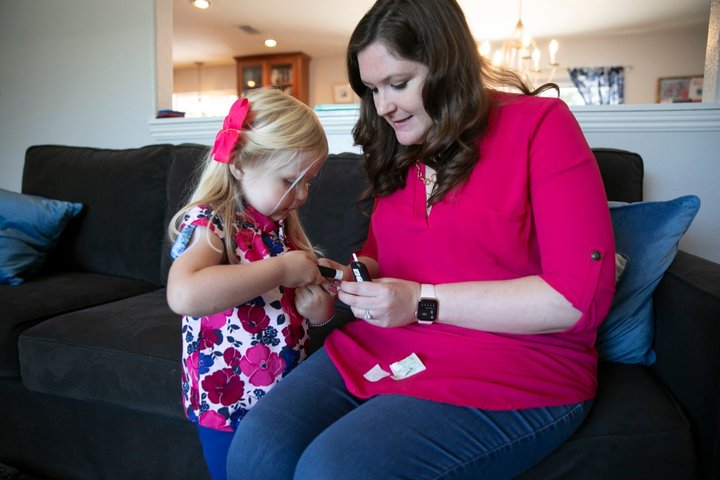
Noelle Tuominen helps her daughter, Eleanor, 4, test her blood glucose levels at their Livermore home. Eleanor, who was diagnosed with type 1 diabetes when she was 1, has been doing her own finger pricks since she was 2 and wears an insulin pump on her arm to manage her blood sugar. The family worries about the rising costs of insulin. Photo by Anne Wernikoff, CalMatters
###
Early in his term, Gov. Gavin Newsom positioned himself as the governor who would champion health care. He vowed to target rising prescription drug costs and find a way for the state to pay for care for all Californians, a key campaign promise. He also set a goal of creating a blueprint to better serve the Golden State’s growing population of seniors.
But two and a half years after taking office and still struggling to control a pandemic, the governor has had to focus much of his attention on COVID-19, so timelines for other health efforts have been pushed back.
Two of Newsom’s boldest health care promises — affordable medications and universal, state-funded health care — have made little progress during his term. And a third — a master plan for seniors — has been drafted yet actions will be phased in over the next 10 years. So enacting each of them in some form will likely come after Newsom’s term ends — even if he isn’t recalled in September.
Health advocates and experts praise the efforts, but some are less convinced that Newsom can deliver on mammoth goals like creating a state-funded, single-payer health system.
“It’s important not to lose sight of some historic steps taken in expanding coverage,” said Thad Kousser, a political science professor at UC San Diego. “But to be clear he campaigned on a single-payer pledge that a lot of people didn’t think was realistic, and I think the last few years have shown us that it will be incredibly hard to achieve.”
Even before the pandemic, the governor acknowledged that full-fledged plans for reforming health care would take years.
His team says the work is ongoing, pointing to the billions of dollars in this year’s budget to expand health coverage and services. “Governor Newsom is working in partnership with the Legislature to make health care more affordable and accessible for all Californians — regardless of their age, immigration status, or income,” a spokesperson for the governor’s office told CalMatters in an email.
But drug prices are still rising. Last year, drug manufacturers reported price increases of more than 16% on more than 1,200 prescription drugs to state regulators.
Noelle Tuominen and her husband, Richard Pollari, of Livermore know personally about the high cost of medications because they have two children with Type 1 diabetes — their second-born was just diagnosed a few weeks ago.
The list price for ther daughter Eleanor’s insulin, Eli Lilly & Co.’s Humalog, is $274.70 per vial. Some Type 1 diabetics can go through two or three vials per month — although younger patients may need less. What a person ends up paying depends on their insurance.
Tuominen is grateful her family has good health insurance so last year they paid just $600 in co-pays for their daughter’s insulin. But in total, they spent about $17,000 on health care costs last year.
Her daughter, now 4, was diagnosed when she was 1. “It was a shock. We went to the ICU and ended up with a hefty hospital bill,” Tuominen said.
Now money that could be going to her kids’ college fund is going to an insulin fund — a backup plan in case her family is ever without health insurance. She said the pandemic taught her family that job security and the insurance that comes with it is never a guarantee.
“It’s very easy to say we’re going to tackle it, but harder to see action behind it,” Tuominen said of the promises around reducing health care costs. “Every day someone is getting diagnosed and every day someone has a new bill they need to cover to keep their child alive.”
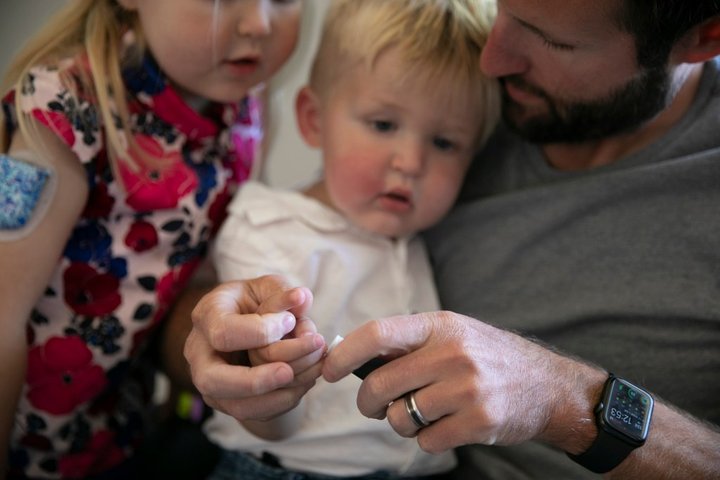
Eleanor, 4, looks on as Jack, 1, has his blood glucose measured by their father, Richard Pollari at their Livermore home. Jack was diagnosed with diabetes a few weeks earlier. Photo by Anne Wernikoff, CalMatters
Annemarie Gibson in San Diego has two sons, 11 and 13, also on the drug Humalog. She pays about $200 a month for their insulin, although she has to first pay a $2,900 per-person deductible before coverage kicks in.
“We started in 2011… and since then I haven’t seen any improvement. I’ve only seen prices go up,” Gibson said. She worries that when her sons age out of their parents’ insurance, they could have a hard time affording their insulin.
“You hear a lot about young adults who are on their own for the first time, they can’t afford their prescription and unsuccessfully ration their insulin,” she said.
About three in 10 adults reported not taking their medications as prescribed at some point in the past year because of the cost, according to a recent Kaiser Family Foundation survey.
But going after pharmaceutical companies during a pandemic could prove to be risky. “This is probably not the right political moment to be bashing drug companies…when vaccines have been so central to the state’s recovery to Covid,” Kousser at UC San Diego said.
“We started in 2011… and since then I haven’t seen any improvement. I’ve only seen prices go up.” — Annemarie Gibson, San Diego parent
Last year, Newsom signed a bill by Sen. Richard Pan, a Sacramento Democrat, that allows the state to take the first steps in creating state-run generics. The state would partner with manufacturers to make or distribute less expensive generic drugs, including one form of insulin, that would be widely available.
“It’s quite feasible. California is big enough that it can do this. But it’s still going to be hard,” said Geoffrey Joyce, director of health policy at the University of Southern California Schaeffer Center.
It will likely be several years before California makes any of its own generic drugs because many steps must be taken first, such as researching manufacturers and approving funding. An initial report on which drugs the state could target first is due next summer.
“We’ve started some important efforts; they haven’t necessarily yielded their full fruit yet,” said Anthony Wright, executive director of Health Access, a Sacramento-based consumer advocacy group that supported Pan’s bill.
The savings that could be passed on to consumers would likely be modest because the generics industry is already fiercely competitive, Joyce said. In the U.S., “nine out of 10 prescriptions filled are generics, but generics only make about 22% of overall drug spending,” he said.
In the meantime, “one thing the state can do is educate people on where to get the cheapest drugs, or say ‘we’ll pay your Costco membership fee to get the best prices until generics in California are up and running,’” he said. One recent USC study found that the federal government in 2018 overpaid by about $2.6 billion for generic drugs compared to what Costco members paid.
Rather than trying to lower drug prices, other states have limited what people pay out of pocket. In 2019, Colorado became the first state to cap insulin copays at $100 a month. Fifteen other states have followed suit with some type of co-pay cap on insulin. In California, two current bills aim to prohibit health plans from imposing a deductible on certain prescription drugs — one bill addresses insulin specifically and a second bill targets prescription drugs for some chronic diseases.
Newsom also issued an executive order on his first day in office directing the state to transition all Medi-Cal pharmacy services from a managed care system, in which the state pays health plans an annual fee for each person covered, to fee-for-service, where the state pays for each service provided. That move was expected to result in $612 million in savings for the state in fiscal year 2021-22.
But that transition, first slated for January of this year, has been delayed.
In 2019, Newsom established a Healthy California for All Commission, tasked with figuring out how to get the state closer to universal coverage, including the possibility of a single-payer system. In a single payer system, the government pays for all or most health costs, like in Taiwan and Canada.
Because of the pandemic, the commission postponed several of its meetings last year, pushing back its original timetable. It started meeting again more regularly this year.
Eleanor, 4, looks on as Jack, 1, has his blood glucose measured by their father, Richard Pollari at their Livermore home. Jack was diagnosed with diabetes a few weeks earlier. Photo by Anne Wernikoff, CalMatters
Experts say California can get closer to covering everyone by continuing to remove eligibility and affordability barriers. In the most recent budget, for example, Newsom approved opening full-scope Medi-Cal to undocumented Californians 50 and older and agreed to remove what is known as the Medi-Cal asset test, which often forced seniors and people with disabilities to spend down their savings to qualify for free or low-cost coverage. Those two moves alone would allow approximately 250,000 more Californians to get covered.
But some of Newsom’s strongest supporters are holding him to the more ambitious goal of creating one state-funded health plan for everyone.
“We now have a willing federal partner, we have AB 1400, we have this commission, we can act now,” said Stephanie Roberson, government relations director for the California Nurses Association, one of the biggest proponents of single-payer health care.
Assemblymember Ash Kalra, a Democrat from San Jose, pulled AB 1400 or CalCare, which would create the framework for state-paid health care, from consideration earlier this year to iron out financing details.
The bill will be back next year. But the overarching question of how to pay for it has yet to be answered. A single-payer bill that was killed in 2017 carried a $400 billion price tag.
The commission is also exploring other options to pay for the program, including new taxes.
“He campaigned on a single-payer pledge that a lot of people didn’t think was realistic, and I think the last few years have shown us that it will be incredibly hard to achieve.” — Thad Kousser, Political science professor at UC San Diego
Although some members have expressed concern about the political pushback that comes with new taxes.
“Sometimes in these groups everyone says, ‘oh yeah, no problem it should be easy to get Democrats or progressives to vote for taxes,’ but this is also the land of Prop. 13. If you want to stay an elected official, you’ve got to think carefully about imposing taxes on people,” Pan, who serves on the commission, said at a recent virtual meeting.
While rolling out such a program would be costly at first, University of California researchers found that single-payer systems could save the U.S. money as soon as the first year of operation — with an average drop of 3.5% in total health care spending. Costs would continue to drop over time and the largest savings would come from lower administrative costs and reduced drug costs, according to their review of 22 single-payer strategies.
What California can accomplish isn’t just tied to money and political will. The state also would have to secure waivers to bypass federal rules and get flexibility on how to spend federal dollars. In May, Newsom made the initial ask in a letter to President Joe Biden.
“The big determinant of whether Sacramento will be able to move on single payer is who is in charge in Washington, DC,” Kousser said. “It probably would have taken a Bernie Sanders victory for any state to move forward. Trump would actively block it, but Joe Biden won’t actively encourage it.”
A ‘master plan’ for older Californians
Before the pandemic, Newsom recognized the state was falling short of meeting the needs of its 65 and older population, which is expected to grow by 4 million people by 2030. In mid-2019, he ordered the creation of a blueprint that would set targets to make California more “age friendly.”
The state unveiled its Master Plan for Aging in January with goals around housing affordability, health care, caregiving and economic security. But the work to meet its goals is just beginning. The plan comes with a scorecard that will track the state’s progress over the next 10 years.
Aging advocates say the state’s goals have become more important than ever after a pandemic most dangerous to seniors. Almost three-quarters of all California’s COVID-19 deaths were among residents 65 and older. The master plan comes with recommendations to redesign nursing homes, noting that their residents made up a third of all pandemic deaths.
This year’s state budget allocates $3.3 million to roll out the plan. Separately, the budget also includes boosts in nutrition and food assistance programs for older Californians, and permanently restores a 7% cut in hours for Medi-Cal’s in-home supportive services that aid seniors and people with disabilities.
“The best news about progress in the master plan is that this new budget includes significant new investments in aging, health care and long-term care programs that are really going to help us move faster,” said Kevin Prindiville, executive director at Justice in Aging, who serves on one of the plan’s committees.
Budget dollars, however, are a mix of ongoing and one-time funding, which means that in tougher economic times, it could be difficult to retain the money needed to build these programs.
“This will require ongoing work to make sure the funding is there in the future,” Prindiville said. “But we’re definitely on an on-ramp and this budget gives us real momentum to build out these systems.”
###
CALmatters.org is a nonprofit, nonpartisan media venture explaining California policies and politics.
Will Hollman with his son outside of his home in the San Fernando Valley. “I love my kids and it is my duty to be a parent,” Hollman said. “I’m fighting a lot of battles.” Pablo Unzueta for CalMatters
###
Two years ago the Los Angeles Department of Water and Power shut off electricity at Will Hollman’s home in the San Fernando Valley, forcing the family to rely on a gasoline generator. In late June of this year, the department disconnected the water, too — despite a statewide moratorium on water shutoffs that Gov. Gavin Newsom recently extended through Sept. 30.
Hollman, his 10-year-old son and his 16-year-old stepdaughter endured 11 days of temperatures in the high 90s to low 100s without water or power. For 11 days, they camped out in air-conditioned grocery stores, Starbucks or his truck. They couchsurfed and used friends’ showers. Hollman played it off with the kids as some kind of fun obstacle course.
He called the department’s customer service, and said a representative told him that he must pay off his utility debt of $9,064.13 — largely consisting of charges that Hollman disputes as erroneous — before water or power could be restored.
“It’s been demoralizing, humiliating,” Hollman said on the eighth day. “I have a history of paying my bills, working, being a good provider. You… start having feelings of failure as a parent.”
Ultimately the state’s water agency convinced the LA department to turn on Hollman’s water.
Those 11 days without water or power are a window into what could happen to millions of Californians in the coming months and years, depending on how swiftly and effectively the state distributes relief.
Official estimates of unpaid water and energy bills accumulated during the pandemic verge on $2.7 billion, affecting a few million Californians — and those figures have been growing rapidly.
The state has so far prioritized rent relief — keeping people housed — over utilities relief. A spokesperson for the state’s COVID-19 Rent Relief program said that of the $158 million distributed as of July 16, less than $40,000 had gone to utilities relief. Utility debt makes up about 6% of all assistance requested so far.
On July 11, lawmakers revealed a plan to use one-time federal relief money to address the debt. The deal is a patchwork of new programs to forgive $2 billion of utilities debt and old programs to help households chip away at the rest, with a wide range of eligibility criteria and timelines. But it doesn’t extend current shutoff moratoria past Sept. 30.
“We’re laser-focused on getting this assistance out the door as quickly as possible,” Newsom said in a statement about ongoing rent relief and the utilities relief plan. He has signed the energy bills relief into law, while the water bills relief still awaits his signature.
This will be an important “reboot” to protect Californians and utility companies, said Ellen Hanak, director of the Water Policy Center at the Public Policy Institute of California.
“You don’t want people to be shut off from basic services,” Hanak said, “But it’s also a hit to the entire community if utilities aren’t able to balance their books, because that can have all sorts of ripple effects on the abilities of water and electrical systems to run well.”
When it comes to forgiving California’s utility debt, key questions remain:
Will $2 billion be nearly enough?
Can the money be distributed quickly enough to prevent shutoffs?
“For public health and safety, it’s important for people to have roofs over their heads, clean water and power. Those are all pieces of the puzzle,” Hanak said.
A Catch-22 at LA’s utilities department?
Hollman’s utilities troubles began well before the pandemic.
After opening an account in 2017, he began receiving unusually high electricity charges topping $1,000 — even during months when no one was living in the house because he was staying with his parents — which Hollman attributes to billing errors by the LA utility.
Under financial stress following a messy separation, Hollman said he let the bills pile up.
By early 2019, his unpaid balance had mounted to nearly $9,000. He applied for $2,000 of assistance from the Los Angeles County Department of Public Social Services to keep service on. But the water agency insisted on full payment of his bill, according to correspondence from his social worker reviewed by CalMatters. In March of 2019, the department shut off his power due to non-payment. He bought a generator.
Following the power shutoff, the electricity charges continued, labeled as “unmetered estimated consumption” in bills reviewed by CalMatters, meaning the utility generated them without checking Hollman’s meter. In December 2019, a customer service representative credited his account with several thousand dollars, but, according to Hollman, told him that the department couldn’t stop the continuing energy charges or issue more credits until a technician read his meter.
Which required that the power be turned back on.
Which couldn’t happen until he paid off the debt.
As Hollman tells it, he was caught in a Catch-22.
In April 2020, amid the first pandemic surge, the LA utilities department closed Hollman’s account with an unpaid balance of $9,064.13, meaning that he couldn’t open a new account until he paid off the debt, which could affect his credit score or be taken to small claims court. But, Hollman said, a representative promised that water would stay on while the pandemic lasted. For over a year, it did — until a technician arrived unannounced in late June.
The LA utilities department tells a somewhat different story. In a statement, a department spokesperson said that it had disconnected Hollman’s water in October 2017 and power in March 2019 because Hollman had made no payments since opening his account in March 2017. The spokesperson said the department turned off his water twice more after detecting unauthorized use, in April 2019 and again this past June, when it “came to light to LADWP… that water service had illegally been turned back on.”
While declining to comment on the high “unmetered estimated consumption” charges or Hollman’s apparent Catch-22, the spokesperson said the department restored water service in early July “in an attempt to work out a payment plan… for the water and power that was consumed since 2017.”
Hollman disputes that he illegally reconnected the water, saying it never stopped flowing and that he never received notices it would be shut off. He said that a water department representative told him last week that he had to pay a third of his outstanding bill — money that he said he doesn’t have — before he can qualify for a payment plan.
Mounting debt, and shutoffs despite protections
Hollman is not alone. Despite shutoff protections, the California State Water Resources Control Board has received 308 reports of water disconnections during the pandemic. No agency tracks power shutoffs.
A spokesperson said the state water board got water restored in each case, including for Hollman.
The California Public Utilities Commission also extended the power shutoff moratorium to Sept. 30, days before it was set to expire on June 30. But that only applies to customers of investor-owned utilities, leaving the quarter of Californians served by publicly owned utilities vulnerable, said Mad Stano, an energy equity attorney at the Greenlining Institute, a racial justice nonprofit.
LA’s water department is the largest publicly owned utility in the United States. During the pandemic, customers’ unpaid bills there increased more than 10-fold, from $37 million accrued during 2019 to $400 million accrued during the first eight months of the pandemic, according to a state Water Board report. More than one in five customers behind on bills had debt over $1,000. The department has voluntarily chosen to extend its own moratorium on shutoffs for nonpayment, according to a spokesperson, but has not yet announced an end date. It has also not publicized that decision.
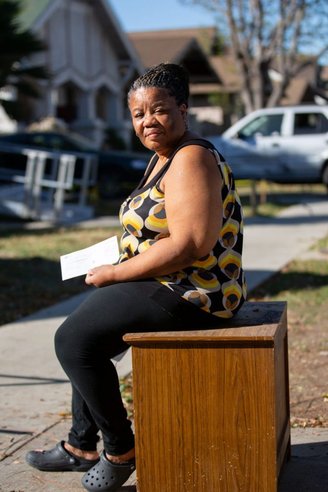
Deborah Bell-Holt sits in front of her house in Jefferson Park near Downtown Los Angeles on Jan. 21, 2021, holding her water and power bill. Photo by Shae Hammond for CalMatters
Her utilities bill ballooned to $19,308.45 during the pandemic as her South Los Angeles household grew to include 12 children, grandchildren and friends.
Bell-Holt assumed that disconnections would start June 30, when evictions were set to begin had lawmakers not made a last-minute deal. She scrambled to send the department $500 in late May and $200 on June 25th, hoping a few payments would stave off shutoffs. To afford that, she said she took out a $500 loan with 347% interest, which she’s still paying back.
Bell-Holt said that if she’d known she wasn’t at risk on June 30, “I wouldn’t put us in a hole like that.”
The state and utilities haven’t done enough to inform Californians about protections, Stano contends. “The state needs to require… communications to people so they don’t make financial decisions that they don’t have to make,” they said.
Living without water or power
On Hollman’s third day this summer without water or power, it hit 100 degrees outside. Inside the house was even hotter.
Hollman and his kids are used to life without air conditioning in one of California’s hottest regions. Their generator — which requires $10 of fuel per day, on average — only powers the lights, electronics and refrigerator. Normally, Hollman might cool the house by hosing down the roof and outdoor plants.
Instead, the family lingered at McDonald’s. “It becomes very difficult to keep your spirit up, but you have to for your kids,” Hollman said. “You can’t crack.”
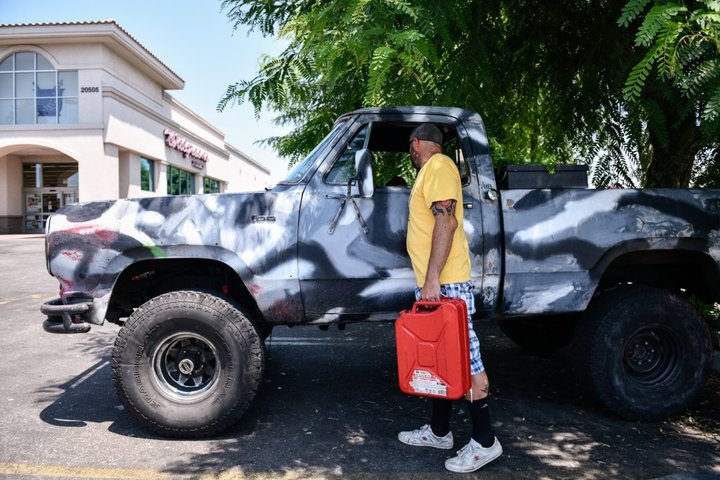
Will Hollman’s day typically begins by filling this container with gas for the generator he’s relied on since electricity was shut off to his San Fernando Valley home. Photo by Pablo Unzueta for CalMatters
On the fifth day, his son thanked Hollman for the best day ever, after the two spent the afternoon cutting through the heat on skateboards.
On the ninth morning, Hollman ran out of generator fuel. He reminded his kids not to open the refrigerator, so the food wouldn’t spoil. He knew his car’s radiator was low, but he was out of coolant and bottled water. He crossed his fingers that the old truck wouldn’t overheat on the way to the gas station. It did.
“It’s a dance that people shouldn’t have to f — ing do,” Hollman said.
Relief on the way for California utility bills
Theoretically, lawmakers’ new deal could prevent more people from that dance.
In both cases, utilities must opt in. They must also offer all customers with pandemic debt a payment plan that would protect them from shutoffs as long as they enroll and stay current on the plan. Plus, the first forbids energy utilities from disconnecting power to a customer for 90 days after applying forgiveness to their account. Neither bill extends the shutoff moratoria, though the Public Utilities Commission has extended a moratorium on shutoffs for a segment of water utilities, which cover about 16% of customers.
The pending legislation also funnels an unspecified amount of federal relief money into two existingprograms for which households must be income-eligible and apply for the assistance.
It’s unclear whether Hollman will be eligible for the programs, given that he accrued his debt before the COVID-19 pandemic. He may be at risk of another water shutoff soon.
A repeat of rent relief troubles?
The state has created countless new assistance programs during the pandemic — many mired by delays, bureaucracy and scandals.
The state’s COVID rent relief program is one example. As CalMatters reported, lengthy online applications available in too few languages initially blocked access to vulnerable renters, while distribution has been painfully slow.
The California utility bill debt forgiveness programs proposed last week sidestep some of these problems by requiring utilities, instead of customers, to apply, and by not requiring customers to prove eligibility. Advocates cheered that choice, but worried lawmakers didn’t go far enough to prevent shutoffs.
The water program legislation requires the water board to start distributing funds by Nov. 1. But that’s a month after the shutoff moratorium ends, said Jennifer Clary, California state director of nonprofit Clean Water Action. “I’m a little concerned about that gap,” she said.
Stano of the Greenlining Institute said that the bill language doesn’t prevent publicly owned utilities from shutting off power right now. They said it also doesn’t provide enough guidance to ensure that payment plans are sufficiently accessible and reasonable to keep people safe from shutoffs — especially given that only about two-thirds of the debt is expected to be forgiven.
“We will not be celebrating anything until the risk of disconnection is removed,” said Stano, who is pushing for the energy shutoff moratorium to be extended past Sept. 30.
A life-long Democrat, Hollman finds his faith in government assistance tested. He says he’s never relied much on it until his work as a telecommunications salesman for brick-and-mortar businesses came to a sudden halt last March. He applied for unemployment benefits so that he could focus on overseeing his children’s virtual schooling without any electricity coming to the house, but the checks don’t cover rent, food and generator fuel. He borrowed money, sold assets and made partial rent payments.
The last one happened several nights after the water department turned the water back on. Hollman received his unemployment payment to his Bank of America unemployment benefits account, but said when he tried paying bills the next morning, the money had already been withdrawn. He said he filed reports of identity theft with police and the Employment Development Department.
Hollman also said he called his landlord to tell him he wouldn’t be able to make July’s rent — and that he hasn’t heard back about the $5,000 in rent relief he’s applied for from the city of Los Angeles. He said he planned to find work this summer, but has been in crisis mode since the water shutoff.
“It can’t be understated,” Hollman texted, “how delicate the balance of survival is.”
###
CALmatters.org is a nonprofit, nonpartisan media venture explaining California policies and politics.
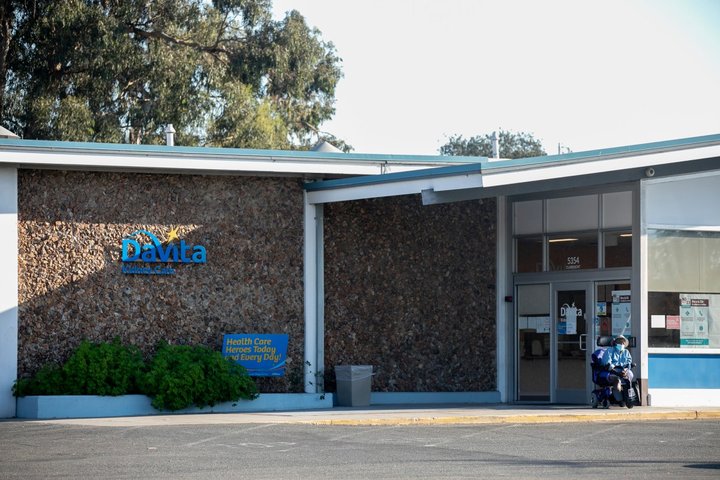
A DaVita dialysis center in Oakland is one of the company’s 320 centers in California. Photo by Anne Wernikoff for CalMatters
###
Federal conspiracy charges against dialysis giant DaVita and its former CEO have cast one of Sacramento’s biggest political spenders in an unflattering light.
The Denver-based company spent $68 million last year to defeat a union-backed California ballot measure to more strictly regulate dialysis centers — and $67 million more to defeat a similar measure in 2018.
“I wouldn’t be surprised to see some politicians give DaVita money back,” California political consultant Steve Maviglio, a leading Democratic strategist, told CalMatters. “Taking contributions from an indicted CEO is the perfect script for an attack ad. Any donation would be considered radioactive.”
The two-count federal indictment announced Thursday is unrelated to treatment of DaVita’s more than 200,000 patients at its 2,800 dialysis centers, including 320 centers in California. The U.S. Justice Department alleges that DaVita and its previous CEO, Kent Thiry, colluded with another healthcare company by agreeing not to poach the others’ employees.
If convicted of the antitrust allegations, DaVita could face up to a $100 million fine per count, and Thiry would face 10 years in prison and a $1 million fine per count. Thiry did not respond to CalMatters’ request for comment on Friday.
DaVita called the charges “unjust and unwarranted” in an emailed statement. “The government’s case relies on an unprecedented and untested application of the antitrust laws to alleged discussions involving former executives that occurred many years ago.”
With 2020 revenues of more than $11.5 billion, DaVita has long spent big money to influence California politics.
In addition to spending roughly $135 million to fight the two ballot measures, since 2011 the company has contributed about $1.3 million to the campaign coffers of more than 180 California politicians and more than $2 million to various political committees, according to data from the Secretary of State.
With 2020 revenues of more than $11.5 billion, DaVita has long spent big money to influence California politics.
The $138.3 million is more than double what DaVita’s dialysis competitor Fresenius Medical Care spent, and more than the combined political contributions of heavyweights Chevron, Uber and Facebook in California over the past decade.
Thiry, who stepped down as CEO in 2019 but remained on the company’s board until spring of 2020, personally has donated more than $154,000 to political candidates and ballot measures since 2000, according to California Secretary of State records. His LinkedIn profile now lists him as an advisor to private equity giant Kohlberg Kravis Roberts. He did not respond to a request for comment Friday.
As DaVita’s legal woes play out, will lawmakers, industry groups and lobbyists be less willing to accept the company’s money?
It’s possible, said Carmen Balber, executive director of the Consumer Watchdog advocacy group, which itself has spent about $3.5 million to influence California policy in the past decade. But she remains skeptical.
“When a company is accused of abusing both employees and labor laws to increase its profitability, and has been accused of excess profits, then every lawmaker should think twice about taking that money,” Balber said.
DaVita gave Senate Health Committee Chair Dr. Richard Pan, a Sacramento Democrat, $11,100 between 2011 and 2019, according to California Secretary of State data. He did not respond to a request for comment Friday.
Spending by DaVita and other industry players to defeat 2020’s Proposition 23 had “the force of a tsunami,” Balber said. Both the 2018 and 2020 initiatives, which would have increased regulation of dialysis centers if approved by voters, were backed by Service Employees International Union-United Healthcare Workers West (SEIU-UHW).
“It’s not impossible to win a ballot initiative fight when you’re an underdog, but the overwhelming saturation of the airwaves make it very difficult,” Balber said.
The dialysis industry characterized the ballot measures as a power play by the union to gain more bargaining power at the for-profit dialysis centers where it wants to unionize workers.
“It’s not impossible to win a ballot initiative fight when you’re an underdog, but the overwhelming saturation of the airwaves make it very difficult”. — Carmen Balber, executive director of the Consumer Watchdog advocacy group
DaVita, along with other dialysis companies, is in a legal battle with California to overturn a 2019 law sponsored by Assemblymember Jim Wood, a Democrat from Santa Rosa.
“As someone who has spent some time investigating the market behavior and practices of large for-profit dialysis companies, this does not surprise me,” Wood said in a statement. “Although my investigations have been related to how they use charitable organizations to increase profits, the theme of increasing profits at others’ expense appears to be a consistent one.”
The law, which a judge barred from going into effect, aims to end a complicated arrangement in which DaVita and its competitors increased their profits by helping pay for dialysis patients’ private insurance costs through an intermediary of patient advocacy groups. This practice was profitable for the companies because they were paid more for dialysis by private insurers than by the government’s Medicare or Medi-Cal. The case is on hold because of the pandemic.
Wood received $10,300 from DaVita between 2016 and 2018 before he introduced his bill. He declined to comment about the company’s donations to his campaign.
DaVita also donated $300,000 and $315,000, respectively, to the state Democratic and Republican parties between 2017 and 2020.
In late June, Senate President Pro Tempore Toni Atkins, a San Diego Democrat, received $30,500 from DaVita between 2003 and this year, including $8,100 donated late last month. Atkins declined to comment.
“DaVita has functionally unlimited resources,” said SEIU-UHW President Dave Regan. “I’d like to believe elected officials take a different view (after the indictment) that … we shouldn’t take DaVita’s money… But I’m sure they’ll find folks to represent them in the Capitol.”
A federal grand jury in Denver indicted the company for two violations of the Sherman Act, the nation’s antitrust law. DaVita’s alleged co-conspirator, Surgical Care Affiliates LLC and its related entity, were charged in January.
###
CALmatters.org is a nonprofit, nonpartisan media venture explaining California policies and politics.
In the evening hours of 7/17/2021 Humboldt Bay Fire responded to over a dozen calls in a two-hour period, including several medical
incidents, a major natural gas leak from a vehicle collision in to a gas service line and a separate, unrelated structure fire with
occupants inside. Humboldt Bay Fire utilized assistance from mutual aid resources to handle all of the incidents.
Although there were multiple incidents occurring simultaneously, the
first major incident of the evening was dispatched as a possible
gas leak on the 3800 Block of Erie Street. A single engine responded to investigate a possible broken natural gas line. Upon that
engine’s arrival HBF personnel discovered a car had driven in to a gas meter, severing the line causing natural gas to flow
uncontrolled from the break. The Fire Captain upgraded the response to a hazardous materials response which added an additional
engine and duty officer. The first engine evacuated nearby residents from their homes and eliminated ignition sources. Pacific Gas and
Electric personnel were notified and responded.
Once the second engine and duty officer arrived, a plan was developed for the fire crews to make entry in to the area with an attempt
to stop the leak by “crimping” the line. Fire personnel tried multiple times to access the break with tools but were unable to with the
vehicle on it. Due to the fire hazard, the vehicle could not be started and it was not safe to use a tow vehicle so close to the leaking
gas line. With additional resources on scene, personnel successfully pushed the vehicle off of the broken gas line, with nearby crews
staffing a hoseline in the event of ignition of the gas vapors. Once the line was removed Pacific Gas and Electric personnel stopped
the leak.
During the incident on Erie Street, another Humboldt Bay Fire unit was moving to a location centrally located in the jurisdiction to
provide coverage. While enroute to the coverage area, the Fire Captain of that unit noticed smoke in the area of the 3300 Block of N
Street. That unit proceeded to the area to investigate and discovered smoke coming from the attic of a three-story Victorian style
structure. Humboldt Bay Fire dispatchers simultaneously received 911 calls regarding the structure fire as the on-scene engine
requested a full structure response. With units already committed on the natural gas leak, the response was upgraded to a second
alarm. Two additional mutual aid units from Arcata Fire and Samoa Fire responded to assist on the structure fire. Humboldt Bay Fire
Dispatchers requested two more units for coverage. Loleta Fire and Fortuna Fire also responded to provide coverage for the rest of
the Humboldt Bay Fire jurisdiction, responding to multiple medical calls while in Humboldt Bay Fire’s response area.
The initial engine that discovered the fire on N Street entered the structure and evacuated all occupants. Eureka Police Officers on
scene assisted with evacuation of some occupants who were hesitant to leave. Additional arriving units attacked the fire that was
burning in the attic and ventilated the structure. Humboldt Bay Fire units had the fire controlled within 30 minutes. Several occupants
were displaced from the residence and Red Cross was requested to the scene to assist with the occupants’ lodging needs. Pacific Gas
and Electric also responded to secure utilities.
There were no injuries at the fire. The cause of the fire appeared to be a cooking fire that spread in to the attic of the kitchen area
through a ventilation duct. Damage is estimated at $50,000.
Humboldt Bay Fire wants to thank all of the allied agencies that responded to assist with these incidents. It demonstrates the
commitment of all emergency services and allied partners in the Humboldt County area.
Last Sunday,
billionaire British businessman Richard Branson flew to space. Says
so here, on the CNN website: “Virgin Galactic founder Richard
Branson successfully rockets to outer space.” Branson, along with
three Virgin Galactic employees and two pilots, climbed to about 55
miles altitude in the rocket-powered winged plane “SpaceShipTwo.”
It actually flew from about 45,000 feet after detaching from the
mothership, “WhiteKnightTwo.” After the engine shut off, the
passengers unbuckled and floated in free-fall for four magic minutes.
So why did CEO Bob
Smith of rival Blue Origin, Jeff Bezos’ sub-orbital rocket company,
tweet, two days before Branson’s historic flight, “…none of our
astronauts [will] have an asterisk next to their name. For 96% of the
world’s population, space begins 100 km [about 62 miles] up at the
internationally recognized Kármán line”? Was he saying that
Branson and company wouldn’t really be going to space?
From the beginning, New Shepard was designed to fly above the Kármán line so none of our astronauts have an asterisk next to their name. For 96% of the world’s population, space begins 100 km up at the internationally recognized Kármán line. pic.twitter.com/QRoufBIrUJ
Oh yeah. Nothing subtle
about it. Blue Origin’s New Shepard rocketship goes into space —
real space — while Virgin Galactic misses the mark by seven miles,
according to Smith. In keeping with the decade-old rivalry between
the two companies, the tweet inspired Virgin Galactic test pilot
Nicola Pecile to respond, “This pissing contest about the Karman
line is so childish that is getting really embarrassing to watch.”
The debate goes back to
1957, when Hungarian-American aeronautical engineer Theodore von
Kármán tried to define the boundary of space. Earth’s atmosphere
doesn’t, of course, abruptly end — one minute there’s air, the
next minute the vacuum of space — but rather the air gets gradually
thinner and thinner the higher you go. On top of Everest (five miles
up) you can still breathe — just — but at eight miles, about as
high as planes fly, you’d soon pass out. Kármán was interested in
defining the height at which “aeronautics” ends and
“astronautics” starts, for the purposes of international
jurisdiction: aircraft fall under a different set of laws than
spacecraft. He established the 100 kilometer “line,” later named
after him, as an arbitrary and easily remembered number, justifying
it by showing that it’s more or less the altitude at which an
orbiting satellite can survive for a long time before slowing,
descending and burning up.
Theodore von Kármán (1881-1963) at JPL in 1950. Photo: NASA.
Kármán’s hope that
100 km would head off international jurisdiction arguments hasn’t
been realized. True, in 1961 the US and former USSR agreed on it as a
way of determining where national air space ends and outer space
(free to all) begins. But it’s never been universally accepted, and
indeed NASA and the USAF define space as starting 12 miles lower, 50
miles above Earth’s surface. Meanwhile the world governing body for
aeronautic and astronautic records, the Fédération Aéronautique
Internationale (FAI), along with most other bodies outside the US,
opts for the Kármán line, 62 miles up. But whether it’s
“internationally recognized,” as claimed by Blue Origin, is
debatable.
So: did Branson reach
space? Depends. He’s a Brit, so you could argue he’s bound by
European — that is, FAI — rules. Sorry Sir Richard, no cigar, you
didn’t get above the Kármán line. But Virgin Galactic is a US
company, so, congratulations, you’re officially an astronaut. Chris
Hadfield, retired Canadian astronaut (and International Space Station
commander and troubadour)
apparently agreed, pinning
astronaut wings on Branson when he landed.
The saga will continue,
with the planned launch, this Tuesday July 20, of Blue Origin’s New
Shepard craft, the 16th flight and the first to have a crew,
including Bezos himself. No ambiguity with this one: the planned
altitude is 105 km. That’s five kilometers — three miles —
above the Kármán line. You know, space.