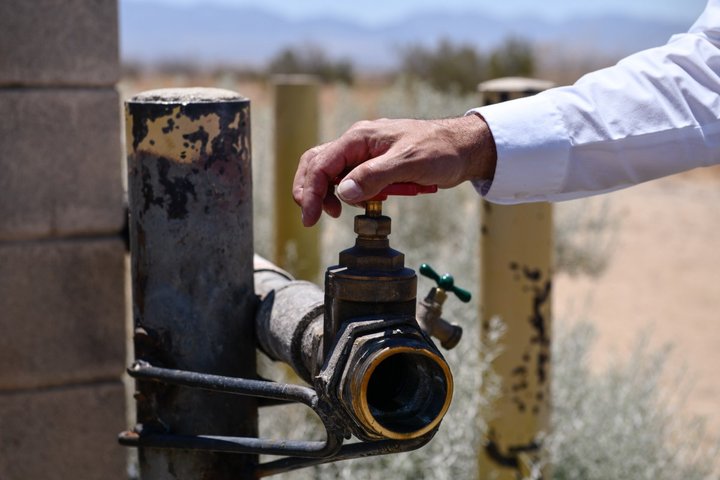
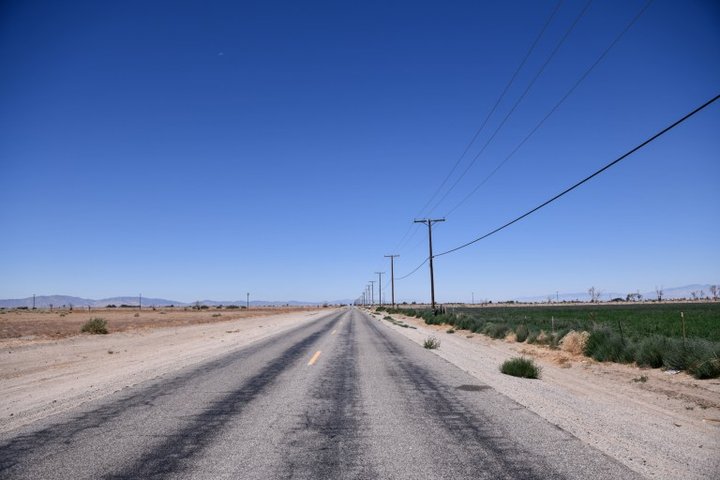
Thieves break into water stations that provide water to California’s rural residents, like this one in Lancaster, located in Los Angeles County’s Antelope Valley. Photo by Pablo Unzueta for CalMatters
###
As drought grips most of California, water thefts have increased to record levels. Thieves tap into hydrants, pump water from rivers and break into remote water stations and tanks.
One day last spring, water pressurein pipelines suddenly crashed In the Antelope Valley, setting off alarms. Demand had inexplicably spiked, swelling to three and half times normal. Water mains broke open, and storage tanks were drawn down to dangerous levels.
The emergency was so dire in the water-stressed desert area of Hi Vista, between Los Angeles and Mojave, that county health officials considered ordering residents to boil their tap water before drinking it.
“We said, ‘Holy cow, what’s happening?’” said Anish Saraiya, public works deputy for Los Angeles County Supervisor Kathryn Barger.
It took a while for officials to figure out where all that water was going: Water thieves — likely working for illicit marijuana operations — had pulled water from remote filling stations and tapped into fire hydrants, improperly shutting off valves and triggering a chain reaction that threatened the water supply of nearly 300homes.
As drought grips most of California, water thievery across the state has increased to record levels. Bandits in water trucks are backing up to rivers and lakes and pumping free water they sell on a burgeoning black market. Others, under cover of darkness, plug into city hydrants and top up. Thieves also steal water from homes, farms and private wells, and some even created an elaborate system of dams, reservoirs and pipelines during the last drought. Others are MacGyvering break-ins directly into pressurized water mains, a dangerous and destructive approach known as hot-tapping.
InMendocino County, the thefts from rivers and streams are compromising already depleted Russian River waterways. In one water district there, thefts from hydrants could compromise a limited water supply for fighting fires, which is why they have put locks on hydrants.
“Any way that you can imagine that somebody is going to grab water, they’re doing it,” said Mendocino County Sheriff Matt Kendall. “For goodness sakes, everybody knows what is going on.”
“Any way that you can imagine that somebody is going to grab water, they’re doing it.” — Matt Kendall, Mendocino County Sheriff
It’s as predictable as a dreary economics lesson: When a commodity becomes scarce and demand soars, it’s worth stealing.
Officials say water thefts are increasing at about the same rate as the decline in California’s water supplies. Complaints have risen sharply this year, mirroring the drought’s inexorable advance.
Halfway through this year, 125 Californians have reported thefts to state authorities, more than twice as many as a decade ago. Those numbers don’t capture calls to local officials or small water districts that shoulder the bulk of enforcement responsibility.
The water thefts not only strain police agencies but also damage valuable equipment. In the Antelope Valley, water main breaks, which can cost $10,000 each to repair, had been averaging about two a year. In the past year, there have been a dozen, Saraiya said.
Water users are now proactively protecting their supplies. Many fire hydrants are being locked or removed altogether. Water tank owners have installed security cameras. In rural areas, residents who have no access to municipal water systems and rely on key-activated water stations are finding their critical lifelines are shut down because of incessant tampering. A robust black market for the keys has popped up, and now most stations operate only during daylight hours.
In the Antelope Valley city of Lancaster, impound yards are hosting growing collections of confiscated water trucks. In one area, fire authorities removed 100 of the area’s 176 hydrants deemed not essential to public safety. Remaining hydrants were fitted with locks.
No cache of water is safe. During the last major drought, businesses, schools and even a fire station were victims of water theft. In 2014, thieves pumped water from storage tanks belonging to the North San Juan Fire Protection District in Nevada County, in the mountains northeast of Sacramento.
“I came to the station one morning and there was a big wet spot,” said Boyd Johnson, the district’s former battalion chief. He said the water was taken for several weeks until they locked the system. “We share that water with CalFire, and, obviously, water was critical to firefighting.”
California’s water and weed
The most-common culprit of water theft: illegal pot farms. While farmers, ranchers and licensed marijuana growers scramble to obtain water through legal channels, clandestine operations are stealing it or purchasing it from illicit trucks.
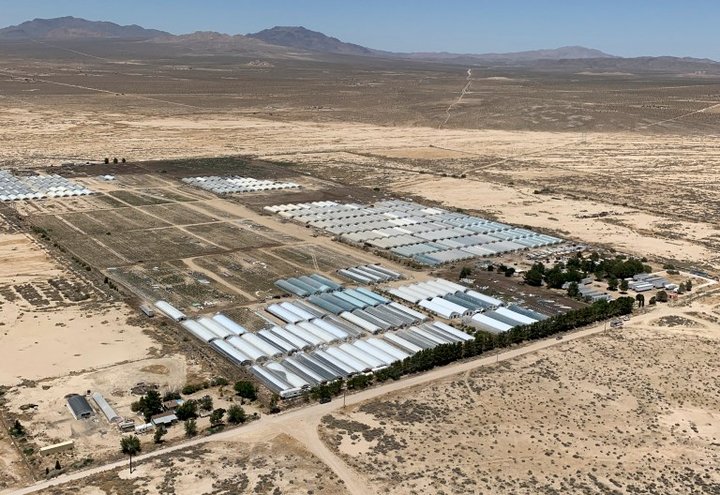
In the Sierra Nevada, as many as 4,000 illegal grow sites are operating in Nevada County, according to county estimates. In the Antelope Valley, illegal grows have doubled from 200 last year to 400 today, according to county data, while other estimates put the number in the thousands.
While the vast desert affords a degree of privacy to pot operations, it lacks a critical component to growing things: water. One cannabis farmer near Lancaster bought a house simply to run a garden hose across the desert to his illegal grow site. Officials shut off the line, but the ever-resourceful thieves tapped into another underground line and kept watering their plants.
Officials say some illegal marijuana cultivation sites in California are expansive, like this one in San Bernardino County. Photo courtesy of San Bernardino County Sheriff’s Department
“Most Californians would be shocked and disappointed at the amount of water these unlicensed, illegal grows are using, especially as California suffers from a drought,” Curt Fallin, a federal Drug Enforcement Agency agent, said during a recent news conference. “By our calculation, the illegal grows in Los Angeles, Riverside and San Bernardino counties require an astounding 5.4 million gallons of water a day, every day.”
That’s enough water for 72,000 people, almost half the population of Lancaster, which is so water-short that the city imposed temporary restrictions on lawn sprinklers last month.
With climate change driving longer and more severe droughts around the globe, researchers last year estimated that as much as half the world’s water supply is being stolen every year, citing statistics gathered by the United Nations and Interpol in Europe.
Whack-a-mole in the Mojave
On a recent hot July day, Charles Bostwick, an assistant field deputy for county Supervisor Barger, piloted his Jeep down mile after mile of dusty roads in the Antelope Valley, past dozens of cannabis grow sites.
Stark white “hoop houses” rise from the flat desert floor. When lit at night, the compounds cast an eerie glow. Operators make little effort to hide the sites, which are littered with trash baking in the Mojave Desert sun and guarded by armed men. Scattered along the road to one site was a porcelain toilet, plastic chairs and a coiled garden hose. Bulldozed Joshua trees lay in haphazard piles. The fender of a rusting truck was spray painted “out” and next to it was another one with “keep” scrawled on the side.
A recently raided marijuana farm in the desert near Lancaster is littered with debris. The illegal operations are straining water supplies in California’s Antelope Valley. Photo by Pablo Unzueta for CalMatters
Bostwick drove up to a grow that was recently raided and razed in a multi-agency bust. The thieves were nothing if not industrious: Not only had another marijuana compound sprouted across the rutted road, complete with a water tank and a large RV, but the just-destroyed site was in the midst of rapid rebuilding.
“We bust them and they move somewhere else and begin again,” Bostwick said. “It’s a non-stop game of whack-a-mole.”
He said drought is accelerating water theft in the already water-stressed region.
“We have no water to spare and our farmers are making do with less,” Bostwick said. “We never had water thefts here (in the Antelope Valley) two years ago. A homeless guy climbing over the fence of a trailer park and filling his five-gallon jug in the laundry room — that was our water theft.”
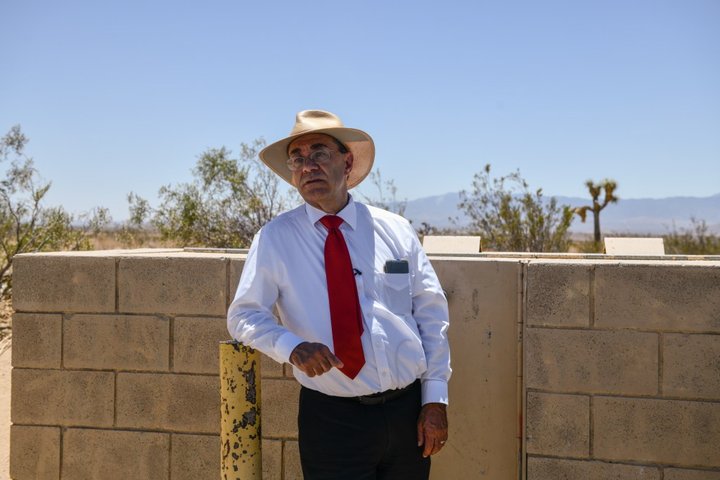
Charles Bostwick, a field representative for Los Angeles County Supervisor Kathryn Barger, stands near a water station that had been broken into in Lancaster. He said stolen water was not a problem during the last drought. Illegal marijuana operations are responsible for many of the thefts, he said. Photo by Pablo Unzueta for CalMatters
Law enforcement officials around the state are employing satellite imagery and drones in high-tech stakeouts to track water diversions. But the thieves are brazen, no longer confining themselves to nighttime water raids. Los Angeles County supervisors have allocated more than $250,000 for enhanced sheriff’s patrols, hunting for water trucks.
But, again, the thieves are a step ahead. When it became clear that law enforcement was on the lookout for suspicious water tankers, thieves shifted to putting 275-gallon water cubes in the back of their pickups or on trailers. More recently, they have taken to renting U-Haul vans to hide their cargo. Any conveyance with space to carry is put to work: Bostwick said someone in the area is driving around an old fire truck, and another guy is using what appears to be a converted airline fuel tanker.
The jerry-rigged water haulers are dangerous and road accidents are common, Bostwick said. A cube containing 275 gallons of water weighs a ton. Lashing such a heavy and easy-to-shift cargo on trucks can cause it to tip over. In May, the driver of a pickup truck hauling a water cube died after he lost control on a two-lane road near Lancaster and ran head-on into a semi tractor-trailer.
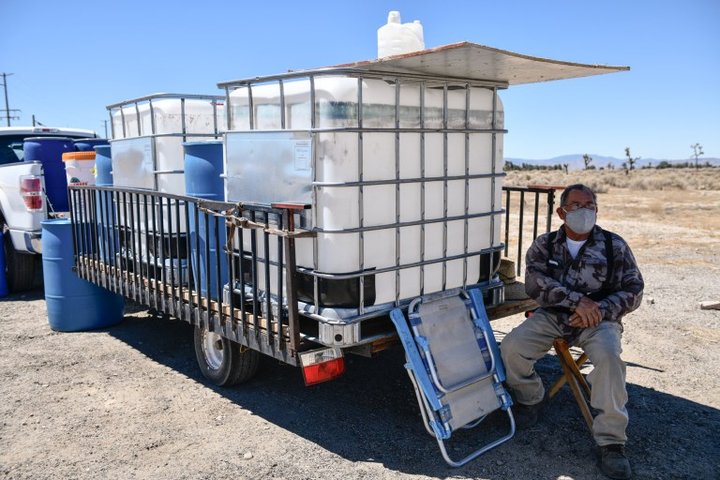
Everyone seems to be in the water business. Jose Huerta set up shop from his pickup at a remote desert crossroads, selling empty 55-gallon water drums for $55 and water cubes — stout plastic containers surrounded by a metal cage — for $100. Business is brisk, he said, adding that he doesn’t ask what his customers do with the containers. “Everyone needs water,” he said.
José Huerta, a Lancaster resident, sells large water containers for $100 each. “A lot of people don’t have water (in this city),” Huerta said. “So people buy these water containers to store more water.” Law enforcement officials, however, say thieves use some of the tanks to store stolen water. Pablo Unzueta for CalMatters
Some take a more direct approach. Locals in the Antelope Valley report high-pressure tactics to sell land for the wells or water rights.
Gailen Kyle grows alfalfa in the arid desert on a farm he works with his wife, Julie. Their home is surrounded by illicit pot operations, which he finds both frightening and frustrating. He’s had intimidating characters come to his door pressuring him to sell out, he said, and other farmers are already reporting that illegal over-pumping is lowering production in their wells.
“I have zero water, all we have is wells,” said Kyle, whose water allocation has been reduced by 50% this year. “They cut my water and these marijuana grows are operating on stolen water. They are getting water from all over and watering hundreds of acres. This is anarchy.”
For those without wells, the problem is more acute. In Lancaster, at a water district parking lot, a water station that supplies residents was in disarray. Scraped and gouged, an armored door appeared to have been opened with a screwdriver rather than a key. A fire hose lay uncoiled on the asphalt, damp and limp.
The water station had been targeted by thieves so often that authorities shut it down. Its digital readout blinked: “Port has been disabled by host.”
Lax penalties and intimidation
The increase in water theft has exposed not only the vulnerabilities in the state systems to secure water, but also the complications of enforcing laws with penalties that no longer reflect the seriousness of the crime.
Authorities in California say they are working with limited tools to understand and combat the problem. In 2018 California law legalized recreational marijuana use by adults, and reduced penalties for cultivation of large quantities of pot from a felony to a misdemeanor. So law enforcement officials say it’s difficult to prosecute water theft for illegal grows because judges are circumspect about issuing search warrants for a low-level crime.
“I don’t mean to be rude, but the state is taking the word ‘criminal’ out of the dictionary,” said Marina West, general manager of the Bighorn-Desert View Water Agency, which serves about 2,000 customers north of Palm Springs.
“We’re here to provide water to this community, we’re not here to provide cheap water to an illegal business that’s making millions of dollars.”
Another impediment to more robust reporting and enforcement: intimidation. According to Kyle, the Antelope Valley farmer, one of his neighbors was shown a photograph of a bullet-riddled truck and warned by an alleged cartel member that it could be her fate if she made official complaints about the illegal cannabis sites. Growers monitor and routinely photograph anyone coming near their operations.
Two managers of Southern California water agencies backed out of interviews with CalMatters, saying they were afraid that going public with information about water theft would put their employees at risk.
A field fallowed due to drought conditions in Lancaster is across a road from an alfalfa field. Photo by Pablo Unzueta for CalMatters
The state Water Resources Board, which has a modest cadre of 80 investigators who track water diversion and theft from California’s rivers and streams, cannot begin to keep up with the epidemic of stolen water. Nor is the agency’s $1,000 a day fine for water theft proving to be an effective deterrent to offset the rewards for a multi-billion dollar criminal industry.
After the last drought, in 2018, state officers found nearly 1,000 water rights violations and imposed more than $1 million in fines. Last year, inspection work was severely curtailed because of the pandemic.
“What we are recognizing is that water scarcity is the new norm. It’s offensive to see water go to support this illegal industry when legal industries are struggling for water,” said Yvonne West, the water board’s director of enforcement.
West’s department keeps an eye on 5,000 legal marijuana cultivators, but an estimated 25,000 are operating illegally “outside the program.” The imbalance keeps state enforcement efforts on a constant back foot.
“The numbers speak for themselves,” she said.
“We’re here to provide water to this community, we’re not here to provide cheap water to an illegal business that’s making millions of dollars.” — Marina West, Bighorn-Desert View Water Agency
Local authorities are seeking more control. Last week, the Los Angeles County Board of Supervisors, fed up with water theft and their lack of authority to address it, passed a resolution to petition state legislators to give them power to prosecute water theft, especially during severe droughts. Other counties are either considering similar actions or, like Siskiyou, have already called on Sacramento for help.
“As the state enters another potential drought emergency, we need to ensure that this new activity does not further exacerbate water scarcity,” said Barger, who co-authored the Los Angeles County resolution.
A model from Down Under
As California officials lament the lack of legal teeth to prosecute water thieves, they can find an enforcement model in Australia, the planet’s driest inhabited continent.
Illegally siphoning of the Murray and Darling rivers, which irrigate crops and livestock in Australia’s agricultural heartland, was until a few years ago common — and commonly overlooked. Fruit, grain and cotton growers operated massive pumps at will, often pulling out many times more water than legally permitted and drawing down the river during droughts.
The powerful growers stole water “with no fear of sanction,” said Grant Barnes, chief regulatory officer for the New South Wales’ natural resources department. “There were more parking wardens in a town in New South Wales than regulators in the entire state.”
Barnes estimated that tens of billions of dollars worth of water was being stolen. But Australian authorities had little understanding of the volumes pumped illegally because farmers often removed or tampered with meters. “You can’t manage what you don’t measure,” Barnes said.
That changed in 2018 when the new agency led by Barnes clamped down with a large enforcement team backed by fines and the threat of revocation of water licenses. In their three years on the beat, the new water cops — about 100 inspectors and other staffers — have prosecuted 31 cases, compared to 8 in the previous 17 years.
Farmers were told “no meter, no pump.” An accurate meter connected to the state system was mandatory before water could be pumped out of rivers.
The New South Wales team employs satellite images, drones, remote-controlled watercraft and software that compares what’s growing on farms with their legal water allocation.
“To steal water, to make it economically viable, you have to take vast volumes and you have to store it. By virtue of that storage you make yourself open to satellite technology,” Barnes said. “Now you can’t hide it.”
###
CalMatters’ Rachel Becker contributed to this report. CALmatters.org is a nonprofit, nonpartisan media venture explaining California policies and politics.
A dispute has arisen over tax returns submitted by conservative talk show host Larry Elder. Secretary of State Shirley Weber said his documents were not submitted properly and so she left him off the ballot. Elder announced Monday that he’s suing to get on the ballot.
“I will not stand for these shenanigans, and I know you won’t either,” he tweeted, asking for campaign donations.
A Larry Elder supporter holds a sticker in Norwalk on July 13, 2021. Photo by Pablo Unzueta for CalMatters
Newsom’s spokesperson said the governor submitted five years of tax returns, the same records he’s allowed reporters to review in the past. Weber’s office is not publishing them, however, because Newsom is not technically a candidate on the recall ballot.
But she has published tax returns of the candidates hoping to replace Newsom. Here’s what we’ve learned from reviewing them:
Even though Cox reported receiving more than $1 million that year from apartments and other investments he owns, he reported losses of more than $2 million. His charitable donations included stock shares to the Rescue California Education Fund — and use of his jet.
The end result was $294,000 in deductions and $279,000 in adjusted gross income, so no federal tax obligation.
In 2018, Cox reported an adjusted gross income of $910,105 and paid $11,654 in taxes — an effective tax rate of about 1.3%.
In 2017 and 2016 — before the tax cut pushed through by then-President Trump and the Republican Congress — Cox had to pay the alternative minimum tax, so he wasn’t able to reduce his bill as much through various deductions.
Public servants, boring returns
Some current and former elected officials on the ballot submitted rather pedestrian tax filings.
Republican Kevin Kiley’s taxes were fairly straightforward. His salary since he began his state Assembly term in 2017 has remained steady around $100,000. Prior to that, he reported income as a contract attorney. In 2020, Kiley reported net profit from a cattle business of $1,436.
As mayor of San Diego, Republican Kevin Faulconer and his wife Katherine Stuart reported combined adjusted gross incomes ranging from $142,609 in 2016 to $358,119 in 2019. Stuart was the primary breadwinner as president of Restaurant Events, Inc., a company that plans block parties and other events. Faulconer reported around $70,000 in wages from the city of San Diego.
GOP Board of Equalization member Ted Gaines had the most complex filings among the elected officials. He and his wife Beth Gaines run an insurance business and own numerous rental properties. In 2020, they reported wages from the state of California of nearly $106,000, earnings from the Gaines Insurance Agency of $172,000 and income from their rental properties of nearly $136,000. However, after expenses and deductions, their adjusted gross income was about $241,000. They paid a little more than $31,000 in federal taxes last year. The couple’s adjusted gross income in 2019 was $405,000, up from $311,000 in 2018.
Caitlyn Jenner, international brand
While Caitlyn Jenner is reportedly in Australia to compete in “Celebrity Big Brother,” she reassured the public on Twitter that there would be “no pause at all on this race to save CA.”
Her multinational presence while campaigning is a reflection of her taxes: Over the last few years, Jenner has paid taxes not only in the U.S., but also to Australia, Greece and Indonesia in 2019, as well as to the United Kingdom and Ireland in 2018.
Caitlyn Jenner, a Republican candidate in the Gavin Newsom recall election, speaks to reporters at the Hyatt Regency in Sacramento on July 9, 2021. Photo by Marissa Garcia for CalMatters
She hasn’t yet filed her 2020 taxes, but her filings since 2016 show a mix of business income, and her earnings from rental real estate, partnerships and royalties. In both 2019 and 2018, Jenner’s total income amounted to more than $500,000, a drop from the $1.94 million she reported in 2017 and $2.52 million in 2016, which was likely fueled by the publishing of her memoir in 2017.
She has also claimed tax deductions for gifts and charities, including the donation of a 2011 Porsche to her foundation.
California caricatures
California, the land of opportunity. Want to make billboards of yourself driving around in your Corvette? Want to lead a sanctuary for spiritual enlightenment and holistic healing? Anything is possible here — with the right tax accountant.
Angelyne, a SoCal billboard icon, and Holly Baade, a Marin County shaman and yoga teacher, are two of the most eccentric gubernatorial candidates. Both of them reported negative adjusted gross incomes last year (due to business losses), received unemployment benefits and owed no federal taxes.
Baade, a Democrat, reported $51,000 in sales and $150,000 in expenses related to her center that offers tai chi, meditation, shamanic healing and ayurvedic therapy. She also reported nearly $21,000 in unemployment payments.
Angelyne, who has no party preference, reported $28,200 in unemployment compensation. Known for plastering her image on Los Angeles billboards, the one-named personality reported nearly $360,000 in business expenses, including $7,800 for costume supplies and more than $58,000 for 102,000 miles on her three Corvettes.
Slammed by COVID recession
Like many Californians, some average folks on the ballot got hammered financially by the pandemic-related economic crisis.
Heather Collins, a Playa del Rey hairstylist, reported $93,294 in income from her business in 2019. But last year, that income plummeted to $16,504, and she collected $15,450 in unemployment benefits.
David Bramante, a Calabasas real estate agent and developer, reported that his business income dropped from $127,485 in 2019 to $74,983 in the coronavirus year of 2020. And David Lozano of San Marino, a former deputy sheriff, and his wife said they made $68,330 from real estate in 2019, but lost $67,289 in 2020 and collected more than $23,000 in unemployment.
But others capitalized on the soaring stock market. Major Singh, a software engineer, reported $540,000 in capital gains for 2020, compared to $132,300 in 2019.
Taxes go beyond politics
Liberal and conservative activists among the candidates may have different political views. But some of their tax returns show them to be more alike financially.
Michael Loebs of San Francisco is an organizer with the California National Party, which advocates for universal basic income and single-payer health care. Sarah Stephens is a Riverside County pastor who has held events calling for the reopening of the state during the pandemic. They both make far less than the median household income of $80,440 a year.
In 2020, Loebs reported wages of $32,510 and federal taxes paid of $2,230. In 2020, Stephens and her husband made $49,452 and paid taxes of $2,530, but claimed an earned income credit of $1,552 and child tax credits of $7,000.
Meanwhile, former labor leader Joel Ventresca, a San Francisco Democrat, and Chauncey “Slim” Killens, a Republicanpastor from Hemet and supporter of former President Trump, get by mostly on pensions and other retirement earnings.
In 2020, Ventresca reported $76,495 from pensions and $25,015 in Social Security. Killens and his wife said they received $64,974 from pensions and $11,444 from Social Security last year.
Of the 41 candidates on the ballot, two — Democrat John Drake and Republican Nickolas Wildstar — didn’t have to file federal tax returns.
###
CALmatters.org is a nonprofit, nonpartisan media venture explaining California policies and politics.
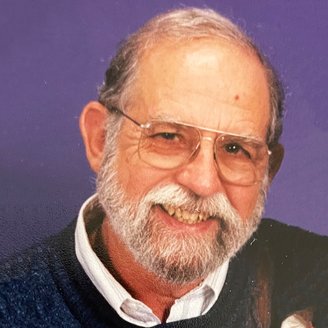
Dorvin
Valgene Phillips, better known as Valgene Phillips, sorrowfully
departed from us on the evening of June 2, 2021. He was a loving
father, husband, good friend to countless many, elder counsel
to many others. Always compassionate and caring, Dad put others
before himself, a direct product of his upbringing and deep religious
faith. He was ever the source of strength and wisdom.
Born
in Butler, Oklahoma, on September 27, 1935, to Lydia Lorene and
Dorvin Oscar Phillips, he was the eldest of five
children, and first-born of many cousins. His family moved to
Bakersfield when Dad was two, and later to San Francisco.
He was a junior at Lowell High when his family moved to Salinas,
where Dad found a group of musical students who would become lifelong
friends.
Having
come from humble beginnings, his family had little or no money. He
was a child of the Dust Bowl years, when many thousands, including
his family, made the great migration west to California, carrying
everything they owned. With this background, he developed a strong
sense of family, and grew to be a model father and family man,
providing for the needs of his children, never complaining, always
keeping the family unit together, doing things and going to places
families go, helping develop the close, loving relationship we
continue to share, along with our mother, Gerre Lyn, his former wife
and life-long friend, fellow musician and accomplished violinist.
He
attended San Francisco
State College, and graduated from San Jose State College with a BA in
music. From the late ‘50s into the ‘60s Dad juggled a career
teaching music, raising a family and
completing his master’s degree, all the while serving in the National
Guard on many weekends and two full weeks each summer at Camp
Roberts.
From
the moment his younger brother was born, Dad was destined to be the
one to lead, blaze the trail, and find the answers. It was a huge and
often daunting responsibility, but one which he performed with
universal admiration. He just did what he knew to be right. That was
his nature — do the right thing. And he was never afraid to so
because he knew God would be with him to show him the way. He learned
the Gospels at an early age, playing piano in church. He knew all of
the popular hymns by heart, having directed many church choirs. Dad
developed early on a love of music, and taught it for over 40 years
to young and old alike. He became the consummate professional
musician and French Horn player and gave countless hundreds of horn
lessons. Band director, choir director and orchestra conductor, he
also added two full opera productions to his repertoire. Dad played
in several symphony orchestras over the years, including Humboldt,
Eureka, Peninsula, Rogue Valley, Los Gatos-Saratoga, San Jose, and
Lake County. To improve his own musicianship, he attended the
international horn festival twice here in California, and his
children can attest to the many, many hours he spent practicing to
“keep the embouchure up.”
In
his earliest years at Humboldt State University, he was instrumental
in getting the Marching Lumberjacks up and running and implementing
the jazz music program. He attended hundreds of student recitals, and
eventually served two separate terms as department chair. But Dad’s
academic pursuits took him far beyond the scope of the music
department at HSU. He occupied positions from student teacher advisor
in the Education Department, to two years as Multiple Subjects
Coordinator, and prior to retirement, took a position as Associate
Dean of the College of Creative Arts and Humanities, moved on to
Acting Vice-President for Academic Affairs, and finally Dean of
Undergraduate Studies.
He
is well-known for his many years as the Director of the Humboldt
Chamber Music Workshop, with which he became
heavily involved, first as participant, then coach, associate
director and finally director.
He eventually started the Brass Chamber Music Workshop at Humboldt
State as well. Musically, Dad also performed in two Humboldt Light
Opera productions, and if you knew him you would smile to know that
he played Charlie Cowell in The Music Man. He also performed with
numerous brass and woodwind quintets, both locally and regionally. He
frequently reunited with his former Los Gatos Woodwind Quintet
colleagues during the annual HCMW, and remained close friends with
them all.
Throughout
his adult life, Dad contented himself with musical composition and
arrangement. His favorite material to work with was the arrangement
of spirituals and hymns. He worked closely with Nathan Smith, a
fellow professor at HSU, and gifted singer of gospel music. Together
they created a small ministry using Nathan’s voice and Dad’s
piano playing to preach regionally.
While
Dad’s world was music, he was also visual, and busied himself with
many projects around the house, and even dabbled in construction,
woodworking, as well as automotive and appliance repair. He also
loved Giants baseball — well, he loved baseball, period. That was
one game he taught us all.
Throughout
his career, dad
received many awards of recognition for his achievements and
contributions in music and instruction. He also received a medal for sharpshooter in the Army National Guard. We were impressed that he
had learned to shoot a bazooka while being trained in heavy weapons!
He received the North Coast California Music Educators Association
Outstanding Administrator Award and served as President of the North
Coast CMEA. He composed two processional marches for ceremonial use
at HSU, “Light and Truth” and “Light and Truth No. 2”. He was
instrumental in founding the Chamber Players of the Redwoods and was
awarded the Floyd Glende Award by CPOTR in 2017. He was also involved
with the Scotia Band.
Most
recently Dad had been working with the the All Seasons Orchestra. In
2014–2015 Dad served on the Humboldt County Grand Jury, which he
enjoyed immensely and took very seriously. He had also been a
dedicated member of the Compassionate Friends grief counseling group
ever since the unexpected passing of his oldest son, Tom.
In
1995, Dad married his wife of 26 years, Joan Sikkens. They had years
of happy times together
– bird-watching
and walks and pets and movies and church, but especially their
musical partnership. Joan sang, and Val played for her on the piano.
He was a fine pianist, but in truth, he didn’t like to play “all
those notes on the page,”
and
much preferred playing the “changes” or the chords. It was a good
thing, too, because almost everything had to be transposed downward
for Joan’s voice. Over the years, they did weddings and funerals,
private parties, Red Lion brunches, the Eureka Inn, Christmas
get-togethers, non-profit fundraisers, museum openings, and churches,
and more churches.
Dad
was preceded in death by his oldest son, Thomas Mark Phillips, his
sweet loving sister, Lorna Joy, and his much-loved niece, Jennifer
Sue Mesquita. He is survived by his former wife, Gerre Lyn Phillips,
and wife Joan Sikkens, and four children, Meredyth Renee Phillips,
Matthew Christian Phillips, Mona Lyn Phillips-Barham (Ty Barham) and
Melinda Sue Skaggs (Cliff Skaggs), his grandchildren Cody Thomas
Green, Timothy Valjean Skaggs, and Gerelyn Jean Skaggs, his brother
Don Ivan Phillips (Dorly) and his sisters Sonja Sue Phillips, and
Frances Leonora Brewer (Howard).
A
memorial service is being held on July 24at
Eureka First Presbyterian Church at 1
p.m. There is a second memorial service being held on September 25
with a formal ceremony in the morning at First Covenant Church in
Eureka. A separate celebration
of life
will be held at the Rose Garden at Redwood Acres at 1 p.m. on that
same day to allow the March Lumberjacks band to attend and play for
Dad. Since it is near his birthday, it is in honor of that as well.
###
The obituary above was submitted on behalf ofValgene Phillips’ loved ones. The Lost Coast Outpost runs obituaries of Humboldt County residents at no charge. See guidelines here.
Jamison Sequoia Sullivan passed away at UCSF Children’s Hospital, in his mother’s arms, one day before turning 4 months old on July 5, 2021. Jamison has greatly impacted our hearts, despite the short time we got to spend with him.
Jamison was born March 6, 2021 to Alora Sullivan, as her first and only child. Alora’s labor was scheduled to be induced that day at 8 p.m. — 38 weeks gestation. Jamison had other plans! He came naturally at 7:32 p.m. They hardly made it to the hospital in time after being stuck in Bay Area traffic. Jamison was born healthy — 5 pounds 10 ounces, 18.5 inches long. Jamison was so sweet, happy, and loving. One of his favorite things was to sing songs like the itsy bitsy spider while he watched his mom’s hands tell the songs story.
Despite having Down Syndrome, Jamison was strong and smart too. He was hitting milestones like rolling and cooing. Unfortunately, Jamison was born with a heart defect that required open heart surgery on July 1, 2021. His heart defect was different than the doctors had seen before. A couple days prior to Jamison’s passing, his mom talked to him and touched his feet. In response, he wiggled his toes, moved his head, and opened his eyes to peek at her as if saying his sweet goodbyes. On July 5, 2021, at around 1 p.m. Jamison had a brain bleed which the doctors could not fix. Alora cleaned him up, took the stickers off of his head and chest, wrapped him in his blanket, held him, sang to him, got foot and hand, prints and casts, cut and saved some of his soft strawberry blonde hair, and said her last goodbyes. His machine was then turned off and he was cremated.
Some of Jamison’s ashes will be spread at beautiful beaches, rivers and next to a big beautiful sequoia tree, in his honor.
Jamison is survived by his mother Alora Sullivan; grandparents Jamey and Shannon Sullivan; aunties Serrina Smith and Andrea Porter; great-aunt Suzanne Lawrence; great-uncles Billy Lawrence and Todd Sullivan; great-grandmothers Cherri Stockton and Karen Sullivan; great-grandfather John Pound; cousins Billy, Cash, Bastion, Sterling, Fern, Azariah, Lyla, Granger, Skye, Jordan, Dakota, William and Jessica.
Jamison is preceded in death by his great-grandfathers Papa Jim Sullivan, Craig Smith and grumpy Jim Woolbert; and cousins Chelsea Lawrence and Noah Sullivan.
There will be no services.
###
The obituary above was submitted on behalf ofJamison Sullivan’s loved ones. The Lost Coast Outpost runs obituaries of Humboldt County residents at no charge. See guidelines here.
Dr.
Howard Edwin Biggs Jr. passed away peacefully in his sleep June 14,
2021 at the age of 88.
Howard
was born April 11,1933 in Toledo, Ohio and spent his early childhood
in Toledo. The family moved to California in 1946 when he was 13.
They lived in various locales (Santa Cruz, Malibu, Aptos) before
settling in San Leandro. Howard attended Santa Cruz High and
graduated from Hayward Union High in 1951.
After
high school Howard attended Stanford University, graduating in 1955.
While attending Stanford Howard met Jeanne Stoney whom he married in
1954. They moved to Buffalo, New York so Howard could attend Medical
School for a year and then moved back to California to finish Medical
School, graduating from UCSF in 1960. He continued his Medical
Education in the U.S. Air Force, where he was honorably discharged
with the rank of Lieutenant Colonel. During the early Air Force years
Howard and Jeanne had four sons, all of whom survive him.
He
had many assignments including McChord AFB in Tacoma,Washington where
he was the Flight Surgeon for the 318th Fighter Interceptor Squadron
and joined an elite group in flying beyond Mach 1, the speed of
sound. He saw active duty in Vietnam in 1971-1972, stationed at Cam
Ranh Bay. After Vietnam, Howard practiced radiology at Queen of
Angels Hospital in Los Angeles, eventually settling in Eureka in
1974. He worked at both St. Joseph’s Hospital and Mad River Community
Hospital as a radiologist, retiring in 1993. Known for his bedside
manner, Howard was well respected in the medical community.
In
1984 he married Lydia Ball, to whom he remained married until his
death. Howard enjoyed music, gardening, travel, flying and the S.F.
Giants.
Howard
was preceded in death by his parents Howard Edwin Biggs Sr. and
Geneva Scharer Biggs.
He
is survived by his sister Sharon McPherson of Oakland, California;
his brother, Gerard (Julie)
Biggs
of Valparaiso, Indiana; his wife Lydia Marie Biggs of Orleans,
California; sons Larry (Beverly) Biggs of Arcata, California; David
(Barbie) Biggs of Lake Havasu, Arizona; Jeffrey (Sandi) Biggs of
Camarillo, California; Ken (Elaine) Biggs of Vancouver, Washington;
grandson Jonathan Biggs of San Diego, California; granddaughter Erica
(Dale)
Hancock
of Fortuna, California; grandson Julian Biggs of Vancouver,
Washington; and four great-grandchildren; Dale III, Addelyn, Dash and
Crew Hancock.
He
is also survived by sisters-in-law Linda (Chaz)
Erickson, Debbie Ball, and Tina (John)
Ball.
A
private family celebration of life will be held at a time and place
to be determined later. In lieu of flowers, donations can be made to
the National Republican Party or a charity of your choosing.
###
The obituary above was submitted on behalf ofHoward Biggs’ loved ones. The Lost Coast Outpost runs obituaries of Humboldt County residents at no charge. See guidelines here.
Press release from the Humboldt County Sheriff’s Office:
On July 16, 2021, at about 4:57 p.m., Humboldt County Sheriff’s deputies were dispatched to a business the 1700 block of Myrtle Avenue, in the county’s jurisdiction of Eureka, for the report of an infant left inside of a vehicle unattended.
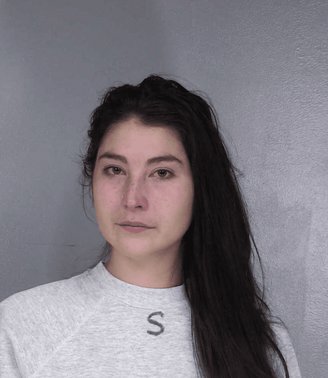
According to the reporting party, the infant had been found alone in the vehicle with the doors locked and the windows rolled up. Deputies arrived on scene and contacted the reporting party, who had gained access to the vehicle and was attending to the infant. Deputies also located the mother of the infant nearby, 25-year-old Jasmine Sadie-Aileen Sheets.
During their investigation, deputies learned that Sheets had left the infant in the vehicle and entered the business to consume alcohol. The infant was left unattended in the vehicle for approximately 1-2 hours.
Sheets was arrested and booked into the Humboldt County Correctional Facility on charges of child endangerment likely to produce great bodily harm or death (PC 273a(a)).
The infant was placed into safe custody.
Under California Vehicle Code Section 15620, it is illegal to leave a child under six years old in a vehicle without proper supervision where there are conditions that present a significant risk to the child’s health or safety. Children should never be left unattended or be able to get inside a vehicle.
Even on mild or cloudy days, temperatures inside vehicles can reach life-threatening levels. On a 70-degree day, the inside of a parked vehicle can reach up to 113 degrees in just one hour. Rolling down a window does little to keep it cool. Heatstroke fatalities have occurred even in vehicles parked in shaded areas and can occur in temperatures as low as 57 degrees.
This case is still under investigation. Anyone with information about this case or related criminal activity is encouraged to call the Humboldt County Sheriff’s Office at (707) 445-7251 or the Sheriff’s Office Crime Tip line at (707) 268-2539.
Press release from the Humboldt County Sheriff’s Office:
On July 17, 2021, at about 1:47 a.m., Humboldt County Sheriff’s deputies on patrol in the area of U.S. 101 and Central Avenue near McKinleyville observed a vehicle traveling with a suspended registration.
Henry Calvin Aubrey III. | HCSO
As deputies attempted to conduct a traffic stop on the vehicle, the driver of the vehicle failed to yield and continued driving on U.S. 101, exiting at Murray Road. Deputies pursued the vehicle to Windy Road, where the driver eventually yielded.
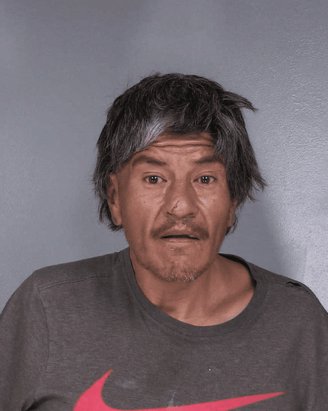
The driver was identified as 52-year-old Henry Calvin Aubrey III. Aubrey was found to have a suspended license and to be on probation with a search clause. During a search of Aubrey incident to arrest, deputies located three concealed throwing knives and over 14 grams of methamphetamine.
Aubrey was booked into the Humboldt County Correctional Facility on charges of carrying a concealed dirk or dagger (PC 21310), driving under the influence of alcohol (VC 23152(A)), attempt to evade a pursuing officer (VC 2800.1(b)), possession of a controlled substance (HS 11377(A)), violation of probation (PC 1203.2(a)(2)) and driving on a suspended license (VC 14601.2(A)).
Anyone with information about this case or related criminal activity is encouraged to call the Humboldt County Sheriff’s Office at (707) 445-7251 or the Sheriff’s Office Crime Tip line at (707) 268-2539.