

Two Arrested in Possession of Meth, Prohibited Weapons After Traffic Stop on Stolen Car on Briceland Road, Sheriff’s Office Says
LoCO Staff / Friday, July 16, 2021 @ 9:26 a.m. / Crime
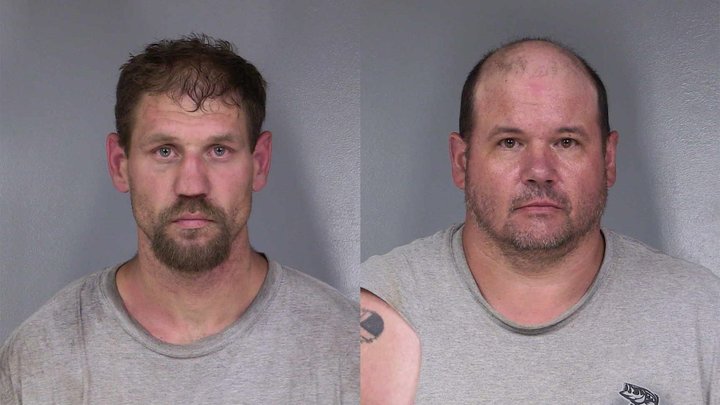
Kanen (left) and Wolf.
###
Press release from the Humboldt County Sheriff’s Office:
On July 15, 2021, at about 2:05 a.m., Humboldt County Sheriff’s deputies on patrol in the area of Briceland Road and Redwood Drive in Redway observed a vehicle reported stolen out of Eureka traveling on Briceland Road.
Deputies conducted a high-risk traffic stop on the vehicle and detained four occupants. Two of the occupants, identified as 36-year-old Dennis Richard Kanen and 47-year-old Kenneth Alan Wolf, were found to be persons prohibited from possessing firearms.
Inside the vehicle, deputies located a loaded firearm and a box of ammunition. During a search of Kanen and Wolf incident to arrest, deputies located over 10 grams of methamphetamine.
Kanen was booked into the Humboldt County Correctional Facility on charges of possession of a stolen vehicle (PC 496d(a)), felon in possession of a firearm (PC 29800(a)(1)), prohibited person in possession of ammunition (PC 30305(a)) and possession of a controlled substance (HS 11377(a)).
Wolf was booked into the Humboldt County Correctional Facility on charges of felon in possession of a firearm (PC 29800(A)(1)), prohibited person in possession of ammunition (PC 30305(a)) and possession of a controlled substance (HS 11377(a)).
Two additional occupants of the vehicle were released at the scene.
This case is still under investigation.
Anyone with information about this case or related criminal activity is encouraged to call the Humboldt County Sheriff’s Office at (707) 445-7251 or the Sheriff’s Office Crime Tip line at (707) 268-2539.
BOOKED
Yesterday: 3 felonies, 8 misdemeanors, 0 infractions
JUDGED
Humboldt County Superior Court Calendar: Today
CHP REPORTS
1 Mm162 E Men R0.00 (HM office): Assist with Construction
9730 MM1 N MEN 97.30 (UK office): Trfc Collision-Unkn Inj
ELSEWHERE
RHBB: Planning for Sea Level Rise Splits Humboldt Commission
RHBB: Burning Starting Today on Vegetation Management Project West of Redding
OBITUARY: Paul Nystrom, 1956-2021
LoCO Staff / Friday, July 16, 2021 @ 6:56 a.m. / Obits
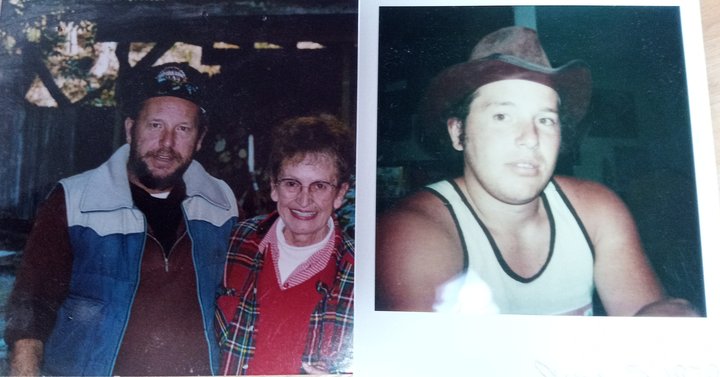
Paul Nystrom was born June 9, 1956 and died on June 16, 2021, in his home in Trinidad. Paul’s physical body was taken care of by Ayers’ Crematorium. There will be no funeral services as per his request as he felt that the spiritual body has already passed on from the physical body, so this obituary will serve as a record of our memory of our family member. Please contact the family regarding any future memorials that may or may not be planned in the future.
Paul was an amazing and resilient person. He had childhood leukemia as a teenager and still lived to be over 60, which was something not so many with this disease were able to achieve. After high school, he went on to work in construction, taking care of horses on a ranch, working for the government making tiles for the space shuttles, and working as a janitor at a mall. He eventually got on permanent disability for a number of reasons.
He suffered from depression and anxiety and extreme hearing loss. Any time the family would contact him, whether on the phone or right next to him, we would have to ask if he had his hearing aids in. He also read lips quite well. This whole mask thing through COVID was hard on him as everyone was masked and he couldn’t read their lips to see what they were saying. And when mom was alive, we could all be blessed to hear, “God damn it, Paul! Put your hearing aids in!” Hopefully, now he doesn’t need them!
Paul liked to read, especially comic books and sci-fi. He also liked to take long walks on the beach or long walks through the woods either with his or mom’s dogs, or with friends. He always shared whatever he had with others as he felt that if he shared with others, they would eventually share with him.
Paul liked to go to mom’s place in Willow Creek and help out. Mom and Lefty (her last husband) had a large piece of property that required more and more care from others the older mom and Lefty got. Paul would frequently take up the slack. After his daily work, he would hit the river and spend hours reading on the bank. Mom and Paul called Willow Creek God’s country, as they both loved the land and the beauty of the river.
He lived out the last 15 years of his life in Trinidad, next to the ocean where he felt solace. He took long walks with friends at sunset and collected many rocks, shells, and sea glass. We also found out many of the tall tales that Paul told over the years. For example, did you know that Don was older than Paul? Yeah! Neither did we! (It’s not true!!)
Paul’s relationship with his son, Casey, was strained from Casey’s younger years on. But his relationship with his nieces and nephews was always vivid. He spoke to many of his friends about them all, including his son, and they could feel the love that he felt for all of them. He never stopped thinking about them and was grateful to have such love reciprocated.
He is preceded in death by his mother, Joy Marlow (Nystrom), who died on October 2, 2011, his adoptive father Lyle Nystrom, who died on January 18, 2011, his sisters Victoria (Vikki) Nystrom and Debra Nystrom, and his nieces Miriam Nystrom and Carol-Sue Riggs.
Paul is survived in death by his estranged son Casey Nystrom, his brother Don Nystrom, his nieces Natasha McDonald, Jessica Nystrom, and Dawn Nystrom, his nephews Yosef Mohamed and Yasin Mohamed, and all of their families. They will miss him.
###
The obituary above was submitted on behalf of Paul Nystrom’s loved ones. The Lost Coast Outpost runs obituaries of Humboldt County residents at no charge. See guidelines here.
(UPDATE) ‘Multiple Fatalities’ Likely in Dinsmore Plane Crash, Says Humboldt Sheriff’s Office
LoCO Staff / Thursday, July 15, 2021 @ 4:35 p.m. / News
PREVIOUSLY: Airplane Crash Reported Near Dinsmore; Forest Service Personnel Battling Fire
###
Press release from the Humboldt County Sheriff’s Office:
On July 15, 2021, at about 11:54 a.m., Humboldt County Sheriff’s deputies were dispatched to the Dinsmore Airport for the report of a small aircraft accident.
According to the reporting party, the aircraft, a fixed wing single engine plane, crashed near the airport and subsequently caught on fire. Fire personnel responded to the scene and extinguished the fire, preventing spread into the nearby wooded area.
No survivors have been located as of Thursday afternoon. Multiple fatalities are believed to have occurred, however, due to the state of the wreckage and continued investigation, the number of victims cannot be confirmed at this time.
The Humboldt County Sheriff’s Office is working in partnership with the National Transportation Safety Board and the Federal Aviation Administration to investigate this incident. The cause of the crash is still under investigation.
The Humboldt County Sheriff’s Office would like to thank the Trinity County Sheriff’s Office, CAL FIRE, US Forest Service, California Highway Patrol, Cal Trans, the National Transportation Safety Board and the Federal Aviation Administration for their assistance and collaborative response.
More information related to this investigation will be released when available and appropriate.
Anyone with information related to this case is encouraged to call the Humboldt County Sheriff’s Office at (707) 445-7251.

(UPDATE) Man Who Went Missing Near Mitchell Heights Early Tuesday Morning Has Reportedly Returned Home
LoCO Staff / Thursday, July 15, 2021 @ 7:59 a.m. / Emergencies
UPDATE, July 17:
A person close to the Fyfe family tells the Outpost that Eureka man Thomas Fyfe returned home this morning after he was reported as missing on Tuesday.
The family is reportedly asking for privacy at this time.
###
From the Eureka Police Department:
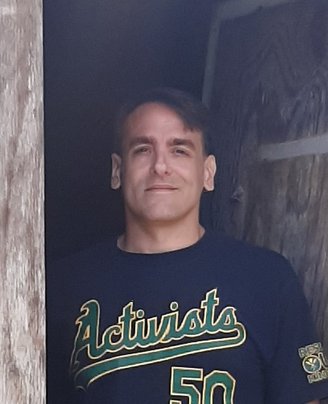
The Eureka Police Department is asking for the public’s assistance in locating a missing person. 40-year-old Thomas Fyfe was last seen leaving his residence on the 1200 block of 8th Street in Eureka on July 13, 2021 around 6:50 a.m. Fyfe’s red PT Cruiser was found abandoned two hours later on Browns Road, a remote and private area of unincorporated Eureka. The Humboldt County Sheriff’s Office searched the area but was unable to locate Fyfe.
Fyfe is described as a white male, 6’, 200 pounds, brown eyes, brown hair. He was last seen wearing a brown/green shirt, brown pants, and hiking shoes. Fyfe is an avid hiker and frequents the McKay tract.
Anyone with information of Fyfe’s possible whereabouts is asked to contact the Eureka Police Department at (707) 441-4044. Case #21-003561.
HSU Cop Under Investigation For Pepper-Spraying Transient at Aquatic Center, University Says
LoCO Staff / Thursday, July 15, 2021 @ 7:32 a.m. / Crime
Press release from Humboldt State University:
An independent review of the use of force by a Humboldt State University Police Department (UPD) officer is being conducted.
At 9:55 p.m. on Thursday, July 8, a UPD officer was conducting a security check of HSU’s Humboldt Bay Aquatic Center in Eureka. The officer encountered an African American male who was sleeping outside the building in violation of University encampment regulations.
The officer woke the man, who stood and began to walk away. The officer repeatedly asked the man to stop and provide his name. In an attempt to physically stop the man, the officer grabbed his arm. When he tried to pull away, the officer proceeded to spray him with pepper spray. The officer took him into custody for resisting a police officer and called paramedics, who treated the man at the scene, flushing his eyes with water.
The man was arrested, subsequently released, and his case has been submitted to the Humboldt County District Attorney’s office.
The officer has been placed on paid administrative leave pending an external investigation into whether his actions aligned with California State University’s use of force policy and UPD protocols.
“We are committed to transparency and ensuring responses to incidents align with the values of the institution, department protocols, and governing policies,” says UPD Chief Anthony Morgan.
More information will be made available following the conclusion of the review.
Is Homelessness Newsom’s Weak Point in Recall? Republicans Are Counting on It
Manuela Tobias / Thursday, July 15, 2021 @ 7:12 a.m. / Sacramento
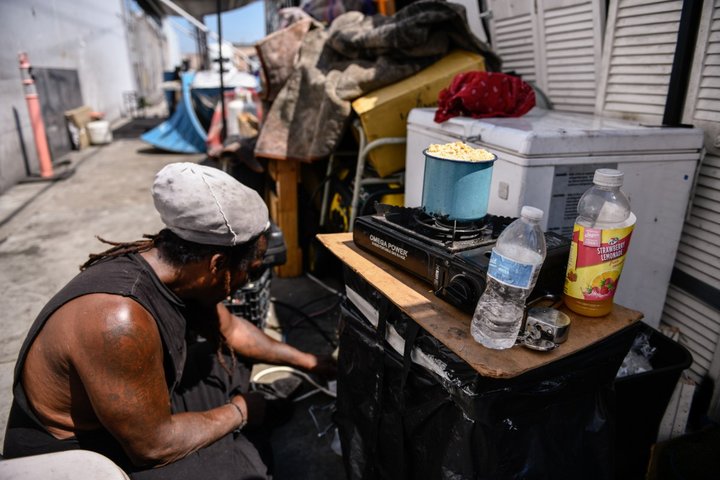
Rafael Suarez tries to restart the generator during a hot day in Los Angeles, on July 9, 2021. The couple tries to keep their space clean to avoid city sweeps, which often lead to having some of their belongings thrown away. As part of their plans to reduce homelessness, Republican recall candidates are calling for a clean-up of the state. Photo by Pablo Unzueta for CalMatters.
###
The Gavin Newsom recall may have picked up steam as a referendum on the governor’s handling of the coronavirus pandemic, but now homelessness is also taking center stage.
Businessman John Cox — perhaps best known as the guy with the bear — has been hauling an eight-foot ball of garbage around California to symbolize “the trash that’s left behind” by people experiencing homelessness and the state’s response to them.
Kevin Faulconer, former mayor of San Diego, named homelessness as his number one campaign issue and put out several ads showing people camped in cars and tents in “Newsom’s California.”
Celebrity Caitlyn Jenner, best known for “Keeping up with the Kardashians,” noted in an interview with Sean Hannity of Fox News that a neighboring private plane owner had moved to Arizona because he couldn’t take seeing homeless people anymore.
While they’re proposing various solutions, the three Republicans agree: Homelessness is getting worse in California — and they can do better than the man they want to replace as governor.
Newsom made reducing homelessness a key part of his 2018 gubernatorial campaign, but the unsheltered population has only increased since then — up by 24% from 2018 to about 161,000 people in 2020. That was before the coronavirus pandemic upended the economy. (A scheduled count in January 2021 was postponed due to COVID-19.)
The increase is especially discouraging after the state has spent $13 billion on homelessness since 2018. A recent, scathing state auditor’s report points to a main culprit: a lack of coordination and accountability across the complicated web of state agencies and local counties, cities and service providers.
The rise also hasn’t been lost on potential voters, who see growing encampments under highways and along streets in many cities. A recent UC Berkeley Institute of Governmental Studies poll showed that while 49% of voters opposed the recall, homelessness loomed as a potential Achilles heel for Newsom: 57% of voters rated his job performance on the issue as poor or very poor and only 13% labeled it good or excellent.
And in a May poll by the Public Policy Institute of California, likely recall voters ranked homelessness the third most important issue in California, after only jobs and COVID-19, with housing costs and availability ranking fourth.
But is what the Republican challengers propose really that much better than what the state is already doing?
Their ideas reflect one school of thought on how to reduce homelessness, but some experts and advocates warn that while the policies might sound appealing, they could worsen the lives of those experiencing homelessness.
What comes first: Housing or treatment?
The United States has mostly embraced the “Housing First” strategy since the early 2000s. It was adopted by both George W. Bush’s and Barack Obama’s administrations, and has been law in California since 2016.
The idea is simple: Give people access to stable housing, and let job training and medical treatment follow. In other words, services aren’t a precondition to enter housing, but instead voluntary once the person is housed.
And yet, there’s a growing frustration, particularly among Republicans, that the strategy isn’t working. Robert Marbut, who served a stint as then-President Donald Trump’s homelessness czar, rejected the idea, and touted the opposite model: A person had to stay on the concrete parking lot outside a shelter and test negative for drugs before entering.
Doug Ose, a former Sacramento-area member of Congress running to unseat Newsom, proposes a similar method. “We need to stop enabling, excusing and ignoring these drug addiction and mental health issues,” he said in a recent interview.
Ose wants to make it easier to bring homeless people into the state’s custody, and then establish enough community care centers to treat drug addiction and mental illness. He also proposes that state-funded facilities demand sobriety from all individuals receiving services.
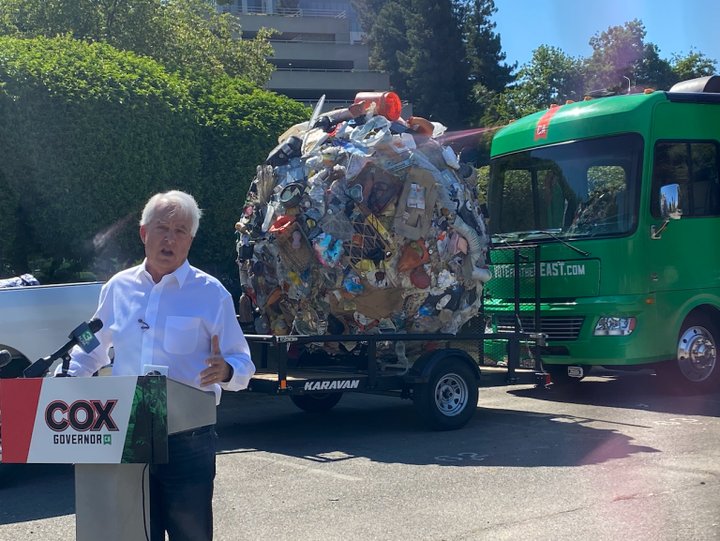
Republican recall candidate John Cox talks about his plan to address homelessness in Sacramento on July 1, 2021. The eight-foot ball of garbage symbolizes “the trash that’s left behind” by people experiencing homelessness and the state’s response, he says. Photo by Manuela Tobias, CalMatters.
Cox also says the state has spent way too much money sheltering homeless people, and that they should be forced into mental health treatment instead.
“First, you’ve got to have treatment first, not housing first, treatment first,” he said at a recent press conference in Sacramento. “And yes, we’re going to have to force people into that treatment if need be.”
In his homelessness plan, Cox cites a Heritage Foundation blog post pointing to a study of “Treatment First” facilities that found nearly half of participants recovered from substance use, entered housing and maintained steady employment.
Neither Cox nor Ose has put forth a price tag for that treatment — but it is likely far higher than simply providing beds for people, as the current shelter model does.
The candidates do, however, have a point that more mental health treatment is sorely needed. Board-and-care facilities for low-income Californians with serious mental illness have been shuttering across the state at an alarming rate. The state budget for the next fiscal year includes $805 million for counties to purchase, build, preserve, or rehabilitate such facilities, but the state has yet to patch the growing hole in the availability and delivery of mental health treatment.
The prevalence of mental illness among the homeless is a source of debate, and being on the streets can worsen existing mental health conditions. There is general agreement among experts and elected officials that mental illness alone isn’t responsible for homelessness.
“The people who are suffering from substance use disorder or mental illness are very visible, they’re very challenging. But there is a very large unsheltered population that doesn’t have either.”
— Janey Rountree, founding executive director of the California Policy Lab at UCLA
Of the more than 248,000 people who accessed homeless services throughout 2020, 41% reported disabling conditions, which could be anything from diabetes or a broken leg to a mental disorder, according to Ali Sutton, the state’s deputy secretary for homelessness at the California Homeless Coordinating and Financing Council.
Janey Rountree, founding executive director of the California Policy Lab at UCLA, said a recent study found that less than a fifth of 37,000 people experiencing homelessness in Los Angeles had a clinically diagnosed mental illness, substance use disorder or both.
“The people who are suffering from substance use disorder or mental illness are very visible, they’re very challenging,” she said. “But there is a very large unsheltered population that doesn’t have either.”
Margot Kushel, a professor of medicine at University of California San Francisco, who leads the UCSF Benioff Homelessness and Housing Initiative, also says there’s little evidence of correlation between mental health and homelessness.
Instead, she says the places with highest homelessness have a split population of high earners who can afford to pay housing costs, and those who can’t, competing for a limited supply of housing. Think: San Francisco.
Once people are living on the street, they’re much more likely to turn to drugs or alcohol, Kushel said.
“A lot of people on the streets use stimulants so they don’t sleep, because when they sleep, they get assaulted, and their stuff gets stolen,” she said. “Turns out that when you bring people inside and that goes away, people’s lives calm down, and they can engage in therapy.”
Kushel recently conducted a study in which researchers approached the 400 most chronically homeless people in Santa Clara — the people who most frequently ended up in the emergency room or jail you might find “yelling in the middle of the street” — and offered them a permanent home. All but one said yes.
Nearly 90% of the 169 participants placed in supportive housing — which included voluntary but not mandatory treatment — stayed in housing for several years.
“This is in California, the sickest of the sickest, and they mostly all got housed,” she said.
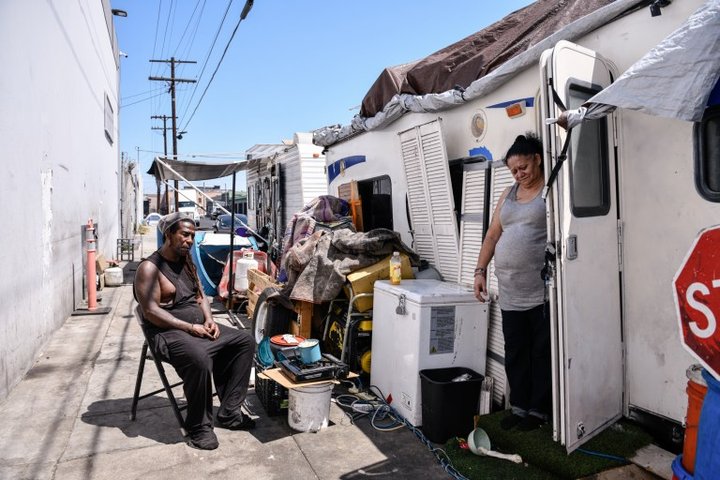
Rafael Suarez and April Lei linger outside their trailer home to try and stay cool during a hot day in Los Angeles, on July 9, 2021. The couple have lived on this block for a year and a half, according to the couple. Photo by Pablo Unzueta for CalMatters
But if “Housing First” is really the answer, why isn’t homelessness declining?
One reason: The state is about one million housing units short for the lowest earners.
And rents are only increasing. A recent report by the National Low Income Housing Coalition found California to be the most expensive state for tenants, when compared to average wages. Renters would need to make at least $39 an hour to afford a 2-bedroom apartment in California, while the average renter makes less than $25 an hour, and the minimum wage is $14.
Rountree likened the situation to watering only 10% of the garden all summer and claiming watering doesn’t work because the other 90% of the garden died: “That’s what people are saying: ‘Housing first’ doesn’t work. But we haven’t actually housed anyone.”
According to the state’s database, of the roughly 248,000 people who accessed local homeless services last year, nearly 40% of those people moved into permanent housing — which could mean anything from moving in with a family member to getting their own place.
“Housing First” is “working faster and better than it ever has, it’s got more resources than it has in ages. Let’s not upset that piece that we know was working really, really well,” said Sutton, the state’s top official on homelessness. “The problem is much more the inflow, and how do we solve that.”
Forcing treatment
Several candidates in the Newsom recall mentioned using conservatorships, or legal guardianships, to force people into treatment. Both Cox and Ose suggest loosening the Lanterman-Petris Short Act, which limited involuntary treatment to those who are a danger to themselves or others, or gravely disabled, and limited the time for confinement.
Ose, for example, wants to change that definition to include anyone “addicted to drugs” and unwilling or unable to “make reasoned decisions consistent with being self-sufficient.”
Cox said: “Britney Spears doesn’t need a conservator. Thousands of Californians living on the streets are the ones that need conservatorships. And we have to force people to do it.”
Newsom and others have also called for limited expansion of conservatorships. Supporters argue it’s too difficult to get help for their relatives who need it under the strict definition of conservatorship. Others say the outdated system doesn’t address the needs of people dealing with substance abuse.
But Kevin Baker, legislative director for the American Civil Liberties Union’s California Center for Advocacy & Policy, said the candidates’ proposals raise serious concerns, and not just about the violation of people’s civil liberties. Turning this into reality would take “an army” of lawyers, judges and guards the state simply doesn’t have.
“If you put somebody in a conservatorship, they’re yours,” he said. “You have to house, clothe and feed them. You have all the obligations to them that you have to prisoners. If we’re going to house these people and take care of all their needs, why don’t we instead do that in a way that is supportive and voluntary and leaves out all the lawyers and guards and the judges and the court costs and everything else?”
Shelter or permanent housing?
Faulconer calls for an audit into the need for mental health services and how the state is spending that money. But his main idea is to create enough shelter beds to get everyone on the streets inside with services, including mental health treatment. Under his plan, if space in a shelter is available, a homeless person must take it.
How many beds would that take? A lot. The 2020 tally of homeless people found California had the highest share of people living on the streets, or unsheltered, at 70%.
Asked about a price tag, Faulconer said “the cost of not doing it is extraordinary.”
“People are literally dying on our streets. And my whole plan is about giving people the ability to get off the streets, out of an unclean, unsafe, unsanitary environment into one that is supportive with the services that they need,” he told CalMatters.
Faulconer cites a 12% reduction in homelessness in San Diego as evidence that shelters work but local critics have questioned that record.
While Newsom has added record numbers of shelter beds in the last year, he has prioritized more expensive individual hotel rooms, as opposed to the large shelters Faulconer suggests.
“People are literally dying on our streets. And my whole plan is about giving people the ability to get off the streets, out of an unclean, unsafe, unsanitary environment.”
— Kevin Faulconer, Republican candidate in recall election
Meanwhile, Cox proposes doing away with shelters altogether, saying they are a waste of money. And many advocates agree. Shelter isn’t affordable housing, so continuing to invest in shelters doesn’t fix the underlying cause.
While advocates and homelessness researchers also acknowledge that existing shelter beds sometimes go unused, they blame the rules. Many shelters have strict curfews and don’t allow people to sleep with their partners, bring in pets or store their personal belongings. Most importantly, they don’t allow people privacy, a need that heightened when shelters became hotbeds for COVID-19.
“People want autonomy in their lives,” said Kushel, from UCSF. “These are adults.”
Chris Martin, policy director at the nonprofit advocacy group Housing California, said the state has increasingly shifted away from the congregate shelter model, including the most recent state budget bill. He says that Faulconer’s plan is inhumane. “It’s warehousing. It really is taking us backwards,” he said.
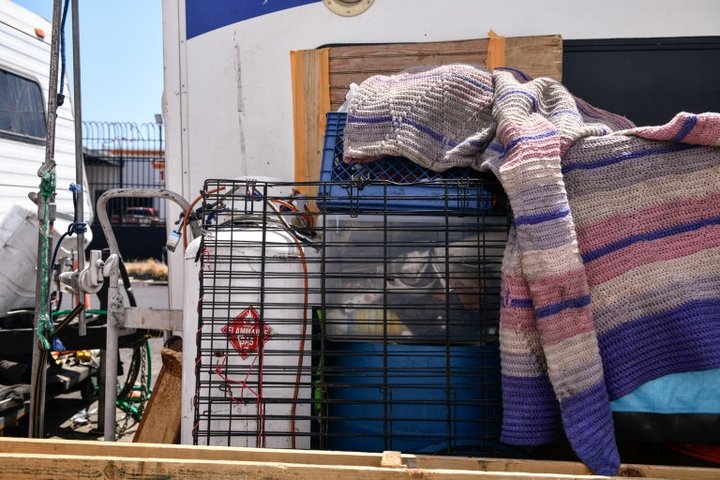
Belongings of Rafael Suarez and April Lei are bundled outside the trailer home in Los Angeles, on July 9, 2021. Aside from the generator, the couple rely on their propane tank to cook food and plastic bins to store supplies and clothing. Photo by Pablo Unzueta for Calmatters.
There are several important points where the candidates align, primarily the push to “clean up” the state. Newsom proposed more than $1 billion in the state budget to pick up trash along freeways and downtown areas. Faulconer proposes establishing the “right to public spaces,” which would require that parks, freeways and other areas be kept clear of debris.
Advocates say these plans stigmatize people who are unhoused: “They’re forced to live in that trash,” Martin said. “And oftentimes it’s not trash. It’s all they have in their life.”
The candidates also all agree: California needs more housing, and addressing the homelessness crisis is impossible without that. That’s the same argument Newsom has been making since his 2018 campaign. His challengers propose changes such as streamlining permits and costly environmental reviews. But none of the candidates offer a clear way around the political pressures that make housing construction so difficult.
Like his opponents, Faulconer says the state simply needs a better governor: “I believe this cries out for leadership at the statewide level.”
###
CALmatters.org is a nonprofit, nonpartisan media venture explaining California policies and politics.
COVID Cases Surging in California a Month After Reopening
Barbara Feder Ostrov / Thursday, July 15, 2021 @ 6 a.m. / Sacramento
A month after California’s reopening lifted most pandemic restrictions, COVID-19 cases and hospitalizations are rising, worrying public health officials as they contend with the more infectious Delta variant and the lagging pace of vaccinations in some communities.
Los Angeles County has drawn particular concern, with five straight days of more than 1,000 new cases, a five-fold increase from mid-June.
Gov. Gavin Newsom on June 15 officially ended the state’s stay-at-home and mandatory mask orders affecting 40 million people, allowing most businesses to fully reopen. Vaccinated or not, many unmasked Californians eagerly crowded into reopened stores, restaurants, churches and sporting events..
The fallout: On Wednesday, nearly 3,100 new COVID-19 cases were reported, compared to 700 on June 15. And the state’s test positivity rate – a measure of how much virus is circulating in a community – jumped from 0.08% to 3%, according to the California Department of Public Health.
The actual numbers of cases remain small, however, compared to the peak of California’s devastating winter surge, when new daily cases topped 50,000.
Case counts and testing results can fluctuate because of reporting delays. But public health officials in some areas have reported notable spikes in cases and hospitalizations.
Between June 12 and July 12, San Francisco, Los Angeles and Orange counties saw the biggest jumps in the 7-day average of COVID-19 cases per 100,000 people, excluding very low-population counties, according to a CalMatters data analysis. San Francisco’s case rate nearly quadrupled to slightly more than six cases per 100,000 people. Los Angeles’ case rate nearly tripled, and Orange County’s more than doubled.
About 1,935 people were hospitalized statewide with confirmed or suspected cases on Wednesday, up about 54% compared to hospitalizations on reopening day. Hospitalization rates spiked in Yolo, Marin, El Dorado, Sonoma and Alameda counties.
Nearly all of the new cases, hospitalizations and deaths have been seen in unvaccinated people. About 40% of Californians remain unvaccinated.
Which raises the question: Did California reopen too soon?
Not necessarily, according to Dr. Peter Chin-Hong, a University of California, San Francisco infectious disease specialist.
“I think we were a very good place in California when we reopened,” Chin-Hong told CalMatters. “And we had no idea what the Delta variant was going to do.”
California waited longer than most states to reopen fully, Chin-Hong pointed out. “We always expected an increase in cases after that.”
California’s regional surges echo those around the nation, with COVID-19 cases rising by more than 50% this past week in 31 states and hot spots reemerging in Missouri, Arkansas and Florida.
Across California, the Delta variant as of July 7 has been found in 1,085 COVID-19 patients whose test results were genetically sequenced, according to the state public health agency. But as a percentage of the state’s cases, it has grown incredibly fast, from just 2.2% of all tests sequenced in April to about 43% of all tests in June.
Chin-Hong says it’s important to distinguish between infections and those that cause serious symptoms or death, because COVID-19 vaccines remain strongly protective against both, even against the Delta variant.
The death rate has actually declined slightly since reopening day; with most California seniors vaccinated, serious cases are seen far more often in younger people, who are more likely to survive the disease. About 70% of the state’s COVID-19 cases as of July 7 were seen in people under age 50.
Improved treatments, including monoclonal antibodies, also have improved patients’ chances.
Still, 30 deaths were reported statewide on Wednesday. About 1,935 people were hospitalized statewide with confirmed or suspected cases, up about 54% compared to the number of hospitalizations on June 15.
Chin-Hong said unvaccinated Californians accounted for nearly all of the hospitalizations and deaths. So-called breakthrough infections remain exceedingly rare in fully-vaccinated people, a tiny fraction of 1% among more than 20 million Californians.
There was a lot of second-guessing before and after Gov. Gavin Newsom’s decision to largely end pandemic restrictions in mid-June.
In late May, Santa Clara County public health officer Dr. Sara Cody – who helped spearhead one of the nation’s first shelter-in-place orders – voiced concerns about the state’s pace of reopening and warned of a potential surge in cases.
Two weeks after California’s reopening, Los Angeles County health director Dr. Barbara Ferrer recommended residents once again wear masks as the Delta variant surged throughout the state and nationwide.
But Chin-Hong suggests that these COVID-19 surges will become a regular part of life in California, much like flu season. It’s just that unvaccinated people will be far more likely to be hospitalized and die, he said.
“Just like there will be two Americas, there will be two Californias: the California of the vaccinated and the California of the unvaccinated,” he said. “If (non-elderly) people didn’t get a flu shot, they’ll probably do fine but with COVID, you’re going to have a very different trajectory.”
###
CalMatters data editor John Osborn D’Agostino contributed to this report. CALmatters.org is a nonprofit, nonpartisan media venture explaining California policies and politics.


