We offered a cursory recap of yesterday’s meeting in the post linked above, but let’s take a closer look at the details of the 5.7-acre cannabis cultivation project that the Humboldt County Board of Supervisors approved on Tuesday — and also at the circuitous and sometimes confused decision-making process that got them there.
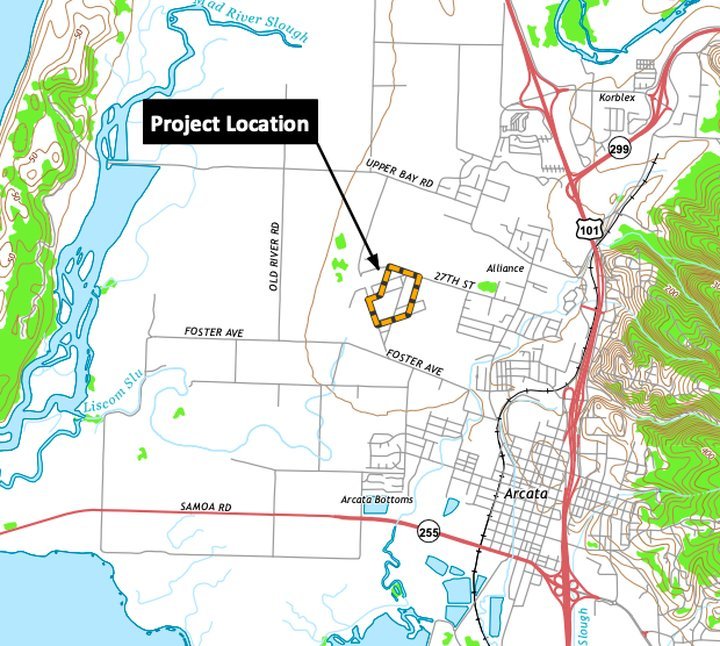
At the outset, Planning and Building Director John Ford reminded the board where they’d left off back on June 22 — namely, asking staff to investigate the effectiveness of the patented odor-control technology proposed for use in Arcata Land Co.’s weed farm. The smell of growing cannabis has been one of the major concerns among neighbors of the property, which is owned by the Sun Valley Group and located in the Arcata Bottoms.
Since the last meeting on this project, county staff talked with officials down in Santa Barbara County, where the smell-absorbing product is already in use, and they vouched for its effectiveness, Ford said. The applicants plan to use a combination of carbon scrubbers and a waterless vapor-phase system called Ecosorb to neutralize the skunky aroma.
The board had also asked staff to explore some additional conditions of approval for the project. These included more thorough odor-control measures; the dedication of a public easement for future trail development; another easement for the two parcels directly east of the project to preserve them as open space and/or an organic farm; and development of a solar system capable of providing all the power needed to
operate the project.
Staff also modified an existing condition of approval, requiring Sun Valley to submit a “Neighborhood Odor
Complaint Response Plan” to the county for review and approval.
As was the case three weeks ago, staff recommended denying the appeal of the Planning Commission’s approval of the project in May and approving eight total acres of greenhouse grow, including 5.7 acres of mixed-light cultivation and 2.3 acres of outdoor light-deprivation
cultivation in enclosed, gutter-connected
greenhouses — plus 30,000 square feet of ancillary propagation activities inside existing hoop houses.
After Ford’s staff presentation, Jim Cotton spoke on behalf of himself and the other appellants, saying that in their opinion the odor-control technology remains unproven and potentially dangerous.
“Bottom line is we don’t want to be a guinea pig for this [technology] until it’s been proven safe,” he said. He suggested the board go with an option proposed during the June 22 hearing by Third District Supervisor Mike Wilson and Fifth District Supervisor Steve Madrone — permitting just one acre of cultivation area and, if all goes smoothly, allowing a second acre after a year.
A series of speakers then weighed in on behalf of Arcata Land Company. Land use consultant Jordan Main argued that county staff and multiple outside agencies have vouched for the efficacy and safety of the odor-control technology.
“The proposed conditions [of approval] completely eliminate the possibility of an odor issue,” he said, adding that the additional measures, including the employment of a certified hygienist, “do more to address odor than any I’ve ever seen.”
Nearly two-thirds of the 29 public speakers voiced either outright opposition to the project or support for capping it at two acres. They expressed concerns about odor, air quality, public safety, declining property values and the market impacts of an industrial-scale cannabis operation.
Supporters who spoke focused mostly on the potential economic benefits while decrying what one man called the “NIMBY loudmouth group” that opposes the project.
The board took a 10-minute break after the public comment period, resuming deliberations around 3:40 p.m., and their ensuing discussion lasted roughly two hours. While odor was at least nominally the main reason for continuing the June 22 hearing, the board proceeded to discuss a wide range of issues, including noise, land use/zoning, the proposed easements, energy sources, toxic chemicals and much more.
Madrone was the first supervisor to lay his cards on the table. He argued that the applicant probably should have been required to prepare a full environmental impact report (EIR) rather than the less-comprehensive mitigated negative declaration (MND), but he nevertheless said he planned to stand firm with his support of a phased-in project starting with one acre, going up to two if all goes well.
Madrone also spoke about the importance of supporting the existing local “craft” cannabis growers rather than bulk producers who aim to supply the commodity market with consistent, if inferior, product.
Wilson reiterated a point he made at the June 22 hearing — that the land in question was slated to be rezoned from heavy industrial to agriculture-exclusive, and that the change would have been implemented if not for a lawsuit that halted implementation of the general plan update. That rezoning would have capped the weed grow at two acres, and thus Wilson felt two acres should be the limit.
Lane DeVries, the CEO and president of Sun Valley Group, was clearly frustrated, saying he thought odor was the topic at hand. He said he’d be willing to consider phasing in the project as long as phase one was 5.7 acres and phase two was the remaining 2.3.
First District Supervisor Rex Bohn made a motion to approve exactly that. He noted that the project was originally proposed at 33 acres before getting cut down to 22 and reduced again to eight.
“If we cut this half up any more, the baby’s out with the bathwater,” he said.
Bohn didn’t get a second on his motion, and the conversation veered into talk about the proposed trail easement and solar infrastructure.
After a while, Madrone inched toward some possible middle ground, saying he’d be willing to approve more than two acres — maybe up to three or four — if they were phased in slowly, ensuring that the neighbors weren’t negatively impacted.
From there, the conversation just got more convoluted. Wilson suggested a process whereby the board could consider amending sub-motions to the main motion on the table — that is, considering amendments pertaining to project details before voting on the primary motion pertaining to the whole project.
This suggestion only seemed to confuse people.
Bohn’s motion belatedly died for lack of a second, and Second District Supervisor Michelle Bushnell then took a stab, making a motion to approve a grow of up to 5.7 acres, phased in one acre at a time over multiple years.
Bohn seconded the motion for purposes of discussion, and there was no shortage of that.
Wilson made an impassioned pitch for requiring a dedicated easement on the land between the proposed weed farm and the nearby neighborhood, two large parcels of land that currently host an organic quinoa farm operated by Sun Valley.
But each of the other four supervisors had concerns of their own, and the discussion rapidly lost focus.
Fourth District Supervisor and Board Chair Virginia Bass made a few attempts to bridge the divide between her colleagues. Wilson stayed focused on the conservation easement. DeVries argued against being told what to grow on that stretch of land.
At one point, Bushnell turned to Wilson and asked whether his dogged pursuit of this easement proposition meant he was willing to vote “yes” on her motion, approving up to 5.7 acres of cultivation area.
“That’s a good question!” Wilson said with a smile. “Now you’re playing hardball!” He considered this quandary before saying that no, he was still not willing to support more than two acres. But he still considered the easement — preferably for an organic farm — very important.
Amid more confusion about the process and deliberations over the dimensions of the potential easement in question, Wilson wound up amending his amending motion. He modified his proposal to require not the entirety of the two parcels to be dedicated as an easement but just a portion of them — a 500-foot-wide swath along the eastern edge of of the project site.
DeVries said he’d feel a lot better about making all these concessions if the board were willing to permit the full eight acres he was requesting, and Bass made a comment suggesting she’d be willing to go for that.
Wilson balked. He said that if his proposal for a conservation easement was used as a vehicle to negotiate up to eight acres, “there’s no way.”
Eventually, the board got around to voting on Wilson’s amending motion. To clarify, they were voting on whether to attach a new condition of approval establishing a 500-foot-wide conservation easement directly east of the project site.
Madrone and Wilson voted yes; Bohn and Bass voted no; and after a dramatic pause, Bushnell voted yes. The amending motion passed.
Next it was time to vote on the main motion — whether to approve 5.7 acres of cultivation with all the conditions that had been added along the way.
Madrone called the decision “a tough one” and said he appreciated all the efforts to make the project more palatable, but 5.7 acres was just too big. He voted no, as did Wilson.
But Bass, Bohn and Bushnell all voted yes, and the motion carried. Sun Valley Group, which has been in the cut-flower business for decades, is about to diversify into the cannabis business.
LoCO has chosen to highlight this particular page because it has a doggo on it
Humboldt County Administrative Office release:
The County of Humboldt launched its redesigned website Wednesday, July 14, after it was delayed for more than a year due to the COVID-19 public health emergency.
The web address will remain the same, humboldtgov.org, but the redesigned site allows for improved navigation and a cleaner, more modern feel than the previous one.
Last spring, the county’s website shifted its focus to COVID-19, remaking its front page and main navigation to ensure residents could easily access pandemic-related information. While designing the new site, making COVID-19 information easily accessible remained a priority.
Now that the community is opening back up, the demand to access the full breadth of county services online has returned, and staff have worked hard to improve the site, with a goal of making it more accessible and easier to use.
“As our community reopens our residents need improved access to information related not only to COVID-19, but to all of the public services we provide,” said Acting County Administrative Officer Elishia Hayes. “This is a positive development, and I am hopeful that this redesign allows community members to more easily get to the information they need. From a county perspective, it is no small undertaking to redesign a website and I want to thank all county departments and staff for their hard work and continued commitment to this vital service. We look forward to maintaining the website and welcome the community’s feedback on how it can be improved.”
Some website upgrades include:
A “portal page” that separates COVID information from the main county website
A redesigned homepage that brings many of the website’s most popular links and most frequently searched terms to the front page
A centralized search so visitors can find what they are looking for
More organized and accessible sitemap navigation
More modern look.
Prior to 2014, the county website was hosted on county servers and maintained by one staff member in the CAO’s Information Technology Division. In 2014, the county contracted with CivicPlus to host its web services, and maintenance of the website was dispersed among all county departments which has allowed information to be updated more quickly. In subsequent years, staff and residents identified a need for better navigation.
In 2019, county staff responsible for maintaining the website met with CivicPlus to assess the website and started planning for a redesign—the development and launch were free as part of the original contract. As staff prepared to launch in spring 2020, the COVID-19 pandemic started and the need for community residents to be able to easily locate information on the existing site took priority. Now that our community is opening back up, the county is launching its new site which will make online services more accessible.
A seventh grader from the Myers Flat area earned one of the top honors at the Rocky Mountain Nationals wrestling tournament in Las Vegas on Saturday.
Aidan Ayers with his championship belt. | Photos provided by the Ayers family and Cass Bell.
Thirteen-year-old Aidan Ayers was named the “Rookie of the Year” at the event after winning his divisional championship match.
The “Rookie of the Year” award is given to the wrestler with the most wins of all competitors with two years or less of experience. After competing in 14 tournaments this year, Ayers finished the season with an impressive 50-2 record.
The young wrestler’s father Bruce Ayers told the Outpost that Saturday’s competition was one of the toughest youth tournaments in the nation.
“He attends practice [in Arcata] (2 hours and 20 minutes round trip) three days a week, lifts weights four days a week and runs for 30 minutes a day five days a week,” father Bruce Ayers said. “He has scarified more than most adults would — much less any child — to achieve this goal.”
Aidan Ayers trains with renowned local MMA pro Cass Bell at the institute of combat, where Ayers and Bell’s 12-year-old son Kaidan Bell work together as training partners.
“Kaidan took him under his wing and started teaching/training with him,” Cass Bell said. “They became best friends from the beginning.”
After shutting down his gym for months due to COVID-19, Bell said that Ayers only received a few months of training this year. Despite the restrictions, Ayers became the first wrestler from Humboldt County to achieve “Rookie of the Year” honors.
“To win ‘Rookie of the Year’ is a huge accomplishment,” Bell said. “It took a lot of dedication and sacrifices with the team and his parents.”
Aidan Ayers at the tournament with his family.
Ayers’ championship match, embedded at the top of this story, had an emotional ending. After all of his hard work, he was visibly brought to tears by the win and ran over to hug his coaches before thanking his opponent.
“Being from Southern Humboldt, where resources and opportunity are scarce, I feel like this is one of the great triumphs I’ve seen a child complete here,” Bruce Ayers said.
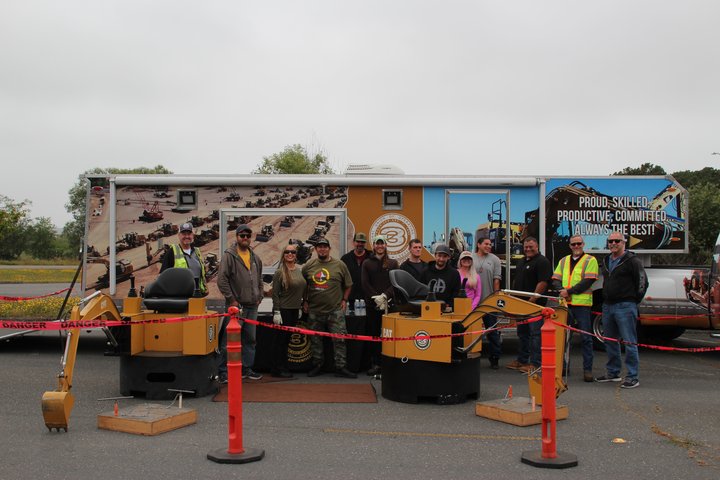
Students and instructors of Humboldt’s pre-apprenticeship program at a construction equipment simulation at College of the Redwoods. | Photos by Jacquelyn Opalach
###
Want to explore the many disciplines of trade work for free? There’s a program for that!
[It’s too late to dive into that opportunity right this minute, because the new program referenced above is wrapping up. But if you’re interested in what that program looked like — and what future sessions of that program will look like — then here’s an article for that.]
Over the past five weeks, the Building and Construction Trades Council of Humboldt and Del Norte Counties — which represents 14 union labor crafts — has been delivering a free multi-craft core curriculum (MC3) pre-apprenticeship program at College of the Redwoods. It’s designed to teach people interested in the trades — like carpentry, plumbing or electric, to name a few — about how many options there actually are, and what to expect from those jobs, before jumping into a union apprenticeship blind.
“This MC3 training has been an eye-opener to what all’s available as far as the trades go,” one student told the Outpost. “I mean, I’m 45 and I’m ready to do a career change, you know?”
Although there’s no requirement to go through a program like this when pursuing the trades, it is useful, Zachary Love, the lead instructor of the program, told the Outpost. Most students change their minds about what trade is right for them three or four times over the course of the program.
The free course is designed to provide students with preliminary information about pursuing a number of trades that pay a living wage, pushing people toward a career instead of just a job. “Trades have been left behind as far as an option,” said Jeff Hunerlach, secretary-treasurer for the Building and Construction Trades Council of Humboldt and Del Norte Counties.
“Normally, in high school, you generally don’t hear anything about construction. It’s either college or the military,” Love said. “Instead of going and flipping burgers at McDonald’s or Burger King, they can be starting out at 15 to 19 dollars an hour, and then getting a two-dollar raise every six months.” Post-apprenticeship, which usually lasts about five years, trade workers start out making around 45 to 60 dollars an hour.
“They’ll be in the middle class, instead of being in the lower class … It’ll change people’s lives,” Love said.
It’s harder than it looks.
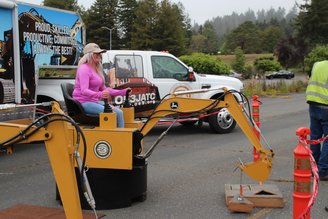
On Tuesday, at a machine operation simulation courtesy of Operating Engineers Local 3 at College of the Redwoods, another student said he’s excited for his career. “This was what I wanted to do from the get-go, was [become an] operating engineer. After doing the little class today, it solidifies exactly what I want to do. It’s a good program. It gives people opportunities and it doesn’t really matter what your background is, either.”
The seven-hours-a-day course material relies heavily on math, but also includes blueprint reading, eco practices, diversity training and sexual harassment training, Love said. Through the course, students become CPR and OSHA-10 (workers’ safety and health rights) certified, which is a requirement of most apprenticeships. Plus, program leaders will try to help interested students secure apprenticeship placement after the course, although some trade opportunities are more fruitful locally than others.
Anyone is eligible for the course, however, apprenticeships usually require a driver’s license and high school diploma. The program “targets people maybe out of prison, on unemployment, people not knowing what they really want to do in life,” Love said, adding that there’s also a push to recruit women, who make up a very small percentage of trade workers.
Funding for the program came from California gas tax grant money written by the North Central Counties Consortium, and College of the Redwoods donated a classroom for the course. In addition to affordably widening opportunities, the program reciprocates those benefits back into Humboldt by developing a pool of local folks interested in the trades.
“I, of course, said, ‘Of course! CR would love to help,’” said College of the Redwoods President Keith Flamer. “And what it means for us is twofold. One, it gives us an opportunity to directly support all the workers in a trade craft, and the educational needs of folks going into trades in Humboldt County … but also, we want to be seen as supporting our economy, and supporting [our] workforce, because, as we know, moving forward the only way that our economy is going to be safe in California is if we train more workers, and this is our attempt to do what we can to help our economy grow.”
This year’s session was Humboldt’s first, but similar programs have been running in a few other northern California counties for a couple of years. Next year, the Building and Construction Trades Council of Humboldt and Del Norte Counties will run the program again, with 20 open slots.
On July 6, 2021 a FedEx truck was stolen while parked for a delivery at the 3300 block of Broadway. The truck was located a couple hours later by CHP in the Elk River area of Eureka. Suspects were no longer with the vehicle but it was confirmed multiple packages from inside had been stolen.
During the course of the investigation, video surveillance from the location of the theft and from inside of the truck was obtained. The officer reviewed all video and determined that a male and female were involved. The female entered the delivery truck and drove away. The male entered a gray older model sedan. The female followed the male to the location in Elk River where they stole packages and ditched the delivery truck. The officer recognized the gray older model sedan and the male and female from a previous contact.
On July 10, at about 10:45 a.m., the investigating officer located the involved gray sedan parked at a gas station at the 1300 block of 5th Street in Eureka. Officers conducted a vehicle investigation and detained Halli Pole (28 of Eureka). Pole was found to be on searchable probation. During a search of the sedan, officers located a package with a FedEx shipping label addressed to a store in the mall. Additionally, Pole matched the description of the female involved in the theft of the delivery truck.
Pole was transported and booked into the Humboldt County Correctional Facility for vehicle theft, possession of stolen property, and probation violation. The male’s involvement is still under investigation.
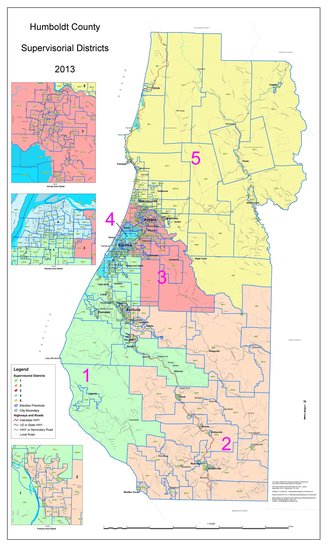
The current map of Humboldt County’s five supervisor districts. | Image via County of Humboldt
The county supervisor districts will soon change shape — probably not by much, but the new lines could have meaningful consequences. Some might remember, for example, what happened a decade ago. Rex Bohn was getting ready to run for his current First District seat on the Board of Supervisors only to see his then-home in Eureka’s Pine Hill neighborhood [CORRECTION: It was at the end of Henderson on V]. drawn out of the First and into the Fourth District. (He moved; problem solved.)
On Tuesday, the Humboldt County Board of Supervisors was presented with a few different options for how to go about redrawing those lines.
Counties, cities and states have to perform this redistricting, as it’s called, every 10 years following the federal census count, and this time around, jurisdictions in California have some new rules to follow thanks to a pair of bills passed two years ago in the state legislature — AssemblyBill 849 (aka the FAIR
MAPS Act) and AB 1276.
At yesterday’s meeting, Chris Chaffee, COO of the independent consulting firm Redistricting Partners, told the board that they had several options:
They could lead the redistrict process themselves, holding a series of public hearings and eventually selecting their own new map, or
They could enact a redistricting commission, which could be either:
entirely independent (redrawing and implementing a new map without board input),
advisory (developing and presenting the board with a recommended map for approval), or
a hybrid commission, somewhere between independent and advisory, where the board agrees to accept one of the commission’s proposed maps but the commission reserves the right to reject amendment requests by the board.
Chafee explained that the state has set a firm December 15 deadline for final passage of the new maps, which puts the county in a bit of a time crunch. The entirely independent commission would be the most time consuming, he said, so most counties are choosing a process led by supervisors — and Humboldt County in particular is getting a late start.
Fifth District Supervisor Steve Madrone was annoyed by that fact.
“My preference would be [to establish] a completely independent commission,” he said. “I think that’s what the public’s would probably prefer … .” He said he would like to have seen these options presented a year ago. “That bothers me a bit in that my choices are being limited.”
A few key principles for drawing the boundaries: Each district should take into account “communities of interest,” which means grouping together areas where residents share social and economic interests, use the same transportation facilities and generally think of themselves as a community. They should also be contiguous (meaning no little jurisdictional islands off by themselves), compact (no weird, squiggly peninsulas) and more or less equal in population.
Chaffee said that appointing and training a redistricting advisory committee — say, with one member appointed by each member of the board — is “a great path to go down. The county is working with the California Center for Rural Policy (CCRP) to develop resources and
engage in community outreach efforts.
After some discussion among the board members, Second District Supervisor Michelle Bushnell made a motion to do what Chaffee suggested: form a five-member advisory committee with appointees selected by the board.
The motion was approved unanimously. (Third District Supervisor Mike Wilson was absent during the morning session of the meeting. He was remotely attending a meeting of the Bureau of Ocean Energy Management, which was discussing the future of offshore wind energy projects.)
Staff will return next week with an agenda item allowing the board to make appointments to the committee. The schedule calls for the committee to undergo training in September and for a series of community outreach meetings to be held across the county in October. There will be five public hearings before the board adopts a final map in December.
The Water Committee of the City of Trinidad has announced a drought notice for its residents.
Trinidad draws about 2 million gallons of surface water each month from Luffenholtz Creek and
processes it for about 323 water customers. Surface water flow of the creek has been steadily
decreasing since June.
“This year’s drought is steadily approaching the peak severity of the last one,” Richard Clompus,
Water Committee and City Council Member said. “And unfortunately, we don’t have another water
source for the City at this time.”
Luffenholtz Creek has been the sole source of water for the city for decades. Voluntary reductions in
water use is being communicated to each water customer. If creek water flow were to decrease
further, mandatory restrictions of water use would be enforced. The City’s website will be updated
to indicate drought conditions and recommendations to reduce water usage. For more information,
please visit www.Trinidad.ca.gov. “We have always lived within our means when it comes to water
in the greater Trinidad area. But as the conditions change, so must we change our behavior and
attitude towards water” says Steve Ladwig, Mayor of Trinidad.
For further information, please contact Eli Naffah, Trinidad City Manager,
citymanager@trinidad.gov.