

Arcata is Making More Sales Tax Money than Ever Before
Dezmond Remington / Wednesday, Aug. 27, 2025 @ 9:58 a.m. / Government

A chart showing Arcata’s sales tax revenues for the last six years.
Fiduciary fanatics can celebrate: Arcata’s sales tax numbers from last year are IN — and higher than ever before. What fun factoids are buried in the documents shared at last night’s Transactions and Use Tax Oversight Committee meeting?
The big one: Arcata made almost $3 million in sales tax fees during the fiscal year 2024-2025 which ended June 30 ($2,979,490 if you’d like to quibble), about 13% of all General Fund revenue. It’s an increase of over $100,000 more than the year before that, boosted at least a tad by the 0.75% increase to the tax that voters approved last year that went into effect on April 1, and a massive $700,000 more than the 2018-19 fiscal year.
The years following a pandemic bump in spending were more profitable to the city than the ones before, though the earnings from this last fiscal year have soared above even the pandemic-era high.
Over $500,000 of that revenue was construction-related, at least partially related to the work done on Cal Poly Humboldt’s dorm and engineering buildings which have to ship in large amounts of material and pay a tax on it. During the last fiscal year, Arcata only made $466,000 on building and construction sales taxes.

Arcata’s sales tax revenue, broken down by category.
A memorandum composed by the committee estimates that Arcata will make about $2.7 million on the sales tax the next fiscal year, and the next few years will see “minimal to moderate growth” of between 0.3-3.1%.
OK, but where’s it all getting spent? For 25-26, Arcata is budgeting $1.75 million for road improvement and $972,000 for the police out of the 2008 Measure G’s 0.75% tax, split 64-36. Last year’s ratio was closer to 71% of Measure G funding for street maintenance and 29% for the police. Some past police funding went to $50,000 bonuses for new officers, a program which allowed the police department to reach full staffing levels.
BOOKED
Today: 2 felonies, 15 misdemeanors, 0 infractions
JUDGED
Humboldt County Superior Court Calendar: Today
CHP REPORTS
BRICELAND THORN RD / SEELY RD (HM office): Trfc Collision-No Inj
ELSEWHERE
RHBB: The field is set: Meet the candidates officially running for California governor
RHBB: Willits Faces Night of Reckoning as City Council Considers Declaring a Financial Emergency
RHBB: Raging Grannies, Protest Signs, and Community Voices at International Women’s Day Rally in Eureka
RHBB: Two Airlifted After Major Crash on Highway 20 Near Spring Valley Road in Lake County
EPD Releases More Info About the Man Who Allegedly Torched His Own Car on the Courthouse Lawn
LoCO Staff / Wednesday, Aug. 27, 2025 @ 9:49 a.m. / Crime

Still of video by Shannon Cortez.
PREVIOUSLY
###
Press release from the Eureka Police Department:
On August 23, 2025, at approximately 7:51 pm, Eureka Police Department (EPD) officers and Humboldt Bay Fire personnel responded to the 800 block of 5th Street for a report of a vehicle fire on the front lawn of the Humboldt County Courthouse.
Upon arrival, the first officer observed a white sedan fully engulfed in flames on the courthouse lawn. The officer recognized the vehicle from prior contacts and quickly located the registered owner, identified as Stephen Paiment, 69, of McKinleyville, standing in the intersection of 5th and I Streets acting erratically. Based on witness information that a male subject had intentionally set the fire, the officer detained Paiment without incident.
The investigation determined that Paiment drove his vehicle onto the courthouse lawn, exited, and then reached back through the window to deliberately ignite the vehicle. Several witnesses positively identified Paiment as the individual responsible.
Paiment was arrested and booked into the Humboldt County Correctional Facility for felony arson and littering.
Paiment is known to local law enforcement and has been engaged in protests regarding an alleged useof-force incident. His vehicle and scattered papers at the scene contained writings related to those allegations, as well as statements opposing nuclear power. Investigators also believe Paiment is responsible for chalk messages recently written on the courthouse sidewalk.
No injuries were reported. Damage was limited to Paiment’s vehicle and the courthouse lawn.
This remains an active investigation. Anyone with additional information is asked to contact the EPD Criminal Investigations Unit at 707-441-4300.
A Mini Cascadia Quake? What the 6.5-Magnitude Earthquake of 1954 Reveals About the ‘Big One’
Isabella Vanderheiden / Wednesday, Aug. 27, 2025 @ 7:36 a.m. / Earthquake , Science
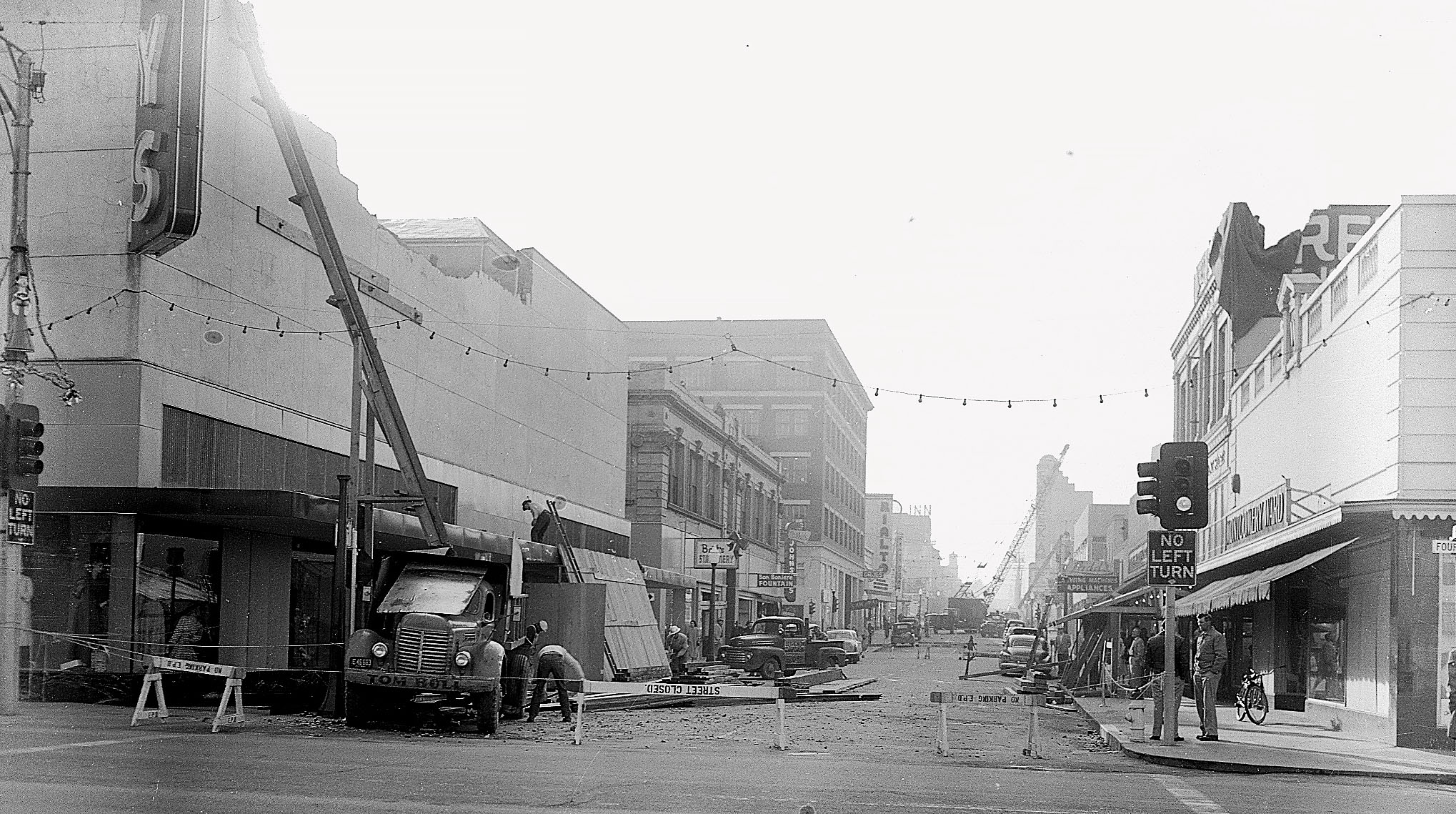
The aftermath of the Dec. 21, 1954, earthquake, as seen from Fourth and F streets in downtown Eureka. | Photo contributed by Lori Dengler via the Humboldt Times.
###
Just before noon on Dec. 21, 1954, a 6.5-magnitude earthquake rocked northern Humboldt County, toppling chimneys, shattering storefront windows, buckling old buildings and causing irreparable damage to Eureka’s old courthouse. The initial jolt triggered the collapse of a log deck in Korbel, killing an employee at the mill. Fifty others were injured, and countywide damages were estimated at $2 million.
While destructive, the earthquake itself wasn’t unprecedented — the North Coast region has experienced four dozen earthquakes of a magnitude 6.0 or greater since 1900, according to data from the U.S. Geological Survey (USGS). What set this one apart was its unusual inland location and the intensity of its shaking.
This so-called “enigma” earthquake was long thought to have been the only quake in our historic catalog centered on one of our region’s many surface faults, until now.
A newly published study in the Bulletin of the Seismological Society of America revealed that the earthquake “most likely” took place approximately seven miles beneath Fickle Hill on the infamous Cascadia Subduction Zone interface, a major offshore fault line that runs from Northern California to British Columbia.
“One of the things that’s so unusual about the Cascadia Subduction Zone is how quiet it is,” said Lori Dengler, emeritus professor of geology at Cal Poly Humboldt and co-author of the study. “We don’t see small or moderate earthquakes on it. There have been a few very small magnitude twos and threes that appear to be close to the interface … but we’re talking about really, really small earthquakes. It never occurred to me that [the 1954] earthquake was actually an interface event, and now it looks like it was.”
The finding prompts new questions about seismic activity along the Cascadia Subduction Zone, which is capable of producing “great earthquakes,” defined as a magnitude 8.0 or greater. The last time the Cascadia Subduction Zone produced a “great earthquake” was in January 1700, when a 9.0-magnitude quake ruptured from the Cape of Mendocino north to Vancouver Island, causing coastlines to drop by several feet and an “orphan tsunami” to crash into Japan.
Before this research, seismologists didn’t know that the Cascadia Subduction Zone was capable of producing “moderate” earthquakes, ranging in magnitude from 5.0 to 6.9.
“What we now know is that this Cascadia Subduction fault can have moderate-size earthquakes,” said Peggy Hellweg, a retired seismologist at UC Berkeley’s Seismological Laboratory and lead author of the study. “It may be a relatively rare occurrence, but it can happen.”
Uncovering 70 Years of Seismic Data
Most “moderate” or “strong” earthquakes we feel here in Humboldt County originate way out in the ocean near the Mendocino Triple Junction, a tectonic boundary where the Juan de Fuca/Gorda, North American and Pacific plates meet.
Since 1950, the USGS has recorded 28 earthquakes in our region that exceeded a magnitude of 6.0. “Eight were centered in the triple junction region within 25 miles of Cape Mendocino,” Dengler wrote in a July 2024 column published in the Times-Standard. “Thirteen were in the Gorda plate offshore of Humboldt and Del Norte Counties. Six were Mendocino fault quakes, on the plate boundary that marks the southern edge of the Gorda plate. There is one enigma.”
The enigma is, of course, the Fickle Hill earthquake of 1954.
When the shaking began that December morning, it triggered nearby seismic stations in Arcata, Eureka and Ferndale. Preliminary data indicated the earthquake’s epicenter was onshore, somewhere within a huge “cloud of probability” between Arcata, Blue Lake and Dinsmore.
“Even with the seismic networks of that time, it was clear it was constrained to being onshore,” Dengler said. “The genesis of this project was: Can we figure out exactly where it was? Can we figure out if it was deep? However, our ability to constrain depth in 1954 was not very good. Now, obviously, we can’t go back and rerecord the earthquake, but what we could do is find all the records that did record it and use modern techniques to get a much better sense of the geology.”
Dengler had discussed the enigma earthquake with Hellweg many times over the years. When Hellweg retired a few years back, she decided it was time to take on the project. She dug through decades of paper records looking for any information relating to the December 1954 earthquake. Once she had what she needed, she passed it on to another researcher to be digitized and analyzed.

Scans of paper three-component accelerograms from Eureka and Ferndale seismic stations. | Image contributed by Peggy Hellweg.
While Hellweg scoured 70-year-old documents, Dengler conducted in-person interviews with people who had lived through the earthquake. “It was amazing how vivid their recollections were,” she said.
“There was the four-year-old boy who was sitting at his kitchen table and watching a cup and a saucer vibrate along the countertop and then stop and not fall off. It’s one of his earliest memories, and we can actually tell [a lot] from that story,” Dengler said. “First of all, it was high-frequency motion. If it had been low, slow motion, it wouldn’t have vibrated; it would have just sat on the counter. We can also tell that it wasn’t super strong at his location because it didn’t go flying off the counter.”
Dengler also recounted the story of an 11-year-old girl who was riding her bicycle around Eureka with a friend when they were “suddenly stopped in their tracks” because the shaking was so strong.
“They could see the ground rolling like the ocean and see chimneys toppling,” Dengler said. “One thing she said that really stuck in her mind was the woman in her bathrobe and her curlers racing out of her house onto the street, which, in 1954, was definitely not something you did. … It was fascinating, not only to get a sense of the pattern of shaking, but that the pattern of shaking supported this moderately deep — not super deep and not super shallow — earthquake.”

The aftermath of the 1954 earthquake at the old Arcata Market. | Photo contributed by Lori Dengler via the Arcata Union.
When Dengler first began her research, she theorized that the 1954 earthquake occurred within the subducting Juan de Fuca/Gorda Plate, where we tend to have strike-slip earthquakes.
“That would have been my guess … because that’s where we see the most earthquakes,” she said. “I would have bet that this was a moderately deep strike-slip earthquake, but it wasn’t. … It was definitely what we call a ‘thrust’ earthquake, where one side is shoved up over the other.”
There are only two places on the North Coast where thrust earthquakes can occur. “One is in the faults really near the surface,” Dengler said, referring to a series of exposed fault lines that trend northwest, parallel to mountain ridges. The Little Salmon Fault, for example, runs through the College of the Redwoods campus and has several parallel fault strands running through the Mad River Fault Zone.
The other place where thrust earthquakes can occur is, of course, the Cascadia Subduction Zone.

Cross-section of the Cascadia Subduction Zone. | Graphic: USGS
‘It’s Certainly Opened Our Eyes’
What does this new research mean for our understanding of the Cascadia Subduction Zone, you ask?
“The results [of this study] have contributed new insights into its source, which is quite possibly the Cascadia subduction interface, making the 1954 earthquake the first large event to be documented in the instrumental era centered on the locked boundary,” the study states. “[O]ur study of the 1954 Fickle Hill earthquake provides a template for the reexamination of other significant earthquakes of the pre-digital age.”
In simpler terms, seismologists now know that the fault line is capable of producing moderate earthquakes, not just catastrophic events.
“The Cascadia Subduction Zone is about 650 miles in length. … [The 1954] earthquake caused slip on a patch [of the fault line] that was about 10 miles, maybe even less than that,” Dengler said. “One side slipped up and over the other, only on the order of a foot or so. For a magnitude 9.0, we would expect a rupture of 650 miles long. One side would be shoved over the other on the order of 30 to 60 feet.”
“It’s certainly opened our eyes,” she continued. “It’s causing a lot of discussion in the scientific community, which is exactly what we wanted to do.”
The work isn’t quite finished. Dengler is still looking for eyewitness accounts of the 1954 earthquake. Hellweg will continue collecting records and seismic signals to better understand the complexities of the Cascadia Subduction Zone, and whether the next “great earthquake” could be preceded by a foreshock (a small to moderate earthquake that occurs before the big one).
At several points during our conversation, Dengler emphasized that this study “does not in any way change our perception of the hazards” posed by a rupture on the Cascadia Subduction Zone.
“One magnitude 6.5 earthquake 71 years ago is not going to relieve stress on the interface, especially since it only slipped a 10-mile zone,” she said. “It’s completely negligible in terms of the general picture of Cascadia.”
If you’ve read Kathryn Schulz’s article “The Earthquake That Will Devastate the Pacific Northwest,” published in The New Yorker in 2015, you are almost certainly already terrified of the impending catastrophe that awaits within the Cascadia Subduction Zone. Among other frightening things, the article claims that Cascadia is “long overdue” for a rupture, an assertion Dengler passionately disputes, given that geological evidence indicates the Cascadia Subduction Zone ruptures every 200 to 800 years.
Rather than taking a fatalistic approach to the inevitable rupture of Cascadia, Dengler encouraged residents and local governments to start preparing for a massive seismic event sooner rather than later.
“Thinking ‘Oh my god, we’re all going to die!’ means ‘I’m just not going to think about it because there’s nothing I can do to prepare. That’s exactly the opposite of what you want to do,” Dengler said. “What you do and what your community does beforehand will make a huge difference in terms of how comfortable you are in the hours, weeks and months afterwards, and how quickly your community can recover and kind of get back to a new normal.”
Dengler is still looking for eyewitness accounts from the 1954 earthquake. If you or someone you know lived through the earthquake — or if you happen to have old newspapers, church records, diaries, or anything from that time period — give Dengler a call at the Humboldt Earthquake Education Center at 707-826-6019 or send an email to kamome@humboldt.edu.
###
###
Want to prepare you and your family for an earthquake or tsunami? Check out the links below for local emergency preparedness tips.
OBITUARY: Robert ‘Mickey’ Dale Huber, 1940-2025
LoCO Staff / Wednesday, Aug. 27, 2025 @ 6:56 a.m. / Obits

Robert
“Mickey” Dale Huber
September
10, 1940 – August 21, 2025
Robert “Mickey” Dale Huber passed away at the age of 84 on August 21, 2025, at his home surrounded by family.
He was born on September 10, 1940, in Ukiah to John and Agnes Huber, the youngest of nine children. In the 4th grade, his family moved to Eureka, where he would spend the rest of his life.
Mickey met the love of his life, Gloria Joyce Richardson, around 1960 through mutual friends. They married on May 4, 1962, and together raised three children: Michael Bennett, Debra Bennett-Stauffacher, and Julie Huber-Schaefer.
He worked nearly 30 years for Simpson Timber Company. When the plywood mill closed, he began a new chapter as a bartender, working at Rico’s, Gloria’s Pub, and Myrtlewood. Later, he joined the road crews for Mercer Fraser, where he finished his career.
Mickey had a gift for building and fixing anything, with a tool for every project and a love for guns and reloading. He was known for his pranks, his stories, and his sense of humor. Remembering names wasn’t his strong suit—everyone was simply “sweet pea” or “dickhead.” He was one of a kind, the end of an era, and will be deeply missed.
He is survived by his daughters, Debra Bennett-Stauffacher and Julie Huber-Schaefer (husband Jim); his daughter-in-law, Beth Bennett; his grandchildren, Clay Bennett, Michael Bennett, Samantha Bennett, Gracelyn Bennett, Dustin Veatch, Thomas and Karen Bennett, James Cameron, Danielle Cameron-Sproul, Brandy and Melissa Parker, Jynelle and Jayme Schaefer; and many great-grandchildren.
He was preceded in death by his wife, Gloria Huber (2012); his parents, John (1979) and Agnes (1968); his siblings John, Oliver, Eugene, Stanley, Lois (Pat), Ralph, Jerry, and Larry; his stepson Michael Bennett (2008); and his granddaughter Jessica Clark-Cameron (2005).
A casual potluck in Mickey’s honor will be held on Sunday, August 31, 2025, at 1 p.m. at the family home, 1474 Terrace Way, Eureka.
###
The obituary above was submitted on behalf of Mickey Huber’s loved ones. The Lost Coast Outpost runs obituaries of Humboldt County residents at no charge. See guidelines here.
OBITUARY: Barbara Schuler Hight, 1937-2025
LoCO Staff / Wednesday, Aug. 27, 2025 @ 6:56 a.m. / Obits

Passed away Aug. 20, 2025 at 11 a.m.
Barbara was born in 1937 in Redwood City, California. Barabara was preceded in death by her father Fred Schuler and mother Ethel, brother James, husband Bill Hight and daughter Cheryl Yanchunis.
She is survived by her son Ken Strombeck from Crescent City, daughter Leesa McCluskey and husband Jerry from Loleta, stepson Tom Hight from Fallen, Nevada.
Her family moved to Petaluma when she was six and bought a chicken ranch. Moved to Carlotta, where she attended the old Cuddeback School. Moved to Loleta (Beatrice) and went to Eureka Junior High and Eureka High School. Graduated class of 1955.
In 1969 she was married to Bill Hight. They had a trucking business and owned Hunters Inn in Loleta.
They started Hight Community Service in 1997 (Representative Payees for Social Security) and had the Community Thrift Store, which helped the low-income elderly with food, clothes, etc. They were in business for 22 years.
Barbara enjoyed her children, grandchildren, and great grandchildren, and working in her yard was her hobby until she could no longer do it.
Barbara will be cremated and placed next to her husband at Oceanview Cemetery in Eureka.
###
The obituary above was submitted on behalf of Barbara Hight’s loved ones. The Lost Coast Outpost runs obituaries of Humboldt County residents at no charge. See guidelines here.
DILLON FIRE UPDATE: Evacuation Orders in Siskiyou County; Highway 96 Could Close, Forest Managers Warn
LoCO Staff / Tuesday, Aug. 26, 2025 @ 4:19 p.m. / Fire
Press release on the Dillon Fire, from Six Rivers National Forest:
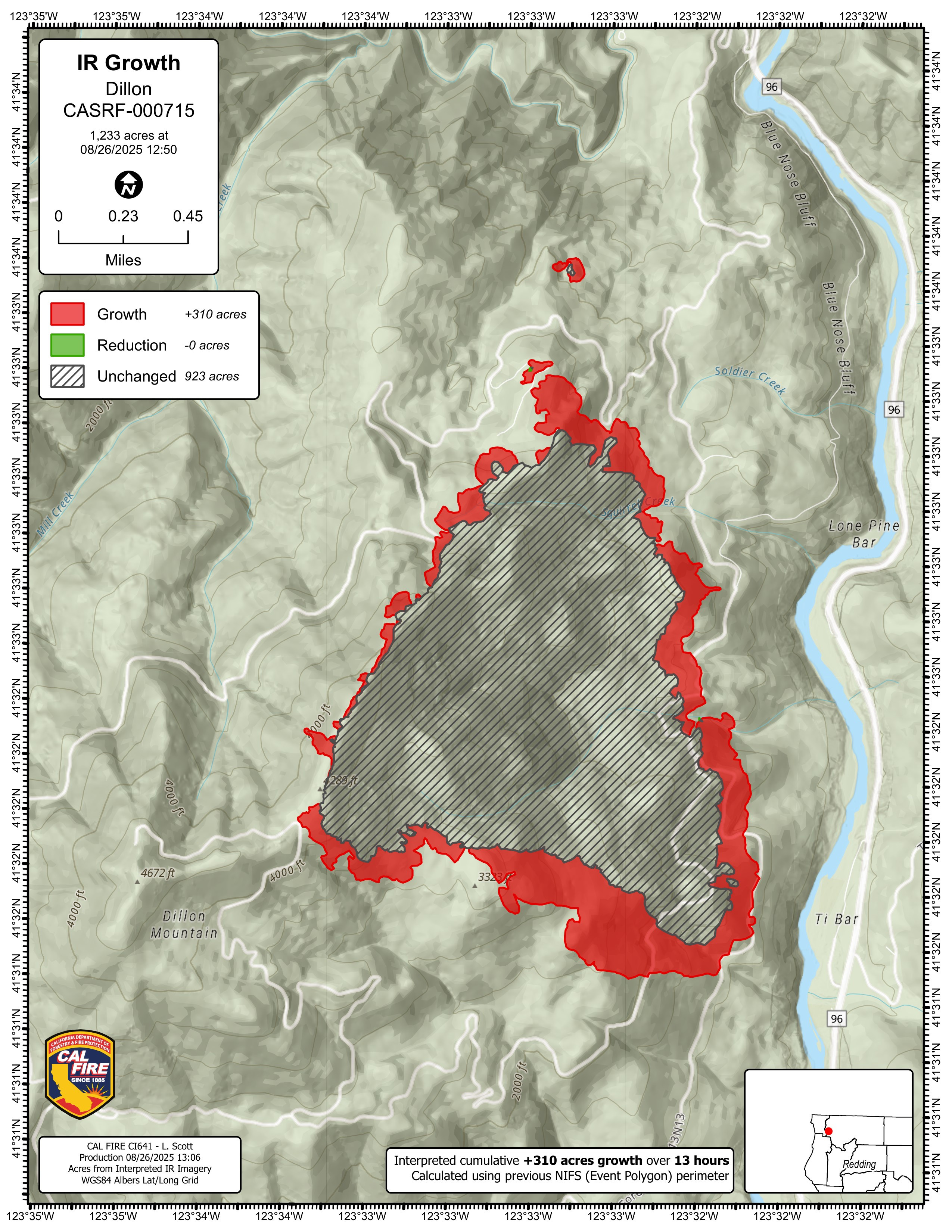
Estimated size: 1,233 acres
Containment: 0%
Date of Origin: 8/25/25
Cause: Under investigationUpdate: Firefighters on the Six Rivers National Forest are continuing response on the Dillon Fire located near Ti Bar north of Somes Bar in Siskiyou County. The fire was reported yesterday at approximately 6:30 p.m. A complex incident management team (CIMT) was ordered this morning.
Fire Behavior: The Dillon Fire is burning in steep, rugged terrain with heavy fuels. Firefighters are working on full suppression with a focus on public and firefighter safety as the highest priority.
Roads and Highways: California State Highway 96 is currently open, but that status can change by the moment. The public should watch for increased firefighter traffic in the area as resources respond and check the Caltrans Quickmap for up-to-date road status information at this link.
Current Evacuation Information:
If you are in the following zones, LEAVE IMMEDIATELY:
- SIS - 1402-A *NEW ORDER & NEW SPLIT*
- SIS - 1503-A *NEW ORDER & NEW SPLIT*
- SIS - 1509-B *NEW ORDER & NEW SPLIT*
- SIS - 1506
If you are in these zones are now under an EVACUATION WARNING:
- SIS-1402-B *NEW SPLIT*
- SIS-1509-A *NEW SPLIT*
- SIS-1604 *NEW WARNING*
- SIS-1503-B *NEW SPLIT*
- SIS-1300 *NEW WARNING*
- SIS-1301*NEW WARNING*
- SIS-1405 SIS-1408
How You Can Help: Our wildland fire crews are well equipped and cared for. Creating defensible space around your home is the BEST thing you can do to help firefighters. Learn how: https://www.ready.gov/. Banners and signs boosting morale are also appreciated. Please confirm needs by contacting organizations of your choice before donating items.
Recreation Opportunities: Many recreation areas remain open. However, Dillion Creek Campground has been closed due to the Dillion Fire.
With Labor Day weekend approaching, area residents and visitors are reminded to be careful with anything that can spark a wildfire. Visitors should also be aware of any road or recreation site closures due to wildfire suppression.
For more information about this incident and the Six Rivers National Forest, visit our webpage or Facebook page.
We’ll Have to Wait Until October to Finish the Prelim Hearing for Man Charged With Threatening Schools, Businesses
Ryan Burns / Tuesday, Aug. 26, 2025 @ 3:04 p.m. / Courts
File photo.
###
PREVIOUSLY
###

Jones in court Monday. | Photo by John Chiv.
Deputy District Attorney Roger Rees offered apologies to the court and its staff this afternoon while taking responsibility for a filing mistake that will cause a nearly two-month delay in the preliminary hearing of Daryl Ray Jones, the man accused of making dozens of threatening phone calls to local schools and businesses earlier this year.
After hearing about an hour of testimony from Arcata Police Officer Jayme Lewallen this morning, Judge Timothy Canning announced that the court would break early for lunch because the People (as represented by Rees) had just turned over some additional documents to the defense counsel, Meagan O’Connell with the county’s Conflict Counsel office.
When everyone filed back into the courtroom shortly after 1:30 p.m., O’Connell revealed that Rees had just this morning turned over 23 previously undisclosed supplemental reports from the Arcata Police Department, which contained information about additional alleged victims and locations. She’d had an opportunity to read through some of those documents during the extended lunch break, but not all of them.
“My client’s wish is to continue [the preliminary hearing] to a future date … and proceed once all of the charges have been incorporated into a single complaint,” O’Connell said.
Rees said the late delivery of those supplemental reports to the defense was “entirely our fault.” He explained that the Arcata Police Department had finished the reports back in May, though it didn’t send them to the DA’s Office until Aug. 14. Still, he acknowledged, that was nearly two weeks ago.
“It’s my mistake,” he reiterated, noting that he hadn’t read all of the information himself until just this morning. The documents contain “a lot of additional potential victims and witnesses,” he said.
Jones was again seated at the defense table in a white dress shirt, having been granted the opportunity to change out of his orange inmate’s jumpsuit at yesterday’s hearing. Judge Canning asked him if he was willing to waive his right to a continuous preliminary hearing, and he replied, “Yes.”
The hearing was then scheduled to continue on Monday, Oct. 20 at 1:30 p.m.
So that’s that. In the meantime, we can marvel at the obsessive persistence of the person behind the threatening phone calls. It wasn’t just local public schools that were threatened. Officer Lewallen, who worked for the Yurok Tribal Police and the Humboldt County Sheriff’s Office before getting hired by APD in January, testified that one local business, NorthPoint Consulting Group, received 64 phone calls in February alone from a caller with a male voice. The man often made threatening statements, though other times he hung up within seconds, Lewallen said.
On Feb. 28 she responded to a call for service at NorthPoint Consulting, which is located on Samoa Boulevard. An employee told her that after answering a recent call she’d heard the male voice reply, “Wuddup, bitch? You know who this is. Look outside.”
That same day, Lewallen responded to calls from both Arcata High School and Humboldt Brews. Employees at both locations had been receiving harassing phone calls. A secretary at AHS said the male voice had asked, “What would you do if I came over and beat your ass?” When the secretary asked for his name, the man said, “You already know” and later gave the name Jeremiah, Lewallen recalled on the stand.
A witness at yesterday’s hearing said the mysterious caller had given the name Jeremiah to employees of the Fortuna office of the California Conservation Corps, which was receiving phoned-in threats that same week.
No students were on campus at Arcata High since it was Presidents’ Week, but the school’s administrative office was placed on lockdown.
At Humboldt Brews, a female employee reported that the caller had expressed a desire to murder her, told her there was no need to call the cops and said he planned to follow her home, Lewallen testified.
As she recounted these events from the stand, Officer Lewallen periodically checked her report to refresh her memory. The Humboldt Brews employee reported getting nine calls from the man in a single hour and said she was not initially concerned but eventually grew more worried.
Taken together with yesterday’s testimony, the case thus far has seen three law enforcement officers recounting reports of nearly 100 threatening phone calls received at local preschools, elementary schools, high schools, businesses and a nonprofit. The calls prompted a series of lockdowns at local schools, terrorizing children, their families and school employees.
Jones, who is facing 19 felony counts related to criminal threats, underwent two mental health evaluations earlier this year to evaluate his competency to stand trial. The evaluations were ordered by the judge after both Jones and O’Connell said he didn’t entirely understand the charges or court proceedings.
With today’s delay, the preliminary hearing is now on a mid-season hiatus, of sorts — to be continued in October.
###
UPDATE 4:47 p.m.: District Attorney Stacey Eads provided the following details regarding the charges and potential terms that Jones is facing:
In the criminal complaint filed by my office in court docket case CR2500835 on April 15, 2025, there are nineteen felony charges with eighteen separate alleged victims. Most of the charges are Penal Code section 422 violations, criminal threats, each of which carries a maximum 3 years in prison.
Additionally, he is charged with a single charge of stalking in violation of Penal Code section 646.9, which absent special allegations also carries a maximum of 3 years, and two felony attempted criminal threats, which carry 1.5 years each.
In the criminal complaint filed on April 29, 2025, in CR2500921, he Is charged with two violations of criminal threats with the same victim.
There are numerous sentencing laws and rules that may come into play in the event Mr. Jones suffers convictions for the alleged offenses, but as currently charged he faces a potential prison sentence in the range of 12 years in prison.
Additionally, as we continue to receive additional information it is plausible there could be modifications to charges, potentially changing the exposure. In sum, it is fair to say he faces a potential prison sentence in double digits.


