

California Has 40,000 Affordable Housing Units Ready to Break Ground. One Setback Is Holding Them Up
Ben Christopher / Monday, March 9 @ 8:06 a.m. / Sacramento

Framers work to build the Ruby Street apartments in Castro Valley on Feb. 6, 2024. The construction project is funded by the No Place Like Home bond, which passed in 2018 to create affordable housing for homeless residents experiencing mental health issues. Photo by Camille Cohen for CalMatters
###
This story was originally published by CalMatters. Sign up for their newsletters.
###
The apartment building planned on East Morris Avenue in Modesto is exactly the kind of thing that California’s political leaders want to see a whole lot more of: The project promises 44 units of affordable housing — half reserved for people without homes. It’s received zoning approval, weathered public feedback, earned the support of local elected officials and sits beside a busy bus line. Once built, the project promises on-site mental health services, job training and Zumba classes.
What the project lacks is money.
Having quilted together a financial patchwork of local government and corporate grants, private debt, and a plot of land donated by a foundation, it remains just shy of the total needed to break ground.
Six years and 13 funding applications after it was first proposed, the Morris Village project sits ready, but waiting.
An estimated 39,880 affordable units across California are stuck in financial purgatory, according to a new report by Enterprise Community Partners, a national nonprofit that funds, consults and advocates for affordable housing. That’s 461 “shovel-ready developments” that, like the one on East Morris, are fully designed, legally green-lit and backed with a significant — but still insufficient — amount of money.
Many have “been sitting for a year or two waiting for funding,” said Justine Marcus, policy director for Enterprise’s Northern California office and one of the report’s co-authors. “There’s no exit route right now. It’s a bottleneck.”
For many developers and affordable housing advocates, that bottleneck represents an especially frustrating inconsistency of California public policy. Lawmakers are desperate to see the state build more homes — of all kinds, but especially for people with the least ability to pay the state’s exorbitant rents. State housing regulators have ordered local governments to plan for the construction of an additional 2.5 million units by the end of the decade. One million of those are supposed to be for people making less than 80% of each region’s median income.
As a general rule, that’s a population of hard-up renters that the private market has been unable to profitably serve at scale. To fill that gap, non-profit low-income housing developers typically turn to taxpayer-funded support. At the moment, according to the report, there isn’t enough of that to go around.
Enterprise took publicly available but hard-to-parse applicant lists from seven subsidy programs administered by various wings of California’s state government going back three years. With a combination of number crunching and a little inference, the report estimates that clearing the current backlog would require an extra $4.1 billion, split between state administered grants, low-cost loans and tax write-offs.
Once awarded, this final layer of state subsidy has to be spent in relatively short order. That means this list of 39,880 units comprise a group of affordable housing projects that are all but ready to go, said Marcus. “They kinda have to have their (stuff) together.”
Case in point: Two-thirds of the projects on the list have already received support from at least one other state program. Those dollars aren’t awarded to just any developer, said Betsy McGovern-Garcia, vice president of Self-Help Enterprises, one of two non-profits behind Morris Village.
“These are all projects that are close to amenities,” she said. “These are all projects providing resident services. These are all projects that are financially feasible…They are all meeting the bar for what we want to see as a state out of our affordable housing community.”
In February, McGovern-Garcia and her colleagues applied for a final round of financial support from the state “to close the gap” and finally start construction.
“We are optimistic this might be our round,” she said in an interview, her fingers crossed.
A moving bottleneck
California has seen gridlock in affordable housing production before, but the precise location of the traffic jam has changed over time.
When Nevada Merriman was leading a team of affordable developers in Silicon Valley a decade ago, she said local approval was the major hold-up. Getting the legal okay to build low-income housing on a particular site in a particular town required developers to run a gauntlet of planning department and city council meetings, win over hostile neighbors with costly concessions, community meetings and design revisions and to fend off the ever-present possibility of litigation. Because relatively few projects survived that ordeal, the competition for funding on the other side wasn’t especially stiff, said Merriman, who is now policy advocate for MidPen Housing, an affordable developer in San Mateo County.
That began to change earlier this decade. California lawmakers began passing laws overriding these local impediments — especially for affordable projects. All of a sudden more projects were clearing those early regulatory hurdles and competing for Low-Income Housing Tax Credits, the federal government’s signature affordable housing construction subsidy. The bottleneck moved further up the road.
But then that too began to change late last year. Buried in President Donald Trump’s signature tax bill from 2025 was a significant boost to the tax credit program. (Specifically, the law increased the total supply of one type of credit while allowing another kind to be spread out over twice as many projects).
Which brings us to the latest bottleneck.
Now projects can get through local approval. They can more easily acquire the final and most important layer of federal financing. But project sponsors typically can’t apply for that until all other financial holes are plugged.
“We’re looking for state sources to fill that gap,” said Merriman. “We want to make sure we don’t leave those federal sources on the table.”
MidPen currently has 1,198 units spread across seven developments waiting for that last bit of funding, she said. “Should there be a source…there’s a pipeline that is ready to go.”
“There’s no exit route right now. It’s a bottleneck.”
—Justine Marcus, Northern California policy director, Enterprise Community Partners
California’s last major infusion of public affordable housing dollars came in the form of a voter-approved bond in 2018. That well has run dry. A hodgepodge of funding streams remain.
Adding together funding that has already been approved by legislators but not yet spent and a variety of other state and federal sources, California’s Housing and Community Development department says at least $1.8 billion should be available for affordable developer applicants this year. Gov. Gavin Newsom’s budget proposal for the coming fiscal year doesn’t include any new discretionary spending beyond that.
Boosters of more funding have reasons to be optimistic. Newsom has taken such an austere posture in early budget negotiations before only to have the Legislature successfully pour hundreds of millions of dollars of affordable housing subsidies back into the final budget agreement.
California lawmakers are also considering a record-breaking $10 billion affordable housing bond for the 2026 ballot. If a majority of voters go for that, “we’d be off to the races,” said Merriman.
Cutting costs
One way to get more affordable housing built is by spending more money. The other is trying to make the existing money go further by cutting costs.
The cost of affordable housing construction is notoriously high in California: A 2025 study estimated that tax credit-financed projects here cost two- to four-times the amount of comparable projects in Colorado and Texas. There is no single reason for this disparity. Land costs in California are significantly higher. So too, often, is the cost of labor. Regulatory barriers like restrictive zoning, slow permitting and stiff impact fees are frequently named as culprits. Sometimes old-fashioned construction methods and materials get blamed.
But there’s also the cost of just waiting around.
A typical affordable development in California will have two or three public funding sources, with some drawing on six or more. Many of these sources are awarded on their own timelines. Each has its own program-specific requirements that can take time to meet. Some are conditional on the receipt of another. As time goes by, developers still have to make payroll, pay interest on pre-construction loans and watch as inflation drives construction costs up further. As delays compound, funding sources that have already been secured might expire, setting things back further.
Each additional funding source delays the start of construction on a project by an average of four months, adding an extra $20,460 per unit, according to an analysis by the Terner Center for Housing Innovation at UC Berkeley.
The Newsom administration is currently tinkering under the hood of California’s affordable housing finance system in an effort to speed things up.
Last year, the governor proposed the creation of the state’s first ever cabinet-level housing agency. The California Housing and Homelessness Agency is scheduled to take over the state’s disparate housing loan and grant programs. The governor’s office also proposed legislative language that would force the new agency and the Treasurer’s Office to operate in tandem, giving affordable housing developers a single place to apply for the state’s various funding programs — and to cut out some of the time they spend stuck in line.
BOOKED
Yesterday: 10 felonies, 12 misdemeanors, 0 infractions
JUDGED
Humboldt County Superior Court Calendar: Today
CHP REPORTS
852 MM199 S DN 8.50 (HM office): Trfc Collision-1141 Enrt
Poppy Dr / Sherwood Rd (HM office): Closure of a Road
ELSEWHERE
Mad River Union: Arcata’s petite data center only the first
Mad River Union: Whistleblower calls for Miranda’s Rescue end
Mad River Union: EV infrastucture needs in rural areas reviewed
Mad River Union: $600K grant for Jolly Giant, Butcher’s Slough resilience
TO YOUR WEALTH: Investing in a Time of War
Brandon Stockman / Sunday, March 8 @ 7 a.m. / Transportation
As a wealth advisor, my job is to talk to clients about their money. And to do so in all seasons of their life: marriage and divorce, career promotion and job loss, and birth and death. Financial advisors regularly deal with crisis in the lives of their clients and how that influences investment decisions.
I have mixed feelings when writing about investing in times of war like this because human beings have far more dignity and value and influence for good or evil than money. Flipping such things into a conversation about investing can feel trite and insensitive, and we should resist that impulse.
But it’s my job and therefore my responsibility to speak to the potential impacts of geopolitical conflict on our financial journeys, specifically in how we invest.
It might surprise you to find out that typically the impact of military invasions and conflicts when it comes to market volatility, as JPMorgan puts it, is “short-lived”.(1)

Furthermore, the below chart compiles major geopolitical calamities and shows that the US stock market has averaged a one-year return of 14%.

Ryan Detrick, a Chief Market Strategist at Carson Group, digs even deeper on the details of general (not only military) geopolitical shocks.(2)

On average, the S&P 500’s investment return is positive over a 3-, 6-, and 12-month period.
What about the impact of an oil shock?
We know this affects gas prices, is inflationary, and can crunch the pocketbooks of the consumer. But how does it affect the stock market?
Matt Cerminaro, a data research associate at a wealth management firm, has this encouraging chart(3):

Translation: since 1990, the S&P 500 has been down in only 17% of years that followed a dramatic oil price spike, and the average and median performance is above a 20% return.
Those odds are worth considering.
What’s the takeaway from all this data?
The stock market does not always perform how you think it will.
Therefore, don’t become a bigger problem to your portfolio than the event itself. Investment decisions you make may have a longer impact than the events themselves.
None of the above guarantees anything.
But it does give perspective.
In times of flooded news feeds and division, hard data cuts through the noise.
Overall, make sure you have an investment portfolio that #1 you can handle and #2 enables you to reach your goals.
Thus far, the investment return of the US stock market has withstood incredible pressure from crisis and benefited long-term investors significantly. (4)

Investing is hard. Life can be hard.
Don’t give up.
###
1. Madison Faller & Erik Wytenus, “The US and Israel strike Iran: what it could mean for markets” (March 2, 2026). Accessed online.
2. Posted on X by Ryan Detrick (February 28, 2026 at 12:48pm). Accessed online.
3. “What Happens to Stocks After Oil Rips?” (March 3, 2026). Accessed online.
4. “Markets in Perspective Client Resource Kit” (Fourth Quarter 2025). Accessed online.
# # #
Brandon Stockman has been a Wealth Advisor licensed with the Series 7 and 66 since the Great Financial Crisis of 2008. He has the privilege of helping manage accounts throughout the United States and works in the Fortuna office of Johnson Wealth Management. You can sign up for his weekly newsletter on investing and financial education or subscribe to his YouTube channel. Securities and advisory services offered through Prospera Financial Services, Inc. | Member FINRA, SIPC. This should not be considered tax, legal, or investment advice. Past performance is no guarantee of future results.
THE ECONEWS REPORT: Transmission Upgrades for Offshore Wind
The EcoNews Report / Saturday, March 7 @ 10 a.m. / Environment

Photo via Pixabay.
###
For offshore wind to fight climate change, that power needs to reach the larger statewide grid where it can replace fossil fuel electricity generation. The catch? Humboldt’s current transmission lines are too small to transmit that power out of Humboldt. New transmission infrastructure has been proposed to solve this problem, with the California Independent System Operator selecting Viridon to build new 500kV transmission lines. While this is a big project, new analysis from the Schatz Energy Research Center found that the cost to California ratepayers is low, about $1.68 per year. Tanner Etherton, Awbrey Yost and Jim Zoellick from Schatz join the show to nerd out over transmission infrastructure planning.
Have other questions about offshore wind? Check out northcoastoffshorewind.org
###
HUMBOLDT HISTORY: How Humboldt State Became a Top University in the Field of Natural Resources
Richard L. Ridenhour / Saturday, March 7 @ 7:30 a.m. / History

The first fish hatchery at Humboldt State College. Photos via the Humboldt Historian.
###
The following piece has been adapted by the author from his book, Natural Resources at Humboldt State College — the First 30 Years. —HH.
###
In 1935-36, two events occurred which set the stage for the formation of a Natural Resources Department at Humboldt State. First, there was the 1935 authorization to expand the educational opportunities of Humboldt State College. From the time of its founding in 1913 as Humboldt State Normal School, the two- year Arcata college was primarily a teacher-training institution. Then in 1921, it became the four-year Humboldt State Teacher’s College. But in 1935, the school was renamed Humboldt State College and was authorized to expand its offerings in the liberal arts accordingly.
The second key event was the arrival of Hortense Lanphere in 1936. Hortense Marie Lanphere had just completed her master’s degree with a major in Zoology at the University of Washington. She and her husband, Professor William Lanphere, came to Humboldt State for the year in 1936, then returned permanently in the fall of 1938.
Hortense was brightly intelligent, had a strong will and a free spirit, and was intensely interested in the natural world. Probably from her awareness of the fish hatchery at the University of Washington, she was interested in researching fish culture.
However, the Prairie Creek State Fish Hatchery, which began operation in 1936, was not within commuting distance in those days. The enterprising young Hortense came up with a solution to her problem, and, without checking first with Vice President Homer Balabanis as was the usual protocol, she went directly to President Arthur Gist with her proposal. She proposed to build a small hatchery on the campus where she could do her research; it would be built without any financial support from the college; and she would volunteer to teach a class in Hatchery Biology.
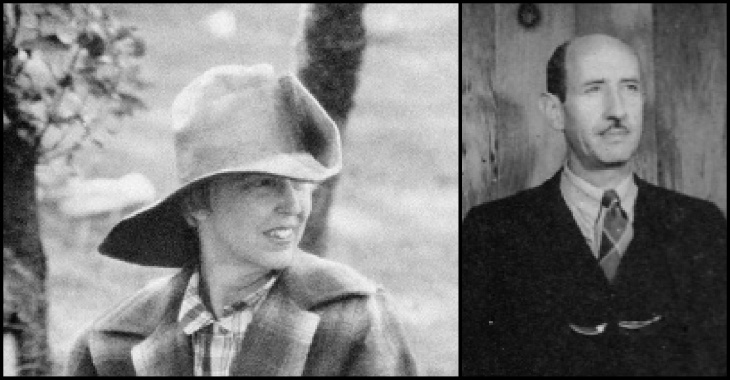
Professors Hortense and William Lanphere.
President Gist, whose primary interest at that time was the training of teachers and not applied science, was reluctant but said he would consider her proposal. He soon notified her that she could proceed the prospect of getting some students to enroll in her class at a time when the college was struggling to keep afloat likely appealed to him. He offered materials from a recently torn down dormitory for the construction of the hatchery and, if there were insufficient student interest, he offered that some of the janitorial staff could help clean the fish troughs. As Lanphere began preparing for what would be the first class in Natural Resources at Humboldt State, nobody guessed what would grow from this initial “proposal.”
Lanphere prepared plans for a building of nearly 300 square feet to contain four standard fish troughs and a small office. The hatchery would be located beside the stream just east of Redwood Bowl at the base of the existing dam creating Fern Lake. She established an account with $250 of her own funds to pay for student help and miscellaneous materials. Lumber and other supplies came from a variety of sources. Reclaimed lumber and probably plumbing supplies came from the demolished dormitory. The California Barrel Company in Arcata, managed by J. J. Krohn, a strong College supporter and avid sportsman, provided redwood bolts to make shingles for the sides and roof of the facility. Four troughs were obtained from Allan Pollitt, Foreman of the Prairie Creek State Fish Hatchery. Professor William Lanphere supervised the construction with volunteer assistance provided by William Johnson, Pete Petrovich, and Jake Relac of the College Plant Operations staff, and students including Gene German, Herb Christie, and Bob Bryan. Primarily for their work building the diversion dam, Nick Barbieri and Merlyn Allen were paid a total of $41.50 (at $0.50 per hour) from Hortense Lanphere’s fund. Lanphere’s records further indicate a total expenditure from May 1939 through June 1940 of $80.61 from her $250 for construction of the diversion dam, the hatchery itself, and miscellaneous supplies.

Hortense Lanphere’s account book for hatchery expenditures, page one.
Her class in Hatchery Biology was first offered in the Spring Semester of 1940 with a planned enrollment of 8 students. Twelve signed up. The students in that first class, each of whom paid $2.00 to help offset operational costs such as fish food, included: Merlyn Allen, Walt Farley, Herb Gomez, Axel Lindgren, Herman Jones, Harry Manning, Walt Munroe, Marshall Rousseau, Frank Sanderson, Al Simay, Richard Tinkey, and Alvin Wright.
Allan Pollitt delivered 10,040 eyed silver salmon eggs in late February. The fish started hatching within a week of their delivery and began swimming about in their troughs. When they were three weeks old, the students began to regularly feed them and clean the troughs. The effort culminated in late May when, with the assistance of Pollitt, the class planted approximately 9,000 fingerlings into Little River. This first academic effort in Natural Resources at Humboldt State was a resounding success and set the stage for the next development.
###
A second class in Natural Resources was launched when August Bade, then superintendent of the State Game Farm at Yountville, spoke to local sportsman groups in early January 1940 about the need for conservation of wildlife and showed pictures of the propagating and rearing of game birds. Later that same month, the Bureau of Game Farms of the California Division of Fish and Game was reported to be considering the development of a game farm with the involvement of Humboldt State College.

Professor Fred Telonicher.
As with the Fish Hatchery, a course of study was proposed along with the rearing project and students would be involved in the care of the game birds. Professor Fred Telonicher expressed interest and willingness to teach the class. President Gist supported developing a program of “practical instruction for students interested particularly in Fish and Game Conservation, forestry, or other related fields of study.” Dr. Homer Balabanis, Vice President of the college, and J. J. Krohn and Dr. Vernon Hunt, College Improvement Association members and avid sportsmen, undoubtedly influenced the President’s support.
Again, the avoidance of direct outlay of college finances was an essential condition for the approval to move ahead. However, due to the interest and support of local sportsmen, the development of pens to raise game birds received much greater publicity and outside assistance than had the effort of Hortense Lanphere. Building materials from the demolished dormitory were still available.
Authorization was obtained for workers from the Works Progress Administration (WPA), already on campus for other projects, to do the construction. And the Humboldt County Board of Supervisors agreed to provide funds: $640 for construction materials and $150 per year, funds available, for operations. These funds would be generated by fines levied on violators of state hunting and fishing regulations.
Work started on the new game pens in March of 1941. The pens were built immediately north of Nelson Hall (where Redwood and Sunset Halls now are located) and were ready to receive the first consignment of 250 day-old pheasant chicks from the Yountville State Game Farm in April The new Game Bird Management class had been started at the beginning of the 1941 spring semester with thirteen students: Herb Christie, Eugene R. German, Warren Haughey, Herbert Hudson, Fred Iten, Angelo Manfreda, Harry Manning, Marshall Rousseau, Elrid Spinas, Marshall M. Taylor, Ben C. Vonah, Arnold Waters, and Daniel R. Williams.
The students were assigned to teams who rotated responsibilities for the care of these birds and subsequent deliveries of chicks and eggs. By the end of the summer of 1941, 475 birds had been released at various locations throughout the Humboldt County. Local sportsmen, including Dedrick Oliver, Axel Anderson, J. R. Bicknell, Elmer Berg, Rease Wiley, C. J. Hill, Harvey Tighe, Waino Atilla, Roderick Frost, and Otto Klopp, gave a hand when it came time to release the birds in various North Coast areas from Ferndale to Orick. As in the hatchery, the hands-on instruction appealed to the students. However, sometimes extra hands were needed: Margaret Telonicher, wife of Professor Telonicher, would often have to help care for the pheasant eggs being incubated in her basement, especially when power outages necessitated that she use her oven to delicately continue the incubation.
###
The College had shown its optimism for the future of the program in the fall of 1940 with the announcement of a two-year program in Wildlife Management. The program included four courses in Natural Resources: Conservation of Natural Resources, Hatchery Biology, Game Bird Management, and Diseases of Game Birds. A Natural Resources program was up and running! Students showed enthusiasm and interest. But the advent of World War II brought the program to a virtual halt. There were fewer than 500 students enrolled at Humboldt State College in 1939 and 1940 and by 1943 and 1944 the enrollment dropped to around 200 with no more than about 50 men. Needless to say, enrollments in the Natural Resources courses declined dramatically and the Hatchery Biology course was not even offered in those years. But Vice President Balabanis saw the potential of the program and anticipated a renewed student interest as the World War II veterans returned. He later recalled that, “By then the program, in our eyes, was justified … our environment was a natural. And, one would think, ‘Why didn’t we do it before?’” He also noted that Humboldt State was the first college in the nation to boast both an on-campus fish hatchery and game pens.

Professor John Lewis.
Even though no student had yet completed the two-year program, a four-year baccalaureate curriculum with a major in Wildlife Management was developed as the war came to an end. Knowing that the program could not continue to be taught as an overload by Professor Telonicher and by Hortense Lanphere as a volunteer, a new faculty member was recruited to lead the program. Professor John Lewis began teaching in the fall of 1946, and, in fulfillment of Vice President Balabanis’ optimism, 40 students enrolled in the new degree program that fall. Professor Lewis was energetic and immensely popular with the students and the community.
As the program grew, Professor John DeWitt was hired in the fall of 1949 to lead a new and separate baccalaureate degree program in Fisheries. A tragic setback occurred when Professor Lewis died in an automobile accident that same fall. Lewis’s replacement was Professor Fred Glover who arrived at the beginning of the 1950 spring semester.
Through this transition, student interest remained high and growing numbers of students were being attracted to the program from throughout the state. Three new faculty members were hired in 1953 Professor Charles Yocom replaced Professor Glover, who had moved on to a position with the U. S. Fish and Wildlife Service. Professor Ed Pierson was hired to lead a new two-year program in Forestry-Lumbering, and Professor Mark Rhea was hired to lead a new two-year program in Agriculture- Dairying.
The size, importance, and future potential of the program was recognized in the fall of 1956 when a Wildlife Building was completed. A separate Division of Natural Resources was created with Professor Yocom as the Chairman. Though the proposed Agriculture-Dairying program never really got off the ground, the Forestry-Lumbering program generated immediate interest with enrollments growing rapidly. In 1956, the two-year program became a baccalaureate degree program with a major in Forestry. That same year master degree programs were authorized with majors in Fisheries and Wildlife Programs, such as Range Management, Oceanography, and Natural Resources Planning and Interpretation and other master degree programs would develop from these beginnings.
Hortense Lanphere clearly did not anticipate what would evolve from her first course in Hatchery Biology. In fact, when asked why she sought to build the hatchery and teach a class, it turned out that she was actually seeking a way to research Saprolegnia (a fungus) affecting salmon eggs, without having to over-expose her fingers to cold water because of her mild Raynaud’s syndrome, a circulation problem of the fingers. “Scrubbing one fish trough would be fun but more troughs would be contraindicated. Why couldn’t students do that?”
Even so, as was reported in the Arcata Union in 1944, “Through her suggestion, the hatchery was built and in the spring of 1940 she taught the first course … The opening of this course was primarily the beginning of Humboldt’s Fish and Game department.”
###
Richard Ridenhour was born and raised in Sonoma County. He attended Humboldt State College and received a BS degree in Fisheries in 1954. After attending graduate school at Iowa State College and then working for the Oregon Fish Commission, Ridenhour joined the faculty in the Department of Fisheries at Humboldt State in 1960, where he remained until retirement in 1992. His tenure included ten years as the Dean of the College of Natural Resources.
The piece above was printed in the Summer 2008 issue of the Humboldt Historian, a journal of the Humboldt County Historical Society. It is reprinted here with permission. The Humboldt County Historical Society is a nonprofit organization devoted to archiving, preserving and sharing Humboldt County’s rich history. You can become a member and receive a year’s worth of new issues of The Humboldt Historian at this link.
OBITUARY: Dennis ‘Buddy’ Ohligschlager, 1942-2026
LoCO Staff / Saturday, March 7 @ 6:56 a.m. / Obits

Dennis
“Buddy” Ohligschlager
April 30, 1942 – February 13,
2026
Dennis “Buddy” Ohligschlager was born on April 30, 1942, in Iowa. He grew up in Southern California, but in 1975 he made a decision that would define the rest of his life. He moved his young family to Humboldt County in search of something quieter, cleaner and more intentional — a place away from the rush of city life, where he could raise his children surrounded by redwoods, rivers and community.
That choice said everything about who he was.
Dennis spent his career as a social worker, first in Los Angeles County and later in Humboldt County, where he worked in Child Protective Services and Adult Protective Services. This was not just a job to him — it was his calling. He took the work personally. He answered late-night phone calls and weekend emergencies without hesitation. He believed people mattered, especially the most vulnerable, and he quietly helped more individuals and families than most will ever know.
The phone ringing late at night was a constant in our home. But so was his steady presence as a father. No matter how tired he was, he showed up — helping with homework, offering advice, or simply sitting nearby to make sure we felt supported. Long before dozens of children would know him by his nickname, he was simply Dad — steady and there.
After retiring from the county, Dennis stepped fully into the name so many would come to know him by. Together with his wife, Janet, he opened a daycare — originally to help raise their grandson. It quickly became much more than that. Dozens of children passed through their doors over the years, and all of them adored “Buddy.” He was the fun one. The one who pulled kids in a bright red wagon through Highland Park — once even making the local paper. The one who got down on his hands and knees to play. The one who made time.
As his grandchildren grew, Buddy became their chauffeur, their loudest fan and a constant presence. He rarely missed a game or event, and his grandchildren’s friends remember him just as fondly as family does. In many ways, Buddy became part of the landscape of childhood for an entire circle of families.
Dennis was remarkably smart — the kind of person who seemed to know something about almost everything. He had a wicked sense of humor and a quick wit that could catch you off guard. He loved riding his bike to work, walking miles each day, and spending time near the Trinity River. He appreciated Humboldt’s beauty and lived in it fully.
In his later years, life changed in ways that were not always easy. Like many families, ours experienced seasons that were complicated and human. But the decades he spent showing up — for his family, for children in his care and for vulnerable members of this community — remain the truest measure of his life.
On February 13, 2026, Dennis was tragically killed by a vehicle while out on one of his long walks — still active, still moving through the community he chose so many years ago.
He is survived by his wife, Janet Ohligschlager; his children, Dennis Ohligschlager and Christina Taylor (Troy Taylor); his grandchildren, Audrey Dart, Cameron Dart and Drake Ohligschlager; many step-grandchildren; and countless others who knew him simply as Buddy.
There will never be another quite like him.
###
The obituary above was submitted on behalf of Buddy Ohligschlager’s family. The Lost Coast Outpost runs obituaries of Humboldt County residents at no charge. See guidelines here. Email news@lostcoastoutpost.com.
OBITUARY: Gerald ‘Jerry’ Lee Polzin, 1947-2026
LoCO Staff / Saturday, March 7 @ 6:56 a.m. / Obits

Gerald “Jerry” Lee Polzin
July
29, 1947-February 2, 2026
Gerald Lee Polzin was born on July 29, 1947, in Arcata, California, the eldest of three children of John and Evelyn Polzin. He grew up in Arcata and graduated from Arcata High School in 1965.
In 1966, Jerry enlisted in the United States Marine Corps. He proudly served in Vietnam, where he was wounded in combat and awarded two Purple Hearts. He was honorably discharged in November 1967.
Following his military service, Jerry attended Humboldt State University, earning a B.A. in Business. He married Sharon Jowers in 1976, and their marriage ended in 2007. He began his career with Cal Farm Insurance, where his dedication and strong leadership quickly moved him into management.
Jerry is preceded in death by his father, John Polzin; his mother, Evelyn Polzin; his sister, Laurie Rapp; and his nephew, Joshua Rapp.
He is survived by his son, Shawn Polzin (Jen); his daughter, Kimberly Johnstone (Braden); and his brother, Rick Polzin. He also leaves behind his beloved grandchildren, Presley, Luke, and Isabella.
Jerry is finally at peace after a yearlong battle with cancer.
###
The obituary above was submitted on behalf of Jerry Polzin’s family. The Lost Coast Outpost runs obituaries of Humboldt County residents at no charge. See guidelines here. Email news@lostcoastoutpost.com.
Supervisor Natalie Arroyo Issues Statement Upon Learning That She Will Run Unopposed For Re-election
LoCO Staff / Friday, March 6 @ 10:18 p.m. / Politics
Humboldt County Fourth District Supervisor Natalie Arroyo released the following statement to the Outpost today:
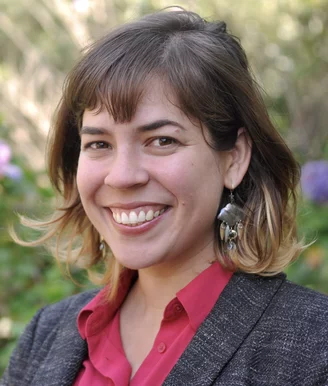
Photo via County of Humboldt
The deadline to file as a candidate has passed as of close of business today, Friday March 6, and I am the only candidate who has qualified to run for the position of County Supervisor to represent District 4.
Over the past 3+ years I’ve been honored to support the great work our County does for residents, to employ thousands of dedicated employees, and to learn deeply about our community. The work counties do isn’t always easily understood and follows strict guidelines – we provide food and housing resources, healthcare, environmental oversight, election services, transportation routes, and much more.
I’m proud to have served as we finished the Humboldt Bay Trail, completed the Regional Climate Action Plan, funded behavioral health priorities, advanced restoration of the Eel River, and enacted policies to make Humboldt stronger. I’m equally proud to be trusted by residents, staff, and community leaders as someone to turn to when they need help.
These are tumultuous times, and I will stay focused on delivering key resources, support, and mandated services over the coming years. Many systems we rely on for our health, basic needs, and foundation of our local economy are threatened by funding cuts and policy changes, placing more load on local systems.
That said, there are some exciting projects that I look forward to seeing progress on, including multiple new behavioral health facilities, our public health laboratory, the County component of the next phase of the Annie and Mary Trail in partnership with Arcata, increased frequency and efficiency of bus service along the 101 corridor, supporting our port partners in long term planning and projects, economic development and tourism projects, Eel River dam removal and restoration, and much more.
The next 4 years won’t be easy, but I will keep showing up, hearing your ideas, and working to keep our community healthy and resilient. While there aren’t other candidates on the ballot, I would nonetheless love to earn your vote. I look forward to a seamless transition and the opportunity to keep serving Humboldt County through the end of 2030.


