Earlier today, local family nurse practitioner Lindsey Mendez — a member of the county’s vaccine task force — took some time to answer media questions about the new Johnson & Johnson COVID-19 vaccine. How does it work? Who is it for? Is it good? (Adenovirus, basically anyone and yes.)
Video above, rough transcript below.
###
Thank you for joining us for the March 4th Media Availability with Family Nurse
Practitioner and Humboldt County Vaccine Task Force member Lindsey Mendez. Lindsey is going
to begin by explaining the characteristics of the Janssen, or Johnson & Johnson vaccine.
Hello thank you, hi Humboldt County again, my name is Lindsey Mendez and I’m here to introduce
the Janssen vaccine to you today, or the Johnson & Johnson vaccine. In December I had the great privilege, with Diane Pacora, to introduce the Pfizer and
Moderna vaccine to you and I would like to tell you a little bit about the differences
between the mRNA vaccines and the new DNA vaccine that’s coming from Janssen.
Just so everybody has less confusion, Johnson & Johnson is the company and Janssen was another
part of the company that supported and sponsored the vaccine and that’s why it’s named that way.
So as we know we have two vaccines that are mRNA vaccines. We have the Pfizer vaccine and
the Moderna vaccine, which we’ve been giving since December. Now we are going to be very excited to
start a single-dose vaccine which is a DNA vaccine and this is going to be a one shot in your arm
vaccine with an efficacy rate that will build over a longer period of time as opposed to needing two
shots. So this DNA vaccine, your immunity is going to be building over the course of
two weeks and then a month and also I would like to review what that means for it to be
an adenovirus vector DNA vaccine.
So what this is is that as opposed to having the mRNA which
we talked about before where you get an injection of the mRNA for a spike protein for the COVID-19
virus and then it going into your cells and allows you to create immunity to that spike protein. Now
this is a little bit different, we are going to be getting a shot that laboratory members have
engineered to be using a virus — an adenovirus — which would usually just give you a common cold
and then it carries the DNA for the COVID-19 spike protein and then in your own cell
in the nucleus you then are creating the information from the DNA to be immune to COVID-19.
So even though it’s a little bit different it’s pretty similar in a way that it’s going to work
for us and the as I said before the good news is is that this is a one-shot vaccine, so we will be
distributing it throughout the county very soon as it will most likely be appearing in the next week.
From the North Coast News: Has public health run into the situation where people are refusing to
take one specific version of the vaccine? For example, someone shows up to their appointment
and says they will only take the Moderna vaccine. What is the frequency with which this happens?
I’m not sure the frequency in which this happens but as a member of the task force,
I do know that it has happened enough times that we are aware that people do have preferences
but the great news is that every vaccine available has excellent efficacy
and that any vaccine that you desire will give you a good protection against COVID-19. It
is the choice of the individual if they would like Pfizer, Moderna or the Johnson & Johnson
and as we’re aware many people are very excited about having all three options.
From the North Coast News: With vaccination rates increasing in Humboldt, when does the
county expect to see a drop in coronavirus cases due to a large amount of people being vaccinated?
This is an excellent question and as we move forward we will be having a better
understanding about the herd immunity of our county as we continue to vaccinate first and
second doses of the Moderna and Pfizer vaccine and also starting with the Johnson & Johnson.
What we do know is that this is going to take months of time, throughout the spring and the
summer and getting into the fall to get everybody fully vaccinated in our county and also in the
state of California to end the pandemic and we would ask that everybody continues to socially
distance and wash their hands and mask as we get to this safe level.
From the Redheaded Blackbelt:
How helpful is it for a rural county like Humboldt to have access to this single-dose vaccine?
I think it’s extremely helpful for any place to have access to a single-dose vaccine but
especially in rural areas where people have issues with transportation, sometimes they
have issues with technology of not being able to use wi-fi perhaps, they can’t get to their
second dose appointment this is a very important thing for people with equity in a rural area.
From the Redheaded Blackbelt: With the addition of the J&J vaccine, how will the timeline of vaccine
distribution locally change, if any?
Well we do not know if it will change if any but what we can
tell you is that with an extra vaccine that we’re having it tells us that we will have more vaccine
of a different kind coming to the county and this will inevitably help vaccinate more people.
From the Redheaded Blackbelt: Would the J&J vaccine be better suited for any particular
demographic due to its (so far) unique qualities of being not only single dose, but also considered
100% effective at preventing hospitalizations and deaths, and if so, who would that be?
The
CDC has made numerous suggestions about how the Johnson & Johnson vaccine can be utilized.
Some of these suggestions include mobile health clinics, primary care offices
and clinics that work with people who are often traveling.
From the Times-Standard: How is the
county focusing its outreach to the Spanish speaking population as the vaccine continues to
be rolled out? Have there been any difficulties in reaching the Latinx community?
I’m very glad
that we have the time to talk about this question today and that it was brought up. Communication
is a challenge for many communities especially if there’s any language barrier and we are aware that
in the pandemic this has not gotten any easier. With that said the Public Health department
and the EOC are actively recruiting staff and volunteers to help us with our vaccination clinics
for Spanish interpreters anyone who is willing to come forward as a bilingual speaker
and ranging from intake to administration to vaccinators, this would be very helpful.
The Public Health department is also engaging in listening sessions with this community, it is
our highest priority that we understand the needs and desires of the Latinx community at this time.
From the Times-Standard: Has the county received any Johnson & Johnson vaccine doses? If not,
when will the county begin receiving the Johnson & Johnson vaccine?
The county has not received
the Johnson & Johnson vaccine in the freezer or refrigerator at this time but we have been
allocated vaccine from the state and we will be getting updates about when we will be receiving
this.
From the Times-Standard: Considering it is a one dose formula, will the Johnson & Johnson
vaccine be given priority for remote areas and people who have trouble making appointments?
At this time we do not know how the state allocation system will be prioritizing the
Johnson & Johnson vaccine. What we do know is that as we move with the state plan changing to
Blue Shield of California taking over the allocation process they will be working hard
to ensure equity and that the Johnson & Johnson is used appropriately.
From the Times-Standard: Will
Humboldt County be receiving any of the vaccines allocated by the state for lower income regions?
At this time again we do not know the answer to that question and
we are waiting for the state to give us more information.
From the Times-Standard: Is there any data being collected on regional vaccine efficacy?
The
data that’s collected by the local public health departments is not data that will be necessarily
telling us about the regional vaccine efficacy, these kinds of trials and studies are done by the
pharmaceutical companies who run the drug trials themselves, and so at this time we are submitting
data using our tracking through what is called VAERS and CAIR which are abbreviations for the
state systems where we document vaccine and demographics.
The Arcata Police Department is providing a new online police reporting option for the public. This web based reporting system will allow the public to file certain incident types (minor theft, vehicle burglary, lost property, non-injury traffic collisions, crime tips, etc.) over the internet at their convenience. The Arcata Police Department expects this internet based reporting service to be very popular among citizens who have come to expect police services to be provided immediately and conveniently online.
The service will allow the public to file a report at a time that is best for them without having to wait for an officer to respond or call them back. The public will be able to print a temporary copy of the report upon submitting the report. The report will be reviewed by police personnel and once approved the filing person will receive an email with a copy of the report attached without cost. The report will transfer into the Arcata Police Department’s records management system and receive the same investigation and statistical analysis ability as if the report had been filed by a police officer.
This web based reporting option will allow officers more time to address community needs while keeping pace with the public expectancy to complete services via the internet. The Arcata Police Department will be using the Desk Officer Online Reporting System from San Ramon, California based software company Coplogic, Inc (www.Coplogic.com).
Press release from the Humboldt County Sheriff’s Office:
The Humboldt County Sheriff’s Office has recently received several reports of a common phone scam circulating again around the community.
As part of this scam, the caller ID appears to be from the Humboldt County Sheriff’s Office. The scammer claims they are from the Sheriff's Office and may use several different names, with the name “Lieutenant Paul Jones and Captain Paul Jones” reportedly being used most recently. The caller tells the victim that they missed a federal court appearance for which they were subpoenaed, and now the victim has a federal warrant for their immediate arrest. The scammer tells the victim to buy up to $6,000 worth of Green Dot cards or other gift cards, then instructs the victim to read the numbers on the back of the card over the phone. The scammer then tells the victim to go to the Humboldt County Sheriff’s Office station to verify their identity and further “straighten out the warrant.”
The Humboldt County Sheriff’s Office would like the community to know that this is a scam. While law enforcement may contact you regarding a warrant or investigation, we will never demand payment in exchange for dropping a warrant or stopping an investigation. Additionally, no government agency will ask you to mail large sums of cash or pay with gift cards or pre-paid money cards.
Remember these tips to help protect yourself from fraud:
1. Spot imposters
Scammers often pretend to be someone you trust, like a government official, a family member, a charity or a company with which you do business. Don’t send money or give out personal information in response to an unexpected request – whether it comes as a text, a phone call or an email.
2. Do online searches
Type a company or product name into your favorite search engine with words like “review,” “complaint” or “scam.” Or search for a phrase that describes your situation, like “IRS call.” You can even search for phone numbers to see if other people have reported them as scams.
3. Don’t believe your caller ID
Technology makes it easy for scammers to fake caller ID information, so the name and number you see aren’t always real. If someone calls asking for money or personal information, hang up. If you think the caller might be telling the truth, call back to a number you know is genuine.
4. Talk to someone
Before you give up your money or personal information, talk to someone you trust. Con artists want you to make decisions in a hurry. They might even threaten you. Slow down, check out the story, do an online search, consult an expert — or just tell a friend.
5. Don’t rely on personal information
Living in the digital age, access to information is easier than ever. Scammers are often able to get their hands on very personal information, providing it to their victims to make their scam look more legitimate. Don’t trust a scammer who is able to provide your personal information. If you followed the above tips and still aren’t sure, call back at a publicly listed number for the organization from which the scammer claims to be or contact your loved one directly.
Sign up for the Federal Trade Commission’s scam alerts at ftc.gov/scams.
Patients at the St. John’s Well Child And Family Center in South Los Angeles were inoculated with the Pfizer COVID-19 vaccine. Photo by Shae Hammond for CalMatters
###
Another sudden shift in state policy has triggered an array of concerns and confusion today about how California’s still-scarce COVID-19 vaccine supplies will be divvied up.
Dr. Mark Ghaly, the state’s top health official, announced that 40% of California’s vaccine supply, starting with 2 million doses, will go to the poorest and most diverse communitIes.
The county and city health officers — who run the vaccine programs in their communities — said they weren’t pleased that they only heard about the major policy shift from news outlets. Community clinics in those neighborhoods also said they were not notified.
Local health officials also highlighted a more immediate concern: As Sutter Health, one of the major vaccine providers in California, cancelled tens of thousands of vaccine appointments for lack of supply, county-run vaccine clinics are starting to see “Sutter refugees” — people who are scrambling to get their second doses before a certain deadline.
The communities receiving the 40% encompass 400 of the state’s ZIP codes, largely in Los Angeles County, the Inland Empire and the Central Valley, based on their low scores on the “Healthy Places Index,” which measures criteria such as income, education, park access, air pollution and housing.
Ghaly said about 1.6 million doses already have been administered to the underserved communities that the state is now targeting. So now those communities will receive at least 400,000 doses more in the next two weeks, double the current supply.
People in those ZIP codes must still meet eligibility requirements before they can be vaccinated — at this point, people 65 and older, health care workers, educators and some other essential workers.
The communities receiving the 40% encompass 400 of the state’s ZIP codes, largely in Los Angeles County, the Inland Empire and the Central Valley
Many questions remain about how the state will ensure doses get into the arms of people in those communities. Many counties and cities, particularly Los Angeles, Oakland and Long Beach, have affluent neighborhoods right next to poor neighborhoods. And some ZIP codes, such as one in Hawthorne and Manhattan Beach, contain both types of neighborhoods.
More appointments through the vaccine registration site, MyTurn.ca.gov, will be reserved for people living in the priority ZIP codes — an attempt to keep people from wealthier communities away.
And community clinics, which serve underserved communities, will be prioritized in the new vaccine network led by Blue Shield, Ghaly said. The state will also have mobile vaccination clinics and add resources for people who are homebound, he said.
“Sending (vaccine) there is one thing, but ensuring it gets to the arms of those living in these communities is another,” Ghaly said.
The allotment of 40% to certain communities raises questions about whether other populations of Californians will be pushed lower on the priority list. In addition, another 10% of doses have been earmarked in California for teachers and child care workers.
If those groups are prioritized for 50% of the doses, it follows that other groups — particularly people outside those ZIP codes who have high-risk health conditions — will be less of a priority.
But Ghaly said he expects vaccine shipments to increase over the next couple weeks, so he thinks other groups will not lose out. He predicts that all communities soon will get at least as many doses as — or more than — they currently receive.
“Of course targeting scarce resources to certain ZIP codes, certain communities, certain eligible populations is going to mean that some communities don’t get as much of an increase as others. But we expect that all communities will get at least as much as they’re getting now,” Ghaly said.
“Sending (vaccine) there is one thing, but ensuring it gets to the arms of those living in these communities is another.” — Mark Ghaly, Secretary of California Health and Human Services
Ghaly said a disproportionate number of people with chronic conditions or disabilities live in the prioritized ZIP codes.
Californians with cancer, heart disease, diabetes and other high-risk disorders become eligible for vaccines on March 15. Guidance on how they can verify medical conditions and access vaccinations will be released in the coming days, Ghaly said.
Advocates have criticized California’s vaccination program for failing to serve poor communities of color, which have been battered by a high rate of COVID-19 infections.
Only about 16% of total vaccines administered in the state have gone to people in the bottom quarter of the Healthy Place Index. In comparison, 34% of the state’s vaccines have been administered in communities in the highest quarter.
California has adjusted its priority system several times since vaccines became available in December. It first put out a system based on employment and medical conditions, with health care workers and nursing homes prioritized. Then the state announced seniors 65 and over would be eligible to sign up, although some counties initially only opened it up to those 75 and over, noting lack of vaccine supply. Teachers and child care workers, along with some essential workers, such as food and agriculture, are now also eligible. State officials have said that after essential workers and people with underlying medical conditions, vaccination eligibility will be based on age.
The result is a dizzying array of constantly shifting priorities that confused and worried local health officials and advocates.
###
CalMatters COVID-19 coverage, translation and distribution is supported by generous grants from the Blue Shield of California Foundation, the California Wellness Foundation and the California Health Care Foundation.
CALmatters.org is a nonprofit, nonpartisan media venture explaining California policies and politics.
On March 4, 2021 at about 7:45 a.m., Detectives with the Eureka Police Department’s
Problem Oriented Policing Team (POP), conducted a probation search of a motel room
at a motel on the 100 block of 4th Street. The room was registered to 46-year-old
Charles Lloyd Gay, of Eureka. Gay is on formal probation in Humboldt County for
possession of heroin for sales.
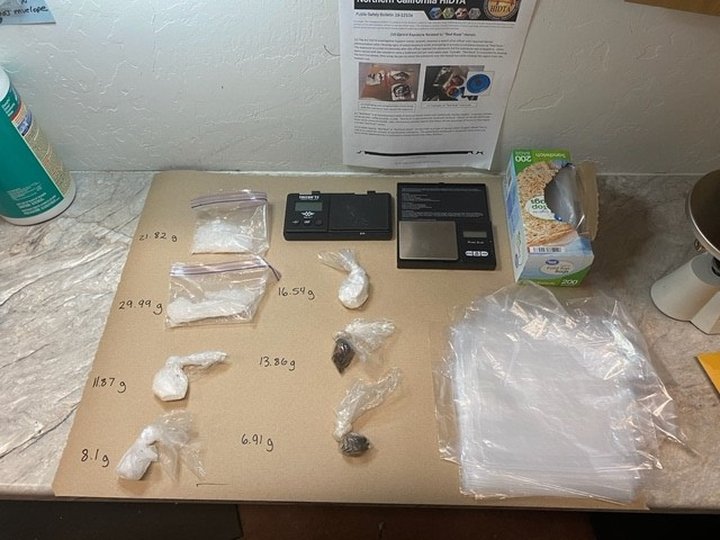
During the search of the room, detectives located 71 grams of methamphetamine, 20
grams of heroin, 16.5 grams of Fentanyl, packaging material and digital scales.
The Fentanyl was tested at the scene with a TrueNarc machine. The TrueNarc machine
is a device used to identify substances in a safer manner, reducing the chances of an
accidental and potentially deadly exposure to the tester.
A vehicle Gay has been seen recently driving was found parked in the parking lot. The
vehicle had dealership plates attached to it. A check of the VIN revealed it was
reported stolen in June 2020.
Gay was arrested and booked into the Humboldt County Correctional Facility for
possession of methamphetamine for sales, possession of heroin and Fentanyl for sales,
possession of a stolen vehicle and violation of probation.
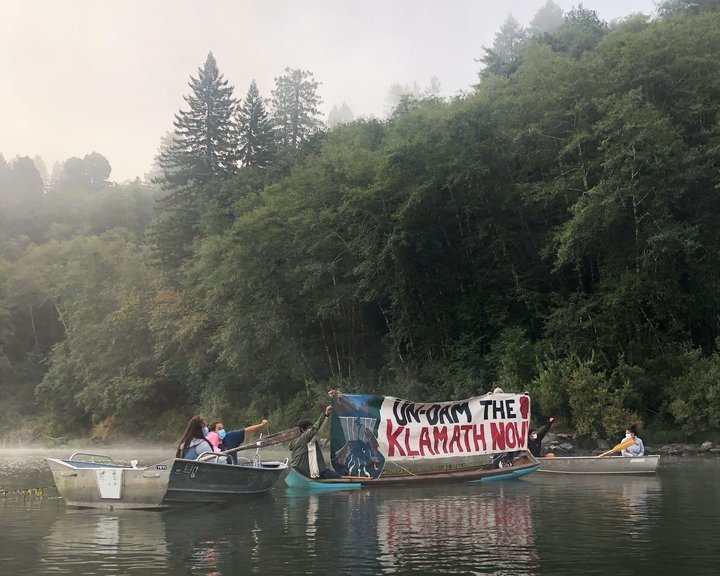
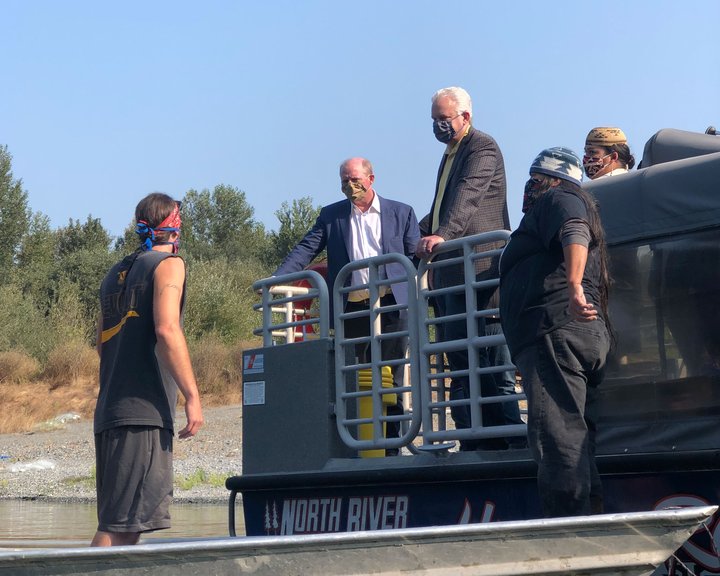
A floating blockade stretches across the Klamath River waiting to stop boats carrying Yurok and Karuk tribal officials and Berkshire Hathaway executives upriver on Aug. 28, 2020. Photo: Mahlija Florendo
###
It
was a Friday in late August when four jet boats made their way up the
Klamath River under a cloudless blue sky. The boats carried three
tribal chairs. From the Karuk Tribe, there was Russell “Buster”
Attebery, who’d found pride as a boy catching salmon from the river
and bringing them home to his family, and later come to believe some
tribal youth’s
troubles —
from suicides to substance use — could be traced back to their
never having had that opportunity, growing up alongside a river now
choked with algae and diminishing fish populations. There was Joseph
James from the Yurok Tribe, who’d come to see the river’s
declining health as a “slow
strangulation” of his people — “river people” — who have
lived along its banks and relied on its salmon as the bedrock of
their diet since time immemorial. And there was Don Gentry, recently
elected to a third term as the upriver Klamath Tribes’ chair, whose
people hadn’t seen salmon and steelhead swimming in their ancestral
territory in a generation.
There
were others on the boats, too. People like Craig Tucker, an
environmentalist who promised himself in school he’d never waste
his career fighting for quixotic causes, yet had now come to spend
two decades working on Klamath dam removal. There was Frankie Joe
Myers, who’d come of age amid the fight to undam the river and was
now in the thick of it as the Yurok Tribe’s
vice chair.
But
the trip up the Klamath that day in August wasn’t really about any
of the people who’d made undamming the river a central part of
their life’s work, it was about about making a case to two men
who’d never set eyes on the river before but held its future in
their hands.
Weeks
earlier, after a Federal Energy Regulatory Commission ruling had
derailed a hard-fought 2016 agreement to remove the four
hydroelectric dams choking the lower Klamath River, Myers and James
had issued a plea. While PacifiCorp, the electric company that owns
and operates the dams, was publicly musing about walking away from
the agreements, Myers and James decided to appeal directly to
Berkshire Hathaway, the holding company run by Warren Buffett,
perhaps the world’s most successful and famous investor, which had
acquired PacifiCorp for more than $5 billion back in 2005.
In
a meticulously worded email to Berkshire Hathaway Energy Vice Chair
Greg Abel, who’s believed by many to be the 89-year-old Buffett’s
successor, Myers said he and James invited one of the world’s most
powerful men to simply come see the river, sit and talk. Abel
accepted and soon he and Berkshire Hathaway Energy CEO William
Fehrman were sitting on a jet boat headed upriver.
It’s
hard to overstate the stakes that day on the river. Activists and
officials alike had long believed the best chance to fundamentally
change the dam-removal conversation was to get Berkshire engaged, a
step the company seemed entirely unwilling to take, a core tenet of
its company ethos being not to interfere in the operations of its
subsidiaries. Yet here sat Abel and Fehrman, the Klamath wind in
their hair.
Tribal
officials had worked hard to keep word of the visit close, concerned
an ill-timed protest or demonstration could jeopardize this show of
good faith. They’d mapped out the day carefully to showcase the
Klamath’s beauty and potential, planning to give the executives a
meandering tour of family fishing holes and camps on the river until
eventually landing where Blue Creek enters the Klamath — a scenic
spot filled with biological diversity and spiritual significance for
the Yurok Tribe — where they’d lunch on traditional salmon cooked
on sticks over an open flame. But as the boats rounded a sweeping
bend in the river, it became instantly clear some had other plans. A
floating blockade — a few boats and dugout canoes, with large nets
stretched across the river — came into view, dotted with signs
calling for the river’s undamming, some punctuated by red fists.
Myers,
who said he’d personally assured Berkshire representatives they
would be safe coming to Klamath, said his heart quickened a bit when
he saw the blockade, unsure what was to follow.
“It
was risky,” Myers said. “There
were a few moments when I was like, ‘I have a couple of the richest
men in the country on a jet boat and I don’t know what [the
protesters] were going to do.’ … Everyone in the boats felt very
vulnerable.”
The
blockade, which comprised a couple dozen of the Klamath River’s
most ardent activists, ordered the jet boats to stop. Then, the
activists took turns addressing the representatives of one of the
world’s most powerful companies.
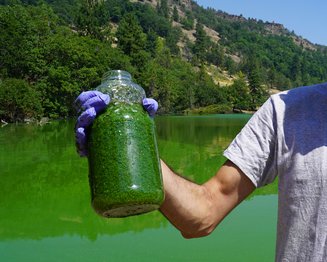
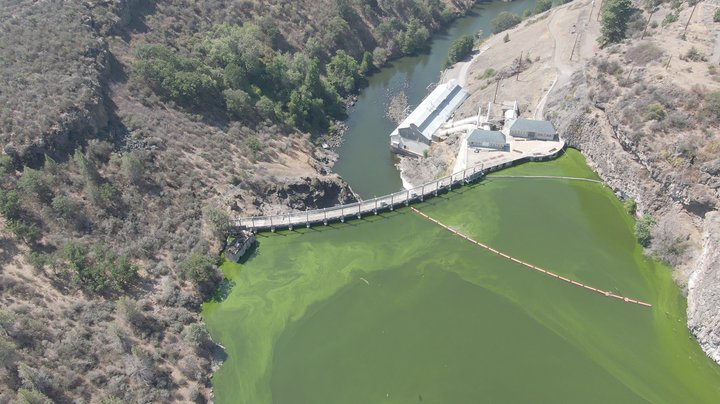
A jar full of Microcystis cyanobacteria in the Copco Reservoir on the Klamath River. The algae produces a carcinogenic liver toxin called microcystin, which is harmful to humans and animals, including salmon. Photo: Stormy Staats.
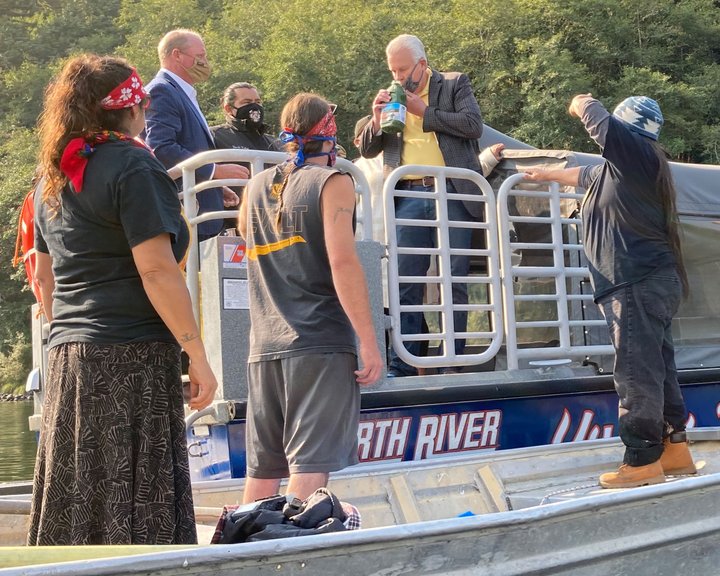
One
of them presented the men with a plastic jug of water pulled from
behind one of the dams, where the water is choked with bright green
algae and pressed them to open the jug and smell the toxic brew.
Another noted that an entire generation of water protectors had been
raised in this fight under the oppressive weight of a sick river. Jon
Luke Gensaw pulled off his COVID-19 facial covering, telling the men
to take a good look at his face.
“If
this doesn’t end, you’re going to see more of us,” he said. “I
want you to remember my face because you’ll see me again.”
Chook-Chook
Hillman, who joined the effort to remove the dams when he was a
teenager and whose dad would take him to the meetings with upriver
irrigators and ranchers that led to the 2010 dam removal agreement
that died in Congress, started by asking his son to present the
executives with a gift.
“Thank
you — very kind,” one of them can be heard to stammer in a
recording of the exchange.
The
gift, Hillman later told the men, was a small white flag affixed to a
wooden stick. Hillman said he and his fellow water protectors would
be waiting when the executives and tribal officials returned
downriver. If they waved the flag, it would be a sign that an
agreement had been restored. But if not, Hillman warned, Berkshire
Hathaway should brace for protests like it had never seen.
“If
you guys ain’t waiving that flag when you’re coming down the
river — it’s on,” he said.
Annelia
Hillman told the executives that the health of the river is their
responsibility — their problem — and one that’s going to effect
their children and grandchildren, their futures.
“It’s
affecting you, too,” she said. “Don’t
think this is an Indian problem. It’s your fucking problem, too.”
After
a tense 15 or so minutes, the blockade moved to the side and the
boats headed on. When they came back down again some hours later,
Hillman said no one aboard would make eye contact with him or the
other water protectors.
The
flag was nowhere to be seen.
###
Berkshire Hathaway executives talk to Klamath Justice Coalition activists who stopped them on a trip to the river. Photo: Mahlija Florendo
About
six weeks before that day on the river, the Federal Energy Regulatory
Commission had issued a ruling that put the groundbreaking dam
removal deal — itself a resuscitation of a more ambitious deal
reached in 2010 that was dependent on Congressional approval that
withered on the vine — in serious jeopardy.
Under
the terms of the 2016 deal, the Klamath River Renewal Corporation had
asked FERC to transfer the licenses of the four dams to a newly
created nonprofit, which would then oversee and assume liability for
the removal process, allowing PacifiCorp to step away cleanly. The
dams would then be removed using $450 million already raised for the
purpose — $200 million from PacifiCorp ratepayers and $250 million
in water bonds authorized by California’s
Proposition 1.
But
FERC ruled the company couldn’t simply walk away from the dams it
built and the situation it had created, and would need to remain
attached to the dams as their co-licensee until their removal.
Regina
Chichizola, the policy director at Save California’s Salmon who has
been involved in Klamath dam removal and other watershed restoration
efforts for more than a decade, said she had mixed emotions watching
the FERC hearing. On the one hand, she said, she personally
understood the ruling and why a private company shouldn’t be
allowed to permanently alter a river for profit and then simply walk
away. She also knew it would mean trouble.
“I
know how PacifiCorp is and I knew they would demand more because they
always demand more,” Chichizola said.
Within
days of the ruling, PacifiCorp began publicly hedging, saying it had
undercut some of the main “customer
protections” that had brought the company to the table for the
deal. This was a foundational shift, it held, and the deal would need
to be re-negotiated.
But
any sizeable delay would cut sharply against the chances of reaching
a new accord and seeing the dams removed, as the pot of money for the
project was unlikely to grow and cost projections would escalate with
every month or year that passed.
In
the days that followed FERC’s ruling, pockets of dam removal
stakeholders met quietly, plotting paths forward. Chook-Chook Hillman
said he and a handful of longtime river advocates got together on the
banks of the Klamath with a whiteboard and started brainstorming.
Chichizola held conference calls with environmental groups and other
stakeholders. Tucker and tribal leaders pondered their next move. And
North Coast Rep. Jared Huffman readied to throw all his weight as a
member of Congress at the problem.
They
all settled on a single target for what would be a months-long,
multi-pronged campaign the likes of which the Klamath had never seen:
Berkshire Hathaway and Warren Buffett.
Since
Berkshire purchased PacifiCorp back in 2005, many dam removal
advocates had felt Buffett was the key to getting the company on
board. He wasn’t simply one of the world’s richest man, but the
Oracle of Omaha, an almost mythical business figure famed for
down-home sensibilities and philanthropy.
Advocates
had long sought to turn his attention to the Klamath. For consecutive
years, Tucker had bought up as many tickets as possible to Buffett’s
annual shareholders’ meetings — known by some as the “Woodstock
of capitalism” — schmoozy affairs more focused on symposiums and
cocktail parties than balance sheets. They’d successfully bombarded
question and answer periods with Buffett with inquiries on the
Klamath, staged die-ins in front of black tie events and even had
Native women flood a cocktail party at a diamond store wearing
traditional regalia to talk to revelers about the Klamath and what it
means to them.
“I
have no idea how somebody like Warren Buffett thinks,” Tucker said
of the rationale for the approach. “It’s
hard for me to put myself in the shoes [of someone] who has more
money than God. But I do know he’s 90 and I do know he has Native
grandchildren. These shareholder meetings of Berkshire Hathaway are
big parties. There’s not that much business but a lot of cocktail
parties. And I don’t think he wants them to be dominated by talk of
the plight of Native people.
But
publicly anyway, none of these efforts seemed to get through to the
man who’d built an empire at least on the image that he purchased
good companies and let them operate as they saw fit.
This
time had to be different. And the effort also had to break through
amid the COVID-19 pandemic, which made mass demonstrations — and
even traditional organizing strategies — dangerous and impractical.
On
the banks of the river, Hillman and other Klamath Justice Coalition
members decided they would use personal connections to write
heartfelt letters appealing to people close to Buffett.
Chichizola
and others, meanwhile, plotted a massive social media push. They
found Gates scholars willing to post messages in support of dam
removal, hoping to catch the ear of Bill Gates, a longtime friend of
Buffett’s. And they’d work toward a large scale day of action
that would feature an online event as well as on-the-ground protests.
Meanwhile,
Myers and James got to work on their letter to Abel, the man many
expect to succeed Buffett at the helm of Berkshire Hathaway and its
quarter of a trillion dollars in annual revenue, imploring him to
come see the Klamath River and its people for himself.
###
Berkshire Hathaway Energy CEO William Fehrman smells a bottle of toxic algae pulled from above one of the four hydroelectric dams on the Klamath River while speaking to protesters at a blockade on Aug. 28, 2020. Photo: Sammy Gensaw
Ten
days prior to the blockade on the river, Huffman convened a special
virtual hearing of his Water, Oceans and Wildlife Subcommittee on dam
removal and Klamath River conditions. The hearing featured tribal
leaders who spoke of the river’s importance to their people;
environmental scientists who detailed its dire condition and the
dams’ impacts on water quality and fish populations; and North
Coast State Sen. Mike McGuire and State Water Resources Control Board
Chair Joaquin Esquivel, both of whom indicated the state had taken a
light hand with permitting PacifiCorp’s Klamath dams — a practice
that would end should the company walk away from the deals.
Berkshire
Hathaway sent to the forum PacifiCorp Vice President Scott Bolton,
whom Huffman, an environmental lawyer prior to entering politics,
seemed to relish questioning.
“Mr.
Bolton, I think it’s pretty clear that you and PacifiCorp are at a
crossroads,” he said. “You
have a choice. The river is dying. The fishery is dying. Your dam is
causing a toxic concentration of algae that’s the worst in the
world. … But you’re not powerless to protect your ratepayers. We
can work shoulder to shoulder, get this done on time and on budget,
or you can blow this thing up.”
The
comment struck back to something Huffman said in his opening
statement, laying the Klamath River’s future squarely at Buffett’s
feet.
“Warren
Buffett has the chance to be a hero in Indian country,” he said.
“Or
he has the potential to be remembered as someone who perpetuated a
grave injustice just to make a little more money.”
The
ensuing weeks would see a bevy of action. Huffman introduced
legislation that would have essentially given downriver tribes a
voice in FERC’s re-licensing processes, ensuring they would be
unpleasant affairs for PacifiCorp moving forward.
Meanwhile,
as Chichizola and others pushed toward the day of action in October,
protests began to pop up — in San Diego, where PacifiCorp was
pursuing a power deal, at the company’s headquarters in Oregon and
elsewhere — and Klamath hashtags began to trend.
“One
of the things I like to stress when talking about the story is how
every single part was in play,” said Chichizola, adding that
scientists argued the scientific case for dam removal, politicians
played politics, tribal leaders negotiated and coordinated, and a
community of activists — many who’d grown up in this effort —
organized and rallied.
When
the day of action arrived, it was massive, with COVID-19 adapted
protests in 11 cities — and in front of Buffett’s home — 7,000
people attending a live online forum and 10,000 signing petitions
calling for dam removal. Multiple national Native rights groups
joined the social media push and #undamtheklamath began trending on
multiple social media platforms. Meanwhile, a coalition took out a
full-page advertisement in USA
Today
calling for dam removal and casting it as a social justice issue.
Tucker
said he’s simply never seen anything like it.
“We
had protests popping up all over the place that we didn’t really
organize and that’s what you want — that’s a grassroots
movement right there,” he said.
###
It’s
hard to pinpoint the moment it happened — whether it was on the
river that day, Huffman’s grilling of Bolton, the scores of
heartfelt testimonials on the day of action — but something moved
and Berkshire came to the table. (Berkshire Hathaway, through a
spokesperson, “declined
the opportunity” to be interviewed for this story.”)
But
when the company did decide to take PacifiCorp’s position at the
negotiating table, stakeholders say everything changed. Myers, the
Yurok Tribe’s vice chair, said Fehrman, Berkshire Hathaway Energy’s
CEO, stepped in as the company’s lead negotiator and took a
granular approach to understanding the agreement, the dam removal
process and potential liabilities involved.
Over
the course of about a week, a core negotiating team formed, with
Fehrman representing Berkshire, Myers representing the Yurok Tribe
and Tucker there for the Karuk Tribe, as well as Oregon Department of
Environmental Quality Director Richard Whitman and California
Department of Fish and Wildlife Director Charlton Bonham. Because
everyone’s schedules were packed, the only time they could find to
meet were early mornings and weekends, but Myers said no one flinched
and the group began meeting three or four times a week, with
participants often joining the video conferences from their homes.
“It
did bring a certain amount of closeness to these meetings,” Myers
said. “The
first hour of everyone’s day, people are pretty straightforward
with who they are. You get to see people in their homes getting their
first cups of coffee. There’s some real humility there.”
Tucker
said Berkshire wanted to be walked through every aspect of the plan
in fine detail, how construction would work and a detailed breakdown
of the budget, the insurance plan and liability concerns.
“We’re
talking about removing four large dams — this is on the scale of
demolishing skyscrapers or decommissioning giant power plants,”
Tucker said. “But
they committed to being open-minded and said, ‘OK, you keep telling
us this is buttoned up, so let’s go through it again.’ Once we
went through it, they were like, ‘Wow, the Klamath River Renewal
Corporation has it together.’ … We kind of watched the
realization of the company that this wasn’t just some pipe dream.
This was well-thought-out and well-managed.”
It
was another shift. “And,”
Tucker continued, “once
they decided they were going to go for it, everything changed. Every
interaction with the company was all of a sudden, they are clearly
100 percent committed to dam removal.”
Ultimately,
the parties agreed PacifiCorp, California and Oregon would pledge
another $45 million in contingency funds to account for cost overruns
or liabilities and that Berkshire would agree to a three-way split of
any liabilities or overruns beyond that moving forward. But a
significant hurdle still remained: Berkshire wanted another entity to
take over PacifiCorp’s status as co-licensee on the dams through
the removal process. Oregon agreed to sign into the role. But the
deal needed California to do so, too.
Myers
said Bonham had done a “phenomenal
job” throughout the negotiations but indicated this kind of
decision was beyond him. The tribes would need to talk directly with
Gov. Gavin Newsom.
When
tribal representatives met with Newsom in Sacramento, Myers said he
knew the stakes couldn’t be higher. His approach, he said, was not
to vouch for the science or the economics of the project — others
had done that for years. Instead, he said, the goal of the day was to
really show Newsom what this agreement would mean to tribal people.
“It
was our role to really say, ‘This is worth it,’ and to speak to
the 150-plus years of pretty horrific negotiations with California,”
Myers said. “When
you look at the gold rush in California, when you look at the timber
barons in California, the commercial fleets of California, the
mission system in California, there is an atrocity built on an
atrocity built on the graves of our people. This is the world’s
fifth largest economy because it’s built on the resources of the
Indigenous people of California. … This is our land and we’re
still here.”
After
the group finished making its case to the governor and the meeting
was wrapping up, Myers said he offered a last push: “California
has a huge debt to Indian people and dam removal does not repay that
debt by a long shot. But it’s a good down payment.”
Newsom,
Myers said, responded: “California
is all in and we’re never going to stop until the dams come out.”
###
Algae builds up behind Copco 1 dam on the Klamath River. Photo: Karuk Tribe
In
late October and early November, word crept into activist circles
that negotiations with Berkshire were going well, that there was
progress. But it was hard to believe.
“I
was still tepid,” said Hillman. I’d heard there was another
agreement in principle. Well, I remembered the other agreements in
principle. We were hearing that there’s an agreement, that the
states are involved. That sounds good. But other agreements have
sounded good as well.”
It
was mid-November when word began circulating that a press conference
was in the works when Newsom, Oregon Gov. Kate Brown, Berkshire
Hathaway and the Yurok and Karuk tribes would announce a new deal had
been reached. But most interviewed for this story recall a singular
moment when this agreement felt not just real but substantively
different than its predecessors — a draft press release began to
circulate and in it was a quote from Buffett himself. And the quote
didn’t talk about ratepayers. It talked about the good of Native
people.
“I
recognize the importance of Klamath dam removal and river restoration
for tribal people in the Klamath Basin,” Buffett said. “We
appreciate and respect our tribal partners for their collaboration in
forging an agreement that delivers an exceptional outcome for the
river, as well as future generations. Working together from this
historic moment, we can complete the project and remove these dams.”
For
Hillman, who once fasted for 10 days in preparation for a meeting
with Buffett only to be turned away, the moment was profound.
“It
hit me a lot harder than I thought it was going to, for his words not
to be about ratepayers but about restorative justice,” he said.
“That
day did feel a lot different than it ever has. People say we’ve
been here before but I’m saying, ‘Not here.’ We haven’t been
here, where the states and the company and Fish and Wildlife are
talking about restorative justice. Those statements are hard to walk
aback. It sure does feel different.”
Last
month, the KRRC filed the new agreement with FERC for approval and,
this time, the consensus is it will be approved without issue, having
checked all the boxes the regulatory agency laid out with its prior
ruling, laying the path for dam removal to begin in 2023. Hillman
said he’s heard Berkshire Hathaway representatives have been
meeting with FERC staff to make sure everything is in order, noting
that he and other advocates were repeatedly denied such meetings.
“That
makes me happy on the one hand but just angry on the other,” he
said. “We’ve
always known that if the big wigs decide they want to do something as
a corporation in America, they do it. They could have done this the
whole time.”
But
they didn’t. Repeatedly. So what, after years of pushing and
angling, finally brought Buffett to the Klamath table? Everyone
interviewed for this story said it’s impossible to pinpoint any one
thing, as changing economics and political sentiments coupled with
stalwart generational activism all created a perfect storm. But if
there was a tipping point, Myers and Tucker said it was likely that
moment on the Klamath when a group of Native people seeking justice
for their river refused to let Berkshire Hathaway executives pass.
“At
the end of the day,” Tucker recalled, “I
was like, ‘I’m not sure that went the way we wanted it to.’ The
tribal activists became a little confrontational and I thought in the
moment, ‘Oh,
no.’
But what I thought was things going off the rails and all our best
laid plans starting to go awry I think was serendipitous. It created
opportunities for interactions that wouldn’t have happened
otherwise.
“No
one sells the Klamath better than the people who live there,”
Tucker continued. “People’s
entire adult lives have been spent fighting these dams. My child is
16 years old and that’s all he’s ever known that I do. And I
think there’s a lot of Native kids who have grown up, and that’s
all they know their parents do. … We are committed. And it’s
generational. If something happens to me, something happens to
Frankie (Myers), something happens to whoever, there’s a generation
of young people who will step in to fill our shoes. I think Berkshire
finally understood that.”
###
Thadeus
Greenson (he/him) is the Journal’s news editor. Reach him at
442-1400, extension 321, or thad@northcoastjournal.com.
Follow him on Twitter @thadeusgreenson.
The
Community Voices Coalition is a project funded by Humboldt Area
Foundation and Wild Rivers Community Foundation to support local
journalism. This story was produced by the North Coast Journal
newsroom with full editorial independence and control.
Children play in the backyard of Ana Ballesteros home where she runs a day care in Delano on Feb. 26, 2021. Photo by Shae Hammond for CalMatters
###
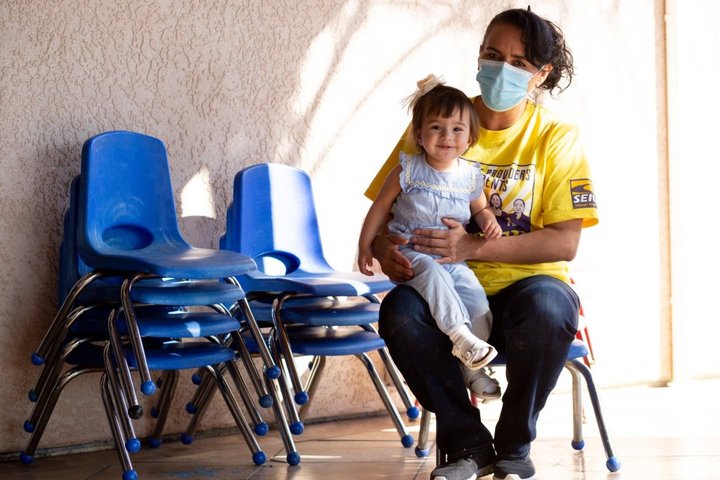
Ana Bertha Ballesteros had to close her home child care in Delano for more than two weeks around Thanksgiving when COVID-19 came to her center. A child and their family were exposed and tested positive. Then Ballesteros did too.
She is terrified of it happening again.
“I’m very concerned,” Ballesteros said. “Thank God I made it for those 14 days but if we were to have another exposure what is going to happen with me and my family? It’s our only income.”
California child care sites have reported to the state 12,032 cases of COVID-19 and 30 related deaths since the pandemic began. Infections have occurred at nearly one-fifth of all centers or homes — among staff, children or their parents. None of the 30 deaths have been children.
The pandemic has led to multiple child care problems in California, including a shortage of care centers, a non-negligible risk of infection even with costly precautions in place, and hardships for child care providers themselves.
Kern County, where Ballesteros operates, has seen 425 reported coronavirus cases at child care centers. Los Angeles County leads the state with 2,702 cases. The state is not releasing the names of the child care sites where infections have been reported because the Dept. of Social Services says they are “exempt from disclosure” under state law.
Ana Ballesteros sits for a portrait with her grand daughter Ava Dominguez at Ana’s Family Child Care in Delano on Feb. 26, 2021. Photo by Shae Hammond for CalMatters
Whether those numbers are good or bad is almost impossible to say at this point, said Dr. Ilan Shapiro, pediatrician with AltaMed Health Services and Fellow of the American Academy of Pediatrics. The circumstances at each center can vary widely, and there is not yet reliable comparison data from other states.
“In general, kids need to be in these types of centers because it helps their social development and health,” said Shapiro. “It also creates a safety net for the kids.”
He encourages parents to learn about what providers will do there is an exposure to the infection and question what protocols they follow to prevent them: washing hands, wearing masks, taking temperatures, using protective equipment.
“We have seen more cases. Kids are getting sick,” he said. “And we know that if at home we are taking care of each other and at school (or day care) they are wearing their masks and washing their hands and doing everything appropriately, that reduces the risk of getting COVID.”
California allowed child care sites to remain open throughout the pandemic — following cleaning and social distancing guidelines. As Scott Murray, spokesman for the Department of Social Services, wrote in an email: “Families need a safe place for their children while they work.”
An estimated 60% of Californians already lived in a child care desert before the pandemic.
Since the pandemic began, 2,160 California child care sites have closed permanently, representing a loss of 33,387 child care slots for children. Another 8,000 facilities — both large centers and family homes — have temporarily closed across the state as of October, according to a report given to a Senate budget committee last month.
“Losing more child care providers means even less access for working parents and their children,” said Kristin Schumacher, senior policy analyst at the California Budget & Policy Center, which made the estimate. “Eventually, we will move past the pandemic and many parents will need to find care for their kids. The economy can’t fully recover until the child care infrastructure is in place to support kids, parents, and providers.”
The loss of child care also impacts children directly. They may lose stable connections, be confused or anxious and experience sadness, said Schumacher, who lost her own child care for her 4-year-old when his child care provider closed early in the pandemic.
Smaller, family child care providers have, for the most part, kept their businesses open, said Keisha Nzewi, director of public policy for the California Child Care Resource & Referral Network. But it’s been difficult, expensive and stressful for them.
“(Child care providers) have been scared the whole time and they follow the guidelines to a T even as they kept changing,” said Nzewi. “They want to do everything to keep their children and families safe, but especially themselves and their own families.”
As of Feb. 24, the more than 12,000 coronavirus cases had occurred at 5,845 day care sites, roughly a fifth of the state’s supply. Cases were reported at both large centers and family care homes where, depending on size and staff, providers can care for up to 8 or 14 children in their personal domicile.
“The economy can’t fully recover until the child care infrastructure is in place to support kids, parents, and providers.” — Kristin Schumacher, senior policy analyst at the California Budget & Policy Center
While most of the cases connected with child care sites have been among adults, the number of COVID-19 cases among kids has risen since the beginning of the pandemic. Initially, the federal Centers for Disease Control and Prevention reported that 2% of coronavirus cases were among children. The figure has risen to 10%. Plus, a small number of those children go on to develop a rare multi-inflammatory syndrome related to having had the virus.
“As a father I completely understand the debate on what to do with our kids and the delicate dance between science, fears and feelings,” said Shapiro, whose youngest child has been attending daycare and only took a few weeks off during the peak of the surge in January and early February. “I tell parents, ‘You need to create a system where you are taking care of everybody including the teachers, parents and kids to make sure everybody is safe.’”
A CalMatters review of the state’s data shows most of the cases at larger child care centers have occurred among staff members. Meanwhile, at family care homes, the number of cases has been fairly evenly distributed among staff, kids and their parents.
Researchers have found that child care sites are not hotbeds of the virus. During the first three months of the pandemic, staff at child care sites that remained open were no more likely to contract COVID-19 than providers who had closed, according to a Yale University study published last month in the journal Pediatrics.
The study reported that those who stayed open “reported frequent handwashing and disinfection of surfaces. They also have high rates of other infection control measures – like daily checks, physical distancing and keeping children in “cohorts.” Researchers did find that Black, Latino and Indigenous caregivers — who make up a large portion of child care providers — tested positive at higher rates than other groups.
Nzewi said that trend is a reflection of the larger impact of the virus on communities of color and not because child care sites are the cause.
Relief from the state
Child care advocates and a newly formed Child Care Providers United union have been negotiating with the state to get more protections for child care providers — including a one-time stipend to help with increased pandemic-related costs and 16 additional paid non-operational days related to the virus, boosting the total number to 40 annually.
Last week, Gov. Gavin Newsom signed a stimulus bill that included both of those benefits for caregivers of children who receive state subsidized care.
But Ballesteros, the child care provider in Delano, said her November closure already put her close to the limit of subsidized non-operational days even with additions from the stimulus bill. She worries about having to close again as the country marks the one-year anniversary of the pandemic.
These concerns — in tandem with frustration about the amount the state pays for subsidized child care and limited support around implementing COVID-19 precautions — are wearing on providers.
“We are not only risking ourselves, we are risking our families,” Ballesteros said.
She said she took all the precautions before getting sick: masks, social distancing, disinfecting her child care center and asking parents all the recommended questions about health and exposure. She waits for the kids outside so no parents has to enter her home, created a space for kids to put their belongings outside, and installed a sink outside for washing tiny hands on arrival.
“We are not only risking ourselves, we are risking our families.” — Ana Ballesteros, child care provider
A few days before Thanksgiving, a mom called Ballesteros to say that she wasn’t feeling well and had tested positive for coronavirus. That woman’s children had been at the center that day. The state licensing office recommended she close for a couple of days, Ballesteros said. But when she, too, tested positive, the local health department advised her to close for two weeks.
During that time, Ballesteros said, five children left her center, leaving her with just nine children in her care and a significant cut in her income.
Nzewi called the stipends a Band-aid remedy will help for that month, but there are larger issues that need to be addressed, including how little child care providers get paid, especially through the state’s subsidy system. They receive on average about $12 an hour, according to their union.
Ballesteros said her costs have increased more than 50% to account for cleaning supplies, additional tables and chairs for social distancing, boosted wi-fi for virtual learning, dividers and supplies to keep the kids busy. She also pays for deep cleaning once a month.
The state did allocate $50 million early on for cleaning supplies and stipends, but those funds ran out at the end of the year.
“Hopefully we don’t get COVID again, and that’s why I’m so afraid of it,” Ballesteros said. “Right now, it’s tight but we are making it. But if this happens again I don’t know if we will be able to continue.”
###
CalMatters coverage of early childhood issues is supported by grants from First 5 Los Angeles and The Ralph M. Parsons Foundation.
CALmatters.org is a nonprofit, nonpartisan media venture explaining California policies and politics.