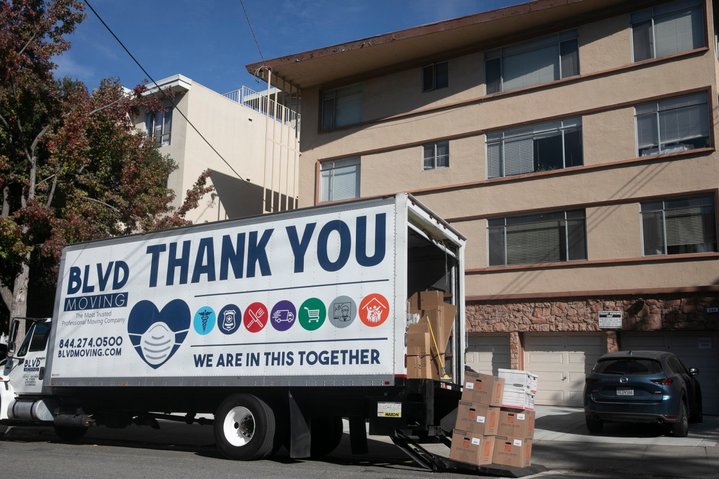
A moving truck with COVID-19 aware messaging outside of an apartment building in Oakland on Nov. 7, 2020. Photo by Anne Wernikoff for CalMatters
###
When a strange and deadly virus shut down Hollywood last March, Alexander Shea knew he had to move fast. But to where?
The 24-year-old actor and usher at Beverly Hills’ Wallis Annenberg theater was out of work overnight. Soon, the whole economy shut down. When rumblings about closing state borders got louder, Shea piled what he could in his Mustang and left his $1,500-a-month, 390-square-foot Glendale apartment for his hometown.
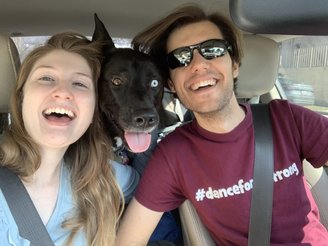
“My girlfriend and I were in the car with our dog driving to St. Louis,” Shea said. “I got like three hours of sleep in two days.”
Alexander Shea and his girlfriend, Alexandria, drove from Glendale to St. Louis with their rescue dog, Bowie, in the early days of the COVID-19 pandemic. Photo courtesy of Alexander Shea.
A new report released Thursday by the California Policy Lab, a research arm of the University of California, found “no evidence of a pronounced exodus from the state,” nor data to suggest that large numbers of wealthy residents are leaving. Two notable exceptions: the city of San Francisco saw a large year-over-year loss, and the state as a whole saw more departures and fewer arrivals in the final quarter of 2020. Some 267,000 people left California around the end of the year, compared to just 128,000 people moving in from other states.
“To date the pandemic has not so much propelled people out of California as it has shifted them around within it,” according to the report. “The absence of a pronounced exodus from the state should come as a relief to people concerned about effects on state tax revenues.”
The decision to move has always been highly personal — subject to work, family ties, lifestyle preferences and a million other variables — and official federal moving data takes years to compile. In California, the nation’s most populous state with some 40 million people, the number of things happening at once can make things even murkier.
The remote work crowd is just starting to confront the prospect of salary cuts if moves to lower-cost locales become permanent. Arts advocates warn of a “cultural depression” after 175,000 creative jobs vaporized during the pandemic. For Californians barely hanging on, breakdowns in the state’s job safety net are colliding with long-running failure to build affordable housing or accurately count people forced into precarious situations like couchsurfing or living in cars. Through it all, the state wound up with $26 billion more than expected, thanks largely to tax receipts from wealthy individuals who are still here.
What we know so far about the much-discussed California Exodus is a patchwork. The new California Policy Lab analysis is based on credit reporting data, which doesn’t necessarily catch movement among young people with little credit history, or some very low-income or marginalized groups. U.S. Postal Service data recently analyzed by the San Francisco Chronicle showed that Bay Area movers overwhelmingly stayed in the region. Companies like Zillow and U-Haul have offered up their own partial data, and a cottage industry of online moving groups say they’re flourishing with ideological pitches to move to Texas, Idaho or beyond.
“The traditional data sets that we use to look at residential mobility are great, but they’re not very frequent,” said Natalie Holmes, the UC Berkeley doctoral student who authored the lab’s report, opening the door to more anecdotal reports. “I have a friend who’s in an Airbnb in Tahoe, because she can work remotely,” Holmes said. “These are all capturing slightly different concepts of where people live.”
New booms and busts
Until recently, San Francisco was often in the headlines for being one of the most expensive places in the world to live. But since last March, the number of people leaving the city on net jumped an eye-popping 649% compared to the same period in 2019, based on the California Policy Lab’s analysis of address information filed with credit card companies and other financial agencies. About 80% of those 38,800 people stayed within the region, though counties in the Sierras like El Dorado, Placer and Nevada also saw sizable gains. The report does not say where those who left the state moved. [For the record: This story has been corrected to reflect that the California Policy Lab found a 649% net increase in San Francisco residents moving out since March 2020.]
It feels like people around here have kind of accepted this ridiculous, expensive market, and they want more of it. — Heidi Hart, owner of California Dreaming Real Estate
The in-state shuffling is already leading to new booms in some corners of California. High in the Santa Cruz Mountains, not even the combination of a pandemic and a summer wildfire that burned down 900 homes has slowed real estate bidding wars. As far as Heidi Hart can tell, all the anxiety has actually supercharged the housing market.
“It feels like people around here have kind of accepted this ridiculous, expensive market, and they want more of it,” said Hart, fresh off her best year ever as owner of Santa Cruz County’s California Dreaming Real Estate. “It’s like it’s a drug or something. There’s money coming out of the woodwork from everywhere.”
Houses in Santa Cruz County are getting up to 20 offers and selling for hundreds of thousands of dollars over the asking price, Hart said, in large part because there are fewer options. She currently has 25 homes listed for sale, compared to the usual 100 or so this time of year. About 60% of buyers are coming from the Bay Area to take advantage of remote work, Hart estimates, some putting up inherited cash or tech stock proceeds to make offers more attractive. Most sellers are staying close to home, at times transferring low property taxes guaranteed by California’s Proposition 13 to bigger houses, but a few have cashed out for Utah or Idaho.
The sense of scarcity is more acute at lower price points, which are harder for researchers and official counts like the census to track. As home bidding wars rage on, would-be renters in Santa Cruz post on Craigslist about doing “the parking lot shuffle” while living in their cars — a precarious situation unemployed Californians in other parts of the state are living through, too.
Roughly 2,000 miles away in Missouri, Shea and his girlfriend are somewhere in the middle of these extremes. Nearly a year after the pair left LA to move in with family, he still spends hours fighting California bureaucrats over what he estimates is around $8,000 in unpaid unemployment benefits.
As for what comes next, an acting agent gave him a lead in Atlanta, where California rent might translate to a mortgage payment. He’s even considered moving to New Zealand.
But there’s one other appealing alternative: “If things go well,” Shea said, “I’ll just move back to LA.”
###
CALmatters.org is a nonprofit, nonpartisan media venture explaining California policies and politics.
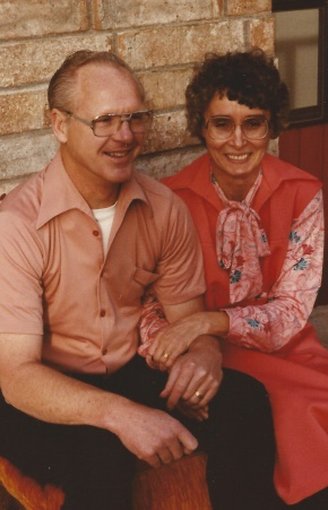
Nona Belle Ludwig was born on August
15, 1932 to Jon and Maud Winkle, in Sheridan, Arkansas.
After high school in Loyalton, she
attended Business College, becoming a legal secretary until her
retirement from the law firm of Harland and Gromala in 1990. She
enjoyed cooking, especially baking. She delighted family, friends
and neighbors with cakes, pies and cookies. She was noted by her
children’s friends for her chocolate gravy and biscuits on Sunday
mornings. She and her husband, Wes, shared the joy of cooking and
had the best stocked freezer in the neighborhood.
She was preceded in death by her
parents, her sister Juanita Colpitts, her son Larry Jay Kitchen, and
great grandson Sage. She is survived by her sister Betty Moore
Rutherford of McKinleyville, her children Nola Lionberger (Dennis) of
Grants Pass, Oregn, Jon Reames (Rita) of Panama, Okla., Kathi
Hendricks (Dennis) of Eureka and Jeffrey Kitchen (Kay) of Eureka.
She is also survived by her step
daughters, Val Slaughter (Bob ) of McMinnville, Oreon and Janelle
Benson of Stokers Siding, Australia, and their father, her beloved,
Wesley Ludwig of McKinleyville.
She is also survived by her
grandchildren Jessica Burks (James) and their children Jammy, Alexis,
Ethan and Bo; Jennifer Elmore (Clinton) and her children Taylor, Jay
and grandchild Jonah; Jana Campbell (Vallard III) and her children
Luke Butler and Trea Jamison, Katie and Vallard Campbell IV, and
Jana’s grandchild Vallard V, all of Oklahoma; Megan (Buddy)
Bartholomy and their children Zane and Kira of Sacramento; Bradley
(Satmander) Lionberger and their children Lily and Sky of Folsom;
Jeffrey (Kay) Kitchen, Eureka and their children Jonathon (Mary) of
Medford, and Nikki Kitchen of Eureka; Ian Hendricks, (Kathrina) of
McKinleyville. Her step-grandchildren are Carly (Brent) of Nepal,
India, Christopher Bryan of Lake Tahoe, and Mathew Benson of
Australia, and Ryan and Travis Slaughter of McMinnville, Oregon. She
is also survived by five nephews, Michael and Randy Moore, David and
Calvin Storie and Brian Colpitts.
She died on March 1, 2021 from
complications following a stroke. Her last days were filled with
family, including her granddaughter Jana from Oklahoma filling her personal
care needs. She was loved deeply and will be missed by all. Per her
wishes, no services will be held.
###
The obituary above was submitted on behalf of Nona Belle Ludwig’sloved ones. The Lost Coast Outpost runs obituaries of Humboldt County residents at no charge. See guidelines here.
On Tuesday, March 9 th at 5:00 p.m., the City of Eureka will host a public workshop on
Zoom to introduce and discuss the proposed draft of the Animal Ordinance. The
agenda item with Zoom link and copy of draft ordinance can be found here. The
workshop will also be streamed on the EPD Facebook page, Facebook.com/eurekapd.
The workshop will cover the proposed changes to the Animal Ordinance and offer the
public an opportunity to make comments. We encourage those interested in attending
the workshop to read the draft ordinance in its entirety prior to the workshop.
The current ordinance was written 62 years ago and has only seen minor updates which
occurred about 30 years ago. Our city, our society and way of life have all seen
significant changes during this time and it is important to have ordinances that focus on
the present and carry us into the future rather than cemented in the past.
Additionally, the ordinance focuses on industry standards and will help align Eureka with
the County and ensure ADA compliance.
The intention of the proposed ordinance is to be a roadmap to responsible pet
ownership with a focus on public safety, encouraging neighborly conduct and establishing
a minimum expectation of care. The proposed ordinance is not intended to increase
revenue. Many incentives are built in for proper licensing and impound discounts.
If you have any questions or concerns regarding the proposed Animal Ordinance, please
contact Captain Stephens by email at bstephens@ci.eureka.ca.gov
On March 2, 2021, at about 10:16 p.m., officers with the Eureka Police Department
responded to the 1500 block of 5th Street (Northbound US Highway 101) for the report
of a vehicle vs pedestrian collision. The 20-year-old male driver, a resident of Arcata,
was traveling on 5th Street when he struck the 54-year-old male pedestrian, a resident of
Eureka.
The pedestrian suffered major injuries as a result of the collision. Humboldt Bay Fire
and City Ambulance responded and provided emergency medical care and
transportation to the hospital, where he remains in critical condition.
The driver was evaluated on scene and DUI does not appear to be a factor. An
Evidence Technician and Officer with Advanced Collision Investigation Training
responded to process the scene. This is an active and ongoing investigation.
This is the twelfth serious injury or fatal collision involving a pedestrian or bicyclist on
US Highway 101 in the city limits of Eureka in the last 12 months. Eight of these
collisions occurred while it was dark or dusk. The City of Eureka’s County-Wide Traffic
Safety Task Force is launching this month and we are committed to improving safety for
the most vulnerable road users in the city.
In Bella Volz-Broughton’s experience, Black History Month was never
really recognized at school while she was growing up. Now, as an
Arcata High senior and president of the school’s Black Student
Union, she and her peers in the BSU are educating their school about
Black history themselves.
“I
never celebrated Black History Month in school. The most that was
ever done was just the simple mention that it was Black History
Month,” Volz-Broughton said in a video posted to the AHS Black
Student Union Instagram
page. “I think BSU is doing a good job of making
that change.”
That
video is part of a Black History Month series of 10 lessons created
by the AHS Black Student Union. The presentations come mostly from
BSU students, but their advisor Shannon Kresge and Northern Humboldt
Union School District board member Cedric Aaron chimed in for a
couple of videos as well. From Black figures to white privilege to
the school to prison pipeline, the speakers cover a lot of ground.
How
systemic racism “affects the Black community is also really
important because that’s not something that white people even have to
think about,” Volz-Broughton told the Outpost. “We just
want our school to be educated on that.”
Arcata
High’s BSU is young; it started in 2018 when Volz-Broughton was a
sophomore. In the beginning, administrative support was lacking and
the club received backlash from some students, she said, but “it
was very important for the Black students on campus to start having
that place of community.”
Since
then, the club’s agenda has expanded to include educating their
peers and community — a goal that, in the past, has also been met
with pushback, Volz-Broughton said. Last February, the BSU hosted a
few 20-minute assemblies aimed to teach the school about Black
History Month, but it took a lot of effort on the students’ part
for the administration to approve the plan, Volz-Broughton said.
On
the first day of those presentations, a group of students staged a
pro-Donald Trump demonstration in the parking lot, which whipped up a
flurry of controversy on campus. The Trump-supporting students told
the Pepperbox,
Arcata High’s student-run newspaper, that they didn’t know the
first Black History Month assembly was scheduled for that day, but
other students speculated that the timing seemed intentional.
In
place of the in-person celebration the BSU hosted last year for Black
History Month, they created the video lessons and posted them on
Instagram throughout the month. This year they’ve received a lot of
support from staff and the community, Volz-Broughton said.
“Obviously, like, in-person a lot more [pushback] happens than
online because people can kind of avoid it more,” she said. “We
haven’t seen much hatred this year towards us, which is very nice.”
High
school Black Student Unions around the county celebrated Black
History Month in other ways. Fortuna High’s BSU also turned to
Instagram
with daily posts about Black figures and history. At McKinleyville
High, students put together a calendar of daily events, which
included videos, articles and activities educating on Black history
and culture.
Luckily
for Humboldt’s non-high school population, these quick AHS BSU
lessons are available to all. Be sure to check them out and learn
something new about Black history and culture if you haven’t
already.
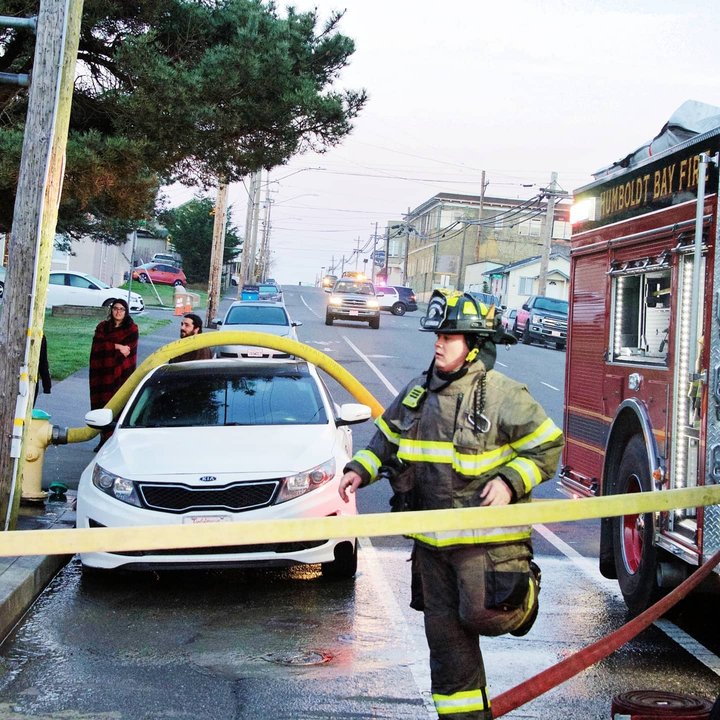
This is why you should never park in front of a fire hydrant.
When a fire breaks out and a vehicle is blocking our water supply, we lose precious time in our effort to save lives and property.
This vehicle owner is lucky the roof was low enough and the engineer found an alternative option to smashing out the windows for access.
Feeding hose around vehicles forces the hose to crimp at the coupling where it attaches to the hydrant, restricting water flow and putting crews fighting the fire in a dangerous position.
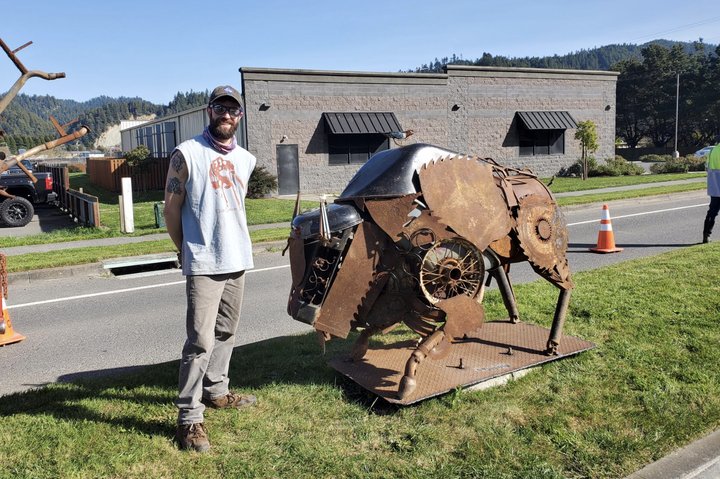
Rio Dell’s main street menagerie has grown again! Learn about Humboldt metal man Dan McCauley’s latest Wildwood Avenue art installation in the City of Rio Dell press release below:
Humboldt County artist Dan McCauley installed his seventh sculpture in the City of Rio Dell on March 2 as a
continuation of a collaborative plan to display art along Wildwood Avenue. McCauley worked with and received support
from the City of Rio Dell, Chamber of Commerce and Eagle Prairie Arts District to realize his vision. The sculpture depicts
a great American Buffalo and follows in the footsteps of McCauley’s other displays including elk, owls, bears, goats and
other creatures.
The art program was made possible by generous donations from Pacific Gas & Electric, The Headwaters Fund, McLean
Foundation and local Rio Dell business Root 101 Nursery. Sculptures are displayed over a five year period and will be
replaced over time as interested buyers purchase the artwork from Mr. McCauley.