Marlon
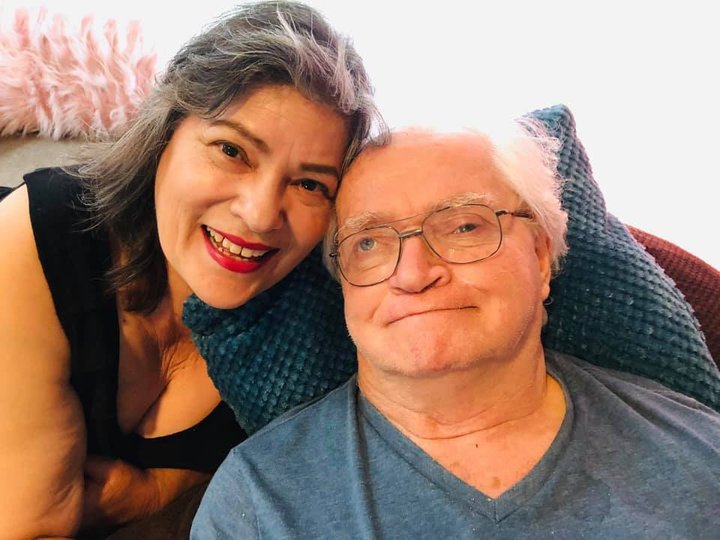
Bernhard Olson, 64, died, February 11, 2021 at St. Joseph hospital.
He was born March 21, 1956, in Longview, Washington, the son of
Kenneth LeRoy and Bessie Jewell (Godwin) Olson.
Marlon
earned his GED in hopes of joining the military. He enjoyed riding
motorcycles with his brother Harold and enjoyed fishing and camping.
He worked several jobs until he moved to California. There he worked
in carpentry with his cousin Eddie McMains.
Severely
injured in a car accident at the age of 27, Marlon took 10
years, with the loving care of his family and much perseverance, to
recover. He rode his four-wheeled
Rhoades Car around Ilwaco, Wash.
to strengthen his legs; used a walker then threw it aside to walk on
his own. He enjoyed his independence despite his challenges. He had a
tenacity about him; he wasn’t going to sit down or sit still for
long. He was very social and enjoyed playing cards and cribbage with
his nieces and nephews and his grandsons. He enjoyed a good cup of
coffee and cookies.
In
Eureka he enjoyed the Eureka Senior Resource Center lunch program and
playing pool. In his hometown of Ilwaco he was involved in the Pace
Program and actively involved in the Seaview Baptist Church,
where he and Carla married in March of 1996. They settled in Redwood
Valley off of Highway
299 near Blue Lake. In March they would have celebrated 25 years of
marriage. He attended the Eureka Adult School TBI (Traumatic Brain
Injury) class led by Brenda Bertain. Marlon and Carla worshiped at
the Blue Lake Community Church and served as leaders in the Christian
youth program, AWANA, for 25 years.
He
was predeceased by his parents. Surviving in addition to his wife,
Carla (Beck) Olson, are his son, Daniel Garl of Tacoma and grandsons
Nicholas and Devon. His daughter, Natalie Barbero-Menchaca of Tacoma,
grandsons Antony Barbero of Spokane and Allen Barbero of Arcata,
granddaughter Savannah Perez and her husband Andrew of Tacoma and
great granddaughter Evelyn. One sister, Tressie Chambers and one
brother, Harold Olson and wife Linda of Castle Rock, and many nieces
and nephews.
A
service of remembrance will be held 10 a.m. Saturday, March 20 at
Blue Lake Community Church, 440 Wahl Street, Blue Lake.
###
The obituary above was submitted on behalf of Marlon Olson’sloved ones. The Lost Coast Outpost runs obituaries of Humboldt County residents at no charge. See guidelines here.
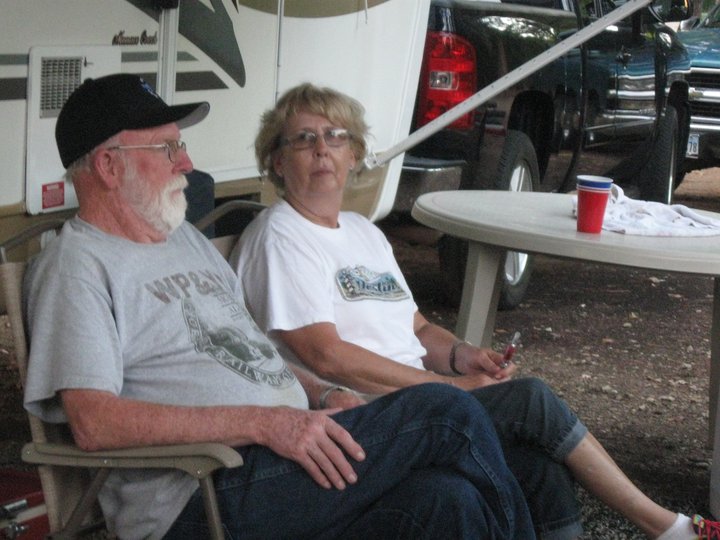
Rex Bardin, 80, of Ferndale, passed away in Eureka on Feb. 23, 2021 with his wife, Phoebe, by his side.
Rex was born in Oklahoma, moving to Ferndale when he was 13. He loved Ferndale and high school sports. He was a member of the Ferndale Booster Club for over 50 years. He especially loved watching his grandchildren playing sports and always attended their event.
Rex was an avid train collector, belonging to the HB&E Train Club in Eureka for well over 50 years. He loved the FRISCO Railroad Line. He retired from L& M Petroleum in 2002. He loved to travel in his fifth wheel, having many adventures with his wife and his beloved cat Bella.
He is survived by his his wife, Phoebe, of 42 years, son Kit{Kimberly}, grandchildren Kelly, Kyle, Kade, Kenton and great-grand daughter Kinsley. Also sisters Patsy (Dave), Delores, Jackie and their families. He also leaves behind his beloved cat Bella and many, many friends. He was preceded in death by father Jack, birth mother, Ardelle, and his mother, Hazel. Also sister Linda, and his son, Bruce.
Family would like to thank the staff of Eureka Wellness for the excellent care Rex received. No service will be will be held at this time. Instead of flowers, please send to your favorite charity or The Booster Club, 2031 Main St., Ferndale, or to HB&E Train Club, Box 232, Samoa, CA, 95564.
###
The obituary above was submitted on behalf of Rex Bardin’sloved ones. The Lost Coast Outpost runs obituaries of Humboldt County residents at no charge. See guidelines here.
UPDATE: Please note! The dates have been changed for this event since this post was published. It’s been updated.
###
Eureka NAACP release:
David Josiah Lawson Oration Festival will be held online on April 17, 2021.
Young Black, indigenous people of color are invited to apply as oral performers.
There will be three categories of performance: 1) original poetry (limited to five
minutes); 2) original prose (limited to eight minutes); 3) recitations of published work
(limited to eight minutes).
Age categories are 8-12; 13-15; 16-18; and 19-25.
In age groups 8-12 and 13-15, no profanity allowed.
Themes for everyone should give voice to the BIPOC experience, including privilege,
solutions to racial discrimination/inequity, talk about race, having hard conversations,
how to be actively anti-racist, past and present issues around race, historical and current
perspectives, Black Joy, experience of family, strength we get from our ancestors,
or other related themes.
For each age category, there will be cash prizes of $250 for first place, $150 for second
place, and $100 for third place.
All submissions must be done in video format and can be submitted between March 1st and March 20th. Submissions should be saved and shared as google docs with the following
information in the email: first and last name, age category, category for performance, and
email address and phone number. Send the link for the google doc to
contact@eurekanaacp.org.
When are we getting the new Johnson & Johnson vaccine? Who will get which shots? Why are some teenagers getting vaccinated now? Is COVID going to be around forever?
These questions — plus an opening statement on the possibility that Humboldt might move back into the state’s purple zone — were addressed in today’s media availability with Dr. Ian Hoffman, Humboldt County’s health officer.
Video above, rough transcript below.
###
Thank you for joining us for the March 2nd Media Availability with county Health Officer Dr. Ian
Hoffman. Would you like to start by addressing the community?
Yes thank you. I want to talk a
little bit about our tier status. We, as we know, we moved into the red tier last week.
That tier status is updated weekly and we are watching it very closely because we have noticed
that the case rate has increased over the past week and not continued to decrease like it was
over the preceding weeks. You know it’s always a good reminder for us to keep in mind that there
could be more cases coming down the line if we are loosening up too quickly. So just a reminder to
continue to mask, distance, avoid gatherings. We also know there will be an update from the
state this week on tier status and we look forward to hearing more about that and how
it could affect us here in Humboldt County.
From the Redwood News: With the recent emergency use authorization of the Johnson & Johnson COVID vaccine,
how soon can Humboldt County expect to begin receiving doses of the vaccine?
How will this increase in supply impact the county’s vaccination plan? Will it move it forward
any quicker?
So we know that California is getting 380,000 doses of Johnson & Johnson this week,
we have not seen any allocation numbers yet for the counties. We’re hopeful we could get some
of that and so certainly if we do get that it will increase our availability for appointments and the
speed at which we can get people vaccinated.
From the Redwood News: Can you talk about how Public
Health and other providers determine who gets what vaccine considering the J&J vaccine is only one
dose versus the two doses required for Pfizer and Moderna? Is one vaccine better than the others?
Will the single dose vaccines be used for any specific groups of the population?
What goes into determining who gets the one dose vaccine versus a two dose vaccine?
So another
example of how we’ve throughout this vaccination effort we’ve been met with many challenges,
adapting to two different vaccines, now a third, different dosing schedules,
you know I think from the standpoint of the efficacy of all three of these vaccines,
they’re all very good vaccines from an individual and public health standpoint
and I think all three of them meet a high bar and exceed what we actually could have expected
from any vaccine in such a short amount of time. They all decrease death, hospitalization
and severe disease at very high rates, so you know, I think that we’re going to be offering, if
we get Johnson & Johnson in Humboldt County, we’ll be offering it to many different groups broadly
and allowing people to decide which vaccine they want, but we always encourage people
to take any vaccine that’s offered to you. I think that it’s really important to recognize
that the faster we can get vaccinated, the faster we’re going to get out of this.
From the Redwood News: Looking back over the last year and living in a global pandemic what would
you say Humboldt County has done right throughout it? What did we do wrong or rather what could the
county have done better during the pandemic? On the flip side what does the path forward look
like for Humboldt County? When do you expect we will return to some sense of normalcy?
So in the early part of the pandemic I wasn’t part of the Public Health effort and the emergency
response here in Humboldt County, I was working as a provider on the you know patient care side,
and so you know I saw a lot of folks early on who were getting sick and inability to get tested.
You know, we saw people struggling to get the right care in the hospital situation
because we just didn’t know how to even care for these folks. So that was my my experience as a
provider.
I think from what I saw from the outside in Humboldt County, and now having
you know several months on the inside, was that Humboldt County was doing everything right, it was
you know taking all the right precautions, you know taking masking seriously, you know,
taking the distancing seriously and putting measures in place around the county to reduce
the spread of COVID, a robust contact tracing and investigations unit, a strong Joint Information
Center to get information out to the community and keep them updated with a very fast-moving
situation that changed sometimes not just day to day but hour to hour.
So I think overall
the response in Humboldt County has been great and continues to be, so
return to normalcy is, as we’ve talked about in the past,
is a bit of a crystal ball moment, but I think we will see some more return to normalcy
in the coming months if we can avoid a surge of new cases. So that’s going to be really
important for us to continue on our path of maintaining the same things that we’ve been
doing all along that reduce the case load. So masking, distancing, avoiding large gatherings
and as we look forward to some guidance around how we might be able to gather more safely
in public spaces, it’s going to be extra important for us to you know adhere to those
guidelines, so that we can have some sense of normalcy without a large surge in cases.
From the Redwood News: We’re almost a full year into the COVID-19 pandemic. Can you talk about how
Public Health’s approach to managing the pandemic has changed since last March? What have been some
of the biggest challenges Public Health has had to overcome during the pandemic?
Yeah so I think that
you know working among all the different partners in both the Public Health side, government,
private entities, not just you know in health care but you know businesses and organizations and law
enforcement, everyone had to come together to meet these complex challenges over the course of this
pandemic. Communication is difficult when you’ve got so many people involved. So I think that’s
been one of the biggest challenges. By far things are fast moving and knowledge changes sometimes
you know, what we know one day might not be the the same as what we know the next day.
So those have been some of the challenges during the pandemic.
The North Coast News:
With Humboldt County now in the Red tier on the state’s reopening blueprint, could we soon
expect a move into the Orange tier. What about the county’s current data led you to that conclusion?
So I’m not seeing movement to the Orange tier right now. Again the case count
is going up so that’s going in the wrong direction for for us to make a move and could potentially
put us back in the Purple tier if that move continues dramatically up into a Purple tier
case count metric.
From the North Coast News: Monday, March 1st marked the start of California’s
transition to enhanced provider vaccination network that’s designed to make COVID-19 vaccines
available to all Californians. Blue Shield said providers and local health jurisdictions may
choose to continue in their roles as vaccine providers by contracting with the third party
administrator for performance management and by using the state’s MyTurn portal for scheduling
vaccination appointments and reporting data to the TPA in the state to provide daily visibility about
the network’s operation. Will this greatly impact the way Humboldt is administering COVID vaccines
now? Why or why not?
Yeah I think it’s another example of some of the challenges that have faced
the response effort from the beginning, not just with the vaccine but every stage along the way.
This is hopefully an opportunity for us to work closely with the the state government
and the third party administrator to improve access to vaccine for Humboldt County
so we look forward to those discussions. We haven’t yet
had the discussions here in Humboldt County, those are happening this week
so we will definitely have more to report on that after our meeting with the TPA later this week.
From the North Coast News: Will the Johnson & Johnson vaccine be given in higher proportions
to the rural areas of the county since it can more easily be taken there due to the temperature
requirements and because those patients don’t have to travel as far to receive a second dose of it,
or will all three vaccines be distributed equally throughout the county regardless
of other logistical factors?
So there are many ways this vaccine will likely be used. I think
it can be used in those scenarios of hard to reach areas populations that might be harder to reach,
I think also some people might just prefer a single vaccine to getting, having to come back
three to four weeks later for a second dose, so we’re going to offer it broadly in many different
scenarios and we hope that people, when they’re offered a chance to get the vaccine, will go out
and get the vaccine.
From the Redheaded Blackbelt: Dr. Mike Ryan of the World Health Organization
explained that the COVID-19 vaccines will potentially need to be quote updated and
periodically tailored to combat the mutations of COVID more easily, similar to with the common flu.
Does this suggest to you any concern that COVID is developing into an endemic virus, like the flu?
I think that all signs do point that COVID-19 will become endemic and yes there’s a lot of
talk about need for likely updates, many of those are in research trials right now with Pfizer,
Moderna vaccines and there’s even a trial underway for a second dose of Johnson & Johnson vaccine so
I think we will see more vaccines for COVID on the horizon and likely boosters in the future,
similar to the way flu is updated yearly.
From the Redheaded Blackbelt? Are you concerned that
it is possible for COVID to become an endemic disease?
Yes.
From the Redheaded Blackbelt:
Humboldt’s new vaccine data added to the dashboard is showing a relatively small number of teenaged
community members having received vaccine shots 144 between the ages of 16 to 19.
Can you explain if these vaccinations were due to the type of employment of these young people
or how how they fit into the tier of vaccine distribution?
Yeah I would suspect these are
young folks who are working in sectors that were open to vaccination or potentially volunteers
as well, that’s another possibility.
From the Times-Standard: How can residents decide
which is the best vaccine for them given that many residents in Humboldt County don’t have
a primary care physician due to the doctor shortage?
I think first and foremost is that
if you’re offered a vaccine appointment, I highly recommend taking that vaccine appointment. I think
for most people there’s not really a reason to pick one or the other, unless there’s individual
choices you know of like I said earlier, you know you don’t want to get a second shot,
maybe it’s difficult for you to make it in for an appointment. These could be personal factors but I
think overall you know we’re we’re working on ways to reach out to folks who don’t have a doctor here
in Humboldt County, we have the Interest Form, encourage people to use that
and I think that the opening up of MyTurn could also increase the ability for people to have
access to appointments here in Humboldt County that wouldn’t be available to them otherwise,
so we’re looking forward to those and work through some of those challenges that are going
to be there for sure and implementing this change but those are some of the sorts of things that
could help alleviate, you know, people who aren’t getting access right now.
From the Times-Standard:
Many people are saying the Johnson & Johnson vaccine will be the one for the masses
but the efficacy was rated at 70 percent versus Moderna and Pfizer which were touted to have 95
efficacy. What are your thoughts on that concern?
I think all three of these are really great
vaccines. I mean if you look at efficacy of vaccines, to have three vaccines that are this
efficacious is actually, you know, an amazing place to be at this point in the pandemic.
So if you’re offered an appointment, I would highly encourage you to take it
regardless of the kind of vaccine that’s being offered and you know the the effectiveness
of Johnson & Johnson in the United States trials was actually upwards of 87 percent, so it’s
still a very good vaccine and has a lot of benefits to it so I hope that
people will consider it and and take it when given an opportunity.
The Humboldt State men’s basketball team saw its first COVID-related game cancelation today, less than a week into its newly approved exhibition road series.
A game with the Dominican University of California was scheduled to take place this afternoon, but was canceled after one of the DUC players reported having COVID-19-like symptoms.
“No one from Humboldt State’s team had contact with the Dominican team member,” the Humboldt State Athletics Department announced today. “HSU continues to follow COVID testing protocols while on the road and currently remains eligible for competition.”
The Humboldt State women’s basketball team, meanwhile, recently announced that it would not compete in any approved exhibition games this season.
“The Humboldt State women’s basketball program has decided to opt out of any competition this spring,” the team was quoted as saying in a tweet posted by the athletics department yesterday. “We are thankful and appreciative that the university has given us the opportunity to compete, however, due to health and safety concerns, we will not be competing this spring. The health and safety of our student athletes will always be our top priority and for our women’s basketball team, we believe this is the best decision for our program.”
However, the women’s team will continue to practice as a group after university approved team practices last week.
The men’s basketball team is scheduled to play its next game on Friday against Fresno Pacific University in the James M. Grant Center in Redding.
Today, the internet tells us, is Read Across America Day, which kicks off the National Education Association’s annual National Reading Month. Good news! By currently reading these words on the Lost Coast Outpost, really, you’re already participating, fine citizen! Good job!
Now to commemorate such an occasion in more normal times, Humboldt County Sheriff’s Office employees would traditionally fan out across the county to visit local schools and read often-rhyming literature to area children. Obviously, the current pandemic precludes them from doing that, but fear not. HCSO has opted to showcase their reading skills online this year. Below you will find a number of local law enforcement officials — including Sheriff Billy Honsal — powering through some colorful quick reads. LoCO invites you to gather round and listen in.
# # #
Sheriff William Honsal reads I Like Myself by Karen Beaumont
Yurok Tribal Police Officer Shan Thacker reads The Itsy Bitsy Spider by Iza Trapani
HCSO’s Ana Hernandez and Samantha Karges read Why I Should Listen by Claire Llwellyn
HCSO Chaplain Bryan Morse reads Oh The Thinks You Can Think by Dr. Seuss
HCSO Sgt. Chelsea Camilli reads Lola Loves Stories by Anna McQuinn
HCSO Corporal Anthony James reads Horton Hatches the Egg by Dr. Seuss
HCSO Deputy Danielle Vickman reads Parts by Tedd Arnold
BONUS: Eureka Police Chief Steve Watson reads Officer Buckle and Gloria by Peggy Rathmann (Includes EPD staff performance art.)
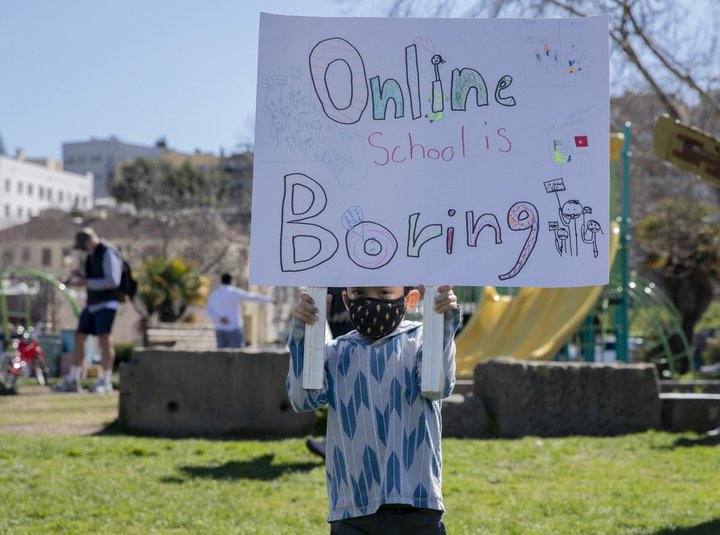
Transitional kindergarten student Jake Schuman, 5, holds up a sign during a rally to reopen schools at Astro Park in Oakland on Feb. 28, 2021. Photo by Anne Wernikoff, CalMatters
###
California public schools will receive financial incentives to reopen campuses by April 1 for their youngest and most vulnerable students under a deal Gov. Gavin Newsom and legislative leaders announced Monday after months of tense negotiations.
Under the plan, schools are not required to reopen. Decisions still rest with school boards, administrators and labor unions, so it is unclear whether the deal will actually result in widespread campus reopenings.
Prompted by parents who have been protesting school closures, Newsom and Democrats who control the Legislature said they hope that the $6.6 billion compromise will prod public schools to reopen after most campuses have been closed for nearly a year.
Legislators said they will vote on the plan Thursday, and Newsom said he would quickly sign it into law.
“We expect that all of our (transitional kindergarten) to (grade) two classrooms will open, and then the next month, we want to see more happen beyond that,” Newsom said during a press conference at an elementary school in Elk Grove. “We’re now accelerating the pace of reopening.”
As California nears the March 13 anniversary of its initial school closures, most of the state’s 6.1 million K-12 public school students remain in distance learning. California and other West Coast states have been among the nation’s most cautious states in returning students and teachers to classrooms.
Under the plan, schools that remain closed would have to explain their reasons why, and they would lose 1% of the grant funding they are slated to receive for every school day their campuses remain closed past April 1.
“We expect that all of our (transitional kindergarten) to (grade) two classrooms will open, and then the next month, we want to see more happen beyond that.” — Gov. Gavin Newsom
The bill also makes clear that districts that have already reopened campuses do not have to negotiate new agreements with their labor unions; they can essentially keep their existing plans in place.
To get their share of the $2 billion in grant funding, school districts will have to do the following:
Offer in-person instruction to students in transitional kindergarten through second grade once case rates in their community fall below 25 positive cases per 100,000 residents, part of the state’s purple tier.
Bring students through sixth grade, as well as students in at least one full middle- or high-school grade level, back in person when local case rates fall below seven positive cases per 100,000 residents, known as the red tier.
Offer in-person instruction to some targeted student groups of all grade levels, regardless of public health conditions or tier status. Included are students with special needs, homeless, foster youth, English learners, kids who’ve been chronically absent from distance learning and students at risk of abuse or neglect.
Families can still opt to keep their students in distance learning even when schools hold in-person classes.
E. Toby Boyd, president of the California Teachers Association, said in a statement that the deal “gets us one step closer to rejoining our students for in-person teaching and learning.”
“We are reviewing the proposal’s details more closely, and we look forward to working with local educators as they negotiate with districts to safely reopen for in-person teaching and learning beginning in one month,” Boyd said.
The deal also includes $4.6 billion in discretionary funds for schools to address students’ learning loss this school year, by, for example, extending the school year or offering summer school.
Republican Kevin Faulconer, who is running against Newsom next year or if a recall qualifies for the ballot this year, criticized the plan, saying it doesn’t go far enough to get students back in classrooms.
“The partial reopening plan announced by Gavin Newsom today isn’t even close to good enough for our kids and teachers,” Faulconer said in a statement. “For him to tout this as an accomplishment after months of inexcusable failures shows how out of touch he is, and why he should be recalled.”
Among the key differences in the new compromise compared to previous proposals is clarification that teacher vaccines are not required for physically reopening schools. But it also would etch in state law Newsom’s pledge to set aside 10% of incoming vaccines for educators, which helped break the political logjam, said Democratic Assemblymember Phil Ting. This helped resolve some of the educators’ concerns.
“What really helped get the confidence of educators was the ability to get a certain amount of vaccine prioritization,” he said on a call with reporters.
Newsom and public-health experts say schools can physically reopen without vaccinating teachers so long as they use strict safety measures such as masking and distancing. But vaccines have been the key sticking point between school districts and teachers unions.
Though teachers were among the prioritized professions in the state’s broad Tier 1B Phase 1 group, a county-by-county rollout resulted in a haphazard picture for teacher vaccinations.
“What really helped get the confidence of educators was the ability to get a certain amount of vaccine prioritization.” — Assemblymember Phil Ting
Newsom said all appointments on Thursday and Friday at California’s two FEMA-run mass vaccination sites in Oakland and Los Angeles will be reserved for teachers, school staff and childcare workers.
Also starting yesterday, the state has set aside at least 10% of all vaccine doses for educators and childcare providers with the goal of giving 75,000 doses weekly to these essential workers, according to Darrel Ng, a spokesman for the California Department of Public Health. More than 50,000 doses are earmarked for Los Angeles County, where the Los Angeles Unified School District alone employs more than 26,000 teachers. San Diego County is expected to receive about 20,000, Ng wrote in an email.
Doses will be prioritized for teachers, childcare workers and school staff already working in person or about to return to schools and daycare centers, Ng noted.
County departments of education will give single-use priority codes to K-12 school districts that staff can use to find appointments on the state’s COVID-19 vaccination website, myturn.ca.gov.
Newsom would not comment on whether the state will add the COVID-19 vaccine to the list of immunizations required for school or daycare. California is one of five states that allow only medical exemptions for school vaccinations, not personal or religious exemptions.
As vaccine accessibility has increased for teachers in recent weeks, more large school districts, including Long Beach and Elk Grove, have set return dates for this month for some students. With roughly three months of school left on most district calendars, about three-fourths of the state’s 100 largest school districts remain in full-time distance learning, according to a CalMatters tally.
Elk Grove Unified, the first California school district to close campuses last spring, reached a deal with its teachers union last week to phase in students’ on-campus returns, beginning March 16 with grades TK-3.
“We’re moving forward because of the relationships that we have with our labor partners,” Elk Grove superintendent Chris Hoffman said.
Though some school districts in the state have been open as early as last August, only about one-fourth of California elementary students are in districts offering hybrid or in-person instruction. About 85% of the state’s high school students remain in distance learning.
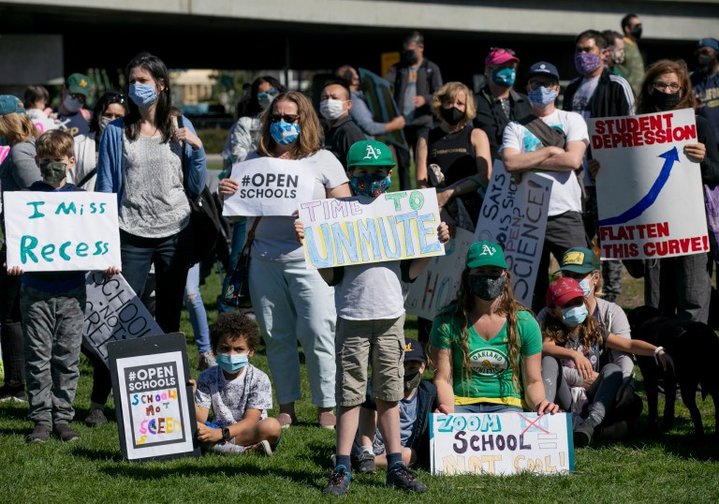
Third-grader Macauley Davis, 9, center holds up a sign during a rally to reopen schools at Astro Park in Oakland on Feb. 28, 2021. Macauley said compared to zoom classes it would be, “way more easier to be in school, even with masks.” Photo by Anne Wernikoff for CalMatters.
A CalMatters analysis of state data found stark inequities in school reopenings: The state’s wealthiest school districts are offering some form of in-person instruction to a far greater share of their students compared with California’s poorest school districts. Private schools, meanwhile have outpaced public schools in reopening.
Widespread criticism tanked Newsom’s original Dec. 30 proposal, which called for schools to reopen by mid-February but tied money to strict testing requirements that groups representing school boards and administrators said was unworkable.
The counterproposal by Democratic legislators calling for an April 15 return aligned most closely with teachers unions’ stances by effectively tying reopenings to vaccinations — a requirement that led Newsom to suggest he would veto the bill after arguing it would slow down school reopenings.
Under the new plan, schools that reopen in the purple tier must follow the state health department’s testing guidelines, which call for testing teachers and students weekly or biweekly, depending on local case rates. Districts that adopt safety plans before April 1, however, are exempt from the state’s testing guidance.
Ting, the San Francisco Democrat who introduced the counterproposal to Newsom’s plan, said he hoped the compromise and greater vaccine availability would help reopen campuses in the state’s largest districts, such as Los Angeles and San Francisco, where the reopening debate has been the most fraught.
“While nobody got everything they wanted, whether it was the school districts, whether it was the educators and whether it was the parents, we think this is a very reasonable compromise,” Ting said. “And we hope that as many districts as possible will be taking advantage of this proposal and opening up as soon as they can.”
###
CalMatters reporters Laurel Rosenhall and Barbara Feder Ostrov contributed to this report.
CalMatters COVID-19 coverage, translation and distribution is supported by generous grants from the Blue Shield of California Foundation, the California Wellness Foundation and the California Health Care Foundation.
CALmatters.org is a nonprofit, nonpartisan media venture explaining California policies and politics.