Important decisions are made at this time of year. If you are considering cultivating cannabis this season without an approved permit and state license, please consider applying for an expedited permit for a small cultivation area of 2,000 square feet or less. These small cultivation permits can be completed within 30 days of application submittal. You have time to obtain a permit to cultivate this year and can find details for this new option on the Small Cultivation Ordinance web page.
Applications Assistance meetings can be scheduled by calling 707-445-7541 to help with your eligibility and application submission. The Planning and Building Department has assigned staff to the counter who are ready to process these applications specifically.
It is not legal to cultivate cannabis without a county permit and a state license, except for personal use. Details for this option are detailed in the Personal Use Ordinance.
Code Enforcement will again be actively surveying for unpermitted cultivations of all sizes. Whether you received a warning letter at the end of 2019 or not, if you are cultivating without a permit in 2021 you are likely to receive a Notice to Abate Nuisance and Notice of Violation. The Planning and Building Department would much rather work with you and issue you a permit.
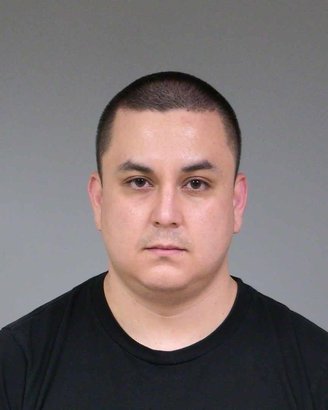
In response to questions from the Outpost, the Humboldt County Sheriff’s Office provided a bit more information about the facts behind Aguirre’s arrest and the allegations against him.
Asked what contraband he’s accused of bringing into the jail, Public Information Specialist Samantha Karges said via email, “[E]vidence indicates that opioids and methamphetamine were brought into the jail by Aguirre.”
The investigation was initiated after a witness “from outside the facility” came forward with information about the alleged smuggling, and all evidence thus far indicates that Aguirre was alone in committing these acts, Karges said.
What was he getting in exchange for this smuggling? “We believe Aguirre was receiving payments in some form of currency,” Karges responded.
She also addressed his background:
Aguirre was hired in 2019 and previously worked in a private prison in Kern County. He received the required correctional deputy college course prior to being hired and passed our in-house training program. Prior to being hired, Aguirre also passed an extensive background, polygraph, and psychological examination.
He posted bail shortly after his arrest. A number of the questions we asked — including which inmate(s) Aguirre allegedly brought contraband to, what relationship they had (if any) to Aguirre, and what Aguirre had on him at the time of his arrest — went unanswered on the grounds that this is still an active investigation.
—Ryan Burns
###
Original post:
Press release from the Humboldt County Sheriff’s Office:
In February of 2021, the Humboldt County Sheriff’s Office received information that a correctional deputy was involved in the smuggling of contraband into the Humboldt County Correctional Facility on behalf of inmates. The Humboldt County Drug Task Force (DTF) was assigned to investigate. A month-long DTF investigation revealed that Ricardo Tranquilino Aguirre, 27, of Eureka, CA, was the involved deputy.
On March 2, 2021, at about 5:30 p.m., Aguirre was taken into custody inside the Correctional Facility for being in possession of a controlled substance while armed (HS 11370.1(a)), smuggling contraband into a jail (PC 4573), possession of a controlled substance for sales (HS 11351) and transportation/sale of a controlled substance (HS 11352(a)).
Aguirre has been a correctional deputy with the Sheriff’s Office since September 2019 and has resigned from his position as of today. Since his arrest, further evidence was discovered that Aguirre had been smuggling drugs into the facility for the past several months and he had acted alone. The investigation is being referred to the District Attorney’s Office for prosecution.
“Correctional Deputies are hired to protect and serve those that are in the care and custody of the Correctional Facility. As members of the Humboldt County Sheriff’s Office we hold ourselves to the highest ethical standards of conduct,” Humboldt County Sheriff William Honsal said. “Ricardo Aguirre’s criminal and disgraceful conduct is the antithesis of the professional standards, ethics and organizational values of the Sheriff’s Office. Mr. Aguirre’s actions do not represent the principles that are the foundation of our organization. He will be held accountable to the fullest extent of the law and I will be working with the District Attorney to ensure this case is fully prosecuted.”
Sheriff Honsal would like to thank the Humboldt County Drug Task Force, the Eureka Police Department’s Problem Oriented Policing (POP) team, and the Drug Enforcement Administration for their support during this investigation.
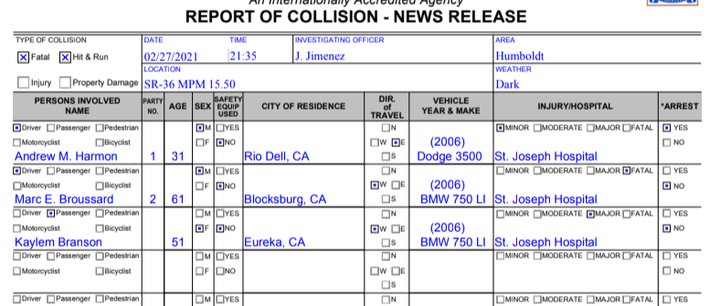
On 02-27-21, at approximately 9:37 PM, the Humboldt Area CHP received a report of a two vehicle traffic collision on SR-36, near mile post marker 15.50.
A preliminary investigation by CHP determined that a 2006 Dodge 3500, driven by 31 year old Andrew M. Harmon, of Rio Dell, CA, was traveling eastbound on SR-36. A 2006 BMW 750 LI was traveling westbound on SR-36, approaching the Dodge 3500. The Dodge 3500 was driven over the double yellow line separating the lanes, and the vehicles collided head-on. The driver of the BMW sustained major injuries, was transported to St. Joseph Hospital, and hours later succumbed to his injuries. The passenger also sustain major injuries and was transported to St. Joseph Hospital.
Andrew M. Harmon left the scene of the collision prior to CHP arrival and was located in the City of Rio Dell. Impairment is being investigated as a contributing factor in this collision. Andrew M. Harmon was placed under arrest for Felony DUI, felony hit and run, and gross vehicular manslaughter while intoxicated. He was transported to St. Joseph Hospital for treatment of minor injuries prior to being transferred to the custody of the Humboldt County Jail.
The CHP Humboldt Area Office is continuing to investigate this collision and asks anyone who may have information to contact the office at 707-822-5981 or send an email to humboldt_area.humboldt_area@chp.ca.gov.
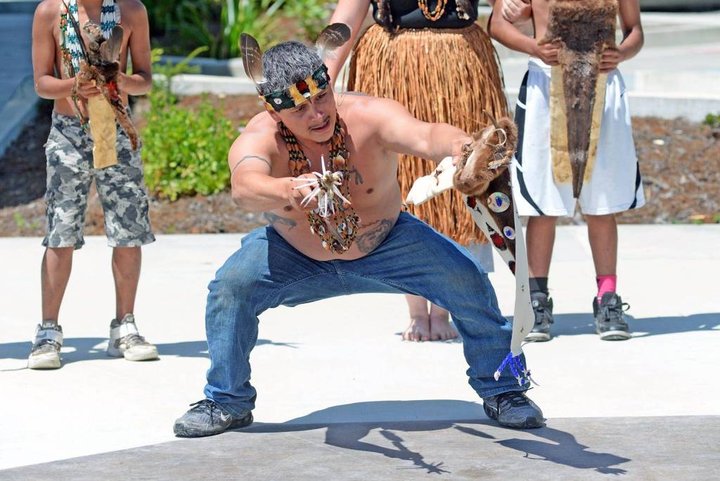
James Gensaw, a Yurok language teacher and ceremonial practitioner, performs a Brush Dance demonstration. Photo provided by Yurok Tribe
###
For years, Betty Sigala spoke to her family about her death: she didn’t want to be put on a machine and she didn’t want to die alone.
When she was admitted in June to the COVID-19 care ward at her local hospital, her family refused a ventilator. One of her grandsons convinced the nurses to ignore the no visitors rule and let him in.
He set up an iPad so the family could speak with her, then held her hand as she died.
Her granddaughter, Leticia Aguilar, 37, lit a fire for her that lasted four days and four nights, a tradition of their Pinoleville Pomo Nation. She cut her hair in mourning, and sang and gave offerings to help her grandmother on the yearlong journey she would take to her final resting place.
As Aguilar arranged for her grandmother’s burial, Liz Sigala, Aguilar’s aunt and Betty Sigala’s daughter, was admitted to emergency room care. She couldn’t breathe, gasping for air when she tried to speak.
Eleven days after her mother’s death, Liz Sigala died from COVID-19. The family held a double burial. Aguilar lit the fire once again.
Amid the ceremony and grieving, Aguilar made sure to fill out both death certificates, marking each of them “Native American.” She was proud she could do this last thing for them.
“I’m so glad that we were able to have them counted,” she recalled nearly eight months later. “It meant a lot for us, as natives.”
Aguilar, who lives in Sacramento, feared that if she let hospital staff fill out the form her family would be misclassified as Latino, white or even marked as “other.”
Native American leaders across California said COVID-19 deaths are a shadow on their communities, yet state figures show few American Indian people have died here compared with other states. Leaders and experts fear their community’s deaths have been undercounted because of a long history of Native Americans being racially misclassified. And data shows they may be correct.
This unacceptable and damaging practice can bar native people from getting the help and resources they actually need, they said.
California has the largest number of American Indians and Alaska Natives in the United States and the largest number of American Indians and Alaska Natives living in urban centers. They are often declared white, Latino or Black on official forms by uninformed hospital workers, according to community leaders and various studies. Sometimes they are simply listed as “other.”
Nearly 9,000 American Indians in California have been sickened by COVID-19 and 163 have died, according to the state public health authority.
Native American leaders said those figures do not reflect the death and sickness they’ve seen invade their communities, both on and off reservation land. It also doesn’t reflect national data that shows Native Americans, who are especially vulnerable to COVID-19 because of chronic diseases such as diabetes, heart disease and hypertension, are dying at horrifying high rates.
Data from the Centers for Disease Control and Prevention shows American Indians and Alaska Natives are the single group hardest-hit by the pandemic. They are diagnosed with COVID-19 at nearly twice the rate of white people, hospitalized almost four times as frequently, and die at a rate of two and a half times that of whites.
As of December, 2,689 non-Hispanic American Indians had died from COVID-19, according to the CDC. However, many states do not separate out American Indians into their own category, which public health experts suggest has lowered the overall tally of native deaths in the U.S.
“For me, this is a culminating event. This is historical trauma playing out in real time.” — Virginia Hedrick, executive director of the Consortium for Urban Indian Health
In California, native people comprise .3% of all deaths and diagnoses of COVID-19, and account for about .5% of the total population, at about 330,000.
The California Department of Public Health said it has worked to decrease instances of racial misclassification in recent years, but conceded that officials may have misclassified American Indians in an attempt to prevent double-counting cases. Under state guidance, anyone who states they have American Indian heritage in combination with another race or ethnicity are counted as Hispanic/Latino or multiracial instead.
“This approach is the national standard for reporting disease rates and has several advantages,” the health department wrote in a statement to The Salinas Californian. “However, it also has limitations. Any classification system will not be able to capture the complexity and richness of racial identity.”
Acknowledging the problem doesn’t change the fact that the data is wrong, experts said.
“The problem is in the data itself,” said Virginia Hedrick, executive director of the Consortium for Urban Indian Health, a California nonprofit alliance of service providers dedicated to improving American Indian healthcare. “I don’t trust the state data. I haven’t ever.
“For me, this is a culminating event. This is historical trauma playing out in real time.”
Native American deaths going uncounted
For many Native Americans in California, it seems like every few weeks there’s another death. San Carlos Apache tribe member Britta Guerrero has donated to a number of funerals and attended a few via Zoom, streaming the proceedings in her living room. The familiar ceremonies and readings meant to guide her through her grief felt remote, unreal.
“I don’t think that we are able to even deal with the trauma of loss yet,” she said.
Guerrero, the executive director of the Sacramento Native American Health Center, has seen nine die in her immediate circle over the past year. Her clinic has donated or sent flowers to a dozen more funerals.
“We’ve been trying to go through the motions of grieving and burying people,” Guerrero said. “We know a lot of people are missing, and we won’t understand the gravity of that until we’re back together and we see who is gone.”
Guerrero’s own experience in the community and her work in American Indian healthcare have shown her the official tally of American Indian deaths is too low.
“There’s misclassification there,” she said, pointing to the health department’s decision to count people with multiple racial heritages as multiracial or Hispanic/Latino instead of American Indian.
That sense of loss the living suffer is heightened by fear that their loved ones might be scrubbed from American Indian history by an inaccurate document.
Aguilar made sure she was the one to fill out her grandmother and aunt’s death certificates. If she didn’t, she worried her grandmother, who was of American Indian and Filipino descent, and her aunt, who had American Indian, Filipino and Mexican heritage, wouldn’t be classified as Native American by hospital staff.
Aguilar became aware of how common racial misclassification was in the run-up to the census last spring, which motivated her to ensure her relatives’ deaths were counted. The idea that their identity and culture could have been erased by the state counting system made her sick with anger.
“That only contributes to the invisibility of our people, which makes it harder for us to even access resources because we can’t prove we exist,” she said. “There is so much more meaning behind making sure we are properly counted as native people.”
‘We’re born Indian and we die white’
Evidence of racial misclassification of American Indians stretches back decades.
A 1997 American Journal of Public Health study that compared birth certificates of American Indians in California from 1979 to 1993 with death certificates during the same time span found that at the time of death, about 75% of native children were racially misclassified.
Misclassification was more likely if the child resided in an urban county outside of Indian Health Service delivery areas.
And a 2016 report by the CDC found that nationally, American Indians were misclassified up to 40% of the time on their death certificates.
These mistakes have far-reaching consequences. In one instance, racial misclassification resulted in undercounting the transmission of STDs through Arizona’s Native Americanpopulation by up to 60%, according to a 2010 Public Health Report article. An undercount can result in less funding for treatment, as well as additional unintended health consequences, such as infertility, which is associated with untreated STDs.
A 2016 report by the CDC found that nationally, American Indians were misclassified up to 40% of the time on their death certificates.
“We’re born Indian and we die white,” said Hedrick,of the Consortium for Urban Indian Health.“I would argue that there are likely more Native Americans in hospital beds that are racially misclassified” than we know.
Tribal members said each American Indian death needs to be counted as an American Indian death. To do otherwise is to further erase a people who have faced kidnapping and forced assimilation of their children, indentured servitude and an 1851 state-funded extermination order that killed as many as 16,000, only to find themselves uncounted, made invisible.
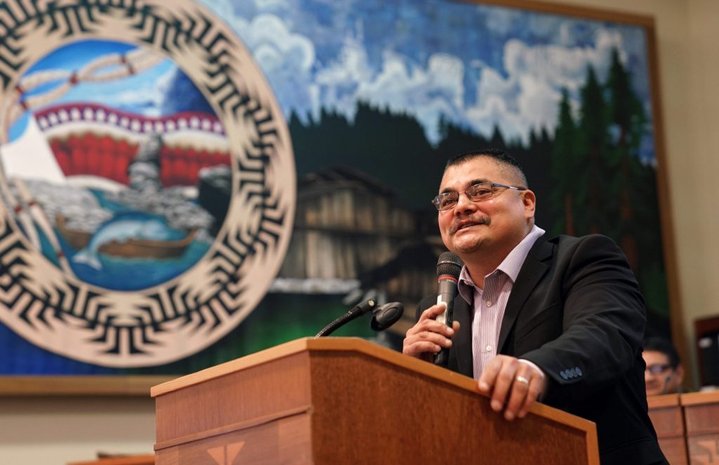
Yurok Tribal Chairman Joseph James, pictured here at the podium, gives his inauguration speech in 2018. Photo provided by Yurok Tribe
State and county roadblocks
Tribal healthcare experts and leaders said they have struggled to challenge the state’s data on COVID-19 deaths because in some cases theywere deliberately left in the dark by state and county governments, which are not required to provide data on COVID-19 cases to tribes. That left tribal leaders unable to contain the spread of the virus on their own reservations and fully understand the threat.
Concerned about the high rate of COVID-19 among the state’s native population, California State Assemblymember James Ramos of the Serrano/Cahuilla tribes, chair of the Committee of Native Affairs, held a hearing on the disparitiesthis past November. There, he learned some counties refused to communicate with tribal leaders even to tell them if there was a positive case on the reservation because of health privacy protections. Other governments, such as state or county governments, are able to receive such data, which is more thorough than the COVID-19 data released on public sites.
In one case, citing HIPAA laws, a county refused to divulge case and death data to the chairman of the Yurok Tribe. The chairman oversees every aspect of the tribe, including healthcare. The Yurok, whose reservation straddles Del Norte and Humboldt counties in northern California,were forced to hire a health officer before they could get the needed information.
Ramos said state and county government endangered native people by denying them information. He said California has a history of refusingto understand or work with tribal governments.
He worried that if these issues aren’t tackled now, they won’t be solved before the next pandemic and will end in deaths of more native people.
Ramos, too, has seen a loved one succumb to the virus. His uncle, an elder in his tribe and a source of support and inspiration for Ramos himself, died of COVID-19 in February. They buried him the day before Valentine’s Day.
In Central California, the Tule River Tribe in Tulare County also found itself cut off from potentially lifesaving data. Of its roughly 1,600 members living on the reservation, 179 have been diagnosed with COVID-19, or roughly 11%. Another 177 of the 357 who live off the reservation have been stricken ill.
Adam Christman, chairperson of the Tule River Indian Health Center and Tule River Tribe Public Health Authority, said California did not grant the reservation health center access to the California Reportable Disease Information Exchange, the state system all testing entities report results to.
“Having access to that system would make it easier for us to identify who should be isolating based on those test results, and monitoring them for quarantine and contact tracing,” Christman said.
After months of agitating for access, the tribe simply gave up asking.
Ricardo Torres, the secretary of the board for the Sacramento Native American Health Center, has helped to mask or vaccinate thousands of Native Americans in the Sacramento area. Photo provided by Ricardo Torres.
‘Nobody’s going to help us’
Without data or consistent government support, tribal leaders and members have leaned on each other to keep each other safe by social distancing, wearing masks and getting vaccinated.
After an outbreak of six cases, the Yurok tribal council closed its reservation multiple times, suspended housing and utility payments and provided supplies such as food, PPE, firewood and emergency generators to residents. They also launched a contact-tracing team, a food sovereignty program and are working with United Health Services on vaccinating their eligible population.
“Basically the way we looked at it, nobody’s coming, nobody’s going to help us,” said Yurok Tribal Chairman Joseph James. “We’re a sovereign government. There’s things we need to work on to improve our daily lives and provide for our own people.”
In the urban American Indian community of Sacramento, advocates and healthcare professionals at the Sacramento Native American Health Center have inoculated 72% of all American Indians 65 and older in the region eligible for the vaccine right now, far more than the state or national vaccination rate.
Ricardo Torres, a member of the Winnemem Wintu Tribe and SNAHC secretary of the board, helps manage a COVID-19 outreach campaign that has seen thousands of native community members receive masks and vaccines.
Over the last 12 months, Torres saw more than a dozen friends and acquaintances die from COVID-19. He worries more will follow, since only people 75 years and older initially had access to the vaccine in California. Native people born today have a life expectancy of just 73 years, more than five years less than the U.S. all-races population.
“Our population is young,” said Torres. “We don’t have a lot of 75-and-over people. They’re already dead…The people that we need to get vaccinated are the younger people.”
A history of mistreatment at the hands of medical providers has led to distrust in the native community, and the swiftness of the vaccine rollout did not engender comfort.
“People can be vaccine-hesitant,” said Guerrero, of the Sacramento Native American Health Center. “There’s a lack of trust in the federal government…so now we’re really pushing a boulder up a hill.”
Until more Native Americans are vaccinated, tribal leaders said community members will continue to voluntarily social distance, wear masks and pray for good health.
“As the Indian people as a whole, as first peoples of this nation, we’ve dealt with pandemic, sickness, illness, historically since the beginning of time,” said the Yurok Tribe’s James. “Our people went through this before. We survived, and we’ll continue to survive.”
###
This article is part of the California Divide, a collaboration among newsrooms examining income inequality and economic survival in California. CALmatters.org is a nonprofit, nonpartisan media venture explaining California policies and politics.
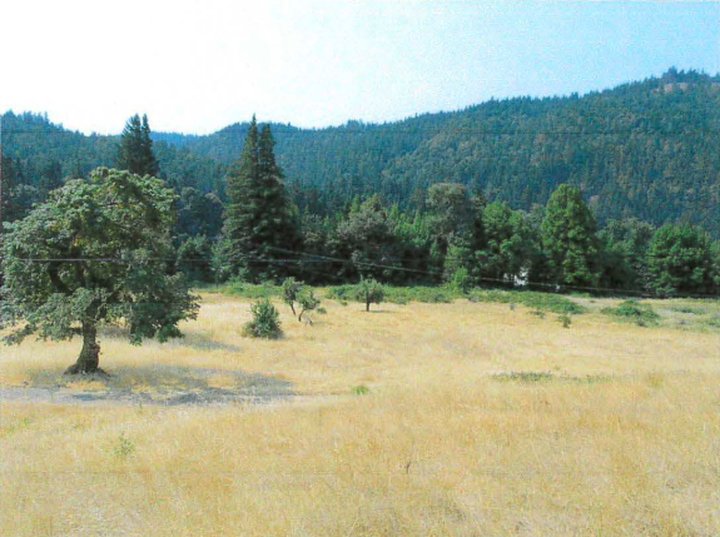
The Rolling Meadow Ranch near McCann encompasses 7,110 acres, some of which run along the bank of the Eel River. | Photo from an Initial Study via the County of Humboldt.
###
Over the course of his long career, Florida resident Andrew Machata has been involved in many industries. A mechanical contractor by trade, he has owned and operated a heating and plumbing company, a construction firm, a mining corporation, a charter jet company and a yacht company. He ran a sod farm for a while.
He also has bought and sold investment properties in numerous states, including an “absolutely gorgeous” expanse of lakes and wildlife, the 5,830-acre Rolling Meadow Ranch, which he sold in 2002 to the State of Florida and the South Florida Water Management District for $38 million. That name, “Rolling Meadow,” has been affixed to several of his properties and companies over the years.
Now, at age 83, Machata is getting involved in the marijuana industry, though in a recent phone conversation with the Outpost he said he’s had second thoughts.
“If I’d have known what I was getting into I probably wouldn’t have done it,” he said. “It’s been such an ordeal.”
Machata owns a sprawling 7,110-acre ranch on the banks of the Eel River near the remote community of McCann. After selling Rolling Meadow Ranch in Florida, he went flying around the country in search of another investment property as a means of deferring capital gains taxes from the multi-million-dollar sale. He considered a place in Colorado but didn’t pull the trigger.
“When I came to Humboldt County, the piece there was a real lush spot with forests, a lot of water on it, creeks … . That’s what I bought it for, all the natural beauty,” he said. And though it looks nothing like his Florida ranch, which was was home to wild pigs, panthers and deer, he christened it with the same name: Rolling Meadow Ranch.
Sixteen years later, Machata is hoping to finally turn a profit off the property. In 2016 he nearly sold it for $15 million to The Wildlands Conservancy, a nonprofit that specializes in converting undeveloped properties into nature preserves, but the deal fell apart after a higher bid came in, only to fall through. So instead, Machata applied for six conditional use permits to develop an 8.5-acre commercial cannabis operation — despite a lack of expertise.
“I know nothing about marijuana,” he said. In fact, he doesn’t even really approve of the industry. “I don’t believe in the recreational,” he continued. “I believe in the medical.” Recreational marijuana has a negative influence on some kids, he explained. “These [proposed] facilities are set up to grow to a quality, medical-grade marijuana. I think even if they legalized it everywhere there’s gonna be need for that.”
Regardless of the eventual quality, Machata’s proposal, which was approved by the Planning Commission on January 21, calls for a commercial operation with up to 16 greenhouses in four distinct cultivation areas, plus propagation and processing facilities, a 20-space parking lot, plus a septic tank and a leach field.
The operation would employ up to 30 people, including 22 full-timers, for year-round cultivation. The estimated annual water supply of 4.6 million gallons would be supplied by three groundwater wells, plus rainwater catchment into a 320,000-gallon hard-sided tank. PG&E would be enlisted to supply power to the site.
In approving the proposal, the Humboldt County Planning Commission found that a full environmental impact report isn’t necessary. Instead it accepted a less-stringent environmental review document called a mitigated negative declaration, or MND.
Chair Alan Bongio said he’d recently visited the property and was struck by how much water is there. He commended Machata for keeping the land intact as one big ranch, rather than subdividing it and selling it off. And he said this proposal will be less impactful than many alternatives.
“What else could you do there?” he asked. Logging it would be “way more destructive.” Growing any other crop would be equally disturbing to the land. “It seems like [this project] is a pretty small impact on a very large piece of property,” Bongio concluded.
Fellow Planning Commissioner Melanie McCavour agreed, saying no “substantial evidence” had been provided to show that the MND prepared by county staff was insufficient.
However, many Humboldt County residents feel quite strongly to the contrary. They argue that such a wild and remote environment is an inappropriate spot for an industrial weed farm. (The land is currently accessed via Dyerville Loop Road and the low-lying, single-lane McCann Bridge, which is often closed due to flooding from November through April, though Machata plans to build new access roads.)
A petition in opposition to the project has gained more than 1,700 signatures. Environmental groups have voiced concerns about the project’s potential impacts to groundwater, wildlife habitat, fire risk and more.
Three county residents have appealed the Planning Commission’s decision to the Board of Supervisors, which will consider the matter at its regular meeting on March 9.
With the recent approval of this and other cannabis cultivation projects in pristine, remote locales, some local residents and regulatory officials are questioning whether these kinds of grow operations are really what county officials had in mind when they crafted cannabis land use regulations. Wasn’t the intention to get weed grows out of the hills and into plain sight?
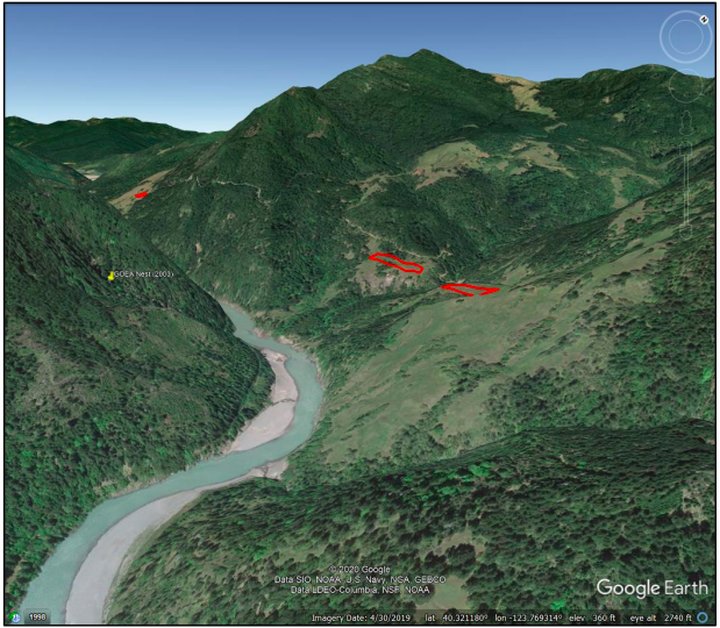
A documented golden eagle nest site (yellow pin) is within line-of-site of proposed cultivations areas for Rolling Meadow Ranch (shown in red). | Image created by CDFW as part of a comment letter submitted to the county.
###
Environmental scientists with the California Department of Fish & Wildlife have recently raised such concerns with the county. At a September meeting of the Planning Commission, for example, CDFW Senior Environmental Scientist Specialist Mike van Hattem brought up what he called “the elephant in the room” — namely, “the approval of large, industrial cultivation sites on remote wildlands.”
The commission was considering another controversial weed grow: two-acres of mixed-light cultivation in eastern Humboldt, near Maple Creek, from a company called Adesa Organics LLC. CDFW scientists had some specific concerns about the project — not least of all its potential impacts to golden eagles, a fully protected species in California — but van Hattem also wanted to address the larger trend.
The county’s Commercial Medical Marijuana Land Use Ordinance, adopted in 2016, says new outdoor and mixed-light grows are only permitted on parcels with prime agricultural
soils on slopes of 15 percent or less. Van Hattem and other CDFW officials reviewed the zoning at the time and saw that most parcels with prime ag were located on flat expanses of existing farmland, such as the Eel River Valley and Arcata Bottoms.
The Adesa project, like Rolling Meadow Ranch, is in the middle of nowhere, accessible only via narrow county roads beyond most services and civilization. Van Hattem posed a question to the Planning Commission: “Is this what you thought was intended? Do you want large industrial cultivation sites in remote wildlands of your county?”
In this case, evidently so, because the Planning Commission approved the project, and on appeal the Board of Supervisors upheld the decision. But critics have become increasingly vocal about what some call “the prime ag loophole”: Property owners can hire soil scientists or geologists to come out and inspect their land, and if portions of their property have soil that meets the criteria of the California Department of Conservation, it can be designated “prime ag,” potentially making it eligible for a cannabis operation in Humboldt County, no matter how far-flung the land may be.
CDFW raised objections again with the Rolling Meadow Ranch project. In a 15-page comment letter submitted to the county on Dec. 30, environmental scientist Greg O’Connell argued, “An unintended consequence
of requiring new cultivation on prime agricultural soils (and allowing new areas to be
classified as such with no minimum size) is the targeting of small, isolated, flat
grasslands within larger prairie complexes on steeper slopes.”
That describes Machata’s property quite well: scattered grassy plateaus nestled within hundreds of acres of forested hillsides. “These habitats [the flat grasslands] are vital
elements of biodiversity and provide important habitat for wildlife,” O’Connell wrote.
The county’s Planning and Building Department has received more than 150 applications for commercial cannabis cultivation projects within two miles of
documented golden eagle nest sites. O’Connell said the cumulative impacts of these projects “could eliminate golden eagle territories within Humboldt County” while harming a long list of other special status species that depend on grassland habitats.
In a phone interview Monday, van Hattem said that while the county required Machata to make some much-appreciated alterations to his plan in response to CDFW feedback, and while the project’s wildlife surveys were adequate, “The bottom line is that this project will transform a very wild area.”
Putting a lot of people into environments where there used to be none changes the way wildlife uses the habitat, he said. And he reiterated that these kinds of projects are simply not what he and his colleagues were envisioning during the drafting of the county’s first cannabis land use ordinance.
“I don’t think any of us thought this was what we were getting out of the ordinance,” van Hattem said. Sun Valley Floral’s recently revealed proposal for 23 acres of greenhouse cultivation in the Arcata Bottoms is large, sure, he said, but it’s on land that’s been in use for generations, near population centers with adequate traffic access.
He made a point of noting that his agency isn’t against legal weed. “It’s not about cannabis; it’s about proper land management,” he said. “Bringing everybody into the legal light, that’s a good thing. It’s why we do planning efforts — to do the best things we can for the county, our watersheds and rivers.”
He just doesn’t think projects like Rolling Meadow Ranch fit that bill. “It’s troubling to put these big projects way out there,” he said.
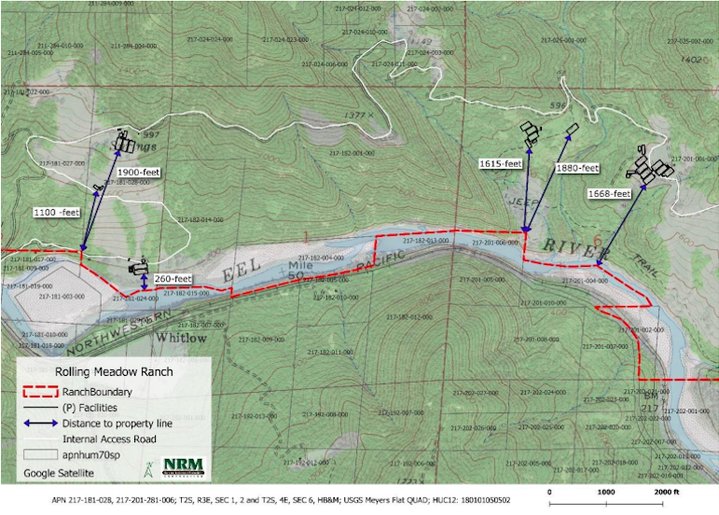
Topographical map showing the distance of Rolling Meadow Ranch project facilities (those tiny black outlines) from parcel boundaries along the Eel River. The squiggly white line represents a proposed internal access road. | Image via County of Humboldt.
###
The notice of appeal of the Rolling Meadow Ranch project was filed last month on behalf of Fran Greenleaf, John Richards and Patty Richards, all of whom live in close proximity to the property. It argues that the Planning Commission erred in concluding that there’s no substantial evidence that the project may have significant environmental impacts and requests that the Board of Supervisors either require a full environmental impact report or deny the application altogether.
The appeal letter describes the setting as “remote” and “undeveloped” and says the project would “forever change the character of the area and pose a danger to public welfare.”
The appeal’s list of concerns include intensified land use, increased traffic and noise, year-round groundwater extraction, the expansion of utility infrastructure, safety and security concerns and “heightened fire danger in a high-fire-risk area located far from public safety resources .”
Reached by phone recently, appellant John Richards said that last one is his main worry.
“You put that many people into the wildlands and it just ups the odds,” he said. “And response time out there is gonna be really slow.”
The conditions of Dyerville Loop Road and McCann Road only add to the problem he said, describing certain sections as little more than “a ledge carved into a cliff.”
It just fundamentally seems like an inappropriate spot for an operation of this size. “Why put that there?” he said. “It should be in Watsonville or the Central Valley.”
Fellow neighbor Mary Gaterud agrees. She has spoken against the project publicly and launched the online petition opposing it. She believes a certified hydrogeologist needs to be consulted to ensure that the wells on Machata’s property are not connected to the nearby Eel River, among other concerns.
“Siting these large grows in remote, mountainous terrain — that was not intended by the county ordinances or the county general plan,” Gaterud said. It’s not sensible planning to site an operation like this out away from services and the highway.”
At the January 12 Planning Commission hearing, however, commissioners and staff alike argued that the rules, as currently written, justify approval of Rolling Meadow Ranch.
Pressed by Commissioner Noah Levy about why staff didn’t require an EIR, Planning and Building Director John Ford said he and his staff are “factually driven,” and the facts simply didn’t elevate the project’s anticipated impacts to that level of review.
The 259-page initial study and environmental checklist, conducted by Eureka-based Natural Resources Management Corporation, analyzed the environmental impacts. Regarding the water source, it quotes David Fisch of Fisch Drilling saying the three wells he dug in June of 2019 are in perched bedrock “with no hydraulic connection to any
surface water.”
“Now,” Ford said at the meeting, “may water ultimately flow through fractured rock and at some point connect with the Eel River or a nearby creek? I don’t think even a hydrogeologist could give you an absolute answer on that.” But that’s not the standard, he said. “The test is: Is this a diversionary water source? We believe it’s not.”
As for the golden eagle, Ford said surveys and supplemental information demonstrate that the previously documented nest site is simply not there anymore. O’Connell, with CDFW, countered that golden eagle pairs may return to prior nesting sites after many years or even a decade, but an attorney for the project said such theoretical conjecture “doesn’t rise to the level of substantial evidence of a significant impact” that would justify an EIR.
Reached by phone on Tuesday, Ford acknowledged that previously unidentified prime ag soils have been designated as such in a lot of remote settings, but he disputed the characterization of this practice as a “loophole.”
“It’s really a technical issue,” he said. “I don’t think it’s a loophole; I think it’s very clear.” The goal of the prime ag requirements was to get grow operations off of steep hillsides that required grading and onto flatter, more suitable land for growing. “It’s just that we’re finding prime ag soils where they hadn’t been previously identified,” he said.
But do projects like Adesa and Rolling Meadow Ranch run counter to the county’s vision for legal commercial cannabis? Ford said such questions are judgement calls placed in the hands of the Planning Commission and the Board of Supervisors.
Machata, for his part, had no idea that his foray into the marijuana industry would require so many surveys, studies, revisions and concessions. Speaking on the phone from Florida he said, “Sometimes I get myself in more things than I want to. I think this is one of ‘em.”
But he defended his stewardship of the land and cited examples of measures he’s taken to protect the environment. He agreed to set aside 1,600 acres of his property as a contiguous piece of untouched land. He agreed to use “first class” greenhouses with no water runoff or nighttime light pollution. He agreed to employ electric buses on the property to carry employees around. And he hired consultants to write a report that “covers everything from frogs to big-eared bats.”
Since he knows nothing about cannabis himself he said he’ll probably enlist local growers to run the facility.
“My intentions are good,” Machata said. And he offered his own conclusion about the project’s impacts: “Everything we’re doing really does not affect the environment.”
More than a few local residents, nonprofit leaders and environmental scientists have argued otherwise. Next Tuesday, the fate of Rolling Meadow Ranch will be a judgment call in the hands of the Humboldt County Board of Supervisors.
The cumulative impacts from such individual judgment calls will not be clear for years or perhaps decades to come.
Denver
Nelson peacefully passed away on February 28, 2021, after suffering a
stroke.
Denver
was born in Spencer, Iowa in October 1941 to Harold and Loramae
Nelson. He left Spencer at 17 and attended the University of Iowa. He
finished his undergraduate degree, medical school, and a 6 year
residency in neurosurgery at Stanford University. Before he began his
residency, he left Stanford for two years and served in the US Air Force
as a flight surgeon in Vietnam, where he was awarded the Bronze Star.
He
met and married Judy, who was a nurse in Stanford’s ICU. After his
residency, he took his first job as a neurosurgeon in Anchorage,
Alaska. One year later, in 1977, he moved to Eureka, where he worked
as a neurosurgeon until his retirement in 2002.
He
was a man with many hobbies and interests. He loved cars and
motorcycles, worked on engines, flew drones, small planes and
helicopters, and raced jet boats on rivers in California, Oregon, and
Idaho. He was a woodworker, a pilot (he owned a Bonanza at one time),
enjoyed air shows, and climbed Mount Rainier in 1969. He owned
logging trucks and timber properties.
He
loved exploring National Parks, the backroads of America, and
especially his yearly trips to Iowa to check on his corn and
soybeans.
He
was involved in many different organizations over the years:
Humboldt-Del Norte Medical Society, The Ingomar Club (he enjoyed
being a docent there), Humboldt County Planning Commission,
Historical Society, Buckeye Conservancy, North Coast Air Quality
Advisory Board, Humboldt County Fish & Game Commission, Salt
River Watershed Council, Redwood Park Conservancy, Mobile Medical
Clinic, and Humboldt County Farm Bureau.
He
was a volunteer at the Redwood National and State Park for 18 years
and a Humboldt County election poll worker for four years.
Denver
had friends from all different walks of life. If you were a friend of
Denver’s, you knew it. If you weren’t a friend of Denver’s, you
probably knew that too. He was opinionated and was always up for a
debate. If he felt strongly enough about a topic, you would probably
read about it in one of his “My Word” opinion pieces. He always
had an inappropriate joke to share. He was a man of few words, but
the words he spoke were meaningful and had purpose. He was a fiercely
loyal friend and will be missed by many.
He
leaves behind Judy, his wife of 50 years, daughter Kristina
Radelfinger, son-in-law Shane, grandson Kyler, granddaughter Sienna,
and his beloved yellow lab, Viking.
Very
special thanks to the nurses and staff at St. Joseph Hospital, Dr.
Tom Rydz, and Dr. Lei Han.
There
will be no services.
In
lieu of flowers, please consider donating to one of your favorite
charities or the Humboldt-Del
Norte County Medical Society Future Physician Scholarship Fund:
℅
Humboldt Area Foundation 363
Indianola Road Bayside,
CA 95524
I
think he would appreciate us ending with his favorite quote by his
favorite hero, Theodore Roosevelt:
“It
is not the critic who counts; not the man who points out how the
strong man stumbles, or where the doer of deeds could have done them
better. The credit belongs to the man who is actually in the arena,
whose face is marred by dust and sweat and blood; who strives
valiantly; who errs, who comes short again and again, because there
is no effort without error and shortcoming; but who does actually
strive to do the deeds; who knows great enthusiasms, the great
devotions; who spends himself in a worthy cause; who at the best
knows in the end the triumph of high achievement, and who at the
worst, if he fails, at least fails while daring greatly, so that his
place shall never be with those cold and timid souls who neither know
victory nor defeat.”
###
The obituary above was submitted on behalf of Denver Nelson’sloved ones. The Lost Coast Outpost runs obituaries of Humboldt County residents at no charge. See guidelines here.
Gabriel Irah LeRoy, 35, left this earth to join the Lord on Jan 21, 2021. He was born in Jonesboro, Arkansas. At the age of 12, he moved with his family back to Humboldt County, where his mother was born and raised. He spent the last 8 years living in Scotia.
Gabe (as he preferred to be called) was a unique, super-friendly guy who seemed to never meet a stranger. Gabe loved a good conversation and would take his time when getting his mail or groceries at the store as he most often was shooting the breeze with the postmaster or the butcher. He was very loving and had a gregarious personality.
Gabe was a very loving, hands-on father. His favorite thing to do was spend time with his two children, Emelia and Caine. Caine and he shared a love for Marvel movies and they would go to the threatre together to see the same one over and over, and when it was released to DVD he’d buy it and they’d watch it again, over and over! Through the years he earned a couple of black belts in karate and was excited to teach karate to his daughter, Emelia, and was teaching her to defend herself. His dream was to one day teach other children.
He really enjoyed going camping and fishing at Ruth Lake with his family.
Gabe was a big kid at heart and liked to roughhouse with his kids and his friends. There are several videos of these wrestling matches! Gabe and his brother-in-law Damon Tucker were like brothers and spent time goofing off (shenanigans) and sometimes ended up breaking stuff as they wrestled all around the house. At times it got pretty loud with the kids yelling with excitement. These special times could go on for hours. So much laughter and fun.
Gabe had a great sense of humor and loved to make people laugh.
He had a very special.bond with his niece Heaven Burns. They enjoyed playing chess and also shared a love of writing. They spent a lot of time discussing her writing and he was instrumental in getting her into Academy of the Redwoods, and was very insistent she go to college and get a career.
Gabe was an incredible actor as a kid in high school. He played in several plays and was quite talented as an actor. He was able to do many types of voices and entertain his family and friends. He was such a gregarious soul.
He really enjoyed quite a variety of music and was known to put out some impressive raps of his own His all time favorite song was Landslide by Fleetwood Mac. He loved singing along to it.
Gabriel is survived by his parents Patricia Guidry & Matthew LeRoy, his children Emelia & Caine LeRoy, his sister Ryanne Tucker and his brother Noah LeRoy.
“You are no longer by our side, but forever in our hearts.”
###
The obituary above was submitted on behalf of Gabe LeRoy’sloved ones. The Lost Coast Outpost runs obituaries of Humboldt County residents at no charge. See guidelines here.