

Say Goodbye to the Parking Lot Behind Lost Coast Brewery Cafe, Which is Being Closed to Make Way for EaRTH Center
LoCO Staff / Thursday, Aug. 13 @ 2:50 p.m. / Housing , Infrastructure

A sign has been posted at 3rd Street, between G & H in Eureka. | Photos by Isabella Vanderheiden.
###
Press release from Danco Group:
Eureka, California — August 13, 2026 — The Danco Group is providing notice of a parking lot closure at the EaRTH Center site in Eureka (3rd Street, between G & H Street) in connection with upcoming project activities. The parking lot closure is anticipated to remain in effect for the duration of the project. [In other words, the closure is permanent. —LoCO] Community members, visitors, and other affected parties are encouraged to plan accordingly and observe all posted signage and access restrictions around the project site.
Project Timeline
Parking Lot Closure: August 17, 2026 – June 1, 2028
The schedule is subject to change based on construction progress, site conditions, weather, and other factors that may affect the project timeline. Updates will be provided as appropriate throughout the project.
Project Contact
For questions regarding the parking lot closure, project timeline, access, or other project- related matters, please contact:
McKenzie Dibble
Development Project Manager
Phone: (707) 822-9000 Email: mdibble@danco-group.com
The Danco Group appreciates the community’s patience and cooperation throughout the project and will work to minimize impacts to the surrounding area whenever possible.

###
PREVIOUSLY
- EaRTH Center a Go: Eureka Council Approves Ambitious Housing/Transit Development Downtown, Despite Parking Concerns
- Eureka City Council Votes to Remove Lots From Parking Assessment District to Make Way for EaRTH Center
- Design Review Committee Narrowly Approves New Plans for Eureka’s EaRTH Center
- Eureka’s Long-Awaited EaRTH Center Awarded $12 Million in Grant Funds; Construction Slated to Begin Spring 2026
BOOKED
Today: 11 felonies, 14 misdemeanors, 0 infractions
JUDGED
Humboldt County Superior Court Calendar: Yesterday
CHP REPORTS
No current incidents
ELSEWHERE
Governor’s Office: Governor Newsom statement on compromise to address wildfire risk, support fire survivors, and create stronger accountability
RHBB: CDFW Announces Angling Closure at Mouth of the Klamath River
RHBB: Humboldt Bay Area Plan Planning Commission Workshop on Thursday, Sept. 3
FERC Will Hold Public Scoping Sessions in Eureka Next Month on the Proposed Decommissioning of PG&E’s Dams on the Upper Eel
Ryan Burns / Thursday, Aug. 13 @ 1 p.m. / Infrastructure
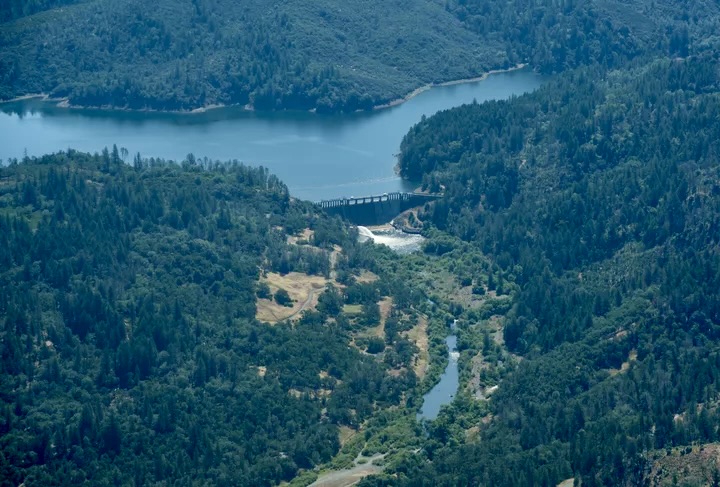
Scott Dam, with Lake Pillsbury behind it. | Photo: Isabella Vanderheiden.
PREVIOUSLY
- POTTER VALLEY DAM UPDATE: The U.S. Secretary of Agriculture Says That a Municipal Water District in Riverside County is Interested in Taking Over the Project
- Statements From PG&E and Friends of the Eel on SoCal Agency’s Potter Valley Dam Bid
- That SoCal Water Agency Says It’s Just in the Very Initial, Exploratory Phase of its Potential Bid to Take Over the Eel River Dams
- ‘This is Not OK’: Huffman Says He’ll Launch an Investigation Into the Trump Administration’s Eel River ‘Water Grab’ Scheme
- Internal Documents From a Southern California Water Agency Outline a Vision to Turn Eel River Water Rights Into a Cash Bonanza — at the Expense of Local Users
- FERC OFF: Federal Agency Tosses Southern California Water Agency’s Bid
###
Humboldt County residents will have a pair of chances next month to weigh in on the future of the Potter Valley Project, with federal regulators holding public meetings at Eureka’s Wharfinger Building as part of their environmental review of PG&E’s plans to decommission the project.
The Federal Energy Regulatory Commission (FERC) will hold an evening session Sept. 15 and a daytime session Sept. 16, giving members of the public a couple of chances to say their piece and have their comments entered into the formal record.
PG&E’s plans to surrender and decommission the Potter Valley Project — a defunct hydroelectric system that diverts water from the Upper Eel River to the headwaters of the Russian River — have become something of a political football in recent months. U.S. Secretary of Agriculture Brooke Rollins seems determined to blow up the “Two-Basin Solution” developed under U.S. Congressman Jared Huffman.
The prospects for that historic agreement have been threatened by the emergence of Elsinore Valley Municipal Water District, a SoCal water agency that has expressed interest in taking over the project rather than seeing it dismantled. The district sought to intervene in the FERC proceeding this summer, but FERC rejected the request, meaning the agency is not currently a party to the case.
The upcoming meetings in Eureka are part of FERC’s review of PG&E’s application, filed in July 2025, to surrender its license and decommission the Potter Valley Project. FERC began its environmental scoping process in May and held its first public scoping sessions in Ukiah in June.
Alicia Hamann, executive director of environmental nonprofit Friends of the Eel River, told the Outpost, “It’s a good thing that FERC is giving residents in Humboldt the same opportunity to give input on dam removal that was given to residents in the Russian River watershed.”
If you can’t make it to either of the upcoming meetings — or if you just prefer not to make your comments directly into a microphone in a public forum — don’t worry: FERC’s comment period remains open until Sept. 18 at 2 p.m. here on the West Coast, and you can submit comments online.
[CLARIFICATION: These days, verbal public testimony at FERC public scoping sessions gets recorded on a one-on-one basis by a court reporter rather than via they traditional public-speech-at-a podium format.]
Here’s the official announcement from FERC:
On July 25, 2025, Pacific Gas and Electric Company (applicant or PG&E) filed an application to surrender and decommission the Potter Valley Hydroelectric Project No. 77. The project is located on the Eel River and East Branch of the Russian River in Lake and Mendocino counties, California. The project occupies federal lands managed by the U.S. Forest Service.
On May 22, 2026, the staff of the Federal Energy Regulatory Commission (FERC or Commission) initiated a scoping process as part of its review and held scoping meetings on June 23 and 24, 2026 in Ukiah, California. On July 24, 2026, Commission staff extended the comment period to September 18, 2026, by 5 p.m. Eastern Time, for the filing of scoping comments.
By this notice, Commission staff provides notice of two additional public scoping sessions to collect comments on the scope of the environmental issues that should be analyzed in the NEPA document. All interested individuals, resource agencies, Native American Tribes, and non-governmental organizations (NGOs) are invited to attend one or both of the sessions.
These additional sessions will follow the format of the June 23 and 24, 2026 sessions. There will be no formal presentations at either session. Numbered tickets will be handed out on a first-come, first-serve basis; individuals will be called in order by ticket number to provide oral comments to be transcribed by a stenographer for the formal record.Time limits on oral comments may be enforced to ensure those wishing to comment have the opportunity to do so. The times and locations of the additional scoping sessions are as follows:
Evening Scoping Session
DATE: Tuesday, September 15, 2026
TIME: 6 p.m.- 8 p.m. Pacific Time (PT)
PLACE: Wharfinger Building
ADDRESS: 1 Marina Way, Eureka, CA 95501
Daytime Scoping Session
DATE: Wednesday, September 16, 2026
TIME: 9 a.m.- 11 a.m. (PT)
PLACE: Wharfinger Building
ADDRESS: 1 Marina Way, Eureka, CA 95501If you provided comments in our previous June 23-24 scoping sessions, you do not need to attend and/or resubmit your comments. For additional information on the proceeding, see our May 22, 2026 notice and Scoping Document 1. The comment period for filing all scoping comments closes on September 18, 2026, by 5 p.m. Eastern Time
For public inquiries and assistance with making filings such as interventions, comments, or requests for rehearing, contact the Office of Public Participation at (202) 502-6595 or OPP@ferc.gov.
If you have further questions, you may also contact Diana Shannon at diana.shannon@ferc.gov or 202-502-6136.
Do You Have Thoughts on Low-Impact Camping on Private Property? If So, You’ll Want to Attend Next Week’s Humboldt County Planning Commission Meeting
Isabella Vanderheiden / Thursday, Aug. 13 @ 12:24 p.m. / Local Government

Ah, the great outdoors! | Photo: Dave Hoefler on Unsplash.
###
Attention, property owners! Have you ever looked out at your sprawling land and thought, Wow! My little corner of Humboldt County is so exceptionally stunning. I wish I could share its beauty with some kind campers who share my appreciation for the great outdoors, but I don’t want to pay the state thousands of dollars to do it? If you have had this exact thought, listen up!
Staff in the county’s Planning and Building Department are developing an ordinance for low-impact camping in unincorporated areas of the county as a part of the implementation of AB 518. The state bill, passed in 2025, allows counties to permit small-scale camping on private property without a state permit, simplifying the application process for landowners and expanding affordable camping options for outdoor enthusiasts.
Hipcamp, the Airbnb of the outdoor world, has led the charge in the low-impact camping movement. The site has listings for both tent and RV camping, glamping setups as well as small cabins and treehouses that average about $40 a night locally.
AB 518 allows for up to nine campsites, including up to four RVs, per property, which must be at least two acres. A host or manager must be available by phone 24/7 and the site must comply with local rules for waste/trash disposal, fire and noise impacts.
Along with increasing access to affordable overnight options, proponents of AB 518 see low-impact camping as another way for farmers and cannabis growers to increase revenue streams. Opponents of the bill, however, worry about careless behaviors that could increase environmental impacts and fire danger on remote properties with sketchy access to emergency services.
Staff are still working out drafts for both the inland and coastal versions of the county ordinance, which have been reviewed by key state and local agencies including the Building Division, Department of Environmental Health, California Department of Fish & Wildlife, Cal Fire, California Coastal Commission and the Farm Bureau.
If you’d like to share your two cents on the ordinance, you’ll want to attend next week’s Humboldt County Planning Commission meeting on Thursday, Aug. 20 at 6 p.m.
More information about the upcoming meeting can be found in the meeting notice below:
The Humboldt County Planning & Building Department is developing an ordinance to allow low-impact camping areas in rural unincorporated Humboldt County and is seeking input from the community.
A workshop will be held at the Planning Commission meeting on Thursday, Aug. 20 at 6 p.m. to share information about the draft ordinance and receive input from the Planning Commission and the public.
To review the Inland Low-Impact Camping Area Ordinance, please visit HumboldtGov.org/LICA.
Background
Assembly Bill 518 was passed in October 2025. This bill allows counties to permit small-scale and low-impact camping on private rural lands without a state permit. Since the bill was passed, the Planning & Building Department has been working to develop a Low-Impact Camping Area Ordinance that follows state law and local health, safety and welfare standards.Drafts of both the inland and coastal versions of the ordinance have been reviewed by important state and local agencies including the Building Division, Department of Environmental Health, California Department of Fish & Wildlife, Cal Fire, California Coastal Commission and the Farm Bureau. Their input has been considered for incorporation into the draft ordinances.
An updated draft of the inland version was released to the public for review on July 8 and a public workshop on this version was held on July 15. Public comment has been received, and county staff have updated the draft ordinance, which will now be discussed at a workshop at the Planning Commission meeting on Thursday, Aug. 20.
The county is still working to address the California Coastal Commission’s comments on the coastal version of the ordinance, which is not currently available to the public. Once this document is ready to move forward, there will be opportunity for public comment at a future Planning Commission meeting.
Planning Commission Workshop
If you would like to be part of the discussion on this ordinance, please attend the workshop at the Planning Commission meeting on Thursday, Aug. 20 at 6 p.m. Community members have the option to attend on Zoom or in person at the Humboldt County Board of Supervisors’ Chamber, located in the Humboldt County Courthouse at 825 Fifth St. in Eureka.
More information and associated workshop documents will be available in the Planning Commission meeting agenda, which will be posted online by 5 p.m. on Friday, Aug. 14 at Humboldt.legistar.com.
How to Attend on Zoom
Members of the public may attend the workshop virtually by visiting Zoom online and entering the password 200525. To access it on the phone, call 346-248-7799, enter the meeting ID: 875 4480 7065 and password: 200525.
A live stream of the meeting will also be available on the county’s meeting agenda web page or by watching Access Humboldt on cable Channel 11.
Following this workshop, the ordinance will enter the hearing stage where the Planning Commission will make their recommendations to the Board of Supervisors, who will consider those recommendations and make a decision regarding the proposed ordinance at a future meeting.
For more information about the workshop, please email macevedo@co.humboldt.ca.us or call 707-441-2634.
The County of Humboldt is committed to providing equal access to all county programs, services and activities through the provision of accommodations for individuals with qualified disabilities as required under the Americans with Disabilities Act (ADA). With 72 hours prior notice, a request for reasonable accommodation for this meeting can be made by calling 707-441-2634. For more information about Humboldt County’s draft Low-Impact Camping Area Ordinance, please visit HumboldtGov.org/LICA.About the Humboldt County Planning & Building Department
The County of Humboldt’s Planning & Building Department is dedicated to supporting safe and well-planned communities throughout Humboldt County. Whether you’re building a home, opening a business or planning for the future, the Planning & Building Department is here to guide you through the processes that help ensure development aligns with local values, environmental stewardship and state law. For more information about the Humboldt County Planning & Building Department and the services it provides, please visit HumboldtGov.org/Planning-Building.
Hoopa Man Arrested for Arson (No, Not the Big Fire) and Assault, Sheriff’s Office Says
LoCO Staff / Thursday, Aug. 13 @ 10:49 a.m. / Crime
Press release from the Humboldt County Sheriff’s Office:

On August 8, 2026, at approximately 5:07 p.m., Humboldt County Sheriff’s deputies were dispatched to a residence in the 1900 block of Pine Creek Road in Hoopa for a report of a physical altercation between two male subjects.
Upon arrival, deputies intervened in the altercation and detained 52-year-old Hoopa resident Aaron James Pole.
According to witness statements, Pole had arrived at the residence and refused to leave the property. Prior to the altercation, witnesses reported seeing Pole near the Hoopa Rodeo Grounds and the river bar, where a small vegetation fire was burning. Witnesses reported that Pole was attempting to accelerate the spread of the fire with his hands.
The fire was quickly extinguished by the Karuk Fire Department, which had been staged at the Hoopa Wildland Fire Department, while Hoopa Wildland Fire personnel were actively engaged in firefighting operations on the Milepost 18 Fire.
Based on witness statements and evidence collected during the investigation, Pole was arrested and transported to the Humboldt County Correctional Facility, where he was booked on the following charges:
- P.C. 451(d)-Arson
- P.C. 148(a)(1)-Obstruct/Resist Peace Officer
- P.C. 240-Assault
- P.C. 978.5 – Bench Warrant/Failure to Appear
The Humboldt County Sheriff’s Office would like to thank the community members who reported this incident and provided information that assisted deputies.
The Sheriff’s Office has also received reports of other suspected arson fires in the Hoopa Valley. We remain committed to thoroughly investigating these incidents and holding those responsible accountable. Anyone with information related to arson fires in the Valley is encouraged to contact the Hoopa Valley Tribal Police Department or the Humboldt County Sheriff’s Office.
Sheriff’s deputies are actively investigating both the Mile Post 16 Fire and the ongoing Mile Post 18 Fire while continuing to support firefighting operations, public safety efforts, and the protection of residents in the surrounding area.
Anyone with information about this case or related criminal activity is encouraged to call the Humboldt County Sheriff’s Office at (707) 445-7251 or the Sheriff’s Office Crime Tip line at (707) 268-2539.

Hoopa’s Mile Post 18 Fire Grows to More Than Six Square Miles; Only Six Percent Contained With 866 Firefighters Deployed
LoCO Staff / Thursday, Aug. 13 @ 9:08 a.m. / Fire

Photos via Hoopa Valley Fire Department and OES.
###
Press release from California Interagency Incident Management Team 1:
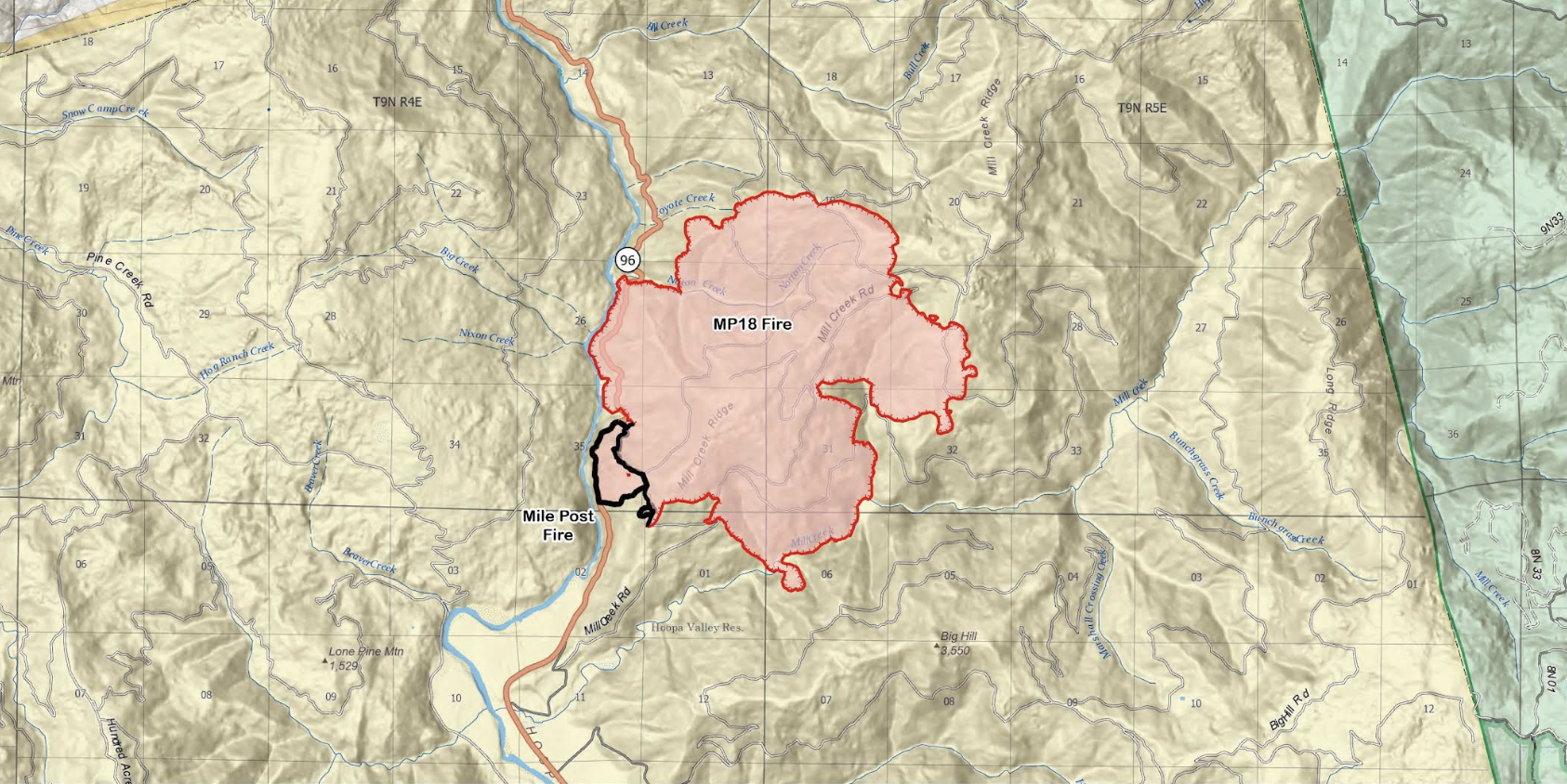
Acres Burned: 3937
Containment: 6%
Start Date: 8/7/2026
Personnel: 866###
Active fire behavior was witnessed late into the evening as unseasonably dry vegetation and steep terrain drives growth on all sides of the fire.
Highway 96 remains closed as crews continue to hold the fire east of the Trinity River. With extremely steep terrain in all directions, fire personnel and large equipment require this limited space along the highway to safely and effectively fight the fire.
Air tankers and helicopters focused most of their efforts on the northern and northwestern perimeter to contain the fire within the Norton Creek and Coyote Creek drainages, with contingency lines already in place north of Skunk Creek.
Firing operations reinforced completed handline, effectively holding the fire east of the Hoopa Community in the Mill Creek area. Fire crossed Mill Creek Wednesday below Big Hill Lookout, and four hotshot crews assisted by helicopters directly engaged the fire there with the plan to hold it below the dozer line on Big Hill Ridge.
Fire managers would like to remind the community to please keep all personal drones grounded. Drone activity forces firefighting aircraft to land, stopping critical air operations.
Weather:
A trough along the coast has allowed marine air to spread into the Trinity River valley. Humidity values are trending noticeably higher with afternoon relative humidity values 25-40 percent and good nighttime recovery from 60-80 percent, even at higher elevations.
Evacuations:
Evacuation Order: HIA-E002-A Evacuation Warnings: HIA-E001-B, HIA-E002-B, HIA-E003, HIA- E004, HIA-E006, and HIA-E014-C
Road Closures:
Highway 96 remains closed north of Hoopa due to fire activity. Closures also are in place for Hostler Ridge Road, Mill Creek Road and Big Hill Road.


Californians Voted to Spend $1 Billion on K-12 Arts. Why Are Schools Returning the Money?
Carolyn Jones / Thursday, Aug. 13 @ 8 a.m. / Sacramento

Kindergarten students participate in a hip-hop dance class at Radcliff Elementary School in Watsonville on May 21, 2024. Photo by Laure Andrillon for CalMatters
###
This story was originally published by CalMatters. Sign up for their newsletters.
###
Three years after voters passed an ambitious arts education funding measure, California’s K-12 schools were supposed to be awash in dance, music, theater and fine arts. But some schools are returning their arts money to the state, saying the rules on how to spend it are too vague and they can’t find enough arts teachers.
“The sad thing is, this means that thousands of kids aren’t getting art,” said Austin Beutner, the former superintendent of Los Angeles Unified who wrote Proposition 28. “We thought Prop. 28 was clear.”
Prop. 28, which voters overwhelmingly approved in 2022, sets aside about $1 billion a year for the arts in California public schools. Schools with more low-income students get more money, but otherwise funding is based on enrollment. Los Angeles Unified, with about 400,000 students, got about $72 million last year, while Death Valley Unified, with 21 students, got about $2,000.
Schools must spend at least 80% of their money on additional arts staff, with the rest going to art supplies and other arts expenses. Whatever they don’t spend, they’re required to return to the state after three years. The first three-year period just ended, and the California Department of Education hasn’t yet announced how much money schools returned. The state redistributes the unspent money to individual schools that are using their Prop. 28 money correctly, based on their annual spending reports.
State data compiled by Create CA, an arts nonprofit that supported Prop. 28, shows dozens, if not hundreds of schools that spent no money. Among them are charter schools, small schools, and mid-sized schools in every corner of the state.
At the other end of the spectrum, many districts have gone on spending sprees, hiring teachers and expanding programs at all schools. Bakersfield City Schools, for example, doubled the size of its folklorico and mariachi dance programs, bought thousands of musical instruments and paired local artists with classroom teachers.
Long Beach Unified has also doubled down on the arts. Its high school course catalog offers dozens of arts classes, including classics like marching band and painting as well as more obscure classes like improvisational dance, steel drums, stage technology, chamber orchestra and photography.
Too few teachers, too much confusion
But other districts, particularly smaller and rural districts, have hit some snags. Even though the state allows districts to pool their Prop. 28 money to share a teacher, the law doesn’t provide explicit language about it. Regardless, schools say there are not enough art teachers to hire. According to a recent Stanford Research Institute study, California needs at least 5,000 new arts teachers to meet the demand. Rural areas in general have a harder time hiring teachers, particularly those with specialized training.
Another obstacle is what some school officials describe as vague directions in the law. Prop. 28 broadly defines what constitutes an arts class, but it doesn’t require those classes to align with the state’s existing arts framework. And schools already get arts funding from the state, leaving some school officials wondering if they can mix their funds and still comply with the law.
“We need clarity and confidence that we’re doing this the right way,” said El Dorado County Superintendent of Schools Ed Manansala, saying schools are afraid of misusing the funds – for example, sharing a music teacher with another district but not dividing their time lawfully. “We have a long history of supporting the arts and we really want to make sure we do this right.”
Manansala and other school officials also say they’re afraid of getting sued if they don’t use the money correctly. That’s what happened to Los Angeles Unified. Beutner sued his former district last year, claiming it cut existing arts funding and backfilled it with Prop. 28 money, which is prohibited.
The lawsuit is pending in Los Angeles Superior Court. The district said that its use of Prop. 28 money was legal.
‘We should not be fighting over this’
Nonetheless, the confusion led Assemblymember Al Muratsuchi to write a bill that would clarify some of the Prop. 28 language – for example, defining what constitutes supplemental arts funding. The legislation so far has had nearly unanimous bipartisan support, but one very vocal opponent: Beutner.
Beutner said that Muratsuchi’s bill, Assembly Bill 2440, essentially guts Prop. 28 by giving schools too much leeway to spend their money. Among his concerns is that districts will not increase arts education at all school sites, but instead cluster it at certain schools or try to pawn off a physical education class, for example, as an arts class.
“I believe in the arts, and what it can do for students. Some kids only come to school because of the arts,” Beutner said. “We should not be fighting over this. Prop. 28 is very clear” in that it requires schools to add extra arts programs, not replace existing programs.
Beutner also described the bill as a “get-out-of-jail-free card” for Los Angeles Unified, because he said it would give the district more freedom in how it spends its Prop. 28 money. District spokesperson Christy Hagen said in an email that the district had nothing to do with the bill and hasn’t taken a position on it.
Beutner said he’d like to see Muratsuchi’s legislation tabled until a judge rules on his lawsuit against Los Angeles Unified. Otherwise, spending the funding could become even more confusing.
The bill is currently in the suspense file in the Senate appropriations committee, awaiting approval Thursday. If the committee doesn’t agree to hear it, it’ll likely die.
Muratsuchi said he’s open to a last-minute compromise.
“(Beutner) and I share the same goal of Prop. 28 providing arts and music to every child in California regardless of zip code,” said Muratsuchi, a Democrat from Torrance. “We want to make sure the law’s language reflects that. Hopefully I convinced him that I mean well and we have the same objective.”
Urgent need for clarity
Clarifying the languageis crucial if the law is going to be successful, said Veronica Alvarez, executive director of Create CA, a nonprofit that promotes arts education in California schools.
Too many school districts are not spending their Prop. 28 money because they’re confused about the guidelines or can’t comply with what they view as overly narrow requirements, Alvarez said.
“We want clearer statewide rules, so all kids from Shasta to Bakersfield get high-quality arts education,” Alvarez said. “Hopefully we can move forward on this.”
A Challenger in Eureka’s Fifth Ward: Retiree Kathleen Herrera Qualifies to Run Against Jeff Leonard for City Council Seat
Ryan Burns / Wednesday, Aug. 12 @ 5:04 p.m. / Elections
PREVIOUSLY
- It’s Official! Former Eureka City Councilmember Jeff Leonard Qualifies for November Ballot
- Here Are Your Eureka City Council and Mayor Candidates; Will Another Challenger Emerge to Challenge Jeff Leonard in the Fifth Ward?
###

Herrera. | Submitted
And we have another challenger!
Kathleen Herrera, a 79-year-old retiree, has qualified as a candidate for the Fifth Ward seat on the Eureka City Council. She will face off against Jeff Leonard, who previously represented Eureka’s Third Ward from 2002 to 2010.
Eureka’s Fifth Ward (see map here) is currently represented by Renee Contreras, whose last-minute announcement that she would not seek re-election allowed a few extra days for potential candidates to turn in the necessary nomination paperwork. Herrera seized that opportunity.
Reached by phone shortly after 4 p.m., she said she first got interested in pursuing a seat on the city council because of her friends’ concerns about C Street’s reconfiguration into a bicycle boulevard. They felt that it’s now “kind of a mess.”
“I ride a bike,” Herrera said. “I actually think it’s quite nice, the bike part [of C Street]. But I was quite disappointed that they made it a one-way.”
The direction of vehicle traffic on C Street’s single lane through downtown alternates between north-south and vice versa, depending on which block you happen to be on. Herrera said she’s seen several people driving the wrong way since the redesign.
“Then, I read there might be another one on G Street, but the City said they won’t make that one one-way. But some of my friends were skeptical. They said, ‘We need you on city council!’”
Herrera was still not planning on running until she heard that Leonard was positioned to run for the seat unopposed.
“That shot me to the top of the priority list,” Herrera said. “Nobody should ever be unopposed. It’s just not right.”
Walking around the city and talking to people, she found that homelessness is at the top of many residents’ lists of concerns. It’s one of hers, too.
“I hate the word homeless,” she said. “I just wish there were another term that weren’t so degrading.”
As for potential solutions, she said, “I am very much in favor of Housing First,” referring to the model that prioritizes finding permanent housing options for those living on the streets. “And I think the City of Eureka has adapted that.”
Ultimately, Herrera said she would like to see people living on the street “disappear as an option in my lifetime. I’m not talking about rounding people up or putting them in jail or giving them one-way bus tickets. But eventually [living on the street] will not be an option.”
Herrera first moved to Eureka in 1978 and lived here until landing a job in Siskiyou County in 2004. She came back to Eureka in 2024, she said, adding, “The house was mine all of the time.”
When she gave her age, 79, Herrera quipped, “Younger than Trump!”
She said she received an email today informing her that she’s been hired as an election worker with the county.
Returning briefly to the subject of bike lanes, Herrera noted that she doesn’t even own a car. She gets around on her bicycle and an e-scooter.
“You would expect me to want more bike lanes, but I’m happy with what we have,” she said.
California’s General Election will take place on Nov. 3. The Outpost will have plenty more news coverage of the local races between now and then.


