California has wholeheartedly embraced the Affordable Care Act — it advertises it, it invests in it, it protects it.
It even goes to court for it.
That’s because the Golden State has a lot to lose if the the act, also known as Obamacare, is overturned.
Today, the high court will hear oral arguments in California v. Texas, a lawsuit that is challenging the health law’s constitutionality. California Attorney General Xavier Becerra is leading the defense of the act, with a decision expected next spring. “The ACA has withstood numerous legal and political challenges,” Becerra said on Monday. “It’s been upheld by the Supreme Court as constitutional twice before. And we are optimistic that it will withstand this challenge as well.”
While not all states embraced the law, California implemented it fully — and built on it.
So how much exactly does the state stand to lose? And what is California’s plan if the law is terminated with no replacement? Here’s what you need to know.
What’s in it for California?
The Affordable Care Act was signed into law in March 2010 and was fully implemented in 2014. The law did several things, among them:
Prohibited insurance companies from denying coverage to people with preexisting conditions
Required that insurers cover young adults on their parents’ plans up to age 26
Eliminated annual and lifetime limits on coverage
The law also allowed states to choose whether to expand their Medicaid programs for low-income people, meaning more could qualify. And notably, the act created state-based marketplaces, such as Covered California, where people shop and enroll in health insurance. Through these marketplaces people can access federal subsidies that help keep their premium costs down. In California, enrollees may also qualify for state-based aid.
Eliminating the Affordable Care Act without any replacement from Congress would cause more than 5 million people in California to lose their subsidized insurance or their Medicaid coverage (Medi-Cal in this state) through the program’s expansion, which some state officials have called a disaster during a pandemic.
California’s rate of people without insurance dropped from 17.2% in 2013 to 7.7% in 2019. By comparison, Texas, which wants to eliminate the law, continues to have the nation’s highest percentage of uninsured residents. Its uninsured rate dropped from 22.1% in 2013 to 18.4% in 2019.
Now before the Supreme Court
California v. Texas, brought by 18 Republican attorneys general and backed by the Trump administration, questions the validity of the act’s individual mandate, which requires most citizens and legal residents to have health insurance or pay a penalty. The mandate was intended to get young, healthy people to sign up and offset the cost of sicker people.
Critics have contended that requiring coverage is unfair, and that a tax penalty is a burden to families. The mandate has been the most unpopular part of the law, according to polls.
In its 2017 tax bill, Congress eliminated the tax penalty associated with not having insurance (California later implemented its own penalty.) The Republican attorneys general argue that with no fine, the federal mandate is invalid — and therefore, so is the entire law.
Today’s hearing comes two weeks after the Senate confirmed a new U.S. Supreme Court justice — and just days after a contentious presidential election. Democratic lawmakers unsuccessfully pushed back on replacing the late Justice Ruth Bader Ginsburg with now Justice Amy Coney Barrett, arguing that a more conservative court would likely lean against the law.
And a Joe Biden presidency won’t make a difference in the court case, said Gerald Kominski, a senior fellow at the UCLA Center for Health Policy Research. “But if the court keeps the law intact, one of Biden’s platforms was expanding the ACA, or what we call ACA 2.0, so he’d try to take it even further.”
COVID-19 as a preexisting condition
As medical experts continue to learn about the lingering health effects of COVID-19, policy experts are raising another concern — that insurers could classify coronavirus as a preexisting condition.
“We think of cancer, diabetes, heart disease — but pregnancy was also a preexisting condition,” Deborah Kelch, a health care consultant, said during a recent legislative hearing. “And of course, as we are looking at it, COVID eventually will be a preexisting condition.”
That means that if Obamacare’s protections for people with preexisting conditions were to go away, hundreds of thousands of Californians who have tested positive for the virus could potentially find themselves with pricier coverage — or none at all. (There are no preexisting condition limits for people on Medicare, which primarily covers people 65 and over.)
Researchers at the Commonwealth Fund estimate that nationally, about 3.9 million adults under age 59 have had COVID-19 and had no prior condition. COVID-19 has been linked to damage of the lungs, heart and other organs. The uncertainty of how vast these effects could be is enough for insurers to want to label coronavirus as a preexisting condition, the Commonwealth researchers say.
Latinos, COVID and health care
In California, Latinos experienced a bigger drop in the rate of uninsured than any other racial or ethnic group following the health law’s implementation. Still, Latinos continue to have the state’s largest uninsured rate — partly because Latinos make up most of the state’s undocumented community, who are not allowed coverage under the law. (Children and young adults up to age 26 can access the state’s Medi-Cal program, regardless of immigration status.)
Latinos also have been disproportionately affected by the coronavirus pandemic. According to data from the Department of Public Health, Latinos make up 60% of the state’s coronavirus cases and almost half of related deaths, even though they are less than 40% of the state’s population.
To complete the trifecta, Latinos, along with Blacks, also are more likely to be affected by COVID-induced layoffs.
“The ACA covered millions of people and reduced the racial and ethnic disparities in health coverage in California,” researchers at the UC Berkeley Labor Center and UCLA Center for Health Policy Research wrote in a recent publication. “(T)o take away these coverage options especially during a global pandemic and recession would exacerbate racial and ethnic inequality in California.”
A major financial blow
Losing the Affordable Care Act also means losing federal funding — California gets an estimated $25 billion in federal dollars from the health law, according to the Legislative Analyst’s Office.
The state would need to make “very serious and perhaps difficult decisions” of how to respond to such a funding loss, said Ben Johnson of the Legislative Analyst’s Office.
Republican Sen. Melissa Melendez of Lake Elsinore, vice chair of the state’s Senate health committee, told CalMatters in an email that she is concerned the state could try to make up for losses in finances by increasing taxes on businesses and individuals. If the law is struck down, the Supreme Court cannot be blamed for Democrats’ fiscal mismanagement or for the state’s prioritization of costly policy, she said.
“At some point, the Democrats need to face the reality that California taxpayers and the federal government may not be there to pay the credit card bill coming due,” she said.
Jobs in peril
The Affordable Care Act helped create thousands of jobs. As more people gained coverage and sought care, the demand for health workers rose.
The UC Berkeley Labor Center projects that overturning the law could cost the state some 269,000 jobs — primarily in the health care industry. That includes jobs at hospitals, clinics, doctors’ offices, labs and insurance companies. Others affected could include suppliers to the health care sector, such as food operations, janitorial services and accounting firms.
How the health law plays out
Dr. Efrain Talamantes has seen the Affordable Care Act play out in his office and community. Based in East Los Angeles, he’s an internist and chief operating officer for AltaMed, one of the largest health centers in the country. Talamantes said because of the health law and the funding that comes with it, AltaMed has been able to build new clinics and bring more providers where needed. Many more of the health center’s patients are also now insured, largely because of the center’s own enrollment efforts.
A growing organization, AltaMed has been able to provide coronavirus testing to more than 65,000 people in Southern California since March, Talamantes said in early October. “My concern is that turning our backs on the ACA will dismantle the infrastructure that is helping us fight this pandemic,” he said.
Pulling the health law now could also stunt the health progress Talamantes expects from his patients with chronic conditions — being insured prompts them to seek regular care and stay on top of their medications, he said. “Things like diabetes and hypertension, it takes about 15 years to start seeing favorable outcomes, and we’re not there yet,” he said.
Looking ahead
California has taken steps to strengthen and expand coverage even beyond what the federal law requires. For many Democratic lawmakers, this is a source of pride and another example of how California leads the nation. But there is a limit to the state’s power and resources.
“If the Supreme Court were to invalidate the Affordable Care Act, and Congress did not act to step in and put something in place to fix it, California cannot solve the gaping shortage of finances,” Peter Lee, the director of Covered California, said during a recent live-streamed conversation with Sacramento Congresswoman Doris Matsui.
But Lee said he is confident the Supreme Court will make the right call. His agency is not spending time coming up with contingency plans. Instead, it’s spending $140 million in advertisement and partnerships for the new enrollment period that started Nov. 1.
Jaycee Cooper, the state’s Medi-Cal director, told legislators that if changes were made to the health law, there likely would have to be a transition period to give states time to plan. And that plan, she said, would ultimately depend on what parts of the law, if any, are pulled.
###
CALmatters.org is a nonprofit, nonpartisan media venture explaining California policies and politics.
Kaylin Tran imagined her first year at UCLA after transferring from Pasadena City College as kind of like a coming of age movie: She’d join clubs, make lifelong friends and pore over books in the university’s iconic library.
Instead, thanks to the pandemic, she’s sitting in front of a computer screen in her family’s San Gabriel home, paying $14,000 a year for tuition instead of $1,600.
“It definitely gives you a disconnect from the actual college experience, because it’s basically like, you’ve been at home for the past two years at community college,” Tran said. “Nothing feels any different.”
The limitations of online education are frustrating for many California college students, but they’re especially so for the tens of thousands who transferred from community colleges to four-year universities this year. With key social elements of a university experience missing since most classes have moved online, new transfer students fear they won’t be able to make meaningful in-person connections with peers and professors — part of the reason they wanted to transfer in the first place.
State lawmakers have pushed colleges and universities to make it easier for students to transfer in from community colleges. It’s a way to open up educational opportunities for more Californians at a time when University of California and California State University campuses turn away thousands of qualified freshmen applicants each year.
But barriers remain. Students are often prevented from transferring because they lack information about financial aid and navigating coursework and degree requirements, according to a survey of 800 community college students released in May by RP Group, a nonprofit research organization that studies California’s community colleges.
“If we could imagine a world where COVID never happened, (colleges) still had work to do in terms of making sure that students are getting the information they need when they need it,” said Darla Cooper, RP Group’s executive director. “The extra piece of that now in the COVID environment is, are you doing that virtually?”
The coronavirus and the shift to online learning have made it more challenging for schools to support students once they’ve transferred.
So far, the pandemic doesn’t seem to have dampened transfer rates: More than 62,000 new transfer students entered California State University this fall, up 4,000 from last year. Nationwide, the number of students transferring from a community college to a four-year college or university grew by about 3%, according to the National Student Clearinghouse.
But the coronavirus and the shift to online learning have made it more challenging for schools to support students once they’ve transferred. Some transfer students say the pandemic has heightened their imposter syndrome — the sense that despite getting accepted to a prestigious university, they don’t truly belong.
“There’s no physical transition from one step to the next for me to signify that, OK, I’m at UCLA now,” Tran said. “In some ways, I just feel like maybe I’m not supposed to be here. You know, maybe there is some flaw in the system that just magically let me in.”
That sense of disconnect could impact transfer students’ success in college: Some studies have found a correlation between a student’s sense of belonging and whether they returned to college the next year.
The increased price tag made the transition harder for Tran. Though she understands that professors still need to be paid during the pandemic, she said it’s frustrating to see a jump in her tuition without getting access to the library or research center that she’s paying for.
“It’s like we’re paying for the concept, but the actual product isn’t really being delivered,” she said.
In theory, transfer students who weren’t thrilled about their options could have deferred enrollment. Most California universities allow students to put a pause on their education, though they have to prove why they need the break and applications are reviewed on a case by case basis.
But the rules differ from campus to campus. For example, UCLA does not offer gap years but allows students to defer enrollment if the pandemic seriously impacts their ability to stay in school. At UC Santa Cruz, students were unable to defer for the fall but the option was available for winter quarter. And at UC Berkeley, new students can apply to defer but the university granted only a handful of requests for fall, and all were for freshmen.
Julia Kolman also had conflicted feelings about starting UC Berkeley online this fall after transferring from De Anza College, a community college in San Jose.
“Not only am I a transfer, but I’m also now an online student among people who have been at the campus for multiple years,” Kolman said. “Like, is my college education the same as theirs?”
Julia Kolman visited UC Berkeley in April to give herself a tour of the campus she planned to transfer to in the fall. But the pandemic interrupted her plans. Photo courtesy of Julia Kolman
Setting up group chats with classmates helped Kolman feel more connected to the college community, she said, as did buying a UC Berkeley jacket. Kolman also intends on visiting the Berkeley campus a few times this semester.
“I just plan to drive up there because I like the area,” Kolman said. “I want to walk around the campus again and look at the buildings where my classes would have been and take in the campus and just feel like it’s mine.”
Even before the coronavirus hit, transitioning from a community college to a four-year university was not easy, which is why most California public universities have centers dedicated to providing support to transfer students.
Andrew Henry, an academic counselor at UC Berkeley’s Transfer Student Center, advises transfer students to put themselves out there by getting involved with events, clubs, and research opportunities. He said that even in a virtual world, that tip still applies.
“We do understand that it’s more difficult to attend events and feel that camaraderie and community building. But in some ways, it’s easier, right, as in you have access,” Henry said. “You can literally join an event from the comfort of your living room. And we try to make it as interactive as possible, whether that’s through zoom breakout rooms, games, activities, things like that.”
Transfer students at UC Berkeley can also enroll in a one-unit transfer transitions course, where they can connect with other students in similar circumstances. “It’s another place where they can feel like they belong,” Henry said.
However, UC and CSU students who have attended transfer center programs said they can only help so much during a time in which the college experience has transformed.
Andrea Trinidad, a third-year student at Cal State Long Beach, has known she wanted to be a physical therapist since she shadowed one at a nursing home during her senior year of high school. She was fascinated by the way the therapist interacted with patients and encouraged them on their paths to regaining motor skills, like learning how to walk again or move their hands.
When Trinidad, a kinesiology major, applied to transfer from Pierce College to Cal State Long Beach this fall, she was looking forward to finally getting hands-on experience in upper division courses. When the pandemic hit and courses moved online, she was among the students who considered taking a gap year, but wasn’t sure how or even if the university would permit her.
“I want to walk around the campus again and look at the buildings where my classes would have been and take in the campus and just feel like it’s mine.” — Julia Kolman, UC Berkeley transfer from DeAnza College
Urged by her parents to continue her education, Trinidad signed up for fall classes at Cal State Long Beach, but said the experience has been disappointing. Even her labs are online, she said, and she frequently hears her professors rave about how much more fun and exciting activities would be in-person.
“It’s definitely been hard and I’m still kind of trying to accept the fact that it’s going to be online the rest of the semester, and I guess now it’s also going to be online for next semester,” Trinidad said. “So it definitely sucks because I was really looking forward to it.”
Aubury Freed, a new transfer student at UC Santa Cruz from Ohlone College in Fremont, also briefly thought about taking a gap year. But when her friends decided to go ahead with school, she did, too. Though her classes are online, she plans to move out of her family’s home in Hayward to an off-campus apartment in Santa Cruz along with fellow transfer students.
“Just the change of setting, I feel like, will kind of inspire me to become more focused and take care of what I need to take care of academically,” Freed said. “I’m just hoping to get to know my housemates and then have a little community within the home that we make in Santa Cruz.”
Finding housing has been challenging, and Freed’s confidence was shaken when the CZU Lightning Complex fires burned through the Santa Cruz Mountains in August and September, forcing the campus to evacuate. Still, starting a new chapter feels important for her mental health, she said.
“Even though things aren’t normal, it’s the new normal,” Freed said. “So I’m trying to normalize it for myself and for my own mental health’s sake.”
###
Rashad is a fellow with the CalMatters College Journalism Network, a collaboration between CalMatters and student journalists across California. This story and other higher education coverage are supported by the College Futures Foundation. CalMatters.org is a nonprofit, nonpartisan media venture explaining California policies and politics.
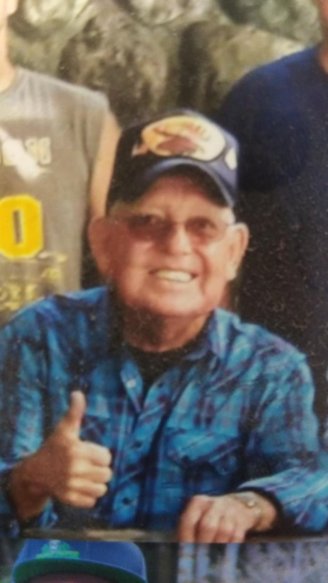
Richard
(Dick) Lee Lipscomb April
6, 1937 – November 1, 2020
Born
in Hydesville to Randolph Lipscomb and Hazel Hawkins Lipscomb at
the same house his dad was born in. He was the oldest of five children.
He
spent his youth helping his grandparents on their dairy ranches. He
attended Humboldt County elementary schools, Arcata High School, and
graduated from Maxwell High School in Maxwell, Calif. In school he was
in choir and played football, baseball, and tennis.
From
an early age he had a charismatic personality and enjoyed helping
people. This lead to many lifelong friends. He touched many lives
and everyone who has met him has a story to tell. He enjoyed
gatherings that included family and friends. He supported and
enjoyed watching his kids, grandkids, and great-grandkids in all of
their sports and activities.
He
had many interests which include bowling, watching sports, hunting,
fishing, barbecuing and making jerky. After he retired he enjoyed
having a large garden, which he shared with everyone he met. You
could always find him working on his vehicles and home or helping
others with theirs.
He
was a jack of many trades and held many different types of jobs. He
worked on dairy farms, was a bartender, a bowling instructor, and
worked in grocery stores. He also drove many types of trucks, was a
land surveyor, and worked in construction. He spent many years in
the timber industry, where he worked with explosives.
Dick
was not a religious person, but was very spiritual.
He
was a long time resident of Willow Creek.
He
is survived by his sister Donna Mitchell. His wife of 63 years,
Sonya. His children Lizia (Ken) Gulley, Danette (Steve) Christian,
Ric Lipscomb, and Peri Lipscomb, nine grandchildren, 21 great
grandchildren, and two great-great grandchildren.
Due
to Covid-19 there will be no services or gatherings at this time.
Stories and memories can be shared on Peri’s Facebook page.
We
will miss you and your stories Dad (Papa). We love you.
###
The obituary above was submitted on behalf of Dick Liscomb’s loved ones. The Lost Coast Outpost runs obituaries of Humboldt County residents at no charge. See guidelines here.
Marguerite
Claire (Newman) Martin May 6, 1926
– Nov. 6, 2020
Our
mom,
grandma
and great-grandma
was born in Portland, Oregon on
May
6, 1926. She was the oldest of three,
followed by sister Laurel (Giacomini) then brother Jim. They then
lived in Crescent City for a number of years before briefly moving to
Los Angeles. The family then moved to Pepperwood to live with
Marguerite’s grandparents, parents to her mother Claire. She attended
Fortuna High, graduating in June 1944.
While
she was attending high school, she stayed with cousins in Fortuna.
She attended dances in the area (as that was their social life!) One
day Marguerite’s friend Evelyn Martin (Chism), told her that she
just had to meet her cousin and introduced Marguerite to her future
husband, Tony Martin, and the rest was history.
They
married November
28, 1944.
This
union led to so many years of great times and friends. Life was
great. The
following year came their first blessing, their son Frederick Antone.
They then lived on their ranch on Kelly Lane off Coffee Creek Road in
Ferndale.
The
years on the dairy were very happy for them. Family
was always around,
and
they all loved a good birthday party, anniversary party, wedding …
and the card parties! Any occasion was always a great get-together of
family and friends. They operated a dairy for many years before
selling the dairy and moving into town. She bought and operated the
Ferndale Dress Shop for several years.
Eventually
Tony and Marguerite moved to Fortuna. Grandma spent many years
working at Linda’s Hallmark, where she would retire from. She
looked forward to seeing so many people throughout her day. I think
she knew practically everyone who came into that store!
In
1970 she was blessed with the daughter she never had when Fred
married Judy Kay O’Connell. The blessings continued with the birth
of three granddaughters — Heather, Jessica and Nicole – then,
much later, two great-granddaughters,
when Kendra and Lexi were born to Nikki and husband Mark Miranda.
Family
trips always involved Grandma and Grampa and none of us would have
had it any other way. They were involved in every holiday, birthday,
special event or game as it meant being able to spend time with their
now grown granddaughters and great-granddaughters!
In
1984 when Tony retired, he and Marguerite then traveled for many
years after all over the United States with the Good Sam RV group
they belonged to. So many wonderful and lifelong friends and memories
were made throughout her 94 years.
Marguerite
was proceeded in death by her parents Claire and Grant Newman,
stepfather
Bill Frasier, sister
Laurel, brother Jim and her love of 72 years, husband Tony, in March
2017.
Marguerite
is survived by
their son and daughter-in-law Fred and Judy; her granddaughters
Heather (James), Jessica (Kris), Nikki (Mark) and their girls Kendra
and Lexi Miranda; brother-in-law
Hap Giacomini and sister-in-law
Helen Newman; numerous
nieces,
nephews
and cousins
all who were so special to her. Also, bonus son Ray (Cathy) Schulz
and special friends Linda and Barry Wiggington.
We
are so thankful and blessed to have been able to celebrate everyday
life with Marguerite. We find comfort in knowing that she is at peace
and together again with her love Tony, dancing away in the stars!
Per
Marguerite’s request, there will be no services at this time. We
hope to have a remembrance in the spring of 2021.
With
all of our love,
Fred & Judy, Heather & James, Jessica
& Kris, Nikki - Mark - Kendra & Lexi.
###
The obituary above was submitted on behalf of Marguerite Martin’s loved ones. The Lost Coast Outpost runs obituaries of Humboldt County residents at no charge. See guidelines here.
As states struggle to contain COVID-19 surges, Gov. Gavin Newsom today warned that California also is experiencing a rise in cases and hospitalizations — though not yet at levels seen across the nation.
In California, 3.7% of tests are now coming back positive, up 0.8% compared with two weeks ago. For weeks, California was able to keep this number below the 3% mark. Hospitalizations also have increased by 30% in the last 14 days.
Over the weekend, some 2,090 people were hospitalized for confirmed COVID-19, with another 811 people in intensive care units, according to CalMatters’ tracker.
The state’s positivity rate, Newsom said, “may sound great compared to most other states right now…but we’re starting to see people again take down their guard, take off their masks, begin to mix outside their household,” Newsom said.
By comparison, Nevada is reporting a 14-day positivity rate of 13.6%. Michigan has a positivity rate of 11.7% and, in Arizona, 10.1% of tests are coming back positive.
Private household gatherings continue to be a major source of transmission, according to Dr. Mark Ghaly, the state’s health and human services secretary.
On Tuesday, Ghaly will give his weekly update on tier assignments for counties, which are based on the level of local virus transmission. He indicated today that potentially no county will be moving forward, but several could be moving backward, meaning they’d have to close down further.
“The (vaccine) availability to you and me and others outside our first responders, outside our health care professionals, is many, many months off.” — Gov. Gavin Newsom
California has yet to release guidelines for the holidays, but as the weather cools and people celebrate indoors, counties have moved to release their own recommendations.
In joint guidance, public health officials from 10 Bay Area counties are advising the public to keep gatherings small, short and outdoors — that means up to three households and no more than two hours. They also discourage any non-essential travel.
In today’s press briefing, Newsom also cautioned people against making plans in response to promising news on the vaccine front.
On Monday, drug manufacturer Pfizer announced that its vaccine was found to be more than 90% effective in preventing COVID-19 during Phase 3 clinical trials.
Pfizer CEO Albert Bourla said in a statement he expects the company to have enough safety data to apply for emergency use authorization from the Food and Drug Administration by next week.
But initial supply will be limited, Newsom warned. “Mass distribution is a ways off,” he said.
“The availability to you and me and others outside our first responders, outside our health care professionals, is many, many months off.”
Today, President-elect Joe Biden also announced his transition COVID-19 advisory board, which includes three experts from the University of California, San Francisco.
###
CalMatters COVID-19 coverage, translation and distribution is supported by generous grants from the Blue Shield of California Foundation, the California Wellness Foundation and the California Health Care Foundation.CALmatters.org is a nonprofit, nonpartisan media venture explaining California policies and politics.
On November 5th, 2020, special agents
with the Humboldt County Drug Task Force (HCDTF), with the assistance
of the Arcata Police Department, served a search warrant on a vehicle
in the alley way behind the 800 block of 9th
St. in Arcata. The driver of the vehicle, Melissa
Parker (37 years old from
Eureka) was detained at the vehicle.
Agents
searched Parker’s vehicle and located stolen property from three
different vehicle burglaries that occurred in Loleta in 2020. On June
25th,
2020 two different victims had their windows smashed out of their
locked vehicles on Table Bluff Rd. in Loleta. Both victims had their
purses stolen. On September 15th,
2020 the third victim had her window smashed out while parked at the
Hookton Slough Unit on Hookton Rd. in Loleta. The third victim’s
purse was also stolen.
As a result of this investigation HCDTF
agents were able to return social security cards, bank cards,
checkbooks, and gift certificates to the victims.
Agents
will forward a case with a warrant declaration to the Humboldt County
District Attorney requesting the following charges be filed:
PC 496(a) Possession of stolen
property
Anyone
with information related to this investigation or other narcotics
related crimes are encouraged to call the Humboldt County Drug Task
Force at 707-267-9976.
Times of great upheaval often produce the most meaningful art — or maybe it’s the other way around: In tough times, we rely more heavily on art to make sense of the madness. Bit o’ both, probably.
Regardless, 2020 has been a doozy of a year, and a group of local students — from preschoolers to college students — set out to document their experiences of this annus horribilis for a Pandemic Photojournalism Contest organized by the Humboldt County Office of Education and the Arts and Creativity Initiative.
More than 40 participating students were challenged to “notice what catches their eye in this new environment” of school closures, illness and social unrest and to write about “how they’re feeling about what they’re seeing,” as local arts educator Bill Funkhouser put it in his instructions.
The winners of the contest were announced today, and with permission, the Outpost is reproducing those images here.
Submissions were adjudicated by a group of 10 art educators and enthusiasts, and the photographers behind the top choice in each category will receive $100 from
Patterson/Conners
Insurance Services. A special winner was chosen by Ellis Art to receive a $50 gift certificate to Ellis Art.
###
College-Level Winner: Tehila Horowitz
Photo by Tehila Horowitz
Horowitz writes:
This photo tells the story of frustration, of being pushed to your limit mentally. At this point in my life I had been quarantined for longer than six months. I had not been able to see any friends (as my family is high-risk) and spent most [of] my days studying to become a nurse.
During this time, I felt strained, worn out, like a former version of me. The spark in my eyes have dulled and I no longer feel young but aged. My mind wanders without my control. I find myself constantly touching my face to see if I can bring myself back.
One “normal” thing that I really miss has been comfort from friends, physical touch such as hugs and holding hands. I am grateful for nature and the feeling of the elements on my skin; it helps to ground me.
You can see in the photo that a blue sky envelops me. The intense blue color in a way compliments my breakdown.
The thing I want people to know about my photo is that it is okay to fall apart. COVID-19 and quarantine are a cruel punishment that takes away everything that makes us human: connection, physical touch and socializing in general. Breakdowns are normal!
###
High School-Level Winner: Ari Alter
Photo by Ari Alter
Alter writes:
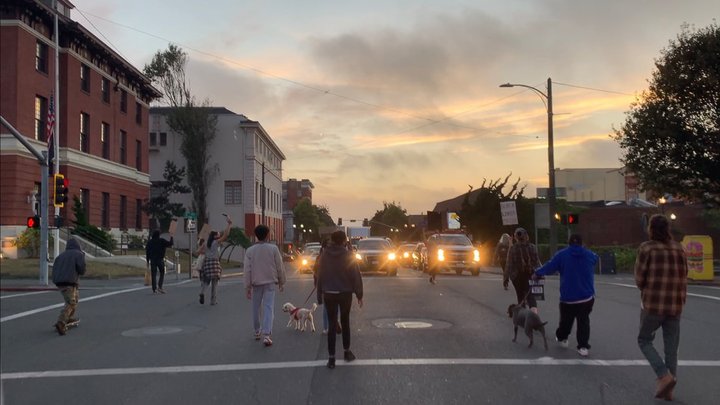
This photo was taken on September 24th outside of the Eureka Court House. This photo tells the story of how protesting has changed in the midst of a pandemic. It also tells the story of the tense time that our country is facing at this time.
My life was different during this time because not only was I experiencing my first protest, but I was also experiencing how large groups interact during the pandemic. During this time, I felt hopelessness and anger, and you can see this in the photo by how I, as the photographer, am marching with others to demand justice and equality.
One normal thing that I really miss is being able to go to events like these without masks or any fears of getting sick. I am grateful that I am able to be a part of change. The one thing I would like people to know about my photo is that it shows how protests have changed in the midst of a pandemic, focusing on how everyone in this picture is social distancing from each other.
###
Grades 6-8 Winner: Avery Packer
Photo by Avery Packer
Packer writes:
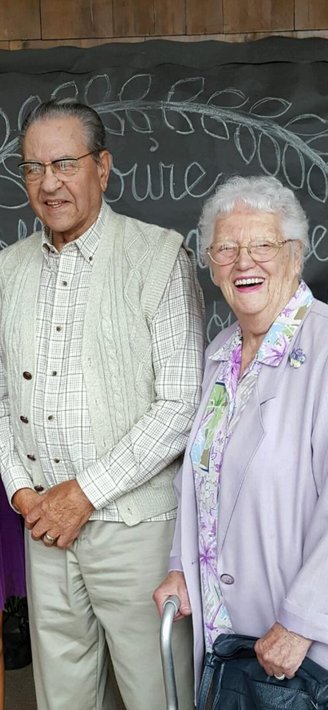
Generations of Change. “I’ve seen so much in my ninety ninety years of living yet I still see the beauty in nature and have missed it oh so much during this pandemic.”
###
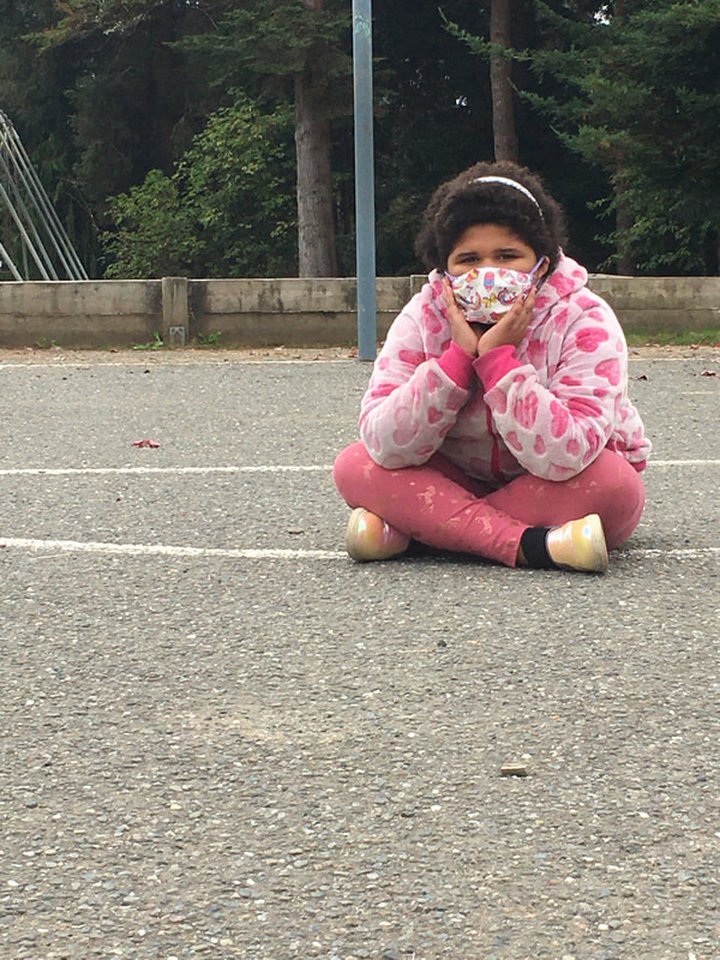
Grades 3-5 Winner: Amaya Teraoka
Photo by Amaya Teraoka.
Teraoka writes:
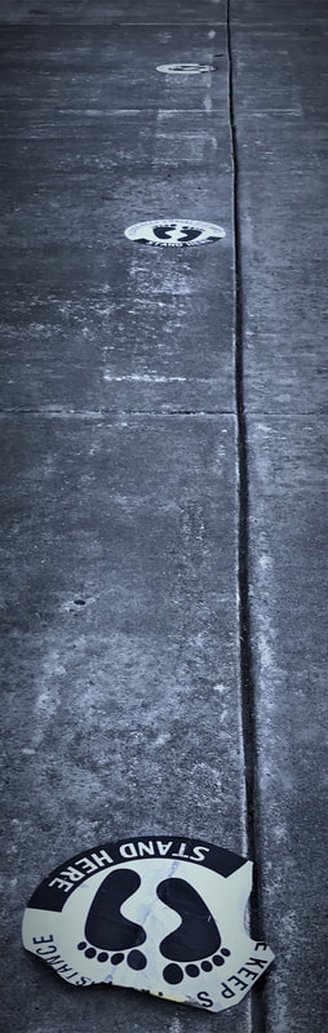
This photo was taken on October 23, 2020 at Dow’s Prairie School (in McKinleyville CA). It shows the story of how we (all of us) have to stand six feet apart in these unexpected times.
My life was different in this time because I can’t just go to my friend’s house or go to school; you have to wear a mask and stand six feet apart.
During this time, I felt a little lonely and I felt I was trapped in a small ball and I could not be free and you can see that because I chose to take the picture on a dark day.
One “normal” thing that I really miss has been the ability to do whatever I wanted and not being trapped in the ball. But I am grateful that I get to spend so much time with my family and you can see that because I chose a very clear day to take [this phote] on.
The thing I want people to know about my photo is that no matter what happens we always, always find a way to make it through.
###
Preschool-Grade 2-Level Winner: Indiana Jensen
Photo by Indiana Jensen
Jensen writes:
This photo was taken on 10/3/20 at Jacoby Creek School in Arcata.
This photo tells the story of my cousin Julia and I during the Covid-19 pandemic. During this photo, we felt sad because we had to social distance and wear masks while around each other.
My life has been different during the pandemic because I have been homeschooled and I don’t get to play with my friends. I really miss them.
The thing I want people to know about my photo is that I miss Julia and I cannot wait for the pandemic to be over so we can play all of the time!
###
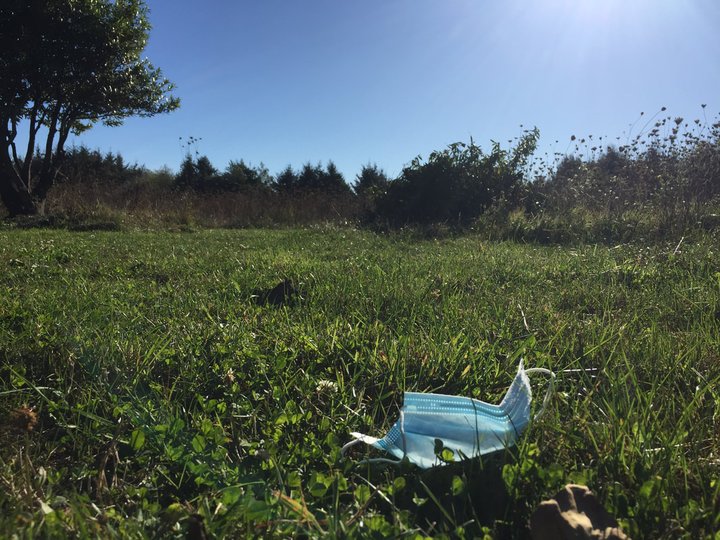
Special Recognition: Stella Saba
Photo by high-schooler Stella Saba
Saba writes:
This photo was taken on October 20th 2020 in the Ku’ wah-dah-wilth Restoration Area at Potawot Health Village in Arcata, CA.
This photo tells the story of the impact that single-use personal protective equipment has on the environment, including masks, gloves, and chemicals like hand sanitizer and bleach.
I am grateful for the time to reflect upon myself and my identity, as well as connect with nature; you can see that in this photo because I captured this image while on a walk in an area that is spiritually meaningful to me.
The thing I want people to know about my photo is that though we are hurting as a people, we need to direct our energy into diverting that hurt from falling on the planet. The health of the environment directly relates to the health of the community and the individual.