GUEST OPINION: Y’all Sure Are Wonderful For Caring About Beach Access For People Like Me
LoCO Staff / Monday, Feb. 16 @ 8 a.m. / Guest Opinion

Beach wheelchair at Trinidad Coastal Land Trust. Photo courtesy Laura Norin.
Dear Lost Coast Outpost Community,
As a mobility scooter user, I’m often torn between wanting more access to the breathtaking wild places I so dearly love and not wanting any more of nature to be paved over. That’s why I’m deeply appreciative of all the creative work that’s gone into developing low-impact ways to improve access to our local natural treasures for folks with limited mobility like me.
Along with numerous paved multi-use trails (including the Hammond Trail, the first mile of the Headwaters Forest Reserve trail, the recently extended Humboldt Bay Trail, and others), there are also many unpaved accessible trails throughout the county, including those at Prairie Creek and the Avenue of the Giants, where I’ve spent many wondrous hours sitting beneath the towering redwoods, filled with awe and gratitude and light. It’s hard to put into words how special it is to ride my scooter into a forest and spend time with my tree friends.
Yet, what I’m most excited about these days are the beaches!
Most days, my partner takes our dogs to Clam Beach, where the dogs run this way and that, frolicking in the surf, overflowing with excitement, and just as happy as can be — totally different from the mellow couch potatoes they are at home. Thanks to the beach access mat installed a few years ago at the north entrance, I’m able to take my scooter a little ways onto the beach and watch them for a minute or two from afar as they run off into the distance … until they disappear from view.
And while I’ve been very grateful for that peak into this part of their lives, I recently learned that I can do more than merely watch them from afar: by making use of the beach wheelchair available free of charge from the Trinidad Coastal Land Trust (link here), I can join them for the entire adventure. I’ve used this wheelchair twice now to be out on the beach with my family — fully participating in the experience in a way that I’d never thought possible — and I’m looking forward to using it a lot more in the future!
But wait, it gets better: according to the California Coastal Commission (link here), there are a number of other places to borrow beach wheelchairs in Humboldt County, including at the Manila Dunes, Arcata Marsh, Sue-Meg State Park, and Gold Bluffs Beach in Prairie Creek.
Oddly, few of the beach wheelchairs are housed at a beach, so a truck or large car is needed to transport the wheelchair to the beach. It would significantly improve access if the wheelchairs were stored on-site at Clam Beach or at other beaches where they might actually be used. I hope someone is working on this!
Being able to join my family’s beach outings has been extremely meaningful to me, and I want to publicly thank the Trinidad Coastal Land Trust and all the other groups who have made expanding access to our local natural wonders a priority. You’ve made a real, very positive difference in my life.

With gratitude,
Laura Norin
McKinleyville, CA
BOOKED
Today: 6 felonies, 12 misdemeanors, 0 infractions
JUDGED
Humboldt County Superior Court Calendar: Today
CHP REPORTS
9400 Mm101 N Men 94.00 (HM office): Traffic Hazard
1050 MM199 S DN 10.50 (HM office): Trfc Collision-1141 Enrt
7985 Mm101 S Hum 79.90 (HM office): Assist with Construction
Us199 / Us101 N Us199 N Con (HM office): Assist CT with Maintenance
Poppy Dr / Sherwood Rd (HM office): Closure of a Road
ELSEWHERE
KINS’s Talk Shop: Talkshop September 3rd, 2026 – William Honsal
Governor’s Office: California prioritized fighting organized retail theft, those results are paying off with 36,000 arrests and $293 million in stolen goods recovered
Mad River Union: Whistleblower calls for Miranda’s Rescue end
Mad River Union: Arcata’s petite data center only the first
OBITUARY: Florence Aimee McGraw, 1941-2026
LoCO Staff / Monday, Feb. 16 @ 6:56 a.m. / Obits

Florence Aimee McGraw, lovingly known as Aimee, and to many simply as Granny, passed away peacefully on February 2, 2026, at the age of 84.
Aimee was born on October 9, 1941, in New York City, New York. As a child, she moved to Los Angeles when her father entered the military during World War II and was later raised in Alhambra, California. In 1982, she settled in Humboldt County, where she made her home and lived the remainder of her life, surrounded by the community and people she loved so deeply. Aimee was the very definition of kindness. She was gentle, giving, peaceful, hardworking, and endlessly loving. Her family meant everything to her, and she poured her heart into caring for those she loved. Anyone who knew Aimee felt her warmth — it was effortless, genuine, and unforgettable. Even those who met her only once walked away feeling seen, comforted, and cared for. Her kindness was not just something she offered; it was who she was. Aimee had a rare gift for making people feel welcome, safe, and loved, and that is how she would most want to be remembered.
One of Aimee’s greatest joys was baking. She was especially famous for her cheesecakes, which brought smiles, comfort, and celebration to countless people. Through her baking business, A Piece of Cake, she shared her talent with many and won numerous awards. More importantly, her desserts were an expression of love — something she gave freely and joyfully.
Aimee’s absolute greatest joy in life was her girls — her daughter Rachel Barnett and her granddaughter Bailee Wright. The bond they shared was deep, constant, and filled with unconditional love. Everyone who knew Aimee knew how fiercely and proudly she loved them; she spoke of them often and held them at the very center of her heart. Being a mom and Granny was her greatest role and her most cherished purpose. One of her proudest and most meaningful moments was being able to attend Bailee’s wedding in November of 2025 — a day she treasured deeply and spoke of with immense joy. Being there, surrounded by love, meant everything to her.
Her life changed profoundly in 2015 with the loss of the love of her life, her husband of 27 years, Marc McGraw. Their love was deep, rare, and unwavering — a true soulmate connection built on devotion, laughter, and quiet understanding. Marc was her greatest joy and her partner in every sense, and her heart remained forever intertwined with his. Though she carried on with grace and strength, she never stopped loving him.
She was preceded in death by her mother Florence Morreale, her father Henry Glucker, and her stepfather Tony Morreale, whom she held close in her heart throughout her life. Aimee is survived by her daughter Rachel Barnett and Rachel’s boyfriend Paul Calvert; her granddaughter Bailee Wright and Bailee’s husband Garrett Wright; her bonus daughter Chris Stacy and Chris’s husband Tim Stacy; their children Dylan Stacy and Taylor Orlando, Taylor’s husband Jake Orlando; and Taylor and Jake’s children, Avery and Sonia (Sunny) Orlando. She was incredibly proud of her family and cherished every moment with them.
Aimee was also deeply involved in the Grandma and Grandpa’s Club for eight years during Bailee’s high school years and beyond. This organization was very near and dear to her heart. In lieu of flowers, the family kindly asks that donations be made to the Grandma and Grandpa’s Club Scholarship in her honor.
A memorial service celebrating Aimee’s life will be held on April 4 from 12 to 3 p.m. at the Moonstone Beach House.
Aimee’s legacy is one of love, gentleness, and generosity. Her presence made the world softer, warmer, and sweeter — and she will be deeply missed by all who were lucky enough to know her.
###
The obituary above was submitted on behalf of Aimee McGraw’s family. The Lost Coast Outpost runs obituaries of Humboldt County residents at no charge. See guidelines here. Email news@lostcoastoutpost.com.
OBITUARY: Gary Dowd, 1955-2026
LoCO Staff / Monday, Feb. 16 @ 6:56 a.m. / Obits

Gary Dowd was born on November 19, 1955, and passed away on February 12, 2026. He was a beloved father, grandfather, brother, uncle, cousin, and friend who lived life as an ongoing adventure. A proud member of the Pulikla Tribe of Yurok People, Gary was a true “down-river” person with a spirit and style like no other. He stood out in any crowd, known for his bold and creative hairstyles often sporting vibrant shades of purple, pink and blue and unique cuts that showcased his one of a kind personality.
A familiar and friendly face to many, Gary was often found walking the road or hitching a ride toward his next destination. He was a lifelong outdoorsman whose deep connection to the Klamath River began in his youth and remained the cornerstone of his life. Fishing was his utmost priority; he was a fierce protector of the river and his right to be on the water. Gary was also a dedicated harvester of the Earth’s gifts, frequently seeking out willow and spruce roots for basket weaving, as well as wormwood and mushrooms.
Gary also served his country in the Army, dedicating a chapter of his life to protecting others. His dedication, courage, and unwavering commitment to both his country and his cultural heritage leave a lasting legacy that will be deeply missed by his family, his tribe, and all who knew him on the road and by the water.
Survived by:
Gary is survived by his children, Ch-Mook Dowd, Sah-sep Dowd, and Derrick Goodlin; his sisters, Rhonda Dowd, Kathy Dowd, and Suzy Dowd, Uncle Donald McCovey, and grandchildren, K-Lynn Dowd, Kyha Dowd, Phoenix Dowd, Denise Dowd, and Eli Dowd and many more.
Preceded in death by:
Gary was preceded in death by his father, Frank Dowd, and his mother, Venola Dowd, as well as his brothers, Frank Dowd, Rick Dowd, and Davy Dowd, and many others.
Pallbearers:
Ch-mook Dowd, Phoenix Dowd, Eli Dowd, Derrick Goodlin, Izzy Dowd, Spaghe Dowd, Rocky Dowd, Guy Dowd, Ricky Dowd, Thomas Gordon, Brody Dowd, Keget Dowd, Kegama Dowd, Range Dowd, Kit-Kah Dowd, Peter Norton, Dayton Dowd, Damian Dowd, Danner Dowd, Draiden Dowd, Zaiden Craft, Jonah Swain, Pergish Montgomery, Lil Rocky Dowd, Ryan Dowd, Justin Dowd, Ethan Dowd, Collin Dowd, Jeremiah Swain, Timber Scott, Mathew Swanson.
Honorable pallbearers:
Donald McCovey, Artie Jones, Forrest Gregg, Ben Ray, Brady Genson.
Service details
The family will honor Gary’s life and traditions with the following services:
* Wake: Thursday, February 19 at 4:30 p.m. at the Lena Reed McCovey Community Center, 169 E Klamath Beach Road.
* Boat Ride: Friday, February 20 at 9 a.m.
* Funeral Service: Friday, February 20 at 1 p.m. at Weirs.
* Graveside Services: Friday, February 20th at 2 p.m.
* Reception: To follow on Friday afternoon; time and location to be announced.
If we have forgotten anyone, please accept our sincerest apologies; the family is going through a lot at this time and deeply appreciates your grace and understanding.
###
The obituary above was submitted on behalf of Gary Dowd’s family. The Lost Coast Outpost runs obituaries of Humboldt County residents at no charge. See guidelines here. Email news@lostcoastoutpost.com.
HUMBOLDT HISTORY: War Brides of Eureka! Plus: The Birth of the World Friendship Club
Naida Olsen Gipson / Saturday, Feb. 14 @ 7:30 a.m. / History

Standing on the steps of the Humboldt County Courthouse, these young Humboldt men have all been inducted into the military on a single day in 1942, following the attack on Pearl Harbor. Phillip died in Humboldt at age 53 from residual complications of meningitis which he contracted during the war. Photos via the Humboldt Historian.
###
Author’s note: This article incorporates quotes about their wartime experiences from letters sent to me over the past two years by several war brides and their children.
###
In August of 1945, a popular song, “My Guy’s Come Back,” filled the airwaves as World War II ended. The guys were not the only ones arriving in America. Some of these veterans brought their brides from war-torn England, France and Italy. Thousands of War Brides arrived in cities and towns all across the United States. They even arrived in the remote, far west city of Eureka.
My cousin, Ray Olsen, brought his bride, Ivy Johnson, known as “Johnny” to her friends in London. Johnny lived in Nottingham, a part of London on the east side of the Thames, within earshot of the Bells of Bow (St. Mary-le-Bow Church), which, it is said, makes one a true Cockney.
In wartime England, all girls of a certain age were conscripted into the military. Johnny was stationed in the main Army Post Office in London. On Thursdays, when the Sergeants Mess served liver and bacon, Johnny and her friend, Betty, ate out. One Thursday they ate at a “palais de dance,” where diners could look down and watch the dancers. Two American soldiers walked up and invited themselves to sit with them. The two Yanks, one of whom was Ray Olsen, wanted to pay for the girls’ dinner, but Johnny said, “No way! We pay for our own, thank you,” and sent him packing. Like other English girls, Johnny had been warned by her mother and grandmother to stay away from the American soldiers. The older women remembered stories about Yanks during the First World War wanting only sex and a good time.

Left: Ivy “Johnny” Johnson of the English Army Postal Service and U.S. soldier Ray Olsen of Eureka in Nottingham at the Sergeants Mess. It is a Sunday, the only day the girls in the English Service were allowed to wear civilian dresses. Johnny wears a dress she made herself, for precious ration coupons were required for the purchase of clothing.
Ray Olsen persisted in his courtship of Johnny, and by the end of 1945 they were married. Johnny, the youngest of ten children, said a tearful good-bye to her family on a cold and rainy morning in March, 1946. She crossed the Atlantic with several other war brides, all of whom shed many tears on the trip. After the ship docked in New York Harbor, the girls took a train to the West Coast, with a three hour lay-over in Chicago.
For three and a half years, Johnny had had nothing to wear but austere uniforms and sensible shoes. In Chicago, she spotted a Marshall Fields store, a place she had heard of but had never seen. Imagine her excitement when she walked through its doors to find pretty shoes and clothing. Johnny bought three pair of high-heeled shoes, and then hurried to catch her train to continue her journey across the continent of North America.
###
Another war bride, Lou McCornack Butler writes: “Ten long years brought an end to a path of destruction and horror such as the world had not anticipated. Thousands of young women found themselves carried forward on a tide of change … Married to World War II [American] servicemen, they became voyagers to a new land and new customs … Would they fit in? Would they measure up?”
When Lou left England at the age of nineteen, she had already lived a lifetime of changes. Lou had been raised on the Southwest side of the Thames, near the old Lambeth Church, Smith’s bookbinding, and the Doulton china factory, where her grandfather had been apprenticed as a boy. She worked at the ivory factory of Puddefoot and Bower, which had been converted to produce airplane rivets during World War II.
At night she served as an air raid warden. Lou married John Edward Campbell, a member of the King’s Royal Rifles and part of the original Scottish Black Watch. Lou had given birth to her first child, Rosina, during an air raid; she had had to search for family members in the rubble after a London bombing; and her husband, John Campbell, was killed on D-Day, leaving Lou an eighteen-year-old widow with a little girl.
At this time, the British and Hollywood movie star, Madeleine Carroll, turned her home on Mansfield Street in London over to the United States servicemen while she went to France to work with the Red Cross and help war orphans. Lou and her mother both worked part time as housekeepers at this house, known as the American Officers Mess. Lou had charge of three apartments: one for a major, and two for generals — General Patton and General Scott — and found it interesting to see these famous men at ease.
Phillip McCornack was Mess Sergeant of the American Officers Mess. He had been rescued from his torpedoed ship during the African campaign and was recovering from meningitis. His normal weight of 160 pounds had dropped to 80 pounds. Lou’s mother felt sorry for this young man and invited him home for dinner on weekends. Lou, like Johnny, had been warned against American servicemen and announced that she would not stay in the house while that Yank was there; however, her father said that as long as she was under his roof, she would be courteous to their guests.
Lou and Phillip were soon dating. Lou’s father always waited up for them, expecting them before the 10 p.m. curfew. The couple would come home to find him standing on the porch with his watch. If it was five minutes after ten, he would say, “You’re late.” Phillip would reply, “I’m sorry” and explain there had been buzz bombs. When you heard the jet engine cut out of what sounded like a plane overhead, it meant a buzz bomb was coming down. Lou recalls that 50,000 people died in bombings over just one weekend in London. At one point, all the buildings around St. Paul’s Cathedral burned, but the Cathedral remained intact. Lou remembers Winston Churchill saying: “We cannot let it burn. It is a symbol of our heritage.”
By the time Phillip was sent back to America, he and Lou had been married a year. Before Lou left for America, her mother warned her about the United States, as she understood it: “Be very careful of New York, because there are gangsters there. In the middle, that is the real America, with homes and families. Be very careful when you get to the west; there are cowboys and Indians.” It took a visit for Lou’s mother to appreciate what America was really like. Then she said, “God has truly blessed America.”
Lou writes: “Some of the war brides crossed the Atlantic on the Queen Mary and other such vessels, but the group I came with boarded a Merchant Marine ship, the Henry Gibbons, with metal bunks three tiers high close together in the cargo hold, damp and cold with the constant noise of engines day and night. I always felt that I could hear the sound of muffled crying and a sense of fear and sadness.” Lou was seasick the whole time of the Atlantic crossing. Her group was the last to go through Ellis Island before it closed. Their names are on the wall for the year 1945.
In 2003, Lou discovered that the merchant ship she had traveled on for eight days, avoiding mines, freezing in the cold and damp, had originally been converted to carry one hundred sick and tortured refugees from Nazi prison camps. “I can only imagine their fears and sorrows being taken to an unknown country after all they had suffered,” writes Lou. “I felt that I had truly been touched by sharing their space.”
###
Joyce Ratcliffe and a girl friend had walked across the moors in northern England during the blackout to attend a “picture show” in Manchester. While standing in line for their tickets, she met an American soldier, Murl Francis Bryan, of the Eighth Army Air Corps. Joyce remembers complaining about the American soldiers taking all the spaces. The picture that night might have been an Alice Fay movie. Joyce notes that she would have remembered if it had been a Betty Grable picture, because Murl always said her legs were just like the movie star’s. Betty Grable’s “pin-up legs” were famous for being insured by Lloyds of London for one million dollars.
When Murl was off duty, Joyce rode her bicycle over the moors to meet him. They decided to marry, but before the wedding, Murl’s chaplain and his commanding officer interviewed Joyce. They warned her that Americans lived in a very different way than the English, and that she was a city girl while Murl was from a rural area. The chaplain pointed out that not many couples successfully overcame these “cultural differences.” Murl’s family had lived in Missouri, but had moved west during the Depression and settled in Miranda, California. Joyce and Murl compromised by moving to Eureka — neither in the country nor in a big city.

Joyce and Murl Bryan on their wedding day in Lancashire. Their marriage ended much too soon: Murl died of a heart attack at age thirty-nine.
Joyce managed to collect enough ration coupons for a wedding dress.
“I didn’t want the ‘wreath and veil,’ what we called the traditional gown,” writes Joyce. “I wanted a dress I could wear afterwards, because I didn’t have a lot of clothing coupons.” The dress was light beige-pink. Shoes were harder to find. “We were lucky when it came to the wedding cake,” Joyce said, “as my cousin Gilbert was a baker.”
They were married on Joyce’s nineteenth birthday, on Thursday, September 1, 1944, at St. James Church in Oldham, Lancashire, England. The church stood just in front of the Platt Company, where Joyce worked. All her friends hung over the wall cheering as they left the church.
Paris had been liberated by the Allies a month before their wedding, and a month afterward, the Warsaw Uprising took place. Vera Lynn, known as “The Armed Forces Sweetheart,” was the most popular female vocalist in England with songs like “We’ll Meet Again,” and “The White Cliffs of Dover.” The big band sounds of Glen Miller and Benny Goodman were popular everywhere. The classic song, “Lili Marlene,” was a favorite with soldiers on both sides of the war — the Allies and the Germans — as it had been during World War I.
Joyce traveled to the United States two years later with her baby daughter, Lesley. Lesley writes, “Joyce started her journey to this country in late June of 1946, arriving sixteen days later on July 10. With only the few belongings allowed by the U.S. Army, and with her ten-month old daughter tucked under her arm, Joyce gamely strode up the gangplank of the Zebulon B. Vance to embark on a new life in a new country. As if immigrating to America was not challenge enough, Joyce had no idea that the ship she and her little daughter were boarding was one of the most controversial and potentially dangerous ships in the fleet of converted Liberty Ships dubbed by the New York press as the “Bride Ships,” and later called by its own crew “the death ship.”
Joyce herself writes: “Conditions were awful. Bunks were stacked three high all in one large room. There were far too few toilets for the number of passengers and absolutely no privacy as they were in open rows. They constantly overflowed and the women had to walk through the waste to get to one of the four showers, not curtained, for water or a wash. Many were so seasick they could not move. Vomit floated on the floors and had to be wiped off the bunks. The crew tried to keep things mopped up and some of the women tried too, but it was nearly impossible.” Some reports state nurses were on board, but Joyce never saw one.
For some strange reason, baby food was confiscated upon boarding, but Joyce hid Lesley’s because her baby had to have a certain kind, and she was afraid she might not get it back. She washed her baby’s bottle and nipple in the hot tea water and also used that boiled water to make her formula. Baby Lesley lost four pounds in sixteen days.
The women were subjected to “flashlight exams” for lice and venereal disease. Joyce writes: “These exams were often performed by non-medical personnel, in the open, and frequently included humiliating and offensive remarks.” She recalls that when a U.S. Army officer was questioned about these exams in 1946, he replied to the effect that these women weren’t asked to marry our guys and come over. He was wrong about that: the girls had been asked by the men they married to be their wives and come to America.

The New York Times published this photo of Joyce Bryan, wearing her identification tag, and her baby daughter, taken the day of their arrival in New York Harbor, with the caption: “TINY SOPRANO, Darlene [Leslie] Bryan, 10 months, gives out with blues number, accompanied by Mrs. Joyce Bryan.
Finally, on July 10, 1946, the Zebulon B. Vance steamed into New York Harbor and was met by a reporter from the New York Times. He interviewed Joyce, and took a photograph of her seated at an upright piano with the baby sitting on top of the piano, crying. At least nineteen babies had died on this trip, due to the unsanitary conditions. The surviving babies and women were all tagged like pieces of luggage, and told they had to board a bus, probably for the Red Cross Center, where they would be reunited with their husbands. But Joyce had seen her husband, Murl, the love of her life, standing on the dock, wearing a light gray suit. This was the first time she had seen him in civilian clothes. A crewman told her she had to go with the other brides to the bus, but she told him her husband was waiting right there for her and nobody was going to stop her from going to him. Holding little Lesley, she walked right off that ship and into his arms.
The women had been cautioned to dress warmly as it might be cold (New York City in July?), so Joyce wore a red wool suit in 100 degree weather. The first thing she and Murl did was go to the bank where Joyce had had money transferred from England, then to a drug store for cream for the baby’s rash, and finally to a shop for a few cool summer dresses. This done, they boarded their train for San Francisco.
###
Johnny’s and Lou’s husbands met them in San Francisco. Ray Olsen met Johnny at the train station, and they drove up Highway 101 to Eureka, a ten-hour trip in 1945. Johnny didn’t know what to expect. The redwood trees were magnificent and the rugged beauty of the country awed her, but Humboldt County was a totally different environment from her home in London.
Lou and Phillip spent one night in San Francisco, and then drove to Eureka. Lou remembers feeling “loneliness, a separation from loved ones … Like most I was pregnant immediately.” She wrote to her mother about her feelings: “It’s very nice, but this must be the end of the world because the railroad ends here. It doesn’t go anywhere further. The ocean goes off to Japan and there’s no theater, no ballet.”
Her mother replied, “My dear girl, we love you, but you chose your bed, now make it as comfortable as possible, it’s up to you. God Bless you all.” Lou says it was the best advice of all.
When Ray and Johnny arrived in Eureka, my mother, Laura Olsen, invited them to dinner at our house. Before the war, Ray, as a teen-ager, had worked in my father’s auto repair shop. Here Ray had learned skills from my father, Mike Olsen, that enabled Ray, with his natural talent for things mechanical, to help keep the bombers flying over Germany during the war. My father had died the previous December of cancer. Johnny told us that when Ray received this news in England, it was the only time she had seen him cry. Mike’s girls — my mother and my sisters and I — welcomed Ray and Johnny to Eureka.
Later, as more war brides arrived, we would have little parties for them. One time I tried to be helpful and make tea in a land of coffee drinkers. I put loose tea leaves in my mother’s antique bone-china tea pot and poured hot water over it. The result was the way I liked tea, if I ever drank it — pale-colored water. But the English girl for whom I had made the tea couldn’t abide it. I later learned that English tea is strong and dark. Lou McCornack Butler recalls her father saying: “If you can see the bottom of the cup, it’s water bewitched and tea begrudged.”
Joyce Bryan writes about her arrival in Eureka: “We were all warmly welcomed by the community and I was eager to learn all about Eureka and Humboldt County.” Joyce and Murl took baby Lesley to beaches on the Eel River near Miranda and Garberville. Joyce was impressed with the Redwoods. The climate in Eureka agreed with her, as it was much like the climate in England. “It was actually very pleasant to walk to visit each other in our homes, pushing our baby buggies. We walked often to Sequoia Park.”
There were many new American words for everyday things, such as buggy for “pram” and drugstore for “chemist.” The English girls sometimes made comical or embarrassing remarks by using British words or expressions that meant something else in America; for example, to be “knocked up” in England meant to be awakened by the “knocker-upper,” whose job was to awaken people for work in the morning by rapping on their windows. The girls quickly learned that it meant something different in America.
Johnny Olsen will never forget her wonderful neighbor, Mrs. Del Dotto who taught her how to cook and to care for her small children as they arrived over the years. “She was always there for me,” says Johnny.
Johnny will also never forget her first washing machine. It took a while after the war for factories to gear up to civilian needs again. Up until then she had had to do laundry by hand with a scrub-board. “Disposable diapers?” she queried. “I think not.”
###

Below: Anna Maria at her desk as secretary for Kelton Steele.
Not all the war brides who came to America stayed. Anna Maria Albonetti was nineteen when she met American serviceman Raymond Hull in Rome. She was standing on her terrace when Raymond stopped to speak to her. Anna Maria did not speak English, but somehow they managed to communicate with each other. At the time, she was engaged to her childhood sweetheart, but “the blue eyes of the American soldier changed her mind.” Her parents convinced the couple to postpone marriage until after the war. Anna Maria then joined Raymond in Eureka, traveling by air to New York City and then by train to Oakland, California. They were married in San Francisco and drove to Eureka, where their children, Vincent and Pamela were later born. But in 1959, Anna Maria decided to return to Rome, “the eternal city,” with her children. In 1973, she remarried, to a widower. Her new husband was her former Italian fiancé, her original childhood sweetheart.
Although she didn’t stay, Anna Maria has many wonderful memories of her life in Eureka and still keeps in touch with the friends she made here. She improved her English by borrowing books from the Eureka Carnegie Library, and became secretary to lumber businessman Kelton Steele. “This was the job anyone could desire,” writes Anna Maria. “I was the office manager of the Western Timber Company and although in Italy I didn’t know how to add one to one, they gave me a chance, and I learned to be a good bookkeeper… I also had some wonderful colleagues, besides a very dear boss, Kelton Steele, who always showed to be very satisfied of my work.” Anna Maria writes of the following memorable experience:
“The most wonderful thing happened to me while living in Eureka. [One day] … instead of going out to lunch, I stayed in the office reading The Wall Street Journal while having a sandwich. The Federal Housing Administrator was looking for one hundred housewives wishing to write to him telling about their ideas concerning what they would like their house to be. I said to myself: I have some ideas about this! And I wrote my letter. Only a few days later I was called from Washington D.C. to inform me that I had been selected for the First Congress on Housing.”
Anna Maria received an airline ticket for the capital, and her boss gave her fifty dollars expense money. She spent a little of the money for a white gardenia to wear on her suit.
“It was a wonderful experience. We were brought to the President’s studio [oval office] inside the White House, and had the honor to meet with Mrs. Eisenhower. Only in America could something like this happen to an ordinary person. I am still very proud to be an American citizen.”
###

The World Friendship Club holds its first official meeting at the YWCA in 1947. President: Joyce Bryan Von Strahl; Secretary: Rene Eyler; Treasurer: Jimsky Butterfield; Publicity: Lou McCornack Butler. From left: Anastasia (Mrs. Alfred) Barthelemy; Jeannette (Mrs. William R.) Zerlang; Simone (Mrs. Clyde F.) Sadler; Maria (Mrs. Thomas) Bascomb; Mrs. Louis DeRoos, Eureka advisor; Lou (Mrs. Phil- lip) McCornack Butler; Joyce (Mrs. Murl) Bryan Vonstrahl; Rene (Mrs. Frank) Eyler; Jimsky (Mrs. Wil- liam) Butterfield; Joan (Mrs. Frederick) Printy; Irene (Mrs. James) Riley; Ivy “Johnny” (Mrs. Raymond) Olsen; Ursula (Mrs. Kermit) Ostrander; Elsie (Mrs. Benjamin) Young.
Lou Butler soon realized that there must be other war brides like herself in Eureka who were lonely. She and another English bride, Elsie Young, gathered names of eighty-two “aliens” like themselves. At first they went door to door. They telephoned. Then, with the help of Fred J. Moore, Jr., County Clerk, they recruited as many war brides as they could find. In 1947 the girls organized a charter group of The World Friendship Club under what Lou calls the “loving wings” of Mrs. Katherine Shattuck, director of the YWCA. While the club originally consisted of war brides, it soon opened up to any foreign-born bride.
“A lot of people came over afterward, but weren’t necessarily what you’d call war brides,” said Jeannette Zerlang in a November 2, 1997 Times-Standard interview. Jeannette was a war bride from France who married Army Sergeant William Zerlang, on May 17, 1945.
Lou Butler writes: “Jeannette Zerlang was from Alsace-Lorraine [and] part of the French Underground.[She had] incredible ‘joie de vivre.’ [She] insisted her name be spelled ‘avec deux n,’ and began all our Christmas parties with ‘Zh-h-h-ingle Bells.’ We mourned our sister when she took her final voyage in 2004, but heaven will ring with Zhingle Bells!”
The World Friendship Club held meetings once a month and put on shows and rummage sales. The money earned was donated to local charities such as Seeing Eye Dog organizations and orphan advocacy groups. They also raised money for the “Y” by preparing card parties, tea parties, and international dinners.
One time the girls dressed a beautiful doll in a coronation outfit complete with a crown, orb and scepter. The doll and her collection of costumes representing all the countries the girls came from were fitted in a wooden wardrobe. This was raffled and the funds given for equipment for children with hearing problems. As “aliens,” they took classes with those who needed to learn English, helping each other and learning American History in order to become naturalized citizens. Later, when most of them had little children, they still did their part, working the first March of Dimes fundraiser in Eureka, door-to-door with babies in buggies.
Local and national politics came to their attention and they helped with campaigns. They petitioned the city to resurface a local tennis court and succeeded in this mission. They were involved with PTA and school activities and civic matters. Their families grew in size until the meetings overwhelmed the YWCA facilities. The girls decided their husbands would have to recognize women’s rights and babysit one night a month so that they could meet as a group.
Lou writes: “Not all the original members attended every time, and some moved away, lifestyles changed, but we all remained friends. We became a band of sisters … we were all so different, yet so much alike. We helped each other through bouts of homesickness, pregnancies, and emergencies … We spoke of families, loneliness, children and ‘back home.’ We lamented customs we did not want to lose … We shared memories of childhood and how much we had in common although we had grown up thousands of miles and half-a-dozen languages apart across the world. We spoke of the war and knew … when the battle is over, there are no enemies, only sisters. Johnny Olsen was our in-house piano player and we sang all our native songs and danced; and laughter healed our hurts and gave us support.”
Of her life since she became a war bride, Johnny writes: “I am happy to say my husband Ray and I have been married for sixty years. [Ray Olsen died in 2006.] We have visited my family in England many times and have attended reunion functions of “The 95th Bomber Group,” with whom my husband served and was stationed at Horham, England. We both know most of the residents, and they welcome us back each time with open arms. They go out of their way to entertain us to show their appreciation of what ‘the Yanks’ did to help end the war in England. They will never forget it, nor will I. Ironically, created by a devastating war, my new life went on to become some of my most memorable and happy years that I have ever spent. The connections I have had with the other war brides are very special to me. Looking back, I don’t t hink I would change a thing.”
Joyce’s daughter, Lesley, writes about her mother: “I am the daughter she brought on board [the Zebulon B. Vance] and whom she kept alive and well through a small but significant act of defiance [hiding her baby’s special food] … Although she endured humiliation, filthy and unsafe conditions, and sixteen days at stormy sea, Joyce … never considered even for a moment, anything other than a positive outcome.”
“We did not come to America looking for a hand out,” concludes Lou Butler, “but like early immigrants before us, we came with hands out ready to become part of a great nation. I think that most of us who stayed have proved that the choices made by those young men we married over sixty years ago, were good choices.”
The World Friendship Club celebrates its sixtieth anniversary this year.
###
The piece above was printed in the Fall 2007 issue of the Humboldt Historian, a journal of the Humboldt County Historical Society. It is reprinted here with permission. The Humboldt County Historical Society is a nonprofit organization devoted to archiving, preserving and sharing Humboldt County’s rich history. You can become a member and receive a year’s worth of new issues of The Humboldt Historian at this link.
(UPDATING) 101 CLOSED: Broadway Street in Eureka is Closed Between 14th and Wabash Following Fatal Collision
Hank Sims / Friday, Feb. 13 @ 4:47 p.m. / Traffic

Photo: Ryan Burns.
UPDATE, 5:25 p.m.: Commander Wayne Rabang of the Eureka Police department tells the Outpost that his team is still investigating the incident. There is no indication that DUI is a factor, Rabang said.
Rabang confirmed that the decedent owned a black dog, and that they’re not certain where the dog is now. He didn’t have a better description of the dog yet.
The vehicle involved in the crash was a motor home, which is now parked in the Patriot gas station. Police have been looking it over.

###
UPDATE, 5:01 p.m.: Eureka Police Department spokesperson Laura Montagna confirms that this was a vehicle v. pedestrian collision, and that the pedestrian is deceased.
###
ORIGINAL POST:
Caltrans is noting that Highway 101 is closed between Wabash and 14th just ahead of the evening commmute. Avoid the area.
Several people have told the Outpost that there was a vehicle v. pedestrian collision at the site. The Outpost’s Ryan Burns is en route, and we will update.
Until then: If there’s a stop sign in the map below at the moment you’re reading this, the road is still closed.
A (Growing) Number of Runners Are Planning to Run 62 Miles Between All Five Murphy’s Next Month
Dezmond Remington / Friday, Feb. 13 @ 3:06 p.m. / LoCO Sports!

Pete Ciotti outside the Jogg’n Shoppe. Photo by Dezmond Remington.
What’s 62 miles? Truly, how long could 62 miles be? Well, conveniently, if you split the distance up just right, distribute it around a bit, put some here, some there, it’s pretty much precisely the distance between all five of the Murphy’s grocery stores in Humboldt County.
Wait, you’re thinking. This feels kind of like an article I’ve read before, in this same esteemed publication. Has the erstwhile dependable Lost Coast Outpost made a mistake?!
No. That does not happen. That article you’re thinking of was about cyclists, and it ran last year. The particular breed of endurance freaks traveling all 62 miles between the Murphy’s this time are doing it on foot.
Runners will tackle the Murphy’s 100k on March 14. (See, that’s how you know this is a footrace: a cyclist would call it a metric century.) From the Trinidad Murphy’s, they’ll run down Scenic Drive to Clam Beach onto the Hammond Coast Trail to the Arcata Westwood Murphy’s, then out to Glendale, back to Arcata, down the Bay Trail to Cutten, and then come right back to Sunny Brae for a cool 62.

Ciotti’s poster.
Organized by Pete Ciotti, the unflaggingly enthusiastic ultrarunner who also organized last month’s sufferfest, the race is also a fundraising effort for the businesses and residents affected by the Jan. 2 fire. There’s not a registration fee, although he does ask that runners interested in completing the run donate to them through the GoFundMe links supported by Humboldt Made on the Arcata Chamber of Commerce‘s website. Murphy’s is also planning to contribute by asking customers to round up to the nearest dollar when checking out for the week prior to the race; the sum of the differences will go through the chamber.
Ciotti told the Outpost that he was inspired by his two-wheeled predecessors, but the idea had several parents. He said Murphy’s was a good local business worth supporting; he wanted to run a 100k this year, but also wanted to avoid registering for too many races; he’s been focusing on organizing his own local events; and he’s been trying to help the fire’s victims however he can.
Ciotti said Murphy’s was “stoked” about the idea and will support the runners as well. Employees will set out aid stations for the runners at every location.
About 15 people have signed up to run since Ciotti put the word out yesterday. One group is planning to run a relay from one store to the next.
Although running 62 miles in a day is no easy feat, Ciotti said it’ll be a great opportunity to get some fresh air, help those in need, and perhaps make some new friends.
“It’s a great way to get everyone moving and see all the cool spots around the area,” Ciotti said, listing off the Bay Trail, Trinidad, Clam Beach, and a few other places the course winds through. “I encourage everybody to check out the local run clubs around town…Everybody out there promoting running and being healthy and doing good stuff. In these dark times, it’s good to have people like that who are doing positive things.”
Interested in joining? Email Pete Ciotti at PeteLovesRunning@gmail.com.
Amazon Confirms Plans for a Distribution Warehouse in McKinleyville
Ryan Burns / Friday, Feb. 13 @ 1:01 p.m. / Business
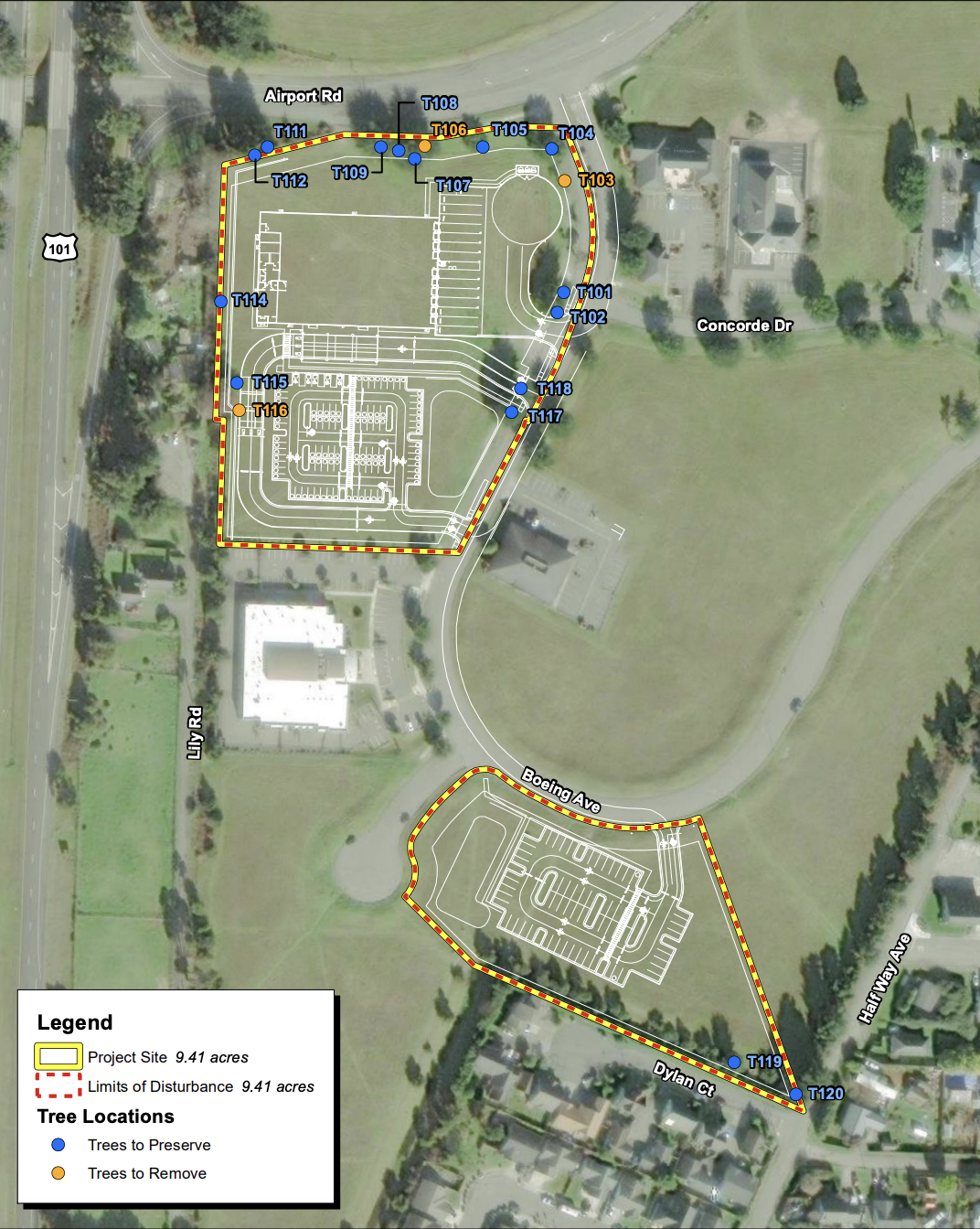
Schematic illustration shows the outline of an Amazon warehouse and two parking lots just off the freeway by the airport in McKinleyville. | Images via Humboldt County.
###
Amazon, the world’s largest online retailer, plans to build a “last-mile” distribution warehouse near the Humboldt County Airport in McKinleyville, a company spokesperson confirmed to the Outpost on Thursday.
This thing will actually be fairly small, by Amazon standards. Planning documents describe a single-story commercial warehouse of 40,290 square feet, which might sound impressive until you consider that the company’s large fulfillment centers average around 20 times that size (800,000 square feet) and some mega-sites exceed 4 million square feet. (An acre is 43,560 square feet.)
Even Amazon’s other rural-focused delivery stations are typically larger. One being built in Redmond, Ore., for example, will be 83,559 square feet. Amazon considers 150,000 square feet to be “medium-sized” while “small facilities” are 60,000 square feet or less.
Here’s the sum total of what the mega-retailer was willing to say publicly in response to a list of questions:
“Amazon [plans] to open a delivery station in Humboldt County to better serve customers in the region,” company spokesperson Natalie Banke wrote in a prepared statement. “We’re early in the process and will share more details as plans progress.”
Fortunately, more details are already available in planning documents and emails, some of which were first reported by Lisa Music of Redheaded Blackbelt. (Like her, the Outpost obtained the documents via a Public Records Act request to Humboldt County.)
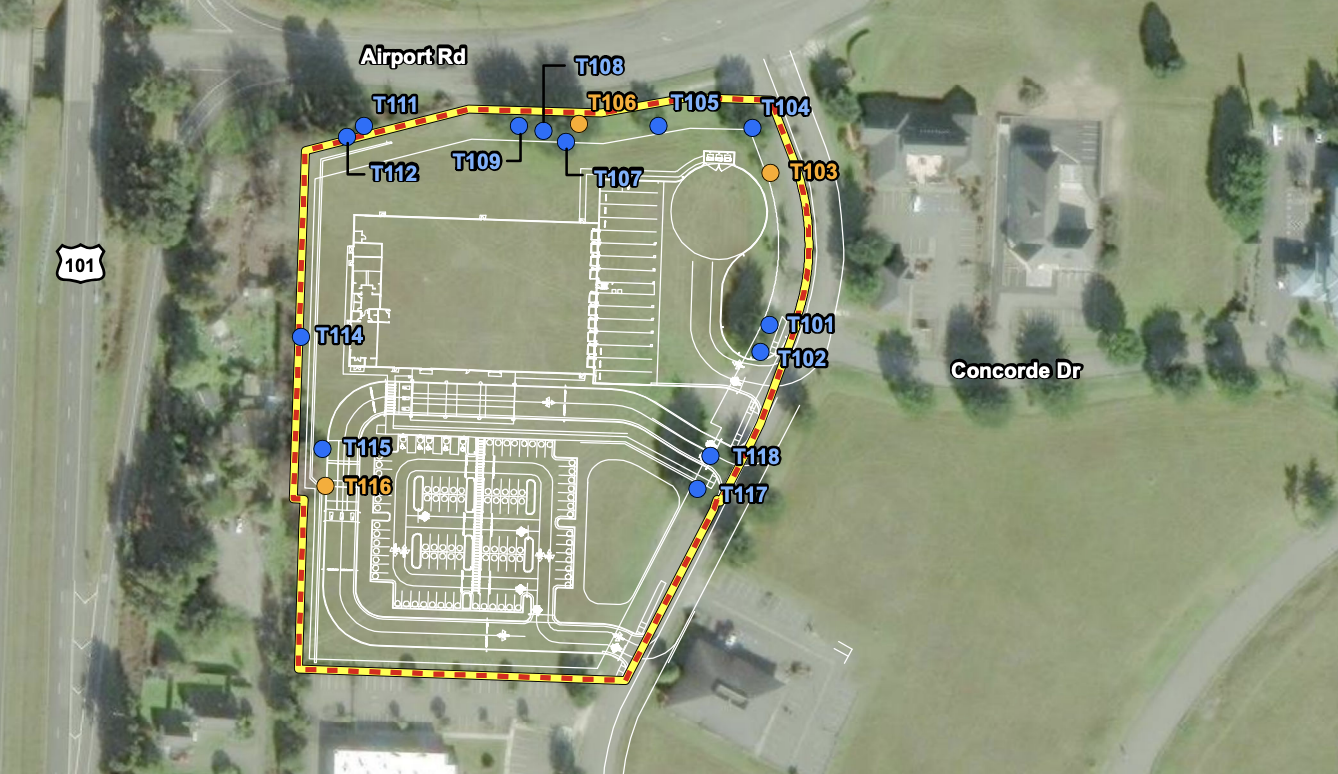
The warehouse and a parking lot will be located at 3110 Boeing Avenue, adjacent to the 101 offramp to Airport Road. Plans indicate a separate lot for fleet vans and employee parking located just south of the federal courthouse.
Here’s a map of the location, with the upper perimeter (outlined in red) showing the location of the warehouse and northern parking lot while the lower perimeter shows the location of the southern parking lot:
And there’s more! Below is a site plan for the warehouse and northern lot. Loading docks are slated for the southern edge of the building. A pair of new stormwater ponds, each approximately 0.2-acres big, will be constructed east and southeast of the warehouse, and a third pond (about 0.3 acres) will be built near the southern parking lot.
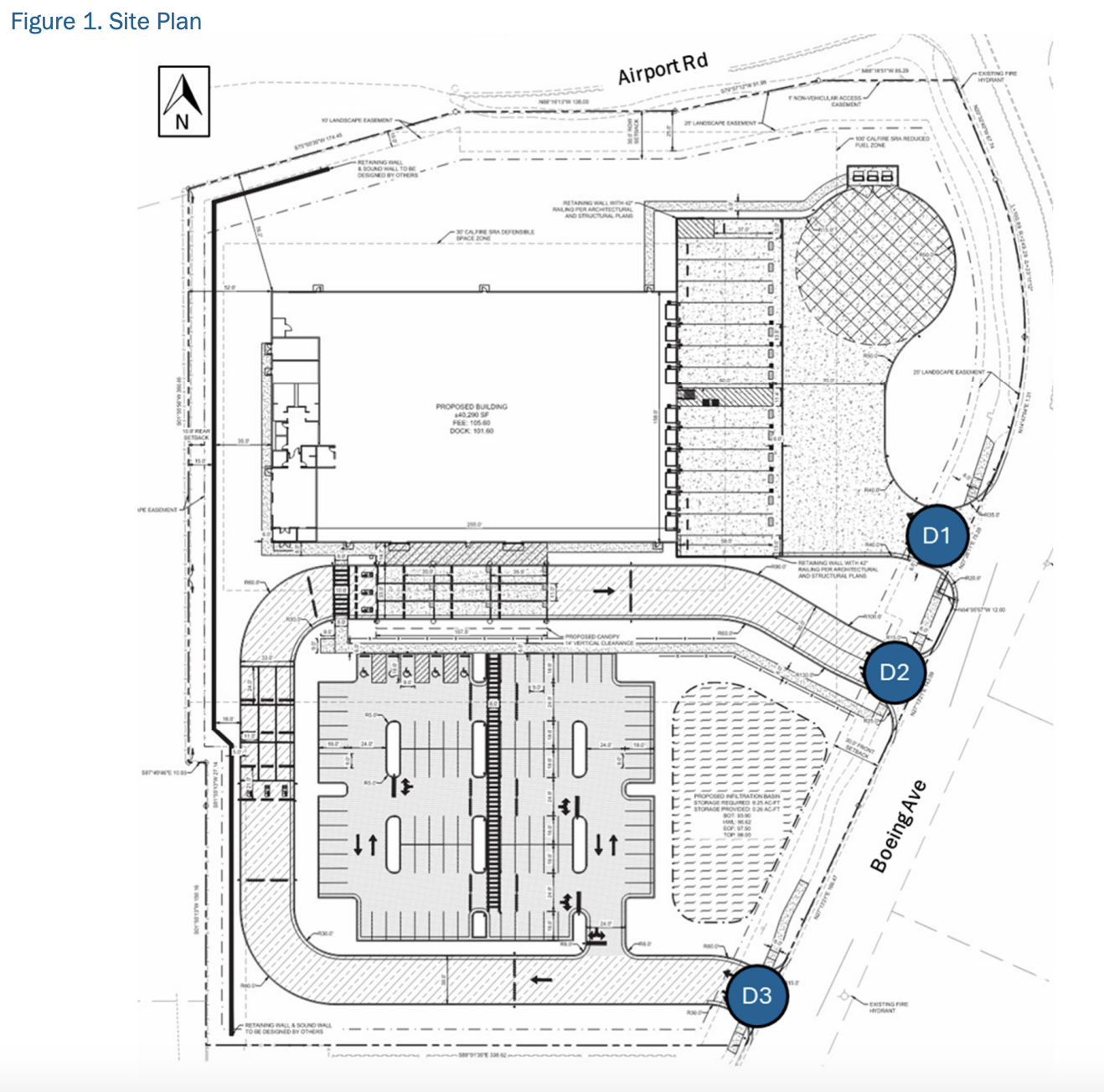
Engineering plans for an Amazon delivery warehouse and northern parking lot. | Plans by Nv5 Global, Inc., obtained via County of Humboldt.
###
In all, there are six parcels incorporated into these plans, with a total project size of about 9.4 acres. Line-haul delivery trucks will access the warehouse via a driveway on Boeing Avenue, according to a project description prepared by the development company Panattoni.
“Delivery stations like this one power the ‘last mile’ of [Amazon’s] order process and help speed up deliveries,” Panattoni Senior Development Manager Sonya Kinz explains in a project description prepared for the county. “Packages are shipped to a delivery station from [Amazon’s] nearby fulfillment and sortation centers, loaded into delivery vehicles and delivered to customers.”
How many jobs will be created by this project? According to this project description, 115 employees are expected to be onsite daily during off-peak periods with up to 172 during seasonal spikes.
Site operations will occur 24 hours a day, with the bulk of employee vehicle trips taking place between 7-9:30 a.m. and 7-8:30 p.m. Line-haul truck trips will mainly occur overnight, between 9:30 p.m.-5:30 a.m., according to the project description.
But it won’t just be Amazon-employed delivery drivers going in and out. The company has a program called Amazon Flex, which works a lot like Uber and Lyft, with delivery “partners” using their own vehicles to deliver packages while maintaining control over when, where and how often they work. That’s the pitch, anyway.
“Delivery stations offer entrepreneurs the opportunity to build their own business delivering [Amazon’s] packages, as well as independent contractors the flexibility to be their own boss and create their own schedule delivering,” the project description reads.
There’s expected to be 112 “flex” drivers each day between 10:30 a.m. and 1 p.m., increasing to 172 drivers during peak seasonal periods. The distribution center will generate a total of 542 daily trips (in/out), increasing to 828 daily trips during peak seasonal periods, the plans say.
Here’s another rendering of the warehouse and northern parking lot:

Rendering from a geotechnical engineering report by Terracon.
And here’s the southern lot:

The land is already zoned as a business park, which means it won’t need to be changed. The parcels are currently owned by Stephen Moser and Dan and Debra Woods, according to the documents we’ve reviewed.
What does the property look like currently? Here’s the northern parcel:

And here’s the southern:

Of the 18 county-protected trees onsite, the project would remove three and while preserving the other 15.
So, what will the place look like once it’s built? Well, good news and bad news on that front. The good news? Panattoni did create visual renderings of the warehouse. The bad news? Those renderings have the building almost completely obscured by surrounding landscaping.
Here’s the view from the northeast corner of the property:

And here’s the view from the northwest:
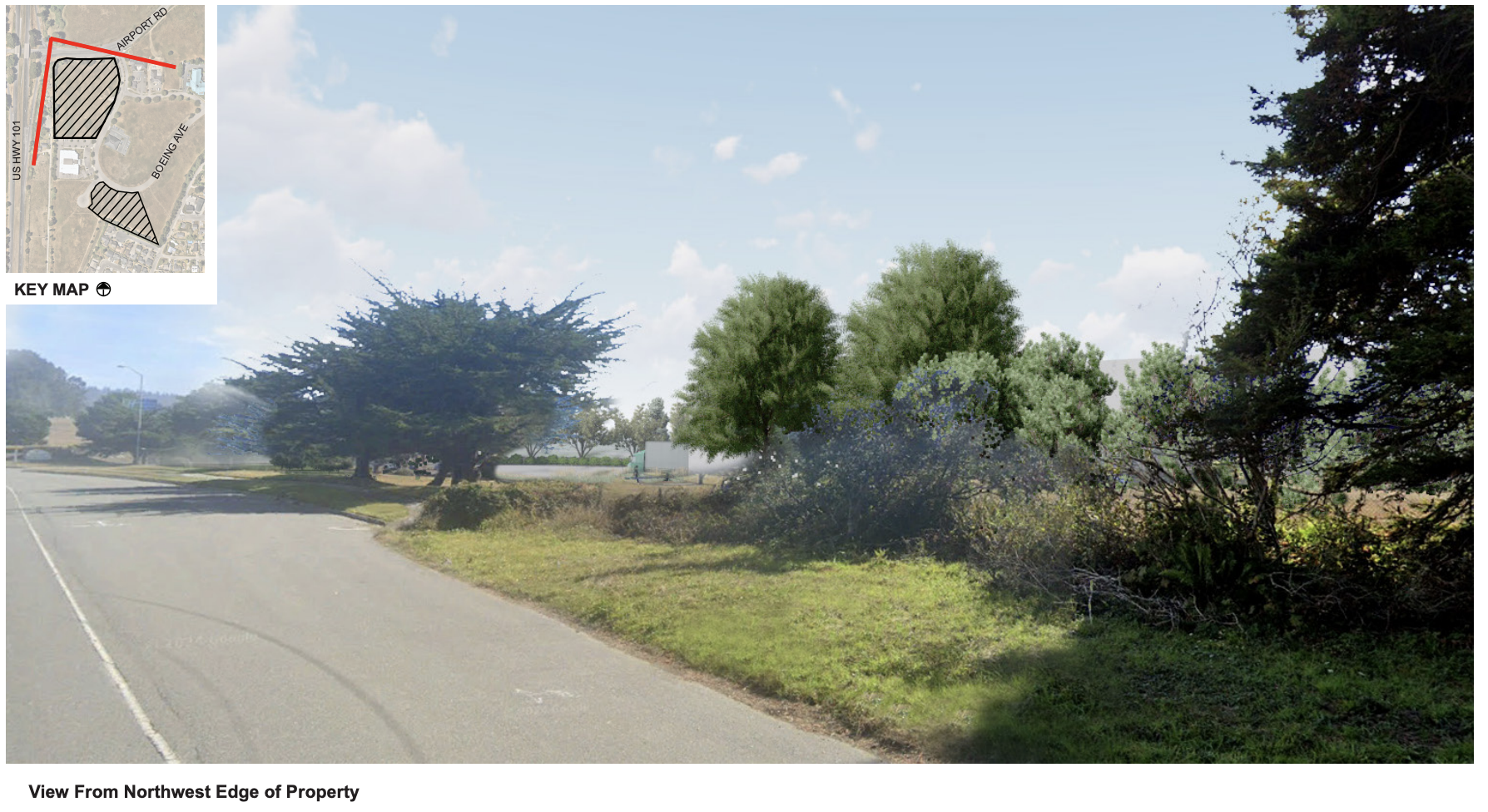
Construction is expected to be completed by late 2028, according to the Panattoni description. Email communications from county planners to the development company indicate that there’s still some work to be done before construction begins. In November, county planners noted that additional field studies for bees and rare plants are required.
The California Department of Fish and Wildlife, meanwhile, recommended incorporating native landscaping species rather than the initially planned Afghan pine and Chinese hackberry. The California Coastal Commission has expressed some concerns about the mitigation approach for impacts to Environmentally Sensitive Habitat Areas (ESHA). And county staff said in an email last year that it was still awaiting comments from other agencies.
There’s bound to be plenty more to report on as the project progresses. We reached out to the county in hopes of speaking with one of the planners working on this project but have not yet heard back. Stay tuned!