
Tribal member William Frank burns angelica root at the ceremony. Photos by Dezmond Remington.
PREVIOUSLY
###
When Elizabeth Hernandez moved to Eureka 12 years ago at the age of 18, she was excited. She was ready to be independent, an adult in a new city. But a harsh reality immediately stymied her attempt to strike out on her own: she couldn’t find an affordable place to live. It’s not a unique situation, Hernandez said this morning at a groundbreaking ceremony for the Wiyot Tribe’s new affordable housing project. In her role as the tribe’s education director, she said she’s seen many families — and not only Native ones — struggle with the same problem.
“We know that affordable housing, childcare — there’s a shortage here in our community and throughout the greater United States of America,” Hernandez said. “So it’s exciting for all of us to break ground today and to bring back our families to Jaroujiji, and to live sustainably and well in our ancestral territory.”

Elizabeth Hernandez speaks.
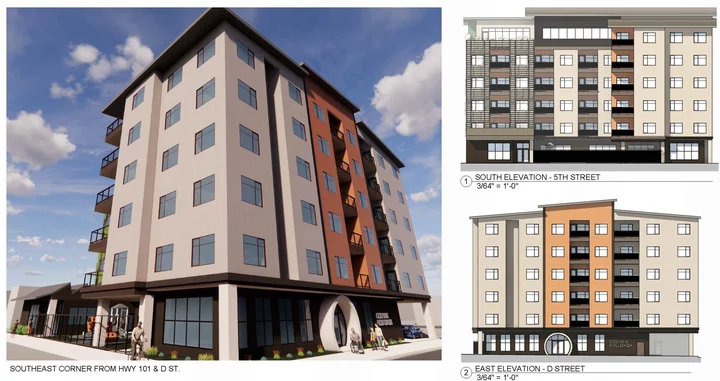
The corner of Fifth and D streets in Eureka is, right now, just a parking lot. But when the Gou’Wik Hou Daqh development is completed, it will transform the space into an 80-foot tall building with 41 units of affordable housing, a licensed childcare facility, a playground, and a green space. Translated from the Wiyot language Soulatluk as “Where the Families Are,” it’ll be mostly one- and two-bedroom apartments, with another 11 three- and four-bedroom units as well. Though tribal members will be prioritized, anyone who meets the income thresholds can apply.
The tribe and housing developer Travois say the project will be completed in 2027. The project, budgeted at $27.3 million, was financed through the Low-Income Housing Tax Credit (LIHTC) program, a federal tax credit that subsidizes the acquisition, rehabilitation and construction of affordable housing for low- to moderate-income tenants. Ownership of the lot was transferred to the tribe from the city, an action multiple speakers at the ceremony lauded.
“It demonstrates how local governments and tribes can work together towards meeting our mutual goals,” Tribal Administrator Michelle Vassel said. “The city needs more affordable housing. Wiyot people need more affordable housing. By working together, we help the whole community.”

Travois employees and tribal and city delegates celebrate with their golden shovels.

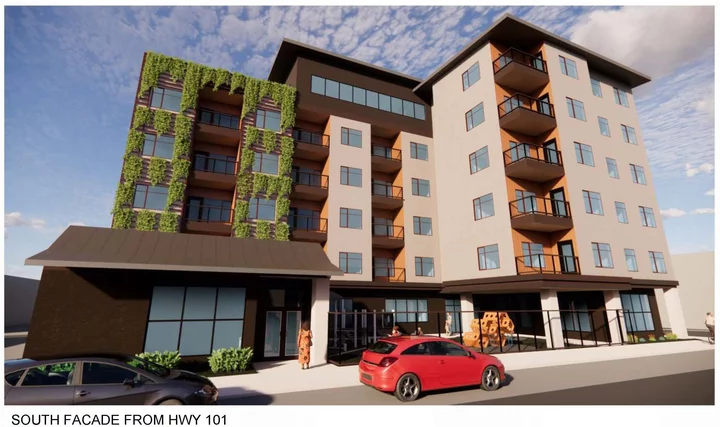
Mockups of the completed project. Courtesy of Travois.
CLICK TO MANAGE