Gambling is big business in the land of the free and the home of the brave.
Even the government is reaping growing revenues from gambling.
According to the U.S. Census Bureau, sports betting tax revenue was near $200 million midway through 2021. Four years later it’s around $1 billion.1

Consequently, it’s not just sports betting that is on the rise. You can now put money on politics, policies, and cultural moments like who will win Best Picture or how many times Elon Musk will tweet via Polymarket.
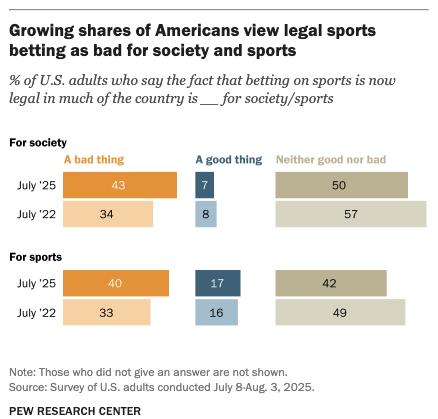
All this legal wagering is becoming a problem for some. Though not all gamblers are addicts, some are enslaved to it. The National Problem Gambling Helpline has spiked in comparison to where it was just a few years ago2, and more and more Americans view it as a growing problem and bad for society.3
Economist Kyla Scanlon believes that gambling is not simply something that people do at casinos or on phone apps. The entire economy is now a casino. She identifies “gambling throughout the economy — in markets, policy and how we talk about the future”.4 She points to things like cryptocurrency, memecoins, tariff political theatre, and big bets by tech companies on AI to justify her claim.
I don’t think it’s just the thrill gambling offers the consumer and the increasing ways to scratch that itch that are contributing to the effect of widespread betting on a society. It may also be driven by a seductive neurotransmitter: dopamine.
Let’s be honest, even if you aren’t high on gambling, you may be drunk on dopamine.
One writer, who served on the faculty of Stanford, compares the differences between slow traditional culture, fast modern culture, and dopamine culture — of which gambling is a part — along with their impacts on anything from athletics to relationships.5

As a financial advisor and one who spends time thinking and talking to people about their finances and how to build wealth, I could add a whole row on this kind of culture’s impact on investing:
- SLOW TRADITIONAL CULTURE: Read about financial markets in a newspaper the day after the news happened or watch it on the 6 o’clock news.
- MODERN CULTURE: Watch it 24/7 on CNBC from market experts and call your stockbroker.
- DOPAMINE CULTURE: Watch it, read it, click it, swipe it from a TikTok, Instagram Reel, Facebook post, or YouTube video from people creating financial media who might have an MBA from a reputable university or who might live in their mom’s basement straight out of high school. A constant stream of amateurs and experts on finance from any algorithm that fits your political, religious, and cultural tastes is at your fingertips. Pull up your trading app that lets you buy/sell at the push of a screen or swipe of a finger, as if you are playing a video game.
Dopamine investors make financial decisions based on the immediate present. An investment decision about your financial future is reduced to a swipe. Don’t think first and act later. Feel first and act immediately.
In the investing world, day-traders get this chemical rush often. One writer for Morningstar, a global investment research firm, put it this way:
On a neurochemical level gambling, day trading and speculation are not very different. Behavioural economist Sarah Newcomb says “there are certainly legitimate reasons for the occasional trade. Some trading is the result of long-term planning and the execution of a solid strategy. However, repeated studies, including Morningstar’s annual Mind the Gap report, demonstrate that investors who actively trade tend to underperform the market.”6
Long-term investors, on the other hand, will need durability over dopamine. They have more in common with gardening than gambling.
Resilience and durability are something that our culture could use a bit more of.
I’m not naive. I know that investing in the stock market has often been compared to gambling.
That critique is not always valid, though.
While investing in the stock market for a day compares to a coin flip, investing in it for decades increases to high probabilities of success. In fact, the S&P 500 (America’s largest publicly traded companies) has been 100% positive across every 20-year period since 1950.

This is not to say that investors will not experience large drawdowns. They most certainly will.
Investors in the 2000s lost an entire decade.

Durability matters.
If you had put $10,000 at the beginning in 1999 in the S&P 500 index — enduring events like the tech bubble popping to 9/11 to the Financial Crisis to the COVID crisis — that would have increased nearly ninefold, totaling around $90,000.

How do you become a durable investor in a dopamine culture?
You may want to consider fasting.
Dr. Anna Lembke, author of Dopamine Nation: Finding Balance in the Age of Indulgence, gave an interview where she described what this kind of fast looks like:
The intervention is basically, very simplified, and threefold.
1. Abstaining for a period of time from our drug of choice.
2. Learning to sit with discomfort, which is, of course, something that many different traditions teach.
3. Intentionally doing things that are painful: things that are physically hard and mentally hard.7
Nothing sells nowadays like abstinence, discomfort, and hard things.
But durable investors will need to abstain from the constant drama coming through their devices. They need to learn to sit with the discomfort of portfolio drawdowns and the constant hum of negative what-if scenarios from financial media. They will need to do hard things like cutting back on spending, paying off debt, adding to savings, and investing based on their future desires, not only their present ones.
Durability may not be pleasurable in the moment. It may force you to say “No” to reactive, impulse-driven investment decisions, but it just might lead to long-term rewards.
Invest like a gardener who is focused on a harvest that comes through all kinds of seasons, not a gambler trying to get rich quick.
You might get “lucky” gambling, but it won’t make you wise.
###
Sources:
1. Chart from Axios article “The high cost of the U.S. sports betting boom” published by Erica Pandey on December 14, 2025.
2. See Axios article above.
3. Chart taken from Pew Research Center published on October 2, 2025.
4. NY Times, “It is Trump’s Casino Economy Now. You’ll Probably Lose.” Published on October 16, 2025.
5. Ted Gioia, “The State of the Culture, 2024” published February 18, 2024.
6. Jessica Bebel, “Dopamine Rushes: is Day Trading as Addictive as Gambling?” published November 23, 2023.
7. Mary Beth Maslowski interview with Dr. Anna Lembke on Psychiatry Advisor on February 24, 2023: “Interview with the Author of *Dopamine Nation: Finding Balance in the Age of Indulgence”.
# # #
Brandon Stockman has been a Wealth Advisor licensed with the Series 7 and 66 since the Great Financial Crisis of 2008. He has the privilege of helping manage accounts throughout the United States and works in the Fortuna office of Johnson Wealth Management. You can sign up for his weekly newsletter on investing and financial education or subscribe to his YouTube channel. Securities and advisory services offered through Prospera Financial Services, Inc. | Member FINRA, SIPC. This should not be considered tax, legal, or investment advice. Past performance is no guarantee of future results.
CLICK TO MANAGE