

Just a Heads-Up: PG&E is Installing and Replacing Gas Lines in Eureka This Week
LoCO Staff / Thursday, Jan. 29 @ 10:18 a.m. / News
Press release from Pacific Gas and Electric:
Beginning the week of January 26, PG&E will be making updates to our natural gas system in the Eureka area. This important safety work includes installing and replacing gas distribution pipelines and service equipment and will enhance natural gas safety and reliability for customers in the Eureka community.
PG&E’s work will take place between West 15th Street and West Buhne Street, along Spring Street, Union Street, California Street, West Wabash Avenue, West Hawthorne Street, Summer Street, Pine Street, W Sonoma Street, W Church Street, Albee Street, West Buhne Street, Fairfield Street and West Del Norte Street.
We expect most work to take place between 7 a.m. to 5 p.m. on weekdays. During the day, customers may observe PG&E employees and contractors in the area performing work with equipment such as bucket trucks and diggers. PG&E’s work will not impact the community’s gas service. Weather and other factors that affect safe working conditions may change our schedule.
As a part of this project, customers may notice markings on the ground to ensure safe digging. Prior to any digging, underground utilities will spray paint markings or insert flag markers on the ground to represent the location of their lines underground so we can safely avoid them during our work.
If the work impacts local traffic patterns, PG&E will post “No Parking” signs at least 72 hours before we begin our work. Crews will route traffic around work areas if needed.
Residents and businesses that may be impacted by this work have received letters detailing the project.
BOOKED
Yesterday: 10 felonies, 12 misdemeanors, 0 infractions
JUDGED
Humboldt County Superior Court Calendar: Today
CHP REPORTS
852 MM199 S DN 8.50 (HM office): Trfc Collision-1141 Enrt
Poppy Dr / Sherwood Rd (HM office): Closure of a Road
ELSEWHERE
Mad River Union: Arcata’s petite data center only the first
Mad River Union: Whistleblower calls for Miranda’s Rescue end
Mad River Union: EV infrastucture needs in rural areas reviewed
Mad River Union: $600K grant for Jolly Giant, Butcher’s Slough resilience
Five Old-Growth Redwoods Were Cut Down in Lower Redway. How Could That Happen?
Isabella Vanderheiden / Thursday, Jan. 29 @ 7:48 a.m. / Environment
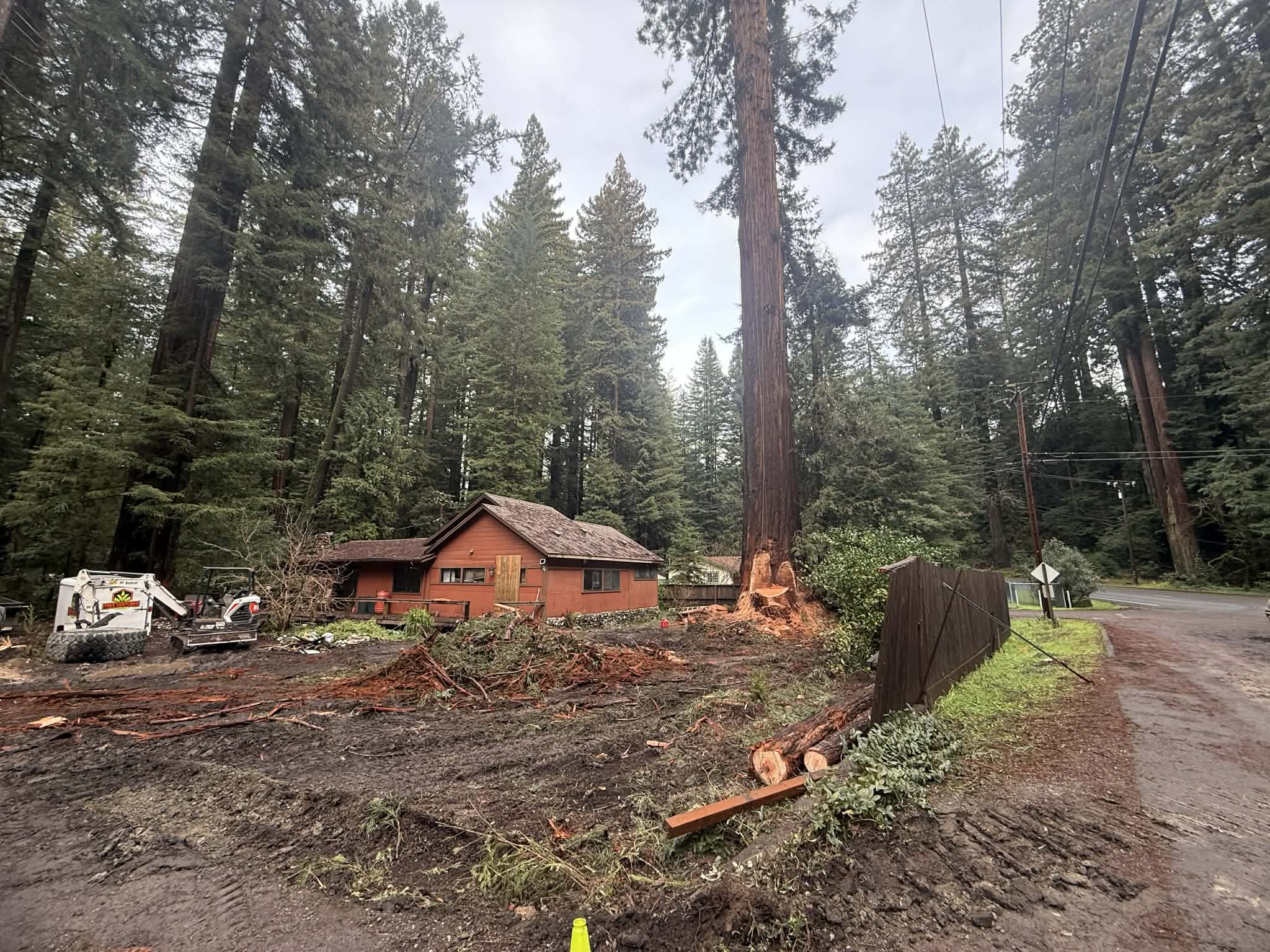
Five “hazardous” old-growth redwood trees were removed from a Lower Redway property earlier this month. | Photo submitted by the Environmental Protection Information Center.
###
AFTERNOON UPDATE: CalFire has launched an investigation into the tree removal in response to concerns raised by the Environmental Protection Information Center (EPIC).
###
The cutting of several “hazardous” old-growth redwoods in a Lower Redway neighborhood has sparked outrage among residents and environmental advocates, raising questions about whether decades-old policies designed to protect old-growth trees are being properly applied.
Several residents spoke out about the controversial tree removal at this week’s Humboldt Board of Supervisors meeting, with several speakers expressing concern that the case sets a dangerous precedent for old-growth trees throughout Lower Redway.
While many people were shocked to see the redwoods cut down, the action complies with state law.
As originally reported by the Redheaded Blackbelt, last year, property owner Robert Scarlett secured a hazard tree exemption from CalFire to remove “approximately five” old-growth redwoods, estimated to be between 200 and 300 years old, from a residential parcel on the corner of Oakridge Drive and Briceland Road in Lower Redway. Scarlett, who is also employed by CalFire, said that he had purchased the single-story house — located on a 0.43-acre parcel directly across the street from his own home — for his mother to live in, but feared that the redwoods surrounding the property posed an immediate safety risk.
He told the news outlet that the trees he considered hazardous were “so close to the structure that we keep getting branches through the roof.” Removing the trees would ensure “nobody gets hurt” and eliminate potential threats “to the structure or any life,” he said.
Reached for comment, Scarlett told the Outpost in no uncertain terms that he did not want to participate in this story.
‘A False Sense of Security’
The removal of the trees has reignited long-held concerns among some residents who thought the days of logging old-growth redwoods were a thing of the past.
“I think some environmentalists were lulled into a false sense of security that, because there are so few [old-growth] trees left and that there’s protections in place, they’re good, and that doesn’t appear to be true,” said Andrew Morris, owner of Briceland Vineyards. “It’s possible that maybe one of those trees was genuinely unsafe, and maybe there was a legitimate case for taking one tree down. … If that’s the case, then several foresters should look at it from the point of view of ‘How can we preserve these trees and the safety of the house?’ Not, ‘Can I construct a narrative to take these trees down that is legal?’”
Several people interviewed for this story expressed similar concerns, many of whom voiced doubt that tree removal was necessary.
Tom Wheeler, executive director of EPIC, acknowledged that falling tree limbs — especially those of gigantic old-growth redwoods — can present safety hazards to structures around them, but felt additional steps could have been taken to prevent the trees from being removed entirely.
“Old-growth can’t just be wantonly removed under the guise of some sort of hazard tree protection,” Wheeler told the Outpost. “Could we limb dangerous branches instead? Is there an alternative? Are all of the trees hazards? … When we’re talking about old-growth redwood, I think that we, collectively as a society, want to be more cautious about removal like these.”
EPIC launched a mass emails campaign urging county officials to take immediate “enforcement action and issue a stop work order to allow for a more considered approach to dealing with any potential hazard” presented by the trees. The letter warns that if logging is allowed to occur, “nearly all of the trees in the community could be declared ‘hazards’ and removed.”
As of this writing, 594 people have sent such an email.

The Lower Redway property captured via Google Street View in June 2025.
Was Tree Removal Justified?
As the Department of Forestry and Fire Protection, CalFire has permitting and enforcement jurisdiction over timber operations on timberland pursuant to the Forest Practice Act of 1973. The County of Humboldt also has a hand in the permitting process, but it’s taken a step back in recent years due to a provision in the Forest Practices Act that precludes the county from requiring permits that would supersede an exemption from the law. (We’ll dive deeper into that process below.)
A Service Record Report obtained by the Outpost includes site notes from CalFire Supervising Forester Lucas Titus, who inspected the Lower Redway property on Oct. 21. In his report, Titus says he visited the property “several times in the past year under the previous owners, who harvested several trees around the property and wanted to harvest several more after their house was damaged” by broken limbs.
“During the inspection approximately five trees/clumps were identified all within 30 feet of structures as having the defect and site conditions indicative of tree failure,” Titus wrote, citing a section of the Powerline Fire Prevention Field Guide relating to hazard tree removal. “These identified trees have already damaged the roof and deck of the main habitable structure and caused damage to the adjacent shed and adjacent property and continue to pose a safety threat.”
But how do foresters determine whether or not a tree poses an immediate threat?
It depends on a few factors, including the size and condition of the tree, as well as its proximity to nearby structures and utilities. A tree can be rendered “defective” due to root rot, deformities, cracks, splits, crown dieback or “any other reason that could result in the tree or a main lateral of the tree falling,” according to Titus’ report.
Yet another factor is the zoning of the site. Because the Lower Redway property is situated within a county-designated “Q Zone,” trees exceeding 12 inches in diameter can only be cut “in an emergency situation” when trees are “threatening people or property.” Under such circumstances, the county requires a special permit.
In his report, Titus notes that he contacted the county about the special permit, and was told by Code Compliance Officer Warren Black that he “didn’t think the County was requiring a permit within the Redway Zone to harvest select safety hazard trees but was going to investigate zoning further.” Still, Titus noted at the end of his report that the property owner might want to get some form of written verification or documentation from the county, just in case.
“Based on the safety issues surrounding the proposed trees this RPF [registered professional forester] agrees that the selected trees pose a safety hazard to the habitual structures and may be harvested,” the report concluded.
Reached for additional comment, Planning and Building Director John Ford confirmed that the county “signed off on [CalFire’s] permit for Hazard Tree Removal” at the Lower Redway site, but did not issue its own permit. Why?
Ford explained via email that the county used to require a special permit in addition to the permit required by CalFire. That changed in 2022 after the county tried to take enforcement action against a local property owner who cut down a small grove of redwoods without a special permit.
“We [were] working towards enforcement of this action when the county was called into a meeting with area foresters and CalFire, and it was presented to the county that the Forest Practices Act precludes the County from requiring permits that would supersede a Timber Harvest Plan or exemption from the Forest Practices Act,” Ford said. “Since that time the county has stayed away from tree removal done under the authority of the Forest Practices Act.”
However, in response to the onslaught of letters opposing tree removal in Lower Redway, Ford revisited the California Code of Regulations and discovered a provision that requires timber operations to “conform to the applicable … city or county zoning ordinances within which the notice of exemption is located.” In simpler terms, because the tree removal occurred within the Lower Redway “Q Zone,” it should have been subject to a higher level of scrutiny.
“There seems to be an inconsistency between the premise that the county has been operating under and the California Code of Regulations and possibly how the Forest Practices Act was interpreted to the county,” Ford explained. “As of now, the Planning and Building Department staff has been instructed to require permits for all activities where a permit would normally be required, associated with tree removal.”
“I know this does not help in the Redway case,” he added.

Another view of the Lower Redway site. | Photo: Mary Giardino
‘The Worst-Case Scenario is Bad’
While Wheeler was relieved to hear that the county is reevaluating its approach to hazard tree exemptions, he lamented the fact that several old-growth trees were lost in the process.
“If we don’t change the way that we deal with these sorts of things … all the old growth of Lower Redway could come out under pretty flimsy justification,” he said. “The worst-case scenario is bad, but I don’t think the worst-case scenario is likely. … I want folks to know that, yes, something was messed up, but people responded, and now change has happened. Otherwise, I think it’s a pretty despondent, sad tale.”
A Redway resident interviewed by the Outpost, who asked to remain anonymous, felt the county and state should expand oversight over hazard tree exemptions to ensure all ecological and environmental factors are properly evaluated. They also questioned whether there could have been a conflict of interest in CalFire approving the exemption for another CalFire employee.
“I’m still flabbergasted … because everyone thought that certainly you cannot cut old-growth down under an exemption,” the anonymous source said. “That limited analysis [from CalFire] could not have been seen as sufficient to make such a huge alteration to the growth here. No consultation, no mention about endangered species take? There’s no marbled murrelet consultation, no identification of spotted owl habitat. I believe a CDFW [California Department of Fish & Wildlife] person should have at least been consulted.”
Reached for additional comment, Titus, the CalFire forester who inspected the site in question, emphasized that the property owner went through the appropriate channels for hazardous tree removal. He added that the county “acted appropriately” in not interfering with the “property owner removing trees that were deemed a safety hazard.
“Rarely do I see trees proposed for harvest that meet these requirements,” Titus wrote via email. “When I have received a harvest document proposing to harvest a tree with these characteristics it has been [for] safety issues. I don’t believe anyone is encouraging landowners to harvest these types of trees and it rarely happens unless it is a safety issue. … During the onsite inspection I conducted on October 21st, 2025, there were several redwood limbs stuck in the roof of the house that are the sleeping quarters for occupants of the house.”
Asked to respond to the allegation that the property owner was given special consideration from CalFire because of his employment with the agency, Titus said Scarlett contacted CalFire’s resource management office and requested a site visit “like any other landowner would.”
“The landowner than [sic] hired a Licensed Timber Operator (LTO) and submitted the harvest document to the CAL FIRE Region office in Santa Rosa which is standard practice for all timberland owners seeking approval to harvest trees,” Titus said. “To date the LTO that was hired and signed onto the harvest document has operated in a professional manner and has not violated any Forest Practice Rules to date on this harvest document.”
“I think it’s extremely important that readers understand that the State of California is not going to prohibit a timberland owner from removing a tree that is a danger to life and property,” he continued. “As a licensed professional with over 25 years of experience working in the forest I can’t with good faith not allow someone to harvest a tree that is a danger to them.”
Reigniting a Culture War
Despite CalFire’s assurances, some residents are still concerned about the precedent set by the lower Redway case. Morris, the Briceland winemaker you heard from earlier in this story, said he’s heard rumors that some locals are now seeking hazard tree exemptions to have old-growth redwoods removed from their properties. For now, that’s just hearsay.
On a more philosophical note, Morris worried that the outrage surrounding the recent tree removal would rekindle a decades-old culture war.
“Another concern is that this is a rekindling of the hippies versus the rednecks war,” he said. “We have enough division in the country, in the state, in the county and our local community that we don’t need an active war.”
COMMUNITY ENERGY INSIGHTS: Your Energy Bills Probably Skyrocket in the Winter. Let’s See What We Can Do About That
Beth Burks / Thursday, Jan. 29 @ 7:48 a.m. / Energy

RCEA team member Mario Gonzalez sharing a No Cost Energy Efficiency Kit packed with practical tools to help save electricity with a customer. Photo: RCEA.
###
Ed. note: “Community Energy Insights” is a new monthly column from the people at the Redwood Coast Energy Authority, Humboldt County’s intergovernmental joint-powers authority on all things electrical. Look for it on the last Thursday of the month.
Here is the inaugural episode, with RCEA executive director Beth Burks.
###
If your electricity bill tends to creep up during the winter months, you’re not alone. Every year, we hear from Humboldt County residents who are surprised by higher winter bills and wonder what has changed.
The short answer? Winter is peak energy season in most of Humboldt County, and a few common factors can add up quickly. The good news is there are also simple, low-cost ways to manage your energy use and get support if you need it.
Let’s break it down.
Why winter energy bills are higher

Beth Burks.
Although energy prices are lower in the winter, during the colder months, most homes use more electricity. So, you may actually be seeing your largest electricity bill in the winter. Days are shorter, heaters run longer and lights stay on more often. Even small changes in daily habits can have a noticeable impact when they happen consistently.
The biggest drivers of higher winter bills:
- Heating use increases. Furnaces, electric heat pumps and heaters run more. Many gas heaters use electricity, too, causing increases in gas and electricity. Heating is often the single largest source of electricity use in a home.
- Longer nights mean more lighting. With fewer daylight hours, lights stay on longer, especially in the morning and evening.
- Water Heaters Work Harder. Hot showers, laundry and dishwashing all require energy, and water heaters tend to run more in cold weather.
Five simple ways to save energy this winter
You don’t need a major home upgrade to make a difference. Whether you rent or own, consistent actions can help lower energy use and improve comfort.
- Set your heater wisely. Lowering your thermostat by just a few degrees, especially overnight or when you’re away, can reduce energy use without sacrificing comfort.
- Seal the drafts. Cold air sneaking in around doors and windows makes heaters work harder. Temporary fixes like door sweeps, weatherstripping, or draft stoppers can be surprisingly effective.
- Use space heaters safely and sparingly. Space heaters use a lot of electricity. If you use one, keep doors closed so you’re only heating the room you’re in and turn it off when you leave.
- Switch to LED bulbs. LED bulbs use up to 75% less energy than older incandescent bulbs and last much longer.
- Wash clothes in cold water when possible. Heating water uses energy. Cold-water washing works well for most loads and can help reduce energy use over time.
Who we are and why that matters
Redwood Coast Energy Authority is the locally owned electricity provider for about 92% of Humboldt County. If you live or run a business in the county, chances are we provide your electricity generation, while PG&E continues to deliver it and handle billing.
Our office is right here in Eureka, and we’re go
RCEA team member Mario Gonzalez sharing a No Cost Energy Efficiency Kit packed with practical tools to help save electricity with a customer.
RCEA team member Mario Gonzalez sharing a No Cost Energy Efficiency Kit packed with practical tools to help save electricity with a customer.
verned by a board of elected officials from the communities we serve. That means decisions about electricity are made locally, with community priorities in mind, not by distant shareholders.
We’re here to help
Whether you’re trying to understand your bill, finding ways to save, or exploring assistance programs, RCEA is here as a local resource.
Resources to help make your bill more manageable
If winter bills are creating financial stress, you don’t have to navigate it alone. Several assistance programs are available, including:
- CARE and FERA bill discounts, which provide reduced electricity rates for income-qualified households
- Payment assistance programs administered through PG&E
- Rebates for energy-efficient appliances, water heaters and heat pumps
If you’re unsure what you qualify for, our Account Service team will be happy to walk through options with you and also to help you assess whether you are on the best electricity rate. Call (707) 269-1700 or email info@redwoodenergy.org today!
Free upgrades to help you save
RCEA offers a no-cost energy efficiency kit for customers, available in partnership with the Northern Rural Energy Network (NREN). The kit includes simple upgrades like LED bulbs and other efficiency items that can help lower energy use right away.
It’s one of the easiest ways to make your home more energy-efficient without spending extra money. Check it out at at this link.
What Next?
This Community Energy Insights series is designed to answer real questions we hear from the community and share practical information you can use right away. In future articles, we’ll dig into topics like clean energy projects, electric transportation and how local energy choices impact Humboldt County.
Get in Touch
If you have questions or want to learn more about available programs, reach out to Redwood Coast Energy Authority via phone, (707) 269-1700, email info@redwoodenergy.org, or stop by our office in Eureka at 633 3rd St. We’re proud to serve this community — especially during the colder months, when reliable, affordable electricity matters most.
Two Arrested for Fentanyl Sales in Redway Yesterday, Drug Task Force Says
LoCO Staff / Thursday, Jan. 29 @ 7:47 a.m. / Crime

Photo: HCDTF.
Press release from the Humboldt County Drug Task Force:
On Jan. 28th, 2026, the Humboldt County Sheriff’s Office Problem Oriented Policing (HSCO POP) team assisted by the HCSO Marijuana Enforcement Team (MET) and the Humboldt County Drug Task Force (HCDTF) served a search warrant in the Redway area after a month-long investigation into the distribution of Fentanyl.
The search warrant was served on 33-year-old William Branscomb, 36-year-old Eva Markowitz and their associated residence located in Redway. Upon service of the search warrant, deputies located one ounce of fentanyl, drug paraphernalia and items consistent with drug sales.
At the conclusion of the investigation, Branscomb and Markowitz were booked into the Humboldt County Correctional Facility for the following charges:
HS 11366.5 – Knowingly owning property for drug manufacture, storage, or distribution
HS 11351 – Possession of a controlled substance for the purpose of sales
The Humboldt County Sheriff’s Office remains committed to addressing narcotic related crimes and improving public safety through proactive enforcement and community partnerships.
Anyone with information related to this investigation or other drug related activity or problems areas related to criminal activity are encouraged to call the Humboldt County Sheriff’s Office at (707) 445-7251 or the Sheriff’s Tip line at (707) 268-2539.
California State Employees Alarmed by Demand to Prove Their Citizenship
Khari Johnson / Thursday, Jan. 29 @ 7:41 a.m. / Sacramento

Department of Health Care Services headquarters in Sacramento on Sept. 15, 2022. Photo by Rahul Lal, CalMatters
###
This story was originally published by CalMatters. Sign up for their newsletters.
###
About 4,000 California Department of Public Health employees have been told they must use a federal verification system to prove they’re U.S. citizens.
Leaders of the agency said in a memo obtained by CalMatters that the verification is necessary to receive federal funding, but employees and unions are resisting the directive.
In the memo, a department human resources deputy director asked employees to comply with a series of deadlines that culminate on April 10. A separate document distributed by the department said that failing to complete the verification may result in the state losing a contract with the Centers for Disease Control for the national death index, which collects death certificate data from authorities nationwide.
The department is also making the move to address incomplete employment eligibility records identified in a recent audit, according to the Service Employees Union International Local 1000, which represents roughly 3,000 department employees.
As at other U.S. employers, all new California health department employees complete a federal I-9 form to prove their citizenship. The department is now asking them to enroll in E-Verify, a program administered by the U.S. Citizenship and Immigration Services and the Social Security Administration. That system compares information provided by an employee on the I-9 to records in federal databases, including at Social Security and the Department of Homeland Security. In some cases it also prompts employers to compare each applicant’s identification document photo with the one they provided during the E-Verify process. The memo said employees will specifically use E-Verify+, which combines filling out an I-9 with verification. Employees hired before November can opt out of using that specific version of E-Verify.
SEIU Local 1000 President Anica Walls told CalMatters in an email that forcing all employees to use E-Verify “raised serious concerns for our members about privacy, data security, and the unnecessary re-verification of workers who are already legally employed.”
The union sent a petition to executives in charge of the state agency last month to express concern about the verification and underline that employees submitted documents to prove their citizenship when they were hired. Walls told CalMatters the health agency is currently the only California state department the union is aware of that has asked their employees to recertify their citizenship status. The union represents about 100,000 state employees at 140 state agencies, boards, commissions and departments.
“When federal systems and funding conditions are used to justify expanded data collection from workers, it raises red flags — especially when those workers have already met employment eligibility requirements,” she wrote. “Our members are concerned about their personal data being sent to federal systems with known accuracy and security issues. And this is coming at a time when both U.S. citizens and immigrant workers are understandably concerned about how employment data could be accessed or used by federal agencies.”
The E-Verify+ requirement is creating fear and uncertainty among employees and may affect employee recruitment and retention in the future, said Jacqueline Tkac, president of the California Association of Professional Scientists-UAW Local 1115, a union that represents roughly 800 health department employees. Amid reports of ICE activity at workplaces and people being taken off the street, the timing could not be worse.
“E-verify+ is not a neutral administrative tool. It’s deeply integrated with DHS databases, including systems used by ICE, and relies on biometrics and cross-agency data sharing,” she said in a statement shared with CalMatters. “Introducing this at a time when immigrant communities and public health scientists are being openly targeted by the current federal administration is extremely chilling.”
The California Department of Public Health did not respond to multiple requests to answer questions. State information officer Nicole Snow told CalMatters that the California Department of Human Resources does not monitor how state agencies verify employment eligibility and that use of E-Verify is determined at a department level.
“It raises red flags — especially when those workers have already met employment eligibility requirements.”
Anica Walls, president, SEIU Local 1000
Since it became available in the 1990s, E-Verify has been, by default, a voluntary program for employers, but it has become mandatory for more and more of them over time. The federal government has required E-Verify for certain contracts since 2009 and more than 20 states now require E-Verify for their own contracts or to issue business licenses. Earlier this month, Florida lawmakers passed a bill that requires employers of all sizes to use the federal program.
Critics of E-Verify say the program needs reforms to address instances in which it makes mistakes, including cases where people commit identity fraud to get jobs they shouldn’t have and false positives leading people to lose jobs that they were lawfully allowed to have. Based on Bureau of Labor Statistics data and the E-Verify error rate, if Congress passed an E-Verify mandate today, the citizenship status of more than 120,000 people would get inaccurately labeled, allowing ineligible immigrants to work and labeling some U.S. citizens ineligible to work, which could lead to loss of wages or jobs, said Rep. Jamie Raskin, a Democrat from Maryland, during a hearing last month where members of Congress debated a bill that would require E-Verify use for all federal contracts.
The health department’s push to prove citizenship comes at a time when the U.S. Immigration and Customs Enforcement agency is ramping up I-9 audits that may precede raids. It also comes on the heels of ICE agents shooting and killing two people in Minnesota, the deaths of multiple people in ICE detention facilities, and multiple news reports that the Department of Homeland Security wants to bring similar tactics to California and New York.
It’s possible the department wants to prepare for or forestall an audit from ICE. I-9 audits increased in Minnesota in recent weeks, Minneapolis-based immigration attorney Matthew Webster told CalMatters. Webster said some appear indiscriminate, with audit notices “basically just being dropped off door to door,” and some seeming to be retaliatory, like a hospital where staff protested ICE’s treatment of a patient shortly before the hospital was audited, and a St. Paul toy store that gave away whistles that protesters use to alert their neighbors to ICE activity, also shortly before it was audited. Webster expects such audits to become more commonplace as tens of billions of dollars continue to pour into the law enforcement agency from the federal budget.
A set of “Frequently Asked Questions” drafted by the California Department of Public Health and distributed to employees describes E-Verify+ as intended to “reduce errors, streamline onboarding, and improve the overall employee experience.”
But one employee, who asked to remain anonymous to avoid retaliation, told CalMatters that in light of recent events, they’re concerned about the department providing employee photos to the Department of Homeland Security under E-Verify. They also said the health department should have made it clearer that employees could opt out of the “plus” version of E-Verify and should extend this option to people hired since November, who must always use E-Verify+, according to the questions document.
“Nowhere in the memo does it tell us we can opt out,” they said. “That information only came after employees raised concerns to the director.”
OBITUARY: Lawana Lee Martin, 1933-2026
LoCO Staff / Thursday, Jan. 29 @ 6:56 a.m. / Obits

In Loving Memory of Lawana Lee Martin
Lawana Lee Martin passed into the loving arms of her Savior on January 12, 2026, after a life marked by faith, service and devotion to others. A woman of strength and compassion, Lawana leaves behind a legacy of love that spans generations and touched countless lives.
Born on December 18, 1933, in Bellingham, Washington, Lawana was the daughter of Earl and Vera McCarty. Lawana had two brothers, Pat and Dean and a little sister Linda.
In 1937 at the age of four, Lawana survived polio, leaving one leg shorter than the other. Though others noticed her limp, her family never did—because to them, she walked with unwavering strength and determination. Lawana grew up on an Island in Bellingham and at a young age began to sneak into the back of the school house because she loved to learn, which allowed her to skip ahead two grades when she was finally old enough to start school. Lawana’s father was a career fisherman and the family followed Earl up and down the coast, going as far as Alaska and landing in Humboldt County when Lawana was 12. Lawana loved to roller skate and never missed the weekly skate nights and the chance to show o her skills at the municipal auditorium. Lawana attended Eureka High School, where she was a member of the school marching band, playing the flute, while maintaining a straight A average.
Lawana met James L. Martin at the Grace Baptist Church youth group in 1948 and on January 10, 1952, they married, beginning a partnership grounded in faith and family. Together they raised seven children: Cathy, Kim, Candy, Kelly, Chris, Keith and Casey. Family was the great joy of Lawana’s life. She was blessed with 83 grandchildren each of whom carries a piece of her wisdom and strength.
Lawana answered a calling, she carried from a young age, when she became a nurse. She graduated from the College of the Redwoods nursing program in 1970 while raising seven children, including one who was severely handicapped. She later earned a Bachelor of Science in Nursing from Humboldt State University.
Lawana devoted 48 years to being a nurse. These years started at General Hospital, primarily in the Emergency Room, where a few months after starting she began to serve as night supervisor, and was trusted to oversee the entire hospital. She also became a supervisor at Mad River hospital, worked as a traveling nurse, taught nursing courses at CR and later worked at St. Joseph Hospital, as well as a Dermatology office. Nursing was never just a job to her — it was her ministry. Former patients often stopped her in public to express their gratitude, her coworkers at the hospitals began to call her Mother Martin or just Mom, and her former repeat patients liked to call her Sarge. She has three granddaughters who followed in her footsteps and continue her nursing legacy.
Despite her many responsibilities through the years, Lawana never slowed. She cared for her home and children, preparing lunches for her children each day, baking twelve loaves of bread every week, as well as teaching Sunday school and Bible study for 65 plus years. Sundays were devoted to church, where her faith was not only spoken but lived.
Lawana was deeply involved in First Covenant Church of Eureka. She served as chairman on numerous boards and committees. The Eureka Rescue Mission and Triumphant Life Camp hold a special place in her heart. She spent many summers through 2023 serving as a TLC camp nurse.
In her seventies, her heart led her to welcome a foster child, Alexis, supporting her through the end of junior high and preparing her for high school. Lawana also treasured traveling with her grandchildren around the world and watching them play sports creating memories that will be cherished forever.
Lawana shared a remarkable friendship of nearly 73 years with her dear friend Sherrill Johanson and Sherrill’s husband, Jay. Their enduring bond was a testament to loyalty, love, and shared faith.
Lawana never complained about her health. Her faith never wavered, and she faced each day with strength, grace, and love. Lawana lled her retirement time with board meetings, Sunday school, bible studies, and planning church events. Her favorite thing to do in retirement was get her green waste bins full to the brim every week.
Lawana was known for her skill, leadership and love of the Lord. She was often called upon to help when others struggled, and she consistently encouraged colleagues, family and friends to further their education. During these demanding years as a nurse, she also lovingly cared for her son Chris, whose life, doctors believed was extended through her devoted and expert care. She finally retired from the St Joseph ER in 2016 at age 83, after a health diagnosis.
She was preceded in death by her husband Jim Martin, son Chris Martin, stepdaughter Joyce Ann Kutchara, brothers Edward “Pat” and Dean McCarty. She is survived by her children Cathy Stewart and husband Jim; Kim Martin and wife Verona; Candy Martin and partner Jimmy; Kelly Martin and wife Kala; Keith Martin; and Casey Martin and fiancé Margo; 80 of her grandchildren; and her beloved sister, Linda Muzinich of Santa Barbara, and other extended family who will all miss her dearly.
There will be a celebration of life for Lawana at First Covenant Church of Eureka (2526 J St.) Saturday, February 14 at 2:30 pm with reception to follow. In lieu of flowers donations can be made in Lawana’s name to Triumphant Life Camp, Eureka Rescue Mission and First Covenant Church.
###
The obituary above was submitted on behalf of Lawana Martin’s family. The Lost Coast Outpost runs obituaries of Humboldt County residents at no charge. See guidelines here. Email news@lostcoastoutpost.com.
OBITUARY: Elaine Roxie Chilton, 1954-2025
LoCO Staff / Thursday, Jan. 29 @ 6:56 a.m. / Obits

Elaine Roxie Chilton
March 24, 1954 – Nov. 24, 2025
Elaine was born on March 24, 1954, in Scotia, to Walter Joy and Alene Sorrels. She was the fifth child, following three brothers and one sister. Elaine passed into eternity on November 24, 2025, at home, surrounded by loved ones. She attended grade school in Garberville and high school in Miranda. As a young woman, she married the love of her life, Jackie Chilton, and they spent 37 years together as best friends and soul mates. They went on to have two beautiful daughters, Tami and Heather Chilton.
Elaine loved her family and friends deeply. She was a devout Christian, and her love for Jesus Christ was central to her life. She had beautiful green eyes, a ready smile, and a bit of a stubborn side. She enjoyed walks along the bay, meeting new people, and, with her gentle way, spoke to them about Jesus. She worked as an occupational therapy aid at Humboldt Senior Resource Center and PACE for 16 years, where she provided loving and compassionate care to those in need. Her hobbies included photography, reading, crafting, nature walks, sunbathing, swimming, and singing. She loved listening to gospel and country music, and frequently watched True Crime and Forensic Files.
Elaine was preceded in death by her mother and father, her husband Jack, and her siblings Clifford, Walter, and Shirley. She is survived by her daughters, Tami and Heather Chilton; her grandchildren, Jesse, Jackie, Hannah, and Rylee; her great-grandchildren, Koa, Cielo, Cosmo, and Jack; her brother, Roy “Pee-Wee” Joy, and his wife Linda; her lifelong best friend, Lorna Welty; and many nieces and nephews.
Thanks to Hospice of Humboldt for your dedicated care and compassion. Thanks to Pastor Chris for your time, love, songs, and for helping us remember God’s eternal plan.
A celebration of life will be held at Redway Baptist Church on February 7 at 11 a.m., officiated by Pastor Chris Andrews, and will be followed by a potluck. Elaine left us with love and countless memories to cherish. She will be missed dearly, an angel called home!
###
The obituary above was submitted on behalf of Elaine Chilton’s family. The Lost Coast Outpost runs obituaries of Humboldt County residents at no charge. See guidelines here. Email news@lostcoastoutpost.com.


