

Cities Can’t Punish Outreach Workers for Helping Homeless Californians Under New Law
Marisa Kendall / Monday, Dec. 29, 2025 @ 8:21 a.m. / Sacramento
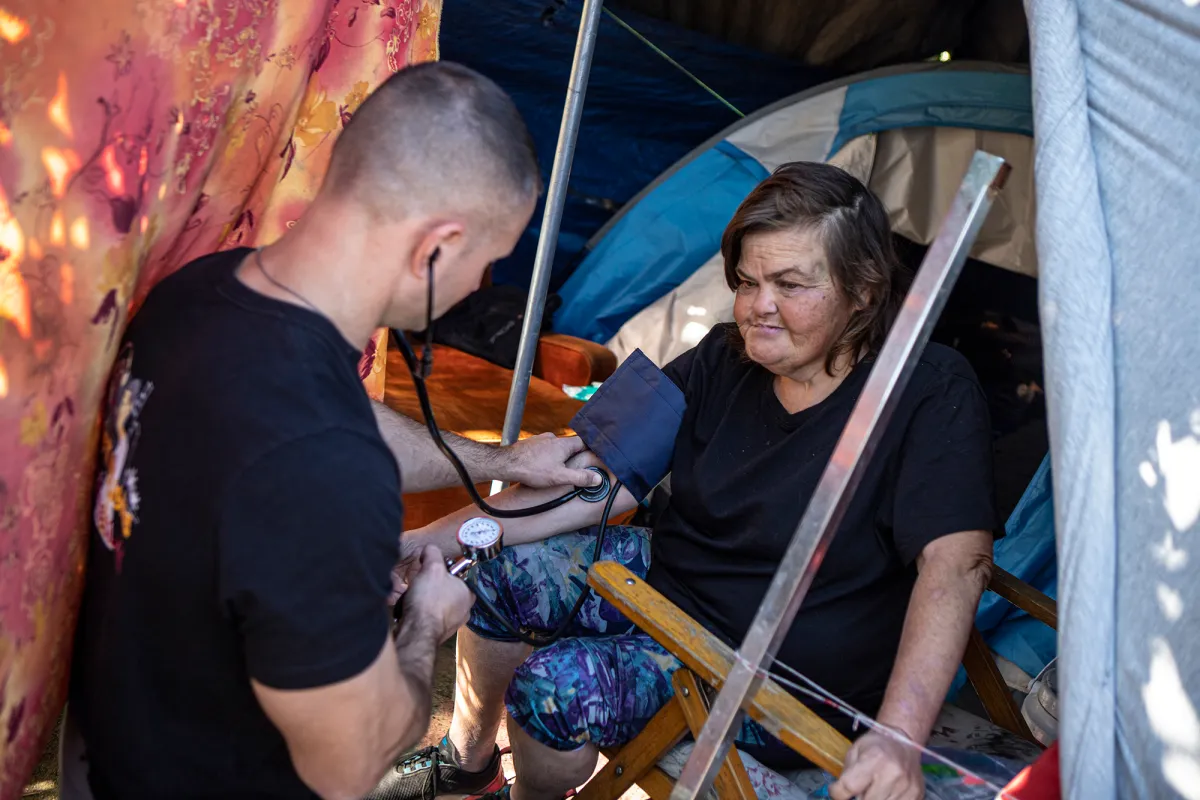
Physician assistant Brett Feldman checks Carla Bolen’s blood pressure at her encampment on the Figueroa Street Viaduct above Highway 110 in Elysian Valley Park in Los Angeles on Nov. 18, 2022. Photo by Larry Valenzuela, CalMatters/CatchLight Local
###
This story was originally published by CalMatters. Sign up for their newsletters.
###
Senate Bill 634 would have made a big splash if it survived in the form Pasadena Democrat Sasha Renée Pérez originally intended. She wanted to make it illegal for cities to cite or arrest homeless Californians for sleeping outside. But, faced with intense backlash from cities and law enforcement agencies, the legislator watered down her bill.
Now signed into law and taking effect Jan. 1, it takes aim at an issue that is much less prevalent on the streets of California. It says cities cannot punish outreach workers for helping homeless clients, even if those clients are sleeping in an illegal encampment.
More precisely, the law says cities cannot bar people or organizations from providing homeless residents with legal services, medical care or things needed for survival, such as food, water, blankets, pillows and materials to protect themselves from the elements.
“The legislation provides commonsense protections for service providers, especially non-profits and faith-based ones, who are doing the work every day to assist unhoused Californians,” Pérez said in an October statement.
San Bernardino County, on the other hand, said the law will “override local authority and restrict enforcement tools that cities and counties use to promote public safety.”
It’s not unheard of for aid workers to find themselves caught in the crosshairs of a city’s crackdown on homeless encampments. The Bay Area city of Fremont earlier this year briefly made “aiding, abetting or concealing” an illegal homeless encampment a misdemeanor. Its city council later walked back that language — after CalMatters first reported it — but it made a lasting impression on state legislators.
The legislation follows a statewide push toward the increased policing of homeless Californians. In 2024, the U.S. Supreme Court gave cities more power to cite and arrest people for sleeping outside, even if they have no shelter available. Since then, arrests and citations for homelessness-related offenses have soared in cities across the state.
BOOKED
Today: 10 felonies, 12 misdemeanors, 0 infractions
JUDGED
Humboldt County Superior Court Calendar: Today
CHP REPORTS
1656 Union St (HM office): Missing Indigenous
ELSEWHERE
County of Humboldt Meetings: Behavioral Health Board - SUD/Dual Recovery Committee - Sept. 10, 2026
County of Humboldt Meetings: Behavioral Health Board Executive Committee Meeting - July 1, 2026
RHBB: Judge Overturns Search Warrant in Student Activist Case: Devices Ordered Returned
RHBB: Multi-Vehicle Crash Closes South Fortuna Boulevard Near Strongs Creek Plaza
OBITUARY: Dr. Richard (Dick) Stepp, 1945-2025
LoCO Staff / Monday, Dec. 29, 2025 @ 7:58 a.m. / Obits

Photo: North Coast Journal.
Dr.
Richard (Dick) Stepp
May
11, 1945 - September 26, 2025
It is with heavy hearts that we share the loss of our beloved friend, Dr. Richard (Dick) Stepp, Professor Emeritus of Physics and Astronomy at Cal Poly Humboldt. Dick collapsed on the Cal Poly campus on September 26, 2025 as he was walking to attend his Feldenkrais body movement class. He was 80 years old.
Richard Daniel Stepp was born in Cleveland, Ohio, on May 11, 1945 to Eleanor Franklin and Robert Stepp. He was the second of three sons. His father became a lawyer, and his mother took charge of raising the three boys. The family lived in the Shaker Heights suburb and spent their summers in a cabin at Lake Erie. At the young age of 8, Dick lost one of his kidneys, and during his youth spent many months in hospitals. Confronted with the prognosis of a shortened lifetime expectancy, Dick committed himself to his health and to living in the moment. He believed that the loss of his kidney stunted his growth, but led him to living life with zest. Dick had a lifelong love and desire to help others, either as a teacher, mentor, training partner, or noted woodsman. He has had several near-death experiences, but had always been too stubborn to give into the shadow of death. Dick led an unbelievable life of achievement and adventure.
Some of his athletic achievements include being a fierce competitor in wrestling, cross country, and track and field. Dick excelled in these athletic endeavors and maintained a passion for them right up to the end. Even in his 70s, he still set an example for Humboldt college students in the weight room. One student even created a documentary of legendary Dr. Stepp titled, “Heart of a Vaulter.”
Dick was a Masters athlete, who, at age 77, competed in his last track and field competition throwing javelin. He also did pole vault, and threw hammer, shot put, and discus. In high school, Dick cleared near 14 feet, pole vaulting, using stiff steel poles, no less. His post collegiate vaulting on fiberglass poles was barely a foot from his high school mark which was a phenomenal achievement as a masters athlete, particularly in light of his petite stature. On occasion he would also coach pole vault at local high schools. One prime highlight for Dick was accompanying his lifelong friend, five-time US Olympic qualifier and three time olympian javelin thrower, Karin Smith, to various national meets and the Olympic trials.
Dick was equally proud to have competed in high school wrestling, achieving high honors in his weight class. He also competed on his Ohio college wrestling team at Baldwin Wallace College, earning all-conference honors, while earning his Bachelor of Science degree in Physics. After achieving his BS, Dick set off to Penn State University where he skipped his Master of Science degree to earn his PhD in Meteorology and Atmospheric Processes, or “Climatology,” as he liked to call it. Dick often told the story of how his youthful arrogance led him to forgo the troubles and distractions of working in a team, for his thesis. Instead, he moved to Munich, Germany for a few months to do his research independently. Caught up in stress from completing his thesis work alone, Dick sought to clear his head with a little jaunt in the German Alps where he almost plummeted to his death. When back at Penn State, he fell in love with, and married Sandra Healy, whom he met when they were in the Rock Climbing and Mountaineering Club. In 1973, Dick and Sandra moved to Humboldt County where Dick accepted a faculty position at Humboldt State University. Years after his divorce with Sandra, Richard married Mary Jo Koen and helped raise her son and mentored her daughters. Dick did not father any children of his own, but has been an adopted father, brother, uncle and grandfather to many in the Humboldt community.
In 1983, Dick published his book, “Making Theories to Explain the Weather.” His lifelong fascination with climate and weather patterns led to his fierce skepticism of the models used to predict climate change, which would sometimes lead to colorful conversations with some modern theories held by others. He felt the models were manipulated to produce desired outcomes, a practice he considered unscientific. He would study radar patterns and barometric readings and always predicted, with uncanny accuracy, the weather, several days in advance. Dick’s predictions often proved to be of greater accuracy than the forecasts by news weathermen.
Dick remained a faculty member at HSU, teaching there for 40 years before his retirement in 2012. For 15 of those years, he was chair of the Physics Department. Dr. Stepp’s scholarly interests were diverse, but the thing that remained constant was his passion for teaching. He taught in unusual, nontraditional, yet relatable ways. He was known for making his topics memorable and understandable:
As a professor, Dick used creative teaching methods and props, and often surprised his audience with his sudden leaps onto his desk to make a point, or by tossing a large ball (which he had pretended to barely be able to carry into the room) to one of the students. He felt that he was part teacher and part actor/entertainer! His methods were unusual but brought both his sleepy students and his lectures to life! Dick was known in the county for his baskets and canvas bags full of endless props. He would invite classes to the lawn, spread a cloth, and pile objects such as salt and pepper shakers, mustard and ketchup bottles, centerpieces, cups and saucers. He would then proceed to identify each object as a weather-related term, like a “cold front, “ or “high pressure system” hopping around (literally) demonstrating how these weather systems interacted with one another.
Dick was committed to using the scientific approach of gathering data, analyzing it and using deduction and reasoning before drawing conclusions. Without any prejudice he kept an open mind to all probabilities and wonders. One of his most well known philanthropic ventures was in the realm of what he fondly called “crackpot science” in the form of finding the truth behind Bigfoot. Dick enjoyed some of his most curious and exciting days while on Bigfoot expeditions in Colorado and in Washington with his two dear friends, biologists and primate researchers John Mionczynski and the late Dr. Jeffrey Meldrum. He subsequently became involved in helping fund John Mionczynski’s Bighorn Sheep studies and twice spent weeks with John at his research site on Middle Mountain in Wyoming. Dick took special interest in Dr. Jeff Mildrum’s evolution and primatology research and teachings at Idaho State University, and funded a trip to study the Caucus Mountain Wildman in Russia, and helped facilitate the studies of Homo Floresiensis in Indonesia. Dick was so inspired by John’s and Jeff’s dedication to preserving the stories, histories, and cultural traditions of indigenous people and early settlers in the American West, that he joined their efforts as a foundational supporter of the Native Memory Project. Within this project, Dick was highly devoted to the archiving and recording of the stories of the Crow Nation and its people, told by Grant Bulltail, a descendant of many Crow Chiefs. Dick was introduced to Reba Jo Teran, a member of the Eastern Shoshone Tribe who has dedicated her life to protecting and perpetuating the native tongue of the Shoshone language for future generations. With barely 100 Shoshone elders fluent in their native language at that time Dick recognized the urgency and the opportunity. He took great pleasure in being a booster to Reba’s efforts of compiling words in both written and audio form for the creation of a Shoshone dictionary.
Although Dick’s expertise was officially in physics, his real passion was politics. He looked forward to verbal jousts with anyone who would take him up on a debate regarding just about any worldly political opinion or fact. Whether it was science, global current events, sport coaching, or the proper way to approach splitting firewood, Dick always sought to gain a greater understanding, contributing philosophical ideas to every conversation, and sharing his profound insights. Dick was in fact, a social animal, who quite enjoyed interactions with people of all ages. He gleaned energy from young people, sharing his expertise, and in turn, became infused by the excitement of young learners being exhilarated by their successes through his help.
Dick Stepp was a very generous man with a big heart. He encouraged and sponsored many individuals, organizations, clubs, and sports teams through his philanthropic endeavors. He frequently volunteered his time and physical labor to help out a worthy cause. For many years on each Saturday Dick volunteered at 4-H T.R.A.I.L., a therapeutic equestrian program for individuals with special needs that was founded and run by Dick’s friend and former colleague Dr. Doug Jager, Emeritus Professor of Forestry at HSU. Dick appreciated that in this program each participant regardless of their age, interests or abilities had responsibilities and was an important member of the team. Although Dick mainly contributed by fixing fences, maintaining equipment and armed with his chainsaw clearing fallen trees off the riding trails, he did develop a strong interest in learning about horse behavior and understanding human and horse interaction. There are so many citizens of the North Coast who worked beside Dick or had him as a teacher and mentor during his 40 years at HSU. Every time he would walk through town, shop at the local health food stores, or just fill up his truck at the gas station, a familiar “Hi Dick!” or “Hey Dr. Stepp!” could be heard.
Throughout his adventurous life, Dick developed an abundance of close relationships. Those who were blessed to know him might use several words to describe him, including: mentor, coach, sponsor, trainer, influencer, competitor, confidant, survivor, counselor, political analyst, philosopher, meteorologist , climatologist, philanthropist, wrestler, pole vaulter, super hero, benefactor, investor, wood splitter, wood stove enthusiast, Bigfoot expert, economist, historian, and maybe a favorite of his would be the “crackpot science buster.”
Dick was well known for finding creative solutions to any problem. He emphasized the importance of people serving a purpose in life no matter how young or old, or how poor or wealthy one is. He believed in the power of keeping a sunny attitude. At all times Dick had such a strong positive outlook on life that he believed to be charmed with a fortune of good luck. Dick’s life reflected genuine kindness, acceptance, goodwill, honesty, integrity, hopefulness, charity, true friendship, determination and most of all, love. He reflected love in the truest sense: patient, kind, not jealous, not boastful, not proud, rude or selfish, not easily angered and not keeping any record of wrongs. He didn’t gloat at others’ wrongdoings and delighted in the truth (especially when it involved proving crackpot science is maybe not so far-fetched). He was always hopeful, trusting, and endured whatever came his way. He was a man who endeavored to make the world a better place whenever he could. If you’ve ever seen the movie “Big Fish,” Dick was the same larger than life character portrayed in that movie. He is greatly missed.
A celebration of Richard’s life will be held at a later date.
If you would like to continue the legacy of Dr. Stepp please consider supporting any of the following organizations close to his heart:
- Native Memory Project: https://nativememoryproject.
- 4-H T.R.A.I.L. in Trinidad CA (Therapeutic Riding for Access to Independence and Leaning): Please mail to: 4-H Trail, 349 Stagecoach Rd. Trinidad, CA 95570
- CASA of Humboldt: https://wl.donorperfect.net/
At Cal Poly Humboldt Foundation:
- Feldenkrais Teaching Fund https://giving.humboldt.edu/
- Women’s Track and Field Team https://giving.humboldt.edu/
- Men’s Track and Field Team https://giving.humboldt.edu/
- Men’s Wrestling Program https://giving.humboldt.edu/
###
The obituary above was submitted by Dick Stepp’s family. The Lost Coast Outpost runs obituaries of Humboldt County residents at no charge. See guidelines here. Email news@lostcoastoutpost.com.
OBITUARY: James (Jim) Kennedy, 1951-2025
LoCO Staff / Monday, Dec. 29, 2025 @ 7:52 a.m. / Obits

James (Jim) Kennedy passed away Saturday December 20, at the age of 74.
Jim was born on September 19, 1951 in Vancouver, Washington to Daniel and Elnora Kennedy. When Jim was two the family moved to Humboldt County and Jim resided here for the remainder of his life.
Jim worked in local lumber mills for over 30 years. In his spare time he enjoyed watching sports , especially baseball and football. When he was younger he loved bowling.
Jim was proceeded in death by his parents Daniel and Elnora Kennedy, brother Dan Jr. and sisters Linda and Patty.
Jim always had a special bond with his nieces and nephews. Jim wasDan never too busy to play with them and they have fond memories of riding on his tall shoulders as children.
Jim is survived by his brother Larry (Sherry) Kennedy of Fortuna and sisters Nancy (Doug) Griffith of Lubbock ,Texas and Barbara Schroeder of Normal, Illinois. Also surviving are his nieces and nephews Chad Griffith of Santa Rosa; Stacy Aldridge of Wewoka, Oklahoma; Miranda Blair of Lubbock, Texas; Glenn Kennedy of Phoenix, Arizona; Brian Kennedy of Grand Junction, Colorado; and Shaina Kennedy of Phoenix, Arizona.
Jim’s family would like to thank the First Choice Care Home in Fortuna for their kind and compassionate care during the final two years of Jim’s life.
In the final weeks of Jim’s life Hospice of Humboldt was so helpful in guiding Jim through this difficult time. In lieu of flowers memorial donations may be made to Hospice of Humboldt.
As Jim requested there will be no public services. Jim’s final resting place will be with his parents and older brother Dan at Sunrise Cemetery in Fortuna. Final arrangements were handled by Goble’s Mortuary in Fortuna.
###
The obituary above was submitted by Jim Kennedy’s family. The Lost Coast Outpost runs obituaries of Humboldt County residents at no charge. See guidelines here. Email news@lostcoastoutpost.com.
OBITUARY: Ina Jean Watson, 1931-2025
LoCO Staff / Monday, Dec. 29, 2025 @ 7:39 a.m. / Obits

Ina Jean Watson, 94, of Eureka, passed away on December 15.
Ina was as beautiful on the inside as she was on the outside. She will be remembered for her unwavering love of family, her kindness, generosity, deep faith, and baking the best pies ever. Ina had a spicy side, even though she was mostly sweet.
Ina got the flower growing and baking gene from her mother, Ota. She grew the most beautiful flowers and especially loved roses. Ina and her husband, Leroy, loved to dance. For many years, they went to the Moose Lodge every weekend and danced their hearts out. She was always up for new experiences, which included dancing the hula on a trip to Hawaii. Ina loved the ocean and the sense of peace it gave her. Her favorite color was green, which went well with her beautiful brown eyes.
Ina was born on January 30, 1931, in Pound, Virginia, the oldest child of the late Buck and Ota Church. In 1937, the family, including her sister, Virginia, and brother, Royce, moved from the mountains of Virginia to Raymond, Washington looking for a better life. She married George Mullins in 1949 with whom she had her five children.
Ina worked at Green’s Pharmacy in Garberville and then for over 20 years for Henderson Center Pharmacy in Eureka, specializing in the make-up counter, serving her customers with knowledge and grace. For the past 2 ½ years, Ina has been a resident at Eureka Rehabilitation and Wellness Center where she was loved by all. She would light up when Leroy came for his daily visits and immediately ask for a kiss.
Ina will be greatly missed by her family. Ina is survived by her loving husband of almost 30 years, Leroy Modine, daughter, Sheila Maraigh (Don), sons, Mark, Greg (Betsy), and Doug (Lorrie) Mullins, seven grandchildren, eight great-grandchildren and her brother, Royce Church. She was preceded in death by parents, Carlis (Buck) and Ota Church, her son, Philip Mullins, grandson, Luke Mullins, sister, Virginia Mossman, and her second husband, Charles Watson.
A graveside service will be held at Sunset Memorial Park in Eureka on Tuesday, December 30 at 10 a.m.
###
The obituary above was submitted on behalf of Ina Watson’s loved ones. The Lost Coast Outpost runs obituaries of Humboldt County residents at no charge. See guidelines here.
HUMBOLDT HISTORY: The Wild River — Life and Loss on the Banks of the Capricious, Destructive Eel
Alice Y. Mulley / Saturday, Dec. 27, 2025 @ 7:30 a.m. / History

Eel River flooding near Loleta in 1937. Photos via the Humboldt Historian.
###
On a summer day, sitting beside the slowly moving waters of the Eel River as it meanders its way from its headwaters in the California counties of Mendocino and Humboldt to the Pacific Ocean, it is difficult to visualize the terror and destruction it can generate when winter closes in. Then, in some years, there are gale winds, torrential rains, and snows at higher elevations.
The river is aptly named, not only for the presence of eels, but because it flows in sinuous, erratic twists and tums, especially after it leaves its narrow confines and spreads out into the lower valley.
Not only in the memory of those now living, but probably for ages past, flood after flood has inundated the lower valley, and the Eel has changed its course time after time, cutting new channels and silting up the old ones.
One of my earliest childhood memories is of the Eel River in flood. We lived on the uplands with a clear view of the valley from the confluence of the Eel and Van Duzen rivers to well below the town of Fortuna. It looked as if the whole valley were under water, and indeed it was. Fields were flooded, houses were surrounded with water, and farm animals smuggled desperately in the swirling current. Great trees, roots and all, parts of houses, and debris of every description hurtled headlong toward the sea. The roar of the rushing water, more than a mile wide, filled the air.
As great as this destruction was, the real damage came as the flood subsided. When the flow of the river dropped to the level where the stratum of topsoil ended and the layer of sand and rock began, the velocity of the water made a neat cutting weapon which undermined the topsoil and sent it tumbling into the stream. Only imprudent people stood near the bank then because great chunks of land disappeared without warning. Tons of topsoil cascaded on downstream and the delta at the mouth of the river built up gradually. Through the years great islands covered with willow trees have formed, until there is no clearly defined channel.
To a child such a spectacle meant little, and it was not until, by a strange quirk of fate, I found myself living on the very banks of the Eel that the full import of its threat was brought home. The plot of ground, a little over twelve acres, was purchased from Romeo and Mary Giacomini about 1920. There were over one hundred acres in the original piece owned by the Giacominis, but year by year the river had claimed all but about twelve, leaving its southward trend toward Waddington and Ferndale and moving northward. By some unknown line of reasoning, it was thought that the trend would be reversed. Some sixty years later, this has not occurred, but perhaps the next sixty or one hundred years will tell a different story.
It was December, and raining, when we moved into the big two-story house. The river was already reaching fiood proportions. It never did overflow its banks that year, but it did reach the cutting stage. By morning a chicken house and other small buildings were gone, the sound of their going lost in the raging torrent.
Not every year produced a loss of land, but in several years’ time the river crept closer and closer. Then one winter again it was raining, the obvious threat was there, and the house was moved to the northeast corner, the farthest boundary possible on Sandy Prairie Road,
By 1952, only three acres remained, with the house perched precariously on the river’s bank. Clearly the battle was lost, and the house was razed. Where it once stood, a levee . was built by the Corps of Engineers, U.S. Army, whose design criterion for protective works encompassed “once-in-a-hundred” years. Judging from the flood of 1964, the levee almost met the design criterion, since history records that a flood of gigantic proportions occurred in 1862, long before loggers appeared on the scene.
A possible witness to this flood of 1862 was an Indian, known as Indian George. No one knew how old he was. His favorite spot in Fortuna was the bench in front of Hansen-Hunter Company’s store on Main Street, now known as Low’s Furniture Store. There he spent much of the day, and many townspeople stopped to have a word with him. During one flood he was asked if this was not the worst yet, but he shook his head and said, “No, When I was a boy whole valley covered by water,” and he waved his hand toward the Ferndale area. “All under water,” he said, and lapsed into his customary silence. He may have meant 1862, but dates, as such, meant little to him. He has been gone many years.
The Killer Eel, published by J. Dwight O’Dell of The Humboldt Beacon following the 1964 flood, is complete with data, photos and commentaries. For those who have not read it and who believe that the Eel can be controlled, it should make interesting reading, as well as for those who believe in wild and scenic rivers.
An estimated flow of nearly half a million cubic feet per second boggles the imagination, not only of the layman, but of engineers engaged in flood control as well, and casts doubt on the hope that protective flood control measures are economically feasible now or perhaps ever, for the lower reaches of Eel River.
At one time, probably around 1912 or earlier, a concrete jetty was built along Sandy Prairie Road between Alton and Fortuna near the John East property and the summer bridge across the river. How it was financed is not known, but it was supposed to divert the Eel from its northward course and prevent bank erosion. Unfortunately, either because of some fault in design or construction, or simply because it was inadequate for the purpose intended, the first major flood flowed around the upper end of the structure, pried it loose and broke it into massive blocks of concrete and steel which were visible for some years.
Studies have been made, read and filed. Meanwhile, mining of sand and gravel along the north bank continues, creating a natural channel, as flood waters rush in to fill the void, thus bringing the river ever closer.
A series of dams in the upper reaches of the river would certainly mitigate minor floods, permitting diversion of the excess, and providing impounded water which could be released during the summer months or years of low flow. rather than allowing it to waste uselessly into the Pacific Ocean. Instead, each political subdivision of the counties which would benefit from such control will fight to the death to keep any water from being diverted to “those vandals” in central and southern California. The story is as old as Aesop — 550 B.C.
To name only two, the battle for the waters of the Colorado and the Rio Grande has been going on for years. Compacts have been made and broken; lawyers and engineers have spent a lifetime in court in never-ending attempts to allocate the water equitably.
Only time — and who can foretell how long — will produce the answer, but it is relatively safe to assume that Eel River will continue to wind its way from its headwaters to the ocean undeterred, as it has for generations past.
For my part, I recall vividly those anxious days and nights when we huddled together in our home on the banks of the Eel, hoping and praying that we would survive one more attack of the Wild River. Let those who will, enjoy their wild and scenic rivers but, without meaning to be sacrilegious or facetious, the words of the old hymn come to mind: “Lord, plant my feet on higher ground.”
###
About the Author: Alice Mulley died March 17, 1999, in Eureka at the age of 94. She was a native of Fortuna, and a graduate of Fortuna schools and the Woodbury Business College in Los Angeles. She was associated for many years with a consulting civil engineering firm in Los Angeles and after her retirement, returned to Fortuna in 1970. This article is reprinted from The Way It Was, Volume II.
###
The piece above was printed in the Fall 1999 issue of the Humboldt Historian, a journal of the Humboldt County Historical Society. It is reprinted here with permission. The Humboldt County Historical Society is a nonprofit organization devoted to archiving, preserving and sharing Humboldt County’s rich history. You can become a member and receive a year’s worth of new issues of The Humboldt Historian at this link.
A New California Law Requires Tortillas to Include an Extra Ingredient. Here’s Why
Ana B. Ibarra / Friday, Dec. 26, 2025 @ 11:35 a.m. / Sacramento

Stacks of tortilla packages at a supermarket in Fresno on April 9, 2024. Photo by Larry Valenzuela, CalMatters/CatchLight Local
###
This story was originally published by CalMatters. Sign up for their newsletters.
###
Tortillas sold in California are going to have a new ingredient, one that’s intended to help nurture healthy infants.
Starting Jan. 1, a new law will take effect requiring most tortillas and corn masa products sold in the state to contain folic acid, a vitamin that’s important to infant health.
Latinas in California are far less likely than other women to get enough folic acid early in pregnancy — a gap that can lead to life-altering birth defects.
State data show that, between 2017 and 2019 – the latest years for which state data is available – about 28% of Latinas reported taking folic acid the month before becoming pregnant. White women took the vitamin at a higher rate, with 46% of them reporting consuming folic acid, according to the California Department of Public Health.
This puts Latinas at higher risk of having a baby born with neural tube defects — defects of the brain and spinal cord. Some examples of that are conditions like spina bifida and anencephaly.
Research has shown that folic acid can reduce birth defects by up to 70%. That’s why it’s found in prenatal vitamins. But because women may not find out they are pregnant until weeks or months after, public health has long recommended that folic acid also be added to staple foods.
In 1998, the U.S. required manufacturers to fortify certain grain products with folic acid, such as pasta, rice, and cereals, to help women of reproductive age get the necessary amounts. Since that rule took effect, the rate of babies born with neural tube defects dropped by about a third, according to the Centers for Disease Control and Prevention.
But even with the addition to these foods, birth defect rates among babies born to Latinas have been consistently higher. In search of a more culturally appropriate addition, in 2016, the federal government allowed makers of corn masa to add folic acid to their foods – but didn’t require it.
Joaquin Arambula, a Democrat from Fresno, who authored the law said leaving folic acid out of corn masa products, used in many Latino staple foods, was a “real oversight.”
Now, with the implementation of Assembly Bill 1830, California is the first state to require folic acid in corn masa products. The law requires manufacturers that do business in the state to add 0.7 milligrams of folic acid to every pound of flour and to list the addition in their nutrition labels. The law makes exemptions for small batch producers like restaurants and markets that might make their own tortillas from scratch.
Months after California’s law was signed, Alabama passed its own version. Its law goes into effect in June 2026.
Some large manufacturers have already been adding folic acid to their products for years. Gruma, the parent company of Mission Foods, said it started fortifying its foods back in 2016, when the federal government first allowed it. A company spokesperson said Gruma “has a longstanding commitment to supporting legislative fortification initiatives” and supports the new laws in California and Alabama.
###
Supported by the California Health Care Foundation (CHCF), which works to ensure that people have access to the care they need, when they need it, at a price they can afford. Visit www.chcf.org to learn more.
New California Laws Rewrite Car-Buying Rules With Return Policy and Pricing Reforms
Ryan Sabalow / Friday, Dec. 26, 2025 @ 11:33 a.m. / Sacramento

A line up of electric vehicles at a Hyundai dealership in Fresno on Sept. 7, 2023. Photo by Larry Valenzuela, CalMatters/CatchLight Local
###
This story was originally published by CalMatters. Sign up for their newsletters.
###
California lawmakers made major changes to the state’s car-buying rules this year, including a controversial rewrite of the state law that allows buyers to get their money back if they are sold a defective vehicle and a right to return a used vehicle within three days.
After an intense lobbying push this year from automobile companies, dealers and consumer groups, more legislative battles over California vehicle purchases could follow in 2026. Sky-high car prices show no signs of falling, and a Republican-led Congress and the Trump administration have sought to thwart Newsom’s goal of having 100% of new cars sold in California be zero-emission by 2035.
Sen. Ben Allen, a Democrat representing the El Segundo area, said he expects California’s Democratic-controlled Legislature will likely push back against national Republicans’ attack on California’s vehicle policies in some form next year, though he said it wasn’t yet clear how.
“We’re very committed to this path, so stay tuned, but clean air is a priority for our state,” said Allen, who chairs the Senate’s Select Committee on Transitioning to a Zero-Emission Energy Future.
In the meantime, Gov. Gavin Newsom signed Allen’s Senate Bill 766, creating a first-in-the-nation policy that allows a buyer to return a used vehicle for a full refund within three days if the purchase price was less than $50,000. Dealers can charge a restocking fee.
The law, which takes effect in October, also contains other protections for buyers intended to prevent them from getting suckered.
Car dealers will have to tell a potential buyer — including in advertisements and initial written communications — the actual price of a vehicle instead of an unrealistic advertised price. Potential buyers will also have to be informed of the full financing costs and lease terms.
The law also prohibits dealers from charging for add-ons that have no benefit to the buyer, such as free oil changes for electric vehicles — which don’t need oil changes.“That is a huge deal,” said Rosemary Shahan of Consumers for Auto Reliability and Safety, which championed the bill. “It’s historic. It’s going to make cars more affordable.”
Allen said he came up with the idea for the bill after shopping for a used car in 2024. He said he wanted to see what it was like trying to buy a used car in California and didn’t tell the various dealerships he visited that he was a state senator.“I was kind of shocked by the hustle and the extent to which prices were quoted online and that ended up not really being truthful,” he said.He ended up buying a 2021 Ford Mustang Mach-E, an electric vehicle.
Newsom blocked document fee increase
Most bills take effect immediately the year after they are signed, but lawmakers delayed the implementation of Allen’s bill until October to give dealers time to change their paperwork, amend their contracts and change their signs to meet the new law’s requirements.
Brian Maas, president of the California New Car Dealers Association, said the law should make buying a used car more transparent and easier for consumers.
“The bill certainly is a net positive in terms of more transparency about the total price and advertising,” he said.
But he said the new law “clearly imposed more responsibility on dealers,” which is why Maas said his group was extremely frustrated Newsom vetoed its bill that would have allowed dealers to raise document-processing fees by $175.
Senate Bill 791 would have raised the fees dealers can charge to process Department of Motor Vehicles and other paperwork from the current cap of $85 to up to 1% of the purchase price, capped at $260.
Maas said dealers were frustrated by Newsom’s veto message which said the fee increase wasn’t necessary because the state had imposed “no new state requirements” on car dealers.
Maas said it was “especially frustrating that the veto message somewhat cavalierly said there are no new state requirements when the governor signed just such requirements a week earlier.”
Before the veto, SB 791 passed the Legislature overwhelmingly and with bipartisan support. The California New Car Dealers Association has donated at least $3 million to legislators since 2015, according to the Digital Democracy database.
Maas said there are so many forms car buyers must fill out, almost all of them stemming from a law the Legislature passed, they’re getting to be like click-through agreements on websites that everyone just agrees to without actually reading.
“You shove form after form after form in front of consumers,” he said. “Consumers just tune it out, turn it off, and say, ‘You know what? I just want to know what my monthly payment is, what’s the interest rate, what the total price of the car is. And then let’s go. Why do I have to sit in here for a half hour or an hour and fill out all these forms?’ ”
Consumers face a watered-down lemon law
Newsom also signed Senate Bill 26, a bill that allows car manufacturers to opt out of changes to the state’s lemon law that gives consumers a right to get their money back if they buy a defective vehicle — sometimes referred to as a “lemon.”
The result is that California car buyers have different legal protections under the state’s lemon law depending on which brand they buy.
The bill Newsom signed was in response to a law lawmakers hastily passed at the end of the 2024 legislative session, watering down the state’s 55-year-old landmark lemon law. Some auto companies, namely GM and Ford, were being sued so often for allegedly selling so many lemons that state courts were clogged with lawsuits.
The companies and some attorney groups persuaded lawmakers and Newsom to pass legislation in 2024 that shrank the length of time a car buyer could sue under the lemon law to just six years instead of the entire life of a vehicle’s warranty
Last year’s legislation also puts more onus on car owners to initiate claims, not auto companies.
But other companies that don’t get sued as often for selling defective vehicles, such as Toyota and Honda, opposed the rule change. Those companies said the new law didn’t give them time to prepare their best defense
Newsom ended up reluctantly signing the 2024 bill, but he urged the Legislature to come back with a new bill in 2025 that would allow companies to opt out of the changes. SB 26 passed overwhelmingly and Newsom signed it.
Meanwhile, several car companies, including Ford and GM and dozens of RV and motorcycle manufacturers, opted in to the 2024 law this year.
Toyota and Honda, as expected, did not.


