

Blue Lake City Council Finalizes Separation Agreement With Former City Manager Mandy Mager, Appoints Finance Manager Dani Burkhart as Acting Replacement
Ryan Burns / Wednesday, May 14, 2025 @ 1:52 p.m. / Local Government

Blue Lake City Councilmembers (from left): Kat Napier, Michelle Lewis-Lusso, Mayor John Sawatzky and Mayor Pro-Tem Elise Scafani. In the foreground, lower right: newly appointed Acting City Manager Dani Burkhart. | Screenshot.
###

One week after “mutually” agreeing to part ways with embattled City Manager Amanda “Mandy” Mager during a closed session hearing — in an apparent violation of California’s open meetings law — the Blue Lake City Council last night made it official, unanimously agreeing in closed session to finalize a separation agreement with Mager. (Councilmember Christopher Firor was absent.)
In announcing the action, City Attorney Ryan Plotz, of Eureka’s Mitchell Law Firm, said the document would be made public at the end of the meeting. Both the Outpost and the North Coast Journal previously requested a copy of that agreement, along with Mager’s letter of resignation. However, Plotz did not provide a copy of the separation agreement until shortly after noon today. [Click here to download a pdf of the document.]
In response to our request for Mager’s letter of resignation, Plotz said via email that no such document exists. She was employed by the city for more than nine years.
Per the terms of the separation agreement, Mager’s final day of employment with the City was May 9. As severance, she will receive $30,000, which represents four months’ worth of her regular salary, and her health care benefits will continue for four months.
As part of the agreement, Mager agreed to “comprehensively” release any and all legal claims against the city arising from her employment, and there is no admission of liability from either party.
Last night, Plotz read aloud the previously released public statement about Mager’s departure.
Later in the meeting, Mayor John Sawatzky announced that Blue Lake Finance Manager Dani Burkhart had agreed to accept the role of acting city manager while the city works to recruit an interim or permanent replacement. Burkhart, who was just hired by the City in February, previously worked as an accounting specialist with the City of Eureka. A former cannabis industry activist and one-time vice treasurer of the Humboldt County Democratic Central Committee, Burkhart ran for Humboldt County supervisor in 2018.
Attempts to reach Mager for this and previous stories have been unsuccessful.
Despite the City’s characterization of Mager’s departure as the result of a mutual decision, some Blue Lake residents are convinced that a council majority forced her out. They’ve launched a recall effort against Sawatzky, Mayor Pro Tem Elise Scafani and Councilmember Kat Napier.
###
NOTE: This post was updated on May 15 to include a couple more facts about Burkhart.
###
PREVIOUSLY
BOOKED
Today: 6 felonies, 9 misdemeanors, 0 infractions
JUDGED
Humboldt County Superior Court Calendar: Friday, Feb. 13
CHP REPORTS
Us101 N / Tompkins Hill Rd Ofr (HM office): Traffic Hazard
ELSEWHERE
RHBB: RV Fire Near Founders Grove
Politico Magazine: The Friday Read ‘The Industry Comes In and Kills the Work of Local Citizens’
The Guardian: Anatomy of an upset: how Ilia Malinin lost Olympic figure skating gold
The Hill: Democrats say Trump’s climate rollbacks ‘corruption in action’
New York Times Publishes Heartbreaking Story on the Search for Emmilee Risling
Hank Sims / Wednesday, May 14, 2025 @ 10:59 a.m. / Missing

Emmillee Risling. File photos.
Three and a half years ago, Emmilee Risling, a 32-year-old Hupa woman went missing while suffering through a mental health crisis. She was last seen in the Pecwan area.
Today, the New York Times takes a long look at the case. Reporter Corinna Knoll writes about Risling’s precocious childhood, the events that led up to her disappearance, the frustrating and sometimes inexplicable bureaucratic responses that followed attempts to locate her, and the pain felt by her loved ones as her story remains unresolved.
Here’s a link that should give you unpaywalled access to the story. It’s beautifully written and well worth your time.
Trump Tariffs and Rising Health Care Costs Knock California Budget Back Into Deficit
Alexei Koseff / Wednesday, May 14, 2025 @ 7:29 a.m. / Sacramento

Gov. Gavin Newsom addresses the media during a press conference unveiling his revised 2024-25 budget proposal at the Capitol Annex Swing Space in Sacramento on May 10, 2024. Photo by Fred Greaves for CalMatters
###
This story was originally published by CalMatters. Sign up for their newsletters.
###
Facing a long horizon of budget deficits, California officials stretched and scrimped and massaged the numbers to stabilize the state’s finances last year. But an unforeseen economic downturn, spurred by President Donald Trump’s chaotic tariffs strategy, has knocked California out of fiscal balance once again.
Gov. Gavin Newsom is now forecasting a $16 billion, or 4%, decline in tax revenues in his revised budget proposal, according to a memo provided by his office in advance of the announcement Wednesday. That plan is the opening salvo in negotiations with the Legislature, ahead of the start of the fiscal year in July.
It’s a sharp turnaround from January, when Newsom projected a modest surplus in his $322 billion spending plan. The memo, which dubs the revenue shortfall the “Trump Slump,” does not provide an updated figure for California’s budget deficit.
“We are seeing the slow-rolling impact of ‘Liberation Day’ and it’s not a good one,” spokesperson H.D. Palmer said. “Conditions have definitely changed for the worse since January, in significant part because of those federal tariffs.”
California’s financial picture was troubled even before the recent turmoil. Newsom and the Legislature took extraordinary steps last summer to close a budget gap projected in the tens of billions of dollars over two years, including by making sweeping cuts to state agencies and positions, clawing back funding increases for health care providers, eliminating affordable housing programs, delaying money for schools, suspending business tax credits and dipping into reserves.
And while tax revenues came in $6.8 billion above forecast through April, other problems were brewing.
A one-man ‘wrecking ball’ to California economy
Medi-Cal, the state’s health insurance program for low-income people, has reported a more than $6 billion cost overrun this year — in part because an expansion to include immigrants without legal status brought in more new enrollees than expected — and it needed an emergency cash infusion in March.
The devastating fires that hit Los Angeles in January also introduced new uncertainty for the budget, because the tax deadline for Los Angeles County — where a quarter of all Californians live — was delayed until October.
But the biggest risk is undoubtedly from Trump’s tariffs, which Newsom sued last month to block. Stock market declines are poised to take a bite out of future income tax revenue, because California relies disproportionately on capital gains earned by the wealthiest taxpayers; that accounts for $10 billion of the projected revenue decline. Higher costs from the tariffs are also imperiling major sectors such as manufacturing, agriculture, tourism and shipping in California, whose largest trading partner is China.
“It’s one person that is taking a wrecking ball to our economy,” state Senate President Pro Tem Mike McGuire, a Healdsburg Democrat, said last week during an event in Sacramento. “That is the existential threat to the state of California right now.”
The grim outlook will almost certainly force more reductions to state programs, and legislative leaders will have their own ideas about what to target after Newsom puts forward his priorities today.
Bargaining will ramp up over the next month, with a June 15 deadline for the Legislature to pass a balanced budget or forgo its pay, though sometimes provisions of an overall deal drag out beyond that.

A binder showing Gov. Gavin Newsom’s revised budget proposal for 2023-24 during a press briefing at the state Natural Resources Agency in Sacramento on May 12, 2023. Photo by Rahul Lal, CalMatters
“Anyone who thinks we’re not going to make cuts this year is not in touch with reality,” Assemblymember Jesse Gabriel, an Encino Democrat who leads the Assembly budget committee, told CalMatters. “Advocates who are proposing major expansions of programs should stop wasting people’s time.”
One likely exception is a proposed $420 million annual increase of California’s film and television tax credit, more than doubling the pot of available subsidies and boosting the amount that individual productions can receive. It’s a priority for Newsom, with the strong backing of many Los Angeles-area legislators, especially as the region seeks a comeback after the fires.
Trump’s effort to slash federal spending is another looming question mark. Congressional Republicans have floated shifting more of the cost of social safety net programs to the states, though they are struggling to reach a budget agreement.
If they ultimately push through major changes to federal funding, lawmakers could be back in Sacramento later this year or early next year revising the state budget once again.
“Ninety percent of the ball game is in Washington,” Gabriel said. “It’s frustrating to me that this is beyond our control.”
Newsom Proposes to Freeze Medi-Cal Enrollment for Undocumented Immigrants
Kristen Hwang / Wednesday, May 14, 2025 @ 7:25 a.m. / Sacramento

Benefits counselor Perla Lopez assists an undocumented adult at St. John’s Community Health in Los Angeles on Dec. 19, 2023. Undocumented adults will become eligible for Medi-Cal health care coverage in the new year. Photo by Lauren Justice for CalMatters
###
This story was originally published by CalMatters. Sign up for their newsletters.
###
A year after granting Medi-Cal access to low-income immigrants without legal status, Gov. Gavin Newsom is proposing to freeze enrollment of new recipients and charge premiums in a move expected to save the state more than $5 billion.
Under Newsom’s proposal announced today, Medi-Cal — the state’s health insurance program for low-income people and those with disabilities — beginning in 2026 would no longer accept new enrollees 19 and older who lack permanent legal status.
The 1.6 million immigrants already signed up would not lose their Medi-Cal coverage, and children could still enroll. All undocumented Californians would still be covered for emergency medical and pregnancy care — so-called “limited scope” coverage that is paid for with federal dollars. But those who don’t enroll before January 2026 would be uncovered for other medical expenses, such as prescription drugs and doctor’s visits.
Before the changes could go into effect, the California Legislature would have to approve them in the state budget. Democratic lawmakers have so far largely balked at making major cuts to Medi-Cal coverage for immigrants.
State Sen. Scott Wiener, a San Francisco Democrat and chair of the Senate budget committee, said at a luncheon last month that despite fiscal uncertainty, Senate Democrats want to ensure healthcare coverage for immigrants in California.
“These are folks who are working, paying taxes. They should have access to health care,” Wiener said.
Newsom also proposed that adults with “unsatisfactory immigration status” should pay a $100 monthly premium starting in 2027. Those are people whose immigration status makes them ineligible for federal Medicaid, including those with lawful status. The $100 premium is less than the average subsidized premium paid under Covered California, according to the governor’s office.
Together these moves would save the state $5.4 billion by 2028-29, Newsom’s office said, helping to address the state’s projected $16 billion deficit.
Newsom’s office said the deficit required “tough decisions” but that the governor remained committed to protecting immigrants.
“These changes are designed to preserve that commitment, protect coverage for millions of Californians, and preserve the strength of our values and health care system,” according to the governor’s fact sheet.
The decision is a bruising blow to Newsom, who ran for governor on the promise of universal health care. California was the second state after Oregon to offer full-scope health insurance to all immigrants without legal status.
“These are folks who are working, paying taxes. They should have access to health care.”
— State Sen. Scott Wiener
Newsom’s office blamed wide-ranging tariffs imposed by the Trump administration for weakening the state’s expected revenues, but the Medi-Cal program was already experiencing cost problems related to growing enrollment and increasing costs of prescription drugs.
In March, the administration reported a $6.2 billion shortfall in its Medi-Cal budget, and had to appropriate additional funds to pay providers through the end of June.
The Department of Health Care Services, which oversees Medi-Cal, cited a number of reasons for exceeding its budget, including that it was spending about $2.7 billion more than anticipated on people without legal status.
The state spends about $8.5 billion a year from the general fund to cover immigrants who are in the country without legal authorization, according to the Newsom administration’s estimates.
The request for additional dollars was criticized by Republicans in the Legislature, who say the governor and Democrats over-promised on what the state could afford.
Newsom’s call to limit enrollment comes as Congress is proposing major spending reductions to the federal Medicaid program. (Medi-Cal is California’s name for Medicaid.)
One proposal aims to penalize states that cover unauthorized immigrants. That penalty would come in the form of reduced federal funding for the Affordable Care Act expansion population — largely able-bodied adults without children. If enacted, that penalty could cost California about $3.2 billion a year in federal funding, according to the Center on Budget and Policy Priorities.
###
CalMatters reporter Yue Stella Yu contributed to this story.
Eureka Fans of Alternative Transportation Have a Couple of Dates to Put On Their Calendars
Hank Sims / Tuesday, May 13, 2025 @ 3:08 p.m. / Transportation

Against all odds, Eureka is becoming a nice place to bike. File photo.
This is an exciting time to be alive for Eurekans who like to get around by bike or electric scooter or roller blade, or even just on their own two damn feet! To name just one big thing: The Eureka-Arcata Bay Trail’s grand opening date is very soon!
But that is far from the only thing happening, and there are a couple of events this month that people of this persuasion might want to take note of.
THING #1: Tomorrow at 5:30 p.m., the Coalition for Responsible Transportation Priorities will be conducting a “bike safety audit” of downtown Eureka to document conditions as of right now, in order to prepare for future amenities. They would love to see you there!
THING #2: Work is really starting to kick into gear on the Bay to Zoo Trail, which will eventually extend from the end of Eureka’s Waterfront Trail all the way out to the Zoo. This season of public outreach will kick off with a May 28 event at Zane Middle School. Imagine! Once they complete this and the county completes the McKay Tract trail network, the whole damn city of Eureka will just about be encircled with non-motorized trails. Dang!
Scroll down below for more detail about each of the above things.
###
For tomorrow’s safety audit, Here’s a press release from the Coalition for Responsible Transportation Priorities:
Next Wednesday, May 14, 2025, from 5:30-6:30 pm, the Coalition for Responsible Transportation Priorities (CRTP) is conducting a bike safety audit of Eureka’s 4th and 5th Streets, part of the US-101 state highway corridor. Participants will meet at the corner of 4th and C Streets in Eureka, and no bike is required to participate.
Bike audits are an opportunity to experience and take note of the conditions for bicyclists in a particular neighborhood or location. Unfortunately, due to the dangerous conditions on 4th and 5th Streets, we will not be riding bikes during the audit. But while we already know 4th and 5th Streets are not safe for bicyclists, the bike audit will help document the exact hazards, and suggest solutions to improve safety.
Participants will walk or roll on the sidewalk while observing conditions for bicyclists, and will focus on observations of three intersections:
- 4th & C Streets, focusing on how bicyclists can connect with the future C Street Bike Boulevard
- 4th & H Streets, focusing on how bicyclists can connect to the new buffered bike lane on H Street from Old Town, Downtown, and the future EaRTH Center transit hub
- 5th & I Streets, focusing on how bicyclists using the new buffered bike lane on I Street can connect to Downtown, Old Town, and the EaRTH Center
The event is free, and all members of the public are invited to participate. No bike is required.
More information about CRTP is available at https://transportationpriorities.org.
May is Bike Month! Information about other local Bike Month events can be found at https://bikemonthhumboldt.org/.
###
For more on the Bay to Zoo Trail Outreach meeting, scope this press release from the City of Eureka:
The City of Eureka will soon be advancing into the design and right of way phase for the Bay to Zoo Trail Project. To ensure clarity, consistency, and accessibility of information, the City is hosting a Public Outreach Event.
This event is just one of the ways the City plans to communicate and engage with the public throughout the project.
Public Outreach Event – Bay to Zoo Trail
When: Wednesday, May 28th 5:30 p.m. to 7:30 p.m.
Where: Zane Middle School Library, 2155 S St. Eureka
What: Join City Staff, Councilmember Scott Bauer, and County Supervisor Natalie Arroyo for a presentation on the Bay to Zoo Trail Project. Following the presentation, a panel will answer questions received prior to the event. To submit a question, email BTZtrail@eurekaca.gov by 5/23.
Project staff will also be tabling at the Bike Month Celebration Fair Saturday, May 31st at the Jefferson Community Park, the Humboldt Bay Trail South Grand Opening Party Saturday, June 28th at Adorni Center, select Friday Night Markets, and more.
Visit https://www.eurekaca.gov/255/Trails to view the project website, for information on proposed alignment, facts, history, funding, FAQ and more. Updates will be shared with the public as they become available. If you have questions or would like more information, contact Project Manager, Brittany Powell at bpowell@eurekaca.gov or (707) 441-4127.
‘They’re Learning and They’re Thriving’: Butler Valley Celebrates 45 Years of Helping Local Adults With Disabilities Gain Independence, Foster Community
Isabella Vanderheiden / Tuesday, May 13, 2025 @ 2:09 p.m. / Community , Feel Good

Goats mill about at the Carole Sund Center Farm in Eureka. | Photos shared by Morgan Huber.
###
Butler Valley will celebrate 45 years of empowering local adults with disabilities at its Spring Fling Anniversary Fundraiser at the Carole Sund Center Farm in Eureka on Saturday. If you’re in the market for a Nigerian Dwarf goat or seeking a few extra plant starts for your veggie garden, look no further.
For decades, the fine folks at Butler Valley, a Eureka-based nonprofit, have provided intellectually and developmentally disabled adults with supportive services and life skills training through its residential care program that helps participants transition into independent living. The nonprofit expanded its programming in 2013 to include the Carole Sund Center Farm, a four-acre property at the south end of Eureka donated by the Carrington family, where participants learn gardening skills and earn money selling fresh vegetables and eggs.
“We provide a space for people with disabilities to learn new skills and to be more empowered and independent within a community that supports them and appreciates the skills that they bring to the table,” said Alicia Durham, program developer at Butler Valley. “And it gives their families comfort knowing that their loved ones have a space where they’re learning and they’re thriving. As a community, we’re teaching appreciation of everybody.”

One of the vegetable greenhouses at the farm.
A few years ago, Butler Valley added a goat breeding program to the farm, giving participants a chance to care for and socialize the goats, nearly all of whom are certified for dairy and show through the American Dairy Goat Association. (Please, prepare yourself for devilishly cute baby goat pictures below.)


The nonprofit also added a recycling pick-up program, beekeeping and aquaponics to the mix of programming, all of which earn participants a small income. Aquaponics — unlike its artificially formulated cousin, hydroponics — is a closed-loop farming system for cultivating fish and plants.
“The difference between aquaponics and hydroponics is that the nutrients are coming from the fish, and then it cycles through the roots of the plants and cycles back down into the fish tank, cleaning the water and providing nutrients to the plants,” Durham said. “We use koi, and when they get too big, we sell them to Fin-N-Feather, and they sell them in their store.”


Koi fish in the aquaponics system.
Butler Valley has a similar partnership with the nursery at Pierson Building Center, which donates ailing plants to the nonprofit’s various flower and vegetable gardens.
“Our day program has gone through a lot of different iterations over the years,” Durham continued. “Having this greenhouse and seeing how much everybody loved working — well, not everybody, but most people! — in the dirt and growing things. … Watching people go from cutting their first boards and then being able to assemble a garden bed — it’s amazing to have that opportunity to share that excitement and joy with people. One of the most rewarding aspects of the job is just seeing people have success in their lives.”
It’s a complex job. Unlike other similar programs in the region, the staff at Butler Valley oversee the day-to-day responsibilities of being licensed care providers while also taking on farmhand and beekeeping duties.

Harvesting honey.
“It’s a really rare program and it’s a complex job — one of the most complex jobs I’ve ever had — but I’m so honored to have it,” said Morgan Huber, direct care staff at Butler Valley. “It’s all about creating a safe, inclusive environment for [our clients]. I want to be able to create a space that gives someone the same opportunities that you and I can have.”
Proceeds from the upcoming fundraiser will go toward supplies needed for upcoming projects, whether that be sewing supplies for making handmade bags and pillows, or hoof-cleaning tools for the goats.
“We really just want to show the community what we’ve been up to at the farm and show off all of our fun projects,” Durham said.
The Spring Fling Fundraiser will be held at the Carole Sund Center Farm — 4634 Broadway in Eureka. More information can be found in the flyer below.
###

County Government Wins $45.3 Million Grant to Build a New Sempervirens in Downtown Eureka
LoCO Staff / Tuesday, May 13, 2025 @ 7:51 a.m. / Local Government
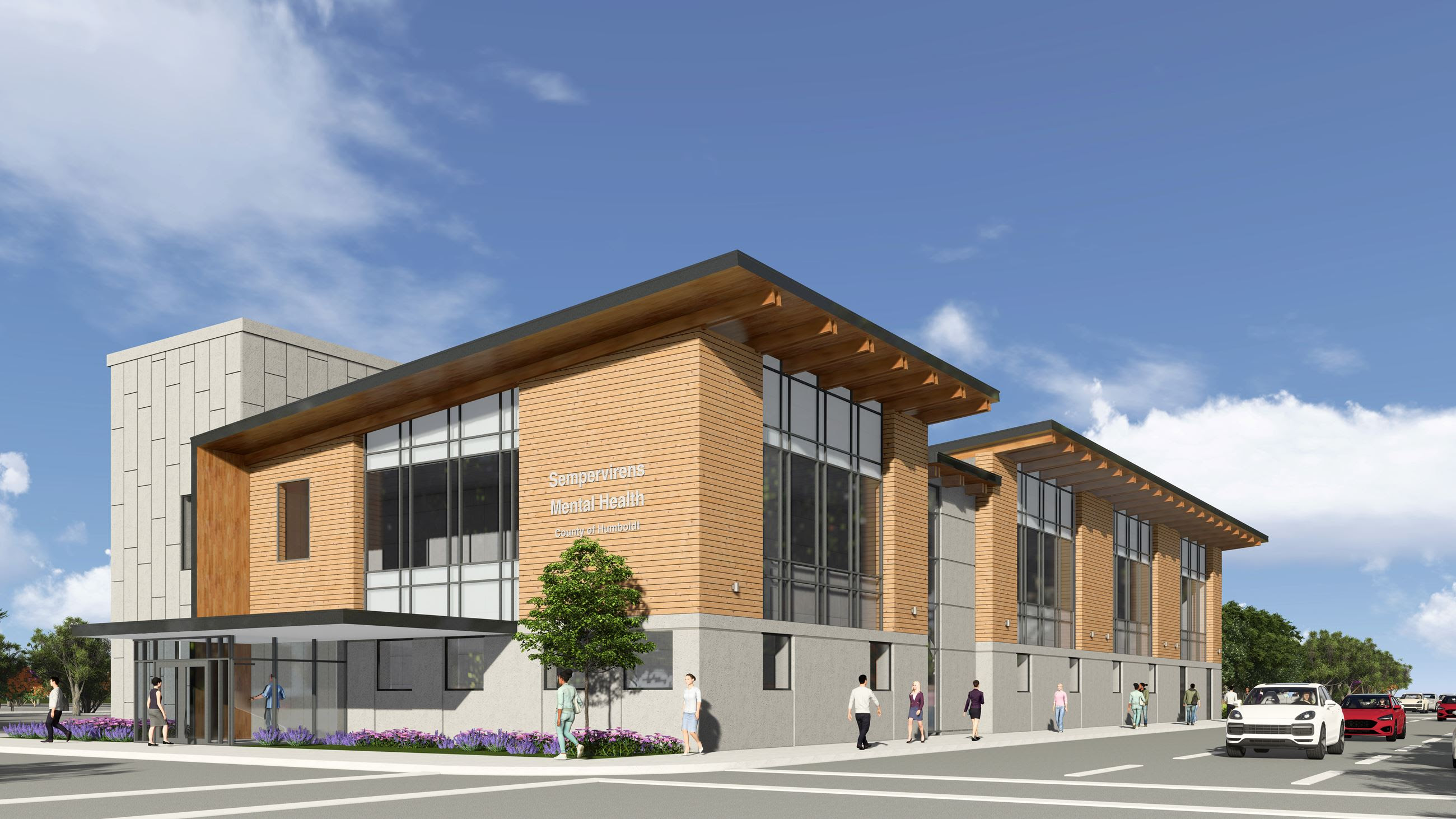
Image: County of Humboldt.
Press release from the County of Humboldt:
Humboldt County Department of Health & Human Services (DHHS) has been awarded more than $43.5 million to help construct a new Sempervirens (SV) psychiatric health facility after county staff submitted a grant application that was approved by the state.
At a May 12 news conference, California Gov. Gavin Newson announced the award which comes from Proposition 1 funding.
Prop. 1, the Behavioral Health Services Act, was passed by California voters in March 2024 and replaces the Mental Health Services Act of 2004. It reforms behavioral health care funding to prioritize services for people with the most significant mental health needs while adding the treatment of substance use disorders, expanding housing interventions and increasing the behavioral health workforce.
The new ADA-accessible facility, which will be housed on Fifth Street across the street from the Humboldt County Courthouse, will be more than 21,000 square feet, include 16 psychiatric health facility beds and four crisis stabilization unit beds, and will make it possible to expand access to children and youth, as well as patients who are not ambulatory.
DHHS Director Connie Beck said, “Building a new SV will be one more puzzle piece in our local behavioral health continuum of care. This new facility will make it possible for us to provide crisis stabilization and improved trauma-informed intensive in-patient services for individuals living with serious and/or severe mental or behavioral health conditions, in a more therapeutic environment than the current facility. I am very grateful to the Governor’s Office and to staff for all the time spent on the grant application. This new facility will ensure these services remain locally available for decades to come.”
The new facility is expected to be completed by 2030. For a list of funded projects, including other local projects, click here.


