
Trump is About to Reclassify Cannabis, Easing Restrictions on Banking, Taxes and Research, According to Multiple News Outlets
Ryan Burns / Wednesday, Dec. 17, 2025 @ 1:30 p.m. / Cannabis

File photo.
###
After spending the past 55 years as a Schedule I substance — the most restrictive category of drugs, grouped in with heroin and LSD — cannabis is about to get downgraded to Schedule III, easing restrictions on the Emerald Triangle’s favorite drug, according to numerous news outlets.
ABC News, for example, cites senior administration officials in reporting that President Donald Trump will sign an executive order to that effect as soon as today or tomorrow.
Reclassifying marijuana would “ease tax burdens, banking limits and research barriers,” according to CNBC. Restrictions on bank financing have been a huge hurdle for licensed cannabis farmers. Restrictions from the IRS prohibit weed-related businesses from deducting standard expenses.
Trump’s executive order may also pave the way for a Medicare pilot program giving some seniors access to (and reimbursement for) cannabidiol (CBD), the non-psychoactive compound that’s already popular in a wide array of wellness industry products.
At recent local government meetings, financially struggling cannabis farmers have expressed hope for federal legalization, saying “normalization” of the crop could give them a leg up over black market growers. Rescheduling wouldn’t go that far, but it would certainly be a step in that direction, allowing for scientific studies and looser business regulations.
BOOKED
Today: 10 felonies, 12 misdemeanors, 0 infractions
JUDGED
Humboldt County Superior Court Calendar: Today
CHP REPORTS
1656 Union St (HM office): Missing Indigenous
ELSEWHERE
County of Humboldt Meetings: Behavioral Health Board - SUD/Dual Recovery Committee - Sept. 10, 2026
County of Humboldt Meetings: Behavioral Health Board Executive Committee Meeting - July 1, 2026
RHBB: Judge Overturns Search Warrant in Student Activist Case: Devices Ordered Returned
RHBB: Multi-Vehicle Crash Closes South Fortuna Boulevard Near Strongs Creek Plaza
No More Gas in Orick! Shoreline Market to Close Jan. 1 as Yurok Tribe Firms Up Design Plans for Brand-New Fuel Mart
LoCO Staff / Wednesday, Dec. 17, 2025 @ 1:02 p.m. / Transportation , Tribes

RIP Shoreline Market. | Photo: Andrew Goff
PREVIOUSLY: Yurok Tribe Lands $6M Grant to Build New Fuel Mart, Laundromat and Tribal Government Offices in Orick
###
Press release from the Yurok Tribe:
Please be advised that effective January 1, 2026, the Shoreline Fuel Mart will be closed until the new Shoreline redevelopment project is complete.
This decision was not made lightly. The store has experienced multiple acts of vandalism and ongoing issues related to aging and failing equipment. Despite our best efforts to maintain the facility, keep equipment operational, and continue providing fuel to the community of Orick, California, the challenges posed by deteriorating infrastructure and repeated vandalism have made continued operations no longer feasible. Every reasonable effort was made to sustain safe and reliable operations under difficult circumstances.
We are grateful for the opportunity to have served the Orick community and appreciate the support and understanding shown over the years.
Importantly, we want to assure the community that the Shoreline Fuel Mart redevelopment project remains on track, and we look forward to serving the community again in the future with improved, modern facilities. The Shoreline Fuel Mart project is currently in the design phase, which we hope to have completed in spring of 2026. The multimillion-dollar project seeks to transform the long-neglected property into a welcoming gateway that serves as an asset and a point of pride for the Orick community. The modern facility will include the following elements: retail space, visitor information highlighting local businesses, food and beverages, signage to slow traffic, six fuel pumps, and two EV charging stations.
We sincerely thank the Orick community for your continued support and understanding.

Conceptual drawings of Shoreline Fuel Mart courtesy Yurok Tribe.
‘False Hope’: Why Families Who Celebrated California’s New Mental Health Court Feel Let Down by It
Jocelyn Wiener / Wednesday, Dec. 17, 2025 @ 7:17 a.m. / Sacramento

Ronda Deplazes, who felt CARE Court let down her son after she placed her hopes in it, at her home in Concord, on Oct. 27, 2025. Photo by Florence Middleton for CalMatters/CatchLight.
###
This story was originally published by CalMatters. Sign up for their newsletters.
###
Boom.
Ronda Deplazes had just gotten out of the shower and placed curlers in her long blond hair when she heard something slam against her front door.
Boom.
Outside, her son — a man who could fix anything, who loved his family, who never remembered these incidents but always apologized later — was yelling and swearing as he pulled large gray river rocks from the planter beds and hurled them at the front of his parents’ suburban Concord home.
Boom.
Deplazes heard a woman scream.
Later she learned her 38-year-old son had ripped a branch from a crepe myrtle in the front yard, leapt over a retaining wall and fallen onto the sidewalk. CalMatters is not naming Deplazes’ son, who lives with psychosis and addiction and could not be interviewed for this story.
Police arrived within minutes that August evening. They found Deplazes, hair still in rollers, in bed cuddling her shaking 17-year-old Labrador, Farley.
This was not the first time officers had visited the family’s home.
“What happened with CARE Court?” one officer asked.
Deplazes offered her assessment of a program she’d once seen as an answer to her prayers.
“They did nothing,” she said.
More than three years have passed since Gov. Gavin Newsom introduced the concept of CARE Court. Standing at a lectern in front of a San Jose treatment center in March 2022, he described a new court system that would steer hard-to-treat individuals down a pathway of housing and services. He called it “a completely new paradigm, a new approach, a different pathway.”
“I’ve got four kids,” he said that day. “I can’t imagine how hard this is …It breaks your heart. I mean, your life just torn asunder because you’re desperately trying to reach someone you love and you watch them suffer and you watch a system that consistently lets you down and lets them down.”
Family members of people with serious mental illnesses told CalMatters they breathed a sigh of relief that day. So many struggled for years to find help for loved ones who seemed to slip ever deeper into psychosis.
While disability rights advocates decried the program as a threat to the civil liberties of people with mental illness, and counties protested that they didn’t have the necessary resources or time, family members described feeling a twinge of something that had long eluded them: Hope.
Finally, they thought, someone heard them.
Finally, their loved ones would get help.
With the vocal support of many of these families, Newsom shepherded CARE Court through the Legislature. That October, he signed it into law. A year later, the program rolled out in an initial cohort, reaching the entire state by December 2024.
Now, many of the same family members who embraced CARE Court say it has fallen short of their expectations. In dozens of conversations with CalMatters, they described loved ones who continue to cycle between jail and homelessness. Some said their loved ones were dropped because they failed to participate in voluntary treatment plans. Others said counties had lost track of them entirely.
Some of the disappointment is a matter of scale. Newsom had initially projected that as many as 12,000 people could be eligible for the new program.
Two years of data from the state’s judicial council shows that, as of October, courts had received 3,092 petitions for CARE Court. Almost half were dismissed. Thus far, these petitions have translated into just 706 CARE plans and agreements.


First: Ronda Deplazes at her home in Concord, on Oct. 27, 2025. Last: A photo of her son, now 38, riding a motorcycle in their backyard as a child, long before his mental health diagnosis. “His love of life,” she said, referring to dirt bikes and how her son has been a risk taker since childhood. Photos by Florence Middleton for Catchlight/CalMatters
County and state officials say it’s too soon to pass judgment on the program. They point to the uncounted individuals who received help without ever enrolling in the program, and to those who have made incremental progress, perhaps working with a substance use counselor for the first time. They also say buy-in from vulnerable people takes a long time to achieve, but that the voluntary nature of the program is essential for lasting recovery.
Some officials acknowledge a significant disconnect between what many families expected, and what the law actually prescribes.
In Contra Costa County, where Deplazes lives, Judge Melissa O’Connell said she meets with participants who tell her they now have stable housing or are preparing for their first job interview. Such accounts buoy her.
“That’s how I view CARE,” she said. “It is helping people that would not be helped if CARE did not exist. It’s not helping everyone. I get that.”
But many families who have spent years or decades begging for help have lost patience.
In Ronda Deplazes’ case, she’s going to war.
“That’s my mission,” she said. “We have to stop CARE Court.”
Years of desperation
Anosognosia.
It’s a word people struggle to pronounce, even as they describe how profoundly it has upended their loved ones’ lives. It means an inability or refusal to recognize a defect or disorder that is clinically evident.
Ronda Deplazes knows it as a Catch-22.
Her son is sick but doesn’t believe he’s sick. Who would voluntarily accept treatment for an illness they don’t think they have?
The conundrum dates to 1967, when California passed the Lanterman-Petris-Short law. Prior to the law, it had been far too easy for family members to force loved ones into mental health treatment. Civil rights violations were rampant. Conditions in state hospitals were dismal.
The landmark law established strict criteria for involuntary treatment. It imposed specific timeframes for confinement and limited who could be subjected to holds: only people deemed a danger to themselves or others, or gravely disabled.
These civil rights protections are still widely considered imperative. But desperate family members say the law has at times made it difficult for them to get their loved ones life-saving treatment.
Many families pinned their newfound hope on Newsom’s initial comments, in which he said individuals who weren’t willing or able to follow through on their CARE plans might be moved “into a different category of care and support, more traditional along the lines of what we have today, through the (Lanterman-Petris-Short) conservatorship system.”
Several family members CalMatters interviewed interpreted that to mean CARE Court could compel their seriously mentally ill loved ones to get help.
“We get so pumped up with hope,” Deplazes said.
“I think the frustration and disappointment is more than a person can bear. That’s the truth of it. That is the bottom line,” she said.
In an interview with CalMatters, California Health and Human Services Undersecretary Corrin Buchanan said CARE Court was never intended to be another form of conservatorship. She emphasized what she considers unique facets of the program – families can directly petition the courts for help, county behavioral health departments face increased accountability and they are getting state support to develop the “three-legged stool” of treatment, medication and housing.
She said she’s heard from many families whose loved ones have benefited from the program, which can provide tools to meet the needs of “the right person, who’s the right fit for the model.”
Growing up, Deplazes’ son loved baseball, tinkering and spending time outside.
In retrospect, the first signs that something was wrong were the risky behaviors — leaping from the second story window onto the trampoline, doing donuts with his truck. By the time he was 19, he had received three DUIs. At one point, neighbors filed for a restraining order against him.

A pillow rests on an armchair at Ronda Deplazes’ home in Concord, on Oct. 27, 2025. Photo by Florence Middleton for CatchLight/CalMatters
Deplazes, a preschool teacher who regularly volunteers through her church, and her husband, Roger, who runs a family solar electricity business, met in middle school and have been together since their teens. They tried everything they could think of to help their son. They paid to send him to a high-end rehabilitation center. Staff told them their son was hearing voices. Eventually, he was diagnosed with schizoaffective disorder, a condition marked by symptoms of psychosis as well as mood disorders.
Deplazes was familiar with the implications of that diagnosis: Her mother, sister and brother had all suffered with similar illnesses. She and her husband found their son a psychiatrist. He thrived for a while, with professional help, a girlfriend and a part-time job.
Then, during the pandemic, Deplazes said her son went off his medication because he didn’t like the way it made him feel.
Things spiraled.
He lived with his parents until violence fueled by fentanyl use made the arrangement untenable.
In 2022, court records show, Deplazes filed for a temporary restraining order.
Her son started sleeping in strip malls near their home.
Inspired by Newsom
After hearing Newsom describe his plans for CARE Court, Deplazes felt inspired to participate in transforming the mental health system. She signed up for a class to help other families navigate mental illness.
In that class, she learned about Contra Costa County’s assisted outpatient treatment program — a court-ordered mental health treatment program that predated CARE Court. Upon her referral, he was accepted, she said; she hoped county mental health workers could convince him to participate in treatment.
One summer day in 2024, Deplazes pulled her car into the parking lot of an abandoned Dollar Tree where her son sometimes slept. She initially didn’t recognize the unconscious body surrounded by trash, grease caked into the neck, face and arms.
When she finally managed to shake her son awake, he was weak and trembling. She moved him to the shade and ran to get water, Gatorade and food.
She called the county behavioral health team.
“You have to help me,” she said.
County workers brought him food and water, she said, but her son wasn’t willing to accept additional help.
“‘Don’t worry,’” she remembers them saying. “‘In December you can apply for CARE Court.’”
Deplazes spent three days filling out paperwork ahead of CARE Court’s rollout in Contra Costa County. It was so complicated, she said, and required so much information that she eventually had to seek help: first from a volunteer from the local chapter of the National Alliance on Mental Illness, then from staff at the local law library. But she got the petition submitted, and in late January, her son was approved.
High expectations, then disappointment
The first CARE Court hearing for Deplazes’ son was on the morning of Feb. 7 of this year. She and her husband arrived at the Martinez courthouse at the appointed time. Their son did not.
In the coming months, Deplazes continued to find him crumpled up in strip malls a few blocks from her home. She had to stop frequenting those shopping centers. It was too hard to see him like that.
Sometimes, in the cold and rain, he would appear on her doorstep barefoot and freezing. He might lie there for days, barely moving. She’d contact the CARE Court team to alert them to his location. On some occasions, she said, they came out and did their best to help him. But most times, he was gone before they arrived.
She cut back on work, spending hours each day on the phone.
He kept getting arrested. Police would drive him to the county jail in Richmond. Often, Deplazes said, they discharged him in the middle of the night and he would walk until he could borrow a phone to call home. Her husband, worried for their son’s safety, would drive 25 miles to pick him up. CARE Court workers often weren’t even aware he was behind bars, Deplazes said.
Deplazes and her husband stopped going anywhere, fearing a crisis would emerge in their absence.
“You can’t have a life when you have a kid like this,” Deplazes said.
By March, she was already convinced that CARE Court wasn’t going to save her son.
She started reaching out to everyone she could. The county behavioral health department. The public defender. The district attorney.
“Dear Secretary Welch,” she wrote in a March email to the deputy secretary of behavioral health at the California Health and Human Services Agency, “This is a desperate plea to save our son’s life as now we are being told that CARE Court is also 100% voluntary…my son is deteriorating rapidly and being arrested on a regular basis for extreme and escalating behaviors….Secretary Welch please let me know if this CARE Court petition is futile and I should go another route. We love our son. He is smart, sweet and worth saving. We will never give up on his recovery. Please send guidance before it is too late for our family.”
She followed up with a second email, but never heard back.
“I’m giving up,” she told a reporter one morning soon after. “Honestly, I’m giving up.”
Instead, she began begging the county to let her son out of CARE Court, reasoning that he would get more treatment through the criminal courts if he was not constrained by his participation in the program.
Welch, in an interview with CalMatters, offered a message to parents like Deplazes:
“We’re listening,” she said. “We’re trying to better understand how we can be helpful. There’s lots of tools in the toolbox and CARE wasn’t necessarily a panacea.”
‘It was my baby’
Not long into her CARE Court experience, Deplazes was introduced to a former police officer named Sam Figueroa. The two instantly bonded over their shared desperation.
During his 25-year career, Figueroa said he had specially trained to help people in mental distress. By his own estimation, he had placed thousands of people on involuntary holds.
In 2023, he said someone called to tell him they heard screaming from his son’s Los Angeles area apartment. Figueroa immediately flew south, arriving to find his son emaciated and lying in the bathtub in a urine-soaked sleeping bag. Feces and rotting food coated the apartment.
“I thought I was in a nightmare,” he said. “And it was my baby.”
His son had recently graduated magna cum laude from UC Santa Cruz. Now, doctors told Figueroa that the sooner he intervened, the more likely he was to save his son’s life.
Despite his years of experience, Figueroa couldn’t convince anyone to place his son on an involuntary hold. Not after the young man tried to break into someone’s home. Not after he jumped from a moving vehicle.
Like Deplazes, Figueroa had started out optimistic about CARE Court. Like her, he soon grew angry. The clock was ticking.
“Doctor says ‘He doesn’t know he’s sick, he needs treatment now.’ CARE Court says ‘He doesn’t know he’s sick, he has to volunteer,’” he said. “I don’t understand that language. And I barely got high school, but that sounds very stupid.”
Gigi Crowder, CEO of Contra Costa’s chapter of the National Alliance on Mental Illness — an organization that represents family members — said she had initially felt hopeful about the new program. She remembers telling parents that CARE Court represented a new opportunity.
“We have failed this community of individuals,” she said recently. “We just have. We continue to do it when we offer false hope.”

Ronda Deplazes at her home in Concord on Oct. 27, 2025. Photo by Florence Middleton for Catchlight/CalMatters
By last summer, Deplazes had had enough.
One June morning, she came before Judge O’Connell, who oversees the county’s assisted outpatient program, conservatorship proceedings and CARE Court.
Deplazes’ health had deteriorated from the constant stress. Her son seemed to be getting worse.
Irate, she begged the judge to remove her son from CARE Court before he ended up dead.
“I said ‘let him out. I need to find him help and he’s not getting it here,’” she said.
In retrospect, Deplazes wishes she had been more tactful.
But, at that moment, she just didn’t care.
The hardest days
O’Connell is not oblivious to the pain of families like the Deplazes.
She and others in her courtroom are acutely aware that many have submitted petitions only after decades of heartache.
The hardest days are the ones when she has to tell family members that CARE Court is not going to help their loved ones.
“As a parent, when you feel like our systems have failed your loved one time and again, that can be devastating,” she said. “That’s never lost on us in CARE. But I know that doesn’t help make someone feel better about it.”
Prior to being sworn in on Jan. 8, 2024, O’Connell spent years working for the Northern California Innocence Project. A psychology major in college, she was excited to take on her new role.
About six or seven months into the county’s CARE Court rollout, she became concerned about the apparent disconnect between what the law described and what community members expected. She edited the county’s CARE Court webpage to better emphasize the program’s voluntary nature.
“I would never want to give someone false hope,” she said. “The only way you can try to avoid that is by being good at communicating and managing expectations.”
As of October, Contra Costa County had received 69 petitions for CARE Court, 28 of which had been filed by family members. Twenty-four of these petitions had since been dismissed, 11 led to CARE agreements with four more agreements pending. Seven individuals had exited the program to enter the Lanterman-Petris-Short conservatorship system, the county said.
Marie Scannell, Contra Costa County’s mental health program chief, and Elyse Perata, the mental health program manager, describe the challenges they’ve faced in rolling out CARE Court. Their staff members spend countless hours searching for hard-to-locate individuals, they said. They then make multiple visits over several months to gradually gain these individuals’ trust.
Then there are the families.
Perata, a therapist, said she empathizes with families frustrated that their loved ones can’t be compelled to participate. But she also emphasized the importance of a client’s buy-in in order to achieve “longstanding success.”
She and Scannell described the dedication of their staff, and the warmth of O’Connell’s courtroom – where participants are greeted with snacks and support.
For some people in the community, they said, the program has worked well.
One 31-year-old man, who asked that his name not be used for privacy reasons, told CalMatters he had participated in the county’s CARE Court program for several months. Prior to that, his father had referred him to a mental health treatment facility after he went off his medication, fell into psychosis and poured water into his gas tank, ruining his car.
He appreciates the help he’s received connecting with job training, as well as the program’s more intangible aspects – moral support, reassurance, a positive outlook.
“I didn’t expect it to be this life-changing,” he said.
After CARE Court
In July, Deplazes’ son was released from CARE Court. Deplazes said the judge told her it was because the CARE Court team couldn’t locate him.
In August, on the evening he was found throwing river rocks at the front door, police arrested him for repeatedly violating his parents’ restraining order, Deplazes said.
In September, she said, a criminal court judge ordered her son placed in 180 days of inpatient treatment, along with domestic violence classes and antipsychotic medications.
“My son, we finally got him criminalized,” Deplazes informed her friend, Figueroa, as the two sat together on the leather couches in her living room.
“God bless,” he said.
Figueroa remained worried about his son. He had brought him back north and put him up in a nearby hotel for nine months, he said, until the young man was kicked out for frightening the staff.
Homeless, his son had wandered into a neighboring county. His county responded by closing his son’s CARE Court case, he said.
Now, Figueroa was trying to track his son’s Instagram posts to make sure he was still alive.
In the meantime, the days of the involuntary hold the judge had ordered for Deplazes’ son were slipping away. She was still desperately trying to find a long-term placement her son would be willing to accept. She knew he longed for his freedom.
“And there’s no talking to him,” she said. “Because remember again, in his mind, he’s not sick.”
The two talked briefly about a new law that will take effect this January. It promises to expand the grave disability standard as laid out by the Lanterman-Petris-Short law. Many families hope it will open a new pathway to conservatorship.
“But again, it’s a law,” Deplazes said.
Implementation, she said, was another question entirely.
##
This project story was produced jointly by CalMatters & CatchLight as part of our mental health initiative.
OBITUARY: Daniel Patrick Adams, 1991-2025
LoCO Staff / Wednesday, Dec. 17, 2025 @ 6:56 a.m. / Obits

Daniel Patrick Adams of McKinleyville was born on December 5, 1991 in Eureka to Michael and Liz Adams, and passed away on November 29, 2025.
Dan loved being outside. As a child, he played roller hockey and baseball in the local little leagues. In the off-season, he could be found riding around the newly developing streets of Little Pond on his bike. On rainy days, he and his sibling, Annie, would go to the giant hills of mud leftover by the construction crews and slide down them for hours, coming home doused in mud. As he got older, he enjoyed playing paintball, ping pong, and bird watching at the marsh. He liked to go kayaking down the Eel River with his dad and dog, wander the local scenery, or go mountain biking out in Kneeland with his friends.
He liked to travel to LA, where there was always a fun restaurant to try, and visit the National Parks, including Yosemite, Crater Lake, Lassen Volcanic and Great Basin.
His calling was in the kitchen. Whether it was homemade fettuccine with bacon, caramelized leeks, and mushrooms or chicken pot pie, everything he made was delicious. He will be remembered most for his pizza. Rarely did a week go by where he didn’t make one; he was always tinkering with his dough recipe or had a new topping combination to try.
Dan will be remembered for his hilarious jokes, wonderful cooking, big heart, and loyalty to his friends and family. He is preceded in death by his maternal grandparents, Norma and Bud Tomascheski, his paternal grandparents, Madge and Pat Adams, and his beloved orange cat, Ironhide. He is survived by his parents and sibling. A memorial will be held on January 10, 2026 at Christ the King Church in Mckinleyville at 11 a.m. with a reception to follow.
###
The obituary above was submitted on behalf of Dan Adams’s loved ones. The Lost Coast Outpost runs obituaries of Humboldt County residents at no charge. See guidelines here.
OBITUARY: Melinda Elaine Petersen, 1958-2025
LoCO Staff / Wednesday, Dec. 17, 2025 @ 6:56 a.m. / Obits

Melinda Elaine Petersen of Eureka passed away peacefully on September 2, 2025 from Glioblastoma. She was 67 years old.
Melinda was born to Charles and Kathlyn “Kay” Nichols in Fortuna on February 28, 1958. The middle child of five siblings, she attended Ridgewood & Cutten Elementary Schools, Winship Junior High School, and Eureka High School, graduating in 1976. She loved spending time with her siblings, Martin, Mark, Melanie & Kari, helping care for the family pets, and spending summers at Ruth Lake with her Auntie and Earl Dillon.
Melinda married the love of her life, Michael “Mike” Petersen, in 1978 in Eureka. They loved skiing, enjoying trips to Ashland, Mt. Bachelor and Tahoe. They had two daughters, Nicole in 1983 and Heather in 1986. The family enjoyed going on trips to visit family, camping, and engaging in outdoor activities. Melinda worked in a number of positions, including as an Aide at Pacific Convalescent Home when she was a teenager, a Secretary at the Federal Land Bank, an Appraisal Technician at Bank of America, and as a Housing Projects Manager at the City of Eureka. She also co-owned Eureka Overhead Door Company with Mike.
She was a wonderful wife and mother, doting on her family and attending various school and sporting events for her daughters. She always brought people together, frequently hosting joyful family and holiday gatherings. She was an incredible cook and had a number of favorite meals and desserts that she would make for loved ones, including her favorite, Angel Food Strawberry Shortcake. Her kind and gentle nature made her beloved by friends and colleagues alike, and she had many friends and family members that she kept in close contact with. She also loved animals and always had pets that she doted on, including dogs, cats and birds. She especially loved riding and caring for the family’s two horses, Holly & Rusty, passing her knowledge and passion for horses on to Nicole & Heather.
She loved to travel and enjoyed trips throughout the United States, as well as to Canada, England, Ireland, Mexico and Scotland. She enjoyed watching hockey and the family went to many San Jose Sharks games with the Humboldt Hockey Jocks group. She and Mike loved learning about new cultures and hosted three exchange students when Nicole and Heather were teenagers: Matilda from Sweden, Julia from Germany, and Jang from Thailand.
Melinda also experienced health challenges earlier in her life. She was diagnosed with kidney failure in her early 40s. After over a year of dialysis, she was blessed with the gift of a kidney donation from her younger sister, Melanie. She was always incredibly grateful to Melanie for her generosity.
After 25 years, Melinda retired from the City of Eureka in 2020. Mike retired shortly after and together they spent their free time camping and traveling in their RV, including two cross-country trips that took them from California to Yellowstone in Montana, to South Dakota where Mike grew up, to visit her sister, Kari, and her family in Kentucky, to Roswell, New Mexico, and to Mesa Verde in Colorado.
She was involved in community organizations as well, belonging to Humboldt Sponsors, the Humboldt County Historical Society, and the Society of Humboldt County Pioneers. Her favorite pastime, however, was spoiling and spending time with her grandchildren, Josiah, Daphne & Farrah. She also loved tending her beautiful yard and flower gardens, playing cards every Thursday, going to the casino, going to restaurants with family & friends, and watching movies at the theater. She was incredibly warm-hearted and kind, and was beloved by all who knew her.
Melinda was preceded in death by her grandparents, Leland & Athlyn Lawson, her brother, Martin Nichols, her father, Charles Nichols, and her daughter, Heather Petersen.
She is survived by her mother, Kathlyn “Kay” Nichols, her husband, Michael “Mike” Petersen, her daughter, Nicole Petersen-Log (Joseph), and her three grandchildren, Josiah Log, Daphne Log, and Farrah Petersen-Log. She is also survived by her siblings, Mark Nichols (Carol), Melanie Coupe (Robert), and Kari Bradley (Kenny), as well as nine nieces and nephews and their families.
The family wishes to thank the exceptional staff at St. Joseph Hospital and Hospice of Humboldt, as well as her best friend, Laurie Altizer, and sister-in-law Monica Caetano, for their love and support, especially following her cancer diagnosis.
###
The obituary above was submitted on behalf of Melinda Petersen’s loved ones. The Lost Coast Outpost runs obituaries of Humboldt County residents at no charge. See guidelines here.
Humboldt County Supervisors Adopt Long-Awaited Climate Action Plan, Set Greenhouse Gas Emissions Threshold
Ryan Burns / Tuesday, Dec. 16, 2025 @ 4:23 p.m. / Local Government
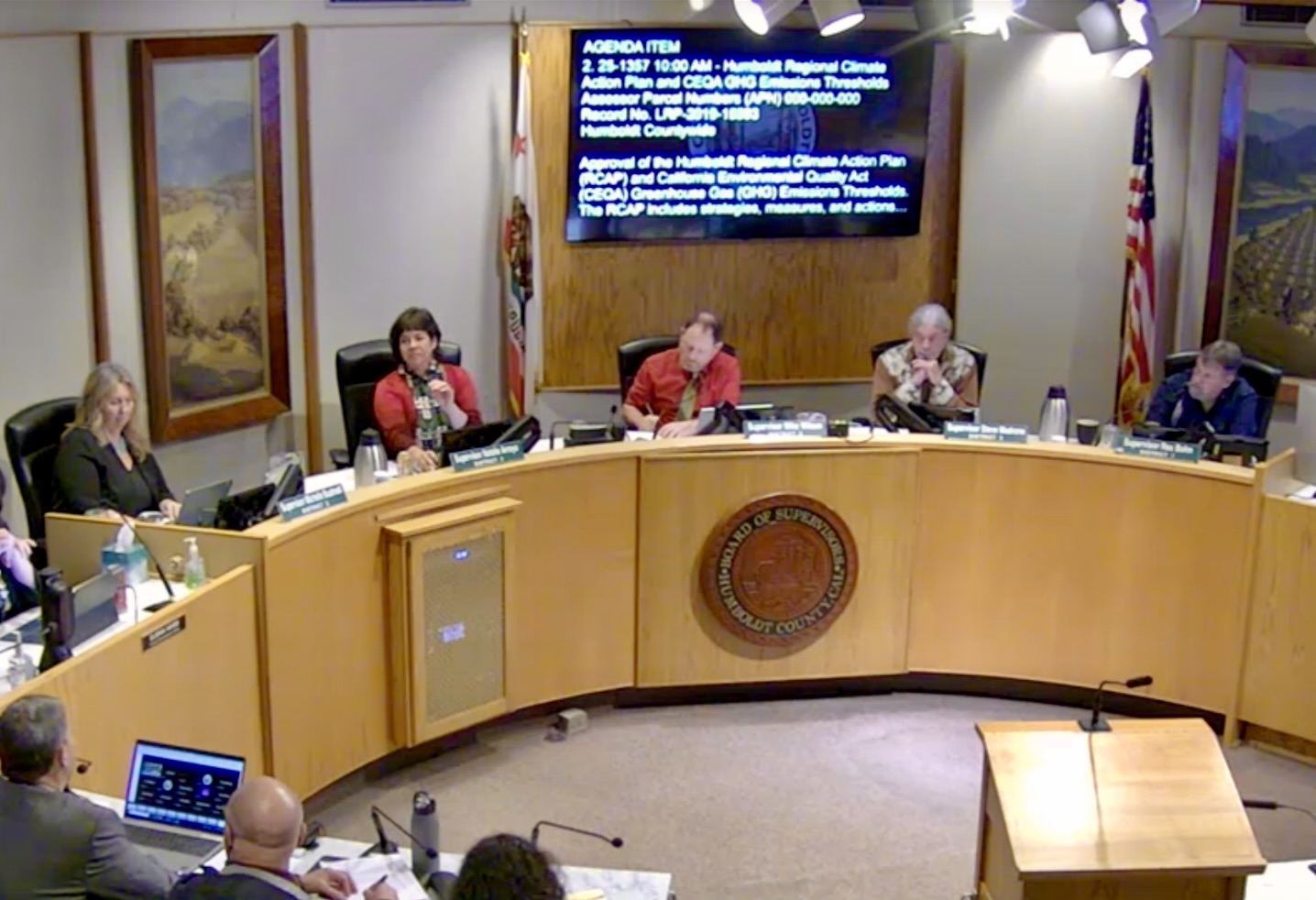
Humboldt County Board of Supervisors (from left): Michelle Bushnell, Natalie Arroyo, Mike Wilson, Steve Madrone and Rex Bohn. | Screenshot.
###
The Humboldt County Board of Supervisors today passed a sweeping environmental document aimed at reducing planet-warming greenhouse gas (GHG) emissions in the coming years.
Passed unanimously, the Regional Climate Action Plan (RCAP), which was developed in collaboration with local cities and other government agencies, includes an array of strategies and measures that, together, are designed to meet certain state and local goals. Specifically, they’re aimed at reducing the county’s GHG emissions to 40 percent below 1990 levels in the next four years and 85 percent below that mark by 2045 while achieving carbon neutrality.
The board also went a step further, setting an even more ambitious GHG threshold that will apply to new development projects requiring review under the California Environmental Quality Act (CEQA) — unless the project in question won’t come online until after 2030. After some deliberations (and confusion regarding percentages), the board agreed to set this threshold 35 percent lower than what’s spelled out in the RCAP.
Confusing? Certainly. Each board member got a bit lost, at one point or another, in what Fourth District Supervisor Natalie Arroyo dubbed the “acronym soup” of this discussion. But the RCAP is actually designed to streamline future development.
“Once the new regulations are adopted, it will better guide future development to locations that are encouraged by the county,” Planning and Building Director John Ford said during today’s meeting. The plan enshrines a tiered environmental review process, which staff said will reduce paperwork and delays by avoiding redundant analysis. In other words, projects that are consistent with the RCAP will have simpler regulatory procedures.

A forecast of the county’s future greenhouse gas emissions shows that transportation is the largest source of such pollutants. | Screenshot.
###
Humboldt County emitted roughly 1.5 million metric tons of carbon dioxide in 2022, according to Planner Megan Acevedo, with road transportation sources accounting for 73 percent of that. The second-highest contributor was building energy use from natural gas, she said.
The plan identifies 12 strategies for reducing emissions, largely focusing on transportation-related measures such as transitioning government fleets to cleaner-running vehicles/fuels while reducing the number of vehicle miles traveled. Land use planning will encourage growth in areas where services and transit already exist, and local governments will promote efficiency upgrades and electrification in homes and businesses.
The RCAP also aims to enhance carbon storage in forests and rangeland; improve energy efficiency in water and wastewater systems; reduce landfilled waste through recycling and organics diversion; and track all of these efforts via annual progress reports.
Ford noted that there has been a lot of confusion regarding the proposed GHG thresholds, as they pertain to new development. Many local residents conflated this with the RCAP. Ford explained that they’re related but distinct components of the county’s climate strategy, and the latter could be adopted without passing the former.
A hired consultant recommended that the county set a GHG threshold 50 percent below what’s spelled out in the RCAP, but when the matter came before the Humboldt County Planning Commission, that body wound up taking a slightly more conservative approach. With a narrow 3-2 vote, the commission suggested splitting the difference by setting a threshold of 25 percent below the RCAP level. Coming in to today’s meeting, staff sided with the Planning Commission, recommending that the board aim for that same 25 percent mark.
First District Supervisor Rex Bohn was skeptical about the whole process leading up to this point. He asked Ford whether staff had consulted with “people that build the houses” and suggested that stringent environmental regulations could prevent future development.
“They [local builders] should have had some input, because the best practices are going to be implemented by them,” Bohn said.
Ford replied by pointing out, “Sometimes people don’t like change, and this, unfortunately, is change.” He also said, “We’re not proposing anything right now that is revolutionary, related to building.”
Both Second District Supervisor Michelle Bushnell and Fifth District Supervisor Steve Madrone expressed concerns about restricting or prohibiting the use of wood stoves for heating rural homes. After doing some research, Ford assured them that wood stoves are still allowed under the RCAP, though they’re regulated through the EPA.
During the public comment period, an attorney representing SN Indianola, a subsidiary of Rob Arkley’s Security National, argued that the RCAP failed to include a planned housing development project along the Indianola Cutoff in its FEIR. Ford later told the board that it was omitted because the developers have yet to submit a permit application.
The majority of public comments came from local environmental activists, who encouraged the board to adopt the RCAP and adopt a lower GHG threshold.
After some more board discussion, Third District Supervisor and Board Chair Mike Wilson made a motion to adopt the RCAP, along with its related documents, and to set the GHG threshold at 50 percent of the RCAP level — a more stringent goal than what was passed by the Planning Commission and recommended by staff.
Bushnell said she wanted to vote in favor of the motion but couldn’t go that far. She requested the GHG goal be 25 percent below RCAP, and Bohn agreed, saying he’d like to defer to the expertise of the Planning Commission.
Percentage confusion ensued as some people did math from point A to B while others were measuring from B to A. Eventually, though, once everyone got on the same page, Wilson suggested a compromise: a GHG threshold of 35 percent below the RCAP.
This middle ground earned unanimous support for the motion.
Tonight’s Eureka City Council Meeting Has Been Canceled
LoCO Staff / Tuesday, Dec. 16, 2025 @ 3:46 p.m. / Local Government

Photo: Andrew Goff.
###
PREVIOUSLY:
###
We just got word from the city of Eureka that tonight’s scheduled council meeting — where they were set to talk about a trans sanctuary resolution and a resolution against war in Venezuela — has been canceled. Presumably those items will be scheduled to a later date.
Press release from the City of Eureka:
The City of Eureka announces that the regularly scheduled Eureka City Council meeting set for Tuesday, December 16, 2025, has been canceled due to the lack of a quorum.
The next regular Eureka City Council meeting is scheduled for January 6, 2026. Any items intended for consideration at the canceled meeting will be placed on a future agenda, as appropriate.
Meeting agendas, updates, and additional information are available on the City’s website at www.eurekaca.gov.
For questions, please contact the City Clerk’s Office at (707) 441-4175.


