

HUMBOLDT HISTORY: The Day They Floated a Complete Two-Story Victorian Across Humboldt Bay
Editor / Saturday, Jan. 17 @ 7:30 a.m. / History

Photo: E.S. Chase, via The Strand.
###
Editor’s note: The story of Humboldt County’s most unusual house-moving project has been told before but not with some of the detail that we have been able to compile for this article. Our thanks go to Eureka resident, Mrs. George (Bobbi) Walker, who called our attention to an article, “How Buildings are Moved,” published in the 1890s in a British magazine called “The Strand Magazine.”
Additional material has been provided by Martha Roscoe, Humboldt County historian.
The house, still standing at the comer of Sixth and N streets, was drastically modified after a fire destroyed the top story in 1935. However, much of its original, impressive ornamentation is still intact. The British magazine item on the house was included in several other accounts of famous moving projects in early U.S. history. The early-day item follows. —HH.
The Strand Magazine, June 1897
An interesting story can be told about the pretty wooden mansion shown on this and the following page, and the operation was certainly one of the most picturesque and scientific feats of modern house-moving. The house belongs to Mr. Ernest Sevier, a prominent lawyer of Eureka, California. It was raised from its foundation in Arcata, a small town near Eureka, and moved on rollers to a marsh on the edge of Humboldt Bay. Here, two large lighters or flat barges, each competent to sustain 300 tons, were in waiting, securely joined together. A square opening had been cut into the edge of the marsh, and in this the lighters were supported with piles, so as to be perfectly stationary at low tide. The house was then shifted to the lighters, and at high tide the piles were withdrawn, and the house and lighters were afloat on Humboldt Bay.
In this fashion, it was towed for eight miles with perfect safety. The house weighed over 100 tons, contained ten rooms, an outside chimney, and was hard-finished throughout. When it reached Eureka, it was transferred from the lighters to the land, in the presence of a crowd of spectators, and then rolled a half a mile within the limits of the City of Eureka … rolling prettily along the street behind a donkey-engine, near its destination. The house was placed on pine timbers, 12 in. by 14 in., running fore and aft, and these again were crossed with other timbers running transversely.

On the move. Photo: J. Vansant Jr., via The Strand.
“The plastering,” writes Mr. Sevier, “was broken in places, but two men repaired it all in one day. Not a panel was started, not a pane of glass broken, and not a brick displaced.” The contractors who moved the house were Messrs. H.M. Mercer and William Berry, and the work was finished in about two months.”
###
Local newspapers printed these items on the Sevier house, also called the Dean house:
Arcata Union, Feb. 23, 1889
Theordore Dean is building a nice residence at the corner of 8th and G streets. [Actually, the site was 7th and G streets. -HH.]

The house in Arcata, shortly after its completion. Unknown photographer, via the Humboldt Historian.
Arcata Union, Oct. 12, 1889
Cards of invitation were sent out last week to a large number of people to attend a house warming at the new residence of Theodore Dean on the corner of 7th and G streets. The party was given under the auspices of the mechanics who performed service in their various callings on building and finishing this model home. The names of the mechanics signed to the invitation cards are: S.R. Wallace, John Bushey, M. Johanson, M. McLeod, W. Boscow, W. Shaffey, T.F. Nicholson, G.N. Stearns, S.B. Clanton, G. Trask, W.A. Trask.
As early as 8 o’clock people began to arrive and at 9 o’clock the house was filled from top to bottom with guests strolling through the rooms, admiring their beauty and convenience and interchanging views in regard to style, finish, etc. The house is an Eastlake cottage containing nine rooms, having two stories and an attic. Mr. Dean, who is an architect and builder himself, superintended the work and made such changes from the established plan of such cottages as were suggested to his taste. Certainly the house is as complete in all appointments as it could be possible to make one of its size. The finish inside is of native wood such as curly redwood, ash laurel and redwood burl. It has high polish and almost dazzles the eye to look at it.
After the crowd had gathered, about 150 in number, J.P. Feaster tuned his violin and with H.S. Stern at the piano and Professor Holland to call, dancing began in the parlor which had been left bare for the purpose. We regret lack of space prevents us from giving a further account of the house.
The Humboldt Times, Oct. 25 1895
Contractors Mercer and Berry have already commenced operations for the removal of the Dean dwelling from Arcata to Eureka and expect to have the structure in position here within a month. As a precaution against accident in transporting the house across the mile of marsh between its present location and tidewater, the route will be planked and timbered to overcome inequalities or soft spots. As the lighters upon which the building will be towed to Eureka cannot be floated nearer than 200 or 300 feet from the dyke, a temporary bridge or wharf will have to be built out to them on the mudflats.
The Humboldt Times, Nov. 15, 1895
Contractor Mercer was in the city yesterday and reported that the Sevier home had been successfully moved onto the lighters at the Arcata dyke and that the steamer Phoenix would start down the bay with the odd tow at noon today. (Sevier purchased the Dean house and had it moved.)
The Humboldt Times, Nov. 19, 1895
The Dean house, which arrived from Arcata by water Thursday, was safely landed at the J St. slip Saturday and is now well on its way up the slope to 2nd St. Contrary to rumors, the building is still intact, chimneys and all, and it is expected by contractors Mercer and Berry that if no accident occurs, the structure will be on level ground on 2nd St. this evening.
The Humboldt Times, Nov. 20, 1895
The Sevier house was successfully hauled up J St. slope to 2nd St. yesterday and last evening had crossed 3rd St. where it rested for the night.
The Humboldt Times, Nov. 23, 1895
The Dean house, brought down from Arcata for Ernest Sevier, is now within one block of its destination on 6th St.
###
Editor’s note from 2026: The house, which stands at 6th and N streets to this day, had a second (third?) notable chapter. Stay tuned to next week’s Humboldt History for that! — LoCO.
###
The piece above was printed in the November-December 1985 issue of the Humboldt Historian, a journal of the Humboldt County Historical Society. It is reprinted here with permission. The Humboldt County Historical Society is a nonprofit organization devoted to archiving, preserving and sharing Humboldt County’s rich history. You can become a member and receive a year’s worth of new issues of The Humboldt Historian at this link.
BOOKED
Yesterday: 6 felonies, 12 misdemeanors, 0 infractions
JUDGED
Humboldt County Superior Court Calendar: Friday, Oct. 9
CHP REPORTS
No current incidents
ELSEWHERE
RHBB: REMINDER: Southbound 101 Closure Starting Tomorrow at the Eureka Slough Bridge
RHBB: Del Norte County Recreational Razor Clam Fishery Closes Due to Public Health Hazard
RHBB: Man Missing in Eureka
RHBB: Artists Wanted: Sooty Grouse to Star on California’s Next Upland Game Bird Stamp
OBITUARY: Leonard (Lenny) Eugene Abbott, 1961-2025
LoCO Staff / Saturday, Jan. 17 @ 6:56 a.m. / Obits
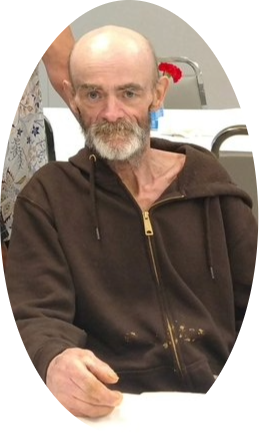
Leonard Eugene Abbott was born October 2, 1961 in Hoopa and passed away peacefully in his sleep on December 27, 2025, under the care of Hospice of Humboldt in Fortuna.
Thanks to Hospice of Humboldt, Lenny’s final days were spent comfortably in a warm bed with a belly full of food. In Lenny’s younger years he was an avid sportsman. He enjoyed a variety of different sports including playing softball, boxing, basketball and volleyball. He was a tough opponent on any court.
Lenny had an unconditional love for animals. He and his dog, Dogwood, could be found walking around downtown Hoopa or even riding on Lenny’s dirtbike together through town. Lenny made sure that Dogwood was always well loved and had plenty to eat. Lenny was great at fixing small engines, and he was always willing to lend a helping hand. He loved to work with his hands and be creative. He made flower planters out of old tires and he always had a carving or two made from rock or wood that he would give to his loved ones.
Leonard was preceded in death by his mother, Madolin Keller; grandparents Casey and Hazel Keller, George and Mae Abbott; siblings Leslie Abbott, Steven Abbott, Robert Robbins, Richard Robbins and Harold Blaine Marshall; nieces and nephew Tracy Melendy O’Rourke, Thomas O’Rourke Jr., Lacey Mae Jackson.
Leonard is survived by his father, George Wally Abbott; children Keith and Ashley Abbott; grandchildren Kenzi Watson, Allister Abbott, Emori Abbott, Aunt Shirley Keller Cushman; siblings Carol Abbott Hutton and Stacey Abbott Bubs Jackson; nieces and nephews Erika Hostler, Loren Hostler (Alisha), Michelle Melendy, (Glen Jones), Aimee Melendy, (Neil Moon) and James Melendy, Gerald Moon, Jr. (Shawnday), Madolin O’Rourke, Gino O’Rourke; and numerous great-nieces, great-nephews and cousins.
Celebration of life services to be held at the Hoopa Trading Post on January 24, 2026, 11:30-2 p.m. Please bring your favorite dish and some memories you would like to share.
###
The obituary above was submitted on behalf of Lenny Abbott’s family. The Lost Coast Outpost runs obituaries of Humboldt County residents at no charge. See guidelines here. Email news@lostcoastoutpost.com.
THE FORGOTTEN DISASTER: King Salmon Was Smashed by King Tides at the Beginning of the Year. Why is No One Talking About It?
Isabella Vanderheiden / Friday, Jan. 16 @ 4:47 p.m. / Community Services , Emergency

A combination of King Tides and an intense storm surge flooded King Salmon at the beginning of the month. | Photos: Fields Landing King Salmon Living with Water
###
Nearly two weeks after King Salmon and Fields Landing were inundated with record-breaking floodwaters, many residents are still struggling to recover, with some facing tens of thousands of dollars in property damage.
Among them are Linda and James Carter. The pair moved into their King Salmon home — a little light blue house just a stone’s throw away from the beach — shortly after they were married in 2010. In their 15-plus years in King Salmon, the Carters have seen their neighborhood flood countless times during storms and high tides, but they never worried much about their own home because a brick retaining wall surrounds the property.
“That property has never flooded before,” Linda told the Outpost during a recent phone interview. “But on the morning of Jan. 2, we saw [the floodwaters] actually breaching our walkway and coming onto the property, but it didn’t come into the house or anything. Then on Jan. 3, the water had actually breached our wall, and within about 10 minutes, it was in the house. We only had about 10 minutes to get things up, and out of the water … [which got to be] just shy of a foot high.”
The floodwaters damaged sheetrock and the flooring throughout their house, destroyed two refrigerators, a stand-up freezer, a dishwasher and totaled one of their cars. Linda also lost a photo album her mother had made for her when she was a kid.
“We were so depressed about what we had already lost, we just quit looking for more stuff,” James said. “It was just beating us down. Those first three days, we were just in survival mode.”

King Salmon is no stranger to flooding. At just three feet above sea level, the tiny bayside community has grown accustomed to the swollen canals, flooded streets and soggy lawns that come with winter rains, but this year was different.
On Jan. 2, a combination of record-breaking King Tides, heavy rains and an intense storm surge pushed Humboldt Bay beyond its shores, inundating King Salmon with seawater. The tide gauge at the North Spit peaked at 10 feet that morning, breaking the previous record of 9.8 feet set in 2005, according to data from the National Weather Service in Eureka. On Jan. 3, a new record of 10.37 feet was set.
The National Weather Service issued several weather alerts ahead of the storm-fueled King Tides and Humboldt County Office of Emergency Services (OES) shared flood safety tips and resources for people living in low-lying, flood-prone areas. On Jan. 2, Humboldt OES issued a notice urging people to avoid King Salmon due to extreme flooding, but residents were never asked to evacuate.
“People who have lived here their whole lives are saying they’ve never seen anything like this,” said Kelsey McMahan, a King Salmon resident of five years. McMahan and her family live in a big two-story house that’s split in two; she and her two youngest children live in the back of the house, and her daughter and her three kids live in the front. “Our house was built in 1953, and the guy we bought it from — his parents built the place — said it’s never flooded.”
McMahan anxiously watched the streets filled with seawater on Jan. 2, but the water eventually receded. “We went and got a ton of sandbags and thought we could stop the water by blocking all the entrances,” she said. “I was up all night checking the water, checking the water, and I had fallen back asleep right before it came in the house.”
She was woken up by a family member who said the water was coming up through the floorboards.
“I got up and started running around, picking things up off the floor and just grabbing anything I could to take upstairs,” she continued. “All of the flooring downstairs is ruined, along with appliances and furniture. … We had an adjuster come out from our flood insurance provider … and he was throwing around figures, like $50,000 to $70,000 in damages. The vacuum cleaner, the internet router and my kids’ shoes were all ruined. It just adds up.”
Fortunately, McMahan and the Carters have flood insurance, but claims can take months to sort out.

A back patio submerged in seawater.
‘I don’t know why we haven’t declared any kind of disaster’
While King Salmon and Fields Landing grappled with widespread flooding, the rest of the county was gripped by a devastating fire in downtown Arcata that destroyed seven local businesses, reducing half a city block to a pile of rubble. Emergency resources from across the county responded to the critical incident, and Humboldt County Sheriff William Honsal declared a state of emergency to bring in state and federal aid for the fire victims.
However, an emergency declaration has not been made for the communities of Fields Landing and King Salmon.
Estimates from Humboldt Community Organizations Active in Disaster (COAD) and the Fields Landing King Salmon (FLKS) Living with Water Project indicate that, of the 200-odd residences in King Salmon, at least 37 houses were flooded on Jan. 3. Another 27 properties were inundated, but floodwater didn’t get inside any buildings. There are still dozens of properties that haven’t been assessed.
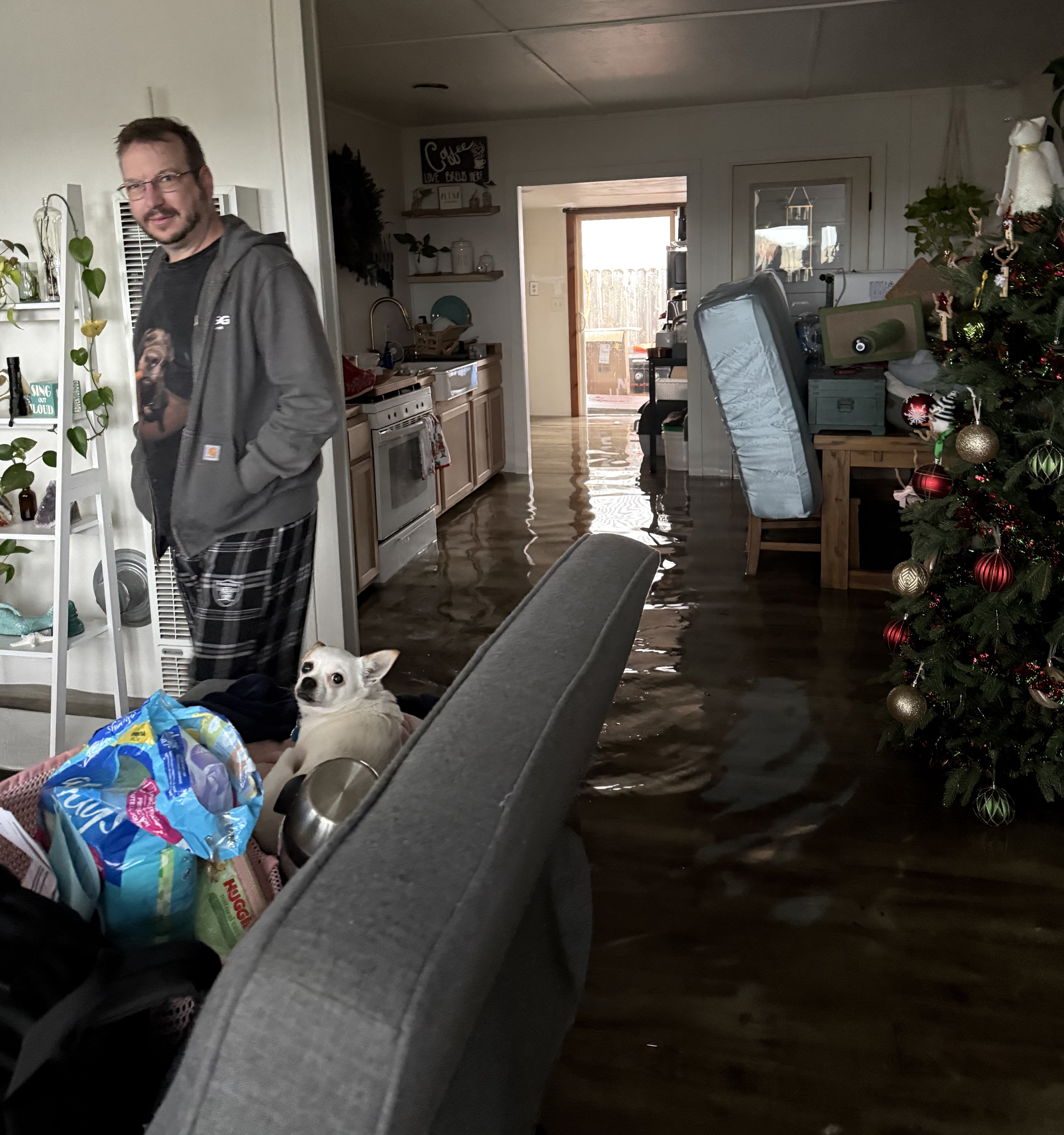
King Salmon resident Ben Jayes wades through his waterlogged home. That’s Lola on the couch.
“I mean, the damage is really bad,” McMahan said. “If there’s a local, state or national disaster, there’s help for people through FEMA [Federal Emergency Management Agency]. Even if it’s just a local disaster, you can get help from different agencies in California to help with building supplies or repairing the electrical or whatever needs to happen. I don’t know why we haven’t declared any kind of disaster, because there’s a lot of people down here who’ve lost a lot.”
Reached for additional comment via email, Sheriff Honsal told Outpost that he must consider the following criteria before declaring a local emergency:
The incident presents conditions of extreme peril to the safety of persons and property. The situation is of such severity and magnitude that effective response is beyond the capabilities of normal county operations. Extraordinary measures are needed to protect life, property, and public health, and to mobilize resources in a way that cannot be done through normal processes. There is also a clear need to activate emergency authority, mutual aid, emergency procurement, sheltering operations, or emergency protective measures on a scale that warrants a declaration.
Honsal explained that a local emergency declaration is “intended for situations where impacts exceed the routine capabilities and resources of the county.” The flooding in King Salmon “did not warrant such a declaration from an OES perspective” as there were “no significant impacts to roads, utilities, public facilities, or critical services.”
“All reports we received indicated that high tides flooded several homes in the King Salmon area,” Honsal continued. “The flooding was temporary due to the high tides, and temporary road closures were implemented. The flooding was not sufficient to justify evacuations due to the risks to the public. If evacuations had occurred, the area would have been inaccessible, preventing homeowners from returning to their homes and accessing their property.”
Staff with several county departments (public works, health and human services, planning and building, etc.) and representatives of the American Red Cross were sent out to evaluate the flood damage, Honsal said. However, none of the agencies asked for additional support or mutual aid.
“Our OES role is to coordinate and support, not to replace the primary response agencies,” he said, adding that OES is responsible for educating and preparing the public before an emergency occurs. “We focus on keeping the public informed, helping connect residents to available resources, and ensuring county partners are supported on response actions.”
Honsal also passed along a fact sheet from California OES outlining the process for emergency proclamations, linked here.

Staff with the Humboldt Community Services District pump seawater out of the system.
Coordinating Local Resources
When floodwaters spilled into the streets on Jan. 2, Cal Poly Humboldt Professor Laurie Richmond and her students, Kailin Sepp and Clara Riggio, were among the first to respond.
For the last two years, Richmond and her students have studied flood impacts in Fields Landing and King Salmon for the FLKS Living with Water Project to get a better understanding of how sea level rise will impact North Coast residents. Through interviews and community workshops, they’ve gotten to know the community and understood that the recent flooding was completely unexpected.
“This happened three days in a row — Friday, Saturday and Sunday,” Richmond said. “It wasn’t something where you could be like, ‘Well, the tides out, it’s done!’ It was kind of like being re-traumatized three times, and knowing that you can’t start cleaning up or doing anything until the tides have worked their way through the system. It was a really prolonged experience, and I think that’s really important to understand.”

Clara Riggio (left) checks on a resident of the RV park.
When the flooding began, the Humboldt County Community Services District quickly dispatched a few employees out to King Salmon. First District Supervisor Rex Bohn and some sheriff’s deputies were on scene as well.
That evening, the Humboldt Grange #501 in Humboldt Hill opened its doors to anyone who needed a free meal and a place to stay, but they didn’t have any takers that first night. When the tide rose the following morning, Richmond and her team packed up the food and made their way into the flood zone make sure folks were fed.
“A lot of folks weren’t able to leave their houses to go to the Grange, so we put it into containers, and just walked through the community asking, ‘Do you need any food?’ Some people said they were fine, but some people took us up on it because their refrigerators had broken and their food had spoiled,” Richmond said. “A lot of folks decided to stay in their houses, though I don’t know if that was the best choice [because of mold].”

Kailin Sepp navigates the flooded streets of King Salmon.
Once the floodwaters began to recede, Richmond and her students went door-to-door to check on folks. As Sheriff Honsal said, the American Red Cross sent out a few members of its Disaster Action Team to help assess the severity of the damage and distribute cleanup kits, blankets and toiletries.
“We have been in the community on four occasions so far to continue connecting with people in need of cleanup kits,” said Janeen Hess, Red Cross community disaster program manager for Humboldt, Del Norte and Trinity counties. “[At] that time, the Red Cross also began responding to individual requests for assistance. … Humboldt County did not ask the Red Cross to open a shelter at any point during the several days of king tide flooding.”
Still, Richmond felt the emergency response was lacking.
“It took a minute to really get the response activated,” she said. “I would have liked to see a [faster] response, but I don’t think there’s anyone to blame or anything like that. I think what’s really stark is that the biggest tide was on Saturday morning, which was the [day after] the Arcata fire. Seeing the differences in response and fundraising efforts has been really interesting, and [highlights] the relative privilege of those two places.”
Richmond acknowledged that she’s not extremely well-versed in the “disaster universe,” but felt an emergency declaration could help those affected.
In the meantime, Humboldt COAD has stepped in to bridge the gap between residents and regional resources. Humboldt COAD helmed the earthquake recovery effort in Rio Dell after the magnitude 6.4 earthquake in December 2022.
“We’re stepping in to help coordinate the relief efforts amongst different organizations and agencies,” said Humboldt COAD Executive Director Nick Bown-Crawford. “It’s a little different than earthquake recovery because we don’t have a big pot of money to work off of. In the absence of that recovery funding, we’re stepping in and trying to meet each resident one-on-one to try to identify their needs and what their situation is. … We work to fill the gaps with services and resources that the government either doesn’t have or can’t activate fast enough for the community.”
Humboldt COAD can help residents navigate insurance claims and legal assistance. They’re also working with the South Bay Family Resource Center, Pay It Forward Humboldt and other local organizations to coordinate fundraising efforts.
Want to donate? Humboldt COAD is taking donations at this link. If you’d like to donate to a specific service or program, you can contact the organization directly here.
‘We’ve been very lucky’
For the next three weeks, the Carters are housesitting for some friends who are traveling abroad. They’re not sure where they’ll go while they wait for their insurance company to sort out their claim. Still, they’re optimistic about the future.
“We’ve been very lucky,” Linda said. “I know that there are some newer people who moved into our neighborhood who were pretty shocked and really devastated by [the flood], but my attitude has got to be that out of 365 days a year, we have about 15 crappy ones because of this kind of stuff. We’ve still got 350 great days in King Salmon.”
Runners are Spending Hundreds of Hours Going Around the Same Arcata City Block This Month in Pursuit of Free Burritos
Dezmond Remington / Friday, Jan. 16 @ 3:18 p.m. / LoCO Sports!

Pete Ciotti stands in front of the Jogg’n Shoppe. By Dezmond Remington.
Pete Ciotti was hard to miss even in 6 a.m. morning gloom. I noticed the pink hoodie first, emerging slowly from the predawn fog muck down the street, and then the lime green shorts and bright hat and gloves. His face, not slathered in neon, shaped itself last. We said hi and started running.
We hung a right at the Jogg’n Shoppe, then a right on F Street, then a right at Adventure’s Edge, then a right on G, then a right at the Jogg’n Shoppe, then a right on F street, then a right at Adventure’s Edge, then a right on G…
We continued like this for about an hour while the sun slowly came up. Pete had already been at it for that long by the time I showed up, and he’d connected those dots more than 200 times in the days before that. I said surely the repetition was getting tiring.
“I don’t get bored. Because — you know what?” he asked me. “You show up, someone shows up, whatever. I actually met a few new people since we’ve been doing this.”
Arcata is a beautiful place to run, full of sights like the forested hills to the east, the Presbyterian Church, city hall, and the Arcata Theater Lounge. There are other places worth checking out, but aside from whatever the weather’s doing, those are the main features to see from that block we were wearing a trench in. It’d be an unremarkable one if more than 30 people weren’t doing the same thing we were doing, albeit usually a little later in the day. They’re crowding it this January, collectively spending hundreds of hours grinding out laps less than a fifth of a mile long.
The record is 1,067. (As of publication. No, that’s not a typo.) Jazmen McGinnis, 31, has run over 200 miles in 0.19 mile increments around that block in the last week alone. The competition started Jan. 10 at 5 a.m., and she’s run multiple ultramarathon-length distances on that short circle, over 40 miles four times and a 50-miler the day after it started. Others have done similar, but right now no one’s within sniffing distance of her stats.
“I wanted to see how far I could run,” McGinnis told the Outpost. “Turns out I can run pretty far.”
The rewards are tantalizing: the top male and female finishers get two burritos every month for a year, supplied free of charge from Backwoods Burritos, as well as entry into the Sonoma Fall Classic.
Organized by Ciotti and other members of Arcata’s Raccoon Run Club, it isn’t the only place with a “Burrito League.” Started in Tempe, Ariz. just a few weeks ago by a group saddened by the end of the Chipotle x Strava running challenge (there’s a lot of lore to this), they decided to do something similar without any corporate backing. Support online was instantaneous and widespread. Dozens of running groups around the U.S. and at least six other countries are sponsoring a Burrito League.

Local runner Elliott Portillo hoisting a burrito. Courtesy of Jazmen McGinnis.
Ciotti, 47 years old, is somewhat of a running influencer (yes, he has a podcast) and is casual friends with the founders of the original Burrito League-ers in Tempe. They suggested that he found one in Arcata. He wasn’t sure if any restaurants would sponsor them. He asked a few; they didn’t get it. One laughed him out. Ciotti thought he was at a dead end for a minute, but he decided to ask Backwoods Burritos, the cart that sets up outside the ATL most mornings. Fortunately for him, owner Britton Latham is also a runner.
“Pete called me, and it was an immediate ‘yeah,’” Latham told the Outpost. “Before I even got the details…I love having fun. I joke with everybody, ‘I’ve always been poor, so I’m not trying to get rich.’ I’m just trying to have fun here.”
It’s been fun. Ciotti and McGinnis are glad to have an opportunity to run and hang out with other runners all day. Ciotti’s getting friendly with all the early-morning regulars on the block; the garbage truck driver greeted us twice. They’re both accumulating a litany of anecdotes about the people they’ve met and the things they’ve learned about those they already knew.
“You get so much more time with people that you’ve never got,” McGinnis said. “Like, run club, it’s an hour or less that you usually spend with these people, and now you’re spending gigantic chunks of time hanging out with these people. You never really would have had the time otherwise.”

They’re both tired but not hurting. McGinnis said she isn’t planning on doing much more running unless someone starts nearing her in the rankings. It wouldn’t be impossible, but it’d take a couple very long efforts to get close. She’s between jobs at the moment and has plenty of time to log a few more ultramarathons.

McGinnis with Jogg’n Shoppe owner Mike Williams. Submitted photo.
Ciotti said the running wasn’t interfering with his landscaping work, even claiming it made him work harder.
The Burrito Leagues have their critics. Ciotti said a business owner on the block complained about the constant traffic in front of his store. Ciotti said he directed the runners to give his door some room now. Bystanders can also get confused.
No matter who runs the most laps, the biggest winners are likely the businesses they’re circling; the Jogg’n Shoppe has been selling a lot of shoes, nearby cafes lots of coffee, and Backwoods lots of burritos. (Latham said he was selling so many he didn’t really need the bump, but was grateful nonetheless.) An employee of the Arcata Smug’s Pizzeria told the Outpost he was glad the “burrito community” was having fun.
The business-friendly outlook was intentional. Ciotti owned the bar the Jam for a while and was concerned about how Arcata businesses were doing during their slow season and after the Jan. 2 fire.
“I’ve been working in front of the ATL for two and a half years, and this past week, I feel like the energy has been more positive than it’s ever been,” Latham said. “You know, we deal with so much riffraff and, like, people just being drunk and causing issues down there. And then I feel like the people running laps has kind of pushed a lot of that away.”
Even if she might miss getting to spend so much time with friends, McGinnis said she’s excited to win her burritos.
“Oh, my god, are you kidding me?” McGinnis asked. “Those burritos are so good. Like, so good. I’ve had a lot of people be like, ‘Okay, when you pick up your burrito, you can get one for you and one for me. We can have a date.’ I’ve had a lot of date invites.”
California Counties Must Jump Through New Hoops to Get Homelessness Funds
Marisa Kendall and Ben Christopher / Friday, Jan. 16 @ 7 a.m. / Sacramento

Linda Vazquez, 52, eats noodle soup outside of her tent on Cedar Street in San Francisco on Nov. 19, 2024. City workers tell Linda and other unhoused people to move on a regular basis during homeless sweeps and cleaning operations. Photo by Jungho Kim for Calmatters.
###
This story was originally published by CalMatters. Sign up for their newsletters.
###
Gov. Gavin Newsom has threatened many times to withhold state homelessness funds from cities and counties that aren’t doing enough to get people off the streets.
This year, those threats seem more real than ever.
Newsom’s administration and the Legislature are adding new strings to that money, which they hope will help address one of the state’s most obvious policy failures: Despite California’s large recent investments in homelessness, encampments are still rampant on city streets. But cities and counties already are chafing under the tightening requirements, which they worry will make it harder to access crucial state funds without directly improving conditions on the street.
To access state Homeless Housing, Assistance and Prevention money, cities and counties are being pressured to enact a policy regulating homeless encampments that passes state muster – a potential challenge in a state where local jurisdictions’ rules on encampments vary greatly, and many localities have no policy at all. The state also wants localities to get a “prohousing designation” – a special status awarded to places that go above and beyond to build housing. It’s a distinction that only 60 of California’s 541 cities and counties (home to just 15% of the state population) have achieved so far.
Newsom, the Legislature, local officials and other stakeholders likely will spend the next several months fighting about those terms, and hashing out the conditions for the $500 million in homelessness funding proposed in this year’s budget.
Until those details are resolved, exactly what standard cities and counties will be held to – and what will happen to those that don’t comply – is unclear. But one thing is clear: The state is done freely handing out cash.
Some counties are already feeling the heat. They report increased scrutiny as they apply for the homelessness funds already approved in the 2024-25 budget (which, thanks to lengthy bureaucratic delays, have just been made available.)
“They’re holding the counties’ feet to the fire,” said Megan Van Sant, senior program manager with the Mendocino County Department of Social Services.
Newsom’s administration and legislators in favor of the new accountability measures say cities and counties for too long have been scooping up state funds without proving that they’re using them wisely. The new message to locals is clear, said Assemblymember Sharon Quirk-Silva, a Democrat from La Palma in Orange County: “The state has been moving forward, not only with the investment in dollars, but also with legislation. Now it is your time to show that if you want these dollars…you have to show us what you’re doing.”
But the new requirements may make it more burdensome to access crucial homelessness funds.
“I worry that, one, we may leave more cities out,” said Carolyn Coleman, executive director and CEO of the League of California Cities, “and, two, that we may cause delays in the ability to get more people housed sooner, which I think is the goal.”
A tougher application process
Applying for state homelessness funds “absolutely” feels different now than it did last year, and the state is asking tougher questions, said Robert Ratner, director of Santa Cruz County’s Housing for Health program.
Fortunately, the county just approved an encampment policy in September, and has started working on getting a pro-housing designation, he said. But the state still returned the county’s application with plenty of notes.
“It has felt, at times, like the goal post keeps moving a little bit,” Ratner said.
The county’s application still hasn’t been approved, but it seems to be getting close, Ratner said.
In Mendocino County, the state appears to be holding funds hostage until the county can explain its plans to pass an encampment ordinance, said Van Sant. The county board of supervisors is working on such an ordinance, though it hasn’t come up for a vote yet.
But the state’s requirement puts Van Sant and her team in an awkward position. As housing administrators, they have no say in any rules the county passes that regulate or prohibit encampments on local streets.
“I wanted to stay out of it,” Van Sant said. “I still want to stay out of it. We’re housing providers. We try to figure out how to provide people housing. We don’t want to weigh in on enforcement. At all.”
This year, the requirements may get even stricter. Under the current rules, the state seems to be satisfied as long as a city or county can show how it plans to get a prohousing designation or pass an encampment policy. In the next round of funding, local leaders worry the state will withhold funds unless cities and counties have actually achieved those benchmarks.
It’s all about accountability
At issue is the state Homeless Housing, Assistance and Prevention program, which provides the main source of state money cities and counties use to fight homelessness.
Though Newsom introduced the first round of funding, $650 million, as a “one-time” infusion of cash for local governments in 2019, it became a recurring feature of his administration’s strategy to reduce homelessness over the next five years.
For four years in a row, the state awarded $1 billion a year to be divvied up between counties, big cities and federally-recognized regional homelessness funding groups known as Continuums of Care. Each round of funding was described as “one-time.” Even so, at least a quarter of the money has gone to day-to-day operating programs, according to data collected by the state.

Last year, things changed. The budget lacked any extra cash for grant funds, and the state’s main homelessness program received no new money. Instead, the Legislature committed to spend $500 million — a 50% reduction from the last round of funding — in the coming fiscal year contingent on “clear accountability requirements.”
Those requirements for localities, spelled out in a follow-up budget bill signed into law last fall, include:
- Having a state-approved housing plan, known as a housing element
- Having a “Prohousing Designation” from state housing regulators
- Having local encampment policy “consistent with administration guidance”
- Ponying up some local funding to match the state contribution
- Demonstrating “progress” and “results” on housing and homelessness metrics
These new demands didn’t come out of left field. For several years now, “accountability” has been one of Newsom’s favorite words when discussing homelessness funding. “People have just had it,” he said in 2023. “We want to see these encampments cleaned up.” He has repeatedly threatened to withhold funds, and has gradually ramped up the strings attached to homelessness dollars.
But the current list represents an especially stringent set of requirements for locals hoping for a cut of what has been one of the state’s signature funding sources to combat homelessness.
Quirk-Silva noted that the current list of requirements is not final. She expects the administration to release additional legislative language in February. Legislators will fight over the details through the June budget deadline.
She expected particularly fierce pushback over any kind of “prohousing designation” requirement.
Revoking funds from areas of the state that lack such a designation would be “penalizing service providers for something that is outside of their control,” said Monica Davalos, a policy analyst with the California Budget and Policy Center, a left-leaning think tank.
San Jose Mayor Matt Mahan wishes the state would focus on more concrete measures of success, such as the number of people housed using state dollars, instead of things like a “prohousing” stamp.
“We’re making this way too complicated,” he said.
California Investigates Elon Musk’s AI Company After ‘Avalanche’ of Complaints About Sexual Content
Khari Johnson / Friday, Jan. 16 @ 7 a.m. / Sacramento
This story was originally published by CalMatters. Sign up for their newsletters.
###
On Wednesday, California Attorney General Rob Bonta announced an investigation into how and whether Elon Musk’s X and xAI broke the law in the past few weeks by enabling the spread of naked or sexual imagery without consent.
xAI reportedly updated its Grok artificial intelligence tool last month to allow image editing. Users on the social media platform X, which is connected to the tool, began using Grok to remove clothing in pictures of women and children.
“The avalanche of reports detailing the non-consensual sexually explicit material that xAI has produced and posted online in recent weeks is shocking,” Bonta said in a written statement. “This material, which depicts women and children in nude and sexually explicit situations, has been used to harass people across the internet. I urge xAI to take immediate action to ensure this goes no further.”
Bonta urged Californians who want to report depictions of them or their children undressed or commiting sexual acts to visit oag.ca.gov/report.
Research obtained by Bloomberg found that X now produces more non-consensual naked or sexual imagery than any other website online. In a posting on X, Musk promised “consequences” for people who made illegal content with the tool. On Friday, Grok limited image editing to paying subscribers.
One potential route for Bonta to prosecute xAI is a law that went into effect just two weeks ago creating legal liability for the creation and distribution of “deepfake” pornography.
X and xAI appear to be violating the provisions of that law, known as AB 621, said Sam Dordulian, who previously worked in the sex crimes unit of the Los Angeles District Attorney’s Office but today works as a lawyer for people in cases involving deepfakes or revenge porn in private practice.
Assemblymember Rebecca Bauer-Kahan, author of the law, told CalMatters in a statement last week that she reached out to prosecutors, including the attorney general’s office and the city attorney of San Francisco, to remind them that they can act under the law. What’s happening on X, Bauer-Kahan said, is what AB 621 was designed to address.
“Real women are having their images manipulated without consent, and the psychological and reputational harm is devastating,” the San Ramon Democrat said in an emailed statement. “Underage children are having their images used to create child sexual abuse material, and these websites are knowingly facilitating it.”
Bonta’s inquiry also comes shortly after a call for an investigation by Gov. Gavin Newsom, backlash from regulators in the European Union and India and X bans in Malaysia, Indonesia, and potentially the United Kingdom. As Grok app downloads rise in Apple and Google app stores, X is facing calls by lawmakers and advocates to ban downloads.
Why Grok created the feature the way it did and how it will respond to the controversy around it is unclear, and answers may not be forthcoming, since an analysis recently concluded that it’s the least transparent of major AI systems available today. xAI did not address questions about the investigation from CalMatters.
“The psychological and reputational harm is devastating.”
— Rebecca Bauer-Kahan, Democratic Assemblymember, San Ramon
Evidence of concrete harm from deepfakes is piling up. In 2024, the FBI warned that use of deepfake tools to extort young people is a growing problem that has led to instances of self harm and suicide. Multiple audits have found that child sexual abuse material is inside the training data of AI models, making them capable of geneating vulgar photos. A 2024 Center for Democracy and Technology survey found that 15 percent of high school students have heard of or seen sexually explicit imagery of someone they know at school in the past year.
The investigation is the latest action by the attorney general to push AI companies to keep kids safe. Late last year, Bonta endorsed a bill that would have prevented chatbots that talk about self harm and engage in sexually explicit conversations from interacting with people under 18. He also joined attorneys general from 44 other states in sending a letter that questions why companies like Meta and OpenAI allow their chatbots to have sexually inappropriate conversations with minors.
California has passed roughly half a dozen laws since 2019 to protect people from deepfakes. The latest, Assembly Bill 621, amends and strengthens a 2019 law, most significantly by allowing district attorneys to bring cases against companies that “recklessly aid and abet” the distribution of deepfakes without the consent of the person depicted nude or committing sexual acts. That means the average person can ask the state Attorney General or the district attorney where they live to file a case on their behalf. It also increases the maximum amount that a judge can award a person from $150,000 to $250,000. Under the law, a public prosecutor is not required to prove that an individual depictured in an AI generated nude or sexual image suffered actual harm to bring a case to court. Websites who refuse to comply within 30 days can face penalties of $25,000 per violation.
In addition to those laws, two bills (AB 1831 and SB 1381) signed into law in 2024 expand the state’s definition of child pornography to make possession or distribution of artificially-generated child sexual abuse material illegal. Another required social media platforms to give people an easy way to request the immediate removal of a deepfake, and defines the posting of such material as a form of digital identity theft. A California law limiting the use of deepfakes in elections was signed into law last year but was struck down by a federal judge last summer following a lawsuit by X and Elon Musk.
Every new state law helps give lawyers like Dordulian a new avenue to address harmful uses of deepfakes, but he said people still need new laws to protect themselves. He said his clients face challenges proving violation of existing laws since they require distribution of explicit materials, for example with a messaging app or social media platform, for protections to kick in. In his experience, people who use nudify apps typically know each other, so distribution doesn’t always take place, and if it does, it can be hard to prove.
For example, he said, he has a client who works as a nanny who alleges that the father of the kids she takes care of made images of her using photos she posted on Instagram. The nanny found the images on his iPad. This discovery was disturbing for her and caused her emotional trauma, but since he can’t use deepfake laws he has to sue on the basis of negligence or emotional distress and laws that were never created to address deepfakes. Similarly, victims told CNBC last year that the distinction between creating and distributing deepfakes left a gap in the law in a number of U.S. states.
“The law needs to keep up with what’s really happening on the ground and what women are experiencing, which is just the simple act of creation itself is the problem,” Dordulian said.
California is at the forefront of passing laws to protect people from deepfakes, but existing law isn’t meeting the moment, said Jennifer Gibson, cofounder and director of Psst, a group created a little over a year ago that provides pro bono legal services to tech and AI workers interested in whistleblowing. A California law that went into effect January 1 protects whistleblowers inside AI companies but only if they work on catastrophic risk that can kill more than 50 people or cause more than $1 billion in damages. If the law protected people who work on deepfakes, former X employees who detailed witnessing Grok generating illegal sexually explicit material last year to Business Insider would, Gibson said, have had protections if they shared the information with authorities.
“There needs to be a lot more protection for exactly this kind of scenario in which an insider sees that this is foreseeable, knows that this is going to happen, and they need somewhere to go to report to both to keep the company accountable and protect the public.”
OBITUARY: Suanna Rowell (Bonhote), 1947-2026
LoCO Staff / Friday, Jan. 16 @ 6:56 a.m. / Obits

Suanna Rowell (Bonhote)
June 10, 1947-January 11, 2026
Suanna Rowell was born to Louis and Barbara Bonhote in the old St. Joseph Hospital in Eureka. She attended St. Bernard’s Elementary and High School and graduated in 1966. After High School Suanna attended College of the Redwoods and then Humboldt State University, and studied history.
Suanna married Marvin Rowell in 1971. They later divorced.
In 1976 Suanna started working at Crestwood Behavioral Health. She starting working as a nurse’s aide. She held numerous positions and her last position was service coordinator, where she provided great insight for new staff sharing how mental health has changed over the years. Suanna received numerous awards for compassionate care of mental illness.
Suanna has been a member of St. Bernard’s Parish her entire life. She was baptized, received her first communion, received confirmation and was married at St. Bernard’s Church.
Suanna was very involved in many activities at the church. She was in the choir for many years. Suanna was also lector and Eucharistic Minister. She would assist the priest in opening the church, setting up for Mass for Saturday and Sunday. Suanna joined the third order Franciscans and grew deeper in her faith. Suanna was a member of the Humboldt Redwood Cursillo for 18 years and spoke so highly of the retreat experience. She always looked forward to the Cursillo retreats.
Suanna was inducted into the St. Bernard’s Alumni Hall of Fame in April 2017.
Suanna was preceded in death by her parents, Louis and Barbara Bonhote.
She was survived by her sister, Sr. Mary Geneva Bonhote, CSJ., her brother James Bonhote, his wife Margie, her nephew Jason Bonhote her niece Chelsey Newman, husband Todd, and her family. Suanna’s special friend- Marian Griffin and numerous friends and co-workers.
A special thanks goes to St. Joseph Hospital Emergency Room and the ICU team of nurses and staff, along with Dr. Chavoshan, MD.
Everyone is invited to attend the Rosary and Mass for Suanna. The Service will be held on January 31, 2026 at St. Bernard’s Church, at 6th and H streets. Rosary 9:30 a.m. and funeral mass 10:00 a.m. Reception to follow in the Parish Hall.
In lieu of flowers, please make a donation in Suanna Rowell’s name to:
Humbold Redwood Cursillo
P.O. Box 735
Eureka, Calif. 95502-0735
###
The obituary above was submitted on behalf of Suanna Rowell’s family. The Lost Coast Outpost runs obituaries of Humboldt County residents at no charge. See guidelines here. Email news@lostcoastoutpost.com.


