

(PHOTOS) At Eureka’s Massive Anti-Trump/Musk Protest
Andrew Goff / Saturday, April 5, 2025 @ 4:20 p.m. / Community

Photos (unless noted otherwise): Andrew Goff
It’s safe to say that the Anti-Donald Trump/Elon Musk protest that stretched for blocks around the county courthouse on Saturday was among the largest political demonstrations Humboldt has ever seen. In recent memory, only the Headwaters Rallies of the ‘90s, the Iraq War protests of the ‘00s and the Women’s March that marked the dawn of the first Trump presidency rival the day’s turnout locally.
The day certainly felt historic. The first weekend of truly glorious Humboldt weather of 2025 enhanced the hopeful spirit of Saturday’s proceedings. Signs were waved. Horns were honked. Connections were made. ‘Twas a vibe.
Officially, the event was one of hundreds of “Hands Øff!” protests taking place across the country in opposition of the Trump administration’s attempts to quickly and aggressively reshape American life. But in practice, those who gathered in Eureka each brought their own motivations.
See for yourself! The Outpost attended the festivities and took too many photos of the colorful signs waved by our neighbors. We invite you to peruse them below.
[Click photos to enlarge]








Photo: Hank Sims

Aerial photos, below, courtesy Donovan Stevahn



BOOKED
Today: 9 felonies, 9 misdemeanors, 0 infractions
JUDGED
Humboldt County Superior Court Calendar: Today
CHP REPORTS
No current incidents
ELSEWHERE
The Guardian: The troubling rise of longevity fixation syndrome: ‘I was crushed by the pressure I put on myself’
Smithsonian Magazine: Your Daily Coffee Might Be Protecting Your Brain From Dementia, a New Study Suggests
Smithsonian Magazine: This Scientist Brewed and Drank His Own ‘Vaccine Beer’ to Combat a Dangerous Virus. It Seems to Have Worked
Smithsonian Magazine: Ice Fishermen Catch Record-Breaking 244-Pound Atlantic Halibut After Hours-Long Struggle
THE ECONEWS REPORT: Coastal Commission Under Attack
The EcoNews Report / Saturday, April 5, 2025 @ 10 a.m. / Environment

Newport Beach. Photo by Kindel Media via Pexels.
Do you like to go to the beach? Do you appreciate having a beach to go to? Are you happier when that beach has clean ocean water, thriving ocean life and isn’t covered by rocks, seawalls or houses intruding on the public sand?
If the answer to any/all of those questions is, “Yes!,” that means you’re a fan of the California Coastal Act, a law passed in 1976 following a 1972 public uprising to defend the coast from development threats. The Coastal Act, as it’s commonly known, protects two key rights — public beach access and coastal preservation – but now those rights are under attack as the Trump administration and California’s own Governor Gavin Newsom seek to weaken or eliminate the agency charged with upholding them, the California Coastal Commission.
Guest Jennifer Savage of Surfrider Foundation joins the show to discuss the movement to protect the Coastal Commission from attacks from the left and right.
Want to help? Surfrider Foundation has the resources for you here.
The Protest in Downtown Eureka Today is Probably Going to Be Big
LoCO Staff / Saturday, April 5, 2025 @ 7:39 a.m. / Activism
Just a quick heads-up: From the chatter we gather on the Internet and elsewhere, we’re getting the impression that today’s demonstration against the Trump Administration in downtown Eureka is going to be pretty large. So maybe you either want to avoid the area or get there yourself.
We’ll have a report later. More information at the link below:

HUMBOLDT HISTORY: I Came To Loleta In 1894
John (Jorgen) Matthiesen / Saturday, April 5, 2025 @ 7:30 a.m. / History
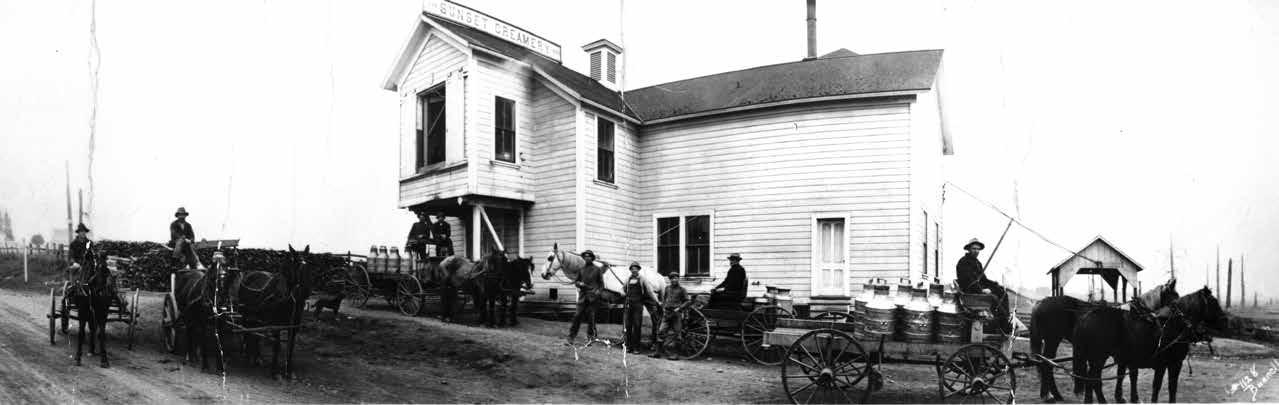
Sunset Creamery, built in 1900. Location 1/2 mile northwest of Loleta. Photos via the Humboldt Historian.
I have been asked to tell you what I remember about
Loleta, or “Swauger” as it was originally called, but
was renamed Loleta about the turn of the century,
upon the suggestion of Mrs. Rufus (Martha) Herrick.
I came to this country from Denmark sixty-eight years ago, when I was seventeen. A group of us, numbering eighteen in all, left Denmark on May 8th, and arrived at Port Kenyon by boat, the Argo, on May 30, 1894.
Many of the persons in our group were relations of Peter Frey, so most of them stayed at his home. Mr. Frey had the Crown Creamery and a ranch rented from Mr. Nix Nisson. The rest of us were lodged in other Danish homes. “Happy” John Christensen, who is Orlan Christensen’s father, and I spent our first night in Humboldt County with the parents of Jimmy Jensen of Loleta, Mr. and Mrs. Svend Jensen. At that time, they lived across the Eel River from Singley’s Crossing, close to what is now Fernbridge.
The next day, they took me over to Swauger, where I started my first job in America working for Mr. Nis Petersen on his 370-acre ranch. This is the same ranch now owned by Orlan Christensen in Loleta and whose home is built exactly across the road from where the old Sunset Creamery was once located. The roads that now cross at that corner are called the Copenhagen Road and the Hawk Hill Road. At that time, it was called the Table Bluff road to Eureka, the only one at that time.
This ranch of Mr. Nis Petersen’s was rented from a Mr. Bagley of Springville, now Fortuna. The barn on this ranch, built in 1893, cost $1,000, and was built by a Swede named Holmberg. Lumber at that time was priced at $2.00 per thousand board feet. There was room for 100 cows and 10 horses in the barn. At that time, there were no dikes on the marsh lands west of Swauger, so when there was an unusually high tide, the salt water would come as far up the gulch as behind the hill, on which stood the one-room schoolhouse. This was on the northwest side of Loleta, where the West Wind Trailer Court is now.
As Mr. Petersen’s ranch had 200 acres of marsh land, he had the tide waters to fight. So, in many of his fields on the marsh, he had plowed his land up into ridges twelve feet wide the length of the field. In this way, the land became high enough to be above the ordinary tides, so it would give the marsh grass a chance to grow and provide feed for his cows and at the same time give the cattle a place to keep dry.
At the end of one of these fields was a big slough where, on a windy day, the water would be blown into waves two feet high. It looked so rough it was almost enough to make me seasick to watch it.
The land on the other side of this slough belonged to Cornelius Rasmussen, who had the Quill place rented. All the land west of us belonged to Rufus Herrick. I worked for Nis Petersen for two years. But it was four years before I had a chance to see Eureka. In 1905 or 1906, Mr. Petersen bought the ranch from Bagley for $35,000 or $36,000. The ranch was diked by this time.
In the late 1890s, Mr. Rufus Herrick owned 1,800 to 2,000 acres of marsh land. He was the only man with enough foresight to see the future value of that land. Mr. Herrick’s neighbors, Patrick Quinn and Hank Knight, only wanted a small amount of that type of land. They each homesteaded only eighty acres, but Mr. Herrick homesteaded close to 2,000 acres. Now, the government would pay a certain amount per rod [16.5 feet] for land reclaimed from the marsh. So, Mr. Herrick, Mr. Quinn, and Mr. Knight hired a Norwegian named Felton Dahle to supervise the building of dikes for them. Dahle hired a crew of Scandinavians who did the job by hand with shovels, spades and wheelbarrows. These dikes were only six to twelve inches, and all tides would go over them.

The card to which this picture was attached had the following caption typed on it: “Loleta’s foremost milk processing plant from 1892 until the present.” Golden State Creamery Co.
But as they actually were dikes, the government paid the landowners for reclaiming the land. This made it possible for Mr. Herrick to have his dikes built higher so that only the highest tides would flood his land. Marsh grass then started growing, and soon there was feed enough so cattle could be pastured at 50¢ per head per month for all that came back alive. Sometimes remains of cattle and horses would be found in the blind sloughs that ran in every direction on the marsh. The animals had died of starvation or had drowned as the tides came in.
An Italian named Serafini rented a few acres of marshland from Mr. Herrick. Both these men kept a few milk cows, and I remember seeing them come to the road with two small cans of milk in the back of their buggy on their way to the Diamond Spring Creamery at Swauger. At times, they hauled it back home again as the creamery had rejected it as being unfit for their use. The milk was bitter because the cows had been eating a yellow weed that grew on the marsh. As a result, Mr. Herrick found it difficult to meet his expenses, so occasionally he would sell some of his land to help pay taxes and the cost of diking. I’m not absolutely certain, but I believe it was at this time that Teichgraber brothers bought sixty acres, Mr. Waldner forty acres. Mr. Petersen paid $25 per acre.
There were many Danes who wanted to rent marshland from Mr. Herrick. Mr. Andrew Petersen rented 300 acres for $3.00 per acre per year for fifteen years; Cornelius Lorense and John Christensen 160 acres for $2.00 per acre per year for 10 years; Niels Schmith and John Holst 160 acres for $2.00 per acre per year for 10 years; and Erik Ericksen 160 acres for $1.50 per acre per year for 10 years. There were so many Danes who settled in this particular area that it was soon named “Copenhagen,” and the road that served it was called “Copenhagen Road.”

Diamond Springs Creamery in Swauger (Loleta) before it burned down.
All the Danes went into the dairying business, resulting in a great increase in milk deliveries to the Diamond Spring Creamery at Swauger. At the time, it was a co-operative creamery owned by several dairymen, who were: Mr. Foss; Mr. Charlie Dickson; Mr. Elliot, father of Wilsey Elliot; Mr. Perrott, grandfather of Henry Perrott; and perhaps a few others. They finally sold their shares in the creamery to the Gold Brook Creamery, which later sold to Smith & Co. They in turn sold to Libby, McNiel & Libby, who sold out to Golden State Creamery, which is now one of the last two remaining creameries in Humboldt County [as of 1964, when this was written].
As the population in Loleta got bigger, the people of the town started to complain about the smell from the hogging, which gave Mr. Foss a chance to offer his eighty acres on the marsh to his creamery for $25 per acre and in addition furnished them a strip of land twenty feet wide for road purposes and a pipeline right-of-way to pump the milk through one and one half to two miles long. Now they had to have somebody to attend to the hogs, so a man by the name of Jake Petersen offered to build them a house free of charge, but for them to furnish the material, if they would give him a job; so they did. That house is there yet and cost $100. It is 24 × 26 feet and 6 feet from the ground; having withstood many floods, storms and the big earthquake of 1906. The owners of the ranch are now Mr. and Mrs. Langhen, who bought from John Helt August 1, 1961. I sold the ranch to John Helt November 1, 1920. My first three children were born in that $100 house.
It was about 1899, when Swauger had been renamed Loleta, that three brothers came to that town. They were the Mitchell brothers. One was a schoolteacher who taught in the small school in Loleta, the second started a blacksmith shop where the Loleta Hotel now is, and the third went to Eureka to live and attend high school there.
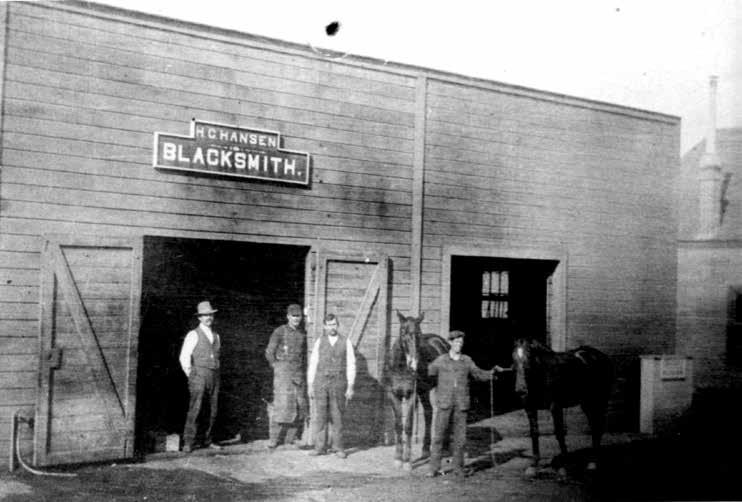
H. C. Hansen Blacksmith.
This third brother was Clyde Mitchell, well-known by all creamerymen and dairymen. The second Mitchell brother, who was the blacksmith, later sold his location to a man named Hans Clausen, who built the hotel there. The blacksmith shop was moved down to the southwest corner of Montgomery and Market Streets where it later became the property of Chris Hansen, who operated it for many years.
Alongside Mr. Hansen’s blacksmith shop, a Mr. Sowash built a harness shop. Mr. Sowash was also a judge for several years. Halley Brothers built a store on Montgomery Street next to Sowash and rented it to a Martin Ericksen. Mr. Frank Bertsch put in 3 or 4 cabins alongside Ericksen’s store. On this same street, was Sam Merritt’s house, Holt blacksmith shop and house, and what you might call Van Duzen’s covered parking lot for horses and buggies of customers doing business in their store on the northeast corner of Montgomery and Market. On Market next to Van Duzen’s store was Mrs. Van Duzen’s home. Next, on the corner of Market and Main was Finney’s or Finney’s Saloon. If you followed Market Street up over and across the railroad track, you would find the Diamond Spring Creamery on your left. Back down on Main Street and directly across from the railroad tracks and depot, was the store of Dickson & Dickson.

Dickson & Dickson, in the picture, was built in 1893, before Bank of Loleta built circa 1910.
The Community Church in Swauger had been started and erected under the supervision of a Rev. Jasper, who came to the town in 1895. He also started a small newspaper here, which he later moved to Fortuna and published under the name of the Humboldt Beacon. Mr. Jasper also built a church over on the Island, along by the Excelsior Creamery, which was built in the same style as the Diamond Spring Creamery, near Peter Nissen’s corner—but neither the church nor the creamery is there anymore.
There is just this one last incident in Loleta’s early history that I want to tell you about. It proved the risk of selling real estate in those days in that part of our county. Mr. Herrick had a wealthy prospective buyer coming from back east to buy his entire ranch. So, Mr. Herrick asked permission of Mr. Nis Petersen to use the part of the road (now Copenhagen Road) that ran through his ranch.
Originally, this road had been graded to become a railroad bed for some railroad company which was going to run the track around Table Bluff. But the Vance Company, which built their railroad to Eureka through Table Bluff, probably bought the other company out and the land reverted to its original owners. So, these owners fenced off the old railroad right-of-way, and it was this road Mr. Herrick wished to use when his prospective buyer arrived. He could have taken the buyer up over the Bluff and then down to his ranch but, up from the top of the hill, the ranch looked like it was half-submerged and cut up in small sections. This was the impression Mr. Herrick wanted to save the buyer from by going across the lower road.
Everything went well and Mr. Herrick was talking and stressing all the good points of the ranch to the wealthy buyer when, all of a sudden, the Easterner disappeared into a blind slough! Needless to say, that ended the sale, and the buyer took the next boat back home.
###
The author, born Jorgen Matthiesen in Denmark, wrote this article in 1962. He passed away three years later at the age of eighty-eight and was buried in the Table Bluff Cemetery alongside his wife, Olga, who died in 1935 and his son, Jakob, who died in 1978.
###
The story above is excerpted from the Spring 2024 issue of the Humboldt Historian, a journal of the Humboldt County Historical Society, which itself had reprinted it from a 1962 issue of the Society’s newsletter. It is reprinted here with permission. The Humboldt County Historical Society is a nonprofit organization devoted to archiving, preserving and sharing Humboldt County’s rich history. You can become a member and receive a year’s worth of new issues of The Humboldt Historian at this link.
OBITUARY: Eileen Frances Fox Parker, 1949-2025
LoCO Staff / Saturday, April 5, 2025 @ 6:56 a.m. / Obits

Eileen Frances Fox Parker, 76, passed away on March
30, 2025, leaving a devoted family behind.
Born on March 18, 1949, at Providence Hospital in Washington, DC. She was the first-born child of Edward and Josephine Noone Fox. She spent her early years growing up in District Heights, Maryland. She married the love of her life, James B. Parker, on February 4, 1967, at Mount Calvary Church. They lived in Stevensville, MD where they raised two children, Victoria and Buzz. In the early 1980s the family moved to Fullerton, Calif. and later to Arcata, to be near their grandchildren, Amelia and Nicholas.
She is also survived by her siblings, Barbara, Carol, Ed, Jeanne, Bill and Bert and multitudes of nieces and nephews.
Eileen’s legacy is one of love, generosity, and unwavering dedication to her family. She was an avid fan of the Humboldt Crabs Baseball team, who play at the Arcata Ball Park, and the San Francisco Giants. Her presence will be deeply missed, but her spirit will live on in the hearts of all who knew her.
In lieu of flowers, donations can be made to the Humboldt Crabs in Arcata.
###
The obituary above was submitted on behalf of Eileen Parker’s loved ones. The Lost Coast Outpost runs obituaries of Humboldt County residents at no charge. See guidelines here. Email news@lostcoastoutpost.com.
Former Preschool Administrator Exonerated By State Investigation Into the Reporting of a Child Abuse Incident at Winzler Children’s Center Last Year
Ryan Burns / Friday, April 4, 2025 @ 12:10 p.m. / Education

Winzler Children’s Center, at 719 Creighton Street in Eureka. | Photo by Andrew Goff.
###
On the morning of Feb. 29, 2024, an aide at Winzler Children’s Center was arrested on charges of child abuse for allegedly throwing a four-year-old preschooler against a wall the previous afternoon.

Rice. | Submitted.
At the time, Elizabeth Rice was in her second year as director of early childhood development and special education at the Eureka preschool. She hadn’t witnessed the incident, but she’d been dealing with the fallout: notifying her supervisor, calling the child’s parents, speaking with staff and being interviewed by a police officer.
The violent event and its immediate aftermath were traumatic and frustrating, Rice said in a recent interview — frustrating because for months she’d been requesting extra help to manage the students, several of whom had challenging behavioral issues. Some had been diagnosed with severe autism. Others were prone to violent outbursts or running out of the classroom.
“There was some really dangerous and scary behaviors happening,” Rice said. “Teachers were overwhelmed and stressed.”
She had asked for additional classroom staff and outside agency support including one-on-one aides, board-certified behavioral analysts and school psychologists. But her requests were denied, with her immediate supervisor, Winzler Director of Student Services Lisa Claussen, citing the cost, among other factors.
The aide who’d allegedly thrown the child into a wall, Alice Hellen Abler, was briefly alone in a classroom with seven kids shortly before she “snapped,” as Rice put it. According to official reports, Abler reacted after the kid snatched a toy away from a three-year-old girl, causing her to cry. An aide witnessed this. Afterward, the victim was sore but had no marks or bruises. (Abler’s case remains open pending a mental health diversion hearing. “She’s petitioned for that [diversion] and we’re opposed,” District Attorney Stacey Eades said in an email.)
What Rice didn’t know at the time was that the fallout from the incident would completely derail her career in early childhood education, a career she’d spent nearly two decades building.
The incident took place on a Wednesday. By the following Tuesday, Rice was ready to move forward.
“I had done the reports, contacted my supervisor [and] the parents, I talked to the police officer, and now we were working on how to heal as a group and recover from this,” she said. Instead, around 10 a.m., Claussen came to Rice’s office and told her she was being placed on administrative leave, pending the results of an internal investigation.
That Friday, Claussen called to inform Rice that her contract was being terminated effective June 30. When Rice asked why, Claussen said she didn’t have to provide a reason since Rice was a probationary employee, she said.
She later learned that the Eureka City Schools Board of Trustees had chosen not re-elect her as director, and she stood accused of violating school policy by failing to immediately report the abuse to law enforcement, the California Department of Social Services (DSS) and the child’s parents, and then allowing Abler to return to work the following day.
“They told me that I could either have ‘terminated’ on my record or else I could resign,” Rice said. “I didn’t know what to do. I felt pressured.”
Not seeing any other options, she submitted her letter of resignation on March 14 of last year, as the Outpost reported shortly thereafter. In it, she defended her job performance, expressed doubts about the validity of the internal investigation being conducted and wrote, “I feel blindsided by the district’s decision to terminate my employment.”
From there, things got worse. An investigation by DSS upheld the allegations, based largely on the testimony of Claussen. The state investigator later admitted that he never spoke with Rice to get her account of what happened, saying his supervisor advised against it while law enforcement was investigating the matter.
As a result of the investigation, DSS’s Community Care Licensing Division issued an exclusion order against Rice, permanently banning her from working or even being in any facility licensed by the department or certified by a licensed foster family agency, including not just child care centers but also adult residential facilities and senior care facilities.
Rice was informed that she had a right to appeal the decision, and after reading the conclusions in the investigation report she was determined to do so.
“I decided, ‘This is not right; this is not what happened,’” Rice said. She hired Ferndale attorney Amelia Burroughs to help write her appeal letter and then waited months for a hearing before an administrative law judge.
“I had a lot of anxiety, because not only had I lost my job, now I had this hearing looming over me,” she said. “I knew my truth and I followed the law and I did everything according to what my supervisor told me to do.” Regardless, she experienced “a long sense of anxiety and doom” waiting for the opportunity to defend herself.
When the hearing was finally held in November, the administrative law judge, Matthew S. Block, interviewed Rice as well as the teacher’s aide who witnessed the incident and the DSS licensing program analyst who conducted the initial investigation. His decision, which includes factual findings that directly contradict the allegations against Rice, was officially adopted at the end of January, 11 months after the incident occurred. He dismissed all of the allegations against Rice and lifted the exclusion order.
Below are some of the details from Block’s decision. Rice faced five accusations in the case, namely that she:
- failed to check on the child’s welfare after being informed of the incident;
- failed to contact law enforcement after being informed of the incident;
- failed to contact the child’s parents about the incident in a timely manner;
- failed to report the incident to Child Protective Services in a timely manner; and
- failed to prevent Abler from returning to work after the reported incident.
Block found that the facts contradicted all five of those charges. In the initial investigation, it was Claussen who alleged that Rice didn’t follow Winzler’s protocol for contacting parents after an unusual incident is reported. However, she was unable to provide the investigator with a copy of any such policy or state when it was enacted.
Claussen also told the investigator that Rice had waited roughly four hours before notifying the victim’s parents about what happened. But at the hearing that same investigator admitted that Rice had contacted them far earlier and had asked witnesses to document what they observed.
Again, the investigator’s recommendation for an exclusion order against Rice was based on Claussen’s testimony, but at the hearing in November he said he now believed Rice had “addressed the incident in a timely manner, and that she did not violate any of the laws regarding mandated reporting,” the ruling states.
Rice had spoken with the victim’s mom on Feb. 28, not long after the incident occurred, and later that evening she followed up with an email letting the mom know that Abler would be fired in the morning and reports would be submitted to Child Protective Services and Winzler’s state licensing agency.
“Thank you so much,” the mom replied. “I can only imagine how hard it is to have to make a phone call like this. Probably nearly as awful as it is to get the call. I appreciate the honesty and integrity of those who had the courage to report what they saw. My deep appreciation for the quick action taken on behalf of my baby.”
As promised, Abler was arrested for child abuse the next morning at about 8 a.m. It was the investigating officer with the Eureka Police Department who suggested letting Abler to return to work that morning so she could be interviewed. Rice said Claussen also advised her to let Abler come back the next morning so she could collect her name tag and release her.
Following the officer’s advice, Rice “contacted the Winzler office secretary and instructed her to have Abler go directly to the office when she arrived at school, so she would have no contact with the children who were being dropped off for the day,” Block’s ruling says.
Rice filed the necessary reports in a timely manner and over the next few days “notified the parents of every child who witnessed the incident and ensured them that Abler would not be returning to the school,” according to Block.
The Outpost reached out to Claussen and Eureka City Schools Superintendent Gary Storts to ask about this case and the discrepancies between Claussen’s allegations and the administrative law judge’s findings. Claussen replied via email:
As a general policy, we don’t comment on personnel matters. However, I can share that Winzler has made great strides in both enrollment and rebuilding community trust. This is due to the hard work and dedication of the personnel on that campus, who have weathered a trying time and remained committed to our students and community.
Storts also replied via email, saying only, “ECS cannot comment on confidential personnel and student matters.”
The Outpost requested a copy of the investigation report from the Eureka Police Department but was told that state law prevents the public disclosure of child abuse reports.
Looking back, Rice said it feels like she was set up to fail and then thrown under the bus by Eureka City Schools, and by Claussen in particular.
“She wanted to cover her own ass and the district’s reputation,” Rice said. “I just feel really lucky that I had the resources to be able to gain this advocacy and [hire] an attorney to support me.” She also got support from friends, teachers, Winzler parents and early childhood education professionals, with 15 people submitting letters of support to the DSS.
Rice feels that she was left in the dark during the initial investigation and never given due process from DSS’s Community Care Licensing Division or from Eureka City Schools. The impacts to her life were severe.
“I had to seek mental health support for this,” she said. “I went to a therapist, I started medication temporarily, my family finances were affected. It affected me on a deep, personal level that wasn’t necessary. It was all very heartbreaking.”
Rice now works for a local nonprofit, supporting seniors and adults with disabilities.
“I never thought I would do this work, but this is where I’ve landed,” she said. Even though she’s been cleared to work with kids again, Rice said it’s been hard to imagine applying for another job in early childhood education “because my name was in the media and it made it seem like I didn’t report child abuse.”
But at the request of one local family, she’s now working part time for Changing Tides Family Services as a respite worker for a child with special needs.
“I love working with preschool-aged children and have a lot of respect for ECE [early childhood education] teachers and the profession,” she said.
Rice spent 15 years working at Cal Poly Humboldt’s Children’s Center, starting when she was just a student. She also worked for Head Start and the College of the Redwoods Child Development Center. She earned her Master of Education degree from CPH in 2021.
Asked if she might return someday to working in early childhood education, Rice said it’s not out of the question “because that’s a lot of where my passion lies.”
She may never go back to being a classroom teacher or preschool administrator but sees opportunities to join the field in another way, possibly by working on policy or in a job affiliated with the California Department of Education.
“But for now I do feel like I am still recovering,” she said, “and I’m jaded from that experience.”

The Winzler campus. | Photo by Andrew Goff.
Fight Over Phonics: Will California Require the ‘Science of Reading’ in K-12 Schools?
Carolyn Jones / Friday, April 4, 2025 @ 7 a.m. / Sacramento

Teacher Katy Reese, center, works with students in a literacy class at Oakland International High School in Oakland on March 7, 2025. Photo by Florence Middleton for CalMatters
This story was originally published by CalMatters. Sign up for their newsletters.
###
Can you spell deja vu?
The battle over the best way to teach children how to read has re-erupted in the California Legislature, as dueling factions haggle over a bill that would mandate a phonics-based style of reading curriculum.
The new bill, AB 1121, would require all schools to use a method based on the so-called “science of reading,” which emphasizes phonics. Last year, an almost identical bill died in the Assembly after pushback from the teachers union and English learner advocates, who argued that curriculum isn’t effective with students who aren’t fluent in English, and therefore shouldn’t be required.
The stakes are high, as California’s reading scores have stagnated since the pandemic. Nearly 60% of third graders weren’t reading at grade level last year, with some student groups faring even worse. More than 70% of Black and low-income students, for example, failed to meet the state’s reading standard.
The bill would build on existing legislation that requires credential programs to teach phonics instruction to teachers-in-training. The proposed legislation would require existing teachers to undergo training in the topic.
Assemblywoman Blanca Rubio, a Democrat from West Covina, who sponsored both bills, hopes this year’s version will fare better than its predecessor, even though it only contains minor tweaks from its earlier version.
“At this point, it’s personal for me. I’m termed out in four years and I want to get this done,” Rubio said. “Reading is such a foundational skill. We need to create the best opportunities for all kids to read, not just for those who can afford after-school tutors.”
Phonics vs. whole-language
The science of reading refers to research that shows reading isn’t a natural skill, like learning to speak. It must be explicitly taught, and the best method, primarily, is sounding words out rather than memorizing whole words by sight or trying to guess a word based on its context — an approach known as whole-language or balanced literacy instruction.
California schools use about half a dozen reading curricula, and some are more phonics-based than others. Typically, schools use a combination of programs and give teachers some leeway. Proponents of Rubio’s bill say that system makes it hard to track which reading curriculum works and can make it tough for students who switch schools, if the new school is using a different approach to literacy. That’s why the state needs a uniform reading curriculum, they said.
The California Reading Coalition, an advocacy group, surveyed 300 districts statewide in 2022 and found that 80% were using older curriculum that didn’t focus sufficiently on phonics. The report highlighted 10 districts that have large numbers of high-needs students but also had high reading scores — including Bonita Unified in Los Angeles County, Clovis Elementary near Fresno and Etiwanda Elementary in San Bernardino County. The districts use a variety of reading programs, but most have an emphasis on phonics.
Nearly 40 other states require phonics-based reading instruction.
“In other states, we’ve often seen governors and state education heads take the lead in driving these policies,” said Todd Collins, an organizer of the California Reading Coalition and former Palo Alto Unified school board member. “That would make a big difference for California — leadership from the top is crucial for getting good results. … We have a state-level reading crisis. State-level problems call for state-level action.”
Opposition from teachers, English learner advocates
The California Teachers Association, the union that represents 310,000 of the state’s K-12 educators, fought the previous literacy bill, arguing that teachers need flexibility in the classroom. So far the union has not taken a position on the new bill.
English learner advocates have fought both bills particularly hard. The California Association of Bilingual Education said the latest bill “fails to address the needs of English learners” and would cost too much money because it requires teachers to undergo training.

Students in a literacy class at Oakland International High School in Oakland on March 7, 2025. The school primarily serves students who are newly arrived immigrants and offers foundational literacy and English language development for its multilingual learners. Photo by Florence Middleton for CalMatters


First: A whiteboard with learning materials in a literacy classroom at Oakland International High School in Oakland on March 7, 2025. Last: Marcela Smith, center, an instructional assistant, works with students in a literacy class at Oakland International High School in Oakland on March 7, 2025. Photos by Florence Middleton for CalMatters
They also said that California already has a literacy framework and the state should do a better job of promoting that rather than introducing a new program altogether.
Students who aren’t native English speakers need a more flexible approach to reading, the group said. Reading programs that are heavily focused on phonics are too narrow and confusing for students who struggle with English, especially if they can’t understand what they’re reading, they said.
Martha Hernandez, executive director of the English learner advocacy group Californians Together, said the new bill is a “non-starter” unless it can include a broader approach to reading instruction, not one that focuses primarily on phonics.
English learners, she said, need schools to teach phonics hand-in-hand with oral language development and reading comprehension in a way that’s specifically suited to second-language acquisition. Prioritizing phonics gives short shrift to those other skills, she said.
“Literacy is multi-dimensional,” Hernandez said. “English learners need a more comprehensive approach.”
The bill has not yet been scheduled for a hearing, as both sides continue to work on a compromise.
Evidence of English learner success
Some districts that use phonics-based programs have seen good results with English learners and low-income Latino students generally.
At Kings Canyon Joint Unified, for example, English learners scored almost twice as high on reading tests last year as their counterparts statewide, according to the Smarter Balanced assessments. Almost half of low-income Latino students met the state reading standard, compared to 33% statewide. Kings Canyon, located in Fresno County, uses a curriculum called Wit & Wisdom, which is phonics-based.
Last year at Bonita Unified, near Pomona in Los Angeles County, which uses a phonics-based program called Benchmark, English learners scored nearly three times higher than their peers statewide. Almost 60% of low-income Latino students met the state reading standard, nearly double the percentage of their peers statewide.
Rubio was an English learner in California schools, and feels strongly that phonics is the most effective way to teach students who aren’t fluent in English. It can help them learn English vocabulary at the same time they’re learning how to decode words, a useful skill in any language.
“Reading is such a foundational skill. We need to create the best opportunities for all kids to read, not just for those who can afford after-school tutors.”
— Assemblymember Blanca Rubio
Yollie Flores, president of Families in Schools, an advocacy group that’s cosponsoring Rubio’s bill, was also an English learner in California schools. Literacy was a priority in her family, she said, in part because her father never learned to read. A laborer from Mexico who never attended school past third grade, he “worked his whole life, but couldn’t read a rental application, he couldn’t read basic instructions, he couldn’t read letters from our school,” Flores said. “He always told us, you must learn to read. It was very important to him — he knew that our ability to read would open our world.”
Flores is frustrated by the state’s persistently dismal reading scores for English learners — a situation that she believes could be improved with a phonics-based program.
“It is mind-boggling and disappointing and frankly, I find it harmful that (the California Association of Bilingual Education) would oppose something that could help all kids, including bilingual students, succeed in school and life,” said Flores, a former Los Angeles Unified school board member. “There is a vast body of research from the most respected reading scientists in the world telling us one unequivocal truth: there is a specific, evidence-based approach to teaching children to read. I struggle to understand why they are fighting it.”
Gov. Gavin Newsom hasn’t taken a position on the bill, but has been a strong supporter of literacy generally. He championed a screening test for dyslexia, which will be given to all kindergarten-through-second-graders starting this fall; approved funding for 2,000 literacy coaches to work in high-needs schools; and fought for transitional kindergarten for all 4-year-olds, which is intended to boost students’ reading skills.
Over the past few years, the warring factions of the literacy battle have found common ground, publishing a pair of papers that essentially call for a truce. In the papers, both sides agreed that English learners have unique needs when learning how to read, and any formal policy or curriculum should address those needs. They also agreed that both sides should dispense with labels and over-simplifying the various approaches to reading instruction, and look at the issue with more nuance.
The truce doesn’t seem to have reached the Legislature, though. So far, English learner groups remain opposed.
‘Unlocking something’
At Oakland International High School, a public school for recent immigrants, nearly all students are English learners and a majority read at a kindergarten level when they enroll. That’s because they’ve had little formal education in their home countries or their schooling has been disrupted, in some cases for years.

International flags hang in the cafeteria as the courtyard is reflected on a window at Oakland International High School in Oakland on March 7, 2025. The school primarily serves students who are newly arrived immigrants and offers foundational literacy and English language development for its multilingual learners. Photo by Florence Middleton for CalMatters
But teachers there use a phonics-based approach that’s tailored to English learners, with good results. A student will learn to sound out the word “hop,” for example, while seeing a picture of a person hopping, then spell “hop” and read “hop” in a passage. They learn to connect the sound of a word with its meaning.
“When they start to see the patterns and rules, it starts to make sense and they get excited,” said Aly Kronick, a literacy teacher at Oakland International High for the past 10 years. “It’s like they’re unlocking something. They feel successful.”
She said the process can be slow, but within two years students go from minimal literacy skills to reading whole passages with high levels of comprehension. Some students have even gone on to four-year colleges. One student went on to become a bilingual teacher. Others have returned to the school after they graduated to lead phonics instruction in the classroom.
Rachel Hunt, a parent in Los Angeles Unified who’s a former teacher and school principal, has been a proponent of phonics-based reading instruction. She noticed firsthand the importance of a good reading program when her family moved from Massachusetts to California about eight years ago. Her child, who uses they/them pronouns, was in second grade when the family enrolled them at an elementary school in Los Angeles County that was using a phonics-based curriculum. Although her child was reading at grade level, they struggled with the ability to identify sounds, which affected their spelling skills.
“They were so behind in that regard,” Hunt said. “They felt so self-conscious. Other kids would call them ‘stupid.’ They developed a lack of self-esteem which was really damaging.”
Her child eventually caught up and is now a sophomore at Eagle Rock High School near Glendale, where they’re an avid reader and doing well.
“If you see that a majority of kids aren’t reading at grade level, and we know that explicit (phonics) instruction works, it seems obvious that this is something we should be mandating,” Hunt said.


