Press release from the Humboldt County Sheriff’s Office:
On Nov.16, 2025, at approximately 12:33 a.m., Humboldt County Sheriff’s deputies were dispatched to a residence in the 7300 block of State Highway 36 in Carlotta for a reported physical assault. While en route, deputies were advised that the suspect had attacked his 70-year-old mother and fled the scene.
Upon arrival, deputies contacted the 70-year-old female victim, who reported that her son, 43-year-old Matthew Warren Bowen had physically attacked her. She told deputies that she attempted to lock herself in a bedroom to prevent further assault, but Bowen forced his way inside, struck her multiple times and slammed her into the furniture. The victim sustained minor injuries and did not require immediate medical attention. Deputies contacted the on-call judge, who granted an emergency protective order for the victim.
Deputies searched the surrounding area for Bowen, but he was not located.
At approximately 8:06 a.m., deputies were dispatched back to the residence after a neighbor called the Humboldt County Emergency Communications Center to report that Bowen had returned. Upon arrival, deputies searched the property and eventually located Bowen hiding in a crawlspace underneath the house. He refused multiple commands to exit, and after several hours of negotiations, deputies sought a warrant for his arrest. Once the warrant was obtained, deputies again attempted to get Bowen to surrender, but he continued to refuse. Deputies then deployed less-lethal chemical agents into the crawlspace.
Bowen subsequently exited the crawlspace and surrendered to deputies without further incident. He was transported to the Humboldt County Correctional Facility, where he was booked on the following charges:
273.6(a) P.C. Violation of domestic violence court order
368(b)(1) P.C. Cause injury to dependent adult
1203.2(a)(1) P.C. Violation of probation
148(a)(1) P.C. Resist/Obstruct peace officer
245(a)(4) P.C. Assault likely to produce great bodily injury
Anyone with information about this case or related criminal activity is encouraged to call the Humboldt County Sheriff’s Office at (707) 445-7251 or the Sheriff’s Office Crime Tip line at (707) 268-2539.
Matt Ritter (L) and Michael Kauffmann (R) visit the world’s largest juniper in the Sierra Nevada, California. Photo by Joe Johnston/University Photographer/Cal Poly 7-8-25.
###
Backcountry Press is one of Humboldt’s great cultural institutions. We at the Outpost love it very much and send it a million congratulations on its latest triumph.
###
Press release from Backcountry Press:
Backcountry
Press, a small but mighty natural-history publisher based in Humboldt
County, is honored to announce that California Trees: A Field Guide to the Native Species, co-authored by Cal Poly San Luis
Obispo botany professor Matt Ritter and Kneeland-based ecologist
Michael Kauffmann, has been awarded the 2025 National Outdoor Book Award (NOBA) in the Nature Guides category. This national
recognition shines a spotlight not only on the book’s exceptional
quality but also on the vibrant culture of ecological scholarship and
stewardship that thrives on the North Coast.
Selected by NOBA
for its clarity, scientific rigor, and exceptional design, California
Trees offers a vivid, accessible guide to all 95 native tree
species found across the state. Through full-color photographs,
detailed range maps, and clear botanical descriptions, the book
illuminates the stories of the trees that define California’s
landscapes—from fog-wreathed coast redwoods familiar to Humboldt
residents to the wind-sculpted whitebark pines of distant alpine
ridges.
“This award
reflects the heart of what we care about most,” said co-author
Michael Kauffmann from his home above the fog in Kneeland.
“Connecting people to the forests that sustain us has always been
central to the work we do here in Humboldt.”
Co-author Matt
Ritter adds, “California’s native trees are endlessly
fascinating, and our hope is that this guide inspires curiosity,
stewardship, and a deeper understanding of the natural world.”
Created by two
long-time educators and field scientists, California Trees
blends expertise with approachability—inviting seasoned botanists,
hikers, students, and casual nature lovers alike to explore the
living diversity of the Golden State. Their collaboration brings
together decades of research, field experience, and teaching,
resulting in a guidebook grounded in scientific integrity and shaped
by a shared love for California’s forests.
For Backcountry
Press—headquartered in Kneeland and known for elevating Northern
California voices in natural history—this honor is especially
meaningful. The National Outdoor Book Award celebrates books that
enrich our connection with the outdoors, and this recognition
highlights both the craft behind California Trees and the
mission that drives Backcountry Press: helping people deepen their
relationship with place.
“We’re
grateful for this honor,” said Backcountry Press co-owner Allison
Poklemba. “But even more, we’re grateful for every reader who has
taken this book into the field, who has paused beneath a tree and
wondered at its story. That curiosity is the beginning of
stewardship.”
California
Trees is available now through Backcountry Press, Humboldt County
booksellers, and independent bookstores statewide.
To learn more or
order a copy, visit: backcountrypress.com
Backcountry Press
is dedicated to publishing high-quality books that celebrate the
natural world. Based in Humboldt County, California, our
titles focus on hiking, ecology, and environmental stewardship,
inspiring readers to connect with and protect the landscapes they
love.
Turkeys at a farm near McKinleyville. Photos via the Humboldt Historian.
###
Author’s Note: A former poultryman and
I were reminiscing about the past. We
didn’t have answers to some questions. A
search in the files of the county library
and Humboldt State University historical records provided very limited information. The persons about whom we were
interested had passed away, as had most
other former poultrymen. Consequently,
much information has been lost — permanently.
From that developed the idea of recording for the future something of the past
poultry history of the county.
As there are no operating poultry in
farms in the area, there are no opportunities for field trips by current
FFA classes, or children interested in
poultry. Soon teachers will not have had
the pleasure of watching a hen mother her
brood, will never see hens scratching in
the hen house litter, will never hear the
rooster crow at the crack of dawn! Just as
the urban child says all milk comes from
the cartons in the store, soon people will
be saying eggs also come from the store,
never realizing all that goes on behind the
scene to have fresh eggs available for
breakfast.
This writing may be of interest in future years and provide a picture of the
poultry industry that once was there.
When one tries to determine who had
the first poultry in Humboldt County, or
when the first poultry came into the
county, or for that matter any information about the facts of poultry in the
county, one has about as much success as
the child on a fruitless search for the
“hen’s tooth.”
###
It is a safe assumption to make that
there was poultry of some kind — whether
it be ducks, geese, chickens or turkeys — in
the county shortly after the first
settlers arrived. Early accounts of the
settlers of the West often mentioned
milch cows and chickens.
There appeared to be a considerable
amount of initiative on the part of local
agriculturalists in the county. The
County Assessor’s first report for the
year 1854 indicated potato crops, 1,400
head for stock raising, 412 milch cows,
grain crops. The year 1857 reported all
kinds of fruit trees now in production, as
well as grapes.
Dairy production took a turn toward
an important business. In 1855 an enterprising merchant of Union (Arcata)
advertised 3,000 pounds of “Premium
Eel River Butter” and Humboldt
cheese.
Ten years later, in 1865, it was reported again by the County Assessor’s
Office that there were 8,100 chickens,
123 ducks, 175 geese and 303 turkeys in
the county.
As the population increased, so did the
demand for food products. A considerable amount of butter was exported to
the mining and lumbering camps of
other parts of the State. More importantly, the San Francisco market was
putting a premium on Humboldt-produced butter. Success in this area could
not help but stimulate the thinking
about and the production of other crops
in the area, such as eggs.
The development of the County area
did not go unnoticed either locally or at
the State level. In the early part of the
20th Century, Humboldt County Promotional and Development Committee
was formed. It is quoted in both the 1915
and the 1916 issues of Humboldt County,
California, published by Ward-Perkins-Gill Company as follows:
There are opportunities galore for
commercial chicken raising in Humboldt County. It is so easy to produce
abundant food for fowls on the rich hill
and bench lands that only a reasonable
knowledge of chicken raising and reacess. On such lands there is an abundance of small insects for the young
chicken’s diet, and as the season advances myriads of grasshoppers make
such locations a chicken paradise. Such
lands are reasonably priced and a market for all out put is assured, for as yet
Humboldt County imports large quantities of eggs and chickens, whereas it
should be a large exporter of such products.
Although this report contains some
questionable statements it nevertheless
shows that there was aggressiveness on
the part of the Committee to promote
chicken and egg production.
An earlier report (1903) of the County
Assessor indicated that 2,372 dozen
eggs had been valued at $5,795.
Humboldt County, Califomia, by
Leigh-Irvine in the Historical Record
Co. of Los Angeles 1913 records: “In
forecasting the possibilities of poultry
raising in the county, the southern part
of the county should not be overlooked.
Those experienced in this line of work
are unanimously of the opinion that our
climatic conditions are such that,
coupled with our soil, make southern
Humboldt the ideal spot for poultry
business.”
Turkey Production
Turkey production started early in
the county in the hill or mountain area of
the southern part of the county and eastern edge of the Humboldt Bay.
Walter Eich, a former poultryman
now resides on Humboldt Hill. He remembers while a student in the Lincoln
Grammar School on Harris Street, Eureka, seeing aflockof about 600 turkeys
being driven down Harris Street by two
men on horseback with the help of one
dog who put straying turkeys back into
the mainflock,keeping the birds bunched together. These turkeys came from
Kneeland. At that time it was reported
there were a considerable number of
turkeys raised in the Kneeland area.
In the early days of raising turkeys in
the county, they were driven to a Humboldt Bay dock and shipped by boat to
San Francisco where they were processed and sold on the market.
Another accounting of turkey drives
comes from the book From Buckskin to
Teambells by Vera Snider Teague. This
story relates to one of the incidents told
to her by her brother, John Snider, an
old-time teamster.
In the days of the pioneers, livestock,
including geese and turkeys, were often
driven to market. Since transportation
presented a problem, as well as other
factors, such as a lack of refrigeration,
the animals or poultry must be delivered alive for transportation was slow
and uncertain that the produce would
spoil before reaching its destination unless delivered on foot.
In southern Humboldt County, however, I found another reason for large
herds of turkeys on the move. Many of
the ranchers found the costs of feeding
these large herds prohibitive so annually would start their herds out in the
early summer, keeping them on the
move for shipment in the late autumn.
One day when I was on my way from
Bridgeville to Blocksburg, I met a band
of perhaps five hundred or more turkeys. There were three herders, a man, a
woman and a boy in his early teens.
These were on horseback, but some
herders went on foot; they had two well-trained dogs. There was a supply wagon
drawn by two horses with all the supplies for the trip, including fencing for
temporary campsites for the turkeys.
I pulled out until they got their herd
safely past. Most teamsters were in the
habit of showing such courtesy.
Two men in the party usually went
ahead to locate a camp, where they set
up the necessary pen. Seldom did turkeys have to be fed, for by evening they
usually had all they could eat. But, if
they passed through sparse feeding
grounds, then grain feeding was necessary for the herd to bed down contented
for the night…
Ranchers welcomed the turkeys, and
when grasshoppers were heavy, some
ranchers offered pay to turkey herd
owners to come their way to help get rid
of the pests. For the service, besides pay,
they would provide quarters and food
for animals and human beings.
The herd I had made way for had
started from Freshwater, a small community about seven miles out of Eureka.
They had consumed grasshoppers across
Kneeland Prairie, over all the open
ranges and through the little valleys.
One could hardly estimate the many
miles traveled during a season, for the
herd was driven from ranch to ranch
and crisscrossed ranches where the best
feed was available.
By late August or early September
the herders would start their flock
homeward and the same grateful ranchers would let them fatten while gleaning
the fields after the grain had been harvested. On reaching their home ranch
they would be crated and hauled to the
dock at Eureka where they would be
shipped on steamships alive to their destination, to market, for there was as yet
no railroad to Eureka.
Those of us who might think otherwise, are surprised to find the turkey
provides no great ‘driving problem.’ As
far as I could determine, the turkeys
were as easy to drive as other creatures.
The procedure took patience, understanding and skill. The dogs were
well-trained for their tasks and should a
turkey start to wander from the herd,
the dog would seldom need to be told. He
knew his job and was always alert. He
would gently urge the turkey back to the
others. The turkeys seldom tried to fly.
This would happen only if they should
become extremely excited. Experienced herders and dogs knew how to
prevent this in most instances….
We found, though, that where crossing a river was necessary, the birds
were encouraged to make their own
crossing—by air! Turkeys driven from
Hyampom were roosted at night in trees
to protect them from predators.
Raising poultry was often a family affair. This photo comes from the Society’s Greater Eureka Chamber of Commerce collection.
Egg Production
The production of eggs early in the life
of the county was quite simple — farm
flocks of relatively small number, turned loose to primarily forage for themselves. In the late afternoon or early
evening a small amount of whole grains
was fed to entice them into the chicken
yard. At dusk they went to roost in the
hen house and were locked in for safety
from marauding predators which could
raise hovoc with birds in just a short
time.
One outlet for eggs was the local
grocer. In the absence of money, the
barter system of exchanging eggs for
merchandise was followed in the most
primitive time of the development of the
county. With the development of shipping agricultural products via ocean going vessels, and a larger variety of merchandise in the mercantile stores, primitive bartering gave way to the purchase
of eggs or credit to the account of those
who gained the favorable status of credit customers. This system worked well
until the merchant took in more eggs
than he could sell. He would have to pay
the freight to ship his surplus stock to
Eureka or the San Francisco market.
Obviously he would lower his price to
the local farmer.
With the passage of time more and
more people, probably listening to the
glowing words of the Humboldt Promotional and Development Committee, or
Mr. J.A. Robson who wrote in 1915, or
who read in the 1916 Supplement to the
Humboldt Times titled “Land, Dairy
and Development,” became interested
in poultry.
Some of the problems facing the poultry egg producers is described by Charles R. Farrer, president of the Poultry
Producers of Northern California in his
written work, “The History of the Poultry Producers of Northern California,”
dated December 1948. Mr. CH. Farrer
was the son of CF. Farrer of the Southern Humboldt area who was one of the
early egg producers in the county. Mr.
Farrer writes:
“During the ‘back yard flocks’ time,
Humboldt growers could only produce
according to the dictates of the local
store owners who were in turn regulated
by the buying power of the local population. Motivated by self interest, the
small private store owner would take
eggs only as payment for articles available in the store, including poultry
feeds, while paying very little cash. The
store’s policy was to insure the maximum of trade and so the owner would
seldom take more eggs from one person
than that person would take in goods.
People with chickens found that about
200 birds would furnish all the eggs that
could be traded for desirable store
items. Producers not only failed to receive cash, but they seldom got the
equivalent value of the eggs under this
one-sided barter system. People with
this sideline job, caught between high
priced feeds and good and low priced
eggs, continued to raise chickens only
because they hated to see the complete
loss of their investment in birds and
equipment.
The manner in which the eggs were
marketed brought loss of demand and
profits which hit both storekeeper and
producer. Due to the barter nature of
these transaction, the eggs were not
graded or candled, nor packed in either
crates or the now familiar one-dozen
cartons. Eggs sold in paper bags from
bulk heaps were often cracked, blood
spotted, dirty, half-rotten and even fertile which, of course, did not enhance
sales. Even the indiscriminate mixing
of varying sizes of eggs, all for the same
price, caused consumer reluctance.
A source of major loss to the storekeeper was the fact that seasonal fluctuations in egg production created an
over-supply that had to be shipped from
the county to find a market. As small
batches of produce were too expensive to
ship, it was customary for the store to
collect several hundred dozen before
shipping. As this collecting period lasted over possibly a month or so, many of
the eggs were rotten and badly evaporated, leaving them completely unmarketable.
As time passed, the few old stores
that had handled local eggs were forced
to close because of poor business management, confronted by better organized
competition. Often many of the ‘old timer’ run stores had most of their assets in
their books as bad charge accounts.
The opening of local branches of
chain stores was the first real market
possibility, but they, like other business-like stores, preferred not to handle ungraded and unpacked eggs. Here was an
outlet for production large enough for a
man to raise poultry full-time provided
the poultry raisers could work out a way
to prepare their eggs for retail handling.
To meet these identified problems,
several steps were needed. The first step
was the production of clean eggs, addressed in part through management
and housing. The second step was the
cleaning of any eggs produced with even
the minimal amount of foreign matter
on the egg shell. The third step was the
grading of eggs considering shell cleanliness, egg size/weight, and internal
quality.
The Poultrymen
The economic bind put on everyone by the Great Depression
of ‘29 was felt very strongly by
poultrymen of the county. They
looked for ways to increase their
profits. A relatively new organization, the Poultry Producers of Northern California
(P.P.N.C), worked hard to help
conditions for its members.
Some poultrymen dropped membership in the cooperative and tried to go on
their own. Only one was successful and
he was Harry McClosky, the largest egg
producer in the county.
McClosky was an elderly man, and the
ravages of time claimed his life immediately thereafter. His son-in-law, David
J. Henry, took a leave-of-absence from
his school administrator position to return to Humboldt to assume management of the operation.
One might wonder if the claim of J.A.
Robson, “One can with a reasonable
amount of intelligence and very little
knowledge of the business, make a very
good profit on poultry raising” might or
might not be true. Dave Henry was a
man of considerable intelligence but
minimal knowledge of the business
when he took over. But he was a very
practical man with an analytical mind.
He made an assessment of the business
of producing and marketing eggs: become more labor efficient, reduce your
operating costs, keep your houses full of
chickens at all times regardless of the
egg prices, produce the very best quality
eggs on the market, look for new markets for your products, and provide outstanding service to your customers. This
was his analysis of what it would take to
become successful in the poultry business in the early ‘30s. These things he
did, and became one of, if not the most,
successful producers of the day.
One producer of eggs. Miller Farms of
McKinleyville, had a good herd of high
producing cows. Their chickens provided an additional source of income
while members of the P.P.N.C. One side
benefit of chickens for them was the
fertilizer which helped maintain the
productiveness of their fields enabling
them to compete production-wise with
dairies on the river bottom lands of Mad
River. They were very strong in growing potatoes.
Miller Farms eventually bought an
egg vending machine. They sold extra
large and large eggs from the vending
machine located in an open-faced shed
at the edge of a drive- through lot on the
ranch.
After the closing of the P.P.N.C, Miller Farms sold their eggs to Hillcrest
Farms which had an extensive wholesale business in the area.
The farm has evolved into Miller
Farms Nursery and Florist Shop on
Central Avenue in McKinleyville.
Francis Randle
Francis Randle, an early poultryman
in the county, had a poultry farm on the
south slope of Bella Vista Hill facing the
old Mad River covered bridge at Hannah’s Crossing. This ranch of 20 acres
had only one acre cleared when originally purchased. At first he worked in the
woods to earn a living but evenings and
“off time” he cleared the land until eventually he had 17 acres cleared.
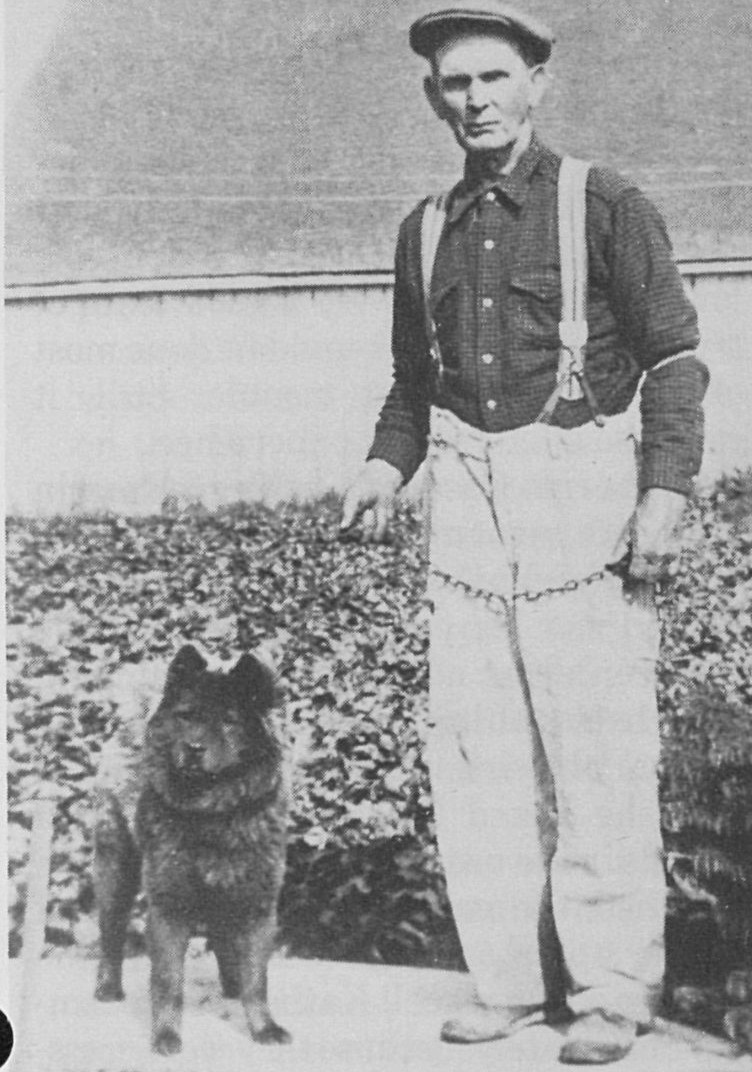
Francis Randall and friend.
He built houses for 900 White Leghorn hens which produced eggs which
he sold to the cookhouse and the grocery
of the Samoa Lumber Mill at Samoa. In
addition to the chickens, he also produced strawberries from 1,500 plants.
Randle had a close relationship with
Luther Burbank, and from him he obtained some of Burbank’s newly developed green garden peas. He developed
quite a good reputation for his berries
and peas which were eagerly sought
after. On May 1,1917, he sold this property to George Zender.
In 1917 Randle purchased 20 acres of
land at 11 and Q streets in Arcata and a
Mr. Gilardoni purchased the other 20
acres of George Zender’s farm.
On this property Zender built three,
165’-long buildings — two were double-deck houses and one was a single-deck
house. He purchased 750 chicks at a
time from Petaluma several times a
year in order to keep his laying houses
full. The chicks were hatchery-run. When five to seven days old, he
could tell the roosters from the pullets,
and if the feed prices were such that he
could profitably raise the rooster chicks,
he did so and sold them to Angelina Inn
and other surrounding customers. If
feed prices were high, the roosters were
disposed of. He added A. Brizard Co.,
and Seely and Titlow to his customers
for eggs.
A Mrs. Dunlap, who lived on 11th
Street in Arcata, cleaned and candled
eggs for Francis Randle at both the Mad
River Ranch and the Arcata Ranch.
His grandson Rodney Thompson used
to get a big thrill of riding with his
grandfather in the horse-drawn buggy
to Samoa to deliver the eggs and poultry, and then on the return trip to bring
home a load of wood.
Randle died in 1934 and the chicken
ranch was sold to the next door neighbor, Sebo Gilardoni, to expand his dairy
farm.
More Than
Producing Eggs
The work of producing eggs was not
all done on the farm; some work was
done in the P.P.N.C. egg rooms. The
following is taken from a letter sent by
Mrs. E. Lorene (Minnie) Allen, a 78-year-old widow now residing in Eureka,
who worked there as a child.
I was only a worker there for two
years or more. During the
Depression my parents had a long divorce. There was no work and my father
didn’t pay the $10 for each child per
month for alimony. So I quit school at
age 15, in the 10th grade, and I tried
work of any kind. Of course, I lied about
my age as we needed the work. I was
hired at the Poultry Producers as an
18-year-old.
I was put on the washing machine
with an older lady, Flonnie Cheetham
(she died two years ago). My job was to
scrape the worst manure off the eggs
and put them in a long trough with a
spiral metal rod that moved the eggs
over brushes to Mrs. Cheetham who
would receive them and place them into
divided wooden boxes in layers of 86
dozen. Then Jettie Hill, in our egg department, would load them on a hand
truck and take them to the next room to
be candled by at least a dozen girls.
Elsie McCartney was in charge and she
would go over them once again before
being placed on the high porch where
trucks waited to deliver them. I think, if
I recall right, she also placed the eggs in
cartons.
In time I was advanced to a candler.
We would work in a dark room and
would whirl two eggs in each hand to the
light globe and decide whether “blood
spots,” which appeared very red, were
present. These were put into boxes for
fertilizer, etc. Our best quality eggs
were called “blues,” which were large,
white-shelled eggs. These were sent
East as in that part of the country they
only ate eggs with pale yolks. If the eggs
weighed less and were as described
above, they were called “greens.” All the
others, due to any change in colors, were
put into several other grades.
This company, at the time I worked
there, was headed by Mr. Bob Moore. He
was a serious man and, as my first boss, I
was always afraid he’d fire me and I
desperately needed the $54 per month as
my mother had to have the $50 and I had
$4 for car fare. But trying to save some
money for Woolworth’s jewelry, I often
walked the 2 miles home on A Street.
We lived across from Mrs. Anderson,
the truant officer. She was a tough lady
and I could never use the front door as
she would catch me, so I used the alley. I
feared her.
A Mrs. Frances Roth was the office
manager along with two or three other
girls. Mrs. Roth and I became good
friends and now and then I was invited
to dinner, which I recall was a delight as
kids were always hungry in that dreadful Depression of several years.
Fond memories of the girls who
worked there are clear in my mind.
Most are dead now: Rose Wager, Ollie
Harris, Flonnie and Elsie and Helen
Nash.
Later I became an usher at the State
Theatre.”
###
Elwain Dreyer was the former owner and manager of Hillcrest Poultry Farm.
The story above was originally printed in the May-June 1992 and July-August 1992 issues of the Humboldt Historian, a journal of the Humboldt County Historical Society. It is reprinted here with permission. The Humboldt County Historical Society is a nonprofit organization devoted to archiving, preserving and sharing Humboldt County’s rich history. You can become a member and receive a year’s worth of new issues of The Humboldt Historianat this link.
Services providers for the homeless across the county are panicking after the federal Housing and Urban Development (HUD) department announced large funding cuts for permanent supported housing for the homeless yesterday.
“They’re killing people,” said Darlene Spoor, executive director of the Arcata House Partnership (AHP) in an interview with the Outpost today. “They’re making choices that will kill people.”
The HUD’s Continuum of Care (CoC) program funds housing for over 750,000 people nationwide and has a budget of over $3.5 billion, according to the National Low Income Housing Coalition. About 87% of the CoC funding goes towards “permanent supported” housing, a type of residency that doesn’t limit how long people who were homeless can stay in funded shelters.
However, HUD said they were now focusing on distributing CoC funding to temporary residencies, like shelters and weather centers, to support “accountability to homelessness programs and [promote] self-sufficiency among vulnerable Americans.” Only 30% of their funding will now go towards permanent supported housing.
Politicoestimates that upwards of 170,000 people might lose their homes. In Humboldt, the CoC funds many local programs for housing for the homeless, including the AHP and the Humboldt Area Foundation. [CORRECTION: A spokesperson for the Humboldt Area Foundation lets us know that this was incorrect.]
It’s a change in line with a Trump executive order from July called “Ending Crime and Disorder on America’s Streets,” which blames homelessness on drugs and mental illness and claims that permanent supported housing incentivizes people to be homeless addicts.
Future CoC funding may not be available until Sep. 30, 2026.
Spoor is worried that the funding cuts will clog an already stressed temporary housing system for the homeless in Humboldt. AHP alone serves over 900 people, and thousands more depend on CoC funding to stay housed. All of them make less than $19,000 a year (many who depend on Social Security and disability-aid programs earn even less than that) and will likely not be able to afford market-rate housing.
“It’s vengeful,” Spoor said. “This pulls the rug right out from under them, the safety nets that we in the homeless service world have made are gone. Gone.”
Spoor emphasized that the funding cuts will end up affecting everyone. Landlords who house CoC-funded tenants will lose a lot of income, and the lack of investment will spread.
“We are all committed to finding ways to get through this, and if the federal government is determined to walk away from our citizens who are the neediest, then we need to speak out,” Spoor said. “We need to talk louder. We need to yell. This is not the way our country takes care of our citizens who need us.”
###
The Outpost contacted Humboldt County’s Department of Health and Human Services for comment, but the department wasn’t able to provide a comment before the publication of this story. We’ll provide more information on Monday.
Press release from the District Attorney’s Office:
District
Attorney Stacey Eads has completed her review of the investigation
regarding the January 22, 2024, Humboldt County Sheriff’s Office
(HCSO) Officer-involved shooting of 43-year-old Daniel Danny
Martinez. A Humboldt County Critical Incident Response Team,
with members from the Humboldt County District Attorney’s Office,
Eureka Police Department, Humboldt County Sheriff’s Office, Arcata
Police Department, Fortuna Police Department, and California Highway
Patrol, conducted the investigation. Additionally, the Humboldt
County Coroner’s Office, Humboldt County CAST, Child Welfare
Services, and the California Department of Justice- Bureau of
Forensic Services, contributed to the investigation.
The
following summarizes the facts derived from the investigation, as
well as applicable law and legal conclusions of the District Attorney
regarding this incident.
Please
be advised the
following contains potentially disturbing content for readers
including descriptions of violence, child abuse, and death.
Factual
Summary
On
January 22, 2024, just before 5:45 in the morning, a 12-year-old boy
covered in fresh blood wearing only boxer shorts ran into Mission
Linen Supply, a Eureka business, looking for help after escaping from
his uncle who attacked him in his home on Union Street. Citizen
Curtis Bethel was there and called the police. Officers were
dispatched to the business at 5:47 a.m., with the first officer
arriving at 5:49 a.m.
The
boy had multiple injuries, including lacerations to his neck and
face, which were actively bleeding, and large abrasions. He told
officers that he and his cousin were attacked with a knife by his
intoxicated uncle, Daniel Martinez. Only the 12-year-old boy managed
to escape, leaving his cousin, who the boy feared may also be
seriously injured, and his two sisters at the Union Street home with
Martinez. Emergency medical personnel soon arrived and transported
the child to St. Joseph’s Hospital.
Less
than 10 minutes after the injured boy ran into Mission Linen Supply
for help, multiple Eureka Police Department officers responded to the
two-story Union Street home. Officers announced themselves and
directed Martinez to come to the front door. Martinez did not come
to the front door of the residence. Rather, in response to the
officers, he yelled out from an upstairs window, stating “No” and
“I don’t give a f***, I got four of them up here with me.” The
four people held hostage by Martinez included a 20-year-old woman,
and three children: ages 12, 8 and 4 years.
Officers
were gravely concerned for the welfare of the occupants, and after
repeatedly knocking on the door and announcing their presence as
Eureka Police Officers, they forced entry into the residence by
kicking in the front door. They again announced their presence from
the front entrance and observed fresh blood on the living room floor.
Officers
entered the home and soon discovered a frightened teenaged girl alone
in a downstairs bedroom. The interior stairwell leading upstairs to
the second floor was barricaded with furniture and other items.
Officers could hear Martinez’s voice and at least one other coming
from upstairs. The girl was safely escorted outside, and officers
made their way upstairs to a closed bedroom door.
Martinez
was barricaded inside the upstairs bedroom, and based upon the
available information at the time, officers believed he held at least
two additional people inside, one of whom may be injured. At 6:06
a.m., a Crisis Negotiation Team (“CNT”) response was initiated,
and one minute later an officer-initiated request for response by the
Humboldt County Sheriff’s SWAT team was activated. While awaiting
arrival of SWAT and CNT members, officers heard loud banging on the
floors and walls, Martinez shouting, sounds as if furniture was being
moved and what sounded like a pistol being manipulated. Officers
learned that Martinez had at least one firearm registered to him.
At
8:00 a.m., a Ramey
arrest warrant commanding the arrest of Martinez for committing
felonious assault with a deadly weapon was issued by Judge Lawrence
Killoran. SWAT team officers, accompanied by the primary and
secondary negotiators of the six member CNT, responded in a Lenco
BearCat vehicle to the Union Street residence to assist. By 8:30
a.m., SWAT officers relieved the Eureka Police Department officers.
For the many hours to follow, negotiators and SWAT team members
positioned themselves in an upstairs landing area just outside the
bedroom wherein Martinez was located. They attempted to effectuate
the safe release of the hostages and peaceful surrender of Martinez.
Shortly
before noon, as negotiations were still underway, the bedroom door
suddenly swung open, and a young adult female ran out of the bedroom.
As she fled, Martinez lunged in an apparent attempt to grab her with
one hand while holding a large knife in the other. She successfully
escaped and Martinez quickly closed the door. Officers learned from
her that one of the three children still held hostage by Martinez had
a laceration to his neck, an injury inflicted by Martinez with a
knife. Additional information regarding the layout of the room,
including Martinez’s use of a mattress to barricade the bedroom
door from inside, was obtained from the young woman.
The
children held inside by Martinez could be heard repeatedly asking him
for water. Negotiations continued. Then, a little over an hour
after the young woman escaped, the bedroom door flew open again. A
child with outstretched arms ran crying and screaming for help from
the room. The child, who suffered a laceration to his neck, was
immediately taken to receive emergency medical care. Negotiations
continued and a few minutes later Martinez released the two remaining
children. They had no apparent physical injuries. By 1:00 p.m., all
hostages were rescued.
Following
the hostage rescue, CNT members and mental health clinicians
continued negotiation attempts to achieve the safe surrender of
Martinez as he remained shut inside the bedroom. Minimal
communication was received from Martinez; however, he requested water
(which was provided), advised he was “going to die”, and that if
he exited, he was going to kill those outside the door. Additional
efforts were made to achieve Martinez’s safe exit and surrender,
including assistance from those familiar with Martinez, such as Yurok
Tribal Police Chief Greg O’Rourke who arrived and engaged in
negotiations with Martinez starting at approximately 4:00 p.m.
Nonetheless, the efforts did not gain Martinez’s compliance.
Shortly
before 5:00 p.m., officers were directed by their superior, HCSO
Captain B. Quenell, to breach the door to the bedroom wherein
Martinez was barricaded. The door was successfully breached and
swung wide open. Inside the bedroom, officers saw Martinez was
pacing before he quickly fled and shut himself inside a closet.
Communication
efforts continued, including with Sergeant Filippini who introduced
himself to Martinez. Sgt. Filippini told Martinez, “We would like
you to walk out so we can end this peacefully. If that is not an
option, we are going to deploy something called a pepper ball into
the closet. It’s going to make you very uncomfortable. I’d
prefer we didn’t have to do that. Would you please come out with
your hands up?” Chief O’Rourke, who encouraged his peaceful exit
prior to breaching of the door, let Martinez know he was still there
and for Martinez to come out and ask for him by name. Chief O’Rourke
repeatedly encouraged Martinez to peacefully exit from the closet,
spoke of Martinez’s strengths and courage, and pleaded with him to
accept the help Martinez requested. However, Martinez remained in
the closet.
At
5:03 p.m., Deputy Tyler Smith at the direction of SWAT Sgt.
Filippini, deployed five pepper balls at a gap between the floor and
bottom of the closet door. Additional SWAT team members present and
ready with their assigned coverage included two officers with tasers,
one with a rifle, and one “hands free” to effectuate efficient
handcuffing of Martinez. Moments after the pepper balls were
deployed, Martinez began coughing and expressed discomfort. Officers
implored Martinez to exit the closet with statements telling him to
“come on out, buddy”. Thirty seconds after pepper ball
deployment, Martinez said “Okay” after an officer says “Yeah,
come on out.” He’s told by another officer, “Empty handed,
come on out, please.” However, he does not exit, and indiscernible
words and yelling are heard coming from Martinez.
Just
less than 90 seconds after deployment of the pepper balls, Martinez
suddenly opened the closet door and charged the officers with a large
knife in his right hand, raised above his head. An officer instantly
announced, “He’s out” then warned the knife is “in his
hands”. SWAT team member Deputy Johnathan Waxler, who was assigned
to provide lethal coverage with his department issued MK18 .223/5.56
Daniel Defense Rifle, feared for his safety when Martinez charged at
him with a raised knife from just a few feet away. Deputy Waxler
fired rounds until Martinez fell to the ground and no longer posed a
threat. Simultaneously, Deputy Colton Ross, assigned as the “hands
free” officer, feared for his safety and his fellow officers, so he
drew his department issued Glock 17 Gen 5, 9 mm pistol and fired
multiple rounds at Martinez. Deputy Smith dropped the pepper ball
launcher to take hold of his rifle and began to raise it as he feared
Martinez was going to try and kill him or another on scene. He did
not fire any shots. Fearing the deadly threat Martinez posed, Deputy
Justin Pryor and Officer Kent Falkenstine, each being one of two
officers equipped with a taser, immediately deployed their assigned
taser. Sgt. Filippini experienced extreme fear for the lives of his
teammates and himself based upon Martinez’s armed exit from the
closet.
After
Martinez fell to the floor, he still held the knife tightly in his
hand. A large, serrated bread knife with a blue handle, was removed
from Martinez and he was handcuffed. Emergency medical care was
immediately provided, and he was transported to St. Joseph’s
Hospital. Martinez succumbed to his injuries at approximately 5:29
p.m.
On
February 26, 2024, Dr. James Olson, Forensic Pathologist, performed
an autopsy on Martinez. A total of five (5) .223 projectiles, one of
which was in pieces, and three (3) 9mm projectiles were recovered
from the deceased. A blood sample taken from Martinez was tested by
a forensic toxicologist. Positive findings of tested sample revealed
the presence of ethanol, with a 0.017 blood alcohol concentration, as
well as 240 ng/mL of amphetamine and 1100 ng/mL of methamphetamine.
The cause of death, as determined by Dr. Olson, was multiple gunshot
wounds to Martinez’s neck, thorax and abdomen.
Five
(5) expended Hornady .223REM cartridges and four (4) 9mmLUGER+P
cartridges were recovered from the shooting scene at the Union Street
residence. Each of the cartridges was forensically examined by
Senior Criminalist Dale Cloutier, California Department of Justice.
The expended 9mm cartridges were determined to have been fired in the
pistol used by Deputy Ross. The expended .223 cartridges were
determined to have been fired in the rifle used by Deputy Waxler.
Subsequent
investigation, including forensic interviews conducted by the
Humboldt County Child Abuse Services Team, revealed the children
rescued January 22, 2024, suffered extensive physical and emotional
abuse while in the custody of Martinez. Multiple incidents of
Martinez utilizing the large knife to threaten the children, damage
their personal belongings and inflict injury upon them were
disclosed. The children recovered from their physical injuries.
The
Law
Under
California law, an officer is justified in using deadly force when
they reasonably believe, based on the totality of the circumstances,
that such force is necessary to defend against an imminent threat of
death or serious bodily injury to the officer or another person.
Moreover, officers need not retreat or desist from their efforts due
to resistance or threatened resistance.
Pursuant
to Penal Code section 196, homicide committed by peace officers is
justified when the peace officer’s use of force complies with Penal
Code section 835a. Thus, the most pertinent law in this
situation is Penal Code section 835a, which states the following:
On
January 22, 2024, when Deputies Waxler and Ross discharged their
firearms, they justifiably used deadly force because the deputies
were confronted by a situation where they reasonably believed the use
of deadly force was necessary to defend against an imminent threat of
death or serious bodily injury, a threat posed by Martinez, armed
with a knife.
Prior
to law enforcement intervention on January 22, Martinez had assaulted
two children with a knife causing significant lacerations to their
necks, amongst other injuries, and made repeated threats of violence.
During nearly 12 hours of extensive negotiation efforts by CNT
personnel, with the assistance of family and community members
familiar with Martinez, he was encouraged to safely surrender. He
refused.
While
on scene SWAT team members heard Martinez threaten to injure and/or
kill his hostages, negotiators and officers. Moreover, a Ramey
warrant
based upon his violent felony assault against a child, was issued
directing officers to arrest Martinez. Therefore, when Martinez
rapidly exited the closet, raised the large knife above his head and
charged officers they reasonably believed the use of deadly force was
necessary to defend against Martinez, as he demonstrated the present
ability, opportunity, and apparent intent to immediately cause death
or serious bodily injury to the peace officers. Thus, Deputy
Ross and Deputy Waxler were legally justified in using deadly force
to defend themselves, and others, against the imminent threat of
death or serious bodily injury Martinez posed.
Conclusion
District
Attorney Stacey Eads has concluded the shooting was legally
justified, in that the actions of Deputy Waxler and Deputy Ross
complied with California Penal Code Section 835a. Martinez’s
family has been notified of her findings and legal determination.
The now-opened restrooms at Redwood Park. Courtesy of the City of Arcata.
Press release from the City of Arcata:
The City of Arcata is pleased to announce that indoor restrooms at
Redwood Park are now open to the public during regular park hours, from sunrise to sunset.
The restrooms are located at Redwood Lodge and can be accessed through the exterior entrances next to
the picnic area. Redwood Park is a beloved gathering place for residents and visitors alike and these
facilities will make it even more welcoming and family friendly.
This improvement responds directly to community feedback following the completion of the 2024
Redwood Park Playground Improvement Project which included a new playground that has quickly
become a popular regional recreation destination. The increase in park use, especially among families
with young children, highlighted the need for indoor restroom facilities.
Since the playground renovation was completed, both the Arcata City Council and the Parks and
Recreation Committee heard strong public requests to prioritize restroom access. In response, the
Committee made this improvement its top priority and the City allocated additional staffing resources to
ensure the restrooms can be maintained and open during regular park hours. The existing portable
restroom will continue to be provided in addition to the indoor facilities.
This is a great example of how community voices help make Arcata’s parks even better. The City invites
residents and visitors to enjoy Redwood Park’s playground, trails and open spaces now with improved
amenities for comfort and convenience.
For more information, please visit cityofarcata.org or call (707) 822-8184.
Klamath River, CA - This week, Ruby Williams, Keeya Wiki, and Kiahna Allen, participants from the Rios to Rivers Paddle Tribal Waters first descent of the Klamath River, head to Brazil to participate in COP30, the largest global United Nations event for discussions and negotiations on climate change. There, they will join scientists, world leaders, and activists to share the Klamath River Accord, a landmark declaration to protect free-flowing rivers and recognize dam removal as a powerful solution for climate resilience and environmental justice.
“The way our communities came together to undam the Klamath River can be done elsewhere,” said Ruby Williams, a Karuk person enrolled with Quartz Valley Indian Reservation. “I look forward to sharing our story, and helping others advocate for their home rivers”
Signed in July after the completion of the First Descent of the Klamath River, the Klamath River Accord is a call to action for global leaders and commits its signatories to protect free-flowing rivers, oppose construction of new dams, support dam removal as a climate solution, support river restoration, and uphold Indigenous rights. Inspired by the successful movement to remove four dams from the Klamath River. It was co-written by the Rivers for Climate Coalition, Native youth and staff from Ríos to Rivers, and river defenders and experts from around the world.
“Hydropower is often touted as a source of clean energy, but in reality, dams cause considerable harm to rivers, ecosystems, and communities.” Said Kiahna Allen, who is from the Confederated Tribes Of Warm Springs and San Carlos Apache Nation. “Putting a dam on a river is an act of theft. It denies the entire ecosystem—from the fish and wildlife to future generations—the right to clean, flowing water.”
“Undamming the Klamath River was a decades-long intergenerational fight,” Said Keeya Wiki, Yurok Tribal member “My greatest hope is that we can spare other communities from that fight.”
Ruby Williams, a Karuk person enrolled with Quartz Valley Indian Reservation, joins Brook Thompson, Yurok Tribal member, at COP30.