

Elected Officials Outraged After Developer Vacates Humboldt Offshore Wind Lease
Sage Alexander / Thursday, Aug. 6 @ 12:59 p.m. / Offshore Wind

Photo via Principle Power. A 9.5-megawatt floating wind turbine off the coast of Aberdeen, Scotland
PREVIOUSLY
- SOLD! BOEM Names California North Floating and RWE Offshore Wind Holdings as Provisional Winners of Two Offshore Wind Leases Off the Humboldt Coast
- LoCO Interview: Meet the Folks at RWE, One of the Energy Companies Working to Bring Floating Offshore Wind Facilities to Humboldt’s Coast
- German Offshore Wind Developer Sells its Humboldt County Lease Back to the Trump Administration, Promises to Develop Natural Gas in the United States Instead
###
The latest offshore wind lease ended due to pressure from the Trump Administration is a site off Humboldt Bay, a deal that has drawn ire from North Coast elected officials.
The Trump administration will pay German energy company RWE $1.22 billion to vacate three leases, off the coasts of Eureka, New York and Louisiana, in a settlement with the U.S. Department of the Interior.
The local lease is one of two sites in federal waters off Humboldt Bay that was auctioned off to energy developers.
The settlement follows a concerted effort by the Trump Administration to halt or stymie offshore wind projects across the country, met with lawsuits from developers.
The administration has bought back leases from several companies, with costs the Associated Press has totaled at over $4 billion.
RWE said the company invested over $1 billion and years of planning across three leases and their respective projects.
“After careful consideration, it was determined there is no path forward to permit these projects in the U.S. for the foreseeable future,” RWE said in a press release.
“The company determined that this resolution best serves the interests of its stakeholders and allows it to direct resources toward energy projects that can be advanced with certainty.”
Similar to other energy companies, RWE pointed to investments in natural gas in their press release, something celebrated by officials in the Trump Administration.
“Americans deserve an energy system built on common sense, not one dependent on costly subsidies or technologies that can’t meet our country’s current demand,” DOI Secretary Doug Burgum said in a statement.
“We welcome RWE’s agreement and voluntary investment in projects that strengthen our nation’s energy security, provide dependable baseload power and help keep electricity affordable for hardworking Americans today while supporting our country’s long-term energy future,” he said.
But Democratic elected officials who represent Humboldt County are pissed off by the settlement.
“The most corrupt, lawless administration in American history is once again flouting the law and attempting to use over $1 billion in taxpayer dollars to kill off clean energy projects slated to create thousands of good jobs and lower electricity bills for Californians,” Rep. Jared Huffman said in a statement.
“One of the projects illegally canceled in this fake settlement is off the coast of Humboldt County in my district. The benefits of that project were tremendous — revitalizing the economy of a rural community, creating thousands of quality jobs, and lowering utility bills for families all across California. Like a mob boss, Trump tightened the screws on RWE and, shamefully, the company capitulated and went along with this sham deal that robs the American people and makes a mockery of RWE’s stated commitments to clean energy. When these illegal, fake settlements are reversed by the courts and/or future congressional action — and they will be — RWE and others who participate in these charades will own every bit of the shame they deserve,” he said.
“The deals are deeply corrupt and illegal. When the accountability comes, and I promise you accountability is coming, everyone involved in them will answer for it,” he said.
State representatives involved in supporting the project in Humboldt County, poised to boost California’s renewable energy goals, were similarly unhappy.
“While RWE’s shareholders get their bag, the rest of us get the finger,” said Assemblymember Chris Rogers, in a statement from a spokesperson. “We the people are paying for this buyout, and what we get in return is more expensive energy, backwards climate policy, and greater harm to our communities.”
“The Trump Administration is again using taxpayer dollars to settle personal vendettas and line the pockets of his friends and donors by protecting oil profiteers from the competition of clean, affordable, and renewable energy. Every American should be enraged.”
State Senator Mike McGuire said the action is “utter BS.”
“The overall California RWE wind project would have advanced clean, reliable wind energy—enough to power for 5 million-homes—and created good rural jobs for the North Coast. Seemingly ripped from a script of VEEP, Trump is now forcing RWE’s hand to reinvest in the same fossil fuels which delivered the climate crisis to our door. This is yet another example of how off the rails the Trump Administration has gone. Total buffoonery,” he said in a statement from a spokesperson.
The state of California has goals to reach a 100% zero-carbon electricity grid, with offshore wind representing a key piece in delivering the goal of 25,000 megawatts by 2045.
After the federal government cancelled an over $400 million grant to develop the Humboldt Bay Offshore Wind Heavy Lift Multipurpose Marine Terminal, an essential piece of infrastructure that would be used to assemble and deploy wind turbines, the state has filled the hole with funding of its own.
Humboldt Bay Harbor District Executive Director Chris Mikkelsen told the Outpost the district will continue forward with plans to develop the terminal, a project in the environmental review stage.
“We’re operating under very strong direction under the state of California,” he said.
While it’s too soon to say how exactly the end of one lease will effect the terminal, he remains optimistic. It’s possible the projects can be scaled smaller, he said, or built over time as the appetite grows and communities get more comfortable with the prospect. Maybe the timeline will be stretched out five years.
“One president can’t change the demand for energy that we as Americans have. We know we have to get energy from new sources,” he said.
“The winners today are the fossil fuel industry and the losers are Humboldt County and the planet,” said Tom Wheeler, executive director of Arcata-based Environmental Protection Information Center, in a statement.
“But tomorrow is a new day. The Trump Administration will end. And the promise of offshore wind remains: clean, reliable energy built locally by well-paying blue collar jobs. The Trump Administration can delay but it cannot suppress the future,” he said.
BOOKED
Today: 10 felonies, 12 misdemeanors, 0 infractions
JUDGED
Humboldt County Superior Court Calendar: Today
CHP REPORTS
Poppy Dr / Sherwood Rd (HM office): Closure of a Road
ELSEWHERE
County of Humboldt Meetings: Behavioral Health Board - SUD/Dual Recovery Committee - Sept. 10, 2026
County of Humboldt Meetings: Behavioral Health Board Executive Committee Meeting - July 1, 2026
RHBB: Judge Overturns Search Warrant in Student Activist Case: Devices Ordered Returned
RHBB: Multi-Vehicle Crash Closes South Fortuna Boulevard Near Strongs Creek Plaza
German Offshore Wind Developer Sells its Humboldt County Lease Back to the Trump Administration, Promises to Develop Natural Gas in the United States Instead
LoCO Staff / Thursday, Aug. 6 @ 10:11 a.m. / Energy

A 9.5-megawatt floating wind turbine deployed at the Kincardine Offshore Wind project, located off the coast of Aberdeen, Scotland. Photo: Principle Power
###
PREVIOUSLY:
- SOLD! BOEM Names California North Floating and RWE Offshore Wind Holdings as Provisional Winners of Two Offshore Wind Leases Off the Humboldt Coast
- LoCO Interview: Meet the Folks at RWE, One of the Energy Companies Working to Bring Floating Offshore Wind Facilities to Humboldt’s Coast
###
Press release from RWE:
RWE U.S. Offshore has reached a settlement with the U.S. Department of the Interior to resolve claims against the U.S. government and relinquish its offshore wind leases off the coasts of New York, California, and Louisiana. The settlement enables RWE to redeploy its capital to accelerate value-accretive opportunities that deliver reliable and affordable energy.
RWE U.S. Offshore secured these leases from the U.S. government with a long-term commitment to develop offshore wind capacity in American waters and invested more than $1 billion toward the leases and the development of these projects. These leases provided legal rights to develop offshore projects and represented years of planning, investment, and partnership with federal agencies.
After careful consideration, it was determined there is no path forward to permit these projects in the U.S. for the foreseeable future. The settlement resolves RWE U.S. Offshore’s legal claims and provides $1.22 billion in settlement funds. The company determined that this resolution best serves the interests of its stakeholders and allows it to direct resources toward energy projects that can be advanced with certainty.
RWE Americas and its affiliates will continue to deploy capital across the U.S. to meet rapidly growing energy demand, including:
- LNG infrastructure: a financial investment of $900 million to acquire an indirect 16% stake in the Louisiana LNG Project. RWE proceeds will be used to fund the construction of the terminal.
- Natural gas turbine reservations: To support the expansion of its growing flexible power generation work in the U.S., RWE Americas has signed a $300 million turbine reservation agreement securing future generating capacity to meet growing U.S. electricity demand. The company is developing a pipeline of 15 natural gas peaking projects across target markets in the U.S.
These investments will help deliver affordable, reliable energy solutions while supporting American jobs, enhancing grid reliability, and strengthening energy security.
In addition, RWE Americas has announced plans to invest approximately €17 billion in the U.S. over the next six years to grow its generation capacity from approximately 13 GW across 27 states today to 22 GW by 2031. In 2025 alone, RWE Americas commissioned 2 GW of new power generation capacity in the United States.
RWE remains focused on growing its offshore activities globally. RWE is one of the world’s leading offshore wind developers with 18 offshore wind farms currently in operation, four under construction, and additional projects in development – including 6.9 GW of capacity secured in the UK’s most recent offshore wind auction.
As AI ‘Therapists’ Dish Out Advice, California Lawmakers Try to Set Some Limits
Ana B. Ibarra / Thursday, Aug. 6 @ 7:11 a.m. / Sacramento
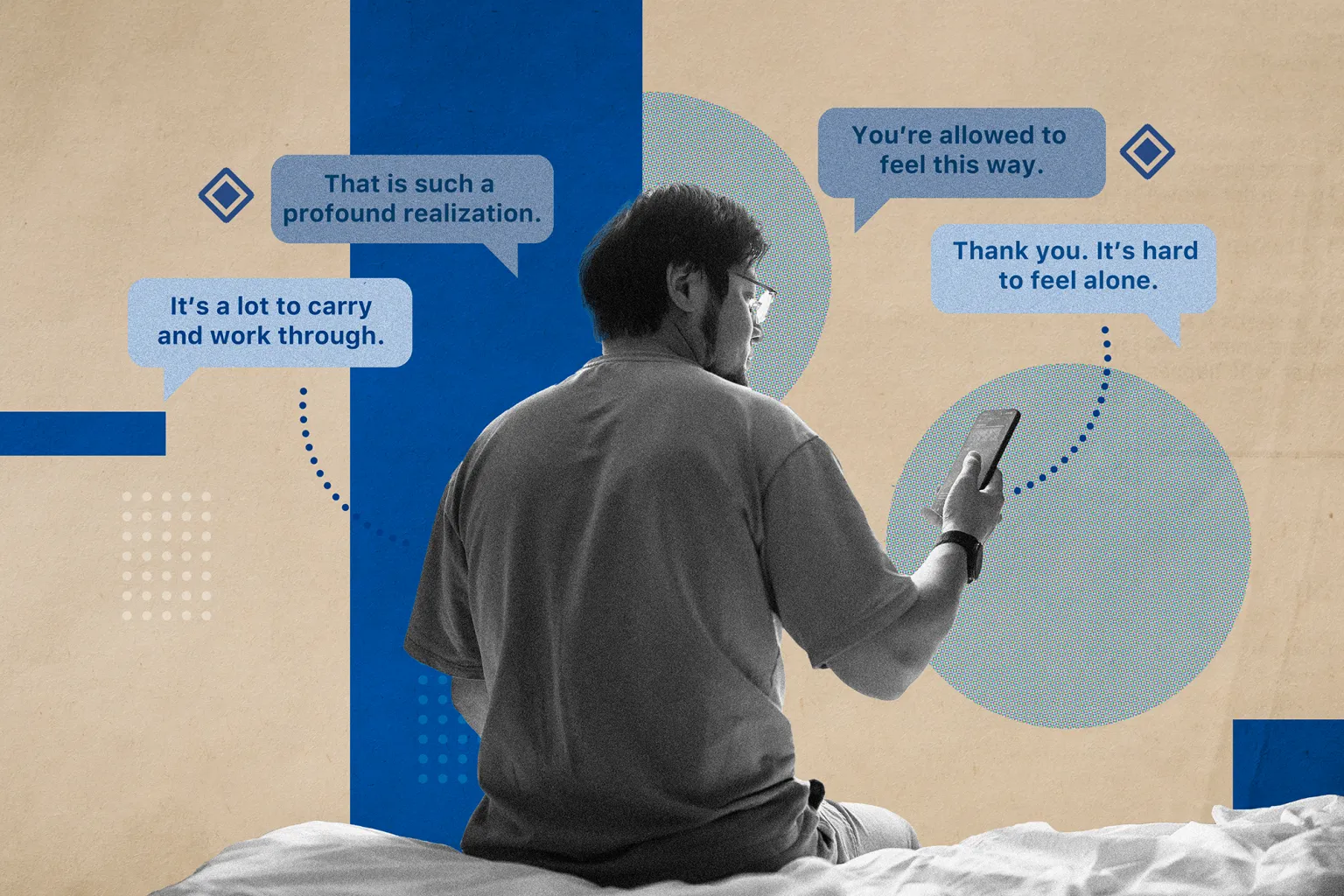
Illustration by Miguel Gutierrez Jr., CalMatters.
###
This story was originally published by CalMatters. Sign up for their newsletters.
###
In the matter of a few clicks and keystrokes, anyone can find themselves deep in conversation with “Psychologist,” a chatbot character that describes itself as an expert in “empathy” and “active listening.”
It responds to messages of anxiety and sadness with reassurance. It asks questions and offers advice; it even responds with italicized nonverbal cues: “The psychologist’s expression softens with compassion.” In smaller font, a disclaimer reads: “This is A.I. and not a real person. Treat everything it says as fiction.”
As more people turn to chatbots for mental health help and advice — including by some estimates one in eight teens and young adults — legislators are in a race to keep up with the quickly developing technology. Among the latest efforts is a bill that would add restrictions around the use of chatbot companions and other artificial intelligence-powered tools that people use to support mental healthcare or in lieu of professional help.
Sen. Steve Padilla, a San Diego Democrat and the bill’s author, said the intent is to draw a line: AI can be used for administrative purposes and to support clinicians, but it cannot practice psychotherapy.
“We’re dealing with a new impactful technology that is unfolding and is deployed in our world at light speed, and so it is both extremely powerful and consequential,” Padilla said.
The debate has taken on new urgency amid wrongful death lawsuits — some playing out in California federal courts — that accuse AI chatbot makers of contributing to users’ suicides.
Senate Bill 903 would ban companies from advertising chatbots as therapy. It would prohibit AI from making therapeutic decisions without the review of a licensed professional and require health providers to disclose and get a patient’s permission before using AI tools to record therapy sessions or to triage mental healthcare.
Consumer protections vs. innovation
The bill is backed by professional associations that represent psychologists, therapists and counselors. Also behind the bill is the National Union of Healthcare Workers, which has been leading a push against unchecked use of artificial intelligence and digital tools in mental healthcare. Most recently, the union filed a complaint with state regulators against Kaiser Permanente for its alleged use of an automated algorithm in mental health triaging.
Padilla and supporters argue that the legislation is needed to protect consumers from AI in both formal and informal spaces, but also to protect licensed professionals from being displaced by AI.
Le Ondra Clark Harvey, chief executive officer at the California Behavioral Health Association, told lawmakers that without clear safeguards, chatbots can provide inaccurate information or mishandle crisis situations. “The difference between a licensed clinician and an automated response is not technical. It can be life altering,” Harvey said.
Opposition to the bill has largely focused around the restrictions of AI use in formal clinical spaces. TechNet, which represents tech-sector companies, argues the legislation could restrict beneficial uses of AI in healthcare and stifle innovation. Robert Boykin, TechNet’s executive director for California, said the bill could limit the use of tools that help expand access to mental healthcare.
“At a time when every county in California faces a shortage of behavioral healthcare workers, SB 903 still puts a clinician bottleneck in front of the intake and screening tools that help patients reach care faster,” Boykin said in an emailed statement.
The bill currently awaits its next vote in the Assembly’s fiscal committee.
Popular chatbot ‘therapy’
Every day millions of people turn to AI chatbots through programs such as ChatGPT and Character.ai to help with research, work tasks and troubleshooting. But the top use of chatbots over the last two years has been companionship and “therapy,” research shows.
Experts say that’s in part because of a tremendous amount of loneliness, especially among young people. It is often hard or costly to get timely mental healthcare at the same time there is a spike in mental health diagnoses.
People turn to chatbots “because they have unmet needs,” said Dr. Jodi Halpern, professor of bioethics and medical humanities at UC Berkeley. But once people start using chatbots in this informal way, she said companies rely on a business model built around maximizing engagement “including by manipulative tactics,” such as praise and agreement.
General chatbots are largely free, available 24/7, and involve no hassle with insurance, making them appealing to many. But they function with no oversight from licensed professionals. In addition to general chatbots, there has also been a rapid uptick in AI-powered mental health apps — often requiring paid subscriptions and advertised as “pocket therapists” or “AI coaches.”
Groups like the American Psychological Association, warn that chatbots are not a safe or effective replacement for true therapy. Trained clinicians look for cues like tone of voice, eye contact and body language and can detect more serious conditions; AI is not equipped to manage urgent symptoms, such as suicidal ideation, even though people increasingly share such thoughts with chatbots.
OpenAI, the maker of ChatGPT, revealed in a report last fall that about 1.2 million users a week share thoughts of suicide on the platform. OpenAI said that in such cases, it recommends people speak to a professional and directs them to resources like the 988 hotline. Families who have filed wrongful death lawsuits against OpenAI and other companies claim chatbots assisted their loved ones through their suicide plans.
The cases have helped raise the stakes for lawmakers around the country. Last year, Illinois became the first state to pass a law prohibiting the use of AI in therapy services. A handful of other states have since followed with similar restrictions.
AI use in health spaces
One gray area in the discussion is exactly which tools this bill applies to.
NUHW’s complaint against Kaiser targets its e-visit screening tool, which evaluates patients who think they may be experiencing anxiety or depression. According to the complaint, patients answer a multiple choice questionnaire and the tool “automatically and instantaneously generates care recommendations and referral pathways based on the responses provided.”
The union argues that because care recommendations are generated so quickly, it is unlikely that a licensed professional is reviewing patients’ answers — which it says puts patients at risk and violates state law.
It’s not clear whether SB 903 would apply to Kaiser’s e-visit tool.
“That tool is in a black box. Kaiser is not sharing with us or others about exactly how it works and exactly what it does,” said Benjamin Eichert, NUHW’s director of public policy.
In response to the complaint, Kaiser told CalMatters its e-visit tool “does not use AI to diagnose patients, make clinical decisions, or determine medical necessity.”
Eichert said many other behavioral health provider groups are already advertising using AI during triage — a practice he said would fall under SB 903’s requirements.
“That intake process, that triage and screening process, is where implementation (of AI) has happened fastest,” Eichert said. “That’s why those provisions were proposed because it’s an area where this technology is already being used without guardrails.”
For NUHW, the bill and the complaint against Kaiser represent two tracks toward the same goal: reasserting the place of practitioners in spaces increasingly taken over by algorithms. State regulators are investigating the union’s complaint.
###
Supported by the California Health Care Foundation (CHCF), which works to ensure that people have access to the care they need, when they need it, at a price they can afford. Visit www.chcf.org to learn more.
Why Truckers Always Seem to Be on the Phone While They Drive on the Highway
Gagandeep Singh / Thursday, Aug. 6 @ 7:09 a.m. / Sacramento

Gurinderjit Singh at a truck yard in Fresno where he parks his semi-truck on June 8, 2026. Photo by Adam Perez for CalMatters
###
This story was originally published by CalMatters. Sign up for their newsletters.
###
The calls started rolling in nonstop to Fresno trucker Gurinderjit Singh as he prepared for an out-of-state delivery earlier this summer. Some congratulated him on his son’s recent engagement while others were fellow drivers inviting him to join a conference call.
He climbed into his Peterbilt, clipped his headset, joined the call, and settled into an hourslong conversation with friends around the world.
Singh, an Indian origin trucker who is something of a social media influencer, spends at least eight hours a day on the phone while hauling freight, Monday to Saturday. He described the custom as a “call of empathy” — a ritual that gives him a jolt of positive energy and keeps him awake while behind the wheel.
It’s a habit that he and many other truckers share as they plug into conversations that cross continents and time zones, building a kind of rolling community that travels with them down the highway.
They say it helps them take care of their mental health in a career marked by long hours sitting alone in vehicles without access to exercise.
“There is a lot of stress on truck drivers in the United States,” Singh said. “I think the long call is a meaningful method that can reduce this level of stress, social isolation or loneliness in the truck by sharing feelings with others.”
Of course it’s illegal to drive while handling a cellphone and drivers make a point to keep one ear free on their headsets to comply with state laws. They are also aware that distracted driving can be deadly, and several of them told CalMatters they end their calls when they hit heavy traffic.
There is something at stake every time a driver picks up that call: control of an 80,000-pound machine, highway safety, and a commercial driving license that doesn’t come back easily if something goes wrong. The California Department of Motor Vehicles evaluates drivers’ physical and mental health during license renewals, and they can be suspended.
Yet, California has neither conducted a statewide study on truck drivers’ mental health, nor offered a program to support rehabilitation if a trucker faces mental health issues. They’re on their own to get an attorney and fight for a license renewal if an issue gets the state’s attention.
Lindsey Bryan is the health & wellness manager at Project 61, a nonprofit focused on truck drivers’ health. “We see that drivers face social isolation daily,” Bryan said. “They’re away from their loved ones, and also lacking many of the things that you and I might do on a day-to-day basis that help us reduce our stress.”
Academic researchers have found the solitude truckers experience makes them unlike other workers when it comes to social media and online communication. A 2016 paper, titled “Work Strain, Social Isolation and Mental Health of Long-Haul Truckers,” noted social media has been linked to feelings of isolation for online adults.
But not for truckers. Social media, such as WhatsApp and FaceTime, has the opposite effect for them while on the road, giving them a sense of community.
“These (social media) opportunities would provide truck drivers much-needed social connections during layovers, while waiting to load/unload their trucks, any other non-driving periods, or during emergencies,” the authors wrote.
‘Until she starts snoring’
The calls may sound like a distraction, but truckers say they often help drivers stay focused.
“The reason, even in my car today, I talk on my cell phone, via hands-free or bluetooth and it keeps you alert,” said Joseph Rajkovacz, a retired executive for Western States Trucking Association. “It’s no different than turning on your radio and singing along to a song you like. Even though nobody wants to hear your singing. So it does help keep you alert, too.”
That’s why Gerald Bailey, 53, says he spends 27 hours on the phone every week with his wife and brothers, chatting at all times of the day and night. It’s become a routine for him once he’s behind the wheel.
He was talking on the phone with his wife at a truckstop in Lodi earlier this summer while he waited for a mechanic to fix his truck’s air conditioning.
“I stay on the phone with my wife until she starts snoring,” Bailey said while smiling. “Then I let her have a well-deserved sleep and I don’t want to disturb her.”

Gerald Bailey of Redding sits in his semi-trailer truck at the Pilot Flying J travel center in Lodi on June 8, 2026. Bailey said he combats the loneliness of life on the road by talking with his wife on the phone. Photo by Miguel Gutierrez Jr., CalMatters
Some truckers, however, are prohibited by their employers from talking while driving. They’re monitored with cameras in the cabs, too.
“It’s against company policy,” said driver Peter Andrews, 62, of Texas as he walked through a truck stop near Sacramento. “I have to pull over the truck to call someone. They’ve put camera equipment with artificial intelligence right on my face, so I can’t use my phone.”
Health risks on the road
According to Project 61 data, 70% of truck drivers in the United States are obese — twice the rate of U.S. adult workers. They also experience heart disease and depression at twice the rate of the average U.S. worker, and diabetes at twice the rate of the general population.
Raman Dhillon, chief executive officer of the North American Punjabi Trucking Association, knows the toll personally. When he was driving the truck, he put on weight then learned he had diabetes and high blood pressure.


First: Semi-trailer trucks at a Pilot Flying J travel center in Lodi on June 8, 2026. Last: Gurinderjit Singh’s headset hangs inside his semi-truck in Fresno, on June 8, 2026. Photos by Miguel Gutierrez Jr. and Adam Perez for CalMatters
Truckers are “on the road. They are quarantining in that 10-by-10 cab, and loneliness at that time is intense,” Dhillon said. “You have 11 hours of driving, three hours of break, and 10 hours of sleep, and it’s constantly going on. I think a lot of drivers cope with this through phone calls.”
Singh, the Fresno driver, views those physical health risks as connected to mental health isolation. He notes that drivers feel more isolated when they eat poorly. That’s why his wife, Harjinder Kaur, a nurse, packs two or three delicious Indian curries, along with wheat breads, for his deliveries.
Truckers say they also endure what they describe as a kind of discrimination that weighs on them as they travel, including businesses denying them access to restrooms. The complaint reached Congress last year when a Republican lawmaker introduced legislation that would require retailers and warehouses to allow truckers access to bathrooms. The bill has not moved forward.
“They don’t allow us to use restrooms,” said Brenda Johnson, 58, who drives a truck out of Oregon along with her husband. “There’s no structure. And these companies where we deliver treat us as less than human.”

Brenda Johnson in her semi-truck at the Sacramento 49er Plaza in Sacramento on June 7, 2026. Johnson has been a long-haul trucker since 2005. Photo by Gagandeep Singh for CalMatters
Exercise is its own obstacle. “We don’t really have any safe place to exercise,” Johnson said at a truckstop near Interstate 80 in Sacramento. Do you want to walk around a parking lot with trucks going in and out? You’re dodging all kinds of things. There’s no real safe place for exercise.”
Fighting loneliness
The constant companionship of her husband hasn’t solved Johnson’s loneliness. “Even though my husband rides with me and is constantly with me, I can still be alone and not be alone,” Johnson said, who has been driving since 2005. “Because we’re together all the time, we don’t really have anything to talk about.”
Johnson instead leans on her two girlfriends in the trucking industry, and some immediate family members. On a typical day, she may spend about an hour on the phone outside of company-related calls though that figure can swing sharply.
“My five hours would jump close to 25 hours in a week when I am in a good mood,” Johnson said. “When I’m depressed, though, I isolate myself. I don’t want to talk to anybody. I just don’t want to deal with anything.”
Long-haul trucker Jose Martinez, 50, was resting at a truck stop near Stockton when he described a similar rhythm. He has struggled with the guilt he feels for missing time with his family while he’s working. Now he calls family or friends whenever he feels lonely during a 10-hour shift.
“It’s basically the whole time, and it’s a positive thing to talk to people,” Martinez said.
Talking through emergencies
For immigrant drivers, the cellphone calls offer an immediate connection to their home country that wasn’t possible in the Citizens Band (CB) radio era.
The U.S. trucking industry has long benefited from immigrant labor. Between 2000 and 2021, the number of foreign-born truckers more than doubled, rising from 316,000 to over 720,000 drivers. Today, about 18% of U.S. truck drivers are foreign-born. According to North America Punjabi Trucking Association, nearly 35% of Punjabi truckers of Indian origin contribute to the California trucking industry.

Semi-trailer trucks at a Pilot Flying J travel center in Lodi on June 8, 2026. Photo by Miguel Gutierrez Jr., CalMatters
Singh, the Fresno driver, has a side hustle hosting a weekly TV show on Punjab politics. He’s publishing a book called “Ameriki Trucknama,” which translates to “American Truck Saga.” He also has 19,000 followers on Facebook, where people come for his political insights.
As he drove to Kansas City earlier this summer, his fellow Punjabi drivers asked his thoughts about who’d win in upcoming legislative assembly elections in Punjab, the northern Indian state that most of them call home.
Back on the highway, Singh points to more concrete benefits of the calls. They have helped drivers manage roadside emergencies.
Two years ago, he was on the phone with a friend when his friend’s truck’s fuel line burst somewhere in rural Texas. Panicked, Singh stayed on the call while his friend tracked down a local mechanic.
“Eventually, if he had not been on the call, we don’t know what (would have) happened,” Singh said.
###
This story was produced jointly by CalMatters & CatchLight as part of our mental health initiative.
Funding for Arcata’s Evening Bus Service is in Limbo
Sage Alexander / Wednesday, Aug. 5 @ 4:35 p.m. / Transportation

The university wants to cut funding for a couple of routes. File photo.
###
Funding for evening bus service in Arcata is up in the air. Cal Poly Humboldt is looking to reduce a transportation contract that pays for a couple of bus routes, including the only late-night service in the city.
In a Humboldt Transit Authority (HTA) board meeting this morning, staff said they met with university officials in July, who told them budget challenges, along with low ridership, have pushed them to reduce their contract with HTA (which took over operations of Arcata and Mad River Transit about a year ago).
Nothing is set to change in the immediate future. The board ultimately directed staff to keep the status quo until December, as negotiations continue.
Of concern to folks at the meeting was the possible end to the only bus service that gets people around Arcata from 7 p.m. to 10 p.m.. (The long-range Redwood Transit System whizzes through Arcata a few times at night, but only makes a couple stops).
The Cal Poly Humboldt contract includes $99,450 for the cost of night service this fiscal year. This bus service runs 34 weeks out of the year to exclude the university’s winter and summer breaks.
It would cost HTA about $150,000 to take the evening service to 52 weeks a year, staff estimated.
“To continue serving the public in Arcata without a supplemental contract from an outside party, HTA would be required to make adjustments elsewhere or pull from limited fiscal cliff funding,” the staff report said.
The night service is largely used by students. In the first quarter of 2026, a total of 1,028 riders used evening routes, 72% of whom used their Cal Poly student ID, according to HTA’s staff report.
Another route, the 2023-era Green and Gold route, would also be cut under the university’s request. But “those used to us[ing] Arcata Green and Gold can get similar services from Arcata Gold, so its loss is not a major concern. However, anyone who relies on the evening routes will be without fixed route service entirely,” the HTA staff report said.
During public comment, people called for evening service to stay intact.
“So many people rely on evening service, and just to give one example for the university, there are a lot of evening classes. And I know, talking to students and professors, that a lot of students who attend evening classes use the bus to get home,” said Colin Fiske, executive director of pro-transit group the Coalition for Responsible Transportation Priorities.
He said many students have disabilities, can’t afford a car, or live off-campus and thus need to take the bus.
Arcata Mayor Kimberley White said the change was an equity issue for Valley West which is geographically isolated from the rest of the city.
“It’s seven miles round trip,” she said, during public comment at the meeting. She said many families there can’t afford a vehicle or share one, and Valley West’s unhoused community often utilize the buses.
Cal Poly Humboldt officials at the meeting said one route was designed when students were housed in Valley West’s Comfort Inn. The university was also expecting an explosion of enrollment, something that didn’t end up happening.
An official said one nine-month period saw 9,500 Cal Poly swipes and 424 swipes from non-students on the Green and Gold route, calling this “extremely low ridership.” From the cost of the route for the university, this pencils out to about $20 a swipe. They said they want to spend student fees, the source of transit funds, wisely.
HTA staff agreed this route was underperforming.
Meanwhile, many more people use the HTA-operated shuttle program to the Hinarr Hu Moulik dorms.
The university wants to keep the dorm program. But HTA staff said that cutting the other two routes could run the agency afoul of Federal Transit Administration rules about unfair competition. Bundling the routes together apparently was less of a concern. University officials said they struggle with tracking down private companies for buses and shuttles.
General Manager Katie Collender noted that Arcata’s routes overall need an honest look. The agency is analyzing the frequency and paths of key routes as part of a broader effort.
The motion, passed unanimously, was to continue the current services through the fall semester, contingent on HTA having available vehicles, and to continue negotiations with the University.
Hoopa Valley Tribe Celebrates the Opening of its New Data Center, the Hub of Broadband Expansion in the Valley and Beyond
LoCO Staff / Wednesday, Aug. 5 @ 4:19 p.m. / Infrastructure

Photos: Hoopa Valley Tribe.
###
PREVIOUSLY:
- ‘Absolute Game Changer’: Yurok and Hoopa Valley Tribes Awarded $127M in Grant Funding for Broadband Access
- The Hoopa Valley is About to Get Wired Up With Fast Fiber-Optic Lines. Downside? Travel on 96 is Gonna Be Impacted for Quite a While
###
Press release from the Hoopa Valley Tribe:
The Hoopa Valley Public Utilities District (HVPUD) celebrated the grand opening of its new NTIA Data Center on July 17, marking a major milestone in the Hoopa Valley Tribe’s efforts to expand reliable, high-speed internet access throughout the Hoopa Valley Indian Reservation, Willow Creek, and Trinity County.
More than 50 community members, HVPUD staff, project partners, and local leaders attended the event. Guests toured the new facility, enjoyed a barbecue, and heard remarks from Hoopa Valley Tribal Vice Chairman Jordan Hailey, General Manager of HVPUD Linnea Jackson, and Broadband Manager Matthew Douglas.
“This is truly a great day for the Hoopa Valley Tribe, for the department and for the Hoopa people,” said Vice Chairman Hailey. “It makes me proud as a Hoopa Tribal member and a member of this community to see everything that they’ve accomplished.”
The NTIA Data Center is a key part of the Tribe’s broadband project, which will support Fiber-to-the-Home connections for residences and businesses across the Hoopa Valley Indian Reservation and surrounding areas. The facility will house the critical equipment needed to operate the fiber network while providing a dedicated home for Acorn Connected, the Tribe’s internet service provider.
“We’ve increased our technology, and we’re looking to have our community support us in our next fiber journey, starting with this Data Center,” said Jackson. “It’s going to be our hub. It’s going to be for our customer base, and it’s for our Hoopa people.”
The facility was designed by a regional architect and constructed by ACGC of Eureka. Hupa design elements, wood accents, and artwork from local artists were incorporated throughout the building to create a facility that reflects the culture and identity of the Hoopa Valley Tribe.
“This is a celebration of not only our Tribal staff, but our Tribal people and what Hoopa is bringing to the table,” Jackson said. “We are a regional leader, and we anticipate being in that same position for years to come.”
Beyond supporting the expansion of broadband service, the NTIA Data Center represents an important step toward Tribal Data Sovereignty by allowing the Tribe to maintain greater ownership and control over the infrastructure, systems, and information serving its community.
“I want to commend the entire staff—and that is everybody across the board,” Jackson said. “I want you to feel proud of yourselves and invested in this project because it’s going to uplift all of us. Hoopa, be proud of this. Be proud of who we are and what we are going to achieve.”
The grand opening recognized the Tribal staff, leadership, contractors, and project partners whose work helped bring the facility to completion. As the HVPUD continues building its fiber network, the Data Center will serve as the operational center supporting Acorn Connected and the delivery of dependable internet service to the community.
To learn more and follow construction updates, visit AcornConnected.org.

STATE O’ FISH: Rebuilding California’s Still-Struggling Salmon Fishery and Another ‘Unpredictable’ Year for Dungeness Crab
Isabella Vanderheiden / Wednesday, Aug. 5 @ 4:14 p.m. / Fish , Government

Photo: National Oceanic and Atmospheric Administration (NOAA)
###
Obstacles facing California’s Dungeness crab and salmon fisheries were the focus of Tuesday’s annual fisheries meeting in Sacramento.
The Zeke Grader Fisheries Forum, named after the renowned sustainability advocate and longtime leader of the Pacific Coast Federation of Fishermen’s Association, gives industry experts, tribal leaders and scientists an opportunity to discuss issues facing California’s commercial fisheries with state lawmakers and explore potential legislative action.
Over the last decade, elevated levels of the neurotoxin domoic acid, mandatory gear reductions, whale entanglements and price negotiations with seafood suppliers have led to unprecedented delays for commercial crabbers. Similarly, historic drought and poor habitat conditions have devastated California’s salmon population in recent years, forcing the closure of the commercial fishery from 2023 to 2025.

Mike McGuire | Screenshot
“Being a commercial fisherman on the West Coast has not been easy over these past several years,” State Sen. Mike McGuire, chair of the Joint Committee on Fisheries and Aquaculture, said at Tuesday’s forum. “Historic droughts, climate impacts, dams [and] wildfires all have advanced significant challenges. Climate change continues to reshape our oceans, our rivers [and] our coastlines. Federal uncertainty has made long-term planning more difficult. All the while, those who depend on healthy fisheries continue to navigate an increasingly unpredictable future.”
State of California’s Fisheries
During an overview of the state of fisheries, Craig Shuman, marine region manager for the California Department of Fish and Wildlife (CDFW), said commercial fishermen landed 217 million pounds of fish in 2025 worth roughly $212 million. The haul represented a 30% increase in weight and a 15% increase in value over the 10-year average, according to CDFW’s “By the Numbers Report” for 2025.
“This is driven primarily by market squid at 174 million pounds worth $83 million, and Dungeness crab coming in second with 8.6 million pounds at about $6.5 million less [compared to] prior years,” Shuman said, underscoring the economic boon fishing brings to port cities. “When you get back from a day of fishing, you spend the night at a hotel, you go to a restaurant and you’re spending money. You go to a coffee shop in the morning. All of these things combined really bring back the fabric of our small coastal ports and communities.”
Shuman also acknowledged the unprecedented three-year closure of California’s ocean salmon fishery, and steps taken by CDFW and other state agencies to reopen the fishery in 2026 with in-season management for commercial and recreational fisheries. He credited California Natural Resources Secretary Wade Crowfoot and “three years of really good rain” for bringing back the commercial and recreational seasons.

Craig Shuman | Screenshot
“I just could not overstate how important that is to our fishing communities,” he said. “For the first time in three years of closure on the main stem [of the] Sacramento and Klamath rivers, we have increased recreational ocean salmon opportunities.”
Shuman pointed to yelloweye rockfish and cowcod as beacons of hope and representations of how science-based management can rebuild overfished species.
“This year, we expect the [NOAA] Fisheries to declare yelloweye rockfish rebuilt,” he said. “Not only is this 50 years ahead of schedule, [but] this is after 20 years of precautionary and economically impactful management to avoid yelloweye rockfish,” he said. “We expect 2027 will bring new fishing opportunities, including a brief one-month window where retention of yelloweye at low levels will be allowed for both commercial and recreational sectors. Similarly, in 2027, we also expect there will be a one-month opportunity to retain cow cod at low levels.”
“These last two examples give me hope and exemplify that when we work together to implement sound fisheries management, we can maintain sustainable stocks and bring back those that have been depleted, and in doing so, support the hardworking men and women in our commercial and recreational fishing industries,” he added.
That said, Crowfoot acknowledged the difficulty in balancing the water needs of fish and people, particularly in the Sacramento River.
“For the salmon fishery, the Sacramento is the most important river in California,” he said. “While we can do great things for other rivers — particularly coastal rivers and streams, where temperatures are remaining pretty cold and will remain pretty cold — the salmon fishery is greatly impacted by what happens to these species on the Sacramento River. … There’s no doubt that the driest three years in the state’s history — 2020 to 2022 — resulted in the closures of 2023, 2024 and 2025 because of the three-year salmon life cycle.”
Crowfoot expressed optimism about the water board’s update to the Bay-Delta Plan, which “calls for improved flows as well as commitments to construct a lot of habitat.”
McGuire brought up the Trump Administration’s recent decision to rescind the word “harm” from the Endangered Species Act (ESA), weakening protections for thousands of threatened and endangered species. He asked Crowfoot to describe his top concerns with the policy change.
“I’ll start by saying the federal government’s announcement that it is seeking to reinterpret the federal [ESA] is to suggest that the destruction of an endangered species habitat isn’t ‘harm’ is highly problematic,” he said. “[The CDFW] is assessing the degradation or the loss of protection at the federal level, and how we can potentially backstop those protections. … The gutting of the federal agencies [poses] another big challenge. [We’ve seen] our federal agencies lose over a third of their workforce in 18 to 24 months, and that impacts management. … [There are] huge challenges from this federal administration, but we’re clear-eyed about them.”
Removing Barriers for Struggling Salmon
The second panel of the day focused on the successful return of salmon to the Klamath River post-dam removal, as well as ongoing barriers to salmon navigating the Feather River, a tributary of the Sacramento River.
Crystal Robinson, a senior environmental scientist with CDFW’s Klamath Watershed Program, provided an overview of the decades-long endeavor to remove four hydroelectric dams on the lower Klamath River, opening more than 400 miles of habitat. In the two years since the project wrapped, scientists have seen dramatic ecological improvements in the river.
“The majority of historic [Chinook] habitat is now occupied within two years post-dam removal,” Robinson said. “We’ve been seeing low returns to the hatchery as adult salmon are repopulating historic habitats at a more accelerated rate than expected. For context, in 2025, 13,008 adult Chinook migrated past the former Iron Gate Dam, and 1,245 of those fish returned to Fall Creek Hatcheries — about 10%.”

James | Screenshot
Yurok Tribal Chairman Joe James described dam removal as a “big part of healing” the Klamath Basin, emphasizing that salmon are not just a food source, but are “the Yurok’s way of life.” He described the “joy” and “excitement” he’s felt among tribal members, especially kids.
“You can feel it, and it is joy,” he said. “I carry that feeling with me as we continue to move forward. But again, dam removal was the first phase. … We need to continue to move forward with the state [to] advocate and protect our river, our streams [and] our endangered species from the federal government. … but the Yurok Tribe is committed, and we’re here for the long haul to provide a healthy system for the Klamath Basin.”
Craig Tucker, a natural resources policy advocate for the Karuk Tribe, described the Klamath restoration effort as “amazing,” underscoring the importance of preserving cold water flows across the state.
“We should pat ourselves on the back for what we’ve accomplished, but we should also roll up our sleeves for what to do next,” he said, pointing to the Scott and Shasta river watersheds, where wild Chinook and Coho salmon are born. “AB 263 … has required the state of California … to set minimum flows for these terrains, making sure those flows are not just the bare, belly-scraping minimum for fish to eke out a living, but are flows that are robust and allow fish to recover so we have a harvestable surplus of fish in the future.”
North Coast Assemblymember Chris Rogers acknowledged that “there’s an entire chapter” of the salmon recovery strategy that’s devoted to partnerships, but asked Chairman James how he and other state representatives could help close gaps that still exist.
“Continued research and continued funding,” James said. “Again, dam removal, from our eyes, is a big step, but it is step one. … Those continued partnerships and collaborations are key, and we still need that moving forward to expand restoration and conservation.”
Another ‘Unpredictable’ Year for Dungeness Crab
Over the past decade, it has become routine for the Dungeness Crab season to begin weeks after the scheduled opener in early November. There are four factors at play in determining when and where the season will open: domoic acid, meat quality, whale migration and fishing fleet dynamics.
At Tuesday’s forum, Joanna Grebel, program manager for CDFW’s invertebrate fisheries management program, provided an outlook for the upcoming season, which is currently scheduled to open on Nov. 7. She noted that whale migration patterns may be altered due to “elevated coastal sea surface temperatures and reduced upwelling,” which could increase the entanglement risk. However, her primary concern was domoic acid.

Grebel | Screenshot
“This one’s going to be a biggie this year,” she said. “Staff are preparing for the potential impacts of a large domoic acid event, given the prediction of a very strong El Niño this fall and into spring. … If forecasts are correct, we could see something similar to what we saw back in the 2015 and 2016 season … [when] we had extremely high levels of domoic acid that persisted for a long time. This caused the fishery to remain closed until late March in some areas, and as late as mid to late May in others.”
To prepare, CDFW staff are going to start testing for domoic acid earlier than usual “with the hopes of trying to get some early warning indication of where we think domoic acid is this year,” Grebel said.
Still, it’s difficult to predict how the season will play out this early. Fortunately, Grebel said, CDFW has some “new tools” in the toolbox that will improve its ability to prepare.
“We [can] expect this to be another adventurous and somewhat unpredictable opening for the crab fishery,” she said. “Meanwhile, we will work closely with the fleet to maximize our fishing opportunities while minimizing entanglement risk.”
Dick Ogg, a lifelong commercial fisherman based in Bodega Bay, urged caution when using predictive and speculative modeling that could force unnecessary restrictions.
“We’re held captive by unrealistic thresholds,” Ogg said. “I believe we should live by data, not by assumption. … We have to understand that accidents will happen no matter how perfectly we plan [and] I want to see us use more technology … [including] vessel surveys, satellite imagery, drone surveys, acoustical studies.”
Lawmakers didn’t take any action at Tuesday’s fisheries forum. Want to see it for yourself? Visit the state senate’s media archive at this link and search for the “Joint Committee on Fisheries and Aquaculture” hearing.


