People walk by the vote center at Valley Ni-North Laguna Library in Sacramento on Nov. 4, 2025. Photo by Jungho Kim for CalMatters
###
This story was originally published by CalMatters. Sign up for their newsletters.
###
[NOTE: With 23,259 Humboldt County ballots counted by last night and many more to go, Prop. 50 is easily passing locally as well, with 61.2% of the vote. —LoCO.]
###
California voters on Tuesday overwhelmingly approved Gov. Gavin Newsom’s measure that allowed the state to redraw its congressional map in favor of Democrats, pushing back against President Donald Trump’s effort to hold onto a Republican-controlled Congress by urging redistricting in Texas.
Tuesday capped off a whirlwind, hyper-partisan two-and-a-half-month campaign for one of the most expensive ballot measures in state history. Supporters poured more than $120 million into Newsom’s committee supporting the measure. Opponents raised just $44 million. Outside groups spent $27 million to try to sway the vote.
Here’s what you missed.
Newsom declares victory
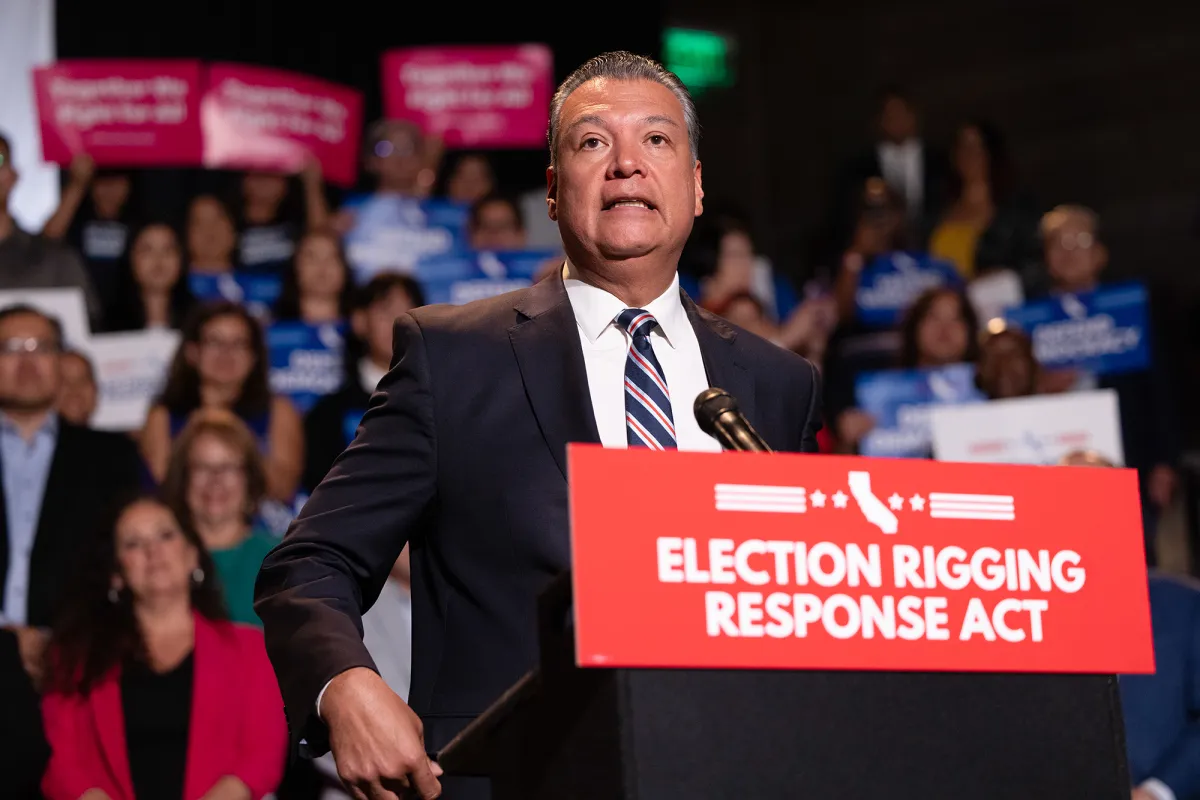
In a triumphant speech, Newsom proclaimed that Prop. 50’s victory was not just a win for California, but a win for the entire country. He called on leaders in other Democratic-held states — Illinois, Virginia, Maryland and New York — to “meet the moment” and redraw their congressional districts, too.
“Instead of agonizing over the state of our nation, we organized in an unprecedented way,” Newsom said. “Tonight, I’m proud. But I’m very mindful and sober of the moment we are living in. Donald Trump does not believe in fair and free elections, period and full stop.”
Prop. 50’s passage marked a significant victory for the governor, who took a political risk on the measure, calculating that it would give the state’s Democratic voters who are frustrated with the Trump administration a way to “fight back.”
Gov. Gavin Newsom speaks to the press, alongside his partner Jennifer Siebel Newsom, after Proposition 50 was passed by California voters, at the California Democratic Party headquarters in Sacramento on Nov. 4, 2025. Photo by Jungho Kim for CalMatters
Though opponents criticized him for using the measure to burnish his national profile, Newsom was joined in his effort by numerous liberal groups, who argued that helping Democrats win the House could counter the administration’s aggressive immigration raids, cuts to social services and erosion of democratic norms.
Republicans vowed they will still challenge Democrats statewide, and said the election distracted from issues like the cost of living.
“Even under this new map, Republicans have clear opportunities to flip seats because Californians are fed up with Democrat chaos,” National Republican Congressional Committee chairman Richard Hudson said in a statement.
What this means for incumbent Republicans
Five GOP congressmembers now face steep odds to re-election and are more likely to lose their seats after next year’s midterms:
Rocklin Rep. Kevin Kiley reaffirmed Tuesday night he’ll run for re-election despite his 3rd District becoming more liberal: “Politicians can change the lines on a map, but they can’t tell you how to vote.”
Chico Rep. Doug LaMalfa, whose 1st District in the vast rural northeast corner of California, will lose several conservative counties and take in liberal Santa Rosa, has also said he will run again.
Corona Rep. Ken Calvert will have to decide whether to run in a primary against a fellow Republican after his Riverside County district moves completely. He’ll instead be in the safe Republican 40th District held by Rep. Young Kim.
Hanford Rep. David Valadao’s district in the southern Central Valley will become slightly more Democratic and stretch closer to Fresno. The race could still be competitive; the Republican has held onto his seat despite a Democratic registration advantage.
Escondido Rep. Darrell Issa’s eastern San Diego County district will lose conservative pockets and gain liberal voters in the Coachella Valley. He said Tuesday night that he’s “not quitting.”
An election worker puts two ballots in a curbside ballot drop box outside a vote center at the Huntington Beach Central Library in Huntington Beach on Nov. 4, 2025. Photo by Jules Hotz for CalMatters
Rep. Josh Harder, a Stockton Democrat, was swept into Congress during the 2018 Democratic wave and he has held onto his Stockton-based seat despite being a perpetual Republican target.
Rep. Adam Gray of Turlock had the closest 2024 House race in the country. With more Democratic voters from Stockton, it will be much easier for him to hold the seat next year.
Rep. George Whitesides of Santa Clarita represents northern Los Angeles suburbs in the 27th District that have grown gradually more liberal. His new seat brings in more Democratic voters from the San Fernando Valley.
Rep. Derek Tran of Cypress should have an easier time defending his seat in the heavily Asian 45th District, which straddles Orange and Los Angeles counties.
Rep. Dave Min of Costa Mesa won his 47th District seat by fewer than three percentage points last November. The new map shifts his district away from Huntington Beach and Newport Beach.
Rep. Ami Bera in Sacramento County, will shift from the 6th District to challenge Kiley in the 3rd District.
In turn, Dr. Richard Pan, a prominent former state senator who had already declared a challenge against Kiley, said he will now run in the 6th District.
Two candidates challenging Calvert in his current district — Brandon Riker and Anuj Dixit — have said they will instead challenge Issa in the newly drawn 48th District.
Trump threatens ‘legal and criminal’ review
Trump threatened Tuesday to challenge California’s mail-in ballot results, claiming without evidence that it was fraudulently conducted — even before any results were in.
The president said there would be “very serious legal and criminal review” of the state’s use of universal mail ballots. White House spokesperson Karoline Leavitt later said Trump was working on an executive order to strengthen elections and assure there isn’t “blatant fraud” in California’s universal mail-in ballots.
About 7 million Californians had already voted by Election Day, 4.6 million of whom put their ballots in the mail. Another 2.3 million put a ballot they received in the mail at a ballot drop-off box or at an elections office. For more than a decade, the majority of voters in California elections have participated by mail. Voter fraud is extremely rare, and studies have found no evidence that voting by mail increases fraud.
Liane Elizabeth John,
72, passed away peacefully at home on October 22, 2025. Born on
August 24, 1953, in Los Angeles, she was the beloved daughter of
Nancy Carol Graden and the late Neil William Graden, and sister to
Dekker Rogue Graden and Derek Storm Graden. A devoted mother, she is
survived by her sons Jason Morley John, Jeffrey Martin John
and Michael Ryan John, all of whom carry forward her spirit of
curiosity, creativity and compassion.
From
her early days as a proud Girl Scout, Liane’s life was colored
by a joy for exploration, artistry and community. She found beauty in
nature — whether bird-watching, stargazing, or collecting treasures
while beachcombing along the Pacific coast. Her array of telescopes
and her iconic red flashlight were staples of many family nights
under the stars, as she passed on her love of the outdoors to her
children and grandchildren.
Liane’s
creativity was boundless. Quilting became both her art form and her
legacy—what began as a pastime alongside her mother blossomed into
an award-winning pursuit that earned her recognition in quilting
circles and even a magazine cover. Later in life, she poured her
heart into teaching others the joy of sewing, patchwork and
self-expression. Her style — whether in her handmade wardrobe or
her whimsical jewelry — was unmistakably her own: fun, fearless and
endearingly offbeat.
Beyond
her artistry, Liane dedicated herself to helping others. As
lifelong public servant, Liane’s career spanned roles in the
Welfare office, the gang task force and as an essential aide to a
leading defense attorney in Humboldt County. She was deeply involved
in civic matters, volunteering tirelessly during elections and never
hesitating to offer thoughtful guidance to anyone who crossed her
path.
She
is survived by her sons, Jason Morley John (Ruthie John),
Jeffrey Martin John (Tawnya John) and Michael
Ryan John; and her grandchildren, Oak Allyson Whitney John,
Connor Neil John, Addison Marie John Sousa,
Cadence Renee John and Opehlia Elizabeth John, who
will carry forward her sense of wonder and compassion.
Liane Elizabeth John will
be remembered for her warmth, her humor and her unwavering belief in
the goodness of people — a legacy stitched lovingly into the lives
of all who knew her.
Celebration
of life will be held at 2 p.m. on January 17, 2026 in the Bay Room
at the Wharfinger Building,
1 Marina Way Eureka. In lieu of flowers please make a donation in her
honor to Sequoia Park Zoo in Eureka.
Many
thanks and appreciation to Goble’s in Fortuna for their support and
services on her behalf. Please text (510) 396-9817 for any further
information.
###
The obituary above was submitted on behalf of Liane John’s loved ones. The Lost Coast Outpost runs obituaries of Humboldt County residents at no charge. See guidelines here.
The Humboldt County Board of Supervisors (clockwise from top left): Fourth District Supervisor Natalie Arroyo, Second District Supervisor Michelle Bushnell, Third District Supervisor Mike Wilson, First District Supervisor Rex Bohn and Fifth District Supervisor Steve Madrone. | Screenshots from Tuesday’s meeting.
This afternoon, at an emotionally intense meeting of the Humboldt County Board of Supervisors, Second District Supervisor Michelle Bushnell was censured by her colleagues and removed from her role as board chair in response to sustained allegations that she mistreated two county employees.
The board also voted to draft a letter asking the Humboldt County Civil Grand Jury to review the board’s Code of Conduct and Ethics. Fifth District Supervisor Steve Madrone proposed taking this step after Bushnell hired a private attorney to challenge that code’s prescribed process for investigating and addressing complaints of supervisor misconduct.
The board chose not to go one step further and remove Bushnell from her other assigned roles on various boards and committees, a step Madrone had proposed.
Bushnell’s removal from the role of board chair will only impact the remaining three supervisor meetings of 2025. Third District Supervisor Mike Wilson, who has been serving as vice chair, will take over the chair’s responsibilities.
As previously reported, an independent investigation, which included interviews with six witnesses, found that on May 5 of this year Bushnell raised her voice, spoke in a hostile manner, and cursed at two employees. The investigative report concluded that she likely repeatedly accused a county employee of being a liar, accused another employee of being a liar and slammed a door after yelling and cursing at the employee.
Today, supervisors repeatedly described their discussion about these matters as “uncomfortable.” Bushnell offered an emotional reflection on her behavior, and over the next hour or so, as her colleagues continued to deliberate what to do about the whole mess, her discomfort clearly accumulated.
“I just want to get through this,” she said at one point. Later, she beseeched her fellow supervisors to hurry up. Her voice trembled as she said, “I need to get off this dais.”
During the public comment period, several speakers voiced support for Bushnell. Former county supervisor Johanna Rodoni described her as “the epitome of a public servant.” Laura Lasseter from the Southern Humboldt Business & Visitors Bureau said she is “vital to Southern Humboldt and to all of her constituents.” Cannabis farmer Craig Johnson said, “What I look for in leadership is exactly what Supervisor Bushnell displays in every facet of the job.”
Bushnell’s appointee to the Planning Commission, Thomas Mulder, also expressed support for her, though he admitted to being really confused about “the censorship,” apparently mixing that word up with “censure.” (Fourth District Supervisor Natalie Arroyo later explained that the latter means a formal expression of disapproval.)
Wilson said the proposed censure was “not about Supervisor Bushnell’s performance as a supervisor in her community.” Rather, he said, “We’re here to to address a specific incident that occurred.”
Given the chance to address the public and her colleagues, Bushnell said, “I am regretful that the incident that happened … made everybody very uncomfortable. I was very loud. I felt wronged, and I reacted bad. I also made staff very uncomfortable, and nobody should have to feel that way in their workplace.”
‘I sometimes get heated when I feel wronged.’ —Michelle Bushnell
By way of explanation — though not an excuse — Bushnell said she has a “fight or flight personality” sometimes.
“It comes from past traumas of a very abusive relationship, and I work really hard, and I’ve been in counseling for it for a lot of years,” she said. “And I sometimes get heated when I feel wronged. In no way, though, should I ever make an employee feel uncomfortable in their work.”
She went on to say that she would respect whatever action the board chooses to take and move forward.
“I do not have the right to raise my voice, slam a door or cuss, and it’s something I work on continually and will continue to work on,” Bushnell said. She then added, “Again, to the employees, I am regretful and wish I would have handled it different.”
Arroyo made a motion to censure Bushnell. Madrone seconded it. Before a vote was taken, Wilson took issue with Bushnell’s framing of the incidents of May 5. He said that being “regretful” and “uncomfortable” is different than being sorry and that a county supervisor bears extra responsibility.
“When … we as people in power are doing or are behaving in this way, it actually is often perceived as threatening; it’s not just uncomfortable,” he said. “People are concerned about their job, about their livelihoods. They’re concerned about their place in the community.”
Wilson added that Bushnell is not the victim in this situation.
Bohn kept his comments brief. He took issue with Wilson’s dissection of Bushnell’s apology and said, “I hope this is a teaching moment and we move forward from here.”
The vote to publicly censure Bushnell was unanimous. Next up was Madrone’s proposal to take further actions he said were “designed to restore public confidence, ensure a safe and respectful working environment and uphold the standards of ethical governance expected by and owed to the residents of Humboldt County.”
Nearly all of the public commenters who’d previously voiced support for Bushnell did so again. While some said it would be fine to refer the board’s code of conduct to the Civil Grand Jury for review, they argued that removing her from her position on various boards and committees would deprive her constituents of the representation they chose.
Madrone countered that while there’s no doubt that Bushnell is a strong advocate for her communities, the code of conduct points out, “We’re supposed to be looking out for the the interests of the county as a whole, the public interest, above and beyond any constituents’ interest.” He also pointed out that Bushnell had a similar instance of losing her temper in 2022, which included a sustained finding of misconduct.
‘I have a growing, increasing concern over that pattern of bullying, intimidation and retaliatory conduct and abusive treatment of others.’ —Steve Madrone
“I have further witnessed similar behaviors towards staff, the public and community partners … ,” Madrone said. “I have a growing, increasing concern over that pattern of bullying, intimidation and retaliatory conduct and abusive treatment of others.”
After Madrone wrapped up his comments, Bushnell, shaken, asked, “Can the board decide what they’re going to do?”
But Wilson had a bit more to say. If any of the county’s non-elected directors, supervisors or managers had acted the way Bushnell did, they likely would have been immediately placed on administrative leave to protect the employees who’d been subjected to such behavior, he argued. In this case, he continued, the right thing to do would have been to ask the Human Resources Department for recommendations and immediately implement them.
“That’s not what happened,” Wilson said. “HR did have recommendations for Supervisor Bushnell, and there were two of them. And one of them was partially done and the other was completely ignored. … That was what happened in May, and we are now in November, right? So there wasn’t much that really occurred in terms of the workplace environment response from that incident until now.”
That five-month delay has left employees vulnerable, Wilson said, adding, “We are responsible for maintaining a safe working environment, free of threats, free of violent behavior. The employees are scared.”
As the discussion continued, the majority of supervisors agreed that the Grand Jury should take an independent look at the board’s code of conduct to see if its procedures can be improved upon.
Bohn then proposed asking Bushnell to step down from her role as chair for the remaining three meetings of the year but not stripping her of her committee assignments. He also suggested that the board should refrain from asking the Grand Jury to weigh in Bushnell’s conduct, but Wilson and Arroyo wanted to keep that included in the motion at hand.
That motion, proffered by Arroyo, was to remove Bushnell as chair and have two supervisors (Arroyo and Wilson) draft a letter asking the Grand Jury to review Bushnell’s conduct and to provide recommendations on changes to be considered for the Board of Supervisor’s Code of Conduct.
Arroyo, Wilson and Madrone voted in favor. Bohn voted “no” and Bushnell abstained.
Another Effort to Address Homelessness
During the morning session, the board spent 90 minutes grappling with the ever-intractable matter of homelessness.
The discussion was prompted by a proposal from Bushnell to ban overnight camping on county-owned properties. The ensuing debate focussed largely on whether such an enforceable measure would offer county personnel another “tool in the toolbox” — an oft-repeated phrase — or be a waste of resources that doesn’t get to the root of the issue.
Bushnell said she’d spoken with both Sheriff William Honsal and Public Works Director Tom Mattson, and her intent was to create an enforcement option that could encourage otherwise recalcitrant squatters to seek out sanctioned housing options.
Referring to issues near Dean Creek in her own district, Bushnell said, “We’re finding some folks that feel very comfortable on those county properties, and so they don’t feel the need to even try to seek that help, even when it’s offered.”
Honsal said his office has responded to about 1,500 calls in the last five years to address illegal camping.
“We lead with compassion in these circumstances, where we’re trying to steer people towards services … to try and care for their needs and provide them housing, food [and] medical care,” he said. “I think people would be shocked if they actually walked with us into these unsheltered areas where people are are struggling and see how we treat them … and also [see] the deplorable conditions that they’re living in. We don’t treat animals the way that people are leave living in some of these areas in Humboldt County.”
Unsanctioned camping on public land has led to persistent trespassing and pollution problems on the McKay Tract by Redwood Acres, off Lucas Street in Myrtletown and near Palmer Boulevard north of Fortuna, according to Honsal.
Mattson said the county spends between $50,000 and $150,000 per year disposing of illegal waste. He noted particular problems at the Fields Landing boat ramp and said a public ordinance banning overnight camping “would probably be very helpful.”
Regarding the problems associated with homelessness, Mattson said, “It’s beyond public works, it’s beyond the sheriff, it’s beyond DHHS [the Humboldt County Department of Health and Human Services]. This is an entire-community issue. It’s all hands on board.”
But some county supervisors were skeptical. Bohn worried that the proposed ban would just push illegal campers onto private property, setting off a game of Whac-A-Mole.
Madrone said homelessness is probably the most difficult issue the board has to deal with. “So I don’t know what the solution is. I really don’t,” he said, adding, “This [proposal], to me, is just going to make it even harder for people to find a place to just survive. So I have issues with it.”
Arroyo said she’s been “down this road before” when she helped to establish camping restrictions during her time on the Eureka City Council, “and I have, frankly, very little appetite to kind of go down that road again.” She argued that there are plenty of existing rules on the books to deal with illegal behavior, and she hasn’t seen broad punitive measures be effective in alleviating homelessness.
During the public comment period, two people called in to urge the board not to enact a camping ban, with one saying, “Criminalization only serves to further marginalize individuals, to further push them into more desperate situations.”
Michelle Stephens, assistant director of administration at DHHS, said a camping ordinance could be a “tool in the toolbox” and asked that her department be included should the board choose to have such a policy drafted.
Ultimately, Madrone made a motion to have staff work with a pair of supervisors — Bohn and Bushnell — to put together what he called a “compassionate assistance ordinance,” something that combines an enforcement mechanism with outreach for public services.
The board approved the motion by a vote of 4-1, with Arroyo dissenting. She said the county already has “a lot of irons in the fire” and she’s not convinced that this particular approach would be the best use of staff’s time.
What Else?
The board considered making changes to the county’s 11-member Human Rights Commission — discussing options to alter its membership, quorum requirements and/or focus — but decided to leave things as they stand.
Following a bit of discussion, the board modified the county’s zoning ordinance to address density bonus provisions. Ford explained that the changes were “largely done to make our ordinance consistent with state law” when it comes to incentives for developing housing with above the maximum density that could otherwise be allowed, just so long as a percentage of the units are reserved for underserved demographics. The board unanimously supported the proposal.
U.S. Senator Alex Padilla attends a rally about redistricting at the Democracy Center of the Japanese American National Museum in Los Angeles on Aug. 14, 2025. Photo by Ted Soqui for CalMatters
###
This story was originally published by CalMatters. Sign up for their newsletters.
###
U.S. Sen. Alex Padilla of California will not run for governor in next year’s highly watched race to succeed Gov. Gavin Newsom, the senator unexpectedly announced in the U.S. Capitol on Tuesday.
The decision comes after months of speculation that California’s senior senator, who Newsom appointed to succeed former Vice President Kamala Harris after she stepped down in 2020, could throw his hat in the ring and dominate an otherwise open field.
Padilla’s staff confirmed Tuesday that he would not be seeking the governorship.
“It is with a full heart and even more commitment than ever that I am choosing to not be running for governor of California next year,” Padilla told reporters in the U.S. Capitol. “I choose to stay in this fight because the Constitution is worth fighting for.”
Padilla, the first Latino to represent California in the Senate, gained national attention this summer after a video went viral of him being forced to the ground and detained at a press conference hosted by Department of Homeland Security Secretary Kristi Noem.
In his brief remarks, Padilla said he had received encouragement to run from people across the state, including business and labor leaders, people who approached him at his church, the grocery store and local parks.
“Californians have urged me to do everything I could to protect California and the American Dream from this vindictive president,” Padilla said. “I’ve been truly honored and humbled by their encouragement, and I’ve taken it to heart.”
The crowded Democratic field still includes prominent names like former U.S. Rep. Katie Porter, who made headlines for threatening to leave a televised CBS interview after the reporter asked questions she didn’t like, and former Health and Human Services Secretary Xavier Becerra. Former California State Controller Betty Yee, the only other female candidate still in the race, has called on Porter to drop out.
Other Democrats still in the mix include former Los Angeles Mayor Antonio Villairaigosa, who lost to Newsom in 2018; former Attorney General Xavier Becerra, State Superintendent Tony Thurmond; former state Controller Betty Yee; and former Assemblyman Ian Charles Calderon. Prominent Republican challengers include Riverside County Sheriff Chad Bianco and former Fox News contributor Steve Hilton.
Bright light city gonna set Humboldt’s soul on fire, reportedly
All hail Breeze Airways! You remember them, right? Back in July, it was announced that, starting in 2026, Breeze will swoop in to fill the Burbank-shaped travel hole left in Humboldt’s heart when Avelo Airlines opted to ghost us. Oh, and they’re going to hook us up with direct Salt Lake City flights as a bonus. Easy Breeze-y.
Huh?!
Well, it appears Breeze blessings continue. Today your Lost Coast Outpost was referred to some small print in an Instagram story posted by the airline that boasts of an ACV to Las Vegas route starting on March 11! How did we not hear of this?! Sure enough, LoCO clicked on over to Breeze Airways website and found ourselves able to book twice-weekly flights (Wednesday and Saturday) to Las Vegas for as low as $118 roundtrip!
Well, then! We’ve been itching to give the Sphere some of our money. Now it’s even easier!
Why are we finding out about this new freedom this way, you may ask? You’d think an airline might issue some sort of formal announcement when they add a sexy new route they want people utilize. A press release! Something! Sure, that might have been nice, but beggars like us can’t be choosey. Humboldt will take it.
UPDATE, 2:45 p.m.: …aaand now here’s the Humboldt County Administrative Office with a press release:
Breeze Airways has announced new nonstop air service between the California-Redwood Coast Humboldt County Airport (ACV) and Las Vegas, NV beginning March 11, 2026.
Starting today, travelers can book a flight on Breeze to Las Vegas, with prices starting from $49 each way.
“Breeze is known for its convenient, affordable flights, premium seating options, and amenities like fast onboard Wi-Fi and power at every seat, and we look forward to introducing travelers in the Humboldt County area to our Seriously Nice™ service,” said David Neeleman, founder and CEO of Breeze Airways. “Arcata-Eureka is exactly the kind of underserved market our airline set out to serve and we’re confident our new guests will enjoy their enhanced travel experience onboard one of our brand-new Airbus A220 aircraft.”
Affordable flights to Las Vegas are scheduled to run Wednesdays and Saturdays, starting March 11, 2026. Travelers can book their flights on Breeze Airways now at FlyBreeze.com.
“We could not be happier that Breeze Airways has introduced new service between California Redwood Coast-Humboldt County Airport and Las Vegas,” said Second District Supervisor and Board Chair Michelle Bushnell. “We are so appreciative of Breeze’s dedication to meeting the needs of Humboldt County travelers and visitors and furthering connectivity in our region.”
For more information about Breeze Airways, visit FlyBreeze.com. For more information on the California Redwood Coast-Humboldt County Airport, please visit FlyACV.com.
What our Congressional district will look like if Proposition 50 passes. Areas in blue would be added to our current district; areas in red would be subtracted from it.
###
By now we’re all clear about what Proposition 50 does, right? The idea is to gerrymander California’s congressional map to elect more Democrats to the House of Representatives. It was prompted, earlier this year, by Texas doing the same thing to elect more Republicans to the House of Representatives. The Supreme Court gave all this the OK a few years ago. Sad, but it is what it is.
What we’re talking about today is how you’re going to return your Humboldt County ballot to the Humboldt County Elections Office. You probably don’t want to mail it. The Postal Service has changed up its game somewhat, and your ballot might not get postmarked today.
What you want to do, today, is vote in person at one of the county’s voting centers, or drop your already completed and sealed (in the envelope) ballot off at one of the county’s ballot drop boxes.
Need a list of those voting centers and drop boxes? Sure. The Elections Office, like most government agencies, loves to publish its information in PDF format, because government workers live in a world where people still print things out on printers, and they can put graphics and stuff in there.
If you’re just looking for the information, rather than to be charmed by the Election Office’s choice of fonts and whatnot, the Outpost has you covered. See below. And if you have any questions or problems at all — lost your ballot, forgot to register to vote, etc. — know that Elections Office personnel will happily help you out. Call them at (707) 445-7481.
###
VOTE CENTERS — OPEN UNTIL 8 P.M.
Humboldt County Office of Elections 2426 6th Street,
Eureka
Jefferson Community
Center 1000 B Street,
Eureka
Arcata Community
Center 321 Dr. Martin
Luther King Jr. Parkway, Arcata
Fortuna Veterans
Memorial Building 1426 Main Street,
Fortuna
McKinleyville Middle
School 2285 Central Avenue,
McKinleyville
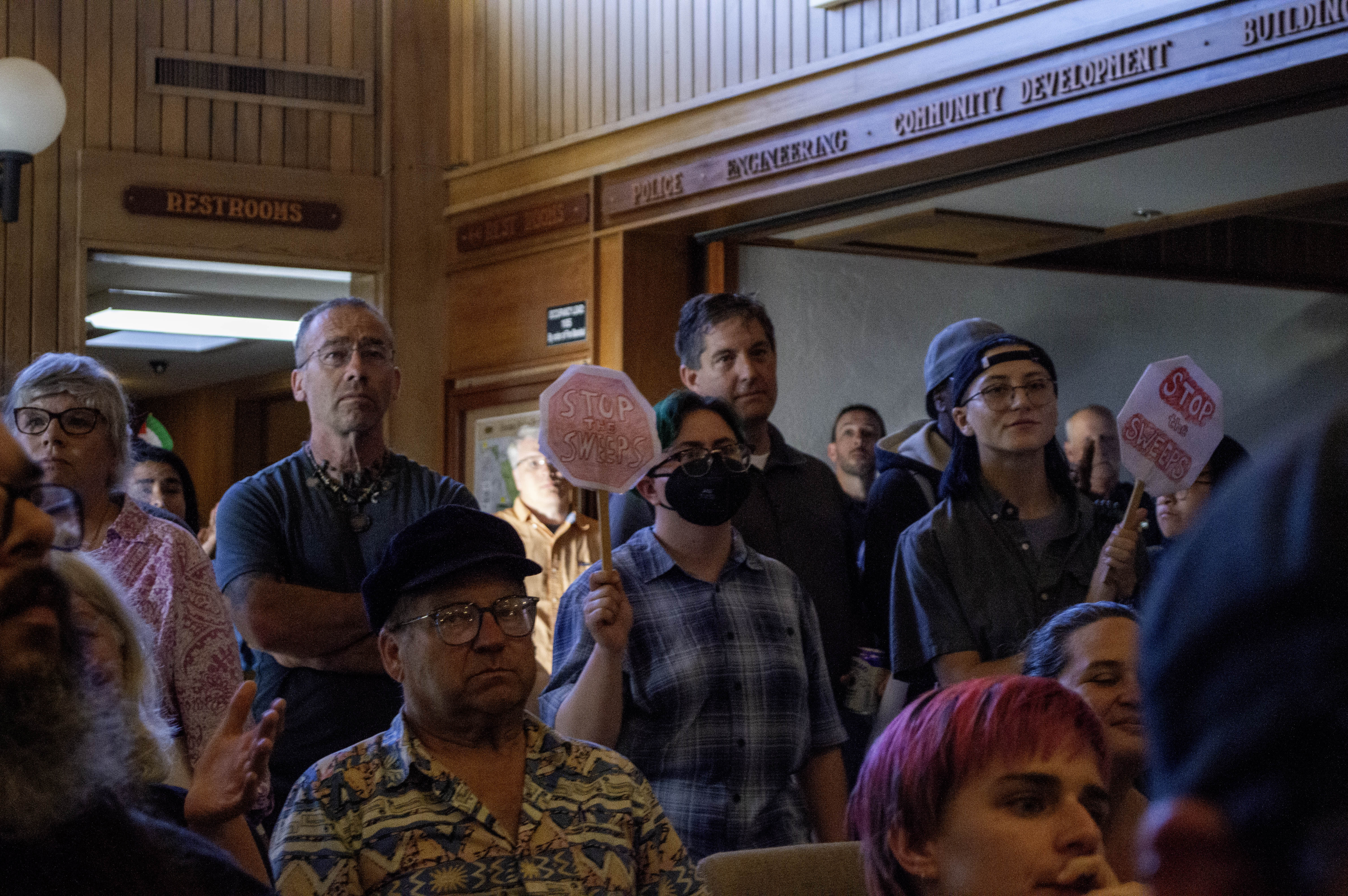
A group of people at an August city council meeting.
The Arcata City Council may have had enough.
Item 11.b on Wednesday’s agenda would, if passed, edit the City Officials’ Protocol Manual to eliminate the option to comment on the city council meetings virtually; it’d require people to attend the meetings in-person if they wish to comment at all.
The public comment section near the beginning of the meeting after the staff reports would also be discarded, leaving one period for three-minute comments closer to the end of the meeting.
The proposed amendment would also add a section on when it’s acceptable to remove unruly participants from public meetings: speaking without the council’s recognition or outside of their allotted time, making threats, or delaying a meeting are all fair game for getting kicked out, though any behavior that disrupts the “orderly conduct” of a meeting would count. Rule-breakers get one warning and then an (optional) second one before being asked to leave, or if that fails, an escort out.
These restrictions come a few months after dozens of activists crashed and neutered a couple city council meetings, screaming and berating city officials and council members. Commenters have been able to call in via phone or Zoom since the pandemic, which some city employees privately blamed for fostering a culture permissive of anonymous personal attacks on other commenters and policy-makers alike. Some commenters also sometimes speak virtually multiple times at a meeting.
“Eliminating Zoom comments ensures that all participants are treated equally and that the Council can efficiently conduct its business,” reads a staff report on the item.
Legally, Arcata doesn’t have to offer virtual options for public comment. Senate Bill 707, which just passed last month, doesn’t force councils that govern cities with fewer than 30,000 people to do so.
Mayor Alex Stillman said during a phone interview yesterday with the Outpost that many of the virtual callers weren’t talking about city-related matters; many often focused on global politics.
She said that if someone was disabled and couldn’t make it to a meeting but wanted to comment, the city would be able to accommodate them in some way. Stillman said she’d made house calls over the years to concerned citizens and that emailing or calling council members on the phone was still an option.
Stillman said that the elimination of the public comment section early in the meeting was kind of a return to the status quo. It was added in the late 2000’s when the council meetings often stretched late into the night to make sure concerned residents didn’t have to stay until the end of the meeting to comment. Now, most council meetings only last until about 8:30. She also pointed out that the virtual comment option was only added a few years ago, and people managed to go decades without it.
“Change is hard,” Stillman said. “And that’s all we’ve got in life, is change…So I think all in all, we’re just going back to the way it was for years in the past.”