

Gavin Newsom’s Biggest Political Test Yet Is on the Ballot Next Tuesday
Jeanne Kuang / Friday, Oct. 31, 2025 @ 7 a.m. / Sacramento

Gov. Gavin Newsom speaks during a rally about redistricting at the Democracy Center at the Japanese American National Museum in Los Angeles on Aug. 14, 2025. Photo by Ted Soqui for CalMatters
###
This story was originally published by CalMatters. Sign up for their newsletters.
###
As President Donald Trump prepared to send a phalanx of federal immigration agents into the Bay Area, Gov. Gavin Newsom bemoaned the lack of outrage about Trump’s actions and ramped up his own warnings about election manipulation.
“He is going to try to rig this election,” he told reporters last week, referring to Trump’s pursuit of Republican gerrymandering in red states to ensure the party holds onto its slim majority in Congress next year.
He called the potential deployment of immigration agents — later called off by Trump — a dictator’s move to suppress the vote. Repeatedly, he’s told the story of Border Patrol agents showing up to his ballot measure kickoff event and said he expects federal agents and troops to monitor polling places next week.
As the campaign for Proposition 50, the anti-Trump Democratic gerrymandering effort California voters are deciding on, reaches a fever pitch, so too has the rhetoric of Newsom, its chief promoter.
“God help us if we lose in California,” he said in a Prop. 50 fundraising email this month. “We may have enjoyed our last free and fair election.”
Approaching his final year as governor, Newsom is staking the next phase of his career on the proposition that he first suggested as a bluff to discourage Texas’ redistricting and that he’s now casting as central to American democracy.
After a few months this year of attempting to make nice with Trump, exploring on his podcast why so many voters shifted right in 2024 and angering the left in the process, the governor spent the summer and fall delighting many Democrats again with a renewed sense of combativeness against the second-term president.
So far, he’s reaped the benefits.
From June to August, he doubled his approval in polls of potential 2028 Democratic presidential contenders rising from 12% of surveyed voters picking him to 25%. Appearing before a friendly Late Show with Stephen Colbert audience in September, he touted his willingness to be a Democrat who fights Trump on his own terms by using social media trolling. He got former President Barack Obama to join him in promoting Prop. 50.
“They’re going to send a very powerful message to the rest of the country that there has to be a new approach to dealing with Trump and Trumpism,” Newsom said of California voters on Tuesday. “It’s about the United States of America, it’s about what our founding fathers lived and died for.”
The big bet is paying off
Whether the measure passes is not just a test of whether the self-styled resister-in-chief can capture national support in 2028, but also whether he has his finger on the pulse today.
“Failure is not an option,” Newsom said last week. “We’re going to win, because people understand how precious this moment is.”
It’s a bet that risks his credibility, said Democratic strategist Matt Rodriguez. Though he added he believes the measure will pass, Rodriguez said Prop. 50 poses political “downsides” that “are bigger than the upsides.”
“His entire messaging is, ‘This is the end of the world if it doesn’t pass,’” he said. “If it doesn’t pass, it’s going to be pretty discouraging.”
Newsom has remained defiant, arguing it’s a bigger risk for Democrats to sit quietly. Asked last week if he had a contingency plan should the ballot measure fail, Newsom instead set up sky-high stakes, vowing it will pass and that Democrats will take the House and spell the “de facto end” of Trump’s presidency.
It’s working, for now: His ballot measure, which allows California to use gerrymandered congressional maps favoring Democrats to offset gerrymandered Republican House gains in Texas, is polling ahead with 56% of likely voters this month saying they would vote yes. The campaign has received so many donations that this week Newsom took the extremely rare step of telling supporters to stop sending money, seemingly an early declaration of victory.
Even Democrats who have fought Trump-backed, GOP-led gerrymandering in their own states are on board.
After Newsom placed Prop. 50 on the ballot, Missouri Republicans at Trump’s behest passed their own gerrymandered congressional map, carving out the seat held by Kansas City’s Democratic congressman. The lines cut through the suburban district of state lawmaker Keri Ingle, who said she nevertheless supports Newsom’s effort because red-state Democrats “are depending on Newsom for representation in Congress right now.”
Missouri Republicans, Ingle said, argued that because they lead the party of the majority there, they should be allowed to redraw that state’s map to gain another seat in Congress.
“To that I say, ‘OK, have it your way,’” she said. “Go get ‘em, Newsom.”
‘Long way to go’
Should the measure pass, using it to propel Democrats — and Newsom himself — further nationally is still a tall order.
There’s no guarantee that passing Prop. 50 will ensure Democrats win back the House. Few other blue states have even considered starting their own redistricting efforts, and none have nearly enough population to produce more than one or two new Democratic congressional seats. This week, Virginia Democrats approved a temporary redistricting proposal similar to California’s, though it couldn’t go to voters there until next year. Meanwhile, three GOP-led states — Texas, Missouri and North Carolina — have already passed their own gerrymandered maps. This week, Republican Indiana Gov. Mike Braun called in a special legislative session to do the same.
And Rodriguez said there’s still little sign Democrats have a platform to win back the middle-ground voters most concerned about crime and their economic prospects.
A September Reuters poll of American adults showed Democrats only two percentage points ahead of Republicans on the issue of “respect for democracy,” and four percentage points behind on “political extremism.” A Reuters poll this month showed 40% of American voters will vote in the midterms based on the cost of living. Protecting democracy was second in importance, at 28%.
“There’s still a long way to go, as to whether this passing will leapfrog him further than he has already,” Rodriguez said of Newsom. “It’s just not a vote-driver for most Americans.”
In red, rural Modoc County, erstwhile Democrat Sarah Merrick said she’d like to see the party develop a clearer national platform “instead of just being anti-Trump,” that includes reining in health care costs, campaign finance reform and committing to winning back moderates. She and her husband left the party in recent years, feeling it was “so leftist” and unnecessarily alienating cultural conservatives.
Prop. 50 and Newsom’s highlighting of democratic principles got her more energized about politics for the first time in years, said Merrick, who leads a local Indivisible activist group. But she’s not sure if she’d support Newsom for president, saying she wants to know more about the state’s decision to provide health care for poor undocumented immigrants and why it hasn’t lowered housing prices.
“I really like his backbone right now, I think it’s awesome,” she said. “I think stressing on Prop. 50 and anti-dictatorship and all that is OK for now, through Nov. 4. After Nov. 4, I think a big shift needs to happen in messaging.”
An economic plan will be important for both swing voters, and for the party’s faithful.
Lorena Gonzalez, leader of the California Labor Federation, has led union workers across California in running an aggressive anti-Trump campaign to help pass Prop. 50. But she said the governor’s future political prospects will depend in part on how he handles American workers’ anxiety around artificial intelligence and job losses, which Gonzalez predicted will be a prominent election issue in 2026 and beyond.
“It’s catapulted him,” she said of Prop. 50 and Newsom. “I don’t think it lasts beyond this time.”
BOOKED
Today: 4 felonies, 7 misdemeanors, 0 infractions
JUDGED
Humboldt County Superior Court Calendar: Today
CHP REPORTS
No current incidents
ELSEWHERE
RHBB: Wildfire Burning Near Highway 101 South of Laytonville
Governor’s Office: California reminds voters to check their mailboxes and return their ballot ASAP!
County of Humboldt Meetings: Oct. 8, 2026 - Humboldt Housing and Homelessness Coalition General meeting
RHBB: CHP Pursuit Ends With High-Risk Stop at Highway 299 and 101
OBITUARY: Danielle Elizabeth Davis, 1993-2025
LoCO Staff / Friday, Oct. 31, 2025 @ 6:56 a.m. / Obits

Danielle Davis
March
10, 1993 – October 18, 2025
Danielle Elizabeth Davis passed away unexpectedly in the early morning on Saturday October 18, 2025 in San Francisco. Danielle was a loving, shy soul who loved her only son, Bentley, immensely.
Danielle is survived by her son, Bentley Davis; her parents, Mark and Jenny Davis of Eureka and Arcata; her sisters, Ashlynn Owens of Eureka and Hailee Davis-Hardaway of Arcata; her brother, Jacob Davis of Eureka; her aunts Vicki (Steve) Gibney of Eureka, Lisa Hider of Weaverville and uncle Kevin Hardaway of Eureka; numerous cousins — Justin, Trevor and Josh Gibney, Amber Legey, Jessica, Joshua, Matt Montel and Thomas Hider and Darren Hardaway; and lots of second and third cousins and great-aunts and uncles.
She is preceded in death by her uncle Jeffrey Hardaway and niece Autumn Hardaway. Her grand-parents both just passed earlier this year — Roger and Ila Hardaway.
The earth feels lighter now that you’re away, but we will forever feel your presence guiding our way. We know you are up in heaven looking down upon us all, with your beautiful smile and twinkle in your eye. Your memory stays with all of us left here on this earth and we will guide and assist your son as he grows up a man. Danielle is now one of the bright stars up in the sky at night to cast a light upon us. With love, your family.
A family celebration occurred Saturday, Oct. 25, in Eureka. Cremation occurred in San Francisco.
You Never Said ‘Goodbye’
You never said I’m leaving, you never said
goodbye.
You were gone before I knew it, and only God knew why.
A
million times I needed you, a million times I cried.
If love alone
could of saved you, you never would of died.
In life I loved you
dearly. In death I love you still.
In my heart you hold a place that
no one could ever fill.
It broke my heart to lose you, but you didn’t
go alone.
For part of me went with you, The Day God Took You Home.
I will always love you mom, your son, Bentley. Until we meet again …
###
The obituary above was submitted on behalf of Danielle Davis’s loved ones. The Lost Coast Outpost runs obituaries of Humboldt County residents at no charge. See guidelines here.
‘Treat Them With Dignity’: Humboldt Residents, Businesses Step Up to Help Local People at Risk of Losing SNAP Benefits
Isabella Vanderheiden / Thursday, Oct. 30, 2025 @ 2 p.m. / Community Services , Food , Government
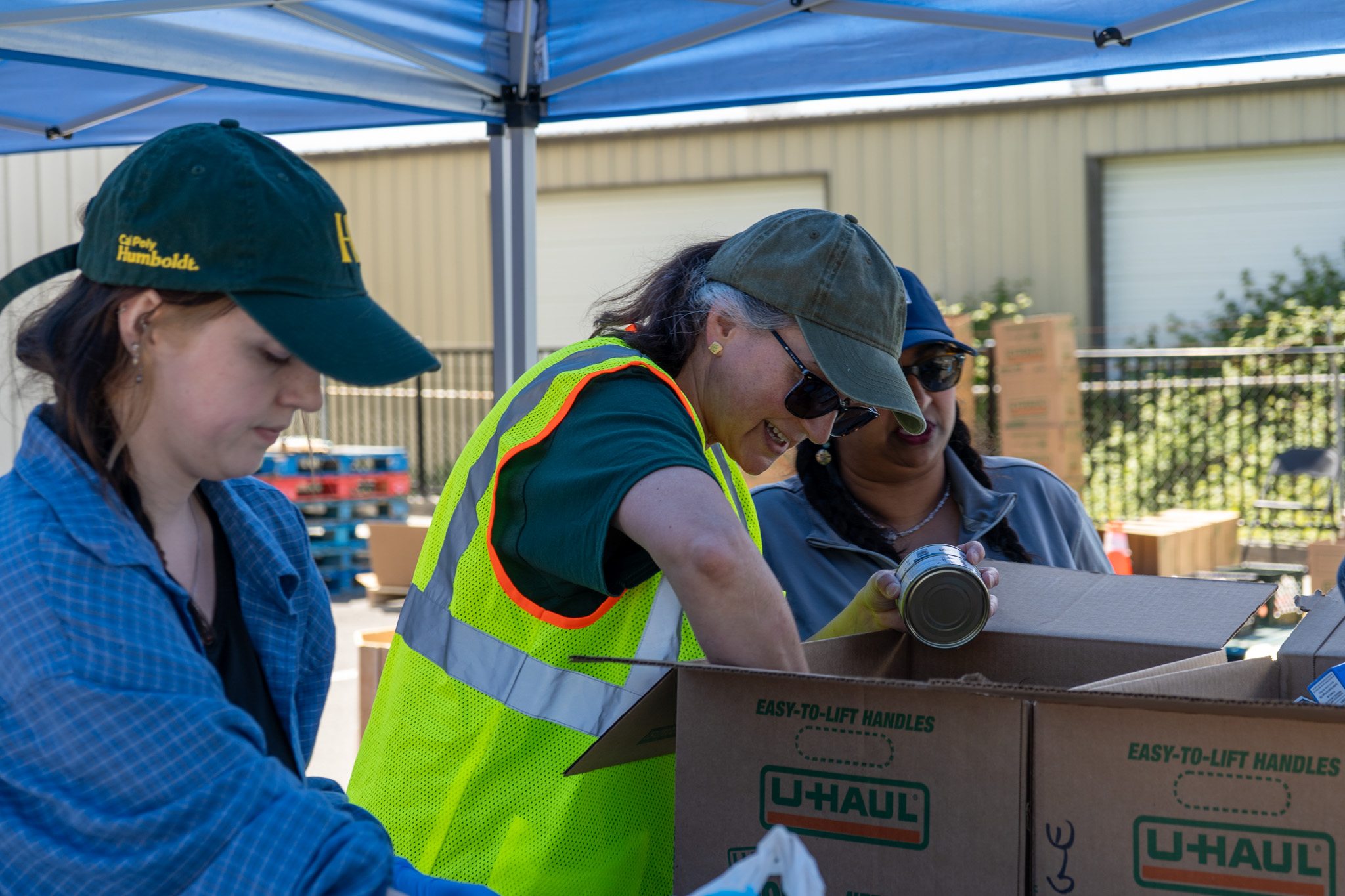
Food for People’s Volunteer & Direct Services Manager Julie Ryan packs boxes with non-perishable food items with local volunteers. | Photo: Food for People
###
As millions of Americans brace for the indefinite suspension of the federal Supplemental Nutrition Assistance Program (SNAP) on Nov. 1, Humboldt County residents, businesses and nonprofits are stepping up to ensure local folks have continued access to healthy food.
SNAP, known as CalFresh here in California, provides monthly food benefits to nearly 42 million low-income people — approximately one in eight U.S. residents — including 5.5 million Californians and 32,000 people here in Humboldt. Those benefits won’t be distributed next month due to the ongoing government shutdown and the Trump administration’s refusal to draw from a contingency fund, marking the first delay in SNAP benefits since the program’s inception.
When Eureka resident Olivia Gambino heard the news in the wee hours of the morning last week, her first thought was how to help.
“The moment I read at 3 a.m. that SNAP was not going to be delivered, I began thinking of a strategy,” Gambino told the Outpost. “It is our job as citizens behind the Redwood Curtain to take care of our own. … As I have grown in this community, so has a fierceness of protection, responsibility, and love towards it. I would like to see everyone — no matter who you are — put your foot down and say, ‘I will protect my neighbors, I will lift them up, and I will show everyone respect and treat them with dignity.’”

Food boxes packed with Costco goods. | Photo: Olivia Gambino
On Monday, she went to Costco and bought enough bulk food to fill nine boxes for families in need. On top of what she’s donated personally, Gambino has raised $1,000 from at least 15 donors to buy Winco gift cards for local families.
“Winco gift cards seemed the way to go [because] there’s dignity in autonomy,” she said, emphasizing the importance of “just acting” and not overcomplicating the issue. “The people who receive these benefits are my friends, my family, my neighbors. You can’t simply look at someone and say, ‘You get what you get.’ Food is very personal, and feeding a family is not one-size-fits-all.”
Gambino said she would “love for this to manifest into a larger effort,” adding that she will continue to accept donations and deliver gift cards “as long as folks keep supporting the effort and I feel like I can persist.”
“I can’t do it all the time, but I loved putting the boxes together from my heart,” she said. “Delivering food is fun!”
Those interested in donating can send funds to Gambino through Venmo. And if you’re interested in doing something similar, be wary of scammers.
“Watch out for internet scammers,” she warned. “I give assistance in person in the form of physical cards or food boxes. Do not transfer money to anyone you do not know! I already had folks ask me to wire them money through the messenger app. You definitely have to use your critical thinking skills.”
[MONDAY UPDATE: Gambino reached out over the weekend to tell us that someone is impersonating her account on Venmo. We’ve removed her account from this story. On the upside, she said she’s helped a total of 30 families since we last spoke.]
Old Town Coffee & Chocolates is also stepping up to help. Starting Nov. 1, both Eureka locations will offer free breakfast to people losing SNAP benefits.
“If you’re losing SNAP benefits for your family, breakfast is on us 7:30 - 10 a.m. Just ask for the Special Snack,” the business wrote in an Instagram post. “We are plotting ways to extend this into dinner hours. … If you’re in a position to help us offer this to our community, please do.”
Staff with the Humboldt County Department of Health and Human Services (DHHS), which administers CalFresh locally, have been meeting with Food for People and family resource centers to ensure vulnerable community members have access to up-to-date information.
“DHHS does not have funding that can support the lack of CalFresh benefits, but staff are continuing to work cases so they will be ready to issue benefits once the shutdown has ended or benefits are funded by another source,” DHHS spokesperson Christine Messinger told the Outpost. “DHHS staff has also joined forces and is launching a county employee food drive to collect food to support some of our local [family resource centers].”
Food for People, of course, is doing what it can to fill the gaps through its countywide pantry network and mobile produce pantry.
“We are trying our very best to prepare for the surge that we are likely to see, given the disruption in benefits,” said Food for People Executive Director Carly Robbins. “It’s really important to remember that nationwide food bank networks are not built for this kind of response. A statistic that I point to a lot is that for every one meal a food bank provides, SNAP or CalFresh benefits provide nine. Trying to take that on in the existing network is kind of inconceivable, but we are doing everything we can to prepare.”
Staff are working with local partners and the county to source as much food as possible to keep the nonprofit’s pantry stocked.
Speaking to criticism that people who receive SNAP benefits are taking advantage of government resources, Robbins said she has found the opposite to be true in her interactions with people at the food bank.
“The folks that we see in our food bank — most of whom do receive CalFresh or have applied in one form or another — by and large fall into categories like seniors and veterans living on low, fixed income, or folks who are employed or underemployed in a region where the cost of living is really high and wages are comparatively low,” Robbins said. “That’s why SNAP benefits are huge. They help stabilize households so people aren’t having to decide, ‘Do I pay my rent so I keep my household stable, or do I feed my child?’”
“At Food for People, we want people to be able to have the stress of feeding themselves and their family off the table so that they can focus their funds — if they need to — on housing and utilities to keep their households stable,” she added. “That’s what creates a healthier community for everyone.”
Those interested in donating funds or food can do so at Food for People’s website — at this link. Monetary donations are ideal because the nonprofit buys in bulk, but food donations — especially high-protein items — will be gladly accepted as well.

Food for People’s Operations Manager Jose Mendez moves pallets of food with a forklift. | Photo: Food for People
‘SNAP Benefits Can and Must be Provided’
California is taking legal action against the Trump administration in response to the SNAP cuts. Earlier this week, Gov. Gavin Newsom and Attorney General Rob Bonta joined two dozen other states in suing the federal government over its “unlawful refusal to fund SNAP benefits due to the nearly month-long federal government shutdown, despite possessing funds to support SNAP in November.”
“Let’s be clear about what’s happening: For the first time ever, SNAP benefits will not be available to the millions of low-income individuals who depend on them to put food on the table,” Bonta said in a prepared statement. “November SNAP benefits can and must be provided, even with the government shutdown. USDA not only has authority to use contingency funds, it has a legal duty to spend all available dollars to fund SNAP benefits.”
The complaint, filed in the U.S. District Court of Massachusetts on Tuesday, argues that the federal government has the funds available to cover “all, or at least a substantial portion,” of November SNAP benefits for its 42 million recipients. The complaint notes that the USDA is sitting on billions in contingency funds, some of which have already been used to fund the Women, Infants & Children (WIC) program during the government shutdown.
“[A]t least one other appropriated fund available to USDA has enough money to fully cover November SNAP benefits,” the complaint continues. “[O]n September 30, USDA itself acknowledged in its own shutdown contingency plan that SNAP ‘has been provided with multi-year contingency funds that can be used for State Administrative Expenses to ensure that the State can also continue operations during a Federal Government shutdown’ and that ‘[t]hese multi-year contingency funds are also available to fund participant benefits in the event that a lapse occurs in the middle of the fiscal year.’”
A full-screen banner on the U.S. Department of Agriculture (USDA) website claims the funding isn’t available: “Bottom line, the well has run dry.” The notice also states that Senate Democrats “have now voted 12 times to not fund the food stamp program” and have opted instead to “hold out for healthcare for illegal aliens and gender mutilation procedures,” a claim Senate Minority Leader Chuck Schumer has called “a total, absolute, effing lie.”
In a newsletter sent out this morning, North Coast Rep. Jared Huffman called the Trump administration’s action “despicable.”

Huffman
“This level of cruelty is incorrigible, and I refuse to sit back and let Republicans put millions of struggling families at risk of being unable to feed their kids and have access to basic health care,” Huffman stated. “I joined 213 of my Democratic colleagues in demanding that Secretary Rollins use the administration’s power and the SNAP contingency fund to provide full November food assistance as the Republican shutdown enters its second month.”
In previous government shutdowns, the USDA has found ways to keep SNAP funded to avoid a lapse in benefits. In 2019, during the first Trump administration, the USDA tapped into contingency funds to issue SNAP benefits early. In a memo issued last week, the USDA claimed the contingency funds are “not legally available” and are set aside for natural disasters.
Federal law requires states to continue operating SNAP programs “even when benefits are suspended or reduced,” according to the complaint. States currently cover 50 percent of the cost of administering SNAP programs, but that figure will increase to 75 percent in 2027, in accordance with the One Big Beautiful Bill Act.
“Plaintiff States are thus being forced to spend their limited resources to operate a benefits program while USDA fails to provide the underlying benefits,” the complaint continues. “Indeed, Plaintiff States have already spent millions in October to administer SNAP benefits … When those benefits do not go out on time (or at all), that investment will have been for naught. USDA has given no indication that States could recoup their share of these forced wasted expenditures.”
Correspondence from the USDA has “instigated significant uncertainty, confusion, and questions among State agencies,” and imposed “an additional administrative burden on already-strained resources and staff trying to operate a complex program,” the complaint states. For some state-run programs, that means preparing for “significant” layoffs.
The coalition has also requested a temporary restraining order that would require the USDA to maintain benefits through November.
‘We Gotta Act Fast and Think Differently’
There’s no telling how long the lapse in SNAP benefits will last. St. Vincent de Paul’s dining facility in Eureka is preparing for an increase in Free Meal attendees. Local volunteer Hannah Ozanian said she’s anxious to see how the organization will be impacted by the influx of new people.
“With homeless services across the board, there is typically a reprieve at the first of every month when folks get their monthly allocations. That’s when a lot of people spend their money, and as it runs out, they come back for meals towards the end of the month,” Ozanian said. “But what if we don’t have that break anymore? What if the numbers just keep going? We gotta act fast and think differently.”

St. Vincent de Paul’s dining facility in Eureka. | Photo: Ryan Burns
Along with Free Meal, St. Vincent de Paul Redwood Region Board President Bob Santilli said volunteers are preparing “commodity boxes” with both fresh and non-perishable food items for people in need.
“We’ll probably see a spike in demand for those,” he told the Outpost. “We are known for having a lot of resources because of our collaborations. There’s a lot of uncertainty when you operate within this industry, and you just have to be aware of that and take any opportunities that come your way. From a donation standpoint, we’re well-supported through several organizations, including Food for People, Costco, WinCo and Coca-Cola.”
On top of that, Santilli said he just received word that the Humboldt Creamery would be donating a bunch of ice cream to the dining facility for the holidays. Pacific Towing is going to donate a few dozen turkeys for Thanksgiving as well.
“We have a lot of empathetic partners,” he added. “And there’s a lot of big-hearted people that volunteer with us, people who’ve never had a great shake in life, but they understand the plight of others.”
St. Vincent de Paul is always looking for new volunteers. A group of high schoolers from St. Bernard’s Academy has been volunteering at Free Meal on Mondays, but they always need more people, especially during the holiday season.
The Community Access Project for Eureka (CAPE) is also working with St. Vincent de Paul’s and other local partners to keep community members informed. Those seeking resources can visit the Eureka Community Resource Center at 1111 E Street, Monday - Friday between 10 a.m. and 4 p.m.
The Community Resource Center can also be reached at 707-441-4242 for more information or to collaborate on program development.
College of the Redwoods Launches Food Drive for Students
College of the Redwoods is expanding access to its Basic Needs Center and launching an emergency food drive to support students. Those who wish to donate non-perishable items can do so at CR’s Eureka, Del Norte and Hoopa campuses, or at its downtown Eureka office at 527 D Street. Donations can also be made at upcoming football and basketball games.
Those wishing to contribute financially can donate online at this link or mail a check to the College of the Redwoods Foundation, 527 D Street, Eureka, CA 95501, with a note indicating the donation should be used for the Basic Needs Center.
“Hunger does not recognize political parties,” CR President Keith Flamer said in a prepared statement. “Our focus is on making sure every student has access to food and the support they need to continue their education, no matter what is happening at the federal level.”
###
A few other local businesses/organizations have announced their own free or meal programs since we originally published this story. Drop us a line at news@lostcoastoutpost.com if you have additional resources. We’ll do our best to keep this list updated.
- Arcata House Partnership has free food at its pantry in Valley West. The nonprofit is in “urgent” need of non-perishable food items. Donations can be taken to Arcata House Partnership’s office at 4677 Valley West Blvd. in Arcata between 10 a.m. and 2 p.m. Monday - Friday. More information here.
- Community United of North Arcata/Comunidad Unida del Norte de Arcata (CUNA) is hosting a free produce day on Saturday, Nov. 1, from 3 to 6 p.m. at 4700 Valley East Blvd. in Arcata. More information can be found on their Facebook.
- Falafelove in King Salmon is a free meal to anyone who’s hungry. “We will be serving a chicken barley soup at no charge for anyone who asks, no questions asked – until the government shutdown resolves.” Details here.
- Food Not Bombs serves free (vegan) hot meals every week in Arcata and Eureka. Meals are served every Sunday on the Clark Plaza in Old Town Eureka at 3 p.m. and the Arcata Plaza at 3 p.m. Food Not Bombs also provides meals at 4 Bayshore Way in Myrtletown on Mondays.
- The Humboldt Gold Exchange in Eureka is providing free meal bags for children with proof of a SNAP/EBT card. More information can be found here.
###
Additional SNAP-related resources:
That Big Hubbub Behind Target Last Night Was All About Trying to Coax a Guy Out of Humboldt Bay
LoCO Staff / Thursday, Oct. 30, 2025 @ 1:42 p.m. / Emerald Triangle
Press release from the Eureka Police Department:
On October 29, 2025, at about 5:25 p.m., a Eureka Police Department (EPD) Community Safety Engagement Team (CSET) Sergeant, Patrol Officers, and members of Humboldt Bay Fire (HBF) were dispatched to a report of a suspicious person and possible water rescue in Humboldt Bay near the Slough Bridge. The reporting party indicated an individual appeared to be walking into the water.
Upon arrival, HBF and EPD personnel observed a male approximately 50 yards from shore, moving erratically and continuing further out into the Bay. HBF rescue swimmers deployed to contact the individual; however, upon contact, it became apparent that the individual was experiencing a mental health crisis and was uncooperative with rescue efforts.
Due to the individual’s location, HBF was unable to safely deploy their larger vessel and requested assistance from the Humboldt County Sheriff’s Office (HCSO) for a smaller, more maneuverable vessel. As daylight diminished, the situation posed increasing safety risks to both the individual and responding personnel. To assist, HCSO deployed a drone to provide aerial lighting and real-time footage to Incident Command. Mental health professionals from the Crisis Alternative Response of Eureka (CARE) program were also notified.
After approximately two and a half hours of coordinated efforts, the individual ultimately complied with first responders and agreed to board the HCSO vessel. With assistance from the drone’s aerial lighting, the individual was safely transported back to shore, where ambulance personnel provided medical attention. The individual was then transported to a nearby hospital and placed on a mental health hold for evaluation and care.
The Eureka Police Department would like to extend its gratitude to the Humboldt Bay Fire Department and the Humboldt County Sheriff’s Office for their collaboration. EPD and HBF would like to thank the Humboldt County Sheriff’s Office for their assistance as their personnel and resources were instrumental in ensuring the safety of both first responders and the individual involved.

Drone invites fellow to abandon his swim. Photo: EPD.
[UPDATED] Sheriff’s Office Says It’s Prepared for Theft and Looting If Community Members Lose Benefits in Government Shutdown
Ryan Burns / Thursday, Oct. 30, 2025 @ 1:18 p.m. / Local Government
UPDATE, 3:04 p.m.:
The Sheriff’s Office posted this message to Facebook a few minutes ago:
###
UPDATE, 1:36 p.m.:
In response to our inquiry about the social media post, Lt. Jesse Taylor texted the Outpost to say that the Humboldt County Sheriff’s Office had received an inquiry from another local media outlet asking how law enforcement was preparing for impacts from the looming government shutdown.
He continued: “[T]he spirit of the post was to message that we would not tolerate theft or looting, which might impact those in need. In retrospect, the post was insensitive and we understand how we missed the mark. We recognized this and took it down for these reasons.”
###
Original post:

Image via Facebook.
###
Earlier today the Humboldt County Sheriff’s Office posted the message below to its Facebook page, accompanied by the above image.
Effective Nov 1, if the government shutdown continues, many members of our community may have their benefits indefinitely delayed. The Humboldt County Sheriff’s Office is ready to respond to any calls for service involving theft or looting.
We encourage our community to stay vigilant and report any suspicious activity. If you rely on food benefits, make sure you’re prepared for possible delays. If you see anything suspicious, let us know.
For more information, visit: cdss.ca.gov.
Reactions on Facebook were mixed, with several people expressing anger at the framing of needy neighbors as criminal threats.
The post was deleted after about 20 minutes, but many local residents remain upset. Humboldt County Fourth District Supervisor Natalie Arroyo told the Outpost she has received multiple calls from constituents who found the post offensive to people who receive benefits.
We reached out to the Sheriff’s Office for comment. Lt. Jesse Taylor said he would inquire with the employees who usually make the office’s social media posts and get back to us. We’ll update this post if and when we hear back.
Eureka Police Announce Arrest of Man Suspected of Smashing Glass Doors Around Town Last Night, Including at EPD Headquarters
LoCO Staff / Thursday, Oct. 30, 2025 @ 12:09 p.m. / Crime
Press release from the Eureka Police Department:
On the night of October 29 and into the early morning hours of October 30, 2025, Eureka Police Department (EPD) patrol officers responded to a series of ten vandalism incidents across the north end of the city. An individual was reported to be shattering multiple glass doors at several businesses, including the front doors of the Eureka Police Department Headquarters and the Humboldt Bay Fire Headquarters.
During the investigation, and with assistance from victim businesses, officers identified and located the suspect near 4th and A Streets. The suspect, 34-year-old Bruce William Snow, was arrested and booked into jail for multiple counts of felony vandalism and probation violations.
If you believe you were also a victim of vandalism during this incident, please contact the EPD Criminal Investigations Unit at 707-441-4300.

Photo of Humboldt Bay Fire headquarters this morning, via the agency’s Facebook page.
Sheriff’s Office Issues Halloween Tips for Kids, Drivers and Registered Sex Offenders
LoCO Staff / Thursday, Oct. 30, 2025 @ 10:45 a.m. / Crime
Press release from the Humboldt County Sheriff’s Office:

Under California law, certain sex offender registrants must abide by special terms between 5 p.m. and 5 a.m. on Halloween night, including:
- Stay in their own home;
- Not answer the door for anyone except Law Enforcement;
- Keep all exterior lights off;
- Cannot pass out treats;
- Cannot decorate their house for Halloween.
Community members are encouraged to review the Department of Justice’s Megan’s Law database for any area where you intend to take children trick-or-treating and practice the following Halloween safety tips:
For Pedestrians:
- Adults should always supervise children while trick or treating.
- If you will be walking at night, be visible. Carry a flashlight and wear light, reflective clothing so that drivers can see you.
- Make sure Halloween costumes are flame-retardant and visible with retro-reflective material.
- Walk in well-lit areas on the sidewalk, not on the street.
- Never allow children to run out into the street.
- Only cross the street at crosswalks or corners where it is safe.
- Only trick-or-treat at residences with exterior lights on or that indicate they are accepting trick-or-treaters.
For Drivers:
- Drive cautiously and slow down.
- Watch for pedestrians who may be in dark clothing or may cross roads unexpectedly.
- Carefully exit and enter driveways and alleys.
- Be extra alert for vehicles backing out of driveways or leaving parking spaces as drive-up trick or treating may be more common this year.
- Do not drink alcohol and drive. Designate a non-drinking driver if your plans for the holiday include consuming impairing substances.
The Humboldt County Sheriff’s Office is a participant in the Region II Sexual Assault Felony Enforcement (SAFE) Team, and these enforcement efforts are funded through the SAFE grant.


