

California Latinos Take Pride in Casting Ballots in Person. ICE at Polls Could Deter That
Maya C. Miller / Monday, Oct. 27, 2025 @ 7:40 a.m. / Sacramento

Voters cast their ballots at the Sacramento County Registrar of Voters office in Sacramento on June 7, 2022. Photo by Miguel Gutierrez Jr., CalMatters
###
This story was originally published by CalMatters. Sign up for their newsletters.
###
As in-person voting begins in California’s special election on redistricting, Gov. Gavin Newsom has repeatedly asserted that the Trump administration could send immigration agents to polling places in an attempt to intimidate voters and depress turnout.
The governor’s warnings, while unspecific, speak to what community leaders call real, palpable fears within some Latino communities that immigration agents could show up on Election Day. And ever since the Supreme Court greenlit using racial profiling in immigration stops, even U.S. citizens are scared they could be detained simply for being in the wrong place at the wrong time.
“You’re going to likely see members of our military in and around polling booths and voting places all across this country,” Newsom warned last week during a virtual event with former President Barack Obama in support of Proposition 50. “I would say the same about ICE and Border Patrol, and I say that soberly.”
Newsom has not provided any evidence to suggest that the Department of Homeland Security will deploy immigration agents to polling sites. But he pointed to the Los Angeles campaign launch event for Prop. 50, his plan to redraw the state’s congressional districts to favor Democrats, where federal immigration agents blocked supporters from entering the area and detained a nearby strawberry vendor.
A spokesperson for Immigration and Customs Enforcement wrote in a statement that the agency “is not planning operations targeting polling locations,” but that if agents are tracking “a dangerous criminal alien” who goes near a voting site they could be arrested there. A spokesperson for Customs and Border Patrol did not respond to emailed questions.
The governor argues that the Trump administration’s indiscriminate immigration raids, military and National Guard deployments are intended to suppress Democratic voters and keep Republicans in control of Congress for the duration of Trump’s presidency.
“We know the intention of this administration — to rig next year’s midterms,” Newsom told reporters recently. “It’s absolutely predictable. It’s a script that’s been written for centuries. It’s the authoritarian playbook.”
The Trump administration’s Justice Department announced on Friday that it will deploy personnel to monitor polling sites in five counties: Fresno, Kern, Los Angeles, Orange and Riverside on Election Day. Fresno, Kern and Riverside counties are majority Latino.
The poll monitors will “ensure transparency, ballot security, and compliance with federal law,” according to the department. The administration has not said whether the agents will be stationed at polling sites in addition to county election offices where ballots are counted.
Democrats denounced the plan.
“Deploying federal forces to ‘monitor’ elections is nothing more than an intimidation tactic meant to suppress the vote,” said Rusty Hicks, chair of the California Democratic Party. “What Republicans are really afraid of is record voter participation and a clear verdict from the people of California in support of Prop 50.”
‘Alarming’ number of Latinos fear ICE at polls
The vast majority of Californians vote by mail, especially since the state adopted universal mail-in voting during the COVID-19 pandemic. Just over 80% of votes cast in the 2024 presidential election were mail-in ballots.
But casting a ballot in-person on Election Day is a point of pride for many American immigrants, especially Latinos, said Yvette Martinez, executive director of the California Democratic Party.
“It’s a cultural thing,” said Martinez. “People want to show up and say, ‘I’m patriotic, here’s my civic duty. I’m here to vote, I’m here to make my voice heard. And when you quell that, it’s dangerous. And it’s actually sad.”
In a September survey of 1,200 registered Latino voters conducted by the Latino Community Foundation, a nonprofit that funds Latino advocacy, 53% said they planned to vote in person. Of those, more than half said they would vote on Election Day.
The same survey also found that two-thirds of the Latino voters surveyed said they were at least somewhat worried that ICE or Border Patrol agents could show up at polling places. The poll had a sampling error margin of plus or minus 2.8 percentage points.
“These are citizens of this country. And if they are concerned about immigration or any type of federal presence at in-person voting sites, that is alarming,” said Christian Arana, who leads policy strategy for the foundation.
“If people want to vote in person, it is their fundamental right,” Arana said. “I never want us to buy into the fear that you can’t participate in democracy because immigration enforcement may show up.”

Federal immigration authorities face off against protesters during an ICE raid at Ambiance Apparel in Downtown Los Angeles on June 6, 2025. Photo by J.W. Hendricks for CalMatters
So far in the race for Prop. 50, only 9% of registered Latino voters have returned their ballots, according to the most recent data available from Political Data Inc., compared to 19% of white voters and 13% of Black voters. California pollster Ben Tulchin, who recently surveyed Latino voters about Prop. 50, said those numbers “are not unusual” since Latino voters tend to lag other ethnic and racial groups in casting ballots.
Sen. Anna Caballero, Democrat of Merced, said U.S. citizens told her they’re afraid to go outside, especially when there have been reports of ICE sightings in the region. Many of her constituents come from mixed-status families in which some family members are citizens and others aren’t. She blames the Trump administration for terrifying those families so much that they don’t want to leave their homes unless absolutely necessary.
“This idea that all you have to do is pull out your driver’s license, or pull out some kind of documentation, that’s a fantasy,” said Caballero. “U.S. citizens have been detained and taken into custody.”
A recent investigation by ProPublica found that at least 170 U.S. citizens have been wrongfully detained by ICE since the second Trump administration took office, prompting intense criticism from opponents. Top Democrats on the House and Senate government oversight committees, Rep. Robert Garcia of California and Sen. Richard Blumenthal of Connecticut, have opened an investigation.
Assemblymember Esmeralda Soria, another Merced Democrat and the daughter of Mexican immigrants, said ever since the Supreme Court issued its racial profiling ruling earlier this summer, she keeps her passport in her bag at all times.
“Just because you may look like an immigrant — which I don’t even know what that really means — you know, I could also be targeted,” Soria said.
‘My voice will be heard’
Opponents of Newsom’s redistricting plan say the governor’s warnings about Election Day intimidation and interference from federal agents are exaggerated.
“People see it for what it is. It’s politics, it’s headline-grabbing,” said Hector Barajas, a spokesperson for the No on 50 campaign.
Barajas denounced Democrats for what he said was intentional disenfranchisement of nonwhite voters, since white college-educated voters are historically far more likely to turn out during off-year elections.
“This is what happens with special elections, is people don’t turn out to vote, especially Hispanics, which is a sad tragedy in itself,” Barajas said.
Martinez said Democratic Party volunteers are for the first time urging voters to return their ballots early via mail or drop-off when they go door to door and handing out pamphlets with instructions for how to report any suspicious activity near polling sites.
The party has also trained hundreds of volunteers as poll watchers who will monitor polling sites for signs of intimidation or federal interference starting the weekend before Election Day.
Arana, with the Latino Community Foundation, said he’s choosing to vote in person as an act of defiance.
“I’m seeing this as a form of a declaration that I am a Latino man in the state,” he said. “My voice will be heard on this issue, and no one is ever gonna take that right away from me.”
BOOKED
Yesterday: 4 felonies, 7 misdemeanors, 0 infractions
JUDGED
Humboldt County Superior Court Calendar: Today
CHP REPORTS
(XXX) XXX-XXXX67 Us101 (HM office): Trfc Collision-No Inj
ELSEWHERE
RHBB: Nov. 3, 2026 General Election Vote Center and Ballot Drop Box Locations
RHBB: Mendocino Railway President And Ceo Robert Jason Pinoli Elected To Aslrra Board Of Directors
RHBB: Wildfire Burning Near Highway 101 South of Laytonville
(UPDATE: FOUND!) Officials Searching For 17-Year-Old Believed to Be in Arcata Community Forest
LoCO Staff / Monday, Oct. 27, 2025 @ 7:09 a.m. / Missing
UPDATE, 8:30 a.m.: The Arcata Police Department says the missing juvenile has been found safe. In keeping with the Outpost’s policy on missing kids, the previous post and identifying details have been deleted.
TO YOUR WEALTH: Nike Investing, From ‘Just Do It’ to ‘Why Do It’
Brandon Stockman / Sunday, Oct. 26, 2025 @ 9 a.m. / Money
“Why?” is the perennial question. From philosophers to theologians to conversations between children and their parents, and now to the next generation of athletes, that deeply human question is being asked.
Recently, Nike switched up their marketing from “Just Do It” to “Why Do It.” Advertisers clearly felt that there was a vibe shift in the culture. They see a realignment from risk to hesitancy among young consumers.
In Nike’s own words about their latest ad campaign: “…the film stands as a challenge to the hesitant generation: Greatness isn’t handed out, it’s chosen—and sometimes the most important choice is to simply begin.”1
Nike’s not the only one identifying caution sociologically. From the impact of COVID to NYU professor Jonathan Haidt’s book The Anxious Generation, there seems to be an uptick in safetyism. This kind of ethos creates the questions the commercial asks: What if we just do it? Is it worth the risk of failure?
The ad, voiced by Tyler, the Creator, ends asking: “What if you don’t”?
I don’t mean to indict the up-and-coming generation. Every generation has its strengths and weaknesses. After all, I remember Bud Dry’s “Why Ask Why” campaign in the 1990s. That implied a dismissive who-cares-about-why approach—just drink the beer. But not only is that beer now discontinued, purpose matters.
Investors should be asking the why question too.
Athletic greatness (or skill) doesn’t come from sitting on the sidelines. Wealth-building doesn’t either. Of course, there is risk. But it cuts both ways.
There is a cost to not investing. Since 1950, a $100 held in cash is worth less than $10, while that same single Benjamin Franklin would be worth $2,899 today if it had been invested in the stock market via the S&P 500.

Many times people come to me asking the “what” questions first.
“What should I invest in?”
Or, even worse, they call announcing what they’ve heard they should invest in.
And they want me to give a quick yes/no answer.
A good financial advisor can’t answer that question without uncovering the why behind it.
- Is the money for your future retirement?
- Is the money for a future down payment on a house?
- Are you trying to earn income off it to pay bills?
- Will you need the money in 1 year or 20 years?
- Is this for your children’s school or your children’s inheritance?
- Why are you investing now and what are your goals?
“I want to make money” isn’t a good enough answer.
Why precedes what in financial advice. You can’t know the what or how to get there without answering the why question first.
Why comes first because if you focus on the what first, and your investment starts to sink, you may stop investing or switch your investments at the worst possible time.
Consider 2025 year-to-date as an example. In order to be up 15% in the S&P 500, you had to endure a -19% drawdown along the way.
If you are only focused on the performance of what you are invested in, you may not make it.
If you zoom out even further, since 1990, investors have had to endure an average of -14% intra-year declines to experience a 10.5% annual return.

It’s been said, “He who has a why can deal with any what or how.” True in life. True in investing. Though not easy in either.
Why are you choosing to invest or not?
What if you don’t?
# # #
Brandon Stockman has been a Wealth Advisor licensed with the Series 7 and 66 since the Great Financial Crisis of 2008. He has the privilege of helping manage accounts throughout the United States and works in the Fortuna office of Johnson Wealth Management. You can sign up for his weekly newsletter on investing and financial education or subscribe to his YouTube channel. Securities and advisory services offered through Prospera Financial Services, Inc. | Member FINRA, SIPC. This should not be considered tax, legal, or investment advice. Past performance is no guarantee of future results.
LoCO SPORTS! A Humboldt Homegrown Youth Rafting Team Just Hosted the Whitewater National Championships, and After Winning Some Big Races They’re Looking to the Future
Justin Garwood / Sunday, Oct. 26, 2025 @ 8 a.m. / LoCO Sports!

Humboldt’s very own Redwood Rafters at USA Whitewater Nationals on the Trinity River in September. Left to Right: Coach Abby, Jameson Wolf, Zade Hatton, Zane Garwood, Miles Frederickson, Ava Wood, Alia Collins, Amaya Teraoka, Nova Garwood, Cooper Willor, Johana Olson, coach Neal Guthrie, Silas Issac, Tobin Jules, Nico Harman, Kiera McIver, Galexy Brents, and Ender Guthrie. Not pictured: Flint Guthrie. Juliana Dean Photography
###
Meltwater cascading from the glacially carved ridges of the Trinity Alps feeds a vast, dendritic network of streams that cut through ancient geology to form the Trinity River, the largest tributary in the Klamath watershed. The Trinity is one of the most ecologically important streams in the Klamath Mountains, a remote and rugged region renowned both as a global temperate biodiversity hotspot and for its dense concentration of Wild and Scenic rivers. The Trinity’s blue-green waters, sculptured bedrock, and steep incised canyons are beloved by the north coast whitewater paddling community. The river supports three of the region’s core adventure rafting companies, all based around the small Trinity County river community of Big Flat. Here, this past September, the Trinity River hosted the 2025 United States National Whitewater Rafting Championships, an event entirely curated by a tenacious homegrown Humboldt County youth rafting team: the Redwood Rafters.

If any river locals have spent recent time on the Illinois, Smith, Salmon, Van Duzen, Eel, Mad, or Trinity rivers — even on Humboldt Bay or Big Lagoon when rivers are swollen — then you have likely run into the Redwood Rafters. The team floats under the radar as a local youth sport but they are hard to miss on an isolated river as a flotilla of 4-person boats in bright river safety gear and their infectious teenage stoke coming out of a posse of 12- to 17-year-olds. They travel rain or shine most Sundays, year-round, to some of the most remote and stunning riverscapes in our region, often leaving surly before sunrise when you can drive through the entirety of Eureka in a tunnel of green traffic lights. All the surly floats away when they push their rafts off the banks. What’s unique about this team is its rarity, being entirely supported by parents, dedicated volunteers from the region’s boating community, and help from local organizations, and businesses.
My kids were recruited to the team from friends they met way back from daycare days. Other rafting families have similar word-of-mouth community connections with kids floating in from six different Humboldt County schools. The Redwood Rafters have blossomed over the past three years to around sixteen kids since its humble beginnings starting with the Guthrie family. Abby and Neal Guthrie met while kayaking on the Klamath River back in 1997 and are both former commercial river guides who worked as young adults for adventure rafting companies across the Sierra Nevada. They, along with their daughter and a few trusting families, created a rafting team during a pandemic and are the reason why this unique and competitive sport exists on the North Coast today.
Like many naïve parents, my daughter, who was 12 at the time, convinced me she needed to join her friends and try rafting. I had no idea this is a very competitive sport that measures athleticism from endurance to technical maneuvers, similar to an all-around track and field athlete. I also had no idea I would be rafting too, supporting the team. Now, as a ‘raft dad’, I find it incredibly inspiring to spend whole days with these kids in nature where, through practice and experience, they are fully engaged and in tune with the pulse of each river. They imprint on everything the river brings to them, especially respect for water, massive helpings of focused teamwork, and rewarding wildlife moments from spending deep time in nature. While driving to the put-ins, along river canyons, they dissect rapids into their parts (holes, waves, eddy lines, wave trains, boof rocks!) while fiercely debating the cleanest line and the line with the most carnage. They know trouble, they know how to avoid it, and they know how to respond to trouble just as much. These decision skills have been patiently and iteratively reenforced by their coaches, Abby and Neal. Parents are improving their boating skills too while serving as backup teenage river chaperons.
As a fish biologist and self-described nature nut, I find it deeply rewarding to see local youth exploring remote areas that few visit outside of biologists, naturalists, anglers, and boaters — especially in winter. Now more than ever, young people need opportunities to re-connect and imprint on the natural world through lived experience. Like surfing, mountain biking, or climbing, competitive rafting blends nature and sport in wild places, fostering senses of belonging and adventure. However, rafting seems to stand apart as a group endeavor, where every paddler shares responsibility and learns to both lead and listen. Based on my own experience, it’s a sport that builds not only physical skill, but also trust, crystal clear communication, and deep connection to place.
Besides being the team superglue, Abby is a big advocate for the sport in the US. She is the secretary of the United States Rafting Association Board, the governing body for whitewater rafting in the US that supports top American whitewater athletes of all ages with goals of advancing to international competitions. Abby encourages youth participation, and some Redwood Rafter members serve on the association’s youth board giving them experience in leadership at a national level. She also heads the USA Rafting Coalition, a nonprofit that promotes rafting, and secured crucial funds to host the Nationals on the Trinity this fall. Oh yeah, it’s also worth mentioning Abby and Neal also race on separate adult teams with members joining from across the western US to represent the United States and compete on the world stage. Through winning 2024 National titles in Oregon, both Abby and Neal’s Masters teams have qualified for the World Championships, and they are travelling to represent USA and race in Malaysia this November. The kids cannot wait to cheer their coaches on!
2025 USA Whitewater Championships
It took nearly a year for the Redwood Rafters to prepare for hosting Nationals this September. Every detail from the US Forest Service use permits to fish surveys, from spectator shuttle vans to installing portable bathrooms in remote locations, all needed detailed advanced planning to create a minimal impact and safe event. The team also got the blessing from a gold miner to let us build a temporary slalom course along a key rapid on a placer mining claim. Many local businesses contributed funds and materials to the event. Special thanks to Jeramiah Lewman of Sotar Custom Rafts, who built and shuttled all of the competition rafts, Wing Inflatables for building racecourse buoys, along with The Mill Yard, Almquist, and Shaffer Ace Hardware for supplying materials to build the Slalom course.

The Cal Poly Marching Lumberjacks playing the National Anthem and much more near the finish line on the banks of the Trinity River, day two Nationals Head-To-Head races. Juliana Dean Photography
In true North Coast spirit, the Redwood Rafters recruited Humboldt’s very own Jacki and the Jollies band to play as the sun set in the V of the river canyon at Friday’s awards dinner. And as any high-profile race in the region would be lacking without the legendary Cal Poly Humboldt marching band. Twenty-six suspender-clad Marching Lumberjacks and their brass were ferried across the river near the finish line, where they played everything from the National Anthem to Ozzy’s Crazy Train as racers paddled for the finish — it was no less than heroic!
The event was also livestreamed on multiple cameras and radio broadcasted live on Arcata’s very own Humboldt Hot Air 94.7FM, and on YouTube.
Four Events, One Goal: National Titles
A rafting team consists of four paddlers per raft who compete in four separate types of races, all in identical rafts, that collectively measure the physical endurance and whitewater skills of each team: Sprint, Downriver, Head-To-Head, and Slalom. Twenty-five teams descended on the Trinity River September 12th-14th, including nine youth and 14 adult team combinations, with teams coming from as far away as Colorado. Team categories include Men, Women, Mixed, Adult Masters (over 40), Adult Open, U23 (youth ages 14-23), U19 (youth ages 14-19), and Cadets (ages 11-19).

Redwood Rafters U19 Boys team sprinting through Hell Hole, Trinity River: Zade Hatton, Silas Issac, Nico Harman, and Cooper Willor. They took home the 2025 Head-To-Head National race title. Juliana Dean Photography
Sprint
The first race was the Sprint, an all-out paddling frenzy, lasting just a minute or so. This race determined each team’s order and opponent pairing for the following three race event categories. The Sprint course on the Trinity required teams to paddle as fast as possible through flat water, then through Hell Hole, a locally famous and stout Class III rapid with a formattable drop and strong hydraulics that can flip or dramatically slow a raft down depending on the line a team chooses—or is forced to choose. In such a short race, just seconds separated the 25 teams, so every element of synchronicity and perfection was needed to have the edge. Surprisingly, not a single raft flipped in Hell Hole. Based on the stunning photos taken by rafter mom and photographer, Juliana Dean, teams were all smiles after dropping through the rapids’ roaring chasm of foam and bedrock as delighted spectators on both banks cheered them on to the finish.

Redwood Rafters U19 Girls team charging downriver: Amaya Teraoka, Ender Guthrie, Nova Garwood, and Johana Olson. They took home the 2025 Slalom National race title. Juliana Dean Photography.
Downriver
The second race was Downriver, a sustained endurance test of synchronic paddling, threading rafts through tight boulder gardens, and navigating Class III rapids as racers vied for the fastest river currents over an average of 28 grueling minutes. Much of this race is won in the slower flatwater sections where teams read subtle currents and eddy lines to minimize drag while maintaining a strict paddling cadence. The faster intermittent rapids are where teams can regroup, catch a breath, and soak up the beauty of the Trinity.

Redwood Rafters Cadet Girls team battle ahead of the California Poppies in Head-To-Head: Kiera McIver, Ava Wood, Alia Collins, and Galexy Brents. Juliana Dean Photography
Head-To-Head
On day two racers competed in Head-To-Head, a spectator favorite which is gaining traction internationally to nominate it as an Olympic Games sport. Two closest-ranked Sprint teams are paired together in elimination rounds and are simultaneously started. The race is timed, and each team needs to circle all four of their heads round two separate giant red buoys suspended from highlines in challenging rapids. One buoy must be navigated on the left side of the river, and the other on the right. There are four buoys to choose from, so this race becomes very tactical, with teams bumping and battling. Being the fastest raft out of the start is not necessarily an advantage in this scenario, as many leading boats get T-boned and pushed out of the way at the first buoy if racers are neck-and-neck. The race is less than 3 minutes, but the side-by-side battling and technical buoy navigation fully tests a team’s strength, endurance, and tactical decisions. This race is often unpredictable with strategic chaos often being imposed on your team by your competitors — adapt or lose. Oh, and let’s not forget the strategically positioned giant marching band that provided auditory jet fuel at the final sprint to the finish!
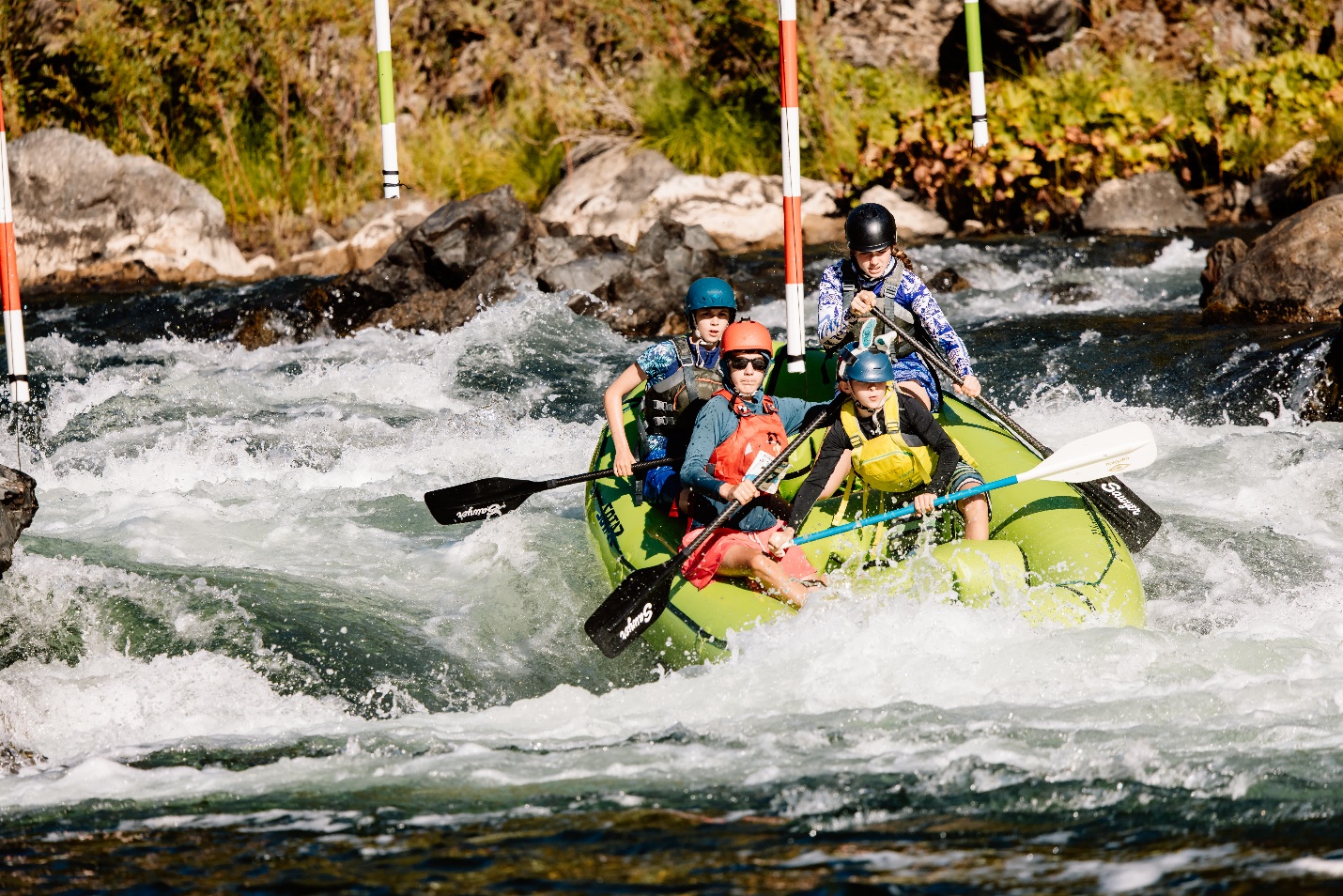
Redwood Rafters Cadet Mixed team taking on the11-gate Slalom course: Kiera McIver, Alia Collins, Jameson Wolf, and Zane Garwood. Juliana Dean Photography
Slalom
On day three, the final race was Slalom at Sailors Bar — the most technical race of the weekend. Teams had to navigate through whitewater and a dizzying maze of 11 gates, formed by pairs of poles slightly wider than the raft that dangle from river-spanning ropes. I helped build this course and it was no small feat erecting 300 ft-long highlines until just days before the race. I came to appreciate Neal Guthrie’s rope skills as we set highlines by adapting gear and methods he used to climb and haul equipment up walls in Yosemite. All our anchors were temporary and constructed out of tree-friendly soft tubular webbing. Some gates were placed in precarious locations with powerful hydraulics that can instantly flip a raft (some did) after a wrong move so split-second team decisions and paddling finesse define this race. To add to the challenge, four gates required teams to pass through the gate against the current—literally paddling upstream in whitewater! Namely, Gate 10 was a crowd favorite because it forced teams to paddle upstream, then get sucked directly into a “hole” that surfs the raft across the river and spits it out on the other side of the gate. To clear a gate, all four paddlers had to pass through in the correct direction without touching the poles. Each team had two timed runs, scored on speed, the number of gates cleared. Points were also subtracted if a gate was touched.

Redwood Rafters U19 Girls team and 2025 Slalom champions: Amaya Teraoka, Ender Guthrie, Nova Garwood, and Johana Olson. Juliana Dean Photography
Redwood Rafters Made Their Mark
In the U19 category the Troublemakers (U19 Boys) and the California Poppies (U19 Girls), both who hail from the Lake Tahoe region, won the overall combined National Race titles. The Troublemakers competed at Worlds in Bosnia the previous year and both Tahoe teams are older (and inevitably stronger) than the U19 Redwood Rafters by a few years on average. Basically, our youth look up to these other teams as inspiration, role models, and the teams to beat as they build their own skills and strength.

Perhaps the most rewarding outcome of the weekend for the Redwood Rafters was the pair of upset-wins made by our U19 Girls and U19 Boys teams. The Girls handily defeated the Poppies in the Slalom race, while the Boys edged the Troublemakers in the Head-To-Head event. These were the most technically challenging races of them all, so our teams were ecstatic when they realized they became the National Champions for these individual events. In the Cadet categories, Boys, Girls, and Mixed teams ran unopposed but delivered strong performances in all four events. These 12- to 14-year-olds confidently navigated the Class III whitewater course highlighting their hard-earned skills and growth in the sport. Our Cadet Girls even edged out the California Poppies in an exhibition match showing they will be a force to be reckoned with.
Rafting is a community-based sport in general so when the boys Cadet team needed another paddler, they recruited a younger sibling from a Colorado U19 team. It’s great to see youth strangers join and achieve shared goals on a big stage. Speaking of recruiting, the Troublemakers have now invited one of our U19 boys, Zade Hatton, to fill a critical spot on their U19 team competing at World’s in Malaysia this November!
Watching all these kids work together hosting this event, cheering each other and other teams on, and racing with everything they had was inspiring and showing their growing leadership will sail far beyond whitewater rafting. Seeing them thrive in such a wild, natural setting also warmed my soul. Based on feedback from many travelling teams and overall event stoke, hosting Nationals locally was a massive success for this growing sport. With their impressive race results, the Redwood Rafters now have realistic aspirations of representing the USA in International competitions in the years ahead. They are the future — one paddle stroke at a time.
Thank you to Abby and Neal, the parents, the teams, the volunteers, the safety team, all the sponsors, the community and businesses of Big Flat, and the US Forest Service for creating such a magical event.
###
Besides being a “raft dad” Justin Garwood is also a co-editor and author of the book — The Klamath Mountains: A Natural History.
THE ECONEWS REPORT: Northern Humboldt Indians
The EcoNews Report / Saturday, Oct. 25, 2025 @ 10 a.m. / Environment

On this week’s EcoNews Report, historian Jerry Rohde joins the show to discuss his new book, Northern Humboldt Indians, which you can download as an e-version here.
In his book, Jerry details the history of the seven tribes of Northern Humboldt County, with many newly colorized photographs and transcripts of interviews that help to bring to light the indigenous people of the area. The book is the companion to Jerry’s 2022 book, Southern Humboldt Indians.
HUMBOLDT HISTORY: Who Were the Mawenoks? Remembering Humboldt’s Lost Native American Tribe, Whose Territory Was Along Mad River From Blue Lake to Iaqua
Jerry Rohde / Saturday, Oct. 25, 2025 @ 7:30 a.m. / History

John Stevens, 1910. Photo: Bancroft Library. Colorized by the author.
###
Ed. note: The following is an excerpt from Northern Humboldt Indians, the latest in local historian Jerry Rohde’s book series on the people and places of Humboldt County. It was published earlier this year by the Cal Poly Humboldt Press.
Like all of Rohde’s recent work, the book is published under a Creative Commons license and can be downloaded as a PDF for free. This is amazingly generous. If you’re looking for a beautiful hardcover copy for your shelves or to give to a loved one, you can pick up a copy at various places around town, including from our friends at the Humboldt County Historical Society.
Northern Humboldt Indians tells the stories of the Hoopa, the Yurok, the Wiyot, the Whilkut, the Tsungwe and the Mawenok — the latter of whom, we’d be willing to wager, you’ve never heard of until now — and their encounters with each other, and with the wave of White settlement that overran Native Americans in the mid-19th century.
There’ll be an interview with Rohde posted on the Outpost a couple of hours from now. In the meantime, check out this excerpt, which Rohde gave us explicit permission to reprint.
###
Mawenok Territory
There was a place, on the Mad River, that must have seemed like a world unto itself. To the west the Iaqua Buttes stood like a dark, unscalable wall, rising abruptly from the canyon bottom and extending so high that they blocked the late afternoon sun. On the south was another mountain barrier that also enshadowed the river, while to the north rose a rolling ridgeline punctuated by Chaparral Mountain, Bug Creek Butte, and Board Camp Mountain, all more than 5,000 feet high. Here, however, the mountains descended more gradually to the river, with grassy, south-facing prairies often warmed by the unobstructed sun. On the canyon floor, near the location that became known as Big Bend, it is easy to believe that the river ran through its gorge like a long, sonorous chord, sending its sound to anyone who paused to listen to it, and telling the listeners that here they were welcome to abide, that here, like the river canyon, the spirit ran deep.
It became the home of the Mawenoks.
Almost no one has heard of the tribe. Between 1906 and 1913 three ethnographers interviewed Mawenoks, but they either failed to confirm their tribal identity or did not broadcast their information. In 1918 Llewellyn Loud, in his monograph on the Wiyot tribe, used statements from John Stevens, whom he indicated was born “one and a half to two miles below Maple Creek.” The location was in the heart of Mawenok country, but Loud didn’t know this and he accordingly labeled Stevens a member of the neighboring tribe, the Whilkuts.
Eight years earlier, Stevens had been interviewed by another ethnographer, C. Hart Merriam, who concluded that the Mad River area previously assigned to the Whilkuts had actually been the homeland of a closely connected but separate tribe called the Mawenoks. Merriam obtained a list and descriptions of numerous Mawenok villages without realizing that his informant was himself a member of the tribe, believing, like Loud, that Stevens was a Whilkut. Merriam’s minimal account of this heretofore unknown tribe was not published until 1974 and then only as a paper from the Archaeological Research Facility at UC Berkeley. An even earlier ethnographical inquiry, conducted by Pliny Goddard in 1906 and 1908, included a brief but detailed report about the tribe that still languishes in the deepest obscurity.
In his 1906 interview with Johnnie Maple, he obtained the tribe’s name, spelling it “Me-wi-yi-nuk,” but he apparently never used it in print. A 1908 Goddard interview with Minnie Pete, a Mawenok who was born at Big Bend in about 1850, never mentions her tribal identity, It was first seen by California Athabaskan language expert Victor Golla in 2015, some 107 years after it was recorded. After studying it, Golla concluded that it “is clear that it was recited in a variety of Hupa closely resembling Goddard’s ‘Whilkut.’”
Over time, according to Goddard’s and Merriam’s information, the Mawenoks came to occupy a long stretch of the river, from above Bug Creek on the south all the way downstream to the North Fork Mad. In about 1849 the Mawenoks and their Whilkut neighbors probably joined together in expanding their boundaries by attacking a Wiyot village in the vicinity of later-day Blue Lake. Some Wiyot men were killed, some were driven off, and some of the younger women, whether willingly or not, became wives or partners of the attackers, so that the village subsequently became a combination of Wiyots, Whilkuts, and Mawenoks, along with their mixed offspring.
Upstream from the main Mad River’s confluence with the North Fork, in the area south of Blue Lake, the Mad flows through a heavily wooded canyon that offers little access to the surrounding forest. In the mountains to the east there were two upland Mawenok villages: Ma-kawch-ting at the future site of the Angel Ranch and Yi-kil-le-yah’ng-ahl-ting, on or near Cañon Creek in the prairie area that later became the John Anderson Ranch. Below them, several Mawenok villages occupied small riverside flats at creek mouths. Upstream from Cañon Creek, according to Loud, “there were six villages or camping places, but none of them could boast of having more than two plank houses, or two or three bark houses.” Then came Tse-didis-ten, which “was situated one and a half to two miles below Maple creek.” It “had 10 or 12 houses” and was the birthplace of the Loud and Merriam informant John Stevens.
Above Tse-didis-ten the river twists in a convolution of curves and passes by three large villages located at the mouths of Maple Creek and Boulder Creek and at Blue Slide. Loud reported that
… there were five houses, mostly bark, but some of plank, at the mouth of Maple creek, while on Boulder creek, one and a half miles above Maple creek, there were a considerable number scattered about on both sides of the creek and also up the creek. Hence the Maple creek district was a comparatively populous center.
About a mile above the mouth of Boulder Creek, the Mad makes a C-shaped bend to the west, bumping into a wall of colorful clay called Blue Slide. The flat on the inside of the bend contained what was described as “one of the largest rancherias in the whole Mad river valley.” The Mawenok name for the village was probably Me-meh, but this is not certain.
Above Blue Slide the canyon is again constricted. Some four miles upriver was a village called Sel-ku-mik-kin-ne-din. It was south of what later became the Mountain View Ranch and was situated about a mile west of the river, near the base of the Iaqua Buttes. Another four miles upriver, near the confluence with Wilson Creek, was the village of Lit-tcite-tcin-nouru-din, “sand blows place,” at the location the Whites called Big Bend. The canyon of the Mad opens here, briefly, so that for about two miles south-facing prairielands slope scenically down to the westward-bound river. About a mile farther upstream, near the mouth of Humbug Creek, was the village of Un-tcin-ta-tci-ki. It was a place where Van Duzen Pete, a member of the nearby Nongatl tribe, stayed as a boy.
The Mawenok village farthest up the Mad River was Tseng-nah-neng-ahl-teng, which Merriam reported was “on or near Bug Creek.” At this point the river turns southeast and the already steep-sided canyon narrows into another gorge. At one time there was a landslide in the vicinity of Bug Creek that in dry years formed a barrier to fish migration. The sudden arrival of this obstacle may have caused the Mawenoks to lose interest in the territory upriver from it. In any case, about three miles above Bug Creek, in the vicinity of Deer Creek, was the first village of the Nongatl tribe, which was the Mawenoks’ neighbor to the south.

Mawenok traditional house, 1906. The unidentified woman out front is probably Betsey Maple. Photo: Pliny Goddard, via the Hearst Museum of Anthropology. Colorized by the author.
When Pliny Goddard Met Johnnie Maple
In September 1906, Pliny Goddard, one of two professors in the University of California Berkeley’s Anthropology Department, found his way to a remote section of the Mad River, ten miles or so upstream from the town of Blue Lake. He arrived at the flat opposite a wall of clay called Blue Slide, and rode his white horse southward until he reached the homestead of the man he had come to see, Johnnie Maple.
Maple’s cabin and barn were nestled in a gentle curve of hillslope curve that rose eastward from the riverside towards the ranchlands of the Maple Creek area. The structures were built White man’s style, with mill-cut lumber for the sidings and redwood shingles for the roofs. Maple, who was part Mawenok and part Whilkut, lived there with his Mawenok-Wiyot wife Ida, two children, a boarder named Leon, and Johnnie’s half-sister, Betsey.
Goddard took out a brand-new “Stenographer’s Note Book,” wrote “Maple Creek” on the cover, turned the page, and went to work.
For several years during the 1900s this was how he spent his summers. When spring classes were over at the university, Goddard would gather up some supplies and head north, picking up the university’s white horse and pack mule at Laytonville, and then riding into the Humboldt County back country, searching for elderly Athabascan-speaking Indians to interview. He had received his Ph.D. in linguistics from Berkeley in 1904, the first such degree ever conferred in the United States. By then Goddard was already an instructor in the university’s anthropology department, and in 1906 he was promoted to assistant professor. He had come to California in 1897 to serve as a lay missionary on the Hoopa Valley Reservation, where he soon bonded with reservation’s Indians. In 1900 he left Hoopa to pursue his academic career at Berkeley, where during his first year Goddard wrote Life and Culture of the Hupa, which became the initial monograph in the university’s American Archaeology and Ethnology series.
Now, a few hundred feet from the Mad River, in the territory of a tribe whose name had never been recorded, Goddard was in his element. He was trained as a linguist, but his heart was not with the language, it was with the people who spoke it. He would dutifully collect a vocabulary from an aging Indian, and perhaps record a series of mythlike stories, but time and again his fingers would seek a different objective, and his pencil would stray from its required task and form words that told of the Indians’ people and places and what had happened to them.
With Johnnie Maple, it happened faster than usual. Goddard skipped the usual preliminaries and went straight to geography.
Goddard learned that Maple’s early-day home had been at Dil-tcwa-yo-o-kut, a village near the mouth of Maple Creek on a hillside above the Mad River. His half-sister, Betsey Maple, was born on Yi-nal-lin-ni-kot, Boulder Creek, a short distance upriver. Her Mawenok name was Kon-na-din-nun, which meant “eye sharp” in the tribe’s language.
Johnnie told Goddard that the “Maple Creek and Rock Ranch” area was his father’s country, and that his father’s people “didn’t go up Mad River beyond Blue Slide.” He also indicated that there was a village called Mista-dun “way down” the river, and that “the people on Mad River from Al Graham’s [Algren’s] to Mista-dun” were called the Me-wi-yi-nuk. As the crow flies, the Mawenoks’ northern boundary at Mista-dun and their southern boundary at the Al Graham Ranch were about 18 miles apart. Along the twisting course of the Mad River, where most of their villages lay, the distance may have been twice that.
When Maple provided his tribe’s name, “Me-wi-yi-nuk,” it had never before been recorded. Four years later, Merriam rendered it as “Mawenok,” a form that is easier to pronounce. The Hupa tribe, which spoke an Athabascan language similar to the Mawenoks, gave the name as Mewinakhwe. Maple’s information indicated that the Mawenoks were not a single, monolithic tribal unit. His own, unnamed group did not go upriver beyond his home area at Blue Slide, while the tribe’s southern boundary was about a dozen river miles to the southeast at Bug Creek, near the Al Graham Ranch. Downstream from Blue Slide, the territory of his father’s tribal group only extended to Maple Creek, many miles from the Mawenoks’ northern boundary near Blue Lake, which meant that at least one unnamed Mawenok tribal group occupied the intervening area. Johnnie also stated that the area across the Mad River from the flat at Blue Slide “belonged to another people not Johnnie’s folks.” Thus there were probably at least three or four Mawenok tribal groups and perhaps more. Johnnie Maple is the sole source of this information. Without his interview with Goddard we would know of no divisions, or their boundaries, within the tribe’s territory.
Goddard also learned a few details about Mawenok life. Maple said that his people “used to dance out of doors, around fire counterclock[wise]. Men and women together.” A person Goddard identifies only as “old woman,” (who was probably Johnnie’s wife Ida) then said “they used to build house of bark and sticks with hides in side. They stay when it is wet and cold [she] pointed to her house.” Johnnie indicated that “they never dug a pit for the houses but put it on top of the ground that is why can’t find the exact places.” Regarding one village area, Betsey Maple added that there was “no sweat house [at] this place.”
The rest of Goddard’s interview with the Maples mostly concerned the names and locations of Mawenok villages or other significant spots. The interview was one of the briefest Goddard recorded; it ends on page 19 of his “Stenographer’s Note Book” and three of the intervening pages are entirely or nearly blank.
John Maple died in 1953. Ida Maple died five years later at age 97. By then their son, Harvey, had returned from living on the coast in the lumber mill town of Samoa and was back on the family’s allotment. At some point his parents’ house was abandoned and Harvey dwelt in a small clapboard house that he probably built himself. In 1973 he was still living on the property at age 74. That year, a project to build a dam at nearby Butler Valley was under consideration. If built, the dam would flood a large section of the Mad River canyon, ultimately covering Harvey Maple’s allotment property. He was interviewed as part of an assessment of the dam’s potential impacts, which noted that he was “the last Whilkut [Mawenok] speaking Indian in existence.”
The dam was never constructed.
Besides being the keeper of the Mawenok language, Harvey also maintained another part of local Indian culture. He made finely crafted dip nets that were used at ocean locations such as Moonstone Beach to gather surf fish.

Harvey Maple shows one of his dipnets to Dennis Turner. Photo: Gloria Turner. Colorized by the author.
###
You like Humboldt history? In addition to buying Jerry Rohde’s new book to read the rest of his stories about the Mawenoks and other local peoples, consider becoming a member of the Humboldt County Historical society. The Humboldt County Historical Society is a nonprofit organization devoted to archiving, preserving and sharing Humboldt County’s rich history. You can become a member and receive a year’s worth of new issues of The Humboldt Historian at this link.
OBITUARY: Nancy Yvonne Detrick, 1951-2025
LoCO Staff / Saturday, Oct. 25, 2025 @ 6:56 a.m. / Obits

Nancy Yvonne Detrick was born on November 19, 1951 in Garberville and died on October 10, 2025 at her home in Wool Mountain surrounded by family. Nancy heroically lost her battle to cancer after a long fight of six years.
Nancy was born to her parents Nancy Sanderson Detrick and Harold Lee Detrick. At an early age, Nancy was nicknamed Voncie, and Voncie is the name that she would grow up with and that most people would know and love her as. Voncie and her family moved around Humboldt County all throughout her childhood, but Alderpoint was the home base for her family, and is the town where she put most of her roots. As a young child she attended Zenia, Hoopa and Casterlin Elementary schools and later moved to Eureka for high school. Her first job was cracking crab for the local fish company.
Voncie came back to Alderpoint because she wanted to move back to the countryside with her little boy, Sonny. Voncie reconnected with her old friend who then became her life long partner, Darrell Wyatt in 1972, where they spent 50 years together growing a family and raising hell in the best way possible. They welcomed their first daughter Misty into their family, and a couple years later they welcomed Echo.
As a family they lived in Alderpoint until they later built their home in Harris. In these early years while the children attended school, Voncie was a home maker and Mother, while also always working alongside Darrell. Voncie enjoyed abalone diving, eeling, commercial salmon fishing and tending to the garden, and animals they had on the farm. In the early 2000s, they built and moved into their home in Wool Mountain. Voncie and Darrell were both lucky to be able to have their final moments in this home. This home became the pinnacle for grandchildren and animals. Voncie enjoyed animals and she was known to have a lot of dogs, chickens, cows and she tamed many wild piglets over the years. She also had two cats that were very important to her. Her garden was a place of peace for her, she always grew a huge garden every year. Voncie hand watered this garden every morning, right up until her final weeks. She enjoyed eating from her garden, and also canning the vegetables and fruit for the winter months. She passed on these traditions to her family
Voncie had 10 grandchildren and 8 great-grandchildren and she was a very proud grandmother who enjoyed doing things for her grandchildren. She was the type of grandma who would have cookies made for you when you got to her house, food on her wood cook stove, and freshly mopped floors. When her grandchildren were younger, one big event every year was getting the Family picture taken at Sears, you could count on matching outfits and maybe a few tears, but that picture was a staple in their lives. The grandchildren always did it, just for their grandma to send her holiday cards out with that picture inside. Holidays were always spent at Grandma Voncie’s house. Christmas, Thanksgiving and Easter, were some of the major holidays that you could count on her whole family gathering together at her house for a meal and celebration. Voncie was not only the designated turkey cooker and pie baker but also the heart of the family.
Voncie was always ready to go on an adventure, whether that meant going and cutting firewood, swimming at the river or creek, Shelter Cove to fish, Ruth Lake to camp, or just simply going on a drive to see what was going on. She was a great passenger and always made sure there was an ice chest in the back with cold Miller and a bag of snacks.
Voncie was competitive by nature. She loved to sit down at the table and play a game of rummy, or see who’s dish was better at the bbq. Speaking of BBQs, Voncie and Darrell hosted a heck of a lot of BBQs all through their years. Friends and family gathered at their houses for various events. When you came to their house, you could count on Voncie having plenty of food cooked up and a joint, or two, or three rolled for you. Voncie was fortunate to have a lot of friends in the hills where she built her life. Friends that became family.
Voncie was the matriarch of her family. Her children, Grandchildren, nieces, nephews, and cousins all looked up to her in so many ways. She will be forever missed. The legacy that she left will be carried on in the hearts and minds of those that she loved.
Voncie is predeceased by: Mother Nancy Sanderson Detrick, Father Harold Leland Detrick, Spouse Darrell Wyatt, siblings: Antone Detrick, Phyllis Wantt, Larry Coleman, Eugene Coleman.
Voncie is survived by her three children Sonny, Misty, and Echo; ten grandchildren Breanna (Zach), Natalee, Kaitlynn, Shasta (Colt), Austin (Makayla), Brennan (Joslin), Jasmine, Kasey, Lily and Tanner; great-grandchildren Brayden, Azalea, Sage, Maverick, Scarlett, Hayes, Waylon and Addison. Siblings: Judy Scott and September Detrick. And lots of nieces, nephews and cousins.
The family would like to extend a thank you to Deena Johnson and the Heart of the Redwoods Hospice for your support and help during the final weeks of Voncie’s life.
There will be a celebration of life on November 22, 2025 at 1 p.m. at the Alderpoint Volunteer Fire Hall. This will be a potluck event, please bring a dish and a memory of Voncie.
###
The obituary above was submitted on behalf of Voncie Detrick’s loved ones. The Lost Coast Outpost runs obituaries of Humboldt County residents at no charge. See guidelines here.


