The Fortuna City Council will likely establish a moratorium on rent increases on mobile home residences at a special meeting this Monday, September 29, to give them time to develop a Rent Stabilization Ordinance for the city.
Though it’s not a set-in-stone RSO, the Fortuna-based group Save Our Seniors (SOS) is calling it a win after months of advocacy.
Announced after a closed session of the Fortuna City Council on Monday, the moratorium pauses all rent increases on mobile home lots within city limits until April 30, 2026, or until it’s repealed. It’ll likely be replaced by an RSO, which will establish some limits on how much owners of mobile home parks can raise the lot rent on their residents.
Increases are usually tied to increases in the Consumer Price Index; SOS spokesperson Hilary Mosher said they’d like them to be around 75% of the CPI. They’re also asking that rents won’t be bumped up more than 5% when the houses are sold.
Mosher said that they were thrilled when they heard the news.
“There was a shocked silence as we all looked at each other and thought, ‘Wait, did you just hear what we just heard?’” Mosher said in a phone call with the Outpost.
If the council hadn’t decided to enact a moratorium, the SOS was planning on switching tactics to trying to pass a citizen’s initiative, which requires a lot more effort, especially for a group mostly made up of the elderly.
“We were despondent,” Mosher said. “We really thought, ‘Oh man, we gotta go around these folks and do the right thing.’ And then when they came out and announced that they had done the right thing, we just felt such a wave of relief and support.”
Mosher, who has helped to pass several RSOs over the last decade in Humboldt County, said that during previous campaigns owners had increased rents on residents while government officials were working to create them — the moratorium prohibits that possibility, a reason also mentioned in the document.
The owners of the Royal Crest Mobile Home Park, the park at the center of the movement, have hinted through their lawyer that they’d be willing to sue if an RSO is enacted. They’d prefer a Memorandum of Understanding (MOU) with the city, but the SOS don’t want the city to enter an agreement that’s mostly dictated by one side and isn’t written into law. According to Mosher, there are also over 100 cities in California with an RSO and only four with an MOU.
City Manager Amy Nilsen said in a voicemail that the moratorium was the result of “significant public comment” from the SOS.
Fortuna Mayor Mike Johnson declined to speak at length about the ordinance.
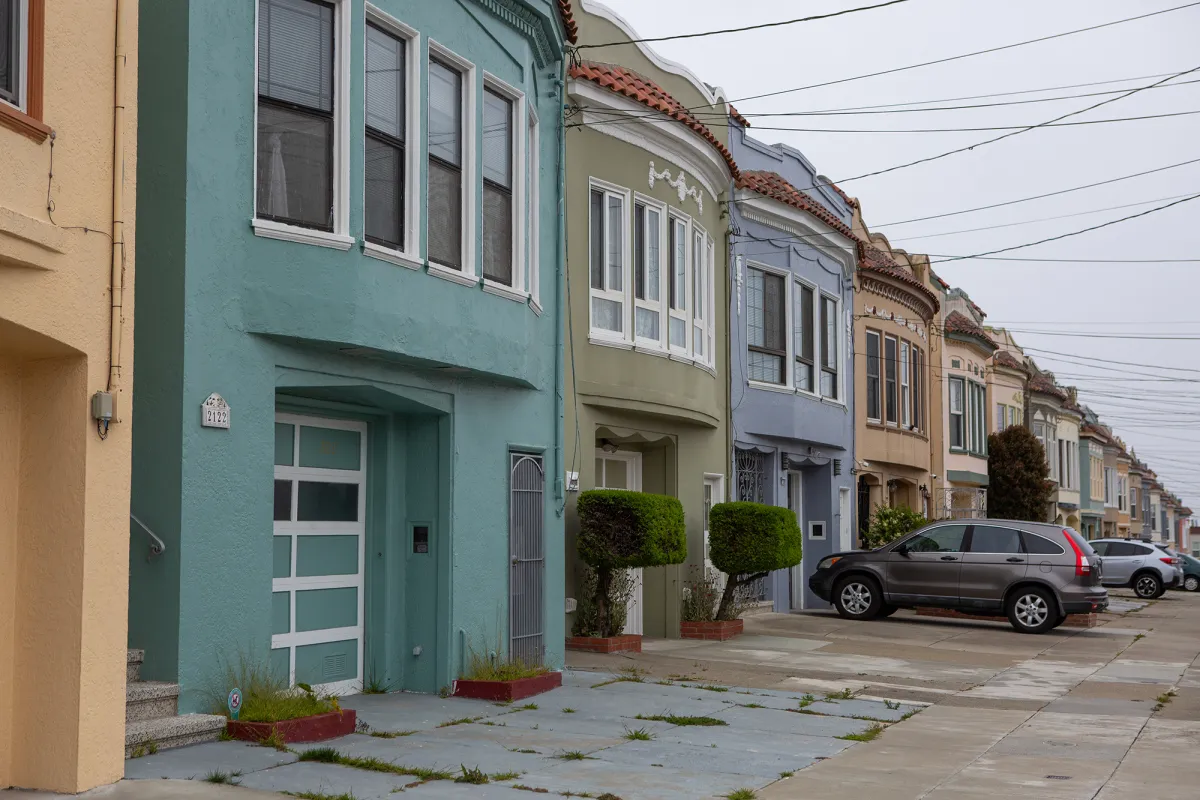
Houses in San Francisco’s Sunset District on July 12, 2023. Photo by Semantha Norris, CalMatters
###
This story was originally published by CalMatters. Sign up for their newsletters.
###
Imagine you’ve finally taken your car to the mechanic to investigate that mysterious warning light that’s been flashing on your dashboard for the past week and a half.
The mechanic informs you that your car’s brake fluid is too low. Dangerously low. Your brake fluid supply, he says, has reached “crisis” levels, which sounds both scary and very expensive.
Naturally, you would prefer that your car have a non-critical amount of brake fluid. “How much more do I need?” you ask.
“A quart,” the mechanic responds. “No, actually, three quarts. Or maybe seven gallons — but only routed to your rear brakes. Actually, let’s settle on half an ounce.”
Such is the situation with California’s housing shortage.
For nearly a decade now, the Legislature has been churning out bills, Attorney General Rob Bonta has been filing lawsuits and Gov. Gavin Newsom has been revamping agencies, dashing off executive orders and quoting Ezra Klein with the explicit goal of easing the state’s chronic undersupply of places to live.
California simply doesn’t have enough housing and this shortage is the leading cause of our housing affordability concerns — virtually everyone in and around the state government, along with the vast majority of academics who have studied the issue, seems now to agree on this point.
This consensus was on display this year when lawmakers passed two sweeping changes to state housing law, one that shields apartment developments from environmental litigation and the other that would permit denser development near major public transit stops in big cities. Both were legislative non-starters just a few years ago. These days even the opponents of these bills have accepted the premise that the state faces a “housing shortage,” a term evoked at least 30 times in committee hearings and floor speeches this year.
Now, if only anyone could agree on how big the housing shortage actually is.
Plenty of people have tried to put a number on the problem.
In 2015, the Legislative Analyst’s Office, which serves as a policy analysis shop and think tank for the Legislature, took an early crack at quantifying the state’s shortage by calculating how many additional units major metro areas would have had to build over the prior three decades to keep housing cost inflation on par with that of the rest of the country.
It came up with 2.7 million missing units.
A year later, consulting giant McKinsey one-upped the LAO, putting the state’s “housing shortfall” at 3.5 million houses, apartments and condos, a number Newsom campaigned on.
Not all estimates hit seven digits. In 2024, the housing policy nonprofit Up For Growth published the more modest estimated shortfall of 840,000 units, which comes pretty close to the 820,000 Freddie Mac put forward a few years earlier.
California Housing Partnership, a nonprofit that advocates for affordable housing, has counted the deficit at 1.3 million units — but not just any units. That’s how many homes the state needs to add that are affordable to people making under a certain income.
Then, this summer, a group of housing analysts including an economist at Moody’s Analytics, came up with the strikingly low figure of just 56,000 — though the authors acknowledged that it’s probably an underestimate.
Estimates of the nation’s overall housing supply are similarly all over the place: From as high as 8.2 million to 1.5 million (and, in one controversial paper, zero).
What even is a housing shortage?
The concept of a “housing shortage” is, in theory, pretty simple, said Anjali Kolachalam, an analyst at Up For Growth.
“It’s basically just the gap between the housing you have and the housing you need,” she said.
In practice, defining and then setting out to quantify the “housing you need” is an exercise fraught with messy data, guestimation and an inconvenient need for judgement calls.
Most estimates begin with a target vacancy rate. In any reasonably well-functioning housing market, the logic goes, some houses and apartments sit empty, either because they’re between renters, they’ve just been built or sold, they’re being fixed or renovated or they’re someone’s second home. A modest vacancy rate is what allows you to pull up Zillow or Craigslist and not get a “No Results Found” error. A very low one suggests there aren’t enough homes to go around.
But choosing a “healthy” vacancy rate — one that reflects a functional housing market — and then backing out the number of additional homes needed to hit it, is more art than science. Most estimates turn to historical data to find some level when supply and demand weren’t completely out of whack. Whether that halcyon period of relative affordability is 2015 or 2006 or 2000 or 1980 varies by researcher and, likely, by the region being considered.
“This notion of ‘pent up demand’ is necessarily in an economist’s judgment call.” — Elena Patel, fellow, Brookings Institution
Beyond that, many researchers have tried to put a value on what is sometimes called “pent up” demand or “missing households.” Those are all the people who would have gone off and gotten their own apartment or bought their own place, but, because of the unavailability of affordable places to live, have opted to keep living with housemates, with parents or, in more extreme cases, without shelter of any kind.
Absent a survey of every living person, there’s no way to precisely measure how many people fall into this camp.
“This notion of ‘pent up demand’ is necessarily in an economist’s judgment call,” said Elena Patel, a fellow at the Brookings Institution who helped put together a nationwide shortage estimate last year (4.9 million).
These variations in methods help explain some of the differences in the shortage estimates. Other differences pop-up thanks to the vagaries of data.
The Moody’s Analytics-led report, for example, calculated a national shortage of roughly 2 million units by adding together both the number of new units needed to raise the overall vacancy rate and the homes needed to backfill their measure of “pent up” demand. But for its California-specific estimate, the data wasn’t available to do the latter, potentially leaving out a big chunk of the statewide shortage.
Then some estimates differ because the analysts are defining the shortage in a completely different way.
The California Housing Partnership looks at the difference between the number of households deemed by federal housing guidelines to have “very” or “extremely” low incomes and the number of units that those households could conceivably rent with less than 30% of their incomes.
That gap of 1.3 million gets at a problem totally distinct from an overall shortage of homes.
Finally, there’s the question of scale. Housing markets are, on the whole, local. A national shortage is going to add together San Francisco and Detroit, masking the extremes of both. A shortage estimate for a state as large and diverse as California may have the same problem.
“It is like looking for a weather forecast for a trip to the beach and being told that the average temperature nationwide is likely to be 67 degrees,” the authors of the Moody’s-led analysis wrote.
Why estimate a shortage?
What might be more valuable than fixating on any one shortage estimate, said Daniel McCue, a researcher at the Harvard Joint Center for Housing Studies, is to look at all the estimates together and appreciate that, by and large, they’re all huge.
“Whether it’s one-and-a-half million or five-and-a-half million, these are big numbers,” he said. That leads to an inescapable takeaway, he said. “There’s so much to do. There’s so far to go.”
Patel, from Brookings, said trying to put a precise tally on what is ultimately the somewhat nebulous concept of a “housing shortage” is still a worthwhile exercise because it gives lawmakers and planners a benchmark against which to measure progress.
How much additional taxpayer money should a state throw at affordable housing development? How aggressive should a locality be in pursuing changes to local zoning? “The more concrete you can be in policy making land, the better,” she said.
The State of California does in fact have its own set of concrete numbers.
Every eight years, the Department of Housing and Community Development issues planning goals to regions across the state — a number of additional homes, broken down by affordability level, that every municipality should plan for. These are, effectively, California government’s official estimates of the state shortage.
To cobble together these numbers, state regulators look at projections of population growth to accommodate the need for future homes and then tack on adjustments to account for all the homes that weren’t built in prior periods, but perhaps ought to have been. If a region has an excess number of households deemed overcrowded, it gets more units. If vacancy rates are below a predetermined level, it gets more units. If there is a bevy of people spending more than 30% of their incomes on rent, more (affordable) units.
It’s a process that the state regulators have come to take somewhat more seriously in recent years, engendering an ongoing political backlash from density-averse local governments and neighborhood activists.
In the state’s last estimate, the topline total was 2.5 million units.
This coming cycle, which has already begun in the rural north and will slowly roll out across the state in the coming years, will produce yet another number. That will be one more estimate for state lawmakers of how much brake fluid the car needs.
Protesters gathered outside the KAEF-TV studio in Eureka. | Photo by Andrew Goff.
UPDATE, Friday, Sept. 26, at 12:21 p.m.:
A couple dozen protesters, give or take, have gathered outside KAEF-TV’s Eureka studio to picket in opposition to Sinclair’s decision to prevent “Jimmy Kimmel Live!” from airing on its affiliate stations.
When Outpost reporter Andrew Goff reported to a few of the protesters that Sinclair has relented and will allow Kimmel’s show to return to its stations starting tonight, they were generally pleased, he said.
###
UPDATE, Friday, Sept. 26, at 11:38 a.m.:
Sinclair announced this morning that it will resume airing “Jimmy Kimmel Live!” on its affiliate stations starting tonight.
The company’s statement reads, in part:
Over the last week, we have received thoughtful feedback from viewers, advertisers, and community leaders representing a wide range of perspectives. We have also witnessed troubling acts of violence, including the despicable incident of a shooting at an ABC affiliate station in Sacramento. These events underscore why responsible broadcasting matters and why respectful dialogue between differing voices remains so important.
###
Original post:
Private security guard Christofer Berg, with Pacific Coast Security, stands outside the KAEF studio at 540 E Street in Eureka on Thursday. | Photo by Ryan Burns.
###
An armed security guard has been hired to stand outside local ABC affiliate KAEF-TV’s Eureka studio amid concerns of political violence as the station’s parent corporation, Sinclair Broadcast Group, continues to boycott “Jimmy Kimmel Live!”
ABC’s parent corporation, Disney, set off a national uproar over free speech last week when it acquiesced to pressure from Donald Trump’s administration by suspending Kimmel, ostensibly over comments he made about the political response to Charlie Kirk’s assassination.
Kimmel returned to ABC airwaves on Tuesday, but the nation’s two largest owners of local ABC stations — Nexstar and Sinclair — have refused to air the program, setting off another wave of First Amendment concerns both nationally and locally.
Andrew Killmer, a sales assistant for KAEF, told the Outpost this afternoon that Sinclair has hired security for all of its local affiliates in response to an incident in Sacramento on Friday when a man opened fire into the lobby of an ABC affiliate.
“It’s a corporate thing,” Killmer said of the decision to hire security guards. “It’s kind of a blanket thing that they’re doing for all of the Sinclair stations during this [time].”
“Their local censorship is detrimental to America’s protection of free speech,” the group says in an email announcing the protest. “Comedians should have the right to criticize our leaders without interference from corporations that lease our public airwaves.”
Other local activists, meanwhile, are encouraging a boycott of businesses that advertise on KAEF.
Killmer said he’d been answering phones all day and explaining that local employees have nothing to do with the Kimmel ban.
“It’s all corporate decisions,” he said, “and [people] can and should, you know, protest what’s going on. … Everybody has their personal politics, you know. When people call, I’m trying to make them feel heard.”
Killmer also noted that many individual employees within the corporate structure share the views and beliefs of outraged viewers, but when he receives their angry calls he has a phone number at his disposal to send their complaints “up to corporate.”
Incidentally, the guard who’s been hired to stand outside KAEF’s studio, Christofer Berg, mentioned that he also works for Lear Asset Management. He’s one of four men charged with battery and false imprisonment after dragging a woman out of a town hall meeting in Coeur d’Alene, Idaho, in February. He and the other defendants pleaded not guilty.
As seen in video of the incident, Berg and his cohorts were dressed in dark pants and black tactical shirts with no indication that they were security guards. They were later identified as employees of Lear, a private security firm with a history of raiding California weed farms.
Berg told the Outpost that he feels a responsibility to be a servant through his security work. He also voiced frustration about security guards being misrepresented in the media.
KAEF-TV is considered a “semi-satellite” of Redding-based KRCR-TV. Sinclair Broadcast Group owns or operates 193 stations across the country in more than 100 markets, covering 40 percent of American households.
A digital rendering of the fully built-out Humboldt Bay Offshore Wind Heavy Lift Marine Terminal. | Image: Harbor District.
###
Nearly two months after the Trump Administration announced its intent to revoke $679 million in federal grant funding for offshore wind projects across the nation, the Humboldt Bay Harbor, Recreation and Conservation District is looking to the state to help fill critical funding gaps for the Offshore Wind Heavy Lift Marine Terminal Project slated for the Samoa Peninsula.
Since 2023, the U.S. Department of Transportation (DOT) has awarded more than $435 million in federal grant funds to the Harbor District, including $426.7 million from the INFRA Program and $8.6 million from the Port Infrastructure Development Program (PDIP). U.S. Transportation Secretary Sean P. Duffy abruptly withdrew those funds at the end of July on the basis that “fantasy wind projects” use “resources that could otherwise go towards revitalizing America’s maritime industry.”
At a special meeting tonight, the Harbor District Board of Directors will discuss the recent loss in federal funds and next steps for the heavy lift marine terminal project. The staff report attached to tonight’s agenda notes that “district staff are currently working with the State and other partners to plan our next steps and determine how to fill the funding gaps left by the Federal government’s actions.”
Reached for additional comment on tonight’s agenda, Harbor District Executive Director Chris Mikkelsen acknowledged that the district is “obviously in a transition,” but said he’s optimistic that the terminal project will move forward with financial support from the state.
“We still have funds available in the original grant we received in [2022] from the California Energy Commission, so we will continue to utilize those funds,” Mikkelsen told the Outpost, referring to a $10.5 million CEC grant. “In addition to that, hopefully late this year or early next year, we will see a grant agreement for what’s called the ‘WFIT’ — the Waterfront Facilities Improvement Program that the CEC put out last year — in which we were awarded a little over $18 million to allow us to expand upon our studies and our technical work.”
“We’re full speed ahead,” Mikkelsen continued. “We’re absolutely focused, shoulder to the wheel, on building a modern heavy lift marine terminal here in Humboldt. … [After] some of these next steps happen and we have more green lights in front of us, then there’ll be … more to share, but right now, that’s where we’re at.”
Image: Harbor District
As seen in the table above, which does not include any matching funds from the state, the district has spent about half of the federal PIDP funds, with approximately $4.15 million remaining. Does that mean the district has to reimburse the federal government for the PIDP funds spent to date?
“No. These are reimbursement grants — we are only reimbursed for the activities that we complete,” Mikkelsen said, noting that the district is covered for the cost up to July 29, 2025, when it received notice that the funds would be withdrawn. “There won’t be any need for repayments there because those funds have not come.”
The staff report notes that the INFRA grant funds have not been spent for two reasons: 1) The majority of INFRA funds are reserved for construction, and 2) INFRA funds cannot be expended until permits are complete.
“While this is a significant blow to the project, this is a longer-term problem as the project is not expected to be ready for construction for a few years,” the report states. “This gives us time to secure alternate sources of funding for construction.”
The district will also seek funding through California’s Climate Bond, also known as Proposition 4, which includes $475 million in funding for offshore wind development. Mikkelsen said the district hopes to get about half of that funding, but it’s yet to be determined.
“We’re going to advocate for and lobby for a very large portion of that money to come to Humboldt,” he said. “We’re uniquely qualified to receive it … [as] only two ports uniquely qualify for about $400 million of it — that’s us and [the Port of] Long Beach. Keep in mind, we work hand in glove with Long Beach on developing these terminals here on the U.S. West Coast.”
The Harbor District Board of Directors isn’t expected to take any formal action on tonight’s status update, but members of the public are welcome to attend in person and via Zoom. The board’s agenda and virtual attendance instructions can be found here.
Press release from the Humboldt County Sheriff’s Office:
On Sept. 23, 2025, deputies with the Humboldt County Sheriff’s Office Marijuana Enforcement Team served three search warrants in the Island Mountain area of northern Mendocino County as part of an illegal cannabis cultivation investigation. The Trinity County Sheriff’s Office and the Butte County Sheriff’s Office assisted in the service of the warrants.
Three parcels were investigated during the service of the warrants. The parcels did not have the required county permit or state license to cultivate cannabis commercially.
During the service of the warrants, deputies eradicated about 6,259 growing cannabis plants. They also seized and destroyed more than 612 pounds of cannabis bud and shake.
Assisting environmental agencies found chemicals restricted for use in California. These included pesticides such as imidacloprid, which is highly toxic to pollinators, and myclobutanil. Both are listed on California’s Groundwater Protection List. Investigators also found bromethalin, a neurotoxic rodenticide known to kill local wildlife. All of these pesticides are prohibited for use in cannabis cultivation by the California Department of Pesticide Regulation.
No subjects were contacted on scene. This is an ongoing investigation into those responsible.
Anyone with information about this case or related criminal activity is encouraged to call the
Humboldt County Sheriff’s Office at (707) 445-7251 or the Sheriff’s Office Crime Tip line at (707) 268-2539.
UPDATE, 12:10 a.m.: Just after midnight, the Eureka Police Department announced on social media that the barricaded subject was in custody and that they’d release more details soon.
# # #
UPDATE, 5 p.m.:The situation is unchanged. Law enforcement remains on scene for the long haul, keeping the Hawthorne Street home surrounded while the subject stays inside despite repeated attempts to draw him out.
# # #
UPDATE, 1:45 p.m.: Police are still on scene, with guns drawn. The Sheriff’s Office’s Bearcat has been brought to the location, and there’s a drone in the sky.
Archives from a Humboldt County scanner feed indicate that the incident began just before 10 a.m., when a man with a gun was found sleeping in a house not his own.
According to the Outpost‘s Andrew Goff, police are currently using a loudspeaker to instruct a person to come out of the house.
###
Photo: Submitted.
Readers alert us to the fact that the Eureka Police Department has taped off a block of Hawthorne Street, in between Summer and Union, while some sort of investigation is underway.
Eureka Police spokesperson Laura Montagna said that the department did not have any information it was able to share at the moment, but she did say the public was not at any risk.
An Outpost reader who witnessed the scene said police were seen outside a home with their weapons drawn a little bit ago.
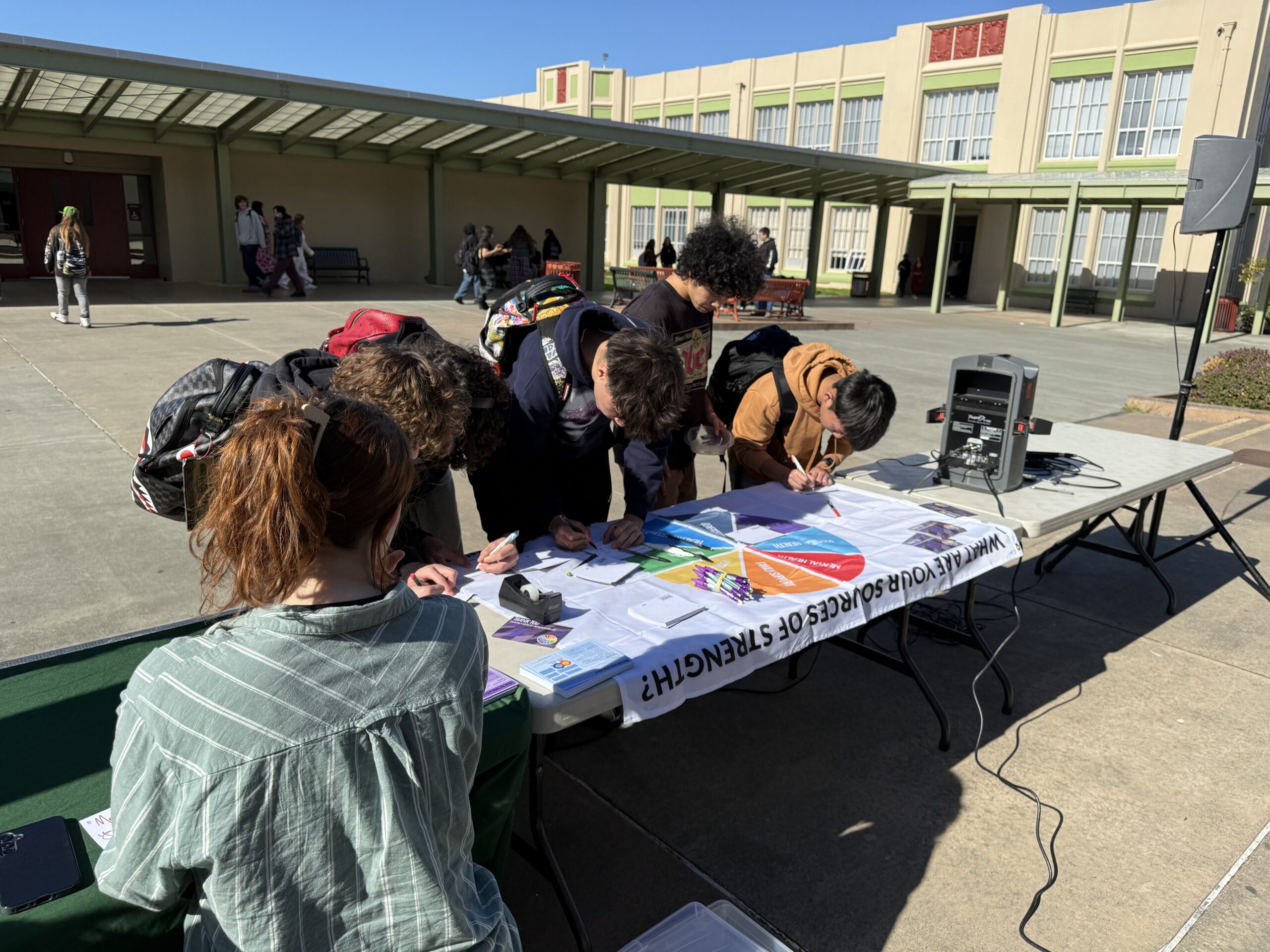
Students at Eureka High School take part in Sources of Strength, a suicide prevention program by mental health counselors at Eureka City Schools District. Photo: Eureka City Schools.
After
Jane Huang graduated from Eureka High School in 2018, she knew she
wanted to go to college in a different town.
She
had struggled with severe depression, and when she could not keep up
with her classes, teachers called her “lazy.” She dreaded going
to school, where she felt isolated from friends and family and
outcast as one of the few Chinese American students in Eureka, a
rural and low-income seaport town in Northern California.
After
graduating from Cal State East Bay with a B.A. in psychology, Huang
returned to Eureka High School as a student mental health worker in a
role funded by the federal government’s school-based mental health
grants in 2022.
“There
was no wellness center when I went to school here, and knowing what
the students go through, I just felt like I could really help them
out,” said Huang, who is now a third-year wellness coach in the
Eureka City Schools district.
Providers
like Huang tackled what experts say is a student
mental crisis,
exacerbated by the Covid-19 pandemic, and most prevalent in
poor, rural parts of the country. Now, as the Trump administration
doubles down on a storm of “anti-DEI” cuts to
education, these services could be terminated next, forcing Huang to
leave students who still need help in Eureka.
On
April 29, the U.S. Department of Education notified 49 grant
recipients that it would cancel roughly $168 million that had been
appropriated for mental health services to students in California,
stating that recipients had violated their standard of “merit,
fairness and excellence in education” and failed to comply with the
“priorities and policy preferences” of the Trump administration.
Effective
Dec. 31, school districts, county offices of education and
universities will lose funds midway through five-year grants, a loss
that will particularly devastate those in Eureka, Northern Humboldt
and Del Norte in Northern California, which together will lose more
than $12 million.
Eureka
City Schools will lose about $3 million, which funds several mental
health workers, including all of the district’s five school social
workers, along with training and supervision for nine graduate
student interns from Cal Poly Humboldt, said Sarahdee Duncan, the
wellness center coordinator with Eureka City Schools. They staff the
district’s core mental health services, like crisis and substance
abuse intervention, one-on-one therapy, group therapy, family
outreach and suicide prevention.
“The
grant allowed us to hire staff and outfit our wellness center —
which will stay, but I’m sad to say, the services provided there
may not,” said Duncan. Ending the grant could mean an end to
in-house services and a return to six-month waitlists and “barriers
like paperwork, insurance or transportation for families and children
seeking help.”
In
June, California joined a
coalition of 16 other states to sue the U.S. Department of Education
over an “unlawful” cancellation of grants that provide “the
nation’s high-need, low-income and rural schools” with services
that are “critical to students’ well-being, safety and academic
success.”
Duncan
said she is not hopeful that the lawsuit would release funds in time,
if at all. Instead, most districts are waiting to see if new Medi-Cal
reimbursement could
salvage a small portion of clinicians, as Duncan said the district
will likely not generate “enough billable income to sustain all
positions.”
As
schools in California prepare to lose hundreds of social workers,
school counselors, school psychologists, wellness coaches and
graduate student interns, as well as years spent building resilience
and trust with students, many are left wondering whether students and
families will have anywhere else to go.
Severe
mental health needs persist
Despite
recent state investments in
youth mental health, most small districts in the state still rely on
federal grants for mental health clinicians. In Humboldt County,
roughly 12.5 per 100,000 young people age 10 to 24 die by
suicide, more
than twice the
rate for urban counties. Northern California has some of the worst
youth mental health provider shortages, as well as the longest wait
times and delays to care,
in the state.
Jack
Bareilles, the grants and evaluation administrator with the Northern
Humboldt Union High School District, said the district will lose more
than $6.5 million after it lost both its appeals to the
cancellation.
Through
the grants, Northern Humboldt has provided more than 3,600 additional
students with mental health services this year and, since 2023, has
helped credential and employ over 25 mental health clinicians in the
county. Canceled funds would have trained over 30 more mental health
clinicians by 2028, Bareilles said.
Thomas
Kissinger, assistant superintendent of educational services with the
Del Norte Unified School District, said his district will also lose
about $2 million from a canceled grant that has employed 14 mental
health service providers since 2023.
“Our
communities are more than 350 miles away from metropolitan areas, so
we don’t have the easiest time getting the mental health support we
need for students and families,” he said. The district can use
other funds to keep clinicians for another semester, but not beyond
the school year.
Before
the grant, Del Norte Unified had severe shortages, averaging about
577 students per school counselor and 690 students per social worker,
Kissinger said. The grant lowered the ratios closer to
the recommended 250
students per school counselor and per social worker.
“We
had to notify employees that we weren’t going to be able to fund
them the next year, and that was devastating,” Kissinger said. “A
lot of them would just ask me, ‘How is this even possible?’”
Students
‘relying more’ on schools
Lora
Schultz, a mental health grant coordinator at Del Norte Unified, said
that sudden cuts to school-based support — where students are most
likely to
access mental health services — could also mean students will have
little to turn to for comparable and integrated support.
For
example, counselors at Del Norte Unified paired mental health and
academic, attendance or social-emotional support in student group
therapies. They designed a daily check-in program that helped lower
disciplinary referrals, along with a mobile counseling van and a
parent engagement project.
“Schools
may now have to go back to counselors and social workers splitting
schools,” Schultz said, recounting a practice she had more than 20
years ago as one of only two school counselors at Del Norte Unified.
As
families are “relying more” on services at school, districts
could also run low on private clinicians to hand off student cases,
Schultz said. And, some students may feel abandoned in the process.
“It’s
about that relationship where (students) know there is an adult that
checks in and cares about them,” Schultz said. “I’ve had kids
come up to me later, when they’re adults and have their own kids,
and they still remember me — and how they had felt seen.”
Huang,
who has weekly non-clinical sessions with her students, said she has
helped students work through issues such as suicidal ideation,
homelessness and substance abuse, among others. She remembered a
student who struggled to attend school, and after connecting with
Huang, started to come back to campus only for their appointments
together.
“I’m
afraid that when we go, our students won’t feel as connected to the
school anymore,” said Huang. “Some of them have been seeing the
same clinician all throughout high school, and we don’t know if
those clinicians are going to return.”
Research
shows that youth who lose long-term clinicians are more likely to
report negative or incomplete outcomes to
treatments for depression, anxiety and other mental health problems.
Students are also much less
likely to trust a
new clinician if they are abruptly handed off to them.
For
Cassandra Garcia-Gonzalez, a senior at Eureka High School, it took a
while to learn how to trust an adult. She started therapy in the
fifth grade, and although she struggled to open up at first, she said
her therapist helped her through her parents’ divorce that year, as
well as with depression and panic disorder later on in middle
school.
“I
do have a better sense of hope, because if I was stuck in that way
(again), I can now understand how I can reach out,” she said.
Garcia-Gonzalez
is now a second-year peer counselor at Eureka High School, and under
guidance from Huang and Duncan, helps other students talk through
their challenges if they don’t feel comfortable reaching out to an
adult.
“There
was one instance where this girl was dating this guy who had done
something bad to her, and as she was crying about it, it made me
realize she’s comfortable enough to open up to me like that,” she
said. “When we were done, she felt a little better, and that made
me realize why I continue to be a peer counselor.
“But,
that’s probably not going to be a reality for me,” she added, “or
for students who are trying to become peer counselors.”
###
Vani Sanganeria covers student health and wellbeing as EdSource’s Local News Fellow, a partnership with the UC Berkeley Graduate School of Journalism.