

Multi-Agency Vehicle and Foot Chase Ends Thanks to a Spike Strip and K-9 Officer
LoCO Staff / Sunday, Aug. 24, 2025 @ 11:36 a.m. / Crime
Press release from the Eureka Police Department:

On August 23, 2025, at approximately 1:18 p.m., an officer with the Eureka Police Department observed a gold Chevrolet Malibu collide with a parked vehicle in the 3100 block of Glen Street. The driver fled the scene, and when the officer attempted a traffic stop, the driver failed to yield, initiating a pursuit.
The pursuit traveled eastbound on W. Harris Street and continued onto Myrtle Avenue toward Old Arcata Road. During the pursuit, an officer successfully deployed a spike strip, causing the suspect vehicle’s tires to deflate and eventually come off. The driver was also seen discarding items from the vehicle while fleeing.
The pursuit concluded at the end of Pamala Lane, where the suspect fled on foot. A Eureka Police Department K-9 officer and his partner K-9 Odin apprehended the suspect without further incident. The driver was identified as 37-year-old Perry Dale Sanderson of Hoopa.
Sanderson was booked into the Humboldt County Correctional Facility on the following charges:
- CVC 2800.4 – Evading a Peace Officer, Driving Opposite of Traffic
- CVC 2800.2 – Felony Evading a Peace Officer
- PC 207(a) – Kidnapping
- PC 236 – False Imprisonment
- PC 3455(a) – Violation of Post Release Community Supervision
- PC 1203.2(a) – Probation Violation
- CVC 14601(a) – Driving with a Suspended License
- CVC 20002(a) – Hit and Run
No officers or members of the public were injured during the incident. The investigation is ongoing, and anyone with additional information is encouraged to contact the Eureka Police Department.
The Eureka Police Department would like to thank the Humboldt County Sheriff’s Office and the California Highway Patrol for their assistance.

BOOKED
Today: 11 felonies, 14 misdemeanors, 0 infractions
JUDGED
Humboldt County Superior Court Calendar: Yesterday
CHP REPORTS
No current incidents
ELSEWHERE
Governor’s Office: Governor Newsom statement on compromise to address wildfire risk, support fire survivors, and create stronger accountability
RHBB: CDFW Announces Angling Closure at Mouth of the Klamath River
RHBB: Humboldt Bay Area Plan Planning Commission Workshop on Thursday, Sept. 3
Artificial Intelligence Has Arrived in Humboldt Commercials, and People Have Opinions
Ryan Burns / Sunday, Aug. 24, 2025 @ 7 a.m. / Business , Technology

Local production company owner Tex Kelly used a generative AI program to place computer-generated cryptids in the real interior of a Eureka Mexican restaurant for a video advertisement. | Video still.
###
Local production company owner Tex Kelly is well aware that some people disapprove of the generative AI technology he’s been using to make commercials for local businesses. He specifically recalls some negative comments he saw on Reddit, like this one, posted last month in response to a video ad he produced for Eureka Mexican restaurant Esmeralda’s 2.0:
“I loathe all of the AI bullshit that local businesses are using for ads. If you can’t do it in house, pay an artist.”
The comment had 54 up-votes, making it the top response to a post seeking opinions on the ad.
“There’s always a bit of worry about harsh feedback … ,” Kelly acknowledged in a recent interview. “We’ll see an ‘AI slop’ comment every once in a while. But the majority of feedback has been really, really good.” [Disclosure: Kelly used to work for the Outpost’s parent company, Lost Coast Communications.]
When it comes to his own justification for embracing the technology, it’s pretty simple.
“I like it,” he said.
More to the point, some of his clients like it. A couple of local business owners have specifically requested the use AI in their commercials because of the attention-grabbing imagery it can create, Kelly said.
Here’s that Esmeralda’s ad, which has been fairly ubiquitous on YouTube, social media and TV:
Kelly explained that recent advancements in generative AI — specifically Google’s VO3 program — allowed him to put computer-generated creatures into real-life local environments he’d photographed. Hence, he was able to “film” Bigfoot breaking out of Redwood Capital Bank (whose name he changed to avoid legal repercussions) and a Yeti flying a helicopter over real aerial views of Eureka.
He’s aware that the results aren’t perfect. (“It was supposed to be Bigfoot, which … Reddit users have said it obviously looks like a gorilla,” he said.) But the ad has made an impression and gotten a lot of people talking, which is one important measure of success in advertising.
“We’re always trying to do something that’s different to get people’s attention,” Kelly said.
That’s not sufficient justification for using AI, according to other locals who work in video production. AI imagery is inherently dishonest, they argue, and its use is actively depriving creative professionals of work.
Justin Grimaldo, a local editor and filmmaker, recently took to Facebook to make his opinion known.
“These aren’t just goofy experiments,” he wrote regarding local ads that employ AI. “Businesses are actually using this stuff in place of real video work—and it’s already pushing out talented local filmmakers and photographers.”
Grimaldo also feels that AI ads are often deceptive. He cited AI-generated real estate video tours and AI-enhanced images of restaurant interiors as examples of misleading consumers.
“Sure, you saved a few bucks today,” his post continued. “But long-term? You’re training your customers not to trust you. You’re also telling local creatives their work doesn’t matter—and that’s not just lazy, it’s a terrible investment in your brand.”
Reached by the Outpost, Grimaldo said he’s not against progress or new technology so much as he’s pro-transparency and human creativity. He thinks AI ads should be labeled as such, and he sees generative AI programs as a poor substitute for hard work and imagination.
“It’s one thing to use AI as a tool to enhance a human-driven vision, but it’s another to slap a few prompts into a generator and call it a day,” he said. “That’s not creative. That’s outsourcing imagination.”
Grimaldo is also not impressed with a lot of what AI generates. The technology is notoriously bad at rendering human hands, for example, and Grimaldo says it also has trouble making mouths and eyes move in realistic, organic-looking ways.
“AI still struggles with the subtleties of human expression, which makes a huge difference in storytelling … ,” he said. “[I]t’s missing soul. [AI imagery] mimics emotion but doesn’t generate it. … That said … give it a couple years. The tech is moving fast, and there’s no stopping that train. It will get harder to tell what’s real and what’s not. But for now, there’s still a noticeable gap and as someone who lives in the edit bay, that gap stands out.”
Kelly actually agrees with that, to an extent. He said nothing can replace the collaborative experience of working on non-AI productions, which he still does, and he supports the efforts of Hollywood labor unions to keep AI out of the feature film industry.
“A robot or something that’s been made by AI is not going to make you feel any depth of loss or anything like that,” he said.
He also doesn’t approve of big corporations using AI for their ads. He recalled the public blowback that came in response to an AI-generated Coca-Cola commercial last year and said the criticism was deserved.
“I think, when you have a budget that is that on that level, you know, you should flex your your muscles with an actual production,” he said.
But Kelly just thinks local businesses should be granted a bit more leeway.
“If we’re managing a whole bunch of clients and [one of them] only has a three- or four-hundred-dollar budget to do an ad, I can create something with that, easily,” he said, referring specifically to the AI tools he subscribes to.
Does he worry about taking away people’s jobs?
“No, because the person making those AI ads and editing them is me,” he said, adding that he still hires people to work on other ads.
Nor does he buy the idea that AI stifles human imagination. Quite the opposite, in fact.
“What set me on to [AI] was that as I’m always thinking of crazy ideas: ‘If I had a million dollars, these are what I would be doing. I’d be breaking out of banks’ and stuff like that,” he said. AI has simply allowed him to make such ideas come to life.
Kelly recently collaborated with the owner of Hunan Chinese Restaurant in Eureka for a longer video that is almost entirely AI-generated. It’s called Wok Master:
In describing the origin of his idea for this video, Kelly touched on one of Grimaldo’s gripes.
“[Real] kitchens don’t look great,” he said. “There’s food everywhere on the pans and stuff, and you’re constantly cleaning that off, and people are moving around. … So, [in order] to not show the un-glorious side of things, we were like, ‘Let’s show a baby using a wok and growing up and coming to the U.S.’”
That latter part of the storyline came from the owner, who moved to Humboldt County roughly 40 years ago, Kelly said.
Still, Kelly doesn’t see the glossy, computerized kitchen footage as inherently dishonest — at least, no more so than advertising has been for decades. The burgers you see in Carl’s Jr. and McDonald’s ads aren’t even real food, he said, and they’re hardly an accurate representation of the actual products.
“I think people have been raised up on the over-embellishment or the overselling” in advertising, he said. “It’s something that they just don’t care about. If you’re entertaining and you’re making someone laugh, I think that’s what they’re going to remember.”
While Kelly may draw an ethical line between low-budget local ads and big-dollar corporate professionals, the larger advertising industry appears to have no such compunctions. A recent industry report found that, among marketers who spent more than $1 million on digital video ads last year, nearly 90 percent are using or plan to use generative AI in their video ads.
Some of those companies are grappling with the same issues as local professionals. A recent New York Times article on the topic noted, “There are ethical concerns about displacing writers, designers and artists. There are also concerns that the ads could fool viewers into thinking something is real when it is actually fake.”
Some companies, including the digital marketing agency Shuttlerock, do employ captions or logos that disclose when AI is used in an ad.
Asked whether he should be labeling his AI ads, too, Kelly said, “I think it’s obvious right now. But in the future?” He paused to think about it, then said, “That’s a tough one. … But I don’t think it has to be labeled, at least not right now. If it was, like, a president or someone saying a bomb threat or something like that, I feel like it would have to. … But right now it’s so obvious when you come across something that is AI.”
He reiterated that the most important thing is grabbing people’s attention and getting customers to walk through the doors for his clients.
We asked Grimaldo if he’d reject a client who specifically requested AI imagery in their commercial. He said he’s already done just that.
”It might just be the artist in me, but when something starts replacing actual crew positions—DOPs [directors of photography], animators, VFX artists—it crosses a line I’m not comfortable with,” he said.
But then Grimaldo made an admission:
“I do use AI on the audio side for things like dialogue cleanup, denoising and other tedious tasks,” he said. “To me, that’s a tool, not a replacement. There’s a difference between using tech to enhance the work and using it to skip hiring real people.”
Regardless of where each person draws their ethical line with AI, one thing is clear.
“It won’t go away,” Kelly said. “There will be people who hate it and there’s gonna be people who love it. But I think you have to be able to craft something with it.”
He argued that, while anybody can now type in some text or upload a photo and ask AI to generate imagery, the art of filmmaking — even on the local commercial level — still requires certain human skills like editing and storytelling to be successful.
“I think if you do something with it and actually create something that’s funny then, you know, that’s good,” Kelly said. “And if it helps the business, that’s obviously what matters the most.”
THE ECONEWS REPORT: Talking CEQA Reforms
The EcoNews Report / Saturday, Aug. 23, 2025 @ 10 a.m. / Environment

Image: ChatGPT.
Hating on environmental laws is now a bipartisan activity. California Democrats have leaned into the “Abundance agenda” — a progressive case against regulations to build more housing, renewable energy, and other public goods — to take swipes at the California Environmental Quality Act (CEQA).
But to what extent does California’s landmark environmental law actually hold back housing production? And are proposed reforms actually aimed at the right targets?
REQUIRED READING:
- In Defense of CEQA’s Swiss Cheese
- “What is ‘abundance’ liberalism, and why are people arguing about it?” The Guardian, March 28, 2025.
HUMBOLDT HISTORY: Just A Kindergartner Jumping Rope All the Way to the Old Marshall School, Where Generations of Eurekans Learned Their ABC’s
Naida Olsen Gipson / Saturday, Aug. 23, 2025 @ 7:30 a.m. / History
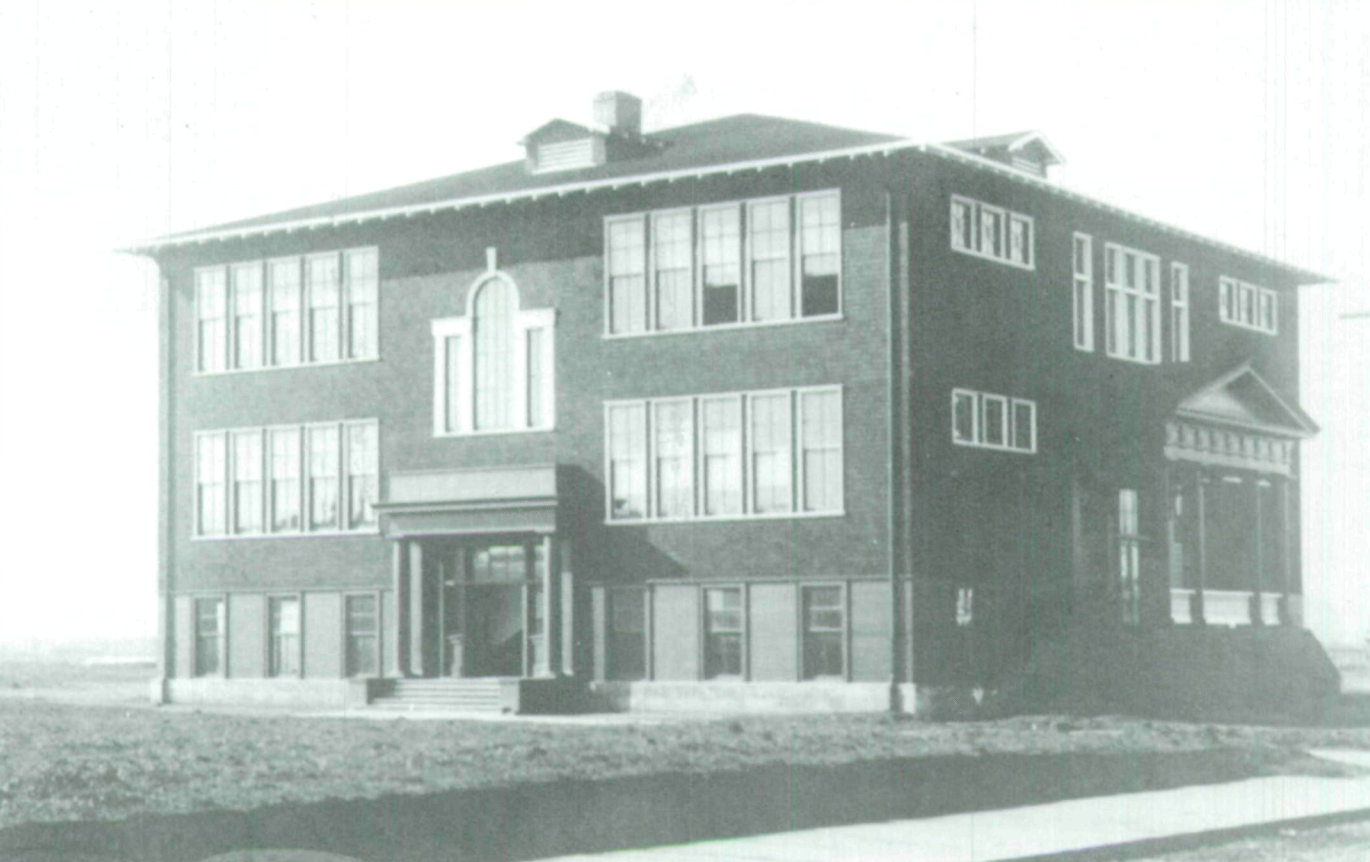
Marshall School, then located on Trinity between I and J streets, was an imposing three-story frame building. Girls entered on one side of the building; boys entered on the other. Photo via the Humboldt Historian.
###
“Tap, tap, tap.”
My jump rope tapped out a rhythm on the sidewalk, as I made my way to Miss Schultz’s afternoon kindergarten. The tapping sound took on different nuances as the sidewalks changed. In front of our house the sidewalk was cement, but as I passed the cow pasture that wrapped itself around our lot from gentle rolling-green hills in the back, up to Harris Street on the east, the sidewalk that followed the barbed-wire fence next door turned into redwood planks with gaps between the boards. Sometimes, if we were lucky enough to have a penny to spend at Hinshaw’s corner store on Harris and K Streets, the penny would slip out of our hands and fall down between the cracks. This was a real tragedy, as pennies were hard to come by. Then the only thing to do was to try to find a piece of gum to put on a stick and fish it out.
As I skipped along, I could see the big redwood snag still standing in the pasture, echoing the eight-foot-high redwood stump in our back yard that my sister and I used as a play house. Sometimes at night when the moon was full, I could look out my window from my bed and see this snag, mute evidence of what had once been a redwood forest. In the moonlight, the snag would magically change into mysterious shapes-usually the face of a witch, scaring me half to death!
At the corner, J Street turned into a dirt road going south, and here I crossed Harris, looking carefully to left and right, as it was a street busy not only with cars, but with the street car line that ran down the middle.
“Tap, tap, tap.”
I headed north on another wooden sidewalk on J Street by the empty lot overgrown with alder trees, blackberry vines and salal. Deep, redwood storm gutters, down which torrents of water rushed when it rained, edged this walk along the unpaved street. The J Street street car line joined the Harris Street line here, and the big, gray street car barns that housed the street cars at night were across the street. Sometimes kids would put a pebble from the oiled and graveled street on the car track, and watch as the street car pulverized it to dust. Other times, but not so often, someone would put a penny on the track and take home a flattened portrait of Abraham Lincoln.
“Tap, tap, tap.”
In front of Don Celli’s house, the sidewalk changed again to cement, but this one was grooved with ribs in the concrete, like the old-fashioned washboards used in many homes then. It was a great temptation to drag the toes of my shoes over this ribbing and listen to the music it made. After wearing out the toes of a good pair of patent leather Mary Janes, I decided I shouldn’t do this.
“Tap, tap, tap.”
The closer I got to the school, the more cement sidewalks were tapped by my busy rope. Some sidewalks were cracked and broken, with grass and weeds growing up through the crevices. Others were perfectly smooth. How wonderful it was to be able to let a five-year-old go to school all alone, and feel sure that child was safe. I’m not sure how far it was, but I think it was nearly a mile. Finally, Marshall School loomed in the distance, its three-story bulk sitting there, solid and formidable as a rock. A path had been worn from the corner of the playground across the grass to the graveled kickball field, and the girls’ door to the first floor of the building.
At the other end of the building was the boys’ door. To my left, as I climbed up the little slope, were huge stacks of redwood slabs and bark as big as a child, that were used to fire up the wood burning furnace. These piles were out-of-bounds for students, as they were piled higher than our heads, and could possibly fall over on someone.
To my right, across the street, I could see a yellow Victorian house with a sign “Kain Apts.” over the door. Perhaps, because I was near-sighted, or perhaps because 1 had heard tales of the Lindberg kidnapping, I thought it said “Kidnappers!” Such an imagination! As if kidnappers would advertise their profession.
The first floor of the school was formed by a concrete slab with heating pipes running under the cement around the edges of the rooms. These pipes carried heat to the upper floors, but the warm strip of floor was nice to sit on in the basement, while having lunch on cold, rainy days. A cement foundation extended upward from this slab about one-third of the way up the wall, ending in a row of windows covered with screening to protect the glass from wild kickballs or baseballs. Under these windows were benches that served as seats for eating lunch, and that were handy for a game of jacks.
The school bathrooms were down here as well, one for the boys and one for the girls. These bathrooms had an acrid disinfectant odor that was sickening to me. I hated to go in, and always held my breath to keep from smelling the awful odor. The water tanks of the toilets were hung near the ceiling, and it seems as though they were made of some dark-finished wood like mahogany. Long chains hung from them to work the flushing mechanism. The seats were the same dark wood as the tanks. The toilets themselves were sized from adult-size to child-size, and the further one progressed into the bowels of this cavern, the smaller the seats became. It was altogether a stark and cheerless bathroom, and I would run from its depths to the play room outside, gasping for breath, the odor permeating my whole being and staying with me, an unwelcome guest, for long minutes afterward. Outside the bathroom was a long sink with several faucets, and glass containers of strong-smelling liquid green soap. At one end was a drinking fountain. Near the back of the basement was a cupboard for lunches that was locked when school started, and unlocked at lunch time. The huge dinosaur of a furnace was in a dark, scary no-man’s-land between the boys’ and girls’ basement rooms, where no children were allowed.
Each of the next two floors had a big square hall with four classrooms (one at each corner), and each classroom had its own cloakroom. Tall windows equipped with brown roller shades lined the outside walls and slate blackboards encircled the rest of the rooms. A long pole with a hook on the end was ready to open the upper parts of the windows. The wooden desks were fastened to the floor on long strips of wood. A broad staircase ascended from the basement on both sides of the building — one for the girls, and one for the boys. Another broad staircase rose from the sidewalk at the front or north side, to the second floor, and was for the use of adults only.
The second floor contained the teachers’ room and first-aid station, with supplies such as iodine, mercurochrome, gauze bandages and tape. Bandaids had not yet been invented. Outside the teachers’ room was the school telephone: a black box fastened to the wall.
Miss Schultz’s kindergarten was in a room at the back of the basement, as was a room for teaching deaf children. The afternoon kindergarten was held in a bright, warm, sunny room, and the teaching was quite advanced for its time - 1932. We painted and sang; we danced and cut out pretty things from colored paper; we played in the doll corner and played rhythm instruments; and we had a huge earthen crock of real clay. Kindergarten was the way kindergarten should be — a time to explore, and to learn how to share. We loved our teacher, and I think she loved us. She was a sweet person who did not marry until she retired from teaching, as she was, I understand, the sole support of her mother. When I had grown up, I heard she finally married the man who had waited for her all those years.
It is interesting to note that nearly all the teachers at Marshall School were “Miss.” I remember only one teacher who was “Mrs.” (Mrs. Kinney) and perhaps she was a widow who had had to go back to teaching. During those Depression years, married women were not hired to teach school, as jobs were so scarce. The thinking behind this was that a married woman had a husband to take care of her, so she had to let someone who really needed a job teach school.
My first grade teacher was Mrs. Hansen. I remember her as being “a gray lady.” She seemed to wear gray dresses, and maybe her hair was gray. She also wore heavy stockings and “sensible” shoes that laced up and tied and had a chunky medium heel. We did a lot of work with phonics charts in her class.
One day I observed another child carving his initials on his desk with his pencil. That seemed like an interesting thing to do, so I did the same. I had just managed a nice big “N” when the teacher saw what I was doing. I had to bring 50 cents to school to pay for the damage I had done.
There was another first-grade teacher, Miss Elsmore, who was principal at the time I was in first grade. Even the really bad boys were afraid of her because it was rumored that she kept a length of rubber hose in the bottom drawer of her desk and would not hesitate to use it, if necessary. My little sister was in her class and having trouble with spelling, so she wrote her words on her desk before the test. Well, Miss Elsmore caught her and proceeded to turn her over her knee in front of the whole class and spank her bottom! Poor little Betty!
In second grade, I had Miss Asselstein — a young, pretty, vibrant girl, probably just out of college. She spent recesses teaching those who were interested to tap dance. We also did a play about American Indians in second grade. We made costumes out of burlap sacks and had to have brown powder all over our faces, arms, and legs to make us look Indian. When I got home that afternoon, my mother wasn’t there, so I tried to scrub the stuff off by myself. It wouldn’t budge. I ran sobbing out to my father’s shop. That poor man thought I had fallen into the fire and burned myself!
The third-grade teacher’s name just doesn’t come to me at all, maybe because, as was sometimes done at that time, I skipped half a grade at that point.
Fourth grade was in Miss McKinnon’s class. She was a nice teacher, tuned into the needs of her pupils.
My fifth grade teacher was Miss Swithenbank. Some kids called her “Miss Swimming Tank” behind her back. They thought they were being so clever.
That year Walt Disney had completed his full-length animated movie “Snow White and the Seven Dwarfs,” and the class did a puppet show about the movie. We all made puppets from socks and odds and ends of materials. My puppet was supposed to be “Dopey,” but the teacher ended up making most of it for me. We were to have a puppet parade for the whole school, and the teacher pinned pieces of paper on us to put down on the floor so the puppets wouldn’t get dirty. When it was my turn, she very nearly pinned it through my skin! I tried not to cry, but stood there, stoically, while she tried to pin this paper to me with a safety pin! All of a sudden, she realized what was happening, and was very sorry. Actually, the paper was useless, as our hands were so busy keeping the strings from tangling, we could not take our papers off to use them. I still have my “Dopey” puppet. It is very like the Dopey in the movie.
Miss Knudsen was the sixth-grade teacher, and also the principal when I was in sixth grade. She was a formidable adversary, and stood for no nonsense. Some said she had eyes in the back of her head, and could nail miscreants without even looking at them. But really, 1 think she was so nearsighted, and got so close to the blackboard when writing on it, that she could see reflections in her glasses. In sixth grade we were required to learn some poetry by heart. What a drag we thought that was, but I still have “In Flanders Field” and “The Daffodils” embedded in my memory, to take out and dust off when I wish, thanks to Miss Knudsen.
The wooden floors of the school were swept each day with an oily compound, which soaked into the wood and made the building vulnerable to fire. It must have been in 1938 that the sixth graders were in a parade, marching for new schools. We had to wear blue jeans or blue pants, and red shirts. Somewhere, someone got red fire hats, and as we marched, we carried fire hoses and signs asking for new schools and no more fire traps. A few years later, the new Marshall School was built on property just across the street and the old school was torn down to make room for the new playground.
In those Depression days of grammar school, we put on a lot of programs. I was in “The Skater’s Waltz” one year. Our mothers had to make red skaters’ costumes for us, and the hems all had to be a specified number of inches from the floor (I think 19 inches). The hats, sleeves and circle skirts were trimmed with lengths of cotton batting to simulate white ermine. As we “skated” around in a circle, with one leg extended gracefully behind, I found I had to hold up not only myself on one foot, but my partner as well, because she leaned so hard on me.
Another time, I was in a minuet dance. We wore costumes from Colonial days and did a courtly minuet dance in a circle.
One time the group was to dance for the people at the T.B. Sanitarium. I knew what tuberculosis was. And I had no intention of catching it. Greta Garbo might have died beautifully of it in “Camille,” but I didn’t plan to go that way. So for the only time in my life, I lied. Deliberately. I was so scared, I told my teacher that my mother said 1 couldn’t go. That didn’t stop the teacher. She immediately got on the phone in the second floor hall and called my mother. She took the receiver off its hook, rattled the hook to get the operator, gave the operator my phone number — 597 — and waited while the operator connected the line, manually, and rang my home telephone, again, manually. I ended up going with the group and dancing. I did not contract T.B., much to my relief.
We did a play about Cinderella one year, and I was chosen to be Cinderella. Maybe because of my long straight braids, the teacher thought I would look sort of waif-like. But the morning of the play, my mother worked and worked to curl my hair, which has always defied curling. I’m pretty sure this was not the effect that was wanted, but we were stuck with it. It was exciting to try on the “glass slipper,” and then pull the matching slipper from under my apron where I had been hiding it.
Rainy day recesses, and there were many in Humboldt County, were spent playing games in the basement or marching around one of the upper halls to the music played on a Victrola. We marched singly. We marched by twos. Then fours, and eights. Then divided back to twos. It was great fun.
We also learned ballroom dancing. The boys lined up on one side of the big second floor hall, and the girls lined up on the other. Then we had to choose partners, sometimes it was “ladies choice,” sometimes it was boys’ choice. Sometimes we formed two circles and walked around in opposite directions until the music stopped. Whomever you happened to stop by became your partner. The boys seemed to hate this form of recreation, but 1 loved it, except for the times I had to dance with one boy whose hands smelled of Lifebuoy Soap, the granddaddy of deodorant soaps. Then my hands would smell the same way. In addition to ballroom dancing, we learned square dancing and the Virginia Reel.
On nice days we were allowed to take our lunches outside and picnic on the grass. Years before, all the playground equipment had been removed when someone was injured on a slide or swing. However, there were a few spots where the grass was worn down to the bare clay earth, and these places made perfect hop scotch areas. My best “token” was a small piece of fine chain that would land on the squares I aimed at without fail. I treasured this trinket because of its accuracy. Other times we played jump rope with a long rope, two people turning the ends and the rest taking turns jumping. We also played singing games such as “Upon a Little White Daisy.”
Looking back over 60 years, I think the schools did a pretty good job, considering what they had to work with. We had no audio-visual aids, no T. V. or computers, but we learned to read and write legibly and to spell and do math, in spite of classes of 35 or 40. School curriculum was based on an orderly progression of learning, and the pressures children encounter today were not there. Now children are expected to learn to read in kindergarten, in my opinion, a waste of the special time of being five years old. More kids are falling through the cracks, because of so much pressure. Although times were hard in the 1930s, families and schools were strong, and we learned respect for ourselves and our community.
###
The story above was originally printed in the Fall 1995 issue of the Humboldt Historian, a journal of the Humboldt County Historical Society. It is reprinted here with permission. The Humboldt County Historical Society is a nonprofit organization devoted to archiving, preserving and sharing Humboldt County’s rich history. You can become a member and receive a year’s worth of new issues of The Humboldt Historian at this link.
OBITUARY: Kenneth Marshall Stoffer, 1930-2025
LoCO Staff / Saturday, Aug. 23, 2025 @ 6:56 a.m. / Obits

Kenneth Marshall Stoffer
July 3, 1930- August 17, 2025
Kenneth M. Stoffer, age 95, of Eureka, passed peacefully at home surrounded by family on Sunday, August 17, 2025.
Ken was born in Eureka to Wilfred and Priscilla Stoffer and attended Eureka City Schools, graduating in 1948 from Eureka High School. While in high school, he worked part time at the Bank of Eureka.
After graduation he enlisted in the U.S. Navy for a 3-year stint, plus served an extra year due to the Korean War. Upon discharge, he moved to Santa Rosa and worked in an auto body shop, sparking his lifelong love of classic cars and stock car racing. In 1953, he married Rita August, with whom he had three daughters. In 1960 he joined the California Highway Patrol, Badge Number 2994, later transferring to Eureka, where he worked until his retirement in 1980. Rita tragically passed in 1968 at age 35 from cancer, leaving Ken with three small daughters. Together, they built a new life with assistance from his parents.
In 1973 Ken met Judith Goodwin on a blind date, and they were married six weeks later at the First Presbyterian Church in Eureka. They enjoyed 51 years of family, dancing, spending time at the cabin, traveling the world, (his favorite trip was to Kenya), and of course the old sailor especially loved cruises!
In retirement, Ken restored award-winning classic cars and cherished 83 summers at the family cabin on the Mad River, water skiing, fishing, and sharing stories by the campfire.
Ken was a member of the California Association of Highway Patrolmen, Korean War Veterans’ Association- Redwood Chapter #176, The Tin Can Sailors, Life Member of Eureka Elks Lodge #652, and the Native Sons of the Golden West- Humboldt Parlor #14. He was a long- time member of the Redwood Vintage Rods, enjoying many years of Rod Runs with his hot rod buddies and their families. We remember a man who loved his cars and knew how to enjoy the ride!
He is survived by his wife of 51 years, Judith Stoffer; daughters Shirley Stoffer, Cindy Rotherham, Lorin Kenney (Cary Schwartz) and step-son Mark Goodwin; sister-in law Deborah Smith; cousins Sandra Kilmer and Delilah Young and families; ten grandchildren: Renee, Chloe, Kristi, Aaron, Emily, Tim, Dresden, Wyatt, Erin and Tyler; thirteen great-grandchildren: Mina, Jacob, Ethan, Kaia, Kodie, Taylor, Dalton, Nevan, Cadence, Juniper, Hunter, Kylee, Lilly; nieces Meredith Smith, Stephanie Hansen Medley and daughter Lauren, and nephew, Kevin Hansen.
1010-Over and Out!
A memorial service will be held at First Presbyterian Church of Eureka, 819 Fifteenth Street, Eureka, CA on Saturday, September 6, at 11 a.m. with luncheon immediately following in the Fellowship Hall. The service will also be shared on Facebook at this link..
For those interested in offering a memorial gift, the family suggests:
- Hospice of Humboldt-3327 Timber Fall Court, Eureka, CA 95503
- California Association of Highway Patrol Widows and Orphans Fund, 2030 V Street, Sacramento, CA 95815
###
The obituary above was submitted on behalf of Ken Stoffer’s loved ones. The Lost Coast Outpost runs obituaries of Humboldt County residents at no charge. See guidelines here.
Sequoia Park Zoo Black Bear Ishūng Has Dropped 100 Pounds and Learned to Love Green Bell Peppers (But She Still Hates Beets)
Isabella Vanderheiden / Friday, Aug. 22, 2025 @ 4:50 p.m. / Animals
When Ishŭng arrived at Eureka’s Sequoia Park Zoo five months ago, she weighed in somewhere between 475 and 500 pounds — more than double the average weight for a healthy adult female black bear. After acclimating to her spacious new home and adopting a more nutritious diet, our extra fluffy girl has dropped an estimated 100 pounds. Give it up for Ishŭng, y’all!
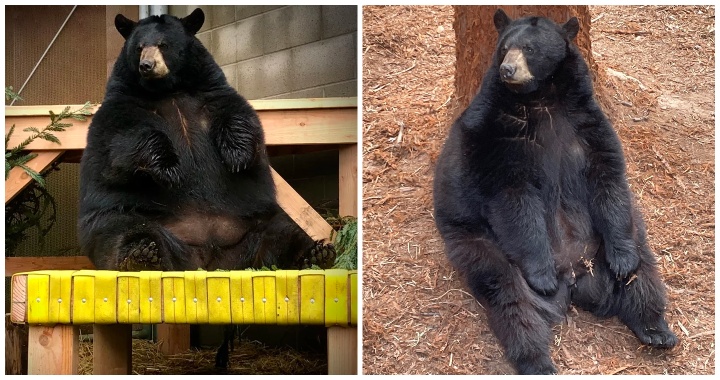
Left: Our chubby queen pictured shortly after her arrival at the zoo in March. Right: Ishŭng now! | Photos contributed by Sequoia Park Zoo.
Before she was placed at the Sequoia Park Zoo by the California Department of Fish and Wildlife (CDFW) in late March, three-year-old Ishŭng lived in subpar conditions — a sparse 16’ by 16’ exhibit with a water tub and few enrichment items — at an unnamed animal sanctuary in another part of the state. The facility’s permits were revoked by the CDFW earlier this year due to animal welfare concerns, and their animals were relocated.
“There were also concerns about animal husbandry, and they weren’t meeting the necessary standards,” Sequoia Park Zookeeper Erin Corrigan told the Outpost. “They were offered opportunities to rectify those problems, and they either weren’t able to or chose not to. Eventually, their permits were not renewed.”
Not surprisingly, the sanctuary wasn’t good at keeping records, Corrigan said, which made it impossible for the CDFW to determine how Ishŭng ended up at the facility in the first place. Knowing next to nothing about her medical background, zoo staff had to draw their own conclusions as to how Ishŭng reached nearly 500 pounds.
“We don’t know for a fact that her whole world revolved around feeding times — which is something that can happen in zoos when your animals are just kind of sitting there waiting to be fed — but we can make assumptions,” Corrigan said. “We don’t know exactly what they were feeding her, but we can assume that it wasn’t nutritionally complete. She just didn’t have a whole lot of space to move around, and didn’t have much stimulation that encouraged her to be active.”
A bear’s weight can vary wildly depending on the time of year. Female American black bears tend to weigh between 100 and 300 pounds, according to the CDFW. At 384 pounds, our Ishŭng still has a ways to go before she hits her target weight.
“She is overweight, but, as far as her frame goes, she is petite. If you look at her in comparison to our big male, Tule, who actually isn’t that big for a male, you can see that her frame, the length of her legs, the size of her feet and her face are actually petite,” Corrigan said. “We don’t really have a goal number for her; it’s more of a range. She’s the one leading us, and we’re thinking she should be in the higher 180- to 250-pound range — maybe 300 at the highest.”

I mean, c’mon! Look at that face!
As it turns out, Ishŭng is a very picky eater. She isn’t too keen on vegetables — bless her heart — but she’s starting to come around a bit, Corrigan said. When she first arrived at the zoo, staff quickly learned Ishŭng “really, really loves” romaine lettuce, and she’s grown to like green bell peppers as well.
“We’ve offered her zucchini in the past, but she’s mostly rejected it,” Corrigan said. “I just tried to feed her a zucchini again, and she’s like, ‘Nope, still garbage.’ She likes carrots and sweet potatoes, but beets are also absolutely garbage. If beet juice gets on any of the other food, that food is also garbage. … She does like citrus, grapes and blueberries, and she’s started eating apples as well.”
The bears are also given two different kibbles that are formulated specifically for bears and omnivores, Corrigan added. Every other day, the bears are given a “direct protein item” that staff hide around the exhibit to encourage foraging.
“She really likes ground beef, steelhead trout, smelt fish, and we’ve recently given her small prey items that we have in-house for some of our other animals, like small mice,” she continued. “She really liked those.”
All told, Ishŭng has adapted quite well to her new home. She’s still getting used to living in a wide open space — a world much different from where she was before. “We don’t know if she’d ever seen trees before,” Corrigan said. “We don’t know what she was exposed to.” Now, she’s getting exercise, playing with sticks and hanging out in the little river that runs through her habitat. She’s also become a bit of a soccer star.
“She really likes soccer,” she said. “We have these small, hard plastic balls that we use as enrichment items for the bears, and most of the time we put food inside of them and they have to move the item around to get the food to fall out. Ishŭng hasn’t really been able to figure that out, but she loves to just play with the ball and push it around.”

Oopsie!
Ishŭng is currently separated from the zoo’s male bears, Tule and Kunabulilh. Tule, who is roughly the same age, was placed at the Sequoia Park Zoo with another bear cub, Noni, in 2023. (Unfortunately, Noni died last year after an emergency surgery.) Kunabulilh, known as “Nabu” among zoo staff, was relocated to the zoo two months ago and is still “behind the scenes.”
Zoo staff are working to integrate Ishŭng and Tule, but it’s a slow process to ensure both bears’ safety. “They are the ones who are leading us,” Corrigan said, “and we don’t want to push them too hard or cross any boundaries that they have kind of established.”
“They have two sections of habitat — the backyard and the front yard — and we can easily move the animals between the two spaces, sometimes multiple times a day,” she continued. “They do sleep in the same night house. There is a chain link fence in between them, but they do sleep in there together.
It’s worth noting that all three bears — and Noni, too — were considered “non-releasable” by the CDFW due to physical impairments that would make it difficult, if not impossible, to survive in the wild. While zoo staff have little information about Ishŭng’s medical history, they know Tule and Nabu were both sick when they were found by CDFW.
“Most, if not all of our native animals are non-releasable,” Corrigan added. “We have our bald eagles, our ravens and our spotted owl in the raptor aviary, and all of those animals were born wild and were injured and are not releasable due to their injuries. We have the ability to offer these animals homes so that they can survive and live a healthy life. They can also be ambassadors for their species.”
Asked about other exciting zoo happenings, Corrigan said the new Red Panda Exhibit is coming along, but it doesn’t have an estimated opening date just yet. There’s also a new troop of spider monkeys at the zoo. One of the monkeys, Sprite, is now reunited with her mama, long-time zoo resident Candy.
(PHOTOS) Massive New Cal Poly Humboldt Dorms Officially Open
Dezmond Remington / Friday, Aug. 22, 2025 @ 4:40 p.m. / Cal Poly Humboldt

(Left to right) Assemblymembers Damon Connolly, Chris Rogers, CPH President Michael Spagna, and Senator Mike McGuire pose during a ribbon cutting for the new dorms. By Dezmond Remington.
PREVIOUSLY
The official grand opening of the $226 million Hinarr Hu Moulik dorms (“our home” in Soulatluk), the seven-story, 964-bed, two-building complex a mile north of Cal Poly Humboldt’s campus, was marked today by speeches from university officials and politicians, including Assemblyman Chris Rogers and Senator Mike McGuire.
Students started moving in last week, and out of the 608 beds currently available, 513 are being used (just one out of the two buildings will be open until the spring semester, which will add another 356 beds). Student enrollment at CPH is up 4.1% this year, a large increase over several years of consistent 1% growth. The new dorms have increased university housing by over 50%.
Composed of apartments ranging from two to four bedrooms, student and RA Cedrik Von Breil said in an interview with the Outpost that he liked his forest view from the sixth floor and really enjoyed having a gym downstairs. The noise from adjacent Highway 101 was almost nonexistent, he said, and although some of the rooms were “small,” he said the other residents were coping with it just fine. (Von Breil later specified that “cozy” would be a more exact term.)
Speakers praised the investment Cal Poly Humboldt put into its students and the power of a college degree.
“The almost half-billion-dollar investment in Cal Poly Humboldt is the single largest non-prison investment in a rural California county in 50 years,” McGuire said. “This seven-story state-of-the-art housing complex — it is transformational… . We know this isn’t just a dorm, this isn’t just a place to sleep, but a place to establish lifelong friendships, lifelong memories, and candidly, this is a place to call home… . There is nothing like a college degree to change one’s life, and there’s nothing like a college degree from the best university system in the United States of America.”
“We know that the cost of living in California is a challenge, and we know that particularly students who are living on thin margins often have to choose between their priorities, whether or not they’re going to meet their day to day needs, or if they’re going to invest in their future,” said Rogers. “It’s a challenge that none of them should [deal with]. We are working on it, but this project represents the best of what our state can do.”
He also lauded the speed the dorms were built with.
“A year ago, my wife and I were living a couple of blocks from here, watching the construction happen — and holy crap. This went up fast.”

A view of the courtyard in between the two buildings.


A view down a hallway inside the dorms.


