She was born an identical twin. Jean and Marlene were adopted at the age of three due to the death of their father and the severe depression of their mother. This separated them from their mother and baby brother.
Jean married twice, having two children with her first husband. Marlene always lived nearby, so the first cousins—six in total—were raised together. Both twins were accomplished artists, winning prizes at state fairs.
In the 1970s, Jean struck a couple of blows for women’s liberation. She was featured in the newspaper as the only female coach in the local little league, with a large picture of her and her son on the front page of the Lifestyle section.
Jean and Marlene were the first two female bus drivers of the OCTD (Orange County Transit District).
Jean decided to go to college and was the first member of her family to graduate from the University of California, Irvine, earning a bachelor’s degree in psychology. Several years later, both her children also graduated from UCI.
She moved to Humboldt County to pursue her master’s degree in sociology at Humboldt State University. With her art background and interest in all things self-improvement — yoga, self-hypnosis, creative expression—she became an excellent recreational therapist. She worked for many years at the in-patient psychiatric health facility, Sempervirens. Around town, she would run into former patients who often said she had changed their lives for the better.
Jean had vision issues that gradually worsened and ultimately left her completely blind by her mid-80s. Being a visual artist, this was very difficult for her, but she faced it bravely. Courage was an attribute she exhibited all her life. Her family will miss her dearly.
She is survived by her children, grandchildren, great-grandchildren, niece, nephew, and their families, as well as great-nieces and great-nephews.
Jean chose cremation in accordance with her final wishes. Her ashes will be spread with immediate family in attendance at a future date.
###
The obituary above was submitted on behalf of Hazel Petty’s loved ones. The Lost Coast Outpost runs obituaries of Humboldt County residents at no charge. See guidelines here.
Jerry
Lowitz, a beloved husband, father, grandfather, musician, and friend
to many, went home to the Lord on his 71st birthday, June 22, 2025.
A
lifelong musician, Jerry’s passion for music was a defining part of
his life. He was a beloved member of the Calvary Baptist Church
worship team and played in multiple bands over the years, including a
popular Humboldt County band, the Roadmasters. Jerry also had a
career as a dedicated logger, working for PL.
Jerry
had a special way with animals and found great joy in the outdoors,
spending his time fishing and hunting. He truly loved his dog, Tank,
who now lives with his wife, Kathy. Jerry will be deeply missed by
his family and friends.
Jerry
is survived by his beloved wife, Kathy Lowitz; daughter, Kimberly
Lowitz; and stepchildren, Lynette Smith and Jeffrey Hernandez. He is
also survived by his grandchildren, Britney, Colton, Ember-Lynn,
Navaeh, Travis, and Waelyn, and also great-grandchildren.
A
memorial service to celebrate Jerry’s life will be held on August
30th at 4:30 p.m. at Calvary Baptist Church, located at 3400 F
Street, Eureka. The family would be deeply touched if those who knew
and cared for him would join them in remembering and celebrating his
life.
A
potluck and fellowship will follow the service. Please text the
number of people attending the potluck to 707-499-3783.
###
The obituary above was submitted on behalf of Jerry Lowitz’s loved ones. The Lost Coast Outpost runs obituaries of Humboldt County residents at no charge. See guidelines here.
Joyce Novelo-Clark was born on July 5, 1957, in Eureka. She passed away peacefully in her home in Eureka on August 4, 2025, after a long battle with cancer. Despite treatments and overcoming cancer, it returned in different areas of her body.
Joyce graduated from Eureka High School in 1973. In 1987, she moved to Veracruz, Mexico, where she made many lifelong friends whom she called family. Around 2009, she returned to Eureka to be close to her family again. In 2011, she traveled to Tennessee for approximately two years, spending time with and getting to know more of her family, before returning to her hometown of Eureka to stay.
Joyce was always the person you could go to for advice on anything. She somehow always knew how to word things perfectly to guide you and help you look at situations from every angle, often adding her quick wit and humor. Joyce never judged and loved with all her heart. She always found the good in bad situations.
Joyce was preceded in death by her grandparents, Jim and Eva Markin; her mother, Barbara Clark; her father, Bill Clark; and her nephew, Steven.
She is survived by her two sons, Michael and Donald Pettitt; her brother, Willie Clark; her sisters, Debbie (Don) Smith and Terri (Orval) Crowl; nieces Deanna (Brian) Hopkins and Amber Dominguez; nephews John (Daphne) Taylor, Wayne Bukowski, David (Lorissa) Dias, Billy Clark, Christopher Clark, and Clayton Clark; along with many cousins and great-nieces and great-nephews.
A celebration of life will be held at Trinidad Town Hall on August 23, 2025, at 1 p.m.
###
The obituary above was submitted on behalf of Joyce Novelo-Clark loved ones. The Lost Coast Outpost runs obituaries of Humboldt County residents at no charge. See guidelines here.
Patrick Martin O’Shea October 22, 1944- June 25, 2025
Pat was born in Eureka to Bill and Helen O’Shea. He grew up in
Eureka and attended local schools: Grant, Marshall, and Washington
elementary schools, Eureka Junior High, and was a 1963 graduate of
Eureka High School. In his early days, he spent a lot of time with
his lifelong friend Joe Walund, playing in the woods and gulches,
damming creeks, building tree forts and riding bikes. Pat was a true
fun-loving character.
After graduation, Pat worked as a salesman for Glaser Bros., a
wholesale distributing company. After leaving Eureka in 1970, he
continued working in sales for other distributing companies,
including Sysco. He spent many years living in Hollister before
moving to Bakersfield in his retirement.
He and his wife Linda enjoyed many relaxing trips to Morro Bay and
numerous fun trips to Reno. Pat was a long-time member of the
Clampers, Elks, and Moose Lodge. He was the life of the party and
always had an entertaining story to share. Pat recently moved back to
Eureka.
He was preceded in death by his parents, Bill and Helen O’Shea,
and his older brother, Mike. He is survived by his wife, Linda, as
well as his longtime friends Joe Walund, Ralph Norling, and Bill
Stringer.
An informal gathering in remembrance of Pat will be held in the
back room of the Vista Del Mar on Saturday,
August 23, from 2 to
4 p.m.
###
The obituary above was submitted on behalf of Patrick O’Shea loved ones. The Lost Coast Outpost runs obituaries of Humboldt County residents at no charge. See guidelines here.
A fishing vessel is towed by a U.S. Coast Guard crew from Station Humboldt Bay into Eureka on Thursday, Aug. 14. Multiple U.S. Coast Guard crews, including fixed-wing, helicopter, cutters, and small boat, searched for the boat’s owner for more than hours. | Photo via the U.S. Coast Guard.
###
A 70-year-old fishermen from the tiny fishing community of Quilcene, Wash., recently vanished without a trace while on a solo fishing trip.
The man, Joel William Kawahara, disappeared shortly after he embarked, a week ago Wednesday Friday. Maritime GPS tracked his unmanned vessel, the Karolee, as it continued slowly south — still rigged for fishing, its lights on, life raft secure in its cradle — until it was intercepted by the crew of a U.S. Coast Guard cutter on Wednesday morning and towed into Humboldt Bay.
After the boat was recovered, the Coast Guard suspended its search for Kawahara.
On a memorial website, friends shared photos and stories, with one poster describing him as “a person of the highest order, with a rare mix of integrity, intelligence, optimism, passion, and humility, all in one so very likable human.”
Here’s the press release from the U.S. Coast Guard:
The Coast Guard suspended its search for a missing fisherman off the coast of Oregon and Washington around 1:30 p.m. Wednesday. Missing is a 65-year-old man. [NOTE: Kawahara was 70, according to his memorial website.]
Coast Guard crews searched over 18 hours, scouring an area of 2,100 sq. miles, including over 430 miles of trackline.
The man departed alone on his fishing vessel, the Karolee, the week prior and was last heard from at 7:30 a.m., Friday, Aug. 8. The boat could be seen via its automatic identification system (AIS) and was traveling a constant southerly course at approximately four knots for several days.
Coast Guard watchstanders made numerous call outs to the Karolee and asked mariners in the area to do the same. No communication was ever received from the Karolee.
On Tuesday morning, a Coast Guard C-27 fixed-wing aircrew from Air Station Sacramento responded to the position of the vessel and attempted to make contact but nothing was heard. The aircrew visually noticed that the vessel was rigged for fishing, lights were energized, and a life raft was observed in its cradle.
The aircrew flew over the vessels’ previous course but did not find any signs of distress. The crew then flew back to Sacramento.
Around noon, watchstanders at the Coast Guard’s Northwest District command center dispatched an MH-60 helicopter from Air Station Astoria and Coast Guard Cutter Douglas Denman to assist in the search efforts. In addition, a boat crew from Coast Guard Station Neah Bay was launched and completed a shoreline search from Cape Flattery towards La Push, Wash.
The MH-60 searched for several hours in the waters west of Grays Harbor, Wash., and then returned to Astoria. The Douglas Denman arrived at the designated area by 8 p.m. and began searching. The Douglas Denman’s search lasted through the night.
The crew searched the trackline where the vessel traversed off the coast of Washington and Oregon to look for any signs of distress.
Watchstanders at the Coast Guard’s Southwest District command center diverted the crew of the Coast Guard Cutter Sea Lion to intercept the vessel and confirm if anyone was onboard.
The crew of the Sea Lion arrived on scene with the Karolee around 10 a.m., Wednesday, conducted a boarding, and confirmed no one was onboard. The Coast Guard crew also noted that all safety equipment was located onboard the vessel.
With no additional reports of distress or responses to callouts, the Coast Guard suspended the search.
The crew of the Sea Lion took the Karolee in tow and brought it to Eureka, Calif., where it was transferred to a Station Humboldt Bay boat crew. The vessel is now moored in Eureka.
“Suspending a search for someone is the toughest decision we make in the Coast Guard” said Cmdr. Chelsey Stroud, search and rescue mission coordinator for the Coast Guard’s Northwest District. “Our crews diligently search hundreds of miles. We are grateful for the numerous Coast Guard crews along the West Coast who assisted in this search. We send our deepest condolences to the family, friends, and loved ones of the missing man.”
Shards of recycling containers collected by the author in McKinleyville. Photo: Dan Levinson.
You’ve probably seen the
smudges and lines of what looks like light blue paint on the streets,
always in front of garbage containers or where they have recently
been. A closer look reveals that it is blue plastic rubbed off the
bottom of recycling and garbage receptacles when they are dragged by
service trucks. You might have also noticed curlicues of plastic
being stripped from the bottoms and sides of the bins, either from
abrasion on the streets or from the large metal forks that move the
receptacles. Though nearly all the scuff marks are on street
surfaces, the one in the picture represents a container being dragged
along an elevated curb. I include it here because it’s the
clearest example from several photos taken over a few years. The
other picture shows curlicues and scraps I’ve collected on my
neighborhood walks in McKinleyville.
The telltale blue streak on the curb. Click photo to enlarge.
It
might be unrealistic to expect Recology — our laudable cleanup and
recycling enterprise — or any other company on the planet that works
on this large scale, to replace their containers, at least in the
short term. However, I’ve written this piece in an attempt to get
the ball rolling, hoping that others will join my voice for change.
At this point in our collective ecological consciousness, it is
glaringly known how toxic and pervasive plastic is. I don’t need
to detail how its overuse, alongside other devastating practices such
as blithely hopping on airplanes for vacations, is destroying species
and habitats. (This world traveler hasn’t been on a plane since
2019 — but that’s another article.)
Four
years ago I brought a small bag of the blue shavings to the Recology
office, simply to share evidence that a company with such a name is
actively creating
plastic waste headed directly into the gutters and then the ocean.
The employee I spoke with was just about polite, but I got the sense
that she thought me a weirdo and I was pretty sure that little bag
was headed straight for the trash and not to any future meeting
regarding clean practices. From there I contacted a couple of people
at the Northcoast Environmental Center, emailing images of smudges
and streaks on the streets, as well an image of the shavings. Our
communication went well enough in the moment but did not lead to any
change.
Surprisingly,
I have not found references to any cities having addressed plastic
waste generated from recycling and trash bins. I have come across
the suggestion to apply protective coatings (but of what?) to a bin’s
underside or placing a buffer material between the bin and asphalt.
Might the arms of the metal forks get a rubber wrap to avoid cutting
into the plastic? Could Humboldt County set a precedent in trying to
solve this? Arcata’s city council, after all, was the first in the
nation to have a Green Party majority. My friends and I, naively,
used to refer to Humboldt as Ecotopia — but the county still sets
stellar examples of different environmental practices. Just think of
the transformation that became the Arcata Marsh and Wildlife
Sanctuary.
What to be done, then? Recology
might respond if citizens visit their office with little bags of blue
plastic shavings, followed up by letters, phone calls, and photos.
We could make a sculpture of plastic bits and set it in the Arcata
Plaza to replace President McKinley, akin to the Artula Institute’s
Washed Ashore project: you may have seen the elaborate sculptures
fashioned from ocean waste on display in Bandon, Oregon and
elsewhere. Perhaps most effectively, Recology could put an employee
to the task of sorting this out. In the meantime, I’ll keep
picking up trash on my daily walks and talking to kids about good
practices as I teach my poetry residencies. The steps to be taken
range from small to global. For instance, it’s hard to imagine
that any readers are still buying sponges made with petroleum-based
plastic — which means choosing to put plastic directly into their
drains — when alternatives are sitting right next to them on our
store shelves. The kids know what’s happening and they wonder when
the adults will stop sleepwalking.
###
Dan Zev Levinson is a teacher and a poet. His website is zevlev.com.
Press release from the Humboldt County Clerk/Recorder/Registrar of Voters:
The
Humboldt County Office of Elections revealed the winning designs of
Humboldt County’s “I Voted” Sticker Contest at the Humboldt
County Fair on Saturday, Aug. 16.
Congrats, Adeline! Second place in LoCO Pollz.
Humboldt
County’s “I Voted” Sticker Contest invited youth and adult
artists to create sticker designs that celebrated voting and
showcased the county’s unique natural environment.
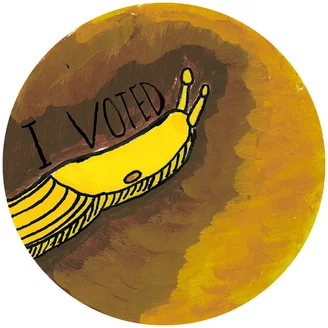
Adeline
Pierce, a student at Sunny Brae Middle School, was named the youth
winner and recognized in for her winning design that featuring a
banana slug. “I love the forest and banana slugs,” said Pierce of
her winning design. “When I was little me and my family would go on
long walks through the forest. I adored banana slugs and would name
them and build them slug houses, so of course I decided to do a
banana slug design.”
Congrats, Carly! First place in LoCO Pollz.
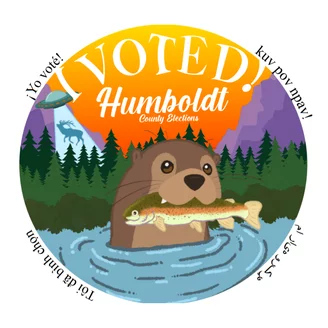
Carly
Haynes, a local educator, was named the adult winner and said her
design featuring an otter is meant to represent one of her favorite
places in Humboldt County, the lagoons by Trinidad. “I also wanted
to stay true to Humboldt’s weirdness which is why an alien
spaceship is seen abducting an elk. I included ‘I Voted’ in
Spanish, Hmong, Pashto and Vietnamese because these are some of the
languages my students hear or speak at home. I wanted everyone in our
community to feel included.”
“Voting
is both a right and a privilege, and this contest was a fun way to
engage our community and encourage voting in Humboldt,” said
Humboldt County Clerk-Recorder & Registrar of Voters Juan Pablo
Cervantes. “I’d like to thank everyone who shared their
creativity, voted for their favorite designs and joined us at the
Humboldt County Fair to celebrate the winners.”
The
Humboldt County Office of Elections is committed to ensuring all
eligible residents have an opportunity to exercise their right to
vote, conducting elections in a fair, accurate and efficient manner,
providing reliable information and the best possible service to
voters, districts, candidates and other interested parties. For more
information, please visit humboldtgov.org/elections.