In this September photo, California Attorney General Rob Bonta announces a lawsuit against St. Joseph Hospital as Eureka chiropractor Anna Nusslock looks on. | Image via Rob Bonta’s X account.
In a case that pits California’s constitution against the religious directives of Catholic hospitals, Providence Health & Services this week leaned into its identity as a faith-based institution in its official response to a state lawsuit concerning women’s access to emergency abortion care at Eureka’s St. Joseph Hospital.
On Monday, attorneys representing St. Joseph Health Northern California, LLC, a subsidiary of Providence, filed a motion to dismiss the lawsuit filed by Attorney General Rob Bonta in September. That suit seeks an injunction and criminal penalties against St. Joseph Hospital for its alleged refusal to provide abortion care to people experiencing obstetric emergencies.
While the U.S. Supreme Court overturned the nationwide right to abortion in June of 2022, the procedure remains broadly legal in most states, including here in California, where voters explicitly enshrined abortion protections in the state Constitution later that same year.
But attorneys for St. Joseph Hospital say hospital employees are bound by a higher law, a religious doctrine that deems abortion immoral.
“Forcing [St. Joseph Health Northern California] to allow procedures to terminate a pregnancy that are not permitted by the Catholic faith would unquestionably impede SJH’s constitutionally protected ability to communicate its faith-based message that such procedures are intrinsically wrong,” argues attorney Harvey L. Rochman, a partner in the Los Angeles-based firm of Manatt, Phelps & Phillips, LLP, on behalf of Providence.
The dismissal request submitted to Humboldt County Superior Court on Monday neither denies nor admits to any of the specific facts outlined in the state’s case. Instead, Rochman argues that the Attorney General’s complaint “does not allege facts sufficient to state a cause of action,” citing a series of procedural, jurisdictional and legal grounds, including the hospital’s constitutional rights to free exercise of religion and free expression.
“Like all Catholic hospitals, [St. Joseph] is required to follow the Ethical
and Religious Directives for Catholic Health Care Services issued by the United States
Conference of Catholic Bishops,” Rochman’s filing argues.
Those directives state in no uncertain terms, “Abortion … is never permitted,” adding, “Catholic health care institutions are not to provide abortion services, even based upon the principle of material cooperation.”
There’s a caveat to that doctrine in Ethical and Religious Directive No. 47, which is cited by Rochman. It says, “Operations, treatments,
and medications that have as their direct purpose the cure of a proportionately serious
pathological condition of a pregnant woman are permitted when they cannot be safely postponed
until the unborn child is viable, even if they will result in the death of the unborn child.”
Regardless, Bonta’s office says the hospital’s policy on emergency abortion care violates California law and discriminates against pregnant patients by making their health care choices for them. Despite rule No. 47, Bonta’s office says St. Joseph Hospital policy bars doctors from providing life-saving emergency treatment when doing so would terminate a pregnancy, even when the pregnancy is not viable.
The Attorney Generals’ suit accuses St. Joseph Hospital of violating California’s Emergency Services Law (the state-level analogue to the federal EMTALA statute), the Unruh Civil Rights Act and the Unfair Competition Law.
With Monday’s dismissal request, St. Joseph Health effectively seeks to sidestep the complaint via a series of demurrers. In legal jargon, a demurrer challenges the adequacy of a complaint without disputing the facts. In other words, the hospital’s legal counsel is arguing that, even if all the facts in the complaint are true, there is no legal basis for the suit.
To briefly recap those alleged facts, the Attorney General’s suit centers on the experiences of Eureka chiropractor Anna Nusslock, who, in February 2024, arrived at St. Joseph Hospital bleeding heavily after her water prematurely broke during the 15th week of her pregnancy with twins.
A doctor at the hospital diagnosed Nusslock with Previable Premature Pre-labor Rupture of Membranes (Previable PPROM) and confirmed that her twins would not survive, the suit alleges. According to state prosecutors, the hospital’s medical staff refused to treat her, citing a policy that prohibits them from providing such emergency care as long as either of her twins had a “detectable heartbeat.”
Instead of helping her, the suit alleges that St. Joseph Hospital discharged a still-hemorrhaging Nusslock with instructions to drive herself to Mad River Community Hospital. “On the way out the door, Providence handed Nusslock a bucket and towels ‘in case something happens in the car,’” the AG’s Office said in a news release.
In filing its demurrers this week, St. Joseph Hospital’s attorneys contend that this dispute should properly be handled by the California Department of Public Health [CDPH], not the courts. The dismissal request argues that Attorney General Rob Bonta’s office is improperly trying to usurp that department’s authority over alleged violations of the state’s Emergency Services Law.
Secondly, the hospital’s attorneys argue that the complaint cites an irrelevant section of California Health and Safety Code, one that places limits on the transfer of emergency room patients for non-medical reasons, whereas the state’s complaint itself “alleges that [Nusslock’s] transfer was for medical reasons.”
The attorneys also dispute the state’s discrimination claim, saying the Catholic hospital’s alleged “faith-based limitation on certain procedures … does not constitute intentional discrimination against any protected group.” In other words, they argue that the complaint fails to allege discrimination against a protected class (women, presumably); instead, it merely alleges that the hospital “did not provide a specific procedure
because of the nature of that procedure,” which isn’t relevant to the Unruh Civil Rights Act.
The hospital’s filing goes on to challenge the case on other procedural and jurisdictional grounds but ultimately returns to the matter of religious liberty, saying Bonta’s office cannot use certain state laws “to penalize a Catholic hospital for applying faith-based policies and procedures.”
The filing further argues that the injunction requested by Bonta’s office, which seeks a court order guaranteeing that patients receive prompt emergency medical care including abortion care, unjustly asks care providers to violate their sincerely held religious beliefs.
“SJH could not comply with such an order without forsaking its Catholic identity — the ultimate burden in a religious freedom case,” the filing says, later adding, “There is universal agreement among courts, legislators, and regulators that the conscience rights of health care providers must be respected.”
In a statement released to news outlets earlier this week, Providence said this:
Our motion raises several procedural legal arguments for dismissal while also affirming both our Catholic identity and our commitment to providing safe, high-quality emergency care for pregnant patients in accordance with state and federal law. Our commitment to both the health of our community and our faith-based tradition remains unwavering.
We have served as a vital safety net in Humboldt County since the Sisters of St. Joseph of Orange founded the ministry more than 100 years ago, and we remain deeply committed to continuing to be here for patients when they need us most. As part of that commitment, we are providing additional training and education to our OB and Emergency Department medical staff and caregivers to support them in the delivery of safe, high-quality emergency care for pregnant patients in the context of our Catholic identity and the requirements of state and federal law.
With the closure of Mad River Community Hospital’s Birth Center in October, St. Joseph Hospital is now Humboldt County’s only licensed medical facility offering labor and delivery services. Earlier this month, attorneys representing a second plaintiff filed a new lawsuit with very similar allegations, accusing St. Joseph Hospital of denying emergency abortion care to a woman in 2022 due to its religious prohibition on giving such care when there’s a detectable fetal heartbeat.
The Outpost reached out to civil rights organizations, attorneys and medical professionals for input on this latest filing but has yet to hear back from most of them (understandable, given the holidays). We will continue to follow this case.
The next hearing date is scheduled for Jan. 27, 2025, at 10:30 a.m. in Courtroom 4 of the Humboldt County Courthouse.
Arcata Downtown Fire Station. Image via arcatafire.org.
###
Press release from the Arcata Volunteer Firefighters’ Association:
The Arcata Volunteer Firefighters’ Association (AVFA) is pleased to announce the sale of
its Arcata Downtown Fire Station, located at 631 9th Street, to the Arcata Fire Protection District (AFPD),
a public agency that has provided essential fire protection and emergency services to the community since
1944. This significant transaction marks the next chapter in the fire station’s history, which has long
served as a cornerstone of Arcata’s emergency response infrastructure. The AFPD has been renting the
9th Street station from the Association since the 1970s and occupying it with career firefighters since
2012.
After Arcata experienced several devastating fires, on January 24, 1884, the Arcata Fire Company #1 was
established. Between 1884 and 1923 fire suppression equipment was stored at various rented spaces around
the east side of the Arcata Plaza. On September 21, 1923, Chief Mathews and Secretary Stromberg were
authorized to purchase the property at the corner of 9th Street and F Street on behalf of the Arcata Volunteer
Fire Department. The property included Excelsior Hall, which later became Firemen’s Hall.
Fireman’s Hall
served as a major social and athletic venue for the residents of Arcata and office space for the Volunteer
Fire Department until it experienced a major fire on July 30, 1945, and was demolished.
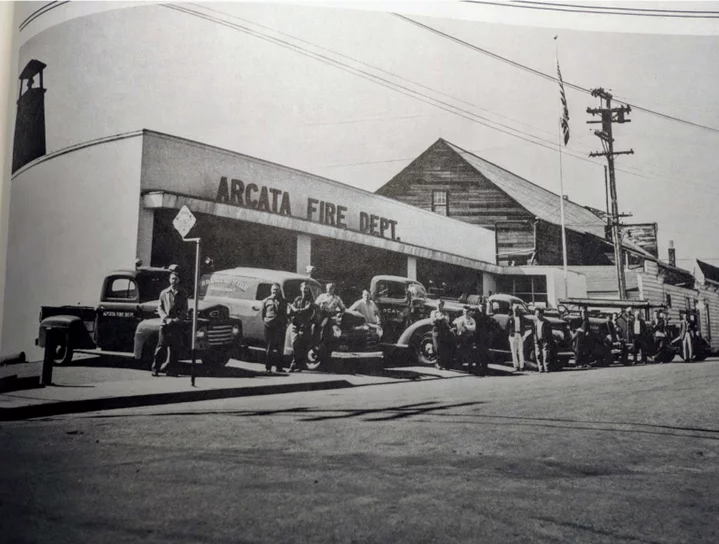
Fireman’s Hall was replaced with a new fire station in 1949. The building was able to house six vehicles
and a few small offices. Prior to that, the fire engines were housed at the Old City Hall on the northeast
corner of 9th and G Streets.
Arcata Volunteer Fire Department, October 1950, prior to addition of the two-story dining room and upstairs clubroom. | Submitted.
###
In 1956 the Arcata Station was expanded to include a dining room/classroom, living quarters and a 2nd story
fireman’s clubroom. The apparatus bays were expanded in 1963 to allow for longer vehicles. In 1990, the
building was seismically upgraded and two of the apparatus bays were converted into additional offices and
a conference room.
In the 1990s the Arcata Volunteer Firefighters’ Association started fundraising efforts to either remodel or
replace the 9th Street station. As the need for fire department services was increasing, management of the
fire department transitioned to the Arcata Fire Protection District and the Arcata Volunteer Firefighters’
Association asssumed a supportive role for the Fire District. In 2015, thanks to fundraising efforts by the
Arcata Volunteer Firefighters’ Association and the generous support of the Orvamae Emmerson
Endowment, the Lucchesi Family, the Rotary Club of Arcata, and many public donations, enough funds were raised to completely remodel and expand the 9th Street station.
At the request of the Arcata Fire
Protection District, the Arcata Volunteer Firefighters’’ Association obtained additional financing to remodel
the McKinleyville fire station owned by the Arcata Fire Protection District. The Arcata Volunteer
Firefighters’ Association agreed to use the rent collected from the Arcata Fire Protection District’s use of
the 9th street fire station to service the new debt.
In 2021 the Arcata Volunteer Firefighters’ Association started the process of transferring ownership of the
9
th Street Arcata fire station to the Arcata Fire Protection District. This would allow the Arcata Volunteer
Firefighters’ Association to retire the additional debt incurred by the remodel of the District owned
McKinleyville fire station. After 100 years of Arcata Volunteer Firefighters’ ownership, on December 17,
2024, the 9th Street Station was sold to the Arcata Fire Protection District.
Roy Willis, President Arcata Volunteer Firefighter’s AssociationZ avfa.pres@arcatafire.org
Californians accused of certain drug and retail theft crimes may already be facing stiffer penalties under an initiative voters passed this year, alongside related bills Gov. Gavin Newsom signed into law.
Voters this November overwhelmingly approved Proposition 36, which both modifies and adds key changes to California law.
That includes prosecutors being able to charge people convicted of various third-time drug offenses with a so-called treatment-mandated felony, which would direct them to substance use disorder or mental health treatment in lieu of up to three years in jail or prison.
Under the new law, courts are also obligated to warn people convicted of selling or providing certain drugs, such as fentanyl, that they could face murder charges for later distributing illegal drugs that kill someone.
And heavier consequences may also extend to petty theft and shoplifting offenses, including the possibility of up to three years in jail or prison if a person has already been twice convicted for certain theft offenses.
Several district attorneys and police departments announced arrests this month that they planned to charge under the new law, including in San Francisco, Solano and Shasta counties.
The measure partially reversed a different initiative voters approved a decade ago, which reduced penalties for certain lower-level drug and petty theft offenses from felonies to misdemeanors. The initiative, Proposition 47, was intended to develop new public safety strategies and reduce incarceration after the state’s prison population exploded due to tough-on-crime policies dating back to the 1980s.
But prosecutors, law enforcement and large retailers who rallied in favor of Prop. 36 said those sentencing reforms went too far and created a revolving door for people to repeatedly commit crimes without being held accountable.
“It’s a clear mandate from the public that we need to take a new approach on public safety issues, specifically hard drugs, retail theft and fentanyl,” said Jeff Reisig, Yolo County District Attorney.
Those who opposed the measure warned that it will worsen homelessness, drug use and crime by cutting funding for treatment programs, and increasing court and prison costs in the hundreds of millions of dollars.
“I believe that (proponents) have also received a mandate to embrace problem solving and supportive services for people who are struggling,” said Cristine Soto DeBerry, executive director of the Prosecutors Alliance of California, a nonprofit organization that opposed Prop. 36.
“I don’t believe the mandate was (to) put more people in prison. It was not what people believed they were voting for. I hope that people with the discretion to enforce this law will think very carefully about the communities they serve and what they were asking for in this moment,” she said.
Gov. Gavin Newsom tried to keep Prop. 36 off of the fall ballot and for a time considered putting a competing crime measure before voters. Instead, he signed a package of 10 bills in August that will make it easier to prosecute retail and vehicle theft. Those laws go into effect on Jan. 1.
Although Gov. Newsom didn’t put any money into fighting Prop. 36, he referred to the initiative as an “unfunded mandate” that will take California back to the War on Drugs. Indeed, the measure included no new funding streams. But supporters like Reisig voiced optimism that funding opportunities already exist in the law, pointing to a $6.4 billion from the mental health bond voters approved in March.
“I hope that lawmakers and the governor embrace the mandate and work collaboratively to make sure that we’re successful in delivering the promise of Prop. 36,” Reisig said.
###
CalMatters.org is a nonprofit, nonpartisan media venture explaining California policies and politics.
UPDATE, SATURDAY: BSA Troop 47 will handle tree-hauling duties in Fortuna on Sundays, January 5 and 12. More information can be found here.
###
Press release from the Scout troops listed below:
Boy Scout Troop 15 and Cub Scout Pack 95 will again be picking up Christmas trees in the Arcata, Eureka, and McKinleyville areas and hauling them to green waste for the community. We will be doing this on Saturday December 30 Sunday, December 29 and again on Saturday January 4 between 10am and 4pm. [NOTE: This post has been edited to reflect the correct dates.]
Anyone who would like to schedule a pickup should text or call 707-273-1997 or email arcatacubscouts@gmail.com with their name, address, phone number and preferred pickup date (12/30 or 1/6).
This is a community service project for the Scouts and there is no fixed cost to pick up a tree - donations are accepted and appreciated but not required. All donations will help fund camping and other outings and summer camp for the Scouts.
Robert
“Beau”
Robbins,
March
18, 1964 — Dec. 18, 2024, passed
away peacefully, after a long illness. He will be remembered for his
uniqueness, his quick wit and his kindness. He loved music and his
family and the people who stuck with him and became his family.
He
spent the majority of his life in the Humboldt area, growing up in
Willow Creek. Beau
was
always a wandering soul, first running away to the hills of Denny to
grow weed, at the age of 16, and from then on he always chose to live
life on his own terms. The years after that included traveling and
playing music with his lifelong friend, James Forbes. One of the
bands they played in together locally was Spud Dogma. He would tell
stories of his band opening for the Circle Jerks and the Dicks years
before. Many road trips to SF and LA were taken, to play and to go to
shows.
Sometimes
you could never tell which stories were true or at least heavily
embellished, but they always made you shake your head and laugh. Beau
worked
for the U.S. Forest Service for years, stationed in the Six Rivers
District, and was very proud of that. In recent years he could be
seen jetting around on his motorized scooter, in the Arcata/Westwood
area. He would start many a conversation with people in his travels
around the neighborhood, looking like Tom Waits on wheels. He was
always the most interesting man in the room and will live on in the
stories of those that love him. Those who
knew him know that there will never be another like him. We would
like to thank his care provider, Jessica McGruder, for her care. She
treated him with love and respect, like a family member.
He
is
preceded in death by his father and mother, Darrel and Florence
Robbins, of Willow Creek.
He
is survived by his sister Katherine Robbins
and
brother-in-law Daniel Schneider of Elk Grove, Calif.;
sister
Cynthia McClure and brother-in-law Chris McClure of Ames, Iowa;
sister
Amber Van Dunk and brother-in-law Michael Van Dunk of Arcata; nieces
Crystal Kirk, Ashley Kirk, Catie Kirk, Alaira Hudson, Constance
Hames; nephews
Alex Kirk, Xander Jackson, Trey Van Dunk, Raheim Lamb, Aedan Kirk and
Albert Hames. A small celebration
of life
for close friends and family will be planned in the future.
###
The obituary above was submitted on behalf of Beau Robbins’ loved ones. The Lost Coast Outpost runs obituaries of Humboldt County residents at no charge. See guidelines here. Email news@lostcoastoutpost.com.
At approximately 6:15 pm on Wednesday, December 25th, Humboldt Bay Fire (HBF) was
dispatched to a reported structure fire on the 3000 block of Jacobs Ave. HBF responded
with a first alarm assignment consisting of three fire engines, one ladder truck and a
Battalion Chief.
The Battalion Chief arrived on scene first and reported a working fire with black smoke
visible from the building, reported missing occupants, and access problems and thus,
requested more assistance from neighboring Fire Departments requesting a second and
third alarm. Battalion 8104 removed one female trapped by smoke in an office adjacent
to the fire building that was becoming overwhelmed with smoke.
Truck 8181 arrived at scene and began to open up the structure and search for occupants.
E8115 and E8114 arrived on scene and established a water supply while E8112 began
attacking the fire. E8115 located an occupant who had burn injuries and removed him
from the structure, transferring medical care to City Ambulance at scene. He was
transported to the hospital for medical care. The rest of the structure was confirmed to
have no other trapped victims.
Fire control was achieved in approximately 20 minutes.
The pre-fire value of the structure was approximately 1.5 million dollars with estimated
fire loss totaling $90,000. Fire crews did an excellent job protecting the majority of the
interior of the building and contents through aggressive fire attack and salvage work.
PG&E responded to the scene and secured the gas and electrical service from the
building.The cause of the fire is still under investigation.
Humboldt Bay Fire would like to thank our mutual aid partners from City Ambulance,
Arcata Fire, Samoa Fire, Loleta Fire, and Blue Lake Fire along with the Eureka Police
Department and PG&E who all assisted in either the direct fire suppression efforts or
providing coverage for the rest of the emergency calls in our area while the fire was
being mitigated.
Humboldt Bay Fire would like to remind everyone that smoke detectors save lives!
Smoke detectors give you crucial early warning that there may be a fire in your home or
business and allots you time to escape. Once you’ve exited a home go to your family
meeting place and ensure that everyone has made it out.
Every day people across the country skip medical care because of cost. Those who do seek medical help may end up with a balance they can’t pay off. That debt can hurt people’s credit scores, resulting in long-term financial burdens.
Starting Jan. 1, a new state law will prohibit health providers and debt collectors from reporting medical debt information to credit agencies. That means unpaid medical bills should no longer show up on people’s credit reports, which consumer advocacy groups say is a boon for patients with debt.
Here’s why: While the law will not forgive someone’s debt, by keeping it off credit reports, it might provide some reassurance that a hospital stay or trip to urgent care won’t later affect their credit standing. Lower credit scores usually result in higher interest rates and make it harder for people to qualify for a home rental, a car loan or even employment.
During legislative hearings, the law’s author, Sen. Monique Limón, a Democrat from Santa Barbara, contended that because people don’t choose to have a medical emergency or illness, this type of debt should not count against them. Supporters also argued that medical debt is more prone to inaccuracies because of billing mistakes by health providers and insurers.
The main three credit bureaus – TransUnion, Equifax and Experian — stopped reporting medical debt under $500 in 2023. But most people with medical debt owe far more than that. The national average for medical balance is $3,100, according to the Consumer Financial Protection Bureau. In California, an estimated 38% of residents carry some type of medical debt; that figure climbs to more than half for low-income residents, according to the California Health Care Foundation.
One key caveat is that patients can only take advantage of this law if the debt is owed directly to a medical provider or collection agency, but not when the debt is charged on a medical credit card or a general credit card.
This new law follows similar ones enacted in a handful of other states, including New York and Colorado. It also mirrors a proposal put forth by the Biden administration to do the same nationwide. However, with a new administration taking over in January, it is unclear whether the federal proposal will go anywhere.
Limón’s office explained that under the law patients have the right to sue a debt collector or provider who reports a medical debt to a credit bureau. Consumers may also choose to file a complaint with the state’s Department of Financial Protection and Innovation, which has authority over debt collectors. Consumers can also file a complaint with the California Attorney General’s office.
###
Supported by the California Health Care Foundation (CHCF), which works to ensure that people have access to the care they need, when they need it, at a price they can afford. Visit www.chcf.org to learn more.
CalMatters.org is a nonprofit, nonpartisan media venture explaining California policies and politics.