

Coast Guard Medevacs 72-Year-Old With Stroke Symptoms Way Up in Trinity Alps
LoCO Staff / Thursday, July 30 @ 10:09 a.m. / Public Safety
Press release from U.S. Coast Guard Sector Humboldt Bay:
Late Saturday night, July 25, the crew of CG-6564 from Coast Guard Sector Humboldt Bay was scrambled for a critical, time-sensitive MEDEVAC: a 72-year-old male experiencing acute, life-threatening stroke symptoms near Caribou Lake in the Trinity Alps Wilderness. Ground rescue crews were facing a multi-hour response followed by a grueling six-to-seven-mile high-altitude hike. Knowing the patient’s survival depended on getting to higher-level care immediately, the aircrew stripped non-essential gear to maximize performance in the thin mountain air and launched into the night.
Navigating through mountain passes exceeding 8,900 feet, the crew battled severe visual illusions, constantly shifting between deep mountain shadows and blinding Night Vision Goggle washout from the poorly angled moon. With the patient and his son in a narrow valley campsite surrounded by 150-foot trees, standard landing or hoisting options were quickly ruled out. In a display of incredible airmanship, the pilots executed a precarious one-wheel landing on a razor-thin, 10-to-20-foot wide steep ridgeline to insert the Rescue Swimmer at ~6050 feet MSL. To guide the swimmer through the pitch-black wilderness, the crew deployed a visual trail of chemical lights through the dense canopy, enabling him to bushwhack 1.2 miles through steep, wildlife-populated terrain with 70 pounds of gear to reach the patient.
While the swimmer escorted the patient back toward the ridge, the flight crew completed a rapid refueling evolution in Redding before returning to the scene. Fighting intense rotor-wash, brownout conditions, single digit power margins, and sliding loose rock, the right seat pilot held another continuous, precise one-wheel landing on the ridge at 6100 feet MSL to load the patient and the swimmer. Demanding nearly all available engine power, the aircraft cleared the 150-foot trees, flying directly to Shasta Hospital to deliver the patient to waiting medical personnel. After navigating low-visibility coastal fog back to Arcata, the crew safely shut down at 0430L.
Bravo Zulu to the aircrew of CG-6564 for their extraordinary airmanship, quick thinking, and unwavering courage under extreme conditions! Coast Guard Aviation at its finest! It was AST3 Regan Lowndes very first SAR case in the US Coast Guard!
Crew:
PIC/Right Seat: LCDR Mitchell Dow
CP/Left Seat: CDR Josh Smith
Flight Mechanic: AMT2 Jacob Eash
Rescue Swimmer: AST3 Regan Lowndes

Photo via U.S. Coast Guard Sector Humboldt Bay
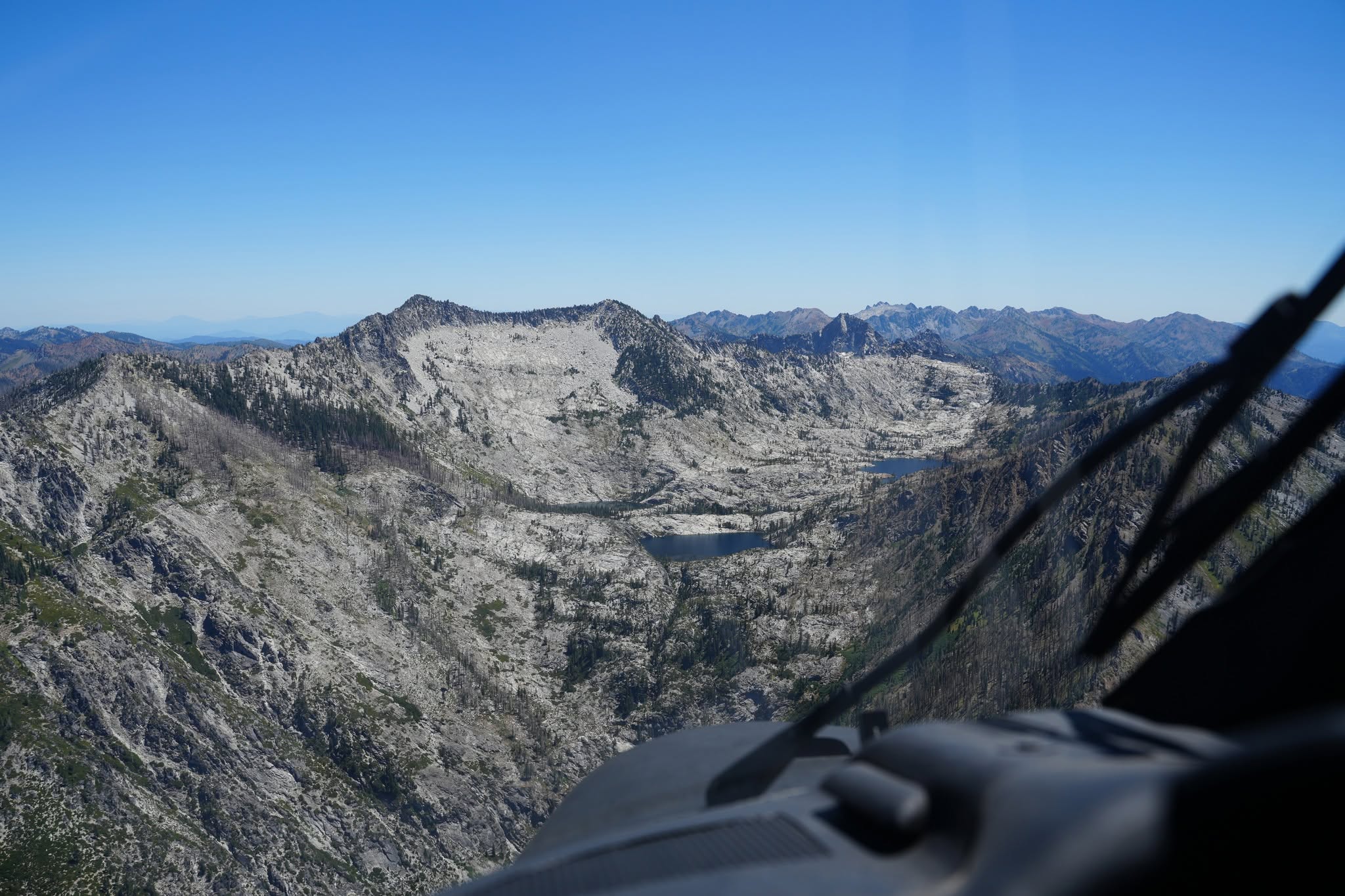
Photo taken the following day. | Via U.S. Coast Guard Sector Humboldt Bay
BOOKED
Today: 10 felonies, 12 misdemeanors, 0 infractions
JUDGED
Humboldt County Superior Court Calendar: Today
CHP REPORTS
1656 Union St (HM office): Missing Indigenous
ELSEWHERE
County of Humboldt Meetings: Behavioral Health Board - SUD/Dual Recovery Committee - Sept. 10, 2026
County of Humboldt Meetings: Behavioral Health Board Executive Committee Meeting - July 1, 2026
RHBB: Judge Overturns Search Warrant in Student Activist Case: Devices Ordered Returned
RHBB: Multi-Vehicle Crash Closes South Fortuna Boulevard Near Strongs Creek Plaza
California Fire Season Has Been Quiet. A Heat Wave Could Change That Fast
Rachel Becker / Thursday, July 30 @ 7:11 a.m. / Sacramento

Cal Fire firefighters work to put out the Dove Fire in Tuolumne County on July 26, 2026. Photo via Cal Fire
###
This story was originally published by CalMatters. Sign up for their newsletters.
###
The fast-moving Dove Fire near a Yosemite gateway town jolted California out of a relatively quiet fire summer, forcing road closures and the evacuations of hundreds of homes.
Former U.S. Forest Service firefighter John Buckley wasn’t surprised to see the fire taking off last Sunday. Driving through the area in the Central Sierra foothills earlier that day, he remembers telling his wife those fuels looked ready to burn.
“We drive back, and they’re burning over at the city of Sonora,” said Buckley, now the executive director of the Central Sierra Environmental Resource Center. “The fuels are now quite primed for burning, and they’re only going to get drier.”
Firefighters have gained the upper hand against the 226-acre blaze, which Cal Fire suspects was set by a reckless 30-year-old man. But high temperatures are looming — and new research puts numbers to the intuitive follow-on: with heat, comes fire.
It’s far too early in California’s fire year to make any conclusions or predictions. But with fires devouring millions of acres in the Western U.S., Canada, and Europe, California stands out for what has been, so far, a below-average summer.
To date, roughly 4,030 wildfires have burned a little over 208,000 acres in the state — down from a five-year average of nearly 5,300 fires burning more than 300,000 acres at this point, according to Cal Fire data.

An aerial view of the Dove Fire in Tuolumne County on July 26, 2026. Photo via Cal Fire
Still, Cal Fire Battalion Chief David Acuña says he avoids the word ‘quiet.’
“There is a superstition that when you use words like ‘quiet, slow, bored’ in the fire station, that just means that you’re about to get hit with an amazingly busy shift,” he said.
California has benefited from lucky weather conditions so far, despite a low snowpack and blistering March, according to John Abatzoglou, a professor of climatology at UC Merced.
That’s about to change. “Now, of course,” he said, “we have a heat wave on our doorstep.”
National Weather Service offices across the state are warning of soaring temperatures starting later this week. The Los Angeles/Oxnard office said conditions will shift to “dangerously hot” by Friday.
That combination — heat waves and fire activity — is a common feature of western wildfires, Abatzoglou’s team found in a recent study published in the journal Science Advances and led by scientist Dmitri Kalashnikov.
The paper found that just under half of the burned area in warm-season months from 2001 to 2024 occurred during or in the wake of a heatwave, particularly in forests.
Heatwaves, defined as at least three days in a row with temperatures soaring past the 90th percentile, make up 15% or less of the warm season. But climate change is fueling an increase.
Abatzoglou pointed to a few reasons for the link. Heatwaves create chronic conditions that lead to drier, more flammable fuels. They also mean hotter nights, which previous research found increases nighttime fire intensity, shuttering a critical window for fire suppression. The researchers found that heatwaves can also prime conditions for lightning, which has sparked some of California’s biggest blazes.
“And then it’s off to the races in terms of fire activity,” Abatzoglou said.
The paper’s findings don’t mean all heatwaves will bring an uptick in fire activity, he added. That still requires ignitions in the right place, at the right time.
Acuña cautioned Californians against creating those sparks. That means mowing before 10 a.m. on hot days or skipping the yard work during a red flag warning. It also means securing tow chains so they don’t drag and spark against the road, and not parking hot cars on dry grass.
California sought and received federal funding assistance related to the Dove Fire within hours. But a separate, monthslong fight between Sacramento and Washington continues over slower-moving wildfire recovery funds — including hundreds of millions in aid tied to last year’s L.A. fires that Gov. Gavin Newsom said in May FEMA was still sitting on.
As for predictions for the season ahead, Acuña likes to make them about as much as he likes the word ‘quiet.’
“It depends on what the weather brings us,” he said. “If it brings us hot, windy, red flag warning conditions, then that could certainly be a problem. If it brings us rain, well, that brings us a totally different concern. We are ready to respond.”
OBITUARY: Blake Whittington, 2003-2026
LoCO Staff / Thursday, July 30 @ 6:56 a.m. / Obits

Angel Marie Whittington, lovingly known as Blake, was born on September 28, 2003. Blake passed away far too soon in an automobile accident while traveling to Oregon.
Blake was a kind, adventurous and caring person who brought joy to those fortunate enough to know him. He had a generous heart, a love for life and a spirit that touched the lives of family and friends. Blake was deeply loved and will be greatly missed by everyone who knew him.
Blake graduated from Blue Lake Union Elementary School and later attended Six Rivers Charter School. Throughout his life, he created many memories with those he loved and will be remembered for his compassion, adventurous nature and the happiness he brought to others.
Blake is survived by his brothers, Richard Waggoner and Steven Jackson Waggoner; his beloved Nana, Ellie Waggoner; and his Pops, David Waggoner. His family and friends will forever cherish the love, laughter, and memories he shared with them.
Funeral arrangements are under the care of Ayers. For additional information, please contact Richard Waggoner at (707) 273-3263 or Ellie Waggoner at (707) 442-8038 or David Waggoner at (707) 719-2205.
Though Blake’s time with us was far too short, his love, kindness and adventurous spirit will live on forever in the hearts of all who knew and loved him.
Rest in peace, Blake. You will always be remembered, forever loved and never forgotten.
###
Another obituary — below — was sent in by Blake’s mother.
###
Angel Marie Whittington was born on Sept. 28, 2003.
She passed away on July 23, 2026 in a horrific car accident.
She was a beautiful person with a great personality and made lots of friends growing up both in Eureka and Arcata.
She was 22 years old and way too young when this horrible accident occurred and is survived by her fiance, two older brothers — Richard Waggoner & Steven Jackson-Waggoner — as well as her great-grandmother Ellie Waggoner, her great-grandfather David Waggoner, as well as several other family members and friends.
She also went by Blake Whittington and she was the best friend to many people growing up as well as to her friends that live up in Hoopa.
I would hope that each and every one of her close friends are able to get a hold of her mother to be able to join in a memorial ceremony for Angel Whittington/Blake Whittington.
I hope that each of you are able to mourn and be there through this hard time of life where she would really love to have you be able to except the accident and be there for the family and friends that will always love, appreciate everything that she’s done for herself and each of her family members friends as well!
Feel free to contact his mother, Jennifer Whittington, at (707) 616-7383.
###
The obituaries above were submitted on behalf of Blake Whittington’s loved ones. The Lost Coast Outpost runs obituaries of Humboldt County residents at no charge. See guidelines here. Email news@lostcoastoutpost.com.
OBITUARY: Lori Ann Moehnke Anderson, 1964-2026
LoCO Staff / Thursday, July 30 @ 6:56 a.m. / Obits

On July 21, 2026, after a difficult battle with early-onset Alzheimer’s disease, we lost our beloved Lori Ann Moehnke Anderson. Lori was born on May 18, 1964, in Eureka to parents Donald and Dian Moehnke. Following in her parents’ footsteps, she soon showed great musical talent and started playing Suzuki method violin at five years of age. Lori’s passion for playing the violin continued her entire life.
Lori attended Cutten Elementary School, Winship Junior High School and graduated as a valedictorian from Eureka Senior High School in 1982. Attending University of Southern California with a music scholarship, Lori went on to participate in a variety of musical adventures! She played violin with the USC Thornton School Of Music Symphony Orchestra and performed with the USC Marching Band as a mellophone player for two years, which enabled her to travel for special events and away-games, including the Orange Bowl in Florida and the Mirage Bowl in Japan. She received her music education teaching credential in 1987 and began her teaching career in Visalia, Calif.
As a music educator, Lori taught string instruments to elementary, middle, and high school students. She taught for the Visalia Unified School District for nearly 30 years and also participated in many local musical activities. She enjoyed playing in chamber music groups, musical theater performances, taught private violin and viola students, and was concertmaster for the Tulare County Symphony (Sequoia Symphony) from 1990 to 2010. During Lori’s time living in Visalia, she was also a member of the Kaweah String Quartet, which performed for countless weddings and other events through the years. Lori loved to sing and play the piano, and in later years enjoyed taking art and dance classes. She especially liked playing in pit orchestras for musical theater performances, and her favorite to play for was The Secret Garden. She considered it a treat when given the opportunity to play with an orchestra accompanying a touring artist, including Smokey Robinson and Natalie Cole.
Upon retirement, Lori moved back to Eureka to be with family and continue to enjoy her lifelong passion of playing music. She loved performing with the Eureka Symphony, the All Season’s Orchestra and in string quartets and other local ensembles. When she wasn’t performing, she was attending and supporting the numerous arts programs that Humboldt County has to offer.
Lori had a great love and appreciation for wildlife and pets throughout her life, especially her golden retriever Cami and her kitties, Lucy and spicy Isabella. As a child, she loved spending summers on Shasta Lake with her Moehnke grandparents and at “The Ranch” and Desert Hot Springs with her Arvidson grandparents. She enjoyed traveling to Yellowstone, Yosemite, Alaska, Hawaii, the Grand Canyon, The Azores, England and Ireland, among other places. Lori also loved vacationing on the Oregon Coast with her sisters and nephews, as well as going to Southern California with Shari to spend time with Aunty Susie. Susie visits were always packed with fun adventures; One of the most notorious was the exciting Newport Beach whale watching tour, where, after being surrounded by an incredible megapod of porpoises feeding on albacore, the boat stopped and drifted for what seemed like hours, finally being towed back to shore, because it had run out of gas! Some of Lori’s favorite visits included getting to see the touring productions of Hamilton and Waitress, as well as exploring the Huntington Library, Art Museum and Botanical Gardens, and touring The Queen Mary. The occasional trip to Disneyland was also definitely a highlight.
Lori is survived by her dear aunt, Susan A. Moehnke; brother, William D. Moehnke; sisters Shari L. Moehnke and Michelle D. (Moehnke) Gibbons (Freeman); nephews Michael W. Moehnke, Paul Z. T. Gibbons, and Freeman James Gibbons; and cousin, David Miller, as well as numerous other relatives.
Lori is preceded in death by her parents, Donald D. and Dian L. (Arvidson) Moehnke; maternal grandparents, Paul and Pearl Arvidson; paternal grandparents, Laverne “Mike” and Ann Moehnke; and cousin, Matthew Miller.
Lori’s family would like to thank Janet Grizzell, Elizabeth Morrison, and Julie Fulkerson, among so many others, for their love and support of music and friendship in Lori’s life. We are grateful for the wonderful care that Lori received from the entire team at Timber Ridge Renaissance in Eureka, as well as the indispensable support from Hospice of Humboldt, with a special acknowledgement going to Katie and Scotty for their particular kind and caring attention.
In lieu of flowers, please consider making a memorial contribution to: your local school’s music program; Hospice of Humboldt; or the Alzheimer’s Association. The family will gather for a private memorial service at a later date.
###
The obituary above was submitted on behalf of Lori Anderson’s loved ones. The Lost Coast Outpost runs obituaries of Humboldt County residents at no charge. See guidelines here. Email news@lostcoastoutpost.com.
TODAY IN COURT: Jake Combs Sentencing Delayed; Glendale Murder Hearing Also Delayed
Sage Alexander / Wednesday, July 29 @ 4:49 p.m. / Courts

Photo: Dezmond Remington
###
The sentencing of Jake Combs, who was convicted twice of first degree murder for shooting Alderpoint’s Trevor Earley, was delayed today over the protests of Earley’s family.
Combs shot Earley in the head during a confrontation on Jan. 6, 2022.
The defense pointed to lingering issues in Combs’ open drugs-in-jail case, which the court wanted work through before he’s sentenced for the murder.
But in court today, Earley’s family pleaded with the judge to finally sentence the man on Friday, as initially scheduled, to allow for them to finally heal over four years later.
“Our lives have been consumed by this case,” Katrina Sutherland, the mother of the victim, told the judge via a statement read by the prosecutor.
She urged the court to consider the effect the lingering case has had on Earley’s loved ones.
She said they have been reliving the events over and over in court, taking time off work to attend every hearing in Eureka, a justice process that has included two full trials.
A jury convicted Combs of murder in August 2023. But due to an error in the judge admitting evidence, specifically information that while in jail awaiting trial Combs attacked another inmate in a wheelchair, the California First District Court of Appeal overturned this conviction.
The Humboldt County District Attorney’s office re-prosecuted the case this year, with a jury again finding Combs guilty of murder and a weapons enhancement on May 14.
“We’re getting thrown in the meat grinder,” said Nicholas Umbrello during a victim impact statement, adding “we can’t heal.” He urged the judge to consider the community, not the defendant alone, and sentence Combs.
During their statements to the court today, Earley’s loved ones pointed to a previous statement by Combs where he admitted to killing Earley and said he was ready to do his time — and pleaded with the judge to allow for this to happen.
In the other case, Combs is charged with possessing meth in the Humboldt County Correctional Facility, along with an enhancement for a longer sentence through California’s three strikes law.
Judge Kaleb Cockrum set a briefing schedule today that will push out his murder sentencing by two months, after Combs’ defense attorney pointed to lingering issues with the drug case. Deputy Public Defender Emery Welton today noted a delay in a doctor’s evaluation and issues with the informant.
Deputy District Attorney Carolyn Schaffer argued Welton didn’t show enough diligence towards addressing these issues, arguing it should have happened sooner.
Judge Cockrum acknowledged that to the family, the sentence feels overdue.
But he also said the court had procedures to follow, and noted there are judges looking over his shoulder, pointing to the appellate court that overturned the conviction.
Combs’ sentencing was rescheduled for September 23. The jury trial for the drugs-in-jail case is scheduled for September 14th, according to court minutes.
Previously, Combs was sentenced to 50 years to life in 2023 for the murder of Earley. The DA’s office offered him this same sentence in exchange for dropping the drugs-in-jail case before the 2026 trial, but he did not take the offer.
PREVIOUSLY
- 29-Year-Old Arrested in Connection With Alderpoint Homicide This Morning
- Friends and Family of Alderpoint Murder Victim Pack Courtroom as Suspect is Arraigned
- TODAY in COURT: Two Local Murder Cases Moving Forward
- TODAY in COURT: Man Convicted of Rio Dell Murder May Finally be Sentenced Next Month; Alderpoint Murder Suspect Scheduled for Preliminary Hearing
- Alderpoint Murder Suspect Told Cops He Shot Man in the Head to Save His Puppy, Investigator Testifies
- Alderpoint Man Convicted of Murder in 2022 Shooting Prompted by Dog Dispute
- Overturned Murder Conviction Retrial Approaches; Jake Combs Jury Trial Set for April
- COURT ROUNDUP: Jake Combs Found Guilty of First Degree Murder (Again); Woman Charged in Death of Her 19-Month-Old Daughter; School Threats Suspect Submits Mental Health Petition
###
Another case delayed today involved suspects accused of the murder and robbery of 37-year-old Joshua Lee McCollister, of Fort Bragg, in the community of Glendale near Blue Lake in 2025.
The preliminary hearing was pushed out by about a month on a request from defendant Deunn Willis’ attorney, due to a couple of lingering pieces of evidence.
Deputy Public Defender Adrian Kamada, who was recently appointed to the case, pointed to evidence like DNA testing of a weapon found at the scene and police reports he needs from the District Attorney’s office.
The hearing is expected to take about a day.
Willis, who is accused of murdering McCollister, has been in custody for over a year, while codefendant Danielle Durand (who is not charged with murder) is out on bail.
The next hearing is set for September 2.
(VIDEO) LOOK AT ‘EM GO! Meet the Remote-Controlled Mowers Caltrans Got to Tend to Unruly Vegetation on Humboldt Highways
Isabella Vanderheiden / Wednesday, July 29 @ 4:06 p.m. / Technology

Check ‘em out! | Photo: Caltrans District 1
###
Here in Humboldt County, it often seems as though we’re behind the times when it comes to cutting-edge technology and other modern luxuries that make people say “Wow!” Well, I think it’s safe to say those days are numbered, folks — Caltrans just got little ol’ Humboldt a tiny fleet of robotic lawn mowers.
Well, technically, these remote-controlled mowers — Can we call them robots? I hope that’s OK. — are for Humboldt and Del Norte counties. Caltrans District 1 got one of these bad boys for their Mendocino crew a couple of years ago, and decided to score two more for its northern region.
The red one is an RC Mowers R-52, which has a “more traditional mower deck,” Caltrans Public Information Officer Myles Cochrane told the Outpost. “The green one is an MDB Green Climber LV 300 PRO, with front-mounted flail head and rotating hammer-style cutters that can handle thicker vegetation and rougher areas.” Wow!
“They are super useful on steep slopes, around tight spaces and in places that are harder to reach with a regular tractor mower,” he continued, emphasizing that the mowers are remote-controlled and not powered by AI. “A Caltrans employee operates the machine the entire time. The crews have had good luck learning the controls and have picked it up pretty quickly.”
Check out the video below to see these monsters absolutely decimate this patch of sweet pea flowers.
Video: Caltrans District 1
The main draw of the machines is safety, Cochrane said. Given the machine’s low center of gravity, it can easily climb up slopes and uneven terrain that could topple a regular tractor mower.
“They’re also easier to move from job to job,” he said. “They can make some jobs quicker by reaching places that would otherwise take more hand work or repeated repositioning with larger equipment, and pair well on jobs where we can use these and the tractor mower. … Both machines are designed to stop if they lose communication with the remote. They also have emergency-stop controls the operator can use.”
These robot mowers will add to Caltrans’ list of roadside vegetation management strategies, which include regular ol’ mowing, hand work and “severely limited, targeted herbicide applications in Humboldt County.” Caltrans doesn’t have any plans to get more, but Cochrane added, “Who knows what the future will bring if these become a huge success.”
The Outpost had to know: Have the li’l mower bots been given playful nicknames?
“No nicknames yet,” Cochrane said. “The crew has had the red one a little longer, so they are more familiar and comfortable with that one so far.”
Casey Dresser, Candidate for Eureka Mayor, Wants a ‘Zero Tolerance’ Policy for Homeless People and Drug Addicts on City Streets
Ryan Burns / Wednesday, July 29 @ 3:19 p.m. / Elections

Dresser. | Photo by Ryan Burns.
Casey Dresser is a 48-year-old electrician who moved to Eureka from the Bay Area about a year and a half ago. He sees a lot of potential in his new hometown, but he feels like the city is in a rut. Recently — very recently, in fact — he decided to run for mayor to see if he can do something about it.
Yesterday afternoon, Dresser sat in a metal folding chair in the parklet outside Ramone’s Bakery and Cafe in Old Town, the sleeves of his brown plaid shirt rolled up to reveal strong, heavily tattooed forearms. During our interview he occasionally poked at the teabag floating in his large to-go cup with a stir stick pinched between the fingers of his (also tattooed) hands.
“I’ve never been interested in politics,” he said. “And I just kind of started paying attention recently [after] seeing what’s going on here and seeing a lot of the problems that are getting ignored.”
Like what, specifically?
“Well, one of the biggest things is there’s drug addicts everywhere on our streets, and it’s just being allowed to go on,” he said. “I don’t see anyone making any attempt to address it.”
The Outpost noted a few of the City’s existing programs, which include Uplift, the Community Safety Engagement Team (CSET) and Crisis Alternative Response Eureka (CARE). Mayor Kim Bergel highlighted these programs while discussing her re-election campaign recently.
Dresser said he’s familiar with those efforts.
“Problem is, a lot of these people aren’t choosing to utilize those programs,” he said. “These people are choosing that lifestyle.”
Dresser has recently been sharing his viewpoints on Facebook. For example, he recently wrote:
We need a different approach to the drug addicts that are ruining this town for everyone and chasing away tourists. We have been rewarding their behavior and encouraging it for too long and it is not helping anyone.
I want zero tolerance for people using drugs, littering and sleeping on our streets. We have options. People can go to rehab and get assistance getting back on their feet. If they choose not to get help, they will have the choice of jail, or leaving town.
During our interview, however, he momentarily backed away from the notion of forced treatment.
“I mean, that’s kind of fascistic, right? Like, ‘You have to get clean,’” he remarked.
Still, he believes something more must be done to address the issue.
“I just feel that these people, the drug addicts we see every day … I just feel [like] they’re really dragging down the quality of life here,” he said. “Friends I have that come visit are like, ‘Dude, I’m never coming back, man.’”
Dresser moved here from the East Bay. He said he lived in Oakland for about a decade and also spent time in Berkeley and, most recently, Castro Valley, where his son (born in 2013) was living with his ex (the boy’s mom). He said Castro Valley recently cracked down on people using drugs, littering and otherwise “disrespecting the town” by giving “a green light” to the Alameda County Sheriff’s Department.
He said Eureka needs to send a similar message: “It’s not okay to sit and shoot up on our sidewalks, poop on our sidewalks and throw garbage,” he said. “If you don’t choose to utilize [Eureka’s existing] programs, then you got to go.”
What exactly would that look like? Dresser mentioned Humboldt County’s longstanding Transportation Assistance Program (TAP), which helps people relocate to other communities where they have friends, family and/or employment opportunities. But the program is voluntary, and the transportation assistance is only provided after Social Services staff verifies that there’s a friend, family member or agency at their destination to receive and support them.
“Right, it’s voluntary now,” Dresser said. “But, I mean, you have to go. We’ll get you to where family is. We can get you somewhere else. But I just don’t see any benefit to this town or to these people [in] allowing them to just sit and kill themselves on the streets.”
‘I have a history’
At this point in the interview, Dresser offered a surprising revelation.
“I have a history,” he said. “I’ve been through addiction. I’ve been homeless.”
Asked to elaborate, Dresser said he’s been “on and off homeless” a few times in his life, including a two-year stretch around 1999-2000 and another period about a decade ago. As for the drug use, he said he’s been clean for three years now. Before making that change he was living in his car.
Asked how he managed to turn his life around, Dresser said he simply reached his limit.
“It wasn’t easy back then,” he said. “[People] weren’t like, ‘Here’s a tiny home that you can sit [in] and get loaded in.’ You know, ‘We’re gonna have people come deliver you clean socks and bring you clean needles’ and things like that. It was hard. It was a struggle, and I just, I couldn’t do it anymore.”
Dresser went through a detox program on his own volition, he said, and he understands that while there may be programs that help people find housing and get jobs, it’s often the first step — that initial week or two of kicking drugs — that’s the hardest to take.
He recently talked to staff at the Eureka Rescue Mission to learn more about the services available there, and he hopes to talk to other local service providers soon. But he only recently started investigating the situation in a serious way.
“I just decided to do this [run for mayor] like a week ago,” Dresser said. “So I haven’t had a chance to do a lot of, you know, to talk to a lot of the people that I would like to talk to and find out what services are being offered.”
Based on his own experience of being homeless and talking with others in the same situation, Dresser said he’d estimate that about 90 percent of the people he spent time with chose to be unhoused and on drugs.
[NOTE: Evidence suggests that the main causes of homelessness are structural and systemic crises like affordable housing shortages, poverty, and untreated health conditions. Statistically very few people choose to be homeless.]
“A lot of people choose that lifestyle, and that’s fine,” he said. “I mean, if that’s the lifestyle you choose, hey, it’s your life.”
But wasn’t he just saying that it’s not fine? Doesn’t he want a zero-tolerance policy? What can be done when an unhoused person or a drug user doesn’t want to get on a bus out of town, or when they don’t have friends and family who are able to help them in another community? What does “zero tolerance” look like at that point?
“I would say we have to figure out some way then to utilize the jail,” Dresser responded. “And I would also suggest making the TAP program not voluntary.”
Isn’t that kidnapping?
“Well, I don’t know,” he said. “I mean, if you’re sending someone who’s already … .” He paused briefly. “I don’t know. I would have to look into that.”
We asked how he would respond to people who point to evidence that harm-reduction programs are effective and have been shown to lower disease transmission, prevent fatal overdoses and connect people to treatment without increasing drug use.
“I do not believe that,” he responded. “I’ve seen no evidence of it.” Turning sarcastic for a second, he continues, “Yeah, sure. ‘Oh, this data says this; this data says that.’ I’ve been on the streets. I’ve seen it. I don’t believe it. And I’ve seen the evidence of what HACHR [the Humboldt Area Center for Harm Reduction] does. I’ve seen the videos of them selling drugs out of their office.”
(In 2020, following a series of undercover operations, the City of Eureka alleged HACHR was complicit in drug sales and use on-site. HACHR denied the claims and maintained a strict zero-tolerance policy against illegal drug activity on its premises. The City Council later temporarily banned the organization’s syringe-exchange program. HACHR continues to operate under state authorization.)
Dresser is far from alone in his frustration with seeing unhoused people downtown. Some of these people are experiencing mental illness. Some openly use drugs in public. Some scream — whether at themselves, at strangers or at the universe can be hard to tell. For Dresser and many others in the community, the continued visibility of such people can be infuriating. They voice their anger at Eureka City Council meetings and online, lambasting the current council and mayor for their perceived inaction and enabling.
Dresser pointed to the City Council’s decision in May of last year to reject a proposed ordinance that would have increased penalties for living in unauthorized homeless encampments, upgrading certain violations from infractions to misdemeanors.
Those who view that decision as an egregious misstep have found an ally in Dresser.
“Some of the people who pushed me to do this [run for mayor] will remain nameless because they do not want their names in this, but I know a lot of business owners around here who are suffering greatly,” he said. “They’ve seen what I say about ending the homeless problem, and they’re the ones who are like, ‘Yes, please run.’ I mean, this is destroying our businesses.”
But if there’s no room in the jail for nonviolent offenders, how do you solve that problem?
At this question, Dresser remained silent for a full 15 seconds. He sat back in his chair and looked into the middle distance, his lips pursed.
“I think we would have to adjust,” he said after the long pause. “We would have to adjust things. I don’t know. Like I said, I’ve never been a politician, so I don’t know what my powers are.”
What can a mayor do?
In Eureka, like many other California cities, mayor is a largely ceremonial position. The mayor presides over council meetings but doesn’t cast a vote unless it’s to resolve a tie. He or she appears at ribbon-cuttings and the like. The current salary for the gig is $625 per month.
“I just didn’t find that out until after I threw my hat in,” Dresser acknowledged. “So I don’t know what-all I really can do, but I know I can influence things. And once I have a better idea, we can say, ‘Hey, I mean, this is what we can do.’”
Dresser said he’d like to find out why other cities, such as Fortuna and Rio Dell, don’t seem to have as many visible homeless people on their streets. He’d also like to speak with the Eureka Police Department to learn more about the laws and enforcement options.
As for other priorities, he said he’s like to see more jobs in Eureka, and he feels that cleaning up the streets and reducing red tape can go a long way toward accomplishing that.
We asked whether he’d considered running for a seat on the city council, rather than mayor, given his evident interest in policy. Dresser lives in the First Ward, where three candidates are already vying to replace Councilmember Leslie Castellano, who is termed out.
“I thought about it,” Dresser said. “Like I said, I already cast my hat in the ring for mayor — and then I found out that, you know, it is what it is. So yeah, I’m already doing this.”
Yesterday evening, a few hours after the interview concluded, Dresser sent a follow-up message via Facebook. He said the conversation got him “thinking deeper about how to approach these situations, and reassessing my ideas.”
“If we are not learning and growing, we are stagnant,” he continued. “I will be reaching out to a lot of people locally and farther away and gathering as many ideas as I can over the coming weeks. I am open to all ideas. If you or anyone you know has any suggestions, I would love to hear them. But I refuse to throw my hands up accept that this is just how it’s going to be.”
###
PREVIOUSLY


