
Sheriff’s Office Looking for Missing, At-Risk 23-Year-Old Man Last Seen Near Honeydew
LoCO Staff / Thursday, July 30 @ 7:37 p.m. / Emergencies
Press release from the Humboldt County Sheriff’s Office:

On July 30, 2026, at approximately 3:00 p.m., Jake Jakubowski was last seen leaving the Mountain of Mercy facility in the Mattole area. Staff reported that he left the property on foot, and his current whereabouts are unknown.
Jake is described as a White male adult, approximately 6 feet 3 inches to 6 feet 4 inches tall, weighing 150 to 160 pounds, with blonde hair and blue eyes. He has a large port-wine birthmark on his right arm. He has no other known distinguishing scars, marks, or tattoos.
Jake has a reported medical condition that may affect his perception, judgment, or ability to safely care for himself, making him an at-risk missing person. Out of respect for his privacy, no additional medical information is being released. Please see the attached Missing Person flyer for additional information. Humboldt County Sheriff’s deputies are currently canvassing the area in an attempt to locate Mr. Jakubowski.
Anyone who has seen Jake or has information regarding his whereabouts is urged to contact the Humboldt County Sheriff’s Office immediately at (707) 445-7251.

BOOKED
Today: 10 felonies, 12 misdemeanors, 0 infractions
JUDGED
Humboldt County Superior Court Calendar: Today
CHP REPORTS
No current incidents
ELSEWHERE
County of Humboldt Meetings: Behavioral Health Board - SUD/Dual Recovery Committee - Sept. 10, 2026
County of Humboldt Meetings: Behavioral Health Board Executive Committee Meeting - July 1, 2026
RHBB: Judge Overturns Search Warrant in Student Activist Case: Devices Ordered Returned
RHBB: Multi-Vehicle Crash Closes South Fortuna Boulevard Near Strongs Creek Plaza
Two of Four Miranda’s Rescue Thrift Stores Closed Today as Animal Cruelty and Fraud Investigation Continues
Ryan Burns / Thursday, July 30 @ 4:56 p.m. / Animals

The Miranda’s Rescue Thrift Store at 1694 Myrtle Avenue in Eureka has been permanently closed, according to a McKinleyville employee. | Photo by Ryan Burns.
###
Two of the four local thrift stores connected to Miranda’s Rescue in Fortuna were closed today, and a store employee says they won’t be reopening.
Miranda’s thrift stores, with locations in Fortuna, Eureka, Arcata and McKinleyville, fall under the same nonprofit umbrella as the now infamous Fortuna animal rescue operation, whose founder and owner, Shannon Miranda, is being criminally investigated and sued in civil court for suspected animal cruelty, theft and fraud.
Following online reports that the Eureka and Arcata stores were closed today, the Outpost tried reaching each store by phone. Sure enough, there was no answer at either the Eureka or Arcata location. A woman answered the phone at the Fortuna location, but when this reporter identified himself she said, “I’m sorry, I’m not going to answer any questions,” and hung up.
We had more luck calling the McKinleyville store, where we reached employee Vincent Wormington. Asked about the Arcata and Eureka stores being closed today, he said, “Yeah, they’re permanently closed.”
This differs from what was reported earlier today by Times-Standard reporter Maranda Vargas. Her story says that the Arcata store remains open, with inventory marked half-off, though it has just one employee whose availability determines the store’s hours.
Wormington said he got hired at the McKinleyville thrift store in 2023, when he was still a minor and a high school student, and he said it has been a good job — until recently, anyway. Lately, employees have had to deal with harassing phone calls. He offered an example.
“Someone called asking if we had a couch. I said not right now, but I can ask if Fortuna has any. And they asked if we sold couches with dead dogs in ‘em,” Wormington recalled.
He said that, in the three years he’s worked at the store, he’s never met Shannon Miranda. His employer never set foot in the store, and Wormington has never visited the animal rescue property.
###
PREVIOUSLY
- Search Warrant Served at Miranda’s Rescue Amid Allegations of Felony Animal Abuse, Fraud and Conspiracy
- Fortuna, Ferndale and Rio Dell Pause Animal Services Contracts With Miranda’s Rescue as Sheriff’s Office Investigation Continues
- Miranda’s Rescue Search Warrant Reveals Eight Dead Dogs Have Been Recovered; Sheriff’s Investigator Believes Miranda Killed Them for Financial Gain
- ‘This Case Remains a Priority’: Sheriff’s Office Issues Update on Miranda’s Rescue Investigation, Asks Public to Come Forth With Information
- BREAKING: At Miranda’s Rescue, Multiple Agencies, Including the FBI, Execute Search Warrant Authorizing Excavation
- (VIDEO) More Than 700 Dogs From Miranda’s Rescue Remain Unaccounted For, Sheriff Honsal Says; Excavation of Grounds to Continue for Several Days
- ‘It’s Gruesome’: Investigators Dig Up More Than A Dozen Dog Carcasses at Miranda’s Rescue on Day Two of Excavations
- ‘This Investigation is Just Getting Started’: Sheriff’s Office Uncovers 117 Dog Carcasses, 21 Skulls and ‘Hundreds of Bones’ at Miranda’s Rescue
- Humboldt County Explains Why It Hasn’t Yet Shut Down Miranda’s Rescue
- (VIDEO) Humboldt County Sheriff Details Evidence From Barn ‘Kill Zone,’ Offers Updates on Miranda’s Rescue Criminal Investigation
- Shannon Miranda Admits Sending Fake Adoption Texts About Dogs He Shot Dead, Affidavit Says
- Microchips From Dogs Exhumed at Miranda’s Rescue Tied to 38 Registered Owners, Including Six Shelters or Rescue Orgs
- Oakland Nonprofit Dog Rescue Sues Shannon Miranda and ‘Co-Conspirators’ for Animal Cruelty and Fraud
[UPDATED: Candidate Found] Five People Who AREN’T Currently on Arcata’s City Council Have Pulled Paperwork to Run for Two Seats. Who Are They?
Dezmond Remington / Thursday, July 30 @ 4:09 p.m. / Local Government

Arcata city hall. File photo.
This November, a battle — an epic one, no doubt — will play out for two Arcata City Council seats. The incumbents, Meredith Matthews and Kimberley White, are attempting to retain control of their positions; five others have decided to run. Who are they?
Note: These candidates “pulled” the paperwork necessary to run, Arcata’s city clerk told us yesterday, and are gathering the needed signatures or finalizing the paperwork. White is, as of yesterday, the only one who has qualified.
Genevieve Serna
An analyst with the county’s elections office, Serna ran for city council during the last cycle in 2024. She lost out on claiming a seat by only 300 votes, the best showing by anyone running who wasn’t already on the council. She’s also the only loser from that ballot making another attempt. (So far.)
She’s also the chair of the city’s Transportation Safety Committee, which she’s been on since 2022. Making getting around Arcata safer was one of her top priorities in 2024; according to her website, she’s an advocate for slower speed limits, enhanced crosswalks, and cyclist-friendly infrastructure. She was in favor of raising the sales tax and was looking forward to the construction of the Arcata Cap because of the safety and connectivity improvements and the potential to build some housing.
“I hold a deep love for Arcata and cherish its breathtaking natural setting and vibrant spirit,” she wrote on her website. “I am dedicated to the future of our city and determined to enhance Arcata for both longtime residents and newcomers. My vision includes welcoming growth while recognizing Arcata’s idyllic charm, making it a place where everyone can thrive amid its unique blend of nature and community.”
Abigail Strickland
Strickland is on the city’s planning commission and is a transportation program analyst for the California Coastal Commission, according to her LinkedIn. She’s also on the board of the Environmental Protection Information Center; she’s “passionate about public service, planning, and improving the quality of life for current and future generations,” EPIC’s website says.
Strickland doesn’t appear to have announced her campaign anywhere. She didn’t immediately respond to a request for comment.
Blase Bonpane
Bonpane, 54, is currently a substitute teacher, though in the past he’s lectured for Cal Poly Humboldt’s and College of the Redwoods’ politics programs. He told the Outpost today that he thinks he’s a “highly qualified” candidate; his degrees, from UC Berkeley in peace and conflict studies, and a master’s in public administration from the University of Washington, should attest to that, he said, but he’s also served on the boards of various organizations, both ones with a local scope and larger ones.
If elected, his top priorities are focusing on dealing with the effects of climate change, “improving our responsiveness to Indigenous people,” “building a profitable while socially responsible business environment,” maintaining Arcata as a sanctuary city and resisting ICE, and also preventing “political denial” from corrupting local politics, which, he said, is the “most dangerous plague that has ever faced humanity.” Some of his examples of political denial: genocide denial, denying Joe Biden won the 2020 presidential election, and denying that Arcata’s city government has ever publicly opposed a political issue. (He cited the annual lantern lighting ceremony and its relationship with Camoapa, Nicaragua as times it has.)
“I think that the city council is great, but we can always improve,” he said. “And I think it’s pretty hard to find someone — to find a candidate with as much experience and background and education as I have.”
Dan Shahin
Shahin’s the only new challenger to the council who has officially announced his run for council, late last year. Shahin is a software engineer and Palestinian-American who, at one point, frequently attended council meetings to advocate for a sister city relationship with Gaza, but his platform’s pillars are affordable housing, keeping the environment healthy, engaging the community and developing the economy by encouraging entrepreneurship and simplifying permitting.
Public safety is also a huge concern of his, he wrote to the Outpost. He’d like to limit new construction to a maximum of three stories so the fire department can easily service them if there’s an emergency.
“We recently saw a two story fire in Arcata require every firefighter in the county just to barely prevent a true catastrophe,” he wrote. “While modern construction may be safer, we must trust the firefighting professionals when they raise a warning flag.”
He was on Arcata’s economic development committee for two years and is the vice president of the board of trustees for the Humboldt Unitarian Universalist Fellowship.
“With his combination of professional expertise, community involvement, and fresh perspective, Dan Shahin is ready to serve Arcata with integrity, transparency, and dedication to the common good,” he wrote on his website. “He looks forward to working with fellow council members, city staff, and residents to build a stronger, more sustainable future for our community.”
Reese Halter
Who’s this guy? Well, his website says he’s a “a decorated scientist, prolific writer, author, poet, barnstormer, philosopher (cherisher of knowledge) and passionate lover of The Great Mystery, Mother Earth” and is focused on a big list of issues, most of them environmental, though he also wants to remove “big corporate money” from politics and to regulate AI. What else do you need to know?
Well, if that’s not enough, he’s got endorsements from people he claims is a former producer for NBC and two Tasmanian senators.
“I love this planet,” he wrote. “I have dedicated my life to learning, serving, defending Mother Earth and leading. I am a decorated PhD scientist and a compassionate vegan. Arcata’s counter-culture community and progressive politics are robust. We embrace kindness and simple living.”
The 2026 election will be held November 3. Candidates have until August 7 to finish filing their paperwork.
Food for People Receives a 40K-Pound Donation from the Mormon Church
Ryan Burns / Thursday, July 30 @ 3:49 p.m. / Community Services , Food

Dozens of pallets of boxed food were delivered to Food for People in Eureka on Thursday. | Photos by Ryan Burns.
###
There were lots of smiling faces this afternoon at Food for People, Humboldt County’s official food bank, as pallet after pallet of food got unloaded from a large semi-truck trailer and hauled via forklift to the warehouse doorway of the nonprofit organization’s Eureka headquarters.
Carley Robbins, Food for People’s executive director, stood in the sun-drenched parking lot as a forklift rolled past carrying a pallet of boxes labeled “Peanut Butter.”
“So, the LDS church is donating a full truckload — 40,000 pounds of food — to Food for People for our clients and our programs, which is incredible,” she explained.
The Church of Jesus Christ of Latter-Day Saints launched a nationwide food-donation program to commemorate the nation’s 250th birthday. The local delivery is just one of 250 truckloads of food being delivered across all 50 states this year.
Robbins estimated that this one delivery represents roughly two to three months’ worth of food, which will be used in a variety of programs.
“It really helps everything from our network of countywide food pantries to our child nutrition programs,” she said. “And they’re donating a lot of amazing things that we might not necessarily get often. There’s stuff like cake mix, cocoa mix that people love but we aren’t necessarily buying — and even on down to laundry detergent, which is something that will fly out of our our pantries.”
Jed Winn, the Eureka stake president for the Church of Jesus Christ of Latter-Day Saints, told the Outpost that the food donations were funded through charitable giving by church membership.
“So the church worldwide looks for ways that it can help communities and help people lift them up and make a difference,” Winn said. The delivery made to Food for People today is for local people who need it, “whether they’re members of our church or not,” he added. “We partner with Food for People because they’re awesome.”
Winn said this Eureka delivery, which will serve people throughout Humboldt and Del Norte counties, is the most important one the LDS church will make this year.
“It does feel that way because it makes a difference to people we know and people in the community that we see every day,” he said.
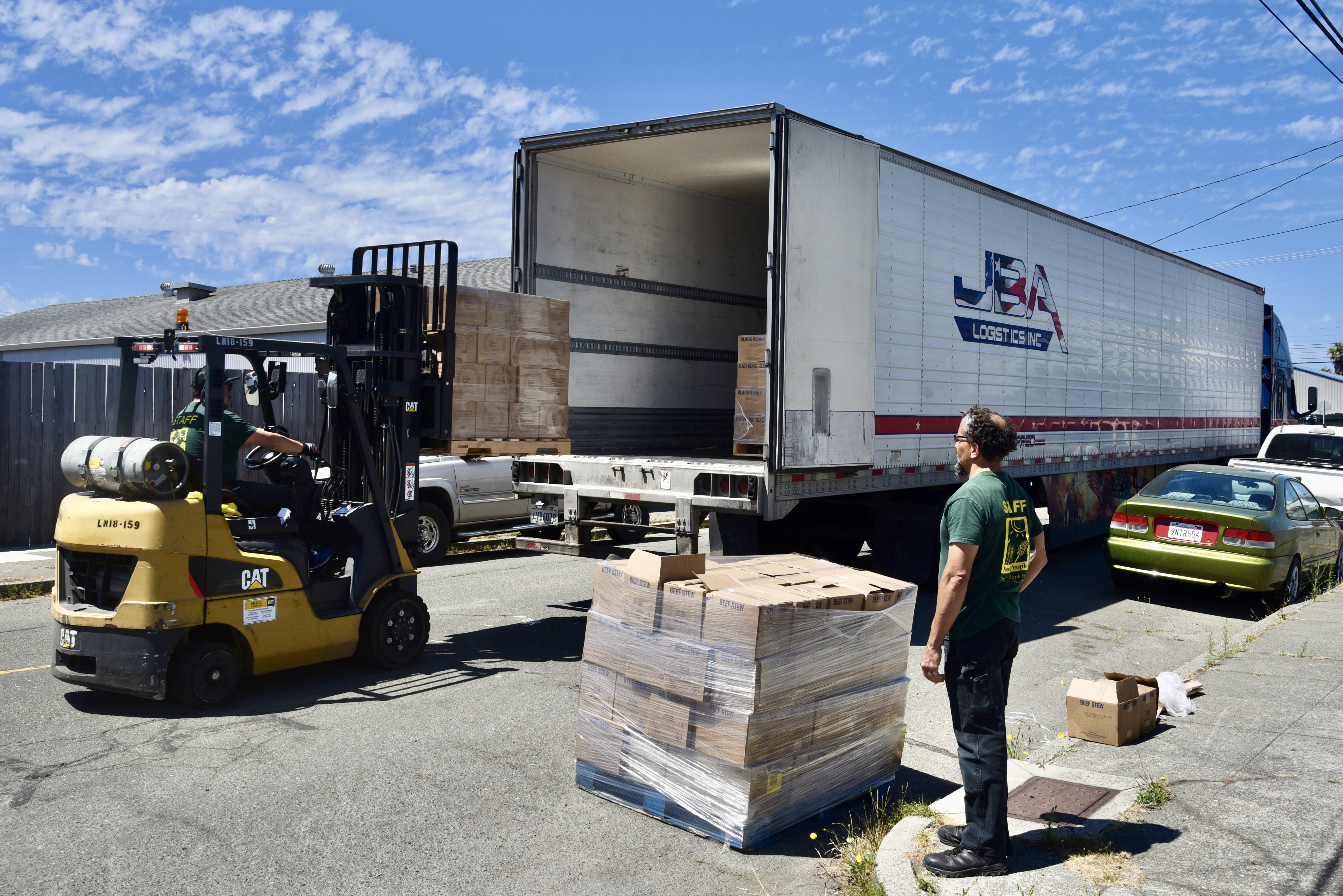
A pallet of peanut butter in boxes gets unloaded from a delivery truck.
It’s Official! Former Eureka City Councilmember Jeff Leonard Qualifies for November Ballot
LoCO Staff / Thursday, July 30 @ 3:08 p.m. / Elections

From left to right: Campaign Manager Cindy Olsen, 5th Ward candidate Jeff Leonard and Assistant City Manager/City Clerk Pam Powell | Photo submitted.
###
PREVIOUSLY: Former Eureka City Councilmember Jeff Leonard Announces Bid for 5th Ward Seat
###
Press statement from 5th Ward Eureka City Council Candidate Jeff Leonard:
Jeff Leonard submitted his nomination paperwork at Eureka City Hall, officially placing him on the ballot for the 5th Ward seat on the Eureka City Council. Leonard previously represented Eureka’s 3rd Ward from 2002 to 2010, serving two successful terms on the city council.
Eureka’s 5th Ward represents the heart of the City, from the Bay to Del Norte Street and C Street to Cooper Gulch. “I love living in Eureka,” Leonard said. “We have such a great community. Innovative. Compassionate. Engaged. Local. I feel lucky to have grown up here.”
As a council member, he helped create the Redwood Coast Energy Authority and was a founding member. He led the Eureka Trails Committee and helped develop the Eureka Waterfront Trail Plan. He served on the Zoo Foundation Board, spearheaded the fundraising and construction of the Eureka Skate Park, and secured grant funding to install new playground equipment at Hammond Park.
Looking forward, Leonard believes improving our quality of life is a critical component to creating positive growth for our local economy. He supports downtown housing that helps increase the customer base for Eureka businesses. “The City is responsible for keeping our streets and public spaces clean and safe. Local businesses will thrive, tourists will visit, if we keep our City safe and clean.”
During his second term, Leonard encouraged the City to sign one of the first contracts with John Shelter and New Directions. The innovative program provided a compassionate approach to addressing encampments behind the Bayshore Mall and the Elk River Wildlife Area.
Today, Leonard supports the programs the City has developed, Uplift, the Community Safety Engagement Team (CSET) and Crisis Alternative Response Eureka (CARE). “I am so impressed with how much the City has accomplished since I served on Council. I look forward to learning more about these programs and meeting the people who work on these teams. Most importantly, I would like to know how I can help support their work. We are a very compassionate community. We’re doing a great job reaching out to members of our community that have been marginalized.”
Leonard also believes the current council majority should reconsider last year’s decision to reject a proposed ordinance that would have upgraded infractions for unauthorized homeless encampments to misdemeanors. The proposed ordinance included a CARE court that would help channel violators to appropriate services.
“We should always offer a helping hand when we see someone in need. Our community also needs to hold people accountable. Community members should feel safe walking in our parks, on the Boardwalk, and the Bay Trail. Public spaces should be clean and accessible.”
“Eureka is already a great place to live, but I believe we can do even more,” Leonard said. “I’m excited to get back to work serving our community. Improving our quality of life – that is job number one for the Eureka City Council”.
Blue Lake Council OKs Step Toward Seizing Water Tank Site
Sage Alexander / Thursday, July 30 @ 1:57 p.m. / Government

The city aims to purchase, through eminent domain, the tank site and associated easements for a water pipeline. | Aerial schematics via City of Blue Lake.
PREVIOUSLY
###
On Tuesday night, the Blue Lake City Council approved a step toward using eminent domain to seize a water tank site.
The move follows years of unsuccessful negotiations with Erin McClure, a beneficiary of the trust that owns the land that city water infrastructure sits on.
The water tank stores 400,000 gallons of water out of Blue Lake’s total capacity of 900,000 gallons, and serves about 750 residents.
The council didn’t discuss the item in full, but voted 4-1 to approve the consent agenda. The action authorized the city manager to contract with a real estate legal firm for appraisal and acquisition for 1.89 acres of land. The council also approved a total of $46,000 for the feat.
Mayor John Sawatzky was hesitant to vote without council discussion. He looked to the other councilmembers to confirm they truly wanted to agree to the move without discussion.
“It’s concerning we’re pushing this through. They are big items we need to have big discussions around,” he said, later voting against the consent agenda.
During public comment, a new wrinkle emerged. There appears to be some conflict between the beneficiaries of the trust. A woman who identified herself as the daughter of the trust’s other beneficiary said she has an attorney working towards dissolving the trust, stating Erin “may not be the executor of the trust much longer.”
According to the city, a previous agreement that would have granted the city an easement to the site ultimately fell through because McClure refused to coordinate the trust’s other beneficiaries to sign their written consent to the agreement, something the city needed for title insurance.
This agreement followed years of negotiations after a century-old lease to use the land expired, and McClure pressed vocally for a new one.
McClure has pushed back against the acquisition by filing a lawsuit for $1.3 million and accused the city of bullying her.
The city has pointed to the need to be able to access the water tank and other infrastructure on site for the municipal water supply and firefighting response.
16-Year-Old Falls Off of Cliff Near Trinidad, Rescued by Coast Guard
LoCO Staff / Thursday, July 30 @ 10:12 a.m. / Ocean

From the Coast Guard.
Press release from the Coast Guard:
A Coast Guard helicopter crew medevaced a 16-year-old girl after she was reported to have fallen 30-40 feet from a cliff near Trinidad, Tuesday afternoon.
At 2:46 p.m., Coast Guard Sector Humboldt Bay watch standers received a request from the California Department of Forestry and Fire Protection to assist in the rescue. An MH-65 Dolphin helicopter crew from Coast Guard Air Station Humboldt Bay was diverted from a training mission to render assistance.
The aircrew arrived on scene and coordinated with ground responders to safely hoist the girl from the cliff. She was then transferred to Providence St. Joseph Hospital Eureka and was reported to be in stable condition.


