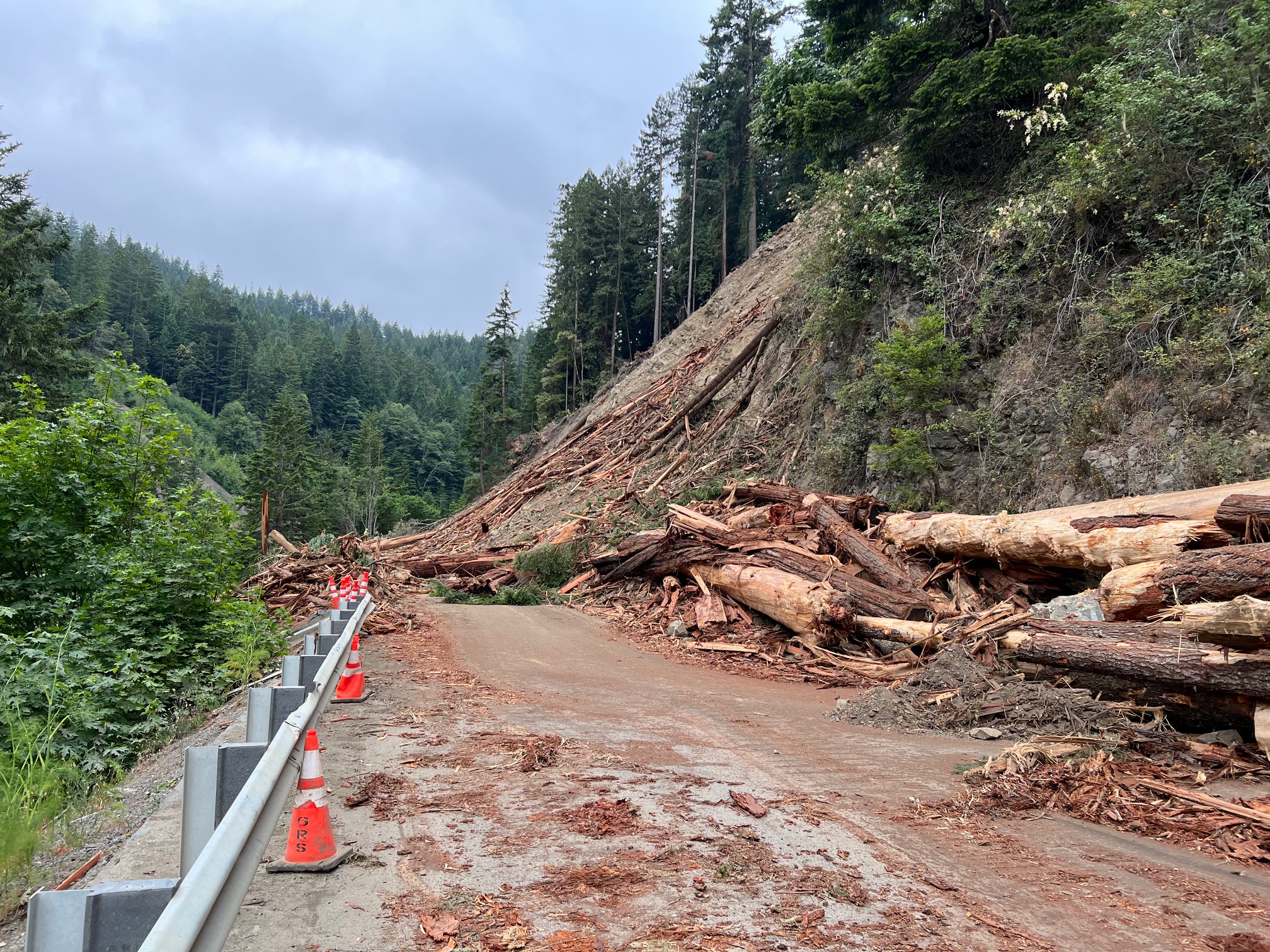
Caltrans Aims to Reopen Highway 36 to One-Way Traffic by Fourth of July Weekend
LoCO Staff / Thursday, June 26, 2025 @ 9:11 a.m. / Traffic

What a mess! | Photos: Caltrans District 1
###
Highway 36 update from Caltrans:
Efforts continue to stabilize and clear the large landslide that has fully closed Route 36 east of Swimmer’s Delight near Grizzly Creek Redwoods State Park. This stretch of road will not reopen this weekend as anticipated. We aim to resume one-way traffic by the holiday weekend, but that timeline could shift based on additional assessments. We’ll provide updates as soon we have them.
So far, roughly 100 hazardous trees have been removed, but many more remain. Much of this additional work must be done with the help of a helicopter, which is currently scheduled for Monday. While helicopter availability has proven difficult during fire season, we are working to accelerate that schedule if possible. In addition to this work, helicopter-based LiDAR scanning is still planned to collect high-resolution topographic data that will inform a long-term slope repair later this summer. Once crews complete their efforts to safely remove hazards within the active slide zone, the focus will shift to building a catchment area and a temporary traffic lane slightly shifted away from the hillside.
We are committed to restoring safe, reliable travel on Route 36 and appreciate the public’s continued patience. Route 299 remains the only detour on the state highway system.
Check out the Caltrans QuickMap for more information.


BOOKED
Yesterday: 10 felonies, 12 misdemeanors, 0 infractions
JUDGED
Humboldt County Superior Court Calendar: Today
CHP REPORTS
852 MM199 S DN 8.50 (HM office): Trfc Collision-No Inj
Poppy Dr / Sherwood Rd (HM office): Closure of a Road
ELSEWHERE
Mad River Union: Arcata’s petite data center only the first
Mad River Union: Whistleblower calls for Miranda’s Rescue end
Mad River Union: EV infrastucture needs in rural areas reviewed
Mad River Union: $600K grant for Jolly Giant, Butcher’s Slough resilience
These 4 Million Acres of California Forests Could Lose Protection. Here’s What Trump’s ‘Roadless Rule’ Repeal Could Do
Rachel Becker / Thursday, June 26, 2025 @ 8:24 a.m. / Sacramento

Tahoe National Forest is one of the national forests in California that has acreage protected by the federal roadless rule. Photo by Miguel Gutierrez Jr., CalMatters
The Trump administration’s plan to repeal a rule prohibiting logging and road construction in undeveloped parts of national forests would strip protection from more than 4 million acres within California’s borders.
U.S. Secretary of Agriculture Brooke Rollins announced on Monday that she will act to rescind the “roadless rule,” developed during the Clinton administration, to allow “for fire prevention and responsible timber production” on more than 58 million acres of national forests.
But experts are divided about whether allowing road development and timber harvest in national forests will help prevent wildfires. Though roads can aid in firefighting and fuel reduction and serve as fire breaks, roads can also mean more people — and people mean more sparks that can ignite wildfires. And some experts say timber harvests do little to reduce fire severity because it can promote growth of more flammable fuels in forests.
California has more national forest acreage than any state other than Alaska. At stake are the roadless reaches of wild areas throughout the state: From dense coastal forests in the far north, to alpine conifer forests in the Sierra Nevada, to Southern California’s great expanses of brush in the Cleveland, San Bernardino and Angeles national forests.
The Department of Agriculture has not said how it plans to rescind the rule, and how long the effort is expected to take. Reversing federal rules usually is a long process, requiring publication in the Federal Register and a long public comment period. The agriculture department did not respond to an inquiry from CalMatters.
 California has more national forest acreage than any other state on the mainland. This map shows the roadless areas within those forests. Map via US Forest Service.
Most U.S. Forest Service land — about 69% or more than 135 million acres nationwide — isn’t covered by the rule’s protections against roads and timber cutting. In California, about 21% of its 21 million acres of national forest — 4.4 million acres — are considered roadless, ranking behind Alaska, Idaho and Montana.
These roadless areas are considered important for providing habitat for more than 200 threatened or endangered species of wildlife, including owls, salmon and frogs, and for protecting vital watersheds.
The Trump administration says revoking the rule is a “common-sense” way to help local officials protect communities from wildfires.
“Of the 58.5 million acres of inventoried roadless areas covered under the 2001 Roadless Rule, 28 million acres are in areas at high or very high risk of wildfire. Rescinding this rule will allow this land to be managed at the local forest level, with more flexibility to take swift action to reduce wildfire risk and help protect surrounding communities and infrastructure,” according to the agriculture department’s statement.
Conservationists call this a ploy to further unfetter logging by an administration that called for an “immediate expansion of American timber production” and ordered drastic cuts to the very agencies that study and fight fires.
“This move is the most irresponsible, because opening up these forests to logging roads and logging is going to degrade them. It’ll actually increase wildfire risks. It’ll harm numerous species and harm watersheds,” said Randi Spivak, public lands policy director at the Center for Biological Diversity. “It’s just a big handout to timber companies.”
Sharon Friedman, a U.S. Forest Service retiree who was a planning director in the Rocky Mountain region and worked on Colorado’s state-specific roadless rule, said she could see why the announcement caused consternation, but she expects that any outcomes that survive in court will likely be long-delayed and less severe than feared. Roadways for fuel management are often temporary and, if done correctly, should bar entry to the public, she said.
She also said she doesn’t expect that it would lead to a boom on logging in roadless areas. “It’s not like people are going to suddenly discover that, in these areas without roads, there’s a lot of desirable timber — because if it had been there, people would have gotten to it in the first place,” she said.
California officials aren’t ready to say what it means for the state.
David Acuña, a Cal Fire battalion chief and public information officer, said “we are simply going to respond if we’re called. Other than that, it is how they choose to handle their roads and/or fire management.”“Picture somebody attempting to redo your personal living room in your home. It would be inappropriate. In the same way, we are not going to attempt to navigate what a partner agency, a neighboring agency, does,” Acuña said.Tony Andersen, a spokesperson for the California Natural Resources Agency, said the agency is reviewing what rescinding the rule would mean for California. He would not provide further comment.
 A trail through the redwood forest in Humboldt County. Photo by Larry Valenzuela, CalMatters/CatchLight Local
Dusty LaChapelle, an engineer with the Lake Valley Fire Protection District, which protects unincorporated communities near Lake Tahoe surrounded by national forestland, said his department already can access remote areas in the South Tahoe basin, including with helicopters and fixed-wing aircraft.“We can get a hold of a lot of the fires already without having to build more roads,” LaChapelle said. “Personally, that’d be hard for me to justify going in there to punch in more roads for the possibility of a fire happening there.” Many of the fires his department fights are caused by people — often, a campfire.Multiple studies have found that roads actually seem to concentrate the risk of wildfires — increasing it up to four-fold in forest areas with roads compared to those without, according to an analysis by the Wilderness Society. And the fires that people spark tend to spread faster and kill more trees.
LaChapelle said he could see the benefit of removing dead and diseased trees, including those damaged by bark beetle infestations. But, he said, “there’s fuels reduction, and there’s logging. If you get in there and thin out some of the forest, then that’s certainly beneficial. But clear cutting — yeah, it will reduce fire risk, because there’s not going to be any trees to burn.” Matt Dias, president and CEO of the California Forestry Association, said the timber industry supports the repeal. Dias has previously called for more funding for fuel breaks to combat wildfires, and said that the roadless rule is part of a landscape of environmental rules and regulations that limit forest management. Still, Dias said, “the roadless rules in California, as far as I know, were not a significant impediment.” He said “most of the areas” where the timber industry is working with the Forest Service on fire management “are not in areas that would be considered roadless.” The roadless rule already allows for roads to be constructed or reconstructed to protect health and safety when threatened by wildfire. And it allows for smaller diameter timber to be removed to improve habitat and reduce the risk of severe wildfires.
The Karuk Tribe, which has ancestral lands in Klamath and Six Rivers national forests, also supports rescinding the rule. Tribe Chairman Russell “Buster” Attebery said burned, downed and hazardous trees should be removed. “There’s a sustainable economy out there — and those logs need to go somewhere,” Attebery said. “We believe that rescinding the roadless rule will be a good thing, but it needs to have tribal input.” Attebery and his father worked in the timber industry for decades. It was an economic driver for the region, but also a source of environmental damage. “They had one thing on their mind. They didn’t care whether they covered over the creeks and streams that fed the rivers. They didn’t care if they blocked them or muddied them,” Attebery said. “You have to put ecology first, and then the economy will follow.”
U.S. Rep. Jared Huffman, a Democrat representing Northern California coastal communities and parts of Trinity and Six Rivers national forests, said the revision would threaten watersheds that provide clean drinking water, the rights of tribes and local communities, and the power of forests to hold onto climate-warming carbon.
It “puts millions of acres of forests on the chopping block to serve (President Donald Trump’s) billionaire cronies in the mining and logging industries.”
But U.S. Rep Doug LaMalfa, a Republican whose district includes Modoc and Klamath national forests, said in a statement that the roadless rule has “done more harm than good in the West” and repealing it is “a major step toward restoring common-sense forest management.”
Even as the Trump administration pushes for more logging, its tariff policy has “created anxiety and uncertainty” for the timber and forest products industry, according to one financial analysis. In California, wildfires, high costs, low income and reduced use of wood products are destabilizing the industry, which saw a 25% drop in softwood sawmill capacity in recent years.
###
This story was originally published by CalMatters. Sign up for their newsletters.
Newsom and Legislature Tangle With Construction Unions Over Minimum Wage
Ben Christopher / Thursday, June 26, 2025 @ 8:11 a.m. / Sacramento

Construction workers building an apartment complex site for an affordable housing project in Bakersfield on May 29, 2024. Photo by Larry Valenzuela, CalMatters/CatchLight Local
California lawmakers are on the cusp of striking a last-minute deal to tie one of the year’s most ambitious and controversial housing bills to a new set of minimum wages for housing construction workers — a proposal that has thrown a wrench into budget negotiations just days before the deadline.
The new legislative language, buried in a sprawling budget bill put into print on Tuesday, represents a grand political bargain between pro-development advocates and the state’s carpenters union. Supporters say the new arrangement could reshape the way that future California housing legislation is written and negotiated.
There is intense opposition from other building trades unions, which are among the most powerful interest groups at the state Capitol and whose leaders argue that the bill would undercut hard-fought pay standards. That’s made for a high-stakes showdown as Gov. Gavin Newsom demands major changes to streamline housing construction as part of the budget.
The new wage rates are a major pivot in a debate that has dominated the legislative politics of housing in California for at least a decade. Past bills aimed at making it easier to build new homes have offered a trade: Ease regulations on approvals, permits and environmental regulations in exchange for, among other things, higher guaranteed pay for construction workers. The standard wage rate in those debates have been the “prevailing wages” — state-determined wages that vary by occupation and location that generally work out to what unionized workers earn.
These new proposed rates are significantly lower and are designed to serve as a more development-friendly alternative. They would apply only in cases where developers opt to use a new proposed exception to California’s premier environmental impact law, the California Environmental Quality Act. The vast majority of those projects, small-scale residential construction projects, are not currently covered by prevailing wage.
That’s why supporters of the deal are arguing that the new standards represent a wage increase.
Residential construction is “a virtually non-union industry,” said Danny Curtin, who heads the California Conference of Carpenters. “You have the ability to give those people a substantial — a modest, but substantial and important — raise.”
Even so, the pushback from other construction labor groups has been fierce.
The State Building and Construction Trades Council, a construction union umbrella group that regularly clashes with the carpenters union on labor issues, excoriated the proposal in a letter to legislative leadership yesterday.
“This proposal is a wage grab of construction workers’ wages disguised in an ‘affordable housing bill,’” the letter by council president Chris Hannan said. “We urge you to abandon any pursuit of this harmful and unprecedented proposal, which would devastate construction workers.”
Lawmakers also appeared caught off guard by the proposal at an Assembly budget hearing on Wednesday packed with union advocates.
“I didn’t come to Sacramento to cut people’s wages,” said Assemblymember Chris Rogers, a Ukiah Democrat. “I didn’t sit through months of budget committee hearings talking about how to preserve our social safety net to then, at the 11th hour, potentially kick more people onto it.”
Assemblymember Lashae Sharp Collins, a Democrat from La Mesa, called the fact that the building trades reportedly weren’t consulted “appalling.”
The new wage proposal received a similarly icy reception from many Democrats in the Senate, which also held a budget hearing on Wednesday.
“You’re presenting something at the last minute, I don’t know who you consulted with, and you reached this conclusion to completely change the structure for the way that workers in the construction industry would be paid,” said Sen. Maria Elena Durazo, a Los Angeles Democrat and a reliable ally of the trades.
The bill was scheduled to be voted on Friday. In the face of furious pushback a budget committee hearing vote in the Senate was delayed on Wednesday, making the timing of its final vote uncertain.
Though the last-minute addition of contentious labor language threatens to divide legislative Democrats, the party holds two-thirds of the seats in both legislative chambers, giving the budget bill ample opportunities to pass even with significant defections.
A debate months in the making
This new proposal is the latest addition to a policy idea introduced in March by Oakland Democratic Assemblymember Buffy Wicks. The bill would exempt most new apartment buildings in urban areas from CEQA, the environmental law.
The 55-year-old law is the frequent target of lawmakers and pro-housing advocates who argue that it can be weaponized to slow or impede desperately needed new housing and other projects. Many environmental advocacy groups and organized labor groups defend the law as an important check on unwanted or environmentally harmful development.
Wicks’ idea got a helpful boost last month when Newsom opted to fold it into his proposed budget for the coming year, putting it on a speedier and surer path to becoming law. He has since threatened to withhold his signature from the budget if legislators do not approve the sweeping housing measures, some of which are still being negotiated.
A key part of that budget package — what’s called a trailer bill — is before the Legislature now. The bill includes Wicks’ exemption tied to the new labor language, along with key components of other housing bills, including a proposed freeze on building code changes, limits on the fees that landlords can charge tenants and an expanded tax credits for renters.
Assemblymember Nick Schultz, the Burbank Democrat who authored the building code freeze bill, noted that he wasn’t informed by the governor’s office or Assembly leadership that his proposal was being tucked into the budget bill. He said he found out from an advocacy group.
By setting wages far below the “prevailing wage” rates required by law for publicly funded projects — and frequently demanded by construction unions for their support for housing bills — it is meant to offer a more financially feasible alternative, while still boosting the pay of workers at the lowest end of the labor market.

In Oakland, for example, a carpenter making the state-set “prevailing wage” for a residential project earns at least $99 per hour including benefits.
The new minimum wages would only require that the majority of construction workers across the Bay Area covered under the policy be paid at least $40 an hour. Less skilled or experienced workers would require at least $27 per hour. Smaller housing projects of 25 units or fewer would be exempt entirely.
The budget bill also includes language that would give unions the right to take contractors to court for workers compensation, insurance and payroll tax violations.
“Yes in my backyard” advocates that have historically looked askance at prevailing wage requirements are celebrating the new deal.
“This is one of the biggest wins for housing in a generation,” California YIMBY president Brian Hanlon said in a statement. “Building infill housing is not a threat to the environment — it’s how we save it.”
Carpenters and YIMBYs collaborate again
Though new wage rates only apply to Wicks’ urban infill exemption, hammering out a deal with a major labor group allowing for pay significantly below prevailing wage would spell a significant shift in California labor policy.
This isn’t the first time the state’s carpenters union has cut a high-profile deal to push a major YIMBY-backed housing bill across the legislative finish line.
In 2022, Wicks’ bill to fast-track apartment construction along stripmall corridors earned the endorsement of the carpenters after she added a prevailing wage requirement, along with some other benefits.
At the time that was considered a political concession. For years the state’s other major construction worker union group, the Trades Council, had made the inclusion of so-called skilled-and-trained standards — essentially, a requirement to hire predominantly unionized workers — the price of their support for housing bills.
Learn more about legislators mentioned in this story.
María Elena Durazo
Democrat, State Senate, District 26 (Los Angeles)
Chris Rogers
Democrat, State Assembly, District 2 (Ukiah)
Buffy Wicks
Democrat, State Assembly, District 14 (Oakland)
Nick Schultz
Democrat, State Assembly, District 44 (Burbank)
LaShae Sharp-Collins
Democrat, State Assembly, District 79 (La Mesa)
In breaking with the trades, the carpenters have long argued that clearing the way for the construction of more housing, even at the expense of higher mandatory wages, represents an “organizing opportunity” for the union.
After Wicks’ bill passed over the Trades Council’s strenuous objection, other pro-development lawmakers came to see that deal as something they could effectively copy and paste into their housing legislation, all but guaranteeing the support of an unlikely coalition of developers, union workers and YIMBY activists.
Even so, many developers continue to argue that prevailing wage rates are still too costly to make construction pencil out beyond the state’s priciest metro areas, making those prior housing bills ineffective at actually producing more housing.
Supporters of this new deal say the lower wage standard could be the next go-to legislative language for future housing bills.
“This bill is a big step forward and an important test of whether the ‘YIMBY-Carpenter alliance’ can enact housing bills that generate housing production at scale,” UC Davis law professor Chris Elmendorf wrote on X.
###
Alexei Koseff contributed reporting to this story. This story was originally published by CalMatters. Sign up for their newsletters.
Are Humboldt’s Ma-le’l Dunes Still at Risk Despite Changes to Federal Land-Sale Bill?
Isabella Vanderheiden / Wednesday, June 25, 2025 @ 3:40 p.m. / Environment

The Ma-le’l Dunes is just one of several locations in Humboldt County “eligible for sale” under the public lands sell-off. | Photo: Jen Kalt - Humboldt Waterkeeper
###
UPDATE: Sen. Mike Lee introduced a revised version of the bill — linked here — shortly after our story was published. While the updated version does not include public lands managed by the U.S. Forest Service, it still calls for the mandatory sale of up to 0.5 percent, estimated at 1.2 million acres, of Bureau of Land Management lands located within five miles of a “population center.”
###
Original post: For a couple of weeks now, social media feeds have been clogged with news of a Republican-sponsored plan to sell off millions of acres of public lands across Western states, including protected areas along the North Coast, a plan that, for the moment at least, is dead.
The controversial proposal, introduced by Utah Sen. Mike Lee, sought to mandate the sale of more than 3,200 square miles of federal lands managed by the Bureau of Land Management and U.S. Forest Service to accommodate new housing and infrastructure developments. The mandate was ruled out of the GOP’s tax and spending bill on Monday after the Senate parliamentarian determined it would violate the chamber’s rules. Lee has vowed to revise and reintroduce the bill.
The plan has sparked concern among local conservationists who fear the mandate would result in the forced sale of public lands here in Humboldt, including the North and South Spits of Humboldt Bay, a piece of the Ma-le’l Dunes, portions of the King Range and large swaths of the Six Rivers, Klamath and Trinity National Forests, among others.

A map showing public lands eligible for sale in Humboldt. To zoom in, go here.
An interactive map published by the Wilderness Society indicates that over 250 million acres of public lands — including 16 million acres in California — “are eligible for sale” under the current version of the bill.
In a recent interview with the Outpost, Rep. Jared Huffman emphasized the distinction between eligible and mandatory sales. “I think it’s important to distinguish lands that would be eligible and lands where sales would be mandated,” he said. “My understanding in reading Sen. Lee’s bill is that there would be a requirement that at least three million acres would have to be offered up for sale, but they could go up to the full amount of 250 million eligible acres. That is theoretically possible in the way this bill is written.”
Still, there’s no telling where those sales are going to happen, Huffman said. “The mandatory sale of those three million acres … would be somewhere on this map depicting 250 million acres of eligible land, but we don’t know where.”
Lee took to social media on Monday night to announce his intent to “SIGNIFICANTLY REDUCE the amount of BLM land in the bill,” noting that “only land WITHIN 5 MILES of population centers” would be eligible for sale. He added that he would “REMOVE ALL Forest Service” land from the plan.
So, if the bill were amended to exclude Forest Service land and focus only on public lands near population centers, what would that mean for those protected areas along the Samoa Peninsula?
Reached for additional comment, Tom Wheeler, executive director of the Environmental Protection Information Center (EPIC), emphasized that Lee’s amended proposal still poses a “credible threat.”
“The North Spit, for example, is adjacent to existing communities and its coastal property in California. It’s not beyond the bounds of reasonable imagination that someone would want to see some development there,” Wheeler said. “Could the Ma-le’l Dunes be turned into a housing development? I don’t know. There would be obstacles — including the California Coastal Commission, Humboldt County’s land use ordinances and local opposition — but it could be sold to somebody who has a couple of million dollars and wants to try to do another Sea Ranch.”
However, Huffman said he wasn’t so sure that there would be obstacles to a federal public lands sell-off, noting that the Trump Administration has been “chopping away” at the National Environmental Policy Act (NEPA) and other federal conservation laws. “If some of these lands ended up making the cut and were put up for sale, I don’t know that there would be a lot of public process and safeguards to control what happens,” he said.
Huffman noted that the proposal has lost traction among Western Republicans facing pressure from hunters and fishermen.
“This is not something the American people want to see,” Huffman continued. “It’s not something that communities that care about these public lands want to see, certainly not the people who care about recreation. The hunters and fishermen? They don’t want to see this. This is coming from a few ideological extremists in Congress who are taking this vulture capitalist approach to our natural resources, where you just try to monetize, liquidate and create fast cash.”
While the public lands sell-off no longer presents an immediate threat, Huffman warned that the “zombie” bill “won’t be fully dead until Democrats have a majority and can enact some permanent protections for some of these places.”
“In the meantime, I think we have to sleep with one eye open,” he said.
HOT, HOT, HOT! It’s Going to Be Scorchin’ Inland This Weekend
Andrew Goff / Wednesday, June 25, 2025 @ 12:48 p.m. / How ‘Bout That Weather

As we near the end of June, inland temperatures in Humboldt, Del Norte, Trinity and Mendocino counties are projected to soar into the triple digits by the end of this coming weekend.
This is the prediction of the National Weather Service, who warn the public to guard themselves against potential heat-related calamities.
“Drink plenty of water, wear light-colored clothing, take frequent breaks in the shade and use sunscreen with a Sun Protection Factor (SPF) of 30 or higher to protect your skin from UV rays,” NWS says.
Find a list of projected temperatures and health advice below:


Dogs Are No Longer Allowed at Eureka’s Friday Night Markets and Fourth of July Festival
LoCO Staff / Wednesday, June 25, 2025 @ 9:59 a.m. / Local Government

###
Press release from the City of Eureka
The City of Eureka, in collaboration with Eureka Main Street, Humboldt Made, and the Eureka Police Department, is announcing that dogs will no longer be allowed at this year’s Friday Night Markets or the 4th of July Festival and Fireworks.
The decision follows record-breaking attendance in recent years, with over 13,000 people joining last year’s 4th of July festivities and more than 7,000 attendees at recent Friday Night Markets. While these events are a celebrated part of summer in Eureka, the large crowds have led to an increase in dog-related incidents — resulting in injuries to both pets and people.
“This policy is focused on safety and prevention,” said Eureka Police Chief Brian Stephens. “With large crowds, loud noises, and fireworks, these events can be extremely stressful for dogs. It’s just not a safe setting. We’re asking the community to help us protect both pets and people by keeping dogs at home.”
Clear signage will be displayed at event entrances, and reminders will be shared across social media leading up to each event. The City asks for the community’s support in helping create a safer, more enjoyable environment for all attendees.
For more information about these events, including schedules, entertainment, and vendor lineups, please visit and follow:
- Eureka Main Street – eurekamainstreet.org and @EurekaMainStreet on social media
- Humboldt Made – humboldtmade.com and @FridayNightMarket and @HumboldtMade on social media
For questions about the dog policy, please contact the City Clerk’s Office at cityclerk@eurekaca.gov.
They Were Convicted of Killing With Their Cars. No One Told the California DMV.
Lauren Hepler and Robert Lewis / Wednesday, June 25, 2025 @ 6:30 a.m. / Sacramento

Joseph Ramirez’s gravesite in Eternal Valley Memorial Park; Ramirez was killed by vehicular manslaughter in 2023, but the Los Angeles Superior Court didn’t report the conviction to the DMV until almost a year later. Photo by Jules Hotz for CalMatters.
###
A CalMatters investigation found that courts didn’t report hundreds of vehicular manslaughter convictions to the DMV, prompting officials to belatedly take many drivers’ licenses.
This story was originally published by CalMatters. Sign up for their newsletters.
###
California courts have failed to report hundreds of vehicular manslaughter convictions to the state’s Department of Motor Vehicles over the past five years, allowing roadway killers to improperly keep their driver’s licenses, a CalMatters investigation has found.
Marvin Salazar was convicted in May 2023 for killing his 18-year-old friend Joseph Ramirez, who was in the passenger seat when Salazar gunned his car, lost control and slammed into a tree, court records show. Under California law, the state should have taken away Salazar’s driving privileges for at least three years.
But the Los Angeles County Superior Court didn’t report the conviction to the DMV. Two months later, the agency issued Salazar his most recent license. Since then, he’s gotten two speeding tickets and has been in another collision, records show.
“How can he keep driving?” said Gaudy Lemus, Ramirez’s mother. “We wanted consequences for him. Remove his driver’s license.”
LA court officials belatedly reported the manslaughter conviction to the DMV last month, after CalMatters discovered the failure and asked about the case. It was only then that the state sent Salazar a notice revoking his driving privileges, records show.

A Scannable LivingTag QR code and a bird-shaped candle on Joseph Ramirez’s headstone in Eternal Valley Memorial Park in Newhall, on June 17, 2025. Photo by Jules Hotz for CalMatters.
###
CalMatters uncovered the error and others like it by cross-checking convictions in vehicular manslaughter cases against motorists’ DMV records, as part of an ongoing investigation. Earlier this year, we reported that the agency routinely allows drivers with horrifying histories of dangerous driving — including fatal crashes, DUIs and numerous tickets — to continue to operate on our roadways.
But this isn’t just a DMV issue. Reporters identified about 400 cases from 2019 to 2024 in which the drivers’ convictions weren’t listed on their driving records, largely because the courts failed to report that information. The review wasn’t comprehensive; records were unavailable or incomplete in a number of counties.
In Los Angeles, about one-third of all convictions in manslaughter cases we identified were missing from drivers’ records. In Santa Clara County, it was half. We found no missing convictions in Orange County.
In response to our questions, 32 county courts so far have reported more than 275 missing convictions to the DMV. As a result, nearly 200 drivers who’ve killed have had their driving privileges suspended or revoked, updated DMV reports for these drivers show. While some already had a separate license suspension, 70 appear to have had a valid license before the agency took action in response to our reporting.
County courts, law enforcement and the DMV have a long history of poor communication that dates to the days of paper records. Today, court administrators blame the breakdowns on a mix of human error and technological bugs.
Chris Orrock, a spokesperson for the DMV, said the agency sends out revocation and suspension notices “as soon as we’re notified.”
Even without a conviction, the DMV does have the discretion to strip a driver of their license for a fatal crash. We reported earlier this year that the agency often doesn’t use that power.
But in many cases, there is no discretion. State law, for example, requires the agency to revoke a driver’s license for at least three years after a felony vehicular manslaughter conviction.
As a result of the delayed reporting by the courts, some drivers could end up losing their licenses for far less than three years. That’s because the DMV typically enforces the sanction from the date of the conviction, not the date the court communicates it to the agency.
Salazar’s current driving record shows him eligible to reapply for a license next spring — three years after his conviction but just a year after records show the state took action to revoke his driving privileges.
His attorney declined to comment on his driving record but said Salazar did everything the court required.
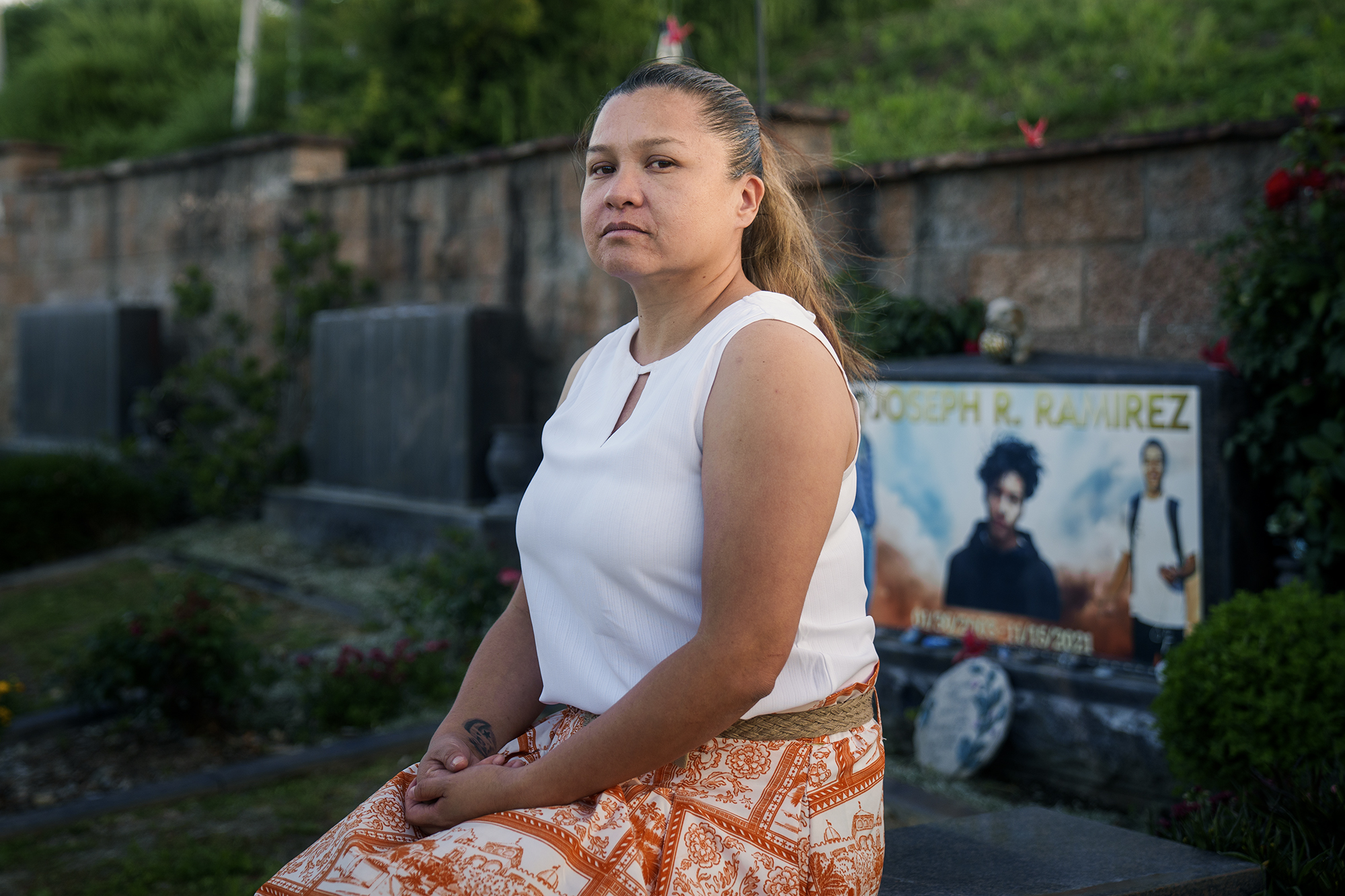
Gaudy Lemus, mother of Joseph Ramirez, visits his grave at Eternal Valley Memorial Park in Newhall on June 17, 2025. Photo by Jules Hotz for CalMatters.
###
For Lemus, the months after her son died in Salazar’s car were a blur. The loss was haunting, coming just as the teenager had decided to pursue a career building tiny homes for the homeless.
She started having such bad panic attacks that she moved to a new city and switched jobs, unable to bear the drive to work through the intersection where the crash occurred. Her 25-year-old daughter still refuses to drive at all.
Lemus said she didn’t initially want Salazar to go to prison, “because it was an accident.” Now, she wonders whether that was a mistake.
“I don’t want another family to go through whatever we went through,” Lemus said.
A series of errors leads to reporting failures
State law has long required courts to report vehicle-related convictions to the DMV, including for speeding, DUI and vehicular manslaughter. The agency then puts the violations on a motorist’s driving record and, if necessary, suspends their license.
Last month, CalMatters reporters sent hundreds of names and case numbers to dozens of courts throughout the state and asked why convictions from vehicular manslaughter cases didn’t appear on drivers’ records. Most courts responded to questions quickly, thanked us for telling them, acknowledged the mistake and indicated that they would report the convictions to the DMV.
“They were errors on our part. I’m not going to sugarcoat it,” said Tara Leal, the court executive officer in Kern County, where we found 22 missing convictions.
In many counties, court staff simply neglected to send the information to the DMV.
Court clerks typically enter convictions into a case management system. Many courts use a system that has a tab for them to click on to transmit the information to the DMV.
Vehicle code violations like speeding tickets and DUIs clearly need to go to the DMV, court officials said. But most penal code violations, including offenses like robbery and assault, do not. Vehicular manslaughter is a penal code violation.
Heather Pugh, the Yuba County Superior Court executive officer, confirmed that her court should have reported conviction information to the DMV for eight cases CalMatters flagged. “To address that, we will reach out to the DMV to provide training to our staff on reporting requirements,” she said. “Additionally, we have instituted manual reviews of reportable non-vehicle code convictions to ensure they have been properly reported.”
Similarly, Fresno County’s director of court operations, Vidal Fernandez, acknowledged “the element of human error” in his court not reporting a half-dozen convictions in recent years. After realizing the problem, he said, staff checked further back, to 2015, identified an additional 17 cases and sent those convictions to the DMV as well.
Other counties have their computers essentially programmed to send conviction information to the DMV when clerks update the disposition information on a case, in theory taking human error out of the equation. But in response to questions from CalMatters, some administrators discovered that the programs were missing certain codes and had failed to function as intended.
“Ultimately it’s our responsibility,” said Jake Chatters, the court executive officer in Placer County, where a coding issue kept the court’s system from reporting two manslaughter cases.
In other courts, convictions were apparently reported, but there was some mistake in the information sent — like an incorrect birth date or a missing digit in a license number — and the DMV kicked the report back with an error message. Administrators said clerks are supposed to fix any errors and resubmit the information to the DMV, but in some cases that didn’t happen.
The result of the patchwork process is that even convictions from some of the most high-profile traffic deaths in recent years were missing from drivers’ records.
A deadly street race that grabbed international attention
Ricardo Aguilar was racing his Dodge Challenger Hellcat in South Los Angeles one December afternoon in 2021, according to the Los Angeles Times, when he struck and killed a pedestrian — Arian Rahbar, a 21-year-old USC student and aspiring medical researcher.
Rahbar’s father, Sam, summarized the void left by his only child. “Without Arian, life as we know it has ceased to exist,” he told a judge.
The story made global headlines amid a spike in traffic deaths in Los Angeles and other California cities. Aguilar was convicted of felony vehicular manslaughter in 2023, court records show. But until a few weeks ago, that was never reflected in his state driving record.
In the section of his DMV report where collisions and traffic violations are supposed to show up, there was instead this message: “NONE TO REPORT.
His driver’s license was still listed as valid.
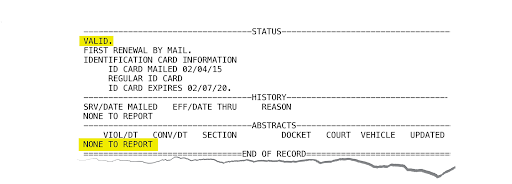
A digital copy of a California Department of Motor Vehicles driver record for Ricardo Aguilar. His status is marked “VALID,” with no violations or convictions reported. Image via The California Department of Motor Vehicles.
###
It was only in May, after CalMatters asked the LA court for an explanation, that officials reported his and more than 100 other convictions to the DMV as required. Aguilar’s license is now listed as revoked.
Aguilar’s attorney did not respond to requests for comment.
Rahbar’s friend and former high school tennis teammate Ashwin Yedavalli was saddened and frustrated all over again to learn about the court error that allowed Rahbar’s killer to keep his license.
Yedavalli, now 25, lives in Long Beach and still stops by the crash scene when he’s nearby. He helped organize a tennis tournament in his friend’s memory, and he said it’s unfair that the legal system failed to deliver on fundamental consequences for his death.
“It’s basically been brushed off,” Yedavalli said. “What about Arian’s life and legacy?”
A decades-long failure to communicate
This is not a new problem.
In the early 1990s, the California DMV was so concerned about getting timely and accurate reports from courts and law enforcement that it produced an educational video called “The Traffic Citation Trail.”
Frank Zolin, the agency’s director at the time, sat behind a desk wearing a crisp suit and chunky glasses, his silver hair swept to the side, to deliver the film’s key message: “We cannot achieve traffic safety without effective teamwork between local law enforcement, the courts and DMV.”
The film goes on to tell the fictionalized story of a reckless young driver who is able to avoid a license suspension because a ticket wasn’t reported to the DMV. In an early scene, the young man rushes to the mailbox to intercept a letter from the agency before his parents can see it.
“They told me four tickets means bye-bye license. There’s only three tickets here,” the driver says in surprise as he reads a warning letter from the state. “The one I got more than a month ago isn’t even here. … It’s party time tonight.”
In a tragic, real-life twist, the actor who played the motorist was killed by a drunken driver more than a decade later. And communication continued to be an issue.
###
Robert Bullock worked at the DMV for more than three decades. In that time, he said, drivers would sometimes come in wanting to know whether they could renew their license, despite a conviction.
“We’d pull up the record and it wasn’t there,” said Bullock, who retired in 2019. He said he would tell them, “The court has screwed up, and you kind of got a freebie.”
Technology has, of course, improved from the era of grainy ’90s videos. Back then, police drove boxy sedans and held walkie-talkies the size of bricks. DMV clerks picked through mounds of paper forms, copying information into clunky gray computers with white text on black screens.
Today, at courthouses equipped with online records and modern digital tools, some administrators said they’re upgrading to a new case management system that should ensure conviction reporting is automated. Others said they’re going to do more training and manual checks to make sure the information is sent to the DMV.
In Los Angeles — one of the nation’s biggest county court systems, where we sent a list of 150 convictions that appeared to be missing from driver records — administrators declined an interview request. Instead, they emailed a statement from Rob Oftring, the court’s chief communications and external affairs officer:
“The Court continues to work expeditiously to identify ways to ensure the successful electronic transmittal of all abstract of judgments to the DMV from its case management systems. This includes additional manual checks to identify in advance technical issues that prevent an abstract from being sent to the DMV. This also includes ensuring all criminal courthouse locations timely process their queues for transmittal and additional mandatory training for court staff.”
A trail of disappointment
For someone like Angie Brey, who’s had to confront a system that often treats deadly crashes as accidents rather than crimes, the promises of change sound hollow.
She lost her partner and the father of her son, Gregory Turnage, on Mother’s Day in 2021. That’s when wealth manager Timothy Hamano drove onto a sidewalk and hit the 41-year-old Turnage, according to records prosecutors filed in court. Hamano had been drinking beer on the golf course and a bloody mary at lunch in San Francisco before the crash, his wife later told police.
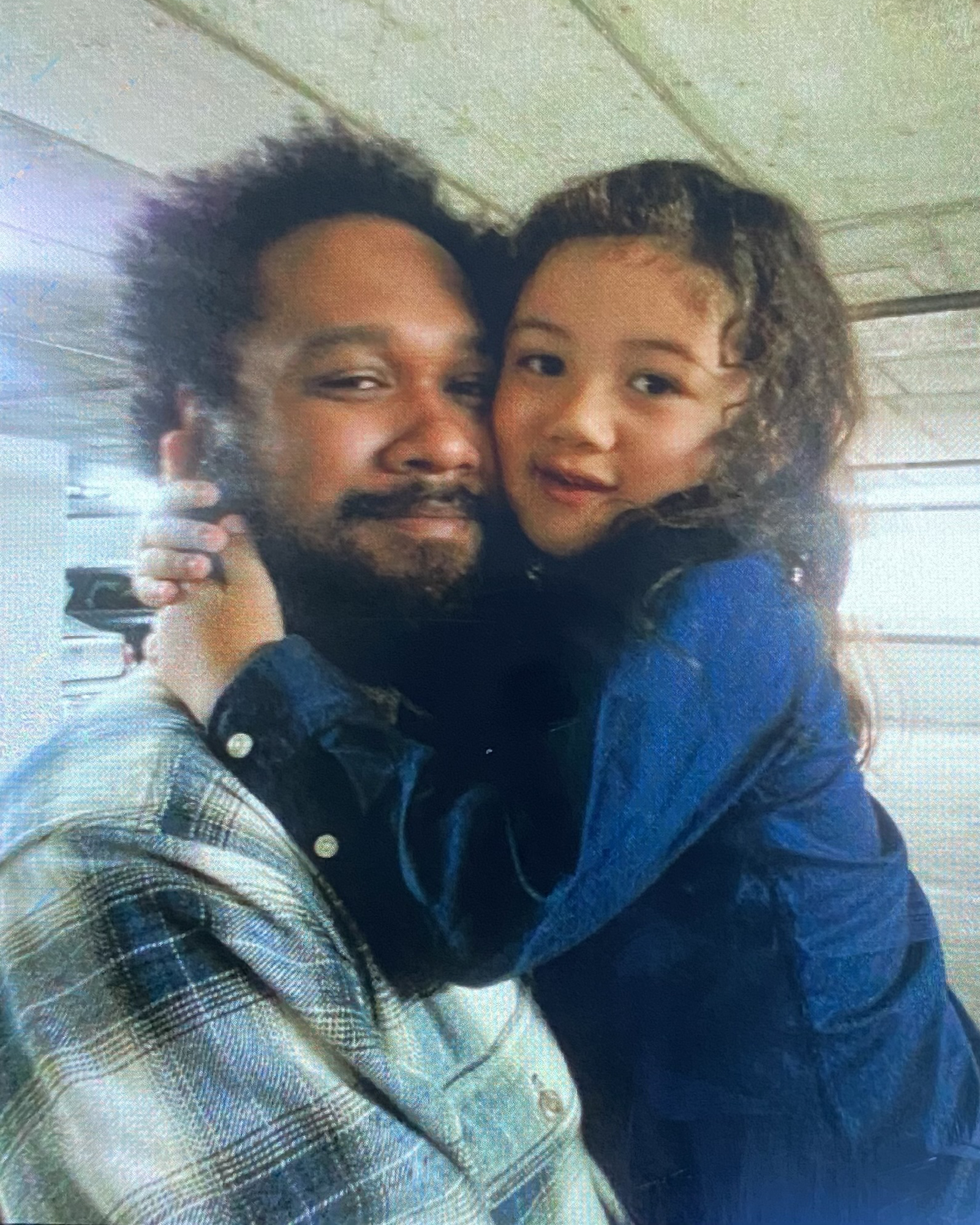
Gregory Turnage with his son. Photo courtesy of Angie Brey.
Hamano pleaded no contest to felony vehicular manslaughter and hit-and-run early last year. He received virtually no time behind bars after getting credit for wearing an ankle monitor at home while the case was open. The conviction should have prompted the state to revoke Hamano’s license, but the Alameda County court didn’t report it.
“They essentially let him get away with murder, in our minds,” Brey said. “The fact that they didn’t even take away his license … is just mind-blowing.”
A spokesperson, Paul Rosynsky, said the Alameda court reports hundreds of criminal convictions to the DMV every month, but he acknowledged that staff had missed sending two for manslaughter in recent years, including the Hamano case.
Hamano’s license appears to have been valid as recently as May 7, when DMV records show he got in another collision. (The records don’t detail who was at fault or the severity.)
The agency sent Hamano a notice on May 28 that his driving privileges were revoked, following CalMatters’ inquiries.
Hamano’s attorney, Colin Cooper, said his client “is traumatized by what he did” and will never forgive himself. Hamano didn’t drive while the case was open and drove afterward only because he had a valid license and insurance, Cooper said. Hamano stopped driving after getting the revocation letter from the DMV, he said.
Brey said holding drivers accountable for death is the least the state can do. She said she worries every day, when their son has to cross a busy intersection to get to school, that history will repeat itself.
“If somebody can come up on the sidewalk and kill my partner,” she said, “it just makes me really scared for my son.”
###
Court research by Robert Lewis, Lauren Hepler, Anat Rubin, Sergio Olmos, Cayla Mihalovich, Ese Olumhense, Ko Bragg, Andrew Donohue and Jenna Peterson.
This is the second piece in a series about how California lets dangerous drivers stay on the road. Read the first story here. Sign up for CalMatters’ License to Kill newsletter to be notified when the next story comes out, and to get more behind-the-scenes information from CalMatters reporting.