Ed Cohen, owner and operator of certified organic farm Earthly Edibles in Korbel, gives a tour of the operation to a group of kids. | Photo courtesy Ed Cohen.
###
The U.S. Department of Agriculture last week announced that it is eliminating two federal programs that injected more than a million dollars into the Humboldt County economy in recent years to help schools, tribes and Food for People buy meat and produce directly from local farmers, ranchers and fishermen.
With the Trump administration describing the decision as a “return to long-term, fiscally responsible initiatives,” the USDA canceled roughly $660 million that would have gone to schools and child care facilities this year through the Local Food for Schools Cooperative Agreement Program (LFS), plus about $420 million for a program called the Local Food Purchase Assistance Cooperative Agreement (LFPA), which helps food banks, Native American tribes and other groups provide locally cultivated food to their communities.
Humboldt County residents involved with these programs tell the Outpost that their elimination represents a huge economic blow to farmers and ranchers; meanwhile, many residents, including children, seniors, tribe members and others, will wind up eating less nutritious food that gets shipped here from out of the area.
Carly Robbins, executive director of Food for People, said her organization has been getting about $360,000 per year in funding from the LFPA program, allowing the food bank to buy and distribute more food to low-income residents.
“Obviously this is a bummer for us,” she said, “and for our clients it means less local produce will get to households.”
One purpose of the USDA’s local food programs was to encourage farmers to increase production, which they could confidently do knowing that their crops would have a buyer.
“Now, farmers may have already planted [this year’s] crop thinking that funding was coming,” Robbins said. “It’s a big blow for us … and it’s harmful for the farming community as well.”
In Humboldt and Del Norte counties, most of the federal LFPA funds have flowed through the North Coast Growers’ Association’s Harvest Hub, which connects farmers and ranchers with restaurants, government institutions, food banks and direct sales customers. The USDA also has an LFPA Plus program, which provides funding for tribal governments. It, too, has now been canceled.
Megan Kenney, the Harvest Hub director for NCGA, explained how the state’s food hubs like Harvest Hub function.
“So the food hub is that sort of middle entity that has a lot of connections with small scale farmers,” she said. “It [gives purchasers] one point of contact, one delivery that they’re getting, one invoice that they have to track. So it’s a lot more manageable for larger buyers.”
That includes schools. A dozen Humboldt County school districts took advantage of the USDA’s LFS program, collectively receiving $108,400 ahead of the 2022-23 school year to be allocated across multiple years. That represents a small fraction of the $15 million annual budget for school nutrition programs countywide, but the funding played an important role, according to Humboldt County Superintendent of Schools Michael Davies-Hughes.
“One of benefits of locally sourced food, obviously it’s the freshness and quality of food but also that partnership with local farmers,” Davies-Hughes said. “It was a win-win for both farmers and the local community and also for students to receive locally sourced food.”
Free meals are available to public school students countywide, and the LFS funding was distributed based on enrollment numbers, with Eureka City Schools receiving the largest share, $29,800, followed by the McKinleyville Union Elementary School District with $11,400 and 10 other districts receiving less than $10,000 apiece.
“There’s a pretty broad segment of the population that gets affected by these cuts, but it’s disproportionately [impactful] for people living in poverty,” Davies-Hughes said.
Mildred Montgomery at the Senior Nutrition Center in Hoopa with her share of eggs and ground beef provided by the Hoopa Valley Tribe’s LFPA Plus program. | Photo courtesy Allie Hostler.
In the Hoopa Valley that includes seniors — tribal and non-tribal alike — who have been getting food produced entirely by tribal farmers and ranchers participating in the Hoopa Valley Tribe’s Niwhong-xw K’iwiyul project, financed through the USDA’s LFPA Plus program.
Tribal member Allie Hostler, who works as managing editor of the tribe’s newspaper, the Two Rivers Tribune, and manages the Klamath Trinity Resource Conservation District, was instrumental in developing that project, which used federal funds to purchase thousands of pounds of fruits, vegetables, eggs, pork, beef and poultry from local farmers and ranchers.
One hundred fifty food boxes per week were distributed to participants of the K’ima:w Medical Center’s Senior Nutrition Program. Last week, after Hostler found out that the LFPA Plus program had been axed, she voiced her frustration in a Facebook post:
This program was critical to the development and strengthening of local food economies, creating a resilient supply chain and reducing dependency on food grown on mega farms hundreds of miles away. It was incredibly rewarding to see our food system begin to function as it should — food grown, produced, raised, & gathered here, stayed here. And, small farmers were valued participants in the market.
This giant unilateral cut will permanently scar RURAL FARMERS and RURAL FOOD SYSTEMS!
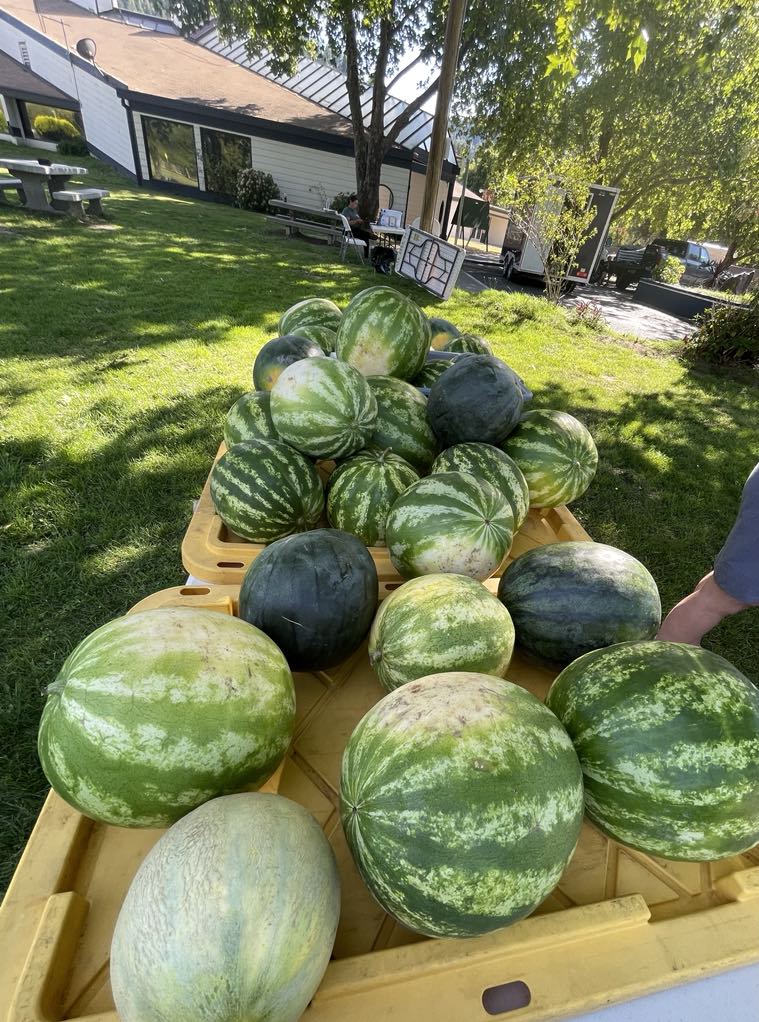
Watermelons grown as part of the Hoopa Tribe’s LFPA Plus-funded Niwhong-xw K’iwiyul project.
She’s concerned not only about the community’s access to affordable and nutritious food but also about the farmers who’ve come to rely on the program’s funding to keep their farms afloat. Reached by phone, Hostler said the USDA strongly promoted its LFPA programs when they were launched a few years ago and specifically encouraged Native American tribes to participate via LFPA Plus.
“Joe Davis, who was tribal chair at time, was in Washington, D.C. for another purpose,” Hostler said. “He met some officials with the USDA, who strongly encouraged the [Hoopa Valley Tribe] to apply.”
Hostler wrote the grant request, and USDA awarded the tribe approximately $727,000 to be distributed over two years. (The tribal council unanimously agreed to have the program run by the Klamath Trinity Resource Conservation District.) However, it took a lot of time and effort to get off the ground, so when the Trump administration killed the LFPA Plus program last week only a small percentage of those funds had been used. Hostler said the tribe will never get to spend the rest.
“In essence we lost $600,000 in procurement dollars for local food,” she explained. “We just won’t be able to provide the food boxes at all [anymore], none.”
She’s worried that elders who can’t affordlocally grown, nutrient-dense foods will turn to cheaper, low-quality options. The tribe already experiences high rates of diabetes and cardiovascular diseases due to a lack of access to nutritious food, generational trauma and other social determinants of health.
“But I’m also completely at a loss about what our farmers will do,” Hostler said. “This was a program that we promoted to our farmers after it was promoted to us by the USDA.”
With the Biden administration investing in development of local food economies, the tribe could assure farmers (and aspiring farmers) that they’d have a buyer for their produce. Same with ranchers and their livestock. Now, that system has evaporated.
“I have farmers worried because they’ve already started to plant 2025 crops,” Hostler said. The LFPA Plus program allowed farmers in this rural and remote area to earn a good return on their investments while improving the health of the community.
Hostler noted that roughly half of the Trinity River’s water gets diverted to “big ag” producers in the Central Valley, where much of the water simply evaporates “because of wasteful watering methods.” The food grown in the Valley then has to be shipped to the North Coast in emission-spewing trucks. Hostler lamented what’s now seemingly lost.
“We were creating a system that was less dependent on the corporate agriculture that depletes our water source,” she said. “Plus, it just makes sense. The food was grown here and consumed here. We were building a supply chain, a distribution chain; we were were tackling issues like storage, and delivery days and pricing, etc. It’s just a huge disappointment. I just don’t see how [the new administration] doesn’t see the value in local food systems — because our story not unique. This is everyone’s story.”
The Hoopa Valley Tribe was able to supply fresh, local produce to seniors while boosting the production and income of tribal farmers and ranchers through Local Food Purchase Assistance (LFPA) Cooperative Agreement Program. | Photo courtesy Allie Hostler.
Other tribes that participated in the LFPA Plus program include the Karuk, Yurok, Tolowa Dee’-ni, Bear River Rancheria and Blue Lake Rancheria, according to Kenney, the Harvest Hub director.
Last week, after learning of the program’s cancelation, Blue Lake Rancheria Tribal Chairman Jason Ramos issued a statement to community members, farmers and supporters. He thanked the USDA for its funding, which allowed the tribe to provide fresh food boxes to more than 150 households each month. [DISCLOSURE: The Blue Lake Rancheria is a minority owner of the Outpost’s parent company, Lost Coast Communications, Inc.]
Since the Rancheria launched its program in 2022 it has distributed more than 20,000 pounds of locally grown produce and more than 6,000 pounds of local fish, meat and eggs, Ramos said in his announcement.
“Through this program, we have not only provided fresh food to our community but also strengthened our local food system by supporting small farmers and fisherman, prioritizing purchases from socially disadvantaged producers, and increasing economic opportunities for those growing, catching, and raising food in our region,” the statement says.
With the program’s cancellation, more than $105,000 in anticipated funding to the Rancheria was eliminated. Blue Lake’s food distribution initiative will end after September.
Earthly Edibles, a certified organic farm in Korbel, grows a variety of row crops, including broccoli, lettuce, cabbage, heirloom beans and sweet corn. | Photo courtesy Ed Cohen.
One of the main suppliers of vegetables and beans to the Harvest Hub is Earthly Edibles, a certified organic family farm on 28 acres near Korbel. Owned and operated by Ed Cohen, the farm provided veggies to the local schools that participated in the USDA’s LSA program and to tribes and Food For People via the LFPA and LFPA Plus programs. Earthly Edibles received between $60,000 and $70,000 via those programs last year alone.
“As you might imagine, this is a huge game changer,” Cohen said regarding the end of those initiatives. The funding helped him afford employees raises, which he considers integral to honoring and retaining workers. The cut in funding will be painful.
Broccoli from Earthly Edibles. | Photo courtesy Ed Cohen.
“We’ll weather it, but it’s gonna be a huge blow,” Cohen said.
He’s more worried about the smaller farmers who, like those in Hoopa, have come to rely on USDA programs to finance the Harvest Hub’s wholesale purchases for their crops. Some of those farmers recently bought or leased new land to increase production.
“It will be devastating for them,” Cohen said.
For his own part, Cohen opted to plant fewer specialized crops in favor of increased broccoli and lettuce production because those items were popular staples in USDA-funded programs. He also increased Earthly Edibles’ acreage for growing heirloom beans, which he believes is the only plant-based protein being grown in wholesale volumes within a 150- or 200-mile radius. His farm was in the process of scaling up bean production because of the demand at the Harvest Hub. He’ll now have to rethink some things.
“But for me, the biggest loss is the connection [between] local farmers and those underserved communities — the tribes, the elderly, the senior resource center and our local kids who for years were just getting the kind of commodity, terrible food that I grew up on,” Cohen said. The younger of his two kids is still a student in the local public school system. “They were switching over to locally grown, fresh food. To me, more than my [financial] loss, that affects me the most. That’s hardest for me.”
Kenney said the North Coast Growers’ Alliance does a lot of collective production planning via a nonprofit endeavor called Farms Together, which helps participating wholesale farmers collectively produce crops that align with regional demand. The surprise announcement that these USDA programs are ending will certainly throw some farmers for a loop.
“Like, one of our farms, Green Spiral Farm [in Arcata], just planted an entire greenhouse full of bok choy because of this [LFPA] opportunity,” Kenney said. Now that the program is dead, the farm may struggle to find a buyer.
North Coast Growers’ Alliance initially received notice that all current contracts were frozen, but that directive was later rescinded, with the agency saying only future contracts will be canceled.
“So we still have about $160,000 in our contract with Food for People,” Kenney said. “Basically, what that means now is that instead of being able to bring them $10,000 [worth] of produce every single week, and really have their clients being able to access this huge variety of whatever they want, we’re probably going to need to significantly reduce our weekly amounts so we can extend the funding for longer.”
The North Coast Growers’ Association worked hard to ramp up local food production with the funding it received through the LFPA and LSA programs. That volume of food production can’t simply be shut off at the drop of a hat — or the whims of a new administration.
“The funding did what it was supposed to do: It really increased the production of all of our smaller scale farms, which are most regenerative farms,” Kenney said. “But they’re also the most vulnerable farms because they don’t have the money to be able to just pay for the seeds and the labor to plant all of these crops [only] to have them not get a return on their dollar.”
That unfortunate outcome may now be inevitable, though.
“I imagine there being probably millions of pounds of produce that are being cultivated right now for this program that aren’t going to have a buyer … ,” Kenney said. “That’s what I see happening to our farmers here on the North Coast as well as across the entire state — well, and entire country, really.”
While the USDA’s local food programs weren’t around for very long — the initiatives began during the pandemic — they brought more than $1 million in federal funding into Humboldt County, where it was reinvested to support local farmers, ranchers and fishermen while improving the diets of children, seniors, low-income residents and other vulnerable populations.
Nationwide, these programs accounted for about 0.016 percent of the federal budget.
A 2022 video by Marcus Villagranfor the North Coast Growers Association documenting the Harvest Hub program’s first delivery.
As of 5:20 p.m. Monday, March 17, Route 36 is OPEN TO ONE-WAY TRAFFIC CONTROL with up to one-hour delays east of Swimmer’s Delight near the Devil’s Elbow picnic area (PM 15-16) in Humboldt County.
# # #
Original Post: Yes, Highway 36 is very much in “You Shall Not Pass” mode. Earlier today Caltrans posted the clip above showing a very active slide east of Carlotta and also had this to say:
As of 8 a.m., Monday, March 17, Route 36 is FULLY CLOSED east of Swimmer’s Delight near the Devil’s Elbow picnic area (PM 15-16). The road will be closed from 8 a.m. to noon and 1 to 5 p.m. and open from noon to 1 p.m.
TRAFFIC ADVISORY: Route 36 is scheduled to close east of Swimmer’s Delight near the Devil’s Elbow picnic area (PM 15-16) on Monday, March 17, from 8 a.m. to noon and 1 to 5 p.m. Vehicles will be allowed through from noon to 1 p.m.
Crews will be removing additional hazards and slide material that came down during the weekend’s storms. This schedule is subject to change depending on slide activity.
This video was taken Friday and shows some of the work being done to clear hazards from the slide area.
Remember, a quick glance of which routes in and out of Humboldt are passable is always available on the LoCO homepage under the Humboldt Roads banner.
Press release from the Humboldt County Sheriff’s Office:
On Jan. 21, 1998, the Humboldt County Sheriff’s Office (HCSO) responded to a call of found human skeletal remains. Deputies met with a citizen who had been horseback riding in the area. The citizen led the deputies to the remains located on Clam Beach near the mouth of Little River.
The remains were collected and later examined by an anthropologist, who confirmed they were human. The remains were sent to the California Department of Justice where a DNA sample was obtained. The sex of the remains was determined to be male. The DNA sample was entered into CODIS (Combined DNA Index System) and compared to reported missing persons. No match was ever made. The case was also entered into NAMUS (National Missing and Unidentified Persons System) under case number UP55179. The remains showed signs of being well-worn from either water or sand erosion. It was reported that there had been heavy rain prior to the discovery. It is possible that these remains are from an ancient burial site located near the beach or nearby rivers.
With the advancement of technology, HCSO has partnered with Othram Inc to complete Forensic Genetic Genealogy. A sample was sent to Othram Inc and later determined to be Native American. The most recent common ancestor was Catherine Prince, born in 1843. Research shows Catherine was one of the sole survivors of a Native American massacre along the Van Duzen River near Alton. Catherine may have later been adopted by the Francis family of California. The Wiyot Tribe was contacted and noted the Prince family is documented within the tribe, but no relatives could be located.
The Sheriff’s Office is looking for family members of the following people:
Catherine “Kitty” Frances Prince 1843-1940
Married to James Napoleon Prince 1843-1910
Possible children: Dan Prince, Theodore Prince, and Edith Anderson
Anyone with information is asked to contact Missing Person/Cold Homicide Investigator Mike Fridley at (707) 441-3024.
The Eureka Police
Department conducted a Shoulder Tap operation on March 15th, 2025 within the city
limits of Eureka, CA as a part of the Department of Alcoholic
Beverage Control’s (ABC)
Annual Statewide Shoulder Tap Operation. This operation resulted in
one subject being booked into
the Humboldt County Correctional Facility (HCCF) for public
intoxication and two additional
subjects being cited for furnishing alcoholic beverages to a minor.
Shoulder Tap
operations target adults who purchase alcohol for persons under the
age of 21.
During a Shoulder
Tap operation, a minor under the direct supervision of law
enforcement stands outside of a liquor
or convenience store and asks customers to buy them alcohol. The
minor also indicates they are
underage and cannot purchase the alcohol.
Underage drinking
harms our community. Preventing the sale of alcohol to minors will
help to increase public
safety and make our roads safer.
If an adult agrees
to purchase alcohol for the underage person, they can be arrested and
cited for furnishing
alcohol to a minor. The penalty for furnishing alcohol to a minor is
a minimum $1,000 fine and 24 hours of
community service.
“We conduct these
operations to keep alcohol out of the hands of our youth,” said ABC
Director Joseph McCullough.
“By preventing underage drinking we can increase the quality of
life in our communities and
reduce DUIs.”
Statistics have
shown that young people under the age of 21 have a much higher risk
of being involved in a crash
than older drivers. About 25 percent of fatal crashes involve
underage drinking according to the
National Highway Traffic Safety Administration (NHTSA).
Funding for this
program was provided by a grant from the ABC Alcohol Policing
Partnership (APP) program.
Fossil
fuels are bad for us, both to our climate and to our health. These
impacts are felt most acutely in fenceline communities immediately
adjacent to fossil fuel power plants, which also tend to be
lower-income, communities of color. Folks from these communities are
banding together to present a new energy future that leans into
renewables and battery storage in order to shut down the gas power
plants that pollute their neighborhoods and harm their families.
Julia Dowell of the Sierra
Club
and Heena Singh of California
Environmental Justice Alliance
join us on the show to talk about their work leading Regenerate California
where they apply pressure on local and state agencies to retire gas
plants in environmental justice communities. They share their
advocacy on how responsible utility scale energy infrastructure (like
offshore wind and transmission) can enable gas plant retirements.
Show your support for state action to build offshore wind by signing
a petition here.
I would like to address the recent cuts approved by the Arcata School District Board reported in the Lost Coast Outpost. There are three aspects of the cuts I want to be sure are clear to LoCO readers and especially our staff and families.
First and foremost is that the board and district leadership value each and every one of our students and the teachers and staff that serve and support them. I am very proud to serve on the board and honored to get to see the hard work and dedication of ASD staff to providing the best possible education to our students, even in the most trying times. That is why we used one time Covid-related money to hire additional support staff, including classroom aides, reading and math intervention specialists, and additional school psychologist staffing. The people who filled these positions helped our students recover from disruptions caused by the pandemic. That is why the district set aside funds when possible over the past few years to extend these positions beyond the life of their original funding source.
Second, the two priorities driving decisions about which positions to cut were minimizing the number of staff affected and minimizing the impact on our students. Half of the positions reported in the LoCO were for 1 on 1 Aides for students who will no longer be in the district next year or no longer need the service. The 1 on 1 Aides provide services to specific students, and regardless of the district’s financial situation, these positions would be released. If additional students at one of our schools need a 1 on 1 Aide, ASD will create additional positions as needed.
Three of the positions were cut because they had been added with grant money to address specific, short-term needs. The Family Services Coordinator helped connect district families with community services during pandemic. This need has reduced coming out of the pandemic. If the position is unable to be restored, ASD now has a Family Resource Center Director who will ensure that the Family Resource Center continues to support our students and their families. Our Teacher on Special Assignment position paid for one of our teachers to work on a School Climate Improvement Grant that ended last year. That teacher will return to the classroom next year. While we would have liked to retain these positions further beyond their grant funding, doing so would have come at the cost of having to cut positions, like the reading intervention specialist, that directly interact with and serve our students on a daily basis. The district added an Education Specialist with Covid-related and other temporary funding to provide specialized instruction for students with disabilities. It was good to have lower caseloads coming out of the pandemic, but we now need to return to previous staffing levels with funding running out and a large group of special education students graduating onto the high school.
The last position is a vacant AES Teacher position for 2025/2026. In deciding on this position, we considered that a couple of our grade levels at Arcata Elementary have particularly small class sizes. Students at Arcata Elementary will continue to have an average class size under 20 students, with both a teacher and paraprofessional support in each class.
Third, California state law requires that notices are given to staff whose positions may be in jeopardy by March 15th. However, the state does not finalize its budget (which is the main source of revenue paying for our schools) until June. We have reason to be hopeful that the district will receive additional funds from state and federal grants for the 2025/2026 school year that will allow us to keep some of these positions. Unfortunately, because those funds are not guaranteed now, initial layoff notices have to be given assuming the worst. Increased enrollment next year would also lead to positions being retained or added to meet the needs of our students. The board and district leadership truly regret the stress caused to those staff receiving initial layoff notices. It is a case of a well-intended law having unintended consequences.
I would also like to address the other side of our budget deficit, revenues. The board heard from both teachers and parents questions about why no cuts were made to the district office. Superintendent Biesecker addressed this in detail for the board and others attending our March board meeting. Our district office serves not only the two public schools located in the district (Arcata Elementary and Sunny Brae Middle School) but also four charter schools. Our oversight responsibility to the charter schools has significantly increased in the past couple of years. The charter schools pay for the services the district office provides them, covering 70% of District Office expenses. If the district office were to reduce staff, we would have to reduce services to the charter schools, leading to a loss of funding without reducing the budget deficit. We would still need to layoff other staff. Superintendent Biesecker did point out that our budget reduction plans do include shifting more of the costs associated with the district office to the charter schools to reflect the additional work we provide to meet our oversight responsibilities.
Sincerely Yours,
Brian Hudgens
President Arcata School District Board of Trustees
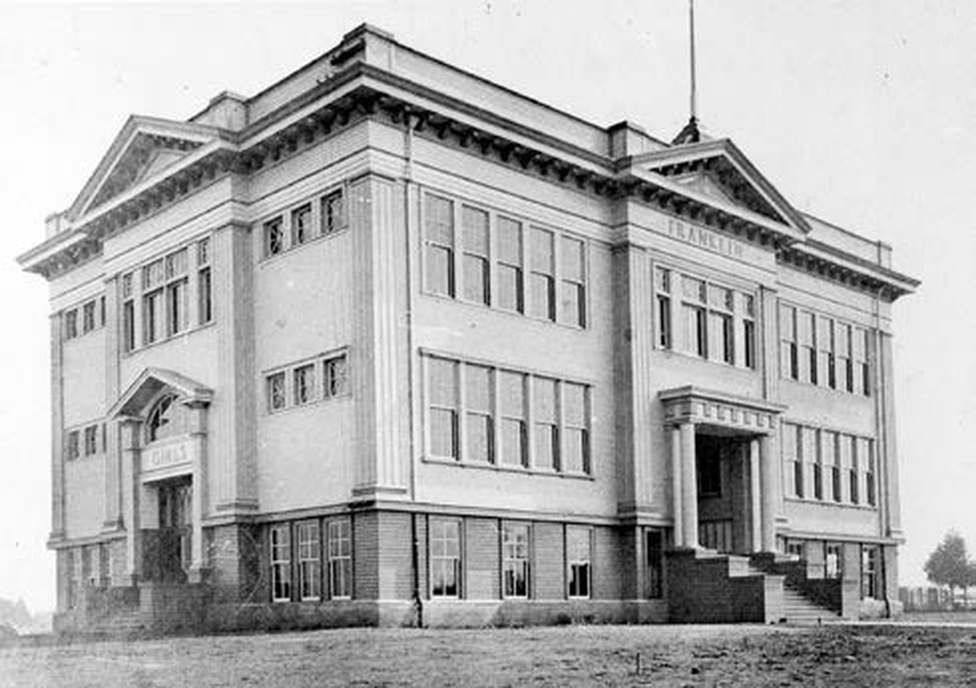
The old Franklin School, seen above, was built in 1909 and torn down in about 1939 and replaced by a new one-story school. It was on Myrtle Avenue, on the lot that currently houses the Humboldt County Office of Education offices. Photos via the Humboldt Historian.
During the Great Depression years, my brothers,
Don, Neil and Bill, and I attended Franklin
School in Eureka. The Franklin School was a unique
experience in that the teachers were all “old maids,” as
we used to say in those days. The Humboldt County
school system had the policy for many years prior
to World War II of hiring single women only. Our
teachers were Miss Shultz for kindergarten, Miss
Bacon for first grade, Miss Murdock for second, Miss
Asselstein for third, Miss Damon for fourth, Miss
Pratt for fifth and Miss Slingsby for sixth.
Speech therapy for those who stuttered was provided
by a visiting public health nurse specialist about twice
a week.
Mr. O’Brien was the heating system steam engineer
who performed many tasks around the school. Fuel
for his boilers was stored in the schoolyard in the
form of a cord of wood. One morning during recess
it was discovered that a transient had stored his
belongings in the wood pile. It was a bundle with a
blanket, some items of clothing and food, etc., which
he obviously thought he had left in a safe place.
During the Depression years, many jobless men
roamed the country looking for work or just enough
food to survive. The thing that struck my young mind
and stayed in my memory was that Mr. O’Brien was
directed to burn the bundle in his boiler.
During art class in the first grade with Miss Bacon,
I drew a purple ball at the end of the lion’s tail, instead
of an orange one, to represent the tuft at the end of
the tail. I was spanked in front of the class for being
a smart ass. I never got over my dislike of school or
teachers from that incident on.
We walked the mile to and from school through the
“back alley,” which passed through the old cemetery
on Myrtle Avenue. Sometimes we would avoid the
cemetery by cutting across to West Avenue, which
only added two blocks to our walk and let us pass by
Hansen’s Store. If one of us had a penny or two, we
would go into the store at the side door. The owner,
Mr. Harry O. Hansen, had a candy display by the side
door where we could buy a one-cent “Guess What.”
This treat was a wrapped paper tube that held a candy
and a small toy. The “Guess What” was made in Japan,
so the supply ended in late 1941, with the attack on
Pearl Harbor.
The Hansens’ son Rodney was in my class through
high school. Rodney studied piano and organ in
school and made the organ his lifelong career. He
played the organ for audiences in the United States
and as far away as Europe and Africa.
During my years at Franklin School, I belonged
to the Cub Scouts, learned to play the E-flat alto
saxophone, played in the school marching band, and
also played the part of a pilgrim in the Thanksgiving
play. I think my line was, “Speak for yourself, John.”
This was said when the subject of Priscilla came up.
Music and acting didn’t follow me into the big time at
Eureka Junior High.
Freshwater School.
We spent about two years at the Freshwater Corners
two-room school beginning in the spring of 1942,
when our family moved to the Freshwater area. The
school was two miles from our house, and no school
buses to ride, so we walked to and from school every
day, rain or shine. When our access road at home
flooded in the winter, we wore knee boots out to the
county road and would leave them at our front gate
for the return trip. When we thought Old Arcata Road
would be flooded in the Skunk Hollow area, we wore
our boots all the way to school. When the Arcata road
did flood, it meant slogging through more than half a
mile of high water.\
Gail Allen catches the pig, donated by Dr. Falk. Freshwater School, 1943.
During the spring of 1943, when I was in the fifth
grade at Freshwater, a nearby neighbor, Dr. Falk,
donated a small pig for a “greased pig” contest. This
meant that whoever could catch and then hold onto
the pig could take the pig home. A bunch of us got
pretty well greased up, but I was the one who won the
contest. Mom never did get all the grease stains out of
my clothes.
The only power equipment Dad owned was our
1929 Dodge family sedan, so everything had to be
done by hand. We spaded, hoed, raked, planted
and watered about an acre of garden every year for
vegetables. The water supply for the garden was the
creek. We dammed the creek every spring to back up
the water and carried the water in buckets all summer
to water the acre of garden.
All four of us Allen brothers belonged to the 4-H for
the duration of World War II. We each had a Victory
Garden for growing vegetables to help with the war
effort. We grew all of our vegetables anyway, so it just
meant making four individual plots look nicer for the
4-H leader to see.
We also got involved in scavenger hunts for old
iron, brass and other metals. Additionally, we stripped
cascara bark from our cascara trees, dried it on the
tin roof of our tool shed, and sold the dried bark at
Breeden’s Junkyard for use by the military in laxatives
and other medicines. Stripping the bark from the trees
killed the trees, so they were turned into firewood for
Mom’s wood cook stove and the living room heater.
After finishing the sixth grade at Freshwater, I
passed on to the seventh grade at Eureka Junior
High School. September of 1945 was to be my
entry into the “Big Time.” Bill was already there.
Just by going from sixth to seventh grade, he had
gone from Billy to Bill. How sophisticated! He was
no longer a juvenile but had been trusted to find his
way to the bus stop each morning on time for the
trip into Eureka, and to reappear each afternoon
on that big yellow bus.
About the Allen Brothers
The author, Gail Allen, became a civil engineer
and worked for the Peter Kiewit Company, which
took him all over the country and the world. He
passed away in September 2018. Both Gail and
his brother Don served in the Korean War. After
the war, Don returned home to Eureka, where
he has lived ever since, working in construction,
including building his own house and the road
leading to it. Neil Allen, now of Sacramento, spent
his life in the Air Force, traveling throughout the
world during his career. Bill Allen, now deceased,
stayed in Humboldt, working for Fuller O’Brien.
All four Allen brothers married — for life, it has
turned out — and raised families.
Above: The 1939 first grade class picture at the old Franklin School. Gail Allen is third from left in the second row.
###
The story above is excerpted from the Winter 2018 issue of the Humboldt Historian, a journal of the Humboldt County Historical Society. It is reprinted here with permission. The Humboldt County Historical Society is a nonprofit organization devoted to archiving, preserving and sharing Humboldt County’s rich history. You can become a member and receive a year’s worth of new issues of The Humboldt Historianat this link.