OBITUARY: Richard Dale Nelson, 1955-2025
LoCO Staff / Thursday, Feb. 27, 2025 @ 6:58 a.m. / Obits

Richard Dale Nelson
December 14, 1955 - February
14, 2025
Richard (Ricky) Dale Nelson passed peacefully on February 14, 2025. He was known to many as “Big Rick, Ricky Jay, Ricky Nelson, Uncle and “Papa”. He was born to Darell and Gloria Nelson in Eureka California as the youngest of three children. Ricky graduated from McKinleyville High School in 1974. While in high school he played football and baseball for the Panthers. He was an avid sports fan and loved the Atlanta Falcons and the San Francisco Giants. Ricky was a proud member of the Yurok Tribe.
For many years he coached Little League in McKinleyville with his buddy Greg Hudson. They coached several championship teams. His love for baseball continued even after he had a tragic accident playing baseball. While playing as an adult, he slid into base and badly shattered his ankle. Over the course of years, he had over twelve surgeries on his foot which eventually lead to his leg having to be amputated. Even though he could no longer play baseball he never missed a game on TV and attended all of his nephews and nieces sorting events and activities.
Ricky helped run the family businesses for over 30 years. He managed the Henderson Center Laundromat in Eureka. After the passing of his stepfather, Delno, Ricky and his sister managed all three of the family laundromats until they were sold in 2023.
Ricky was a wonderful uncle to his nephews and nieces and was always there for them when they were growing up. The older nephews and niece called him uncle but his great niece, Trinity called him “Papa” and he always called her “Princess.” They had a special undescribable bond. He will be deeply missed. Although he had a gruff demeanor, he was a kind hearted man who had a significant impact on many peoples lives.
Ricky is survived by his mother, Gloria Shuster of McKinleyville; sister Linda Ogburn Gillette (Jeff Gillette) of Eureka; niece Barbara Ann Ogburn, Laguna Hills, Calif.; nephews, Ricky and Cory Nelson; great-nephew Dylan Nelson of McKinleyville; great-nieces Trinity Nelson of Eureka and Elizabeth Nelson of Hoopa.
Ricky is predeceased by his sister Diane Nelson; father Darell Nelson; step-fathers Dane Jay and Delno Shuster; and numerous other relatives and friends.
At Ricky’s request there will not be a service but a celebration of life will follow at a later date.
###
The obituary above was submitted on behalf of Ricky Nelson’s loved ones. The Lost Coast Outpost runs obituaries of Humboldt County residents at no charge. See guidelines here. Email news@lostcoastoutpost.com.
BOOKED
Yesterday: 5 felonies, 12 misdemeanors, 0 infractions
JUDGED
Humboldt County Superior Court Calendar: Today
CHP REPORTS
No current incidents
ELSEWHERE
RHBB: Willits Unified Absorbs Credit Downgrade as Reserves Fall Below Mandated Level
RHBB: Injured Mount Shasta Climber Crawled Through the Night After 500-Foot Fall
RHBB: Putting Emergency Plans to the Test: Eureka to Host Rural Preparedness Training
Governor’s Office: Governor Newsom signs legislation 9.14.2026
After Chaotic Public Meeting, Blue Lake City Council Opts to Extend Timeline for Proposed Battery Storage Facility
Isabella Vanderheiden / Wednesday, Feb. 26, 2025 @ 4:27 p.m. / Government

A resident speaks during public comment at the Blue Lake City Council’s meeting on Tuesday night. | Photos: Andrew Goff
Dozens of Blue Lakers packed into the Skinner Store last night to urge the Blue Lake City Council to shut down a controversial proposal to convert the city’s long-disused power plant into a lithium-iron-phosphate battery energy storage system (BESS). The project proposal, submitted by Texas-based energy developer PowerTransitions, has drawn criticism from many residents who fear the BESS would contaminate the nearby Mad River during a flood event or another natural catastrophe.
Following an impassioned and at times chaotic and belligerent two-hour discussion, the city council voted 3-2, with councilmembers Michelle Lewis-Lusso and Christopher G. Firor dissenting, to continue discussions with PowerTransitions and extend the project’s timeline to give the council and community members more time to consider the ins and outs of the proposal.

A sign near the Blue Lake Boulevard offramp encourages people to attend Tuesday’s council meeting
The city has been looking for a way to repurpose the six-acre Powers Creek District site since the Blue Lake Power Plant shut down in 2015. For the past four years, staff have worked closely with the Redwood Coast Energy Authority to develop a small-scale BESS at the site that would collect and store excess energy from the grid in rechargeable batteries for future use. In the event of a widespread power outage, the BESS could theoretically provide up to five days of power for Blue Lake residents.
The city council approved an exclusive right to negotiate with PowerTransitions last year after Jeff Goldstein, a senior advisor to the company’s CEO, approached the city with a multi-part plan to demolish some on-site infrastructure and build a 20-megawatt BESS that would repurpose the existing transformer and substation. Under the proposed agreement, PowerTransitions would pay for site clean-up and remediation, estimated between $750,000 and $1.5 million.

An aerial view of the proposed battery energy storage system. | Image: PowerTransitions

As residents filtered into Skinner Hall at the start of last night’s meeting, it became immediately apparent that there wouldn’t be enough chairs for the crowd of 50-plus residents, leaving many people standing in the foyer. Several others hung out on the porch and listened to the discussion on Zoom, occasionally peering through the window.

Meeting attendees struggle to open a window in an attempt to help people standing outside hear the proceedings.
Shortly after the meeting began, one attendee, who did not identify himself, urged the city council to postpone the meeting due to capacity limitations. He also asserted that the meeting was “illegal” because the city posted the agenda to its website but didn’t advertise it at the post office as it usually does. A few others echoed the sentiment, asking the city council to refrain from making any “irrevocable decisions” at the meeting.
City Attorney Ryan Plotz pushed back, noting that the meeting notice adhered to the Brown Act, which requires local governments to advertise public meetings in a public place at least 72 hours in advance. City Manager Amanda Mager added that the meeting was posted at City Hall, the Mad River Grange, the bulletin board in front of the post office and on the city’s website.

Blue Lake City Attorney Ryan Plotz
The misunderstandings and, at times, hostile disruptions continued throughout the meeting. The audience talked amongst themselves, complaining that they couldn’t hear the city council or expressing concern about the people out on the porch. At one point, former Blue Lake Mayor Adelene Jones turned around and gave someone in the audience a long, stern look. When she turned back around someone loudly whispered “Bitch!” and flipped her off.
During non-agenda public comment, an attendee began talking about the proposed BESS and was asked that she hold her comments for the agenda item. Another commenter, Andrew Orahoske, who appeared via Zoom, blasted Mayor John Sawatzky for interrupting the speaker and accused him of disparaging her comments. Orahoske disrupted the meeting on several other occasions throughout the night, prompting groans from other attendees who begged the council to put him on mute.

Mayor John Sawatzky
The fire department’s siren halted the council’s discussion shortly thereafter. People continued to express concern about the people outside. Mayor Sawatzky looked exasperated at several points throughout the meeting.
About two hours into the meeting, the council finally turned to the battery storage facility. The city’s attorney began the discussion with an overview of the project proposal and outlined the next steps for the BESS.
The main question up for consideration, Plotz said, was whether the council should pursue an expedited timeline for the project, which would require the city council to approve a two-year option agreement (a legal contract that acts as a promise to keep an offer open to another party within a stated timeframe) in March to meet Pacific Gas & Electric Company’s application window. Alternatively, the council could hold off on the agreement until PG&E’s next application window in September.
“If we waited until September, demolition would be pushed back … and I don’t know what the appetite of the other party would be in September,” Plotz said. “Tonight, you’re not committing to anything. Basically, you’re telling staff [to] spend the time and effort to bring [forth] transactional documents that we can begin reviewing for potential approval in March. Nothing is approved until you approve the actual transactional documents, which will happen in the future.”
Councilmember Elise Scafani said she was worried that moving forward with the agreement would obligate the city to move forward with the project, adding that it felt like “too much too soon.” Plotz reiterated that the agreement would allow for “total discretion” in the negotiation process.
The vast majority of the two dozen residents who spoke up during public comment urged the city council to scrap the BESS entirely, though a few speakers expressed interest in at least continuing the conversation. Most of their concerns focused on potential environmental impacts associated with the project, including contamination of the county’s water supply, some of which comes from wells beneath the Mad River.
“I don’t know if the County of Humboldt has been brought in on this conversation … but I don’t personally think that Blue Lake has the right to make a decision about what happens to the water for the rest of the county without talking to them about it first,” said longtime Blue Lake resident Jamie Boltzen. “I also have serious concerns about pollution. … It’s so beautiful here. Why would we risk it?”
Boltzen and others also expressed concern about PowerTransitions’ intentions and whether the company has the county’s best interest at heart. Some expressed concern about the company’s CEO Sean T. Long, who headed Enron’s African investment division before the company declared bankruptcy. One attendee called Goldstein a liar, prompting Mayor Sawatzky to call for a point of order and bang his gavel.
Others expressed concern about the lithium iron phosphate batteries that would be used in the BESS, with some drawing a link to the lithium-ion battery fire that broke out at the Moss Landing Vistra Power Plant in Monterey County last month. Lithium iron phosphate batteries are generally considered safer than lithium-ion batteries and have a lower risk of overheating. Blue Lake resident Jennifer Corse underscored the importance of evidence-based research, adding that “safer does not equal zero risk.”
“I have had a really difficult time finding evidence-based research that proves that this [project] is safe,” she said. “You should be proving to us with research that this is safe.”
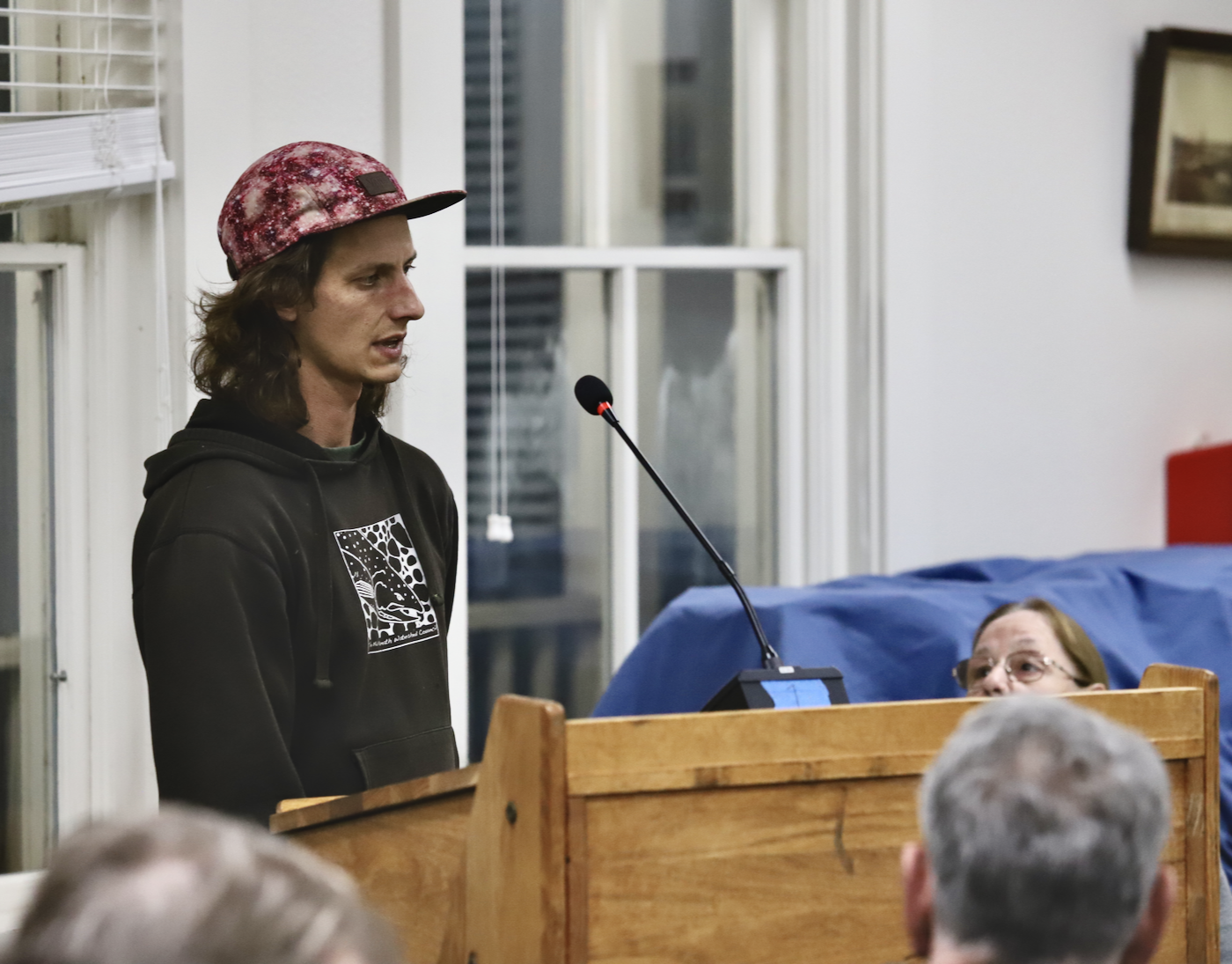
Juniper Summers Somers spoke in favor of the project but agreed with other speakers that the city council should do more research before moving forward with the agreement, urging the council to opt for the extended timeline. [CORRECTION: Somers spoke, in a broad sense, in favor of having “a power system for Blue Lake or Humboldt in general,” but did not speak in favor of this project in particular. Also, he is not a resident of Blue Lake, as initially reported. The Outpost regrets the error.]
As the meeting approached the four-hour mark, the city council began deliberation. Speaking to concerns about potential contamination of the Mad River, the city manager said she recently learned that the Humboldt Bay Municipal Water District had its own BESS at the Essex Pump Station right on the river. She added that the Blue Lake Rancheria, Cal Poly Humboldt, City of Eureka and Providence St. Joseph Hospital have similar systems.

City Manager Amanda Mager
“I just want to reiterate that this might be a quick timeline to start a process, but it’s not a quick timeline to get to an end result,” Mager said. “There’s a lot of process, a lot of time and a lot of questions that will get answered through that process, and CEQA [the California Environmental Quality Act] is there to protect.”
Councilmember Firor spoke in favor of the project, emphasizing the need to get the process moving sooner rather than later. “Anything we could do to fast-track the demolition of that dangerous eyesore over there is paramount to me,” he said.
Councilmember Scafani said she couldn’t help but wonder how the community would have received the project if the city had held a town hall at the beginning of the process rather than waiting until there was an agreement on the table.
“I am stuck feeling like we’re doing this backwards,” she said. “We didn’t decide that we wanted a battery storage project and then put our heads together to figure out how to get that accomplished. That’s very concerning to me because there’s the whole issue of added pressure of the timeline. … How do we get off this path if things start to work wrong to us? Can we really get out? … I don’t really want to take that next step. This feels wrong to me.”
Councilmember Lewis-Lusso said she was disappointed in the “misinformation and propaganda” about the project that she had seen floating around in the community. She also underscored the issue of trust and called for more research. “Unfortunately, because of some trust issues, I fear that this [project] is not going to be possible.”
Councilmember Kat Napier echoed her concerns about trust and said she was conflicted about how the council should move forward with the project.
“I’m not elected to run this [city] as a business and to impose my personal views,” she said. “I have heard the largest element here is we don’t, at this time, have trust. … As so many have mentioned tonight, whether it was the potluck or how many people have been here and care about our neighbors, we are all Blue Lakers, and we can work on this together. … I think that we have to build trust before we leave this kind of decision on others.”
After a bit of additional discussion, Councilmember Scafani made a motion to reject the accelerated timeline. Councilmember Napier seconded the motion, asking if the motion would allow staff to continue with the extended timeline. The city attorney confirmed that it would, noting that staff would get in touch with PowerTransitions staff to see if they’re still interested in moving forward.
The motion passed 3-2 with Firor and Lewis-Lusso dissenting. The city council will revisit the item at its next regular meeting in March.
RELATED:
###
‘I Loved My Job So Much’: Fired Federal Employees in Humboldt County Say Their Unjust Terminations Will Impact the Public
Ryan Burns / Wednesday, Feb. 26, 2025 @ 3:07 p.m. / Government
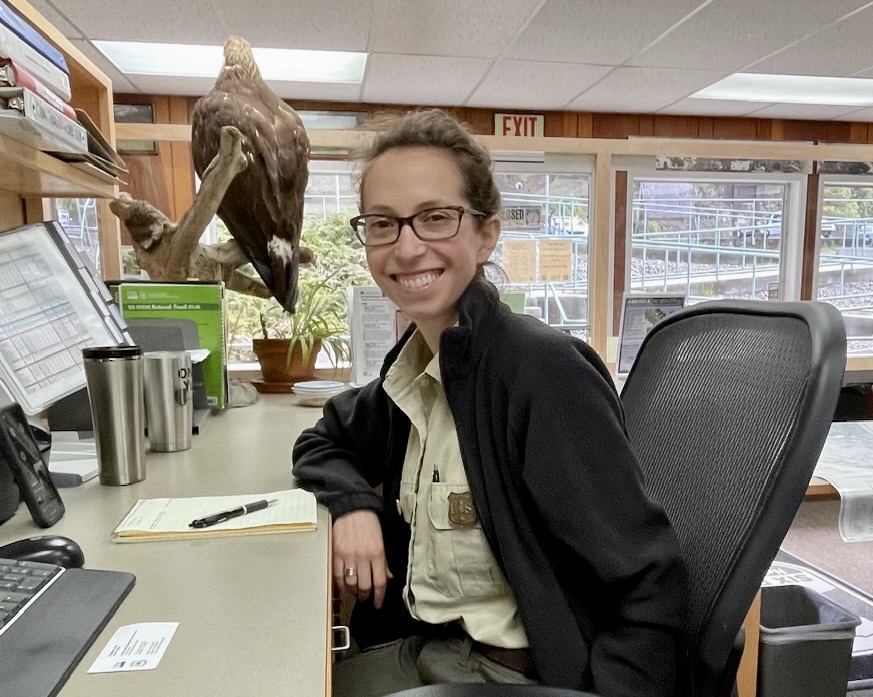
Danielle Bauman-Epstein working at the Mad River Ranger Station of Six Rivers National Forest. On Feb. 15 she was fired from her job as a program specialist. | Submitted.
###
Danielle Bauman-Epstein knew there was a good chance that she’d be fired, but when it actually happened it still hurt.
“Honestly, I’m just devastated,” she said in a recent phone interview. “I loved my job so much. It was really a dream job.”
A program specialist living and working at the Mad River Ranger District in Six Rivers National Forest, Bauman-Epstein said her job involved formalizing agreements between the U.S. Forest Service and outside organizations — nonprofits, tribes, universities, etc. — for projects ranging from climate change mitigation and wildfire reduction to workforce development, reforestation, tribal youth stewardship and more.
“These agreements help disperse federal funds into local communities,” she explained.
She was a year and a half into her two-year probationary period with the U.S. Forest Service and had received nothing but exemplary performance reviews, but she still saw termination coming.
About a month ago, while on vacation with her husband — who also works for USFS, as an archaeologist — Bauman-Epstein learned that the United States Office of Personnel Management (OPM) had asked her agency to turn over a list of all their probationary employees.
Like tens of thousands of other federal workers fired in recent weeks, she got the official word via an impersonal form letter. Hers was signed by the USFS’s acting director for Human Resources Management in Washington, D.C. It said, in part, “The Agency finds, based on your performance, that you have not demonstrated that your further employment at the Agency would be in the public interest.”
She knew this wasn’t true. On top of her stellar performance reviews, she’d received five performance awards during her short tenure, and she got a promotion in August. She believes her recent termination violated the terms of her union contract and federal employment agreement.
She’s not alone in that belief. Earlier this week, unions representing federal employees filed a lawsuit to block the mass firings of probationary federal employees by President Donald Trump’s administration, alleging that officials are exploiting and misusing the probationary period and “acted unlawfully by directing federal agencies to use a standardized termination notice falsely claiming performance issues,” the Associated Press reported.
Last weekend, Elon Musk ordered federal workers to report their previous week’s work accomplishments in five bullet points and warned that failure to do so would be taken as a resignation. Bauman-Epstein is worried that her husband could be among the next wave of fired workers.
“He is not probationary, but is ‘career conditional,’ being just two months away from the permanent status earned after three years,” she said in an email. “I have a medical condition that makes health insurance essential, and we’re very worried about both of us being out of jobs. Additionally, we live in Forest Service housing and may have to move out of our house if he is fired.”
But she said their concerns extend beyond themselves and their coworkers. They’re worried that the reduction in Forest Service employees will harm the local economy and increase the risks of wildfires.
Firefighting
“While it may appear that firefighters were not affected by this firing, many people who work in areas outside of fire support wildfire prevention and incident response,” Bauman-Epstein said. This includes employees who run fire camps, transport resources, manage incident organization and budgets, communicate with the public and more.
According to current and former federal workers interviewed for this story, the mass terminations will have significant local impacts.
“These are skilled individuals and members of our community, many of whom have pursued higher education or moved long distances for these jobs,” said one employee, who requested anonymity due to fear of retaliation. “None of the affected staff were primarily employed as wildland firefighters, however many hold specialized firefighting qualifications and play key roles in response to local wildfires,” they said.
Among those fired were at least 17 employees at Six Rivers National Forest; five at the South Operations Center of Redwood National and State Parks; three employees at the Arcata office of the U.S. Fish and Wildlife Service; the office manager at the Eureka Vet Center (a position that took two years to fill); and several employees at the Natural Resources Conservation Service (NRCS) office in Eureka.

Wildlife biologist and soil conservationist Kate Howard. | Submitted.
Working Lands
The NCRS is part of the U.S. Department of Agriculture. Among the local employees fired this month was wildlife biologist and soil conservationist Kate Howard, who a colleague described as “one of the most experienced and beloved range managers in the county.”
She’d been in her position for nine years but was under “probationary” status because, until two months ago, half of her salary was supplied by a conservation nonprofit via a contribution agreement with the federal government.
In a phone interview, Howard explained that her work involved helping ranchers on privately owned working lands by offering technical assistance and information on financial assistance available through the farm bill.
“My job title was soil conservation but I was essentially the rangeland specialist in my office,” Howard said. She helped private landowners — beef ranchers, mostly — to understand their land’s grazing capacity and learn how to restore grassland and oak woodland habitat.
“At the end of day I don’t know exactly will be lost, but I got calls from most of my clients saying they’re very sorry [to see me go] and [they said] I was very valuable to them.”
Like Bauman-Esptein, Howard saw the writing on the wall beforehand. She knew getting fired under a new presidential administration was a possibility when she switched over to full federal employment status (partially due to evaporating grant funding). And she actually believes in the value of reducing the size of federal government.
“Bureaucracy is the dirtiest word I know,” she said.
However, she enjoyed her job and recognized that she was good at it. And she didn’t expect to be fired via a mass email with the subject line “Excepted Service Termination during Probation Template on Letterhead.” Nor did she expect the attached termination letter to say that her firing was due to poor performance.
“I hadn’t had a performance review yet,” she pointed out.
Howard said one of her coworkers was also fired, just 10 days shy of finishing her year-long probationary period. Howard found her sudden termination devastating, and in a Facebook post she offered an analogy for the way these layoffs are being carried out:
“[I]t’s kind of like a complex math proof taking up a whole blackboard; you ask someone for the solution, and they proceed to simply erase the entire board and walk away.”
While she believes in reducing bureaucracy, she also recognizes the importance of her work she was doing — not just for her clients but for herself, too.
“I really enjoyed being in public service and took that seriously,” she said. “It was personally fulfilling work, and I’m very sad that I’ll have to do something else.”

Biological science technician Aliah Guerrero, formerly of the U.S. Fish and Wildlife Service, stands at the J.C. Boyle Dam site on the Upper Klamath. | Submitted.
Fisheries Management
As a biological science technician with the U.S. Fish and Wildlife Service, Aliah Guerrero monitored salmon populations in both the Trinity and Klamath rivers, conducting out-migration and spawning surveys, depending on the season.
The data she and her colleagues collected — along with data collected by local tribes and the California Department of Fish and Wildlife — informed the catch limits set each year by fisheries managers.
Guerrero worked for USFW for three years, though she left at one point to take a higher-paying job as a project manager, only to realize that she missed being in the field collecting data, working in public service with people she liked. She returned to the agency after a nine-month absence and was therefore relegated back to probationary status despite being more experienced than most of her coworkers.
On the morning of Friday, Feb. 14, the head of her office’s fisheries department came over to the group of cubicles where Guerrero worked.
“He was crying,” she said. “I was not quite understanding what was happening. I had heard that in morning he and our office supervisor were crying with the news because it’s something that had never happened before. It was so confusing.”
At 10 that morning, the probationary employees were called in with their supervisors to a video conference with agency personnel in Washington D.C. Those officials informed the probationary workers that they were being fired, effective immediately. An emailed memorandum confirming the terminations read, “The Department has determined your knowledge, skills, and abilities do not meet the Department’s current needs.”
“It honestly took a really long time to sink in,” Guerrero said. “I was so thrown off and blindsided. I got upset that on the letter said it said I have no rights to appeal this. And the termination letter said it was based on poor performance, which I knew was untrue. … All these people [who were fired] had great performance reviews.”
Guerrero’s office has been impacted by other federal funding cuts, too. This time of year the technicians often travel upriver to Yreka to set screw traps, which are used to catch juvenile salmon for measurement before they’re released. Travel expenses such as hotel stays and car rentals are arranged through the U.S. General Services Administration (GSA).
Recently, Musk’s Department of Government Efficiency (DOGE) put a $1 spending limit on most credit cards belonging to GSA employees and contractors, ostensibly to reduce costs and eliminate fraud. Guerrero said her former coworkers some federal employees had no advance notice of this credit freeze and only learned about it while out in the field after attempting to buy gas or rent a room, only to have their cards declined. Her former supervisors are now hesitant to send crews into the field knowing that the GSA cards might not go through.
“It’s fine to make things more efficient,” Guerrero said, “but the way they’re going about it is crazy.”
Other Programs
An anonymous employee with Six Rivers National Forest told the Outpost that in addition to hampering wildfire response efforts, this federal firing spree will affect numerous other programs locally, including:
- visitor Services (front desk staff)
- archeology
- timber management
- engineering
- recreation
- botany
- wildlife biology and
- geology
When we reached out directly to local offices of the various federal agencies operating in Humboldt County we were typically directed to media relations offices in Washington, D.C. For example, an inquiry sent to the USDA was directed to headquarters, where a spokesperson issued a statement saying U.S. Secretary of Agriculture Brooke Rollins “fully supports the President’s directive to improve government.”
The few local people who responded to emailed inquiries were unable to provide much in the way of details.
However, the fired employees we interviewed reject the notion that their terminations will “improve government” or that they were fired due to poor performance.
“The one thing I want people to know is that all these people are wonderful people who work hard and want to do their job,” Guerrero said. “We weren’t getting paid that much — I was earning $23 an hour, [often working] in the rain, sometimes snow, in cold and hot weather — but they’re committed to doing the work. … It’s a big slap in the face to say our work is not important and that [firing us] will save the government a lot of money.”
The Trump administration this week moved forward with the next phase of overhauling the government, which will include “large-scale reductions in force,” according to an executive order issued earlier this month.
Another Pro-Zionism Billboard Erected Along Highway 101 in the Same Place as the Old One
Dezmond Remington / Wednesday, Feb. 26, 2025 @ 2:15 p.m. / Activism

By Griffin Mancuso.
PREVIOUSLY
Another pro-Zionist billboard has been erected along Highway 101 south of Arcata only 16 days after the last one was torn down.
This one reads “Israel, the Eternal Jewish Nation. Fighting Terrorism. Seeking Peace” with the same background of a woman standing in front of the flags of the United States and Israel.
Like the previous sign, it was paid for by Code Blue and White, a pro-Israel advocacy group.
The last pro-Zionism billboard, located in the same spot, generated huge amounts of controversy. Almost immediately there were dozens of people online who advocated for its destruction.
Tamar Krigel, an Israel-born Arcata resident who helped design the last one, claimed in a statement sent to the Outpost that the online comments were reported to the California Civil Rights Division, the FBI, and the U.S. Department of Justice, and also claimed they were investigating the incident.
Krigel said several weeks ago there were plans to set up another billboard.
As of publication, the Arcata Police Department has not yet responded to a request for comment. Code Blue and White declined to comment for this article.
Sheriff’s Office Makes Very Wet Arrest Near Blue Lake
LoCO Staff / Wednesday, Feb. 26, 2025 @ 2:03 p.m. / Crime
Press release from the Humboldt County Sheriff’s Office:
On Feb. 25 at about 8:30 a.m., a Humboldt County Sheriff’s deputy was dispatched to the area of Hatchery Rd. near Blue Lake for the report of potential drug activity involving two SUVs parked near a bridge.
The deputy observed Jesse Adams, 42, of Eureka, standing near one of the vehicles. The deputy contacted him after confirming with the Emergency Communications Center that Adams had out-of-county warrants. When the deputy informed Adams that he had warrants, Adams turned and ran in the direction of the river. The deputy pursued Adams on foot and both ended up in the river. The deputy recovered Adams from the river, swam to shore, and placed Adams in handcuffs. Adams was then transported to the Humboldt County Correctional Facility for obstructing/resisting a peace offer (PC 148(a)(1)) and violation of probation (PC 1203.2(a)), in addition to his out-of-county arrest warrant.
Anyone with information about this case or related criminal activity is encouraged to call the Humboldt County Sheriff’s Office at (707) 445-7251 or the Sheriff’s Office Crime Tip line at (707) 268-2539.
(AUDIO) Strap on Your Bowling Shoes and Get to Know Florence Parks, Humboldt Champion of Youth Mentorship
Andrew Goff / Wednesday, Feb. 26, 2025 @ 1 p.m. / On the Air

Let’s talk to Florence Parks, shall we?
(AUDIO) Florence Parks on KHUM
As executive director of North Coast Big Brothers Big Sisters, Florence Parks is intimately aware of the struggles youth face daily here in Humboldt. Currently, there are currently 38 local kids on her organization’s waitlist — including one who has been waiting for over 1,000 days — who are in desperate need of mentorship that could positively alter their life path forever. If you’re a person that’s wondered whether or not you have time to make a difference, Parks wants to encourage you: You do.
“It takes little to be big,” she said in an interview this week with KHUM’s Toby Tullis. “It’s like having lunch with a young person once a week. We have a program called Lunch Buddies, where you can spend one lunch time with a young person every single week. That’s 20 minutes! … And it changes their environment!”

NCBBBS: Let’s roll
It’s the work of connecting kids to positive influences they might otherwise never encounter that make Bowl for Kids’ Sake so important. Every year, community members pack Harbor Lanes to raise funds for North Coast Big Brothers Big Sisters by throwing a few strikes and gutters.
Is this event worth your time? Well, we’ll mention that this year’s edition is mushroom-themed — clearly wonderful — but also, we encourage you to listen to Parks’ KHUM interview by clicking the player above so you can experience how passionate she is about improving the lives of at-risk youth in Humboldt.
For more information about North Coast Big Brothers Big Sisters and/or the 2025 edition of Bowl For Kids’ Sake, head to NCBBBS.org.
# # #
PREVIOUS TOBY TULLIS:
(AUDIO) WOMEN TAKE OVER ARCATA! Zero to Fierce Performers Joyful Raven and Kelly McCaughan Stop by KSLG to Discuss
Isabella Vanderheiden / Wednesday, Feb. 26, 2025 @ 10:11 a.m. / On the Air

Kelly McCaughan and Joyful Raven will perform at this year’s Zero to Fierce Festival in Arcata.
(AUDIO) Joyful Raven and Kelly McCaughan on KSLG
What do basket-weaving, burlesque dancing, psychic readings, Indigenous land stewardship techniques, gay liberation and Catholic guilt have in common? They’re all a part of the upcoming Zero to Fierce Festival, a 10-day performing arts event surrounding International Women’s Day that celebrates women’s voices and creativity through storytelling and theater. This year’s event is said to be “fiercer than ever!”

The festival kicks off at the end of this week, and to give us a little taste of what’s to come, KSLG’s very own Rhi Marie caught up with two of the women helping to curate and produce the event, Joyful Raven and Kelly McCaughan. (Listen to their interview at the link above.)
Born into a family of radical theater artists in Petrolia, Raven has honed her skills as a storyteller and performer since she was just a kid, having spent lots of time with the San Francisco Mime Troupe and the good folks at Dell’ Arte International. Raven will debut her new solo show, “The Silver Fox,” a story about aging, abusive clairvoyants and the consequences of psychic readings. McCaughan, a self-described “multi-hyphenate artist of the stage and screen” will perform her award-winning solo act “Catholic Guilt,” an exploration of all things surrounding sin and the impossible standards of the Catholic Church.
Click the link up top for the full interview and catch both performers at the 9th annual Zero to Fierce Festival. The 10-day festival kicks off on Friday, Feb 28 in Arcata. Find the full schedule of events here.
###
PREVIOUS RHI MARIE: