

Previously Announced Health Care Education Hub Will Go Near Arcata High, Not on Samoa Boulevard as Planned
Ryan Burns / Friday, Jan. 17, 2025 @ 4:07 p.m. / Health Care
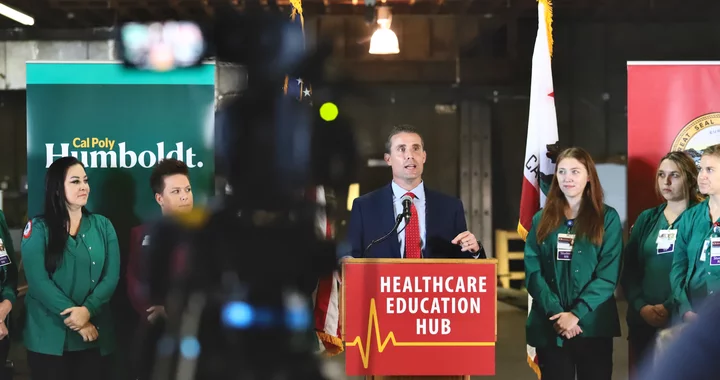
In 2022, State Senator Mike McGuire announced $10 million in funding for a new health care educational hub for Cal Poly Humboldt and College of the Redwoods students. | File photo by Andrew Goff.
###
PREVIOUSLY
###
A new state-of-the-art health care educational hub for both Cal Poly Humboldt and College of the Redwoods, announced in 2022 alongside news of $10 million in state funding, is still in the works, though its planned location has been moved.
When state Senator Mike McGuire first announced the project, on Nov. 1, 2022, he did so from inside the 30,000-square-foot warehouse on Samoa Boulevard, southeast of downtown Arcata and more than a mile and a half from the Cal Poly Humboldt campus.
In an update provided to the Outpost earlier this week, Cal Poly Humboldt Communications Specialist Melissa Hutsell explained that, as a result of the dramatic recent increase in construction costs, the Healthcare Education Hub’s location has been shifted to the Stewart Building, at 1125 16th Street.
Built as a school exactly 100 years ago, the Stewart Building will be cheaper to renovate in part due to lower structural and fire protection system costs compared to the Samoa site, Hutsell said via email. Located across the street from Arcata High, it’s also closer to Cal Poly Humboldt’s main campus, the Foster Road parking facility and community amenities. And there will be opportunities to collaborate with local high school programs.
Once up and running, the educational facility will be used to train health care professionals such as nurses, psychiatric technicians, EMTs, scrub technicians, respiratory therapists, radiology technicians and more. In announcing it two years ago, McGuire said it will be “the most modern health care learning lab between the Golden Gate Bridge and the Oregon border.”
Hutsell said the project remains a priority for Cal Poly Humboldt, College of the Redwoods and other community partners.
“Since embarking on the project, we’ve continued to build partnerships in our local healthcare system, learn more about innovation and modern healthcare, and work through the design of a new facility with Smithgroup Architects,” she said.
We asked the university communications office for a timeline of construction and completion but did not hear back by the time of this post’s publication. We’ll update when we do.
BOOKED
Yesterday: 11 felonies, 14 misdemeanors, 0 infractions
JUDGED
Humboldt County Superior Court Calendar: Friday, Aug. 28
CHP REPORTS
No current incidents
ELSEWHERE
RHBB: Police Chief Talks About Online Reporting as Another Option for the Eureka Community
RHBB: Forest Service Announces Hiring for Fire Positions for 2027
RHBB: The HDNL transitions to new League Names
Governor’s Office: Governor Newsom statement on compromise to address wildfire risk, support fire survivors, and create stronger accountability
Humboldt Sheriff, District Attorney Commit to Uphold Local, State Sanctuary Policies That Protect Undocumented Residents From ICE
Isabella Vanderheiden / Friday, Jan. 17, 2025 @ 3:28 p.m. / Immigration , Local Government
###
At a public meeting last night, Humboldt County law enforcement officials vowed to uphold local and state sanctuary policies aimed at protecting undocumented people from deportation.
“I will be very, very clear here. I will follow our state law, our state ordinances [and] our county ordinance to the T,” said Humboldt County Sheriff William Honsal. “That’s my job … and I just want to reaffirm that we have been following [the Humboldt County Sanctuary Ordinance] since it’s been in place.”
Members of the Sanctuary Standing Committee of the Humboldt County Human Rights Commission convened a public meeting on Thursday to discuss the status of the local sanctuary ordinance, which prohibits local law enforcement agencies from cooperating with federal immigration officials, and what protections it may offer undocumented people once President-elect Donald J. Trump takes office.
The incoming administration’s mass deportation plans have triggered anxiety among immigrant communities, prompting rampant misinformation on social media and false reports of U.S. Immigration and Customs Enforcement (ICE) sweeps in dozens of California cities, including Eureka.
Speaking at last night’s meeting, Humboldt District Attorney Stacey Eads said the county sanctuary ordinance and state sanctuary laws “remain in place,” emphasizing that local law enforcement does not communicate with or assist federal immigration officers. “I hope that can somehow address the real fears that I suspect folks have regarding potential changes within the federal government,” she said. “We will continue to do what we’ve been doing.”
However, there are exceptions for people who have been convicted of serious and violent crimes. In such cases, “some level of communication” with federal immigration officials can occur, Eads said.
One meeting attendee asked if the federal government could pressure local law enforcement “into complying with their objectives” through a lawsuit. Eads acknowledged that “all sorts of lawsuits can be filed” but said there’s no way to tell whether they would be successful.
“That’s a whole other question, and that’s really not what guides me as your district attorney,” she said. “My job is to enforce the laws and uphold the Constitution of both the United States and the State of California, and to ensure that I do everything I can to enhance public safety here in the County of Humboldt. I intend to follow the law, and as the law now states, there are limitations in terms of what sort of interaction or assistance that law enforcement can engage in … with federal immigration officers and officials.”
Honsal took a similar stance, emphasizing that his “primary job” as sheriff is to enforce local and state laws, not federal law. “I have no jurisdiction over federal law enforcement here,” he said. “I cannot enforce federal law. That’s not my job. … [The federal government] can’t necessarily put any pressure on me because they can’t force me to do anything that’s outside of my ability to do.”
Another person in attendance asked if local law enforcement has the ability to verify whether or not ICE is conducting a local sweep. Honsal reiterated that federal immigration officials do not tell local law enforcement when they’re coming to town, which can make it difficult to dispel rumors.
“Before the sanctuary ordinance was in place … we had open dialogue with ICE,” he continued. “Every time they came into town, I was able to call them up, talk to their local agents and they were able to tell me what’s going on. They actually told me when they were coming into town and it was very helpful. … If they do plan on coming here, I would still hope that they would call us but I don’t have any guarantees that they would.”
In years past, a call from ICE was usually triggered by a recent arrest, Honsal said. When a person is booked and fingerprinted at the local jail, their information is transmitted to federal law enforcement and immigration authorities. If the person in custody is wanted for an immigration violation, the feds will ask for them to be held on a detainer.
“We do not [currently] honor that hold,” Honsal said. “We do not hold anyone beyond what their stated charges are keeping them in custody for.” The only time the sheriff’s office will release an individual to ICE is if they have been previously convicted of a serious or violent crime, he added.
Responding to a question about potential ICE sweeps at local schools, Honsal emphasized that federal immigration officials are prohibited from conducting enforcement operations in certain areas, including schools, healthcare facilities and places of worship. (A full list of protected areas can be found at this link.)
“I can tell you right now that students are safe,” he said. “I don’t think there should be any concern that ICE is going to show up and randomly start asking people who they are and whether or not they’re in the country legally. I know it’s hard to offer reassurance to people when it’s something that I have no control over. … I don’t want people to unnecessarily stress or be in fear. We want people to feel comfortable living here and being in Humboldt County, knowing that law enforcement and our government is there to support everyone here.”
After about two hours of discussion, the committee unanimously voted to send a letter to the Humboldt County Board of Supervisors “urging cautious compliance.” (It wasn’t exactly specified what the committee will urge the board to comply with, or what it should be cautious about.) The board will discuss the letter and the county’s sanctuary ordinance at an upcoming meeting on Feb. 4.
Click “play” on the video above to listen to the full discussion.
KIEM Sold Again! The Christian Cowboys Have Sold the Local NBC and CBS Affiliates Down the River; New Owners Say They are Big Believers in the Local Mission
LoCO Staff / Friday, Jan. 17, 2025 @ 2:22 p.m. / Media

A very Humboldt-centric interstitial title card produced by Redwood News. Via Zeam.
PREVIOUSLY:
###
Remember just a couple of years back, when a company named Imagicomm came in and bought local television stations KIEM and KVIQ — those stations that air the locally produced “Redwood News” programs and are otherwise affiliated to the NBC and CBS networks, respectively?
Those folks were most famous for their cable channel, INSP, which features almost total Cowboy programming and used to belong to Jim and Tammy Faye Bakker.
Well, here comes news that these Imagicomm pardners have decided to mosey on down the road after only a couple of years, selling our stations — and another couple in Medford — to a different media conglomeration called Marquee Broadcasting.

Now, this Marque Broadcasting thing projects a very different corporate vibe! Their (trademarked) slogan, as you can see in the accompanying graphic, is “Because Local Matters.”
Here’s an excerpt from their mission statement, which you can find at the website linked above:
Marquee Broadcasting is a family-owned, woman-led, group of television and radio stations intended to serve local communities. Since 2013, Patricia and Brian Lane have assembled a team and group of stations that have won prestigious awards, both nationally and locally, for their television and news production.
…
Our focus is on the smaller markets, where our community involvement can mean the most, and make the biggest difference. Our trademark motto is “because local matters.” In a world of divisive national media, we believe the need for trusted, neutral news has never been greater.
Pretty cool, as far as corporate mission statements go!
Reached this afternoon, KIEM/KVIQ general manager Jenny Olszewski told the Outpost that she hadn’t yet had the opportunity to meet with the new ownership, but she liked the fact that the conglomerate mostly operates in small markets.
“We’re excited about the new ownership opportunities,” Olszweksi said.
Interested in the ins and outs of this deal? Well, no dollar figures were announced but you may find very slightly more info in this article at the TV News Check industry publication.
New Construction Projects Highlighted at Arcata City Council and State of the City Address
Dezmond Remington / Friday, Jan. 17, 2025 @ 7:55 a.m. / Government

Arcata City Manager Merritt Perry gives his state of the city address. By Dezmond Remington.
New apartments, roundabouts, trails and buildings all over Arcata are coming in the following years, said speakers at the Arcata City Council meeting on Wednesday and yesterday’s State of the City Address.
Several of the most significant include the Sunset Avenue Interchange Project, which will turn three intersections along Sunset Avenue into two roundabouts. City manager Merritt Perry said Arcata received a $15 million RAISE Grant from the U.S. Department of Transportation last week to build it. Construction starts in 2026.
The Annie and Mary Trail, a 3.5 mile path built on an old railroad bed traveling from West End road through downtown Arcata and into the marsh, will begin construction this year and finish in 2026. It’s a project that’s been decades in the making, Perry said, and involved reading original land deeds from the 1800s written in longhand cursive.
“This is going to be incredible,” Perry said. “To bring the Mad River, and ultimately Blue Lake and Arcata, taking all of their pieces all the way to the extent and beyond city limits, both on the Bay Trail and here.”

The graph the Community Development Department shared at the city council meeting.

Cal Poly Interim President Michael Spagna (left) and VP Michael Fisher (right) address the crowd. By Dezmond Remington.
At Wednesday’s city council meeting, officials from the Community Development Department said that their efforts to build affordable housing were going well, having met their goals for building “very low” and “moderate” income housing and coming five units short of meeting their goal for “low” income housing. However, only 48% of new units for “above moderate” income housing had been built.
Cal Poly Humboldt’s behemoth Craftsman’s Mall project is also projected to open this fall semester three months ahead of schedule, said associated vice president Michael Fisher. It will house over 900 students. Fisher emphasized their efforts to connect the project to the rest of Arcata and said the Annie and Mary Trail would be a big part of that.
There’s also hope it’ll open up some more single-family homes in Arcata.
“This is a project that will be exclusively housing students, but as we all know there’s a lot of single-family homes that are tied up in the rental market right now,” said Community Development Department director David Loya at the council meeting. “It’s possible that this project could have an effect on loosening some of that up for single-family ownership.”
The project also being renamed the “Hinarr Hu Moulik” (pronounced hi-NAD HU ma-LEEK), which according to Fisher is the Wiyot name for the project.
Another new building in the works on campus is the Housing, Dining, and Health project, which will have dining options and freshman-only housing. It has a budget of $180 million, and will open in Fall of 2029.
Fisher also said that the Campus Apartments dorms are slated to be destroyed this summer. The dorms are famously moldy and unpopular, and their demise has been on the docket for several years.
“[They’re coming down], I’m happy to report,” Fisher said. “That usually gets a lot more applause on campus. But it’s a big deal for us, making sure that we can replace our older housing stock with more safe, new, and comfortable housing for our campus.”
LA Will Need Workers to Clean Up After Fires. It Can Be a Dangerous Job
CalMatters staff / Friday, Jan. 17, 2025 @ 7 a.m. / Sacramento

Day laborer Oscar Hernandez, right, cleans up vegetation debris south of the Altadena Eaton Fire burn area in Pasadena on Jan. 15, 2025. Photo by Joel Angel Juarez for CalMatters.
###
Story by Alejandra Reyes-Velarde and Jeanne Kuang
###
Anabel Garcia’s eyes burned and her breathing was labored and dry as she cleared debris from burned down properties in Sonoma County.
In late 2017, the Tubbs Fire had just scythed its way through towns and crops and Garcia, a vineyard worker, was out of a job. So she joined on with a contractor providing post-fire cleanup services. But that proved painful and dangerous.
“We were sick with throat and skin problems,” she said, of herself and the scores of other immigrant workers who took cleanup gigs in the aftermath of the fire. “There were many consequences we had later, in order to keep working.”
Garcia was cleaning up after what was, at the time, the most destructive fire in California history, which killed 22 people and torched 5,600 structures. The Palisades and Eaton fires that started last week have already caused nearly double that damage and as Los Angeles turns its eye toward recovery, worker advocates and state regulators are concerned about the potential hazards to cleanup workers like Garcia.
The cleanup is essential: The debris must be cleared and the ash-covered houses cleaned before any reconstruction is possible. Much of that work will fall to a cadre of immigrant laborers.
Some are already employed as housekeepers and may be asked by homeowners to clear ash from a damaged house, workers’ advocates said. Others will likely be the gardeners, handymen and other domestic service workers reeling from lost income during the fires, available for work.
“As those big areas of the city that have been impacted get opened up and handed back to property owners, those workers are going to be, no question, in massive demand,” said Kevin Riley, director of the Labor and Occupational Safety and Health program at UCLA. “They’re a critical backbone to reconstruction efforts.”
Fire recovery workers can face numerous hazards, including structurally unsound buildings, toxic gases, exposed electrical wiring, cancer-causing chemicals and ash, soot and dust which can damage the lungs when inhaled, according to the state Division of Occupational Safety and Health.
State environmental agencies usually remove toxic substances that have seeped into the ground, and certified contractors are required to mitigate asbestos and lead risks, Riley said. Those workers tend to be trained for the hazards.
But he’s concerned about anyone hired for a less formal cleanup job, whether directly by a homeowner or by one of a growing number of loosely regulated cleanup-and-recovery contractors that chase climate-driven disasters across the country.
Mike Wilson, senior safety engineer at Cal/OSHA, told the Occupational Safety and Health Standards Board in a public meeting on Thursday that the agency is planning to do outreach about the risks of those jobs.
“We’re also paying attention to the need for getting in front of the next phase of this incident, which is going to be contractors moving into these areas, and what we’ve seen historically, hiring day laborers to do cleanup and salvage work, and often with little to no protection,” Wilson said.
Safety training
On Tuesday morning, day laborers and community volunteers mingled at the Pasadena Community Job Center. The day laborers, who typically wait for work requests from homeowners or contractors at Home Depots or street corners, were instead preparing to lead efforts to clean up the debris left by strong winds.
Dozens of men and women shoveled, raked and swept neighborhood streets where winds had topped over trees, branches and debris that could spark or carry embers. By the end of the day, they had filled a convoy of 15 dump trucks with debris.
The National Day Laborer Organizing Network, which runs the job center, helped organize the volunteers from the community and from throughout the county to clean up throughout the week. The effort highlights the role immigrant workers play helping their communities recover from disasters, said Manuel Vicente, director of the network’s Radio Jornalera program.
“It was a way to respond to the rhetoric about immigrants happening now, the rain of lies about immigrants that have been stigmatizing us,” he said. “That we’re a community that if someone falls, we extend a hand to help them up.”
In anticipation of its members being picked up for cleanup jobs, the network has deployed an OSHA-certified trainer at the job center to teach workers how to identify hazards in burned homes. It also plans to send staff to local Home Depots to hand out pamphlets and educational materials to day laborers.
The network has done similar training in hurricane-battered regions on the East Coast and in Texas and Louisiana.
Officials at the LA County Department of Public Health have been distributing N95 masks to workers centers.
Alice Berliner, director of the department’s office of worker health and safety, pointed to surveys of gardeners, housekeepers and other domestic service workers conducted by advocacy groups after the 2018 Woolsey Fire in Malibu.
“Based on the fact that they were exposed to toxic debris, handling unsafe materials without proper equipment,” Berliner said, “we’re very likely to see a similar dynamic with this upcoming cleanup.”
Cleaning up
In Sonoma County after the Tubbs Fire, Christy Lubin remembers two kinds of disaster responses.
In one, the state sent specialized contractors to remove toxic substances from charred homes. Most of the workers who came to the Graton Day Labor Center in the county’s wine country were shut out from those jobs, lacking the state-required hazardous material certifications, said Lubin, the center’s director.
In the other, the town flooded with other reconstruction contractors from around the country.
“(The contractors) were bringing in a lot of immigrant workers, especially a lot of women, who got hired to go in and do especially interior building cleanup, smoke damage cleanup,” Lubin said. “Those contractors were picking up groups of workers, meeting them on a corner, driving them in a van to these workplaces where they were sent into these buildings without the proper training, without the proper personal protective equipment.”
It can be tough, said Riley of UCLA, to enforce safety regulations in those disaster zones.
“It’s a bit of a wild west situation at times,” he said. “Just because of how massive the work is and how varied the worksites and how spread out they are.”
Garcia, the former vineyard employee, said she found her cleanup job through a Facebook ad for a restoration contractor that said it was working for an insurance company. Hundreds of workers who needed income after the fires responded, she said, and the contractors didn’t seem to care about their immigration status.
The workers boarded 15-passenger vans to burned homes, businesses and even public buildings, she said. Sometimes she worked 10-hour days. She recalled being paid somewhere between $13 and $15 an hour.
For a few weeks, Garcia cleaned a hospital clinic strewn with blood and syringes before then cleaning homes, clearing and bagging up ashes and debris.
“Everything was covered in ashes,” she said. “Everything you saw was black.”
She said workers were given gloves and a helmet, but nothing to protect their bodies or cover their shoes. They only received masks the first two days, then had to reuse them, she said.
‘What we need is to work’
Experiences like those drove Garcia — now a house-cleaner and a board member at the day labor center — and other worker advocates to push California lawmakers to better protect workers.
The state has passed new regulations requiring employers to protect workers from wildfire smoke or prohibiting them from forcing workers to be in evacuation zones.
And in July, some domestic workers will be newly covered under state workplace safety laws. There’s an exception for those hired privately by homeowners, but Cal/OSHA spokesperson Daniel Lopez told CalMatters in an email that anyone who is hired for cleanup — no matter the employer — is already covered by a slew of wildfire-specific safety regulations.
A state advisory committee on domestic labor in 2022 recommended against hiring people commonly employed for household or yard work to clean up soot or ash after a wildfire, “as this may require specialized equipment and training.”
It doesn’t erase their willingness to do the jobs.
On Tuesday morning in Pasadena a handful of day laborers waited for gigs at the corner of Villa and Fair Oaks, three miles south of homes the Eaton Fire had burned one week earlier.
They perked up as cars slowed past the street. Work has been slow all season, they said, even before the fires destroyed many household jobs.
Marcelo Esteban said he knew that there might be work coming to clean up or rebuild burnt down communities, though he expected homeowners to turn to day laborers only after they’ve gotten help from insurance companies or the government.
He doesn’t think much about the risks that work might carry.
“If someone needs help, we can use masks,” he said. “Someone is going to do the work anyway. What we need is to work. It doesn’t matter what.”
###
CalMatters reporter Wendy Fry contributed to this story.
CalMatters.org is a nonprofit, nonpartisan media venture explaining California policies and politics.
Gavin Newsom Has Grown California’s Government to Record Size. Now He, Too, Is Selling ‘Efficiency’
Alexei Koseff / Friday, Jan. 17, 2025 @ 7 a.m. / Sacramento

Gov. Gavin Newsom addresses attendees during his inauguration for a second term at the Plaza de California in Sacramento on Jan. 6, 2023. Photo by Rahul Lal, CalMatters
It’s not only Washington, D.C., where “efficiency” has become the buzzword du jour.
With California facing an uncertain fiscal future, Gov. Gavin Newsom made his own pitch for a leaner state government last week as he previewed his annual budget proposal. Touting billions of dollars in savings from eliminating empty positions and scaling back spending on everything from travel to printing, the Democratic governor compared his efforts to the Department of Government Efficiency, the incoming Trump administration’s push to slash costs across the federal government.
“We’re all taxpayers. We all want to make sure our money is being well invested, not wasted. We want more efficiency,” Newsom told reporters during a stop at the Stanislaus State campus in Turlock.
“Our D.O.G.E. is spelled O.D.I.” he said, referring to the Office of Data and Innovation he created in 2019 to improve public services through technology.
The concept isn’t entirely unfamiliar for Newsom, who has been interested in reinventing government since he served in San Francisco City Hall — and even once wrote a book about it. But his approach as governor has been nearly antithetical to D.O.G.E., which under the leadership of entrepreneurs Elon Musk and Vivek Ramaswamy aims to trim trillions of dollars of what they consider waste from the federal budget by cutting programs and dismantling entire agencies.
Instead, in his six years in the governor’s office, Newsom has steadily guided California’s government to expand its mission and scope: launching flashy initiatives, creating new departments and offering more services to more people, even during periods of deficit. The number of employees per capita — a measurement of the size of state government compared to the population it serves — has reached its highest level in more than five decades of tracking by the state Finance Department.

Even Newsom’s own office has more than doubled in size. At the end of 2024, the governor’s office employed 381 people, according to payroll data provided by the State Controller’s Office, compared to 150 at the end of 2018, before Newsom was sworn in.
It’s another reflection of how Newsom’s governing philosophy contrasts sharply with President-elect Donald Trump and his allies, who treat government as a burden and an obstacle to their ideological goals.
“Gov. Newsom believes there are a lot more societal problems that government should be in the middle of,” Keely Bosler, who served as finance director during his first term, told CalMatters.
Marybel Batjer, who was Newsom’s first government operations secretary and launched the Office of Data and Innovation, said he has expanded state government not because he is an “old dog Democrat who thinks government is good,” but because he wants to help people. She said D.O.G.E. should aim to make government more effective, rather than simply cutting it back.
“You won’t save money that way. You will have more people who are homeless. You will have more people who are sicker. You will have more pandemics,” Batjer said. “Elon Musk doesn’t know shit from Shinola about how government works. He’s a little piggy that’s been at the trough.”
The Trump transition team did not respond to a request for comment.
Yet embracing government efficiency, at least rhetorically, could be a boon to Newsom, who has sought ways to moderate his image after a tough November election for Democrats in which the party lost ground with working-class voters.
Ever eager to be on the vanguard of the Democratic Party, especially as he reportedly mulls a future campaign for president, Newsom has embarked on a tour to promote jobs and economic development in communities that voted for Trump. His budget preview last week in Turlock was the latest stop.
As the governor tries to navigate a fraught relationship with Trump going forward, expressing interest in the president’s ideas could also be a way to build a bridge to the federal government, which controls many of the resources that California needs.
“Language is diplomacy,” said Elizabeth Ashford, a communications strategist who has worked for both Democratic and Republican governors in California. “It would be malpractice if there’s no dialogue.”
Newsom’s early tenure as governor coincided with surging tax revenues and then federal aid from the COVID pandemic, which ballooned the state budget by tens of billions of dollars and underwrote an ambitious and wide-ranging agenda. Total budget expenditures are nearly $100 billion more this fiscal year than before Newsom took office.
Some of that money has gone to one-time projects or to extending existing services, whether because of ideology (making undocumented immigrants eligible for health care and free transitional kindergarten available to all children) or necessity (hiring thousands more state firefighters).
But Newsom, known for his “big, hairy audacious goals” and love of making history, has also consistently added programs and positions with entirely new objectives for state government, swelling its ranks as he transformed its role in Californians’ lives.

The impulse was visible on Newsom’s very first day in January 2019, when shortly after being sworn in, he established the position of California surgeon general to address the root causes of health conditions, alongside an executive order that would allow the state to more broadly negotiate with pharmaceutical companies to lower the costs of prescription drugs.
In his first budget a few months later, Newsom created his 50-person Office of Data and Innovation (then known as the Office of Digital Innovation) and spun off a Department of Youth and Community Restoration to focus on supporting young people in the corrections system.
New government infrastructure has followed regularly in the years since. These include:
- A 106-person Wildfire Safety Division in the California Public Utilities Commission, which grew into the Office of Energy Infrastructure Safety at the California Natural Resources Agency, with nearly twice as many funded positions.
- The Department of Finance Protection and Innovation, a reboot of a business oversight department, with dozens of new employees in divisions to combat consumer financial abuse and study emergency financial services technologies.
- A 13-person office of equity and a 14-person disaster cost tracking unit within the Governor’s Office of Emergency Services.
- The Office of Community Partnerships and Strategic Communications, with more than two dozen staff to manage community engagement and public awareness campaigns.
- California’s first chief equity officer, tasked with developing a statewide equity and inclusion framework.
Additional expansions represent major pieces of Newsom’s platform, including his recent battle against the oil industry. In 2023, he strong-armed the Legislature to create the Division of Petroleum Market Oversight within the California Energy Commission, a watchdog to investigate alleged price gouging.
Though he has not followed through on his campaign promise to set up a single-payer system in California, the governor in 2022 did launch the Office of Health Care Affordability, a regulator that aims to slow the rising cost of care. The California Volunteers office has quintupled in size under Newsom to manage his new initiatives to engage young people in community service and climate action.
Even in his latest budget plan unveiled last week, Newsom proposed creating two new state agencies, to oversee housing and homelessness programs and consumer protection programs. Additional details are not yet available, though state officials said these would largely be a reorganization of departments that already exist.
It’s difficult to get a comprehensive picture of how Newsom’s priorities have enlarged state government.
His Finance Department was unable to answer questions about whether several of his biggest and most expensive initiatives added new positions to the state payroll, including CalAIM, a first-of-its-kind overhaul of medical care for low-income patients; Homekey, which funds the conversion of hotels and motels into homeless housing; the trash pickup program Clean California; and CARE Court, a system to push people with mental illness off the streets and into treatment.
“It’s scary to think that (Newsom) thinks we’re doing good. From my perspective, instead of taking shots at the D.O.G.E., he should be taking notes.”
— Republican State Sen. Suzette Valladares
The increase in the workforce is also driven by laws predating Newsom, including a gas tax hike that has funded thousands of new jobs to repair California’s roads.
Conversely, the governor has shrunk some parts of the state government, such as by closing several prisons.
But the overall trend is up. There are 436,435 government positions in the state budget that Newsom just proposed, including at the public university systems, according to the Finance Department, or about 11.1 state employees per 1,000 Californians. That number has increased from 9.5 before Newsom took office — and is a record high going back to at least 1970, when the Finance Department’s tracking begins.
His office did not respond to a question about how efficiency fits into Newsom’s governing philosophy. But a spokesperson provided a list of initiatives from the Office of Data and Innovation “that are building efficiencies across state departments,” including new tools to forecast community water systems at risk of running dry, evaluate housing projects for streamlined approval, and enhance public participation in the permitting process for toxic substance storage.
State Sen. Suzette Valladares, a Lancaster Republican, told CalMatters that it was “laughable” for Newsom to claim California has been a leader in government efficiency.
“It’s scary to think that he thinks we’re doing good,” she said. “From my perspective, instead of taking shots at the D.O.G.E., he should be taking notes.”
She pointed to the underfunded high-speed rail project and homelessness services as bloated spending by Newsom. Republicans have been highly critical that California’s homeless population continues to increase, despite the governor dedicating tens of billions of dollars in additional money to the problem.
“He’s been at the helm of this mess, yet he has the audacity to mock the federal government’s efforts to cut waste,” Valladares said.
Now the trajectory appears to be shifting course. With growing budget deficits projected in the coming years, Newsom has been forced to tighten California’s belt.
His administration has identified about 6,500 vacant positions that it plans to eliminate and imposed a nearly 8% cut to state operations, which it projects will collectively save almost $5 billion.
“We also have an imperative and that is to meet you where you want us to be,” Newsom said at his budget preview event in Turlock. “That’s leaner, just like you have been in your household. Just like I’ve been in mine. We all have to be more efficient.”
“You won’t save money that way. You will have more people who are homeless. You will have more people who are sicker.”
— Marybel Batjer, Newsom’s first government operations secretary
He’s not the first California governor to take this stance — and those previous experiences suggest how difficult it could be to go further, if Newsom wants to. His office did not respond to a question about whether the governor is planning further cuts to the size of state government.
In 2004, then-Gov. Arnold Schwarzenegger, a Republican, commissioned the California Performance Review to overhaul state bureaucracy. The 2,500-page report recommended more than 1,000 steps to shrink the state government and save billions of dollars annually, including consolidating departments and agencies, eliminating 118 boards and commissions, and cutting 12,000 jobs.
Joanne Kozberg, a veteran of a similar “reinventing government” effort under another previous Republican governor, Pete Wilson, co-chaired the California Performance Review. She told CalMatters that, based on feedback to the report, she suggested focusing their work on just 11 main initiatives, but the Schwarzenegger administration wanted to “go big and bold.” Instead, up against tremendous resistance from Democrats to such sweeping changes, Schwarzenegger dropped his plan and moved onto other priorities.
“Here’s the trouble you run into: How do you implement? Every program has a constituent,” Kozberg said. “It takes a coalition of the enthusiastic. Because nobody really wants to give up their authority.”
Kozberg said that, to succeed, you need not just a leader who is devoted to achieving more efficiency, but also champions inside of government.
“It isn’t sexy. It takes knowledge of government,” she said. “You could do it and you should do it, but it’s going to take a lot of tenacity.”
Eight years later, Democratic Gov. Jerry Brown did push through a reorganization and consolidation plan to “make government more efficient,” aided by a political environment in which an economic recession and steep budget deficits were the prevailing concern. It included eliminating 20 departments, offices and boards, merging the state’s personnel agencies and slashing funding for employee travel and cell phones.
Bosler, who served under Brown before working for Newsom, said some of what California governors have done in the name of efficiency is to demonstrate their values to the public — and some of it is just for show. But it’s difficult to eliminate more than a minor part of state government, she said, because the vast majority of money in the budget pays for services, which are much harder to take away from people.
“Government is not the bastion of efficiency. It’s just not what the incentives are,” she said.
Bosler expressed trepidation about Newsom’s latest approach, demanding an across-the-board 7.95% spending cut for every agency and department. Though it’s easier and appears value neutral, she said, that’s not the effect that it ultimately has on Californians.
“There isn’t a real evaluation of whether this is making government better,” Bosler said. “I worry about all the things that are not going to get done.”
###
CalMatters.org is a nonprofit, nonpartisan media venture explaining California policies and politics.
OBITUARY: Andrew James Lamberson, 1970-2025
LoCO Staff / Friday, Jan. 17, 2025 @ 6:56 a.m. / Obits

Andrew James Lamberson
Aug. 22, 1970 – Jan. 3, 2025
Andrew “Andy” James Lamberson was born August 22, 1970 to Fred and Janet Lamberson, he was the baby of the family. He resided in Trinidad, where he grew up, attending Trinidad Elementary and McKinleyville High School. He was a proud member of the Trinidad Rancheria, and also an employee, dedicating 15 years in more than one department. He valued hard work and was a man of many trades.
He enjoyed swimming and spending the day on sandy bar, skiing, traveling, dirt biking and spending time with his family. Andy also had a true passion for wood, usually carving and crafting his art using the wood from local redwood trees.
In 2010 he graduated Teen Challenge, where he then worked as an intern and touched the lives of many. In that same year he took first place in “The Biggest Loser of Humboldt County” a weight loss competition. With his winnings he was able to make memories with his children.
Andy is survived by his high school sweetheart, Amanda Parsons-Lamberson; their four children Miranda Costa (Bryce Costa), Mariah Lamberson (Jared Patrick), Andrew Lamberson and Makailia Lamberson (Quentin Mosier); their 11 grandchildren, Malachi Costa, Taneyah Lamberson, Jarahlyn Patrick, Maivry Costa, Davina Brown, Brylee Costa, Bryker Costa, Mayleigh Patrick, Jannie Patrick, Mirah Lamberson-Patrick and Drew Mosier; his sister, Wendy Lamberson; sister in-law Shelly Luna; aunt Myra Lowe; nieces and nephews Natae Ramos (Manuel Guerrero), Amanda Christensen (Thomas Christensen), Amelia Buck, Luke Martin and Blaine Martin; his close cousins Butch Rindels, Nichole Rindels, JessieAnn Daughtery, Allen Day, Debbie Day, Kim Day and Glenn Quinn; many great nieces/nephews; and his close friends/co-workers.
He is preceded in death by his parents, Fred and Janet Lamberson; brother Fred Lamberson III; nephew Raymond Eacret-Lamberson; cousin Gary Quinn; and his granddaughter’s dad, Dax Brown.
Andy will be forever remembered by his hilarious humor, willingness to help others, big heart and his invincible spirit.
A celebration of life for Andy will be held Saturday, February 1, 2025 at 12 p.m, at 409 Trinity St., Trinidad Town Hall.
Andy’s family would like to thank everyone for the immense amount of love and support through this hard time.
###
“Be on
your guard; stand firm in the faith; be courageous; be strong. Do
everything in love.”
—1 Corinthians 16:13-14.
###
The obituary above was submitted on behalf of Andy Lamberson’s loved ones. The Lost Coast Outpost runs obituaries of Humboldt County residents at no charge. See guidelines here. Email news@lostcoastoutpost.com.


