

‘Ominous, Weird and Laughably Dumb’: Rep. Jared Huffman Recaps Trump’s Second Inauguration
LoCO Staff / Tuesday, Jan. 21, 2025 @ 10:20 a.m. / Government , Politics
After attending President Donald Trump’s second inauguration on Monday, our local congressman, Rep. Jared Huffman, posted the following writeup on his Facebook page (which he lists under the name of his cat, Truman, for algorithmic reasons):
Huffman
Day 1 of Trump 2.0 is off to a predictable start. I attended the inauguration even though I didn’t want to because I wanted to show Republicans that I’m standing my ground and here to do my job. I wanted all of you to know that too. And I just got back from the traditional lunch the new President and VP have with congressional leaders, which is one of my new responsibilities as Ranking Member of the Natural Resources Committee.
None of today’s events were surprising, but it was still surreal to be in such close proximity to all of those tech billionaires, rightwing gadflies and Trump family members. In the spirit of bipartisanship, I’ll say that Carrie Underwood seems genuinely nice, Ted Cruz and I chatted politely about all the Presidents born in 1946 (Bush Jr., Clinton and Trump), and Interior Nominee Doug [Burgum’s] son is a very thoughtful, pleasant and impressive young man who seems to genuinely care about solving the problem of social isolation. People were on their best behavior knowing this was the calm before the storm, which added to the surreal feeling.
Trump’s speech was at once ominous, weird, and laughably dumb — ranging from dark authoritarian threats he is already acting on (e.g., invoking the 1798 Alien and Sedition Acts to justify using our military to deport people), to things we all know he will never do (taking back the Panama Canal, landing a man on Mars during his presidency), to things that are just bonkers (renaming the Gulf of Mexico). That’s going to be the mix folks — we have to focus on the real and dangerous parts and not chase squirrels.
And get ready for extreme gaslighting to justify unthinkable abuses of executive power. With our border silent, Trump declared an “invasion” to justify mobilizing the military for his mass deportation plan. With our oil and gas production/exports at all-time highs, he declared an energy emergency to justify his extreme “drill baby drill” plans. This is the Reichstag Fire playbook: create a crisis and use it to justify waiving laws, claiming emergency powers, and eventually ending democracy. We’re going to see a lot more of this, and we should know where it leads.
I was also struck by the overt Christian nationalism at every turn — continuous invocations of our country’s Christian roots and heritage, celebrating the totally fake history of George Washington kneeling in prayer at Valley Forge, claiming that God spared Trump from assassination so that he could carry out his MAGA agenda, and that God wanted Trump to win the election, etc. The clear message: God now wants all of US to fall in line and do Trump’s bidding. Between the inauguration and the lunch ceremony, there were at least 8 official prayers from a mix of MAGA evangelicals and rightwing Catholics, and one MAGA rabbi (that is how Christian nationalists’ camouflage their antisemitism, allowing a token Jewish voice in order to claim they are for “Judeo-Christian” values — but notice they never say Abrahamic, since that would bring in Muslims). All of this is standard fare these days, but it still makes me want to burn some sage.
I will need more time to parse and process all of the Executive Orders from our Day-1 Dictator, but all of these orders so far are straight out of Project 2025, just as we warned. Later this week, I’ll lead Democrats into the first hearing of the Natural Resources Committee where we’ll lead the fight against Trump’s “drill baby drill” agenda. And, because we have jurisdiction over the US Geological Survey, we’ll be on point for Trump’s plan to rename the Gulf of Mexico. Things are going to be busy.
I’m ready for all of this. Brace for turbulence. My advice is try to stay focused on things that pose direct threats to our values and our communities. Stay off Twitter, tune out the distractions if you can, and feel free to post cat pictures here anytime.
Onward.

BOOKED
Today: 11 felonies, 14 misdemeanors, 0 infractions
JUDGED
Humboldt County Superior Court Calendar: Yesterday
CHP REPORTS
No current incidents
ELSEWHERE
Governor’s Office: Governor Newsom statement on compromise to address wildfire risk, support fire survivors, and create stronger accountability
RHBB: CDFW Announces Angling Closure at Mouth of the Klamath River
RHBB: Humboldt Bay Area Plan Planning Commission Workshop on Thursday, Sept. 3
Trump Wants to Deport Immigrants Accused of Crimes. California Sheriffs Could Make That Easy
Nigel Duara and Tomas Apodaca / Tuesday, Jan. 21, 2025 @ 7:39 a.m. / Sacramento
California sheriffs once again find themselves navigating a difficult political calculus on immigration as President Donald Trump begins his second term.
They can enforce a state sanctuary law that some of them personally oppose, or they can roll out the welcome mat to federal immigration enforcement authorities whom Trump has promised will carry out the largest deportation program in American history.
Some California sheriffs have pledged not to cooperate with federal immigration enforcement authorities, based on their own policies or laws passed by their counties, and will forbid immigration agents from using county personnel, property or databases without a federal warrant.
Others said that while California law prevents direct cooperation with U.S. Immigration and Customs Enforcement, immigration authorities are free to use their jail websites and fingerprints databases to identify people of interest.
“Several state leaders would prefer we do not have any communication with ICE, however, that is not what (the laws) say,” said Fresno County Sheriff John Zanoni. “ICE may access jail bookings through our public website and fingerprint information put into the national database to identify any incarcerated persons of interest to them.”
And one sheriff, Chad Bianco of Riverside County, said he would work around California law, if he could, to ensure more people are deported.
CalMatters attempted to contact all 58 sheriff’s offices in California. Twenty-seven responded by Friday afternoon. Most sheriffs who responded simply said they will follow state law, spelled out in a bill passed during the first Trump administration that limited California law enforcement participation in immigration enforcement.
Before Trump’s inauguration today, immigration raids in the Central Valley earlier this month already had undocumented migrants and their families concerned about massive enforcement sweeps on immigrant-dependent industries like agriculture. Trump and cabinet officials from his first term have pledged “targeted arrests” of undocumented people, and view local law enforcement as “force multipliers” of that effort.
California sheriffs could play an influential role in determining whether someone gets arrested and deported because they manage the state’s local jail system, where people suspected of committing crimes are held while awaiting trial. A bill named after a slain Georgia nursing student that is expected to pass in Congress could enhance sheriffs’ sway over immigration enforcement by prioritizing deportations of undocumented immigrants arrested on suspicion of burglary and shoplifting, regardless of whether they’re convicted.
The majority of sheriffs who responded to a CalMatters inquiry said they were balancing their duties with their need for cooperation from frightened immigrant communities. They worry those communities will shun all law enforcement if they fear deportation based on their immigration status alone.
“You don’t know how many calls I’ve gotten from Hispanics in my area that I’ve known, I’ve grown up with, they’re all worried about family members,” said Mendocino County Sheriff Matt Kendall. “I’ve got in-laws through my children calling me because they’re concerned, but let’s look at the ability to actually enforce this crap.
“Hell, I’ve got 50 deputies and I can barely keep a lid on crime in a county of 90,000. How are these guys coming out here with all of this ‘We’re gonna deport 10 million people’ or something. No, that’s ridiculous. It’s not gonna happen.”
Kendall said he undoubtedly has people in his community who have committed serious crimes and are also undocumented, and wants those people arrested.
“If they want to go out and deport all the criminals, knock yourselves out, but let’s pick and choose what’s important and what is not,”he said.
One consistent theme: Every sheriff who responded to CalMatters said immigration enforcement isn’t their job. But some of them went further, pledging not to honor immigration holds, while others said they will neither “prevent nor hinder” immigration enforcement agents from doing their jobs.
Sanctuary law divided California sheriffs
When Gov. Jerry Brown signed legislation making California a sanctuary state in 2017, barring police from inquiring about people’s immigration status and participating in federal immigration enforcement, the reaction from the Trump administration was immediate.
The administration cut off hundreds of millions of dollars in law enforcement grants to sanctuary cities that limited cooperation with federal immigration authorities. The Biden administration restored the grants in 2021.
Several California sheriffs were outspoken critics of the sanctuary law during Trump’s previous presidency. A group of San Joaquin Valley sheriffs traveled with Trump to the border in 2019, where they endorsed his immigration policies.
One of them, Tulare County Sheriff Mike Boudreaux, said he doesn’t agree with California’s sanctuary law, and said any governor who supports it should be removed from office.
But Boudreaux said he wants to distinguish between targeted enforcement of “felonious” people, which he supports, and massive immigration raids.
“Now, if they come into the area saying, ‘Hey, we’re just going to scoop up as many people as we can that are here illegally,’ we’re not going to do that, because (we) have a community to serve,” Boudreaux said. “If you can separate the difference between that, you should be able to see what I mean.”
Boudreaux pledged to keep working with federal immigration authorities within the parameters of California law.
“(If) I have a federal counterpart that comes into my county asking for assistance, I’m going to give it to them,” Boudreaux said.
Bianco, the Riverside County sheriff and one of Trump’s most outspoken allies in California, took office in 2019. Now, Bianco said he’s ready to work around state law to step up immigration enforcement.
“I will do everything in my power to make sure I keep the residents of Riverside County safe,” Bianco said to KTTV-TV in November. “If that involves working somehow around (California’s sanctuary law) with ICE so we can deport these people victimizing us and our residents, you can be 100% sure I’m going to do that.”
Immigrant advocates watching sheriffs
Eva Bitran, Immigrants’ Rights project coordinator at the American Civil Liberties Union of Southern California, said her organization would be watching for violations of the state sanctuary law, which would typically involve police calling federal immigration authorities at jails or during arrests.
That’s what happened to Daniel Valenzuela in 2019, when Corona police interrogated him about his immigration status during a traffic stop, then transferred him to U.S. Customs and Border Protection agents. Valenzuela was then deported.
The ACLU sued the city of Corona, which paid Valenzuela a $35,000 settlement.
“Our expectation is that the sheriffs will follow the law,” Bitran said. “We will be watching to ensure they do so.”
In 2020, Los Angeles County banned the warrantless transfer of inmates to immigration enforcement custody. Los Angeles County Sheriff Robert Luna said his department does not honor immigration detainers unless presented with a federal warrant.
Between 2018 and 2023, the last date for which data was available, there were 4,192 transfers of people from California jails to immigration authorities.
But it’s street enforcement that has people worried in both the Central Valley and downtown Oakland, where the Alameda County Sheriff’s Office is already trying to tamp down rumors of immigration raids.
“We want to assure you that this information is false,” said Alameda County Sheriff’s Sgt. Roberto Morales. “This information has caused panic and anxiety in our communities.
“While we respect criminal warrants issued by a judge, Sheriff’s Office personnel do not comply with administrative immigration warrants. Importantly, we believe that local law enforcement involvement in ICE deportation operations undermines our community policing strategies and depletes local resources.”
###
CalMatters reporter Cayla Mihalovich contributed to this story.
CalMatters.org is a nonprofit, nonpartisan media venture explaining California policies and politics.
PASTOR BETHANY: On Earth As It Is In Heaven
Bethany Cseh / Sunday, Jan. 19, 2025 @ 7:05 a.m. / Faith-y
Dear Christian,
Driving down 101 the other day, I noticed a bumper sticker I’ve seen for years. Attempting to seem relevant, written in an edgy font circa 2002 is NOTW: Not Of This World. We Christians love to say our home isn’t here on earth. We say things like, “Our citizenship is in heaven.” We’ve taken ancient texts written thousands of years ago to a culturally specific people and place and arrogantly assume it is written to us. To Americans. To our time and our place and our whiteness and privilege and religious constructs. And that, because our time on earth is meaningless beyond “saving souls for heaven,” there’s a mentality that earth is simply a waiting room for the sweet bye and bye because it’s all gonna burn anyway.
Many of us have witnessed two opposite, but still damaging, Christian realities: NOTW and 7 Mountain Mandate, or Christian Nationalism. One says hunker down and wait it out. The other says to claim dominating Christian authority in every place of power. Both are heresy and neither was modeled by Jesus.
If either of these realities were the case, why did Jesus heal those who were suffering? Why did Jesus ask people to live at peace with each other? Why did Jesus implore his followers to take care of the most marginalized and vulnerable: the widow, the orphan, the immigrant, the incarcerated, the poor? Why did he insist we forgive each other and love our enemies and pray for those who cause us harm? Why didn’t Jesus seek positions of political or religious power to shift the cultural climate of the day? Jesus seemed to model and suggest, instead, that the love God has for a person could transform their response to themselves and everyone else into a greater capacity to love here on earth as it is in heaven.
Monday is full of mixed emotions. It’s Martin Luther King Jr. Day and a new president will be inaugurated. On one hand, it’s a celebration of a continued longing for justice and the work of seeking liberation. It’s the collective naming of past sins and a hopeful, bright future. It’s a declaration to never go back to days of racism and fear. On the other hand, we’ll be gaining a new president who, for many people, represents the opposite of Martin Luther King Jr.. Depending on many different variables (ethnicity, gender, sexuality, race, faith, etc.), you might feel grief and anger or you might feel hope and pride.
Most of us feel the darkness surrounding us. We have school shootings, debilitating medical debt, the fear of deportation for some neighbors, mass incarceration, climate change denial, fires burning LA, wars and rumors of wars, and your own personal relationship / health / family / financial difficulties. So do we hunker and numb through these next four years or do we name it and claim it in White Christian superiority? Do we need to post the Ten Commandments on school walls and cross our fingers in the hope it will help our kids not kill each other?
Maybe if we started living out the ways of Jesus instead of enforcing our religious beliefs upon others, we might just be doing what we pray for most weeks: May Your will be done on earth as it is in heaven. On earth. Today. This prayer demands we stay connected to those who suffer. It demands we never stop working for justice and liberation for the oppressed. It demands we stop clutching our pearls saying, “How did this happen? How did we get here again?” It demands, like Martin Luther King Jr., though we might not get to see the poor fed, the houseless housed, the immigrant wanted, the families not torn apart, the earth healed, the sick cared for, the incarcerated humanized in our time, we never stop seeking and working and healing and hoping.
We just celebrated Epiphany in the Christian Church calendar. This is the Biblical story of the Magi, or Wise Men, who follow a star to seek a foreign savior in a foreign place. It’s a story of light breaking forth in darkness, where oppressive government powers didn’t have the final word.
The Magi were, most likely, Zoroastrian priests from Persia who could interpret dreams, read the stars, and write horoscopes. They were wealthy and well respected people who sought the gods, recognizing that spirituality could not be contained within one path. The Magi were pagan people who didn’t know the Jewish God in the ways one would think they would need to know. They don’t seem to believe the right things or worship the right way or say the right prayers according to our good doctrine. They worshipped all kinds of gods and would be, as I’ve heard, the tarot-card reading, dream interpreting, incense burning, pachouli-smelling, new age yoga instructors of today stating that you are your own goddess. These are people who live open-heartedly towards spirituality in many forms and this softness of heart led them to follow a star in search of a savior.
This all seems a little offensive to the political and religious boxes I was handed and then expected to perpetuate.
It seems like God isn’t only interested in the Republican or Democrat minivan driving, shirt-tucked-in people with nice marriages and nice kids and a nice 401Ks that indicates a nice life and a nice Christianity. God shines a star above the one overlooked and excluded beckoning them to come a little closer to the beauty of Jesus. God turns the lights on for the Muslim and the Christian, for the trans youth and Southern Baptist, for the addict and the abstainer, for the far left and far right, for the houseless, refugee, immigrant, widow, orphan and for the wealthy in Beverly Hills. Whoever you think of as “the other,” that’s who God is for and invites us to always move with compassion and justice. We are not to get distracted by political leaders claiming you must be afraid of “the other.”
“The arc of the moral universe is long, but it bends towards justice,” King once announced. For some of us, it might feel like we’re taking a big step back on Monday, but maybe enough of us can slowly push forward once again to get even more ahead. Maybe this is the time we look honestly at who “the other” is and instead of being afraid, we start working alongside them for liberation and justice, trusting God is with us in this work. Isn’t love a verb anyway?
On earth as it is in heaven.
The power of the people. The power of a crucified and risen Christ. The power of justice.
May it be so.
With (hope, love, and justice),
Pastor Bethany
###
Bethany Cseh is a pastor at Arcata United Methodist Church and Catalyst Church. Follow her on Instagram.
TO YOUR WEALTH: Wall Street’s 2025 Investment Forecasts: Why They’re Probably Wrong
Brandon Stockman / Sunday, Jan. 19, 2025 @ 7:05 a.m. / Money
No one knows the future.
But every single year, Wall Street strategists like to pretend they do.
This year is no different.
Yardeni Research summarizes several year-end forecasts for the S&P 500 (the stock market index for the largest US companies) that range from an annual investment return of essentially 0% to 18%.¹
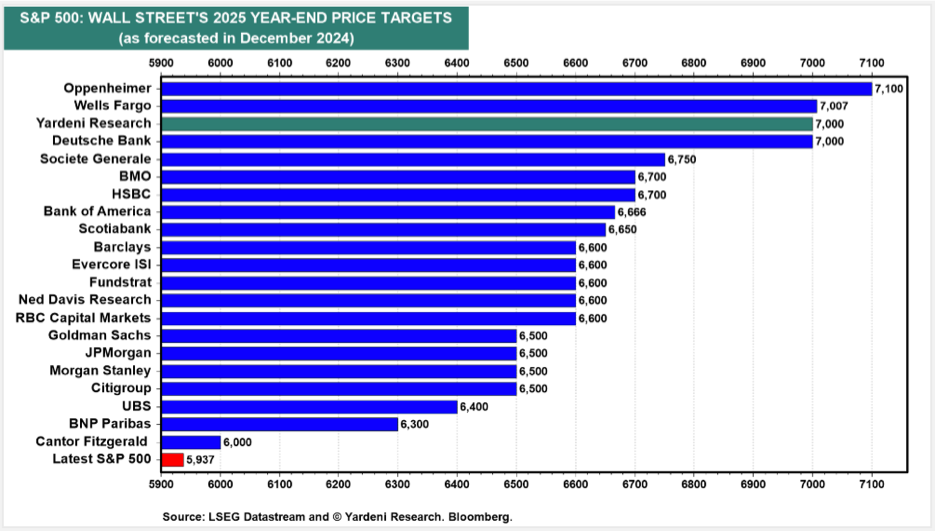
Bloomberg puts together a summary of even more 2025 investment outlooks. They report the overall findings of over 50 financial institutions for the US stock market:
Pretty much every institution warns investors not to expect another year of equity returns topping 20%, just like they did a year ago. But few are ready to call an end to the artificial intelligence-fueled stock boom. BNY believes “AI’s role in the world will surpass that of other technologies that propelled earlier periods of tidal change.” While no one else quite matches that bullishness, many expect gains to broaden as adoption of the tech spreads.²
Last year, the S&P 500 had its second year in a row of being up over 20%.
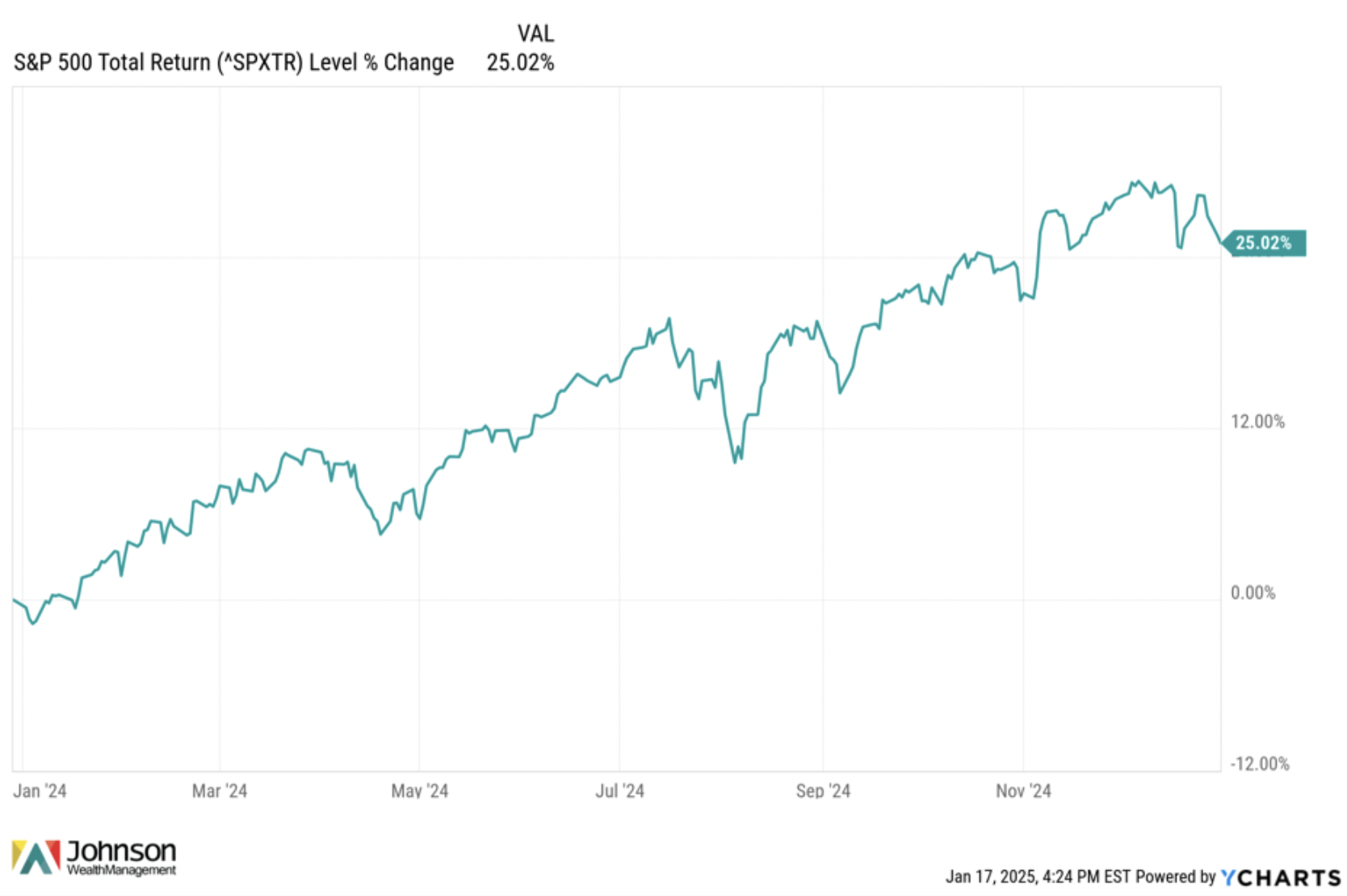
How did the investment forecasters perform in 2024? Not nearly as good as the market.
Here is a chart from Ritholtz Wealth Management with data from Bloomberg³:

Strategists were nowhere close to predicting how stocks performed.
This kind of thing led Warren Buffet, who is ironically called the Oracle of Omaha, to write things like this back in 1993:
Even now, Charlie and I continue to believe that short-term market forecasts are poison and should be kept locked up in a safe place, away from children and also from grown-ups who behave in the market like children.⁴
We still haven’t learned our lesson. Human beings love prophets and experts, especially when they mix and talk about money.
Furthermore, Wall Street enjoys anointing individuals who got one crisis right in the past to make headlines for predicting what may go wrong in the future.
Michael Burry, who foresaw some of the 2008-2009 financial crisis, illustrates this. Since then, he has made several calls about the stock market, that have proved outrageously wrong.⁵

Let’s not pick on an individual like Burry too much.
Wall Street firms, big banks, and individual traders aren’t the only ones bad at predicting the future.
The Federal Reserve is too.
Though they set the Federal Funds rate, they have a hard time projecting where the rate will be in the future.⁶
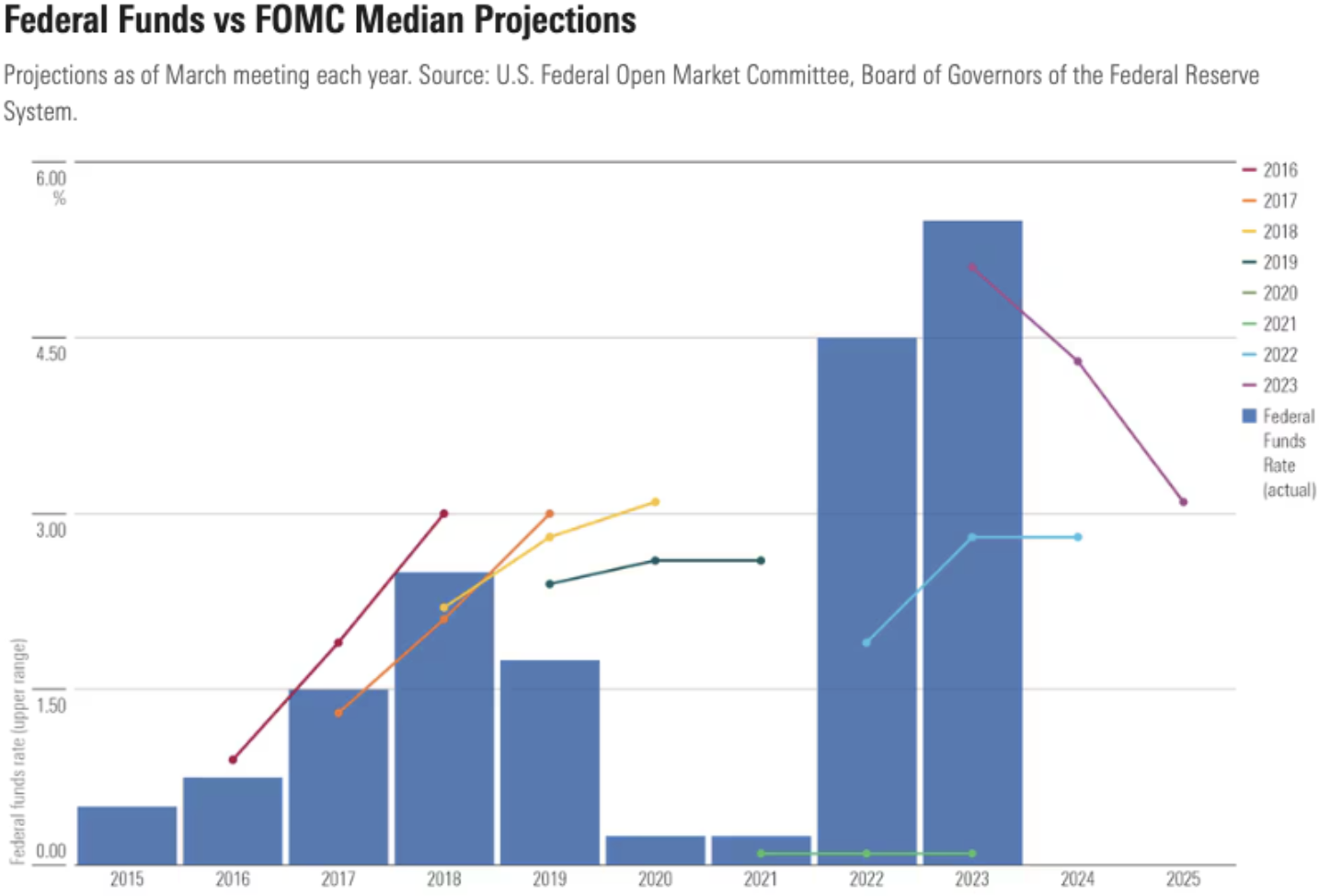
One wonders how numbers for all the above forecasts get picked. I’m sure there is all kinds of mathematics and data analysis, but it can be curious.
Did Bank of America really run all their analysis for 2025 and out popped 6,666? Or were some brilliant, snarky analysts having some apocalyptic fun while crunching numbers with the biblical book of Revelation over lunch?
Here is the point: predicting the future is hard, so don’t get too caught up with investment forecasts no matter where they come from and no matter how fancy the pedigree.
Jason Zweig, a columnist for the Wall Street Journal, zeroes in on what investors should be concerned about while considering their financial future at the beginning of a new year:
“The beginning of the year is the best time to think not about the next 12 months, but all the years to come.”⁷
# # #
Sources:
1. “Wall Street’s S&P 500 Targets”. Accessed online: https://yardeni.com/charts/wall-streets-sp-500-targets/
2. “Here’s Almost Everything Wall Street expects in 2025”, published by Bloomberg on January 1, 2025. Accessed online: https://www.bloomberg.com/graphics/2025-investment-outlooks/
3. Chart from Barry Ritholtz, “Nobody Knows Anything,” Wall Street Strategist Edition”, January 2, 2025. Accessed online: https://ritholtz.com/2025/01/nobody-knows-anything-strategist/
4. March 1, 1993. Accessed online: https://www.berkshirehathaway.com/letters/1992.html
5. Peter Mallouk on X published January 1, 2025. Accessed online: https://x.com/PeterMallouk/status/1874614477666361412
6. Sarah Hansen, “Why Is Everyone Always Wrong About the Fed?”, published by Morningstar on January 26, 2024. Accessed online: https://www.morningstar.com/markets/why-is-everyone-always-wrong-about-fed?utm_source=substack&utm_medium=email
7. “How You Can See Through Wall Street’s Ritual of Wrong,” January 10, 2025. Accessed online: https://www.wsj.com/finance/investing/stock-market-forecast-ritual-of-wrong-add89428?mod=hp_lead_pos11
# # #
Brandon Stockman has been a Wealth Advisor licensed with the Series 7 and 66 since the Great Financial Crisis of 2008. He has the privilege of helping manage accounts throughout the United States and works in the Fortuna office of Johnson Wealth Management. You can sign up for his weekly newsletter on investing and financial education or subscribe to his YouTube channel. Securities and advisory services offered through Prospera Financial Services, Inc. | Member FINRA, SIPC. This should not be considered tax, legal, or investment advice. Past performance is no guarantee of future results.
(PHOTOS) ‘Make America Kind Again’: Hundreds Rally at People’s March in Eureka
Isabella Vanderheiden / Saturday, Jan. 18, 2025 @ 3:47 p.m. / Activism

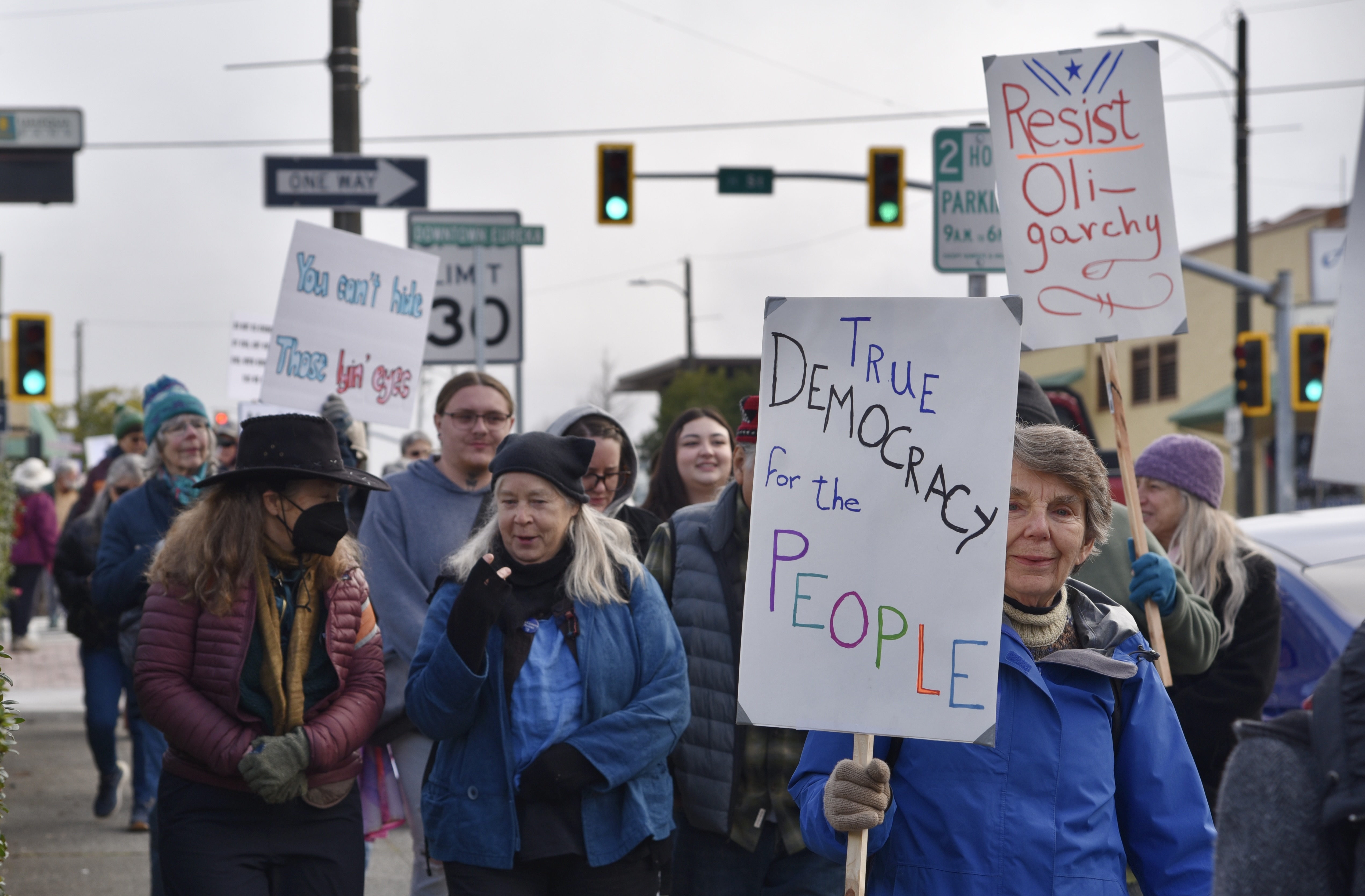
Sign-wielding demonstrators march down Fourth Street in Eureka for the 2025 People’s March. | Photos: Isabella Vanderheiden
###
Hundreds of people rallied in front of the Humboldt County Courthouse in Eureka today for the People’s March, a nationwide “day of joyful resistance” to protest the incoming Trump Administration. Many demonstrators waved handmade signs at passersby as the crowd chanted “Power to the people!” and “Immigrants’ rights are human rights!”
The People’s March is a sequel, of sorts, to the original Women’s March of 2017, which took place the day after Donald Trump was sworn in for his first term as president. The rebranded march has expanded beyond women’s reproductive rights to include more people and a wider range of issues, including LBTQ+ rights, immigration, climate and democracy.
“We’re thanking and supporting the people that have been protesting for generations,” local event organizer Cheryl Furman told the Outpost as she led the crowd of roughly 300 sign-wielding demonstrators down Fourth Street and into Old Town. “It’s also about recruiting more people because it looks like we might be doing this for quite a while.”
Many demonstrators carried signs with choice words for Trump, while others called for kindness and unity. Eureka resident Teri Dulaney held a sign that read “Make America Kind Again.”
“Hate is overtaking our country and our citizens and it doesn’t feel good,” she told the Outpost. “It’s not good to hate. We used to be a kind, benevolent country and that seems to have gone away. … I think that the government needs to know we’re paying attention and that we’d be more than willing to work with them, but they can’t tread on us.”
Keep scrolling for more pictures of today’s rally.
###




“God bless every damn one of ya!”




THE ECONEWS REPORT: President Carter’s Environmental Legacy
The EcoNews Report / Saturday, Jan. 18, 2025 @ 10 a.m. / Environment

Image: Stable Diffusion.
Jimmy Carter: Peanut farmer. Humanitarian. President. Environmentalist?
On this week’s EcoNews Report, we catalogue the environmental legacy of President Carter with Rich McIntyre, friend and fishing partner of the President. Locally, President Carter signed into law the expansion of Redwood National Park (against the protest of loggers).
President Carter was also responsible for doubling the amount of acreage protected by the National Parks Service and conserving over 100 million acres of land in Alaska through the Alaska National Interest Lands Conservation Act. An energy crisis drove President Carter to promote renewable energy, even putting solar panels on the White House (which were later removed by President Reagan.)
HUMBOLDT HISTORY: A Newspaper Editor’s Successful Crusade to Build the Humboldt Bay Jetties
Susan Pritchard / Saturday, Jan. 18, 2025 @ 7:30 a.m. / History

A barge on Humboldt Bay hauls cars loaded with rock for the jetty project. A sailing schooner is in the background. This was near the turn of the century. Photos via the Humboldt Historian.
PREVIOUSLY:
###
One of the first to call for extensive improvements to facilitate shipping across Humboldt Bay Bar was William Ayres, editor of the Democratic Standard. He began his campaign through editorials in 1877.
He proposed that a jetty system, such as the one built at the mouth of the Mississippi River, could result in a safer and deeper entrance channel. His recommendations were rather revolutionary for the reason that jetties were only recently tried and many were skeptical about the results.
There, at the South Pass channel of the Mississippi River mouth, civil engineer James B. Eads, funded by the federal government, had been able to. with jetty construction, increase the depth of the channel at the river mouth from eight feet to 24 feet. With the completion of the jetties at the South Pass in 1877, the “oceangoing ships of the largest size were regularly entering the Mississippi by the smallest of the major passes.”
It is no wonder that Ayres was impressed with the possibilities and potential of jetties to improve the entrance to Humboldt Bay. The conditions at the mouth of the Mississippi were similar to those at the entrance to Humboldt. Trade along the Mississippi was hampered by the large sandbar of the delta, and only ships of shallow draught could make it over the bar. The wave and storm action was less violent then at Humboldt, but Ayres was confident that the problems presented by the stormy North Coast could be overcome, especially by an engineer of Eads’ abilities.
In January of 1879 Ayres had sent Eads a description of Humboldt Bay, and the conditions of the Bar, with a plea for his opinion on the feasibility of improving the entrance. Eads’ response was very positive. After examining the maps sent to him by Ayres and looking at the United States Coast and Geodetic survey maps, Eads was of the opinion that jetties could satisfactorily improve the entrance. In fact, Eads was confident that “the channel through the bar obstructing the entrance into the bay can be permanently deepened by the aid of jetties.” Eads was also willing to travel to California, and examine Humboldt Bay if Ayres or the community would pay Eads $3,000. Eads commented that he was asking for such a modest sum because he was interested in the project and was aware that it would be necessary for a few public-minded citizens to raise the money.
Eads also wrote that he was influenced in making the proposition “more from the desire to aid … in inaugurating and consummating an interesting and important public work.” It must be noted that Eads was a very polished and skillful politician, but it is possible that he was genuinely interested in the improvement of Humboldt Bay.
With the publishing of Eads’ letter, Ayres became very active in trying to raise the money required by Eads. Ayres was particularly hopeful that Eads could examine Humboldt Bay for several reasons. Recognizing Eads’ political clout, Ayres was convinced that a “favorable report from Captain Eads on this proposed work, a memorial to Congress, would be almost sure of gaining the required appropriation.” It was with this goal in mind that Ayres called for a public meeting to “discuss the subject of improving Humboldt Harbor.” The meeting was held on March 19, 1879, and was supported by many of the influential members of the community. Such lumbermen as John Vance, William Carson, and John Dolbeer offered their support to the meeting as did politicians and businessmen C.S. Ricks, E.H. Howard, and Joseph Russ. Despite the support and interest in Eads’ proposal, Ayres was unable to raise the necessary funds.
The interest sparked by the Eads’ correspondence did result in an increase in the awareness of the problems to trade caused by the bar and its shifting channel. Eads, without traveling to Eureka, was able to draw the attention of some congressmen to the condition of the harbor. A few weeks after the meeting to raise money for Eads to travel to Humboldt County, Ayres received a letter from Congressman J.K. Luttrell. Luttrell had been in correspondence with Eads and was very supportive of the proposal to have Eads visit Humboldt Bay.
Luttrell was an influential Democrat to have on the side of the supporters of the improvement of Humboldt Bay. He had recently introduced bills in Congress calling for “appropriations for the improvement of our harbors along the coast between San Francisco and Puget Sound.” Beyond these general bills, Luttrell had also helped to pass an appropriation bill of $250,000 to be used to develop a harbor of refuge on the Pacific Coast north of San Francisco. The specific site was to be chosen by the Army Corps of Engineers. The need for improvements on Humboldt Bay had finally been brought to the attention of Congress.
With the congressional interest came the assignment of the San Francisco District of the Army Corps of Engineers to the problem of improving Humboldt Bay. The San Francisco district was not unfamiliar with the bay, the bay having been examined both in 1871 and 1877 by a Board of Engineers. The Board was seeking to find a bay or harbor along the Pacific Coast that would be suitable to develop as a harbor of refuge. The coast line between San Francisco and the mouth ofthe Columbia River was devoid of a safe harbor for ships in danger and none of the few natural bays or river mouths were of sufficient depth to allow the large naval ships to enter. Humboldt Bay was a logical choice for the Board of Engineers to examine, because of its location almost halfway between San Francisco Bay and the mouth of the Columbia. Humboldt Bay was considered as a possibility for being improved to be used as the harbor of refuge, but was passed over for several reasons.
In 1871, with the encouragement of district Congressman James A. Johnson, the Corps of Engineers made its first examination of Humboldt Bay. The members of the examining board returned a negative response on the feasibility of improving the bay. This finding was made despite the Board’s opinion that once vessels had entered the bay “it is the best harbor on the Pacific Coast between San Francisco Bay and the mouth of the Columbia River.” The problem with the bay was the uncertainty of the entrance. R.S. Williamson, a Major in the Corps of Engineers, in a report to Chief of Engineers Brigadier General Humphreys, described the bar and the obstacles it presented:
The bar, like nearly all ocean bars on the Pacific Coast of the United States is constantly changing. Every severe storm changes the channel; sometimes there are two channels, and sometimes there is but one. In rare cases the channel is so closed that the steamers cannot go out.
Williamson goes on to relate that he himself had been “bar-bound” in December of 1865 for a fortnight. A storm had arisen shortly after his arrival, and destroyed the old channel. It took two weeks for a new channel to open sufficiently to let out the passenger steamer. Williamson adds that no vessel “enters or leaves the bay without a pilot.” Ultimately, it was Williamson’s opinion that such a bar as the one at Humboldt Bay “can never be improved.”
Of the members of the Board of Engineers, Williamson was the only one who had actually been to Humboldt Bay. The Board’s report “on the practicability of improving entrance to Humboldt Bay and Humboldt Harbor, California,” was made without a personal examination. Instead, the report was based primarily on the coast survey chart, “the well-known shifting sands forming the bar and the concurrent testimony of all persons acquainted with…[the bar].
The Board, in spite of the lack of first-hand knowledge, presented two possibilities for the improvement of the bay. Both plans included jetties and both ended in a supposition of disaster. Moreover, neither plan proposed by the Board was considered very practical. The Board believed that the cost of construction would far exceed any possible benefits, which they deemed would be short-lived.
The 1871 report illustrated the skepticism with which jetties were viewed at the time, and the lack of knowledge of what the jetties could or could not accomplish. The two jetty systems proposed by the Board revealed the prevalent attitudes on jetties held by the army engineers. The first example presented by the Board was two jetties or pierres perdues, to use the French term, of stone or masonry. These jetties would confine the channel and secure the depths necessary to allow heavily loaded ships to easily enter and leave the bay. The Board believed that these jetties would easily be destroyed, and leave “the stones or the disjointed masonry…scattered over the bar as so many dangerous obstructions.” Similarly, the Board thought that jetties built of “sufficiently powerful construction to withstand the force of the sea, properly located, and carried out to, say 10 fathoms of water, with their foundations laid so deep so as not to be undermined, we have no doubt but their effect would be to improve the entrance to the harbor, till such time as the resulting currents should accumulate another bar outside of the supposed entrance between such structures.”
This official opinion about the infeasibility of improving the entrance to Humboldt Bay was to mark the Corps’ attitude for the next ten years.
In 1877 the Corps was again directed by Congress to attempt to locate and improve a harbor of refuge as none had been found suitable in the 1871 report.
Specifically, Congress directed the Corps to examine, in addition to the harbor of Humboldt Bay, the harbors of Mendocino, Trinidad and Crescent City. The Corps was to examine each bay, with the aim of finding one that could be made suitable as a harbor of refuge with the construction of a breakwater, and an estimate of cost. It was the final criteria that caused a negative response for Humboldt Bay. The Board believed that two parallel jetties, built out 500 yards apart from the sandy entrance heads could result in a safer entrance to the bay but was convinced that “such construction would be attended with immense difficulties and enormous expense.” One of the reasons for the great expense was the lack of close quarries for the rock to construct the jetties. The Board was also unsure if jetties could be constructed on the sandy heads without collapsing. The Board itself was divided on whether or not the “the construction would be physically possible.” The three-member panel had been unable to closely examine the bay entrance due to the rough condition of the bar, and so were unsure of the results that could be obtained by jetties.
They were impressed with the dangers of the entrance, and the need to improve the bay, however. When they arrived off the bay, aboard the coast steamer Hassler, the pilot had refused to guide the steamer over the bar, even though the weather was moderate, mid-August weather. Further, at the time there was a depth of 20 feet over the bar, and the Hassler drew only 12 feet. The pilot was adamant in his position, stating that he could not bring the Hassler into Humboldt Bay “without running the risk of the vessel striking bottom and her possible loss in the breakers.”
The engineers were forced to accept the pilot’s assessment of the situation. Perhaps in light of the uncertain and often violent condition of the ocean near the entrance to Humboldt Bay, the Board deemed it “highly improbable that a breakwater or jetties would be attempted here at the present time.” The estimation of the Board was accurate, as it was not until 1889 that construction was first begun on the Humboldt jetties.
Despite the two negative reports by the Corps of Engineers, the influence of Ayres and Eads resulted in yet a third examination of Humboldt Bay by the Corps. In 1881 Lt. Colonel George H. Mendall, the San Francisco District Engineer, submitted a favorable report on Humboldt Bay development. This decision marked the first Corps work done on the bay and the first congressional appropriation for the bay improvement. The project consisted of dredging the bay, “mainly in front of the town of Eureka, where the channel has been shoaled in late years. It is proposed to give 10 feet at low water.”
Congress approved $40,000 for this first project. In addition to the dredging, which would be done by W.B. English, the Corps was also to examine the entrance closely, seeking a better understanding of the conditions of the bar. The Corps was well aware of the general situation, as they succinctly stated the general characteristics of the bay entrance in their annual report. The bay entrance “is over a bar, unstable both as to direction and depth, and exposed to an extremely heavy sea in southerly weather.” With an engineer assigned to the bay, it was hoped that he could determine the best way to obtain some degree of control over the entrance channel. It was just a few years later, in 1889, that the hoped-for bar improvements began to materialize with the start of jetty construction.

Small locomotives in this 1914 scene haul rocks during jetty construction.
###
The story above is excerpted from the March-April 1989 issue of the Humboldt Historian, a journal of the Humboldt County Historical Society. It is reprinted here with permission. The Humboldt County Historical Society is a nonprofit organization devoted to archiving, preserving and sharing Humboldt County’s rich history. You can become a member and receive a year’s worth of new issues of The Humboldt Historian at this link.


