A homeless encampment along the sidewalk on X Street under State Route 99 in Sacramento, on Oct. 25, 2024. Photo by Fred Greaves for CalMatters
Ciara Lambright has a lot to worry about: Staying safe while living on the streets of San Francisco, trying to prevent people from stealing her belongings, and packing up her small cardboard bed before it gets swept away by police.
The thought of voting this election is just too overwhelming.
“It’s just not top on my list right now,” said 33-year-old Lambright.
Homelessness is arguably the biggest problem facing California today, it’s a top concern for voters and it’s on the ballot, either directly or indirectly, in nearly every city.
But all too often, what homeless Californians, themselves, have to say about the issue isn’t getting heard.
That’s because while eligible voters can still cast ballots if they are experiencing homelessness, they face a mountain of obstacles, according to elections officials, service providers and potential voters who live on the street.
California’s homeless population has ballooned to nearly 186,000 people this year, so that means one part of the electorate is potentially not taking part in democracy this election. Experts say that’s cause for concern, as many contests — statewide rent control and criminal justice reform propositions, local mayoral races and more — could directly affect unhoused residents.
“Their lives are the central topic of political conversation, and it’s a conversation that they are often left out of,” said Niki Jones, executive director of the Sacramento Regional Coalition to End Homelessness.
There are some efforts underway, both by counties and by local nonprofits, to boost voting among unhoused communities. But those attempts are far from universal. Of 15 unhoused residents interviewed this month by CalMatters in three cities, just three planned to vote and knew how to do so this election.
Tyneeka Bland, a 42-year-old Modesto native who moved to Sacramento earlier this year, said she lived on the streets for two months and stayed at a shelter for another six before she finally found housing in Natomas last month. That prompted her to register to vote with her new address. She mailed in her ballot last Thursday, she said.
But Bland said she missed the March primary when she was still unhoused, because she was unaware that she could vote even without a permanent address.
“I didn’t have no address, so how am I going to be able to vote? How am I going to be able to have a voice if I’m … not on the map somewhere?” Bland asked.
“Their lives are the central topic of political conversation, and it’s a conversation that they are often left out of.” — Niki Jones, executive director of the Sacramento Regional Coalition to End Homelessness
Californians without a fixed address where ballots can be mailed can register to vote using the address of a shelter, or the cross street of the park, street or sidewalk where they spend the night. They can use a P.O. box or business address to receive mail, but not to register.
Voters without a way to get a mail-in ballot have to go to a polling place in person. That can be difficult for reasons including lack of transportation, fear that their belongings will be stolen if they leave their campsite, limited access to voting information, and many other pressing needs facing unhoused people.
Only about 10% of homeless Americans vote each year, according to a 2012 report by the National Coalition for the Homeless.
“When you are not sure where your next meal is coming from, and you’re having to think about where you’re going to sleep tonight, that makes it very difficult to remember that it’s also voting day,” Jones said.
First: A homeless encampment along the sidewalk on X Street under State Route 99. Last: Tyneeka Bland speaks about her experience and challenges with voting during the time she was homeless. Sacramento on Oct. 25, 2024. Photos by Fred Greaves for CalMatters
It’s also more difficult to stay informed about elections when you’re living on the street. Housed Californians get bombarded by political ads on TV, hear reporters discuss ballot measures on the radio and see campaign mailers flood their mailboxes. Homeless Californians without a TV, consistent access to the internet or radio and no mailing address often are left in the dark.
The news that Oakland’s mayor is facing a recall election this year didn’t make it to 63-year-old Ashby Dancy, who was hanging out with two friends at a small tent encampment in East Oakland on a recent afternoon.
Ajda Latimer, who lives in an RV in West Oakland with her two dogs, Damien and Angel, thought she was barred from voting because she doesn’t have an address. When a reporter told her she could vote anyway, she said she’ll try to cast a ballot.
“It does matter to me,” she said.
Some unhoused Californians CalMatters spoke with mistakenly believed their prior felony convictions prevent them from voting. People with a felony conviction can vote in California, as long as they aren’t currently serving time for that offense.
Others are disheartened by a political system that they say never seems to take people living on the street into consideration. Donald Trump or Kamala Harris for president? It doesn’t really matter to 52-year-old Linda Vazquez, who sleeps outside in San Francisco.
“Neither one of them is doing anything that’s going to work for us,” she said.
Melanie Mercado, who said she has lived on the streets in Sacramento for more than a decade, told CalMatters she only voted once in her life — for Barack Obama. But, Mercado said, she has no trust in the government in part because she lost custody to her daughter in a court fight, in which she saw a system “conspiring against” her.
“I don’t think that voting helps decide your own fate,” Mercado said. “How many rulers of the environment do you need?”
Melanie Mercado talks about her experiences with homelessness and voting in Sacramento, on Oct. 25, 2024. Photo by Fred Greaves for CalMatters
In Sacramento, the Regional Coalition to End Homelessness is partnering with Sacramento State University to help encourage more unhoused people to vote. Using a $7,500 grant from the Robert Nelson Foundation, they have been hosting voter registration ice cream socials at homeless shelters, transitional housing sites and outside the county jail.
About 150 people had shown up to their events as of mid-October, and 30 of those had registered to vote, Jones said. Those who already are registered get information about what’s on the ballot and where to vote. Outreach workers help people make a plan to vote, such as choosing a “voting buddy” who can help remind them to vote and hold them accountable to actually cast their ballot.
“Folks really do care about the politics that affect their lives,” Jones said.
Sacramento County also is trying to bridge the gap by hosting voter registration drives at local homeless shelters and affordable housing developments. In addition to registering people to vote (they got 14 new registrants at one event in mid-October) county staff hand out fliers with information about where to vote, and tell people how to access the county’s online voter information guide, said county spokesperson Ken Casparis.
Sometimes people have to re-register, because if their ballot gets mailed to their old address and returned as undeliverable, their voting status changes to “inactive,” Casparis said.
“It is a process,” he said, “but we do do our best to get out there and do as much outreach to that community as we can.”
There are a little more than 600 homeless registered voters in Sacramento County, Casparis said. But the county doesn’t know how many of them end up voting.
Voters cast ballots at a polling site at Modoc Hall at Sacramento State campus on March 5, 2024. Photo by Miguel Gutierrez Jr., CalMatters
There are more than 6,600 homeless people living in Sacramento County, according to the latest point-in-time count. That means about 9% of all unhoused Sacramento residents are registered to vote. Among the general population, nearly 79% of eligible residents were registered as of last year, according to the Secretary of State’s office.
Not every county tracks those numbers. San Diego County, for example, has no way of tracking how many of its homeless residents register to vote or vote, according to Antonia Hutzell, a spokesperson for the registrar of voters.
Alliance San Diego, a community organization, has been distributing voter guides to local homeless shelters to boost voter turnout, said executive director Andrea Guerrero. The organization also is reaching unhoused people via Facebook, email and text messages.
But for someone like 39-year-old Nanie Crossman, who lives in an RV parked on the street in West Oakland, voting isn’t as easy as simply looking up her polling place, and then going there.
First, she would have to find a place to shower and a clean change of clothes. Otherwise, her presence might garner nasty looks from the other voters, Crossman said.
Will she end up voting, come Election Day? It depends on her mood, Crossman said.
“Plans are hard to keep out here,” she said. “If you make plans, something will happen.”
###
CalMatters.org is a nonprofit, nonpartisan media venture explaining California policies and politics.
Carole Presson was born December 1945 in Plattsburgh, N.Y. and died August
18, 2024 in Eureka.
After high school at St Peter’s, Carole Capone met Airman Wayne Presson,
who she married on Oct 10, 1965. Shortly after, she moved to Eureka. She
attended College of the Redwoods; became a teachers’ aide, then a nurses’
aide at Pacific Convalescent and Granada Convalescent hospitals. In her
mid-thirties, while working at Mad River Community Hospital, she was
diagnosed with MS. She continued her work as a home health care aide
until her illness advanced.
She then entered the Eureka Rehabilitation and Wellness Center. In her
13 years there she made many friends among the patients, staff, and
nursing. Carole’s kindness, patience, and composure, and her ability to
see the good in others kept up her own and others spirits. Her daughter,
husband, and old friends were steady company; she went home frequently,
and her dear companion Barbara Paige took her out to stores, movies,
parks, and craft shows. She was able to persevere here, many thanks to
its staff, to Patty and Joe, Magdalina, and Ozadiah to name but a few
who provided special care and compassion. Her care home friends, Irene
and Carol were also cherished.
Carole was the mother of three children: Karen Hernandez of Eureka.
Calvin Presson of Reno, and Brian Presson of Pattaya, Thiland. She
had two grandchildren: Marisa Hernandez of Eureka and Andrew Presson in
Bangkok. Her parents were Frank Capone and Pearl LaMora of Plattsburgh,
N.Y.. Her close sister, Gloria Hutchinson, of Port Orange, Florida died eight
weeks before Carole. Her brother Gerry Capone, a retired professor,
lives in Hartford, N.Y.
The Presson family wants to thank St Joseph’s Hospital for the memorable
and dedicated care it offered Carole in her several times of need;
Hospice of Humboldt and Katasha and Leticia, for providing swell and
commendable care during the final months of her life; and, of course,
the Rehab Center and its entire staff for its longstanding and
compassionate care over the course of Carole’s residency.
###
The obituary above was submitted on behalf of Carole Presson’s loved ones. The Lost Coast Outpost runs obituaries of Humboldt County residents at no charge. See guidelines here. Email news@lostcoastoutpost.com.
Joanne
Darlene Farnsworth passed away September 25, 2024.
Joanne
was born in Long Bottom, West Virginia, in October 1934 to Arnold and
Louise Endicott. The family moved to the West Coast in the mid-1930s.
They later established in Carlotta, where she met and married Bud
Farnsworth on March 17, 1951.
During
their 67 years of marriage, Bud and Joanne lived and raised their
family in Carlotta. They joined the Nazarene church in the late 1950s
and Joanne’s faith was an integral part of her life. She loved to
sing and taught many Sunday school classes. She didn’t finish high
school, but years later, after earning her GED, she received her
Medical Assisting Certificate at College of the Redwoods while
raising her family and working at Bistrin’s and Daly’s. Then she
worked for many years at a Ferndale doctor’s office. After their
retirement, Bud and JoAnne travelled with their little camp trailer.
They also spent many hunting seasons helping Janet and Les at their
hunting lodge in Bridgeville. Later, after knee replacement surgery,
she discovered she had scleroderma, an autoimmune disease, which,
along with dementia, lead to her passing.
She
is survived by her children Janet Barnwell Hunt (Rex Hunt), Marcia
Niles, David Farnsworth (Annette), eight grandchildren, 11
great-grandchildren and numerous nieces and nephews. She is also
survived by her very special Aunt Betty Acheson Collins, sisters
Barbara VanLoon and Linda Maire (Leroy). She also had a very special
love for her Farnsworth family.
She
was preceded in death by her husband, Allen (Bud) Farnsworth, who
passed in April
2018; her mother, Louise Shannon Luther; brother, Richard Endicott;
sister, Sandra Jenkins; brothers-in-law Art VanLoon and Hank Jenkins;
and son-in-law Les Barnwell. A special thank you to Eureka
Rehabilitation and Wellness Center, where mom spent the last two
months. The nurses and aides were very caring and always made sure
mom got her coffee.
###
The obituary above was submitted on behalf of Joanne Farnsworth’s loved ones. The Lost Coast Outpost runs obituaries of Humboldt County residents at no charge. See guidelines here. Email news@lostcoastoutpost.com.
A month after being sued by the California Attorney General’s Office for refusing to provide emergency abortion services, Providence St. Joseph Hospital is now legally bound to provide such care after Humboldt County Superior Court Judge Timothy Canning signed an order codifying the agreement recently reached by both parties.
Per the terms of the agreement, St. Joseph Hospital must fully comply with California’s Emergency Services Law (ESL) with respect to pregnant patients’ emergency medical conditions. This means the hospital must specifically allow its physicians to terminate a patient’s pregnancy whenever the treating physician determines that it’s necessary to prevent serious health risk.
St. Joseph Hospital must also provide written notice of the order to its medical staff and “each and every physician with privileges” by next Tuesday, seven days from when Judge Canning signed the order.
Attorney General Rob Bonta’s lawsuit alleges that Providence St. Joseph Hospital fails to provide adequate emergency services and care to pregnant patients in danger of “loss of life, or serious injury or illness.” In one specific case, it accuses hospital staff of denying an emergency abortion to Dr. Anna Nusslock, a Eureka chiropractor who was just 15 weeks pregnant when she arrived to the hospital hemorrhaging and in severe pain.
“Despite the immediate threat to her life and health, and despite the fact her pregnancy was no longer viable, Providence refused to treat her,” Bonta’s office said in a press release. Care providers instead sent Nusslock up to Mad River Community Hospital. “On the way out the door, Providence handed Nusslock a bucket and towels ‘in case something happens in the car,’” the suit alleges.
The Catholic-owned hospital has denied the allegations. The agreement (or “stipulation”) says both parties “desire to ensure that pregnant patients receive adequate treatment for emergency medical conditions, based on the professional judgment of the treating physician.”
It also says that the parties have begun discussions about a settlement of the suit.
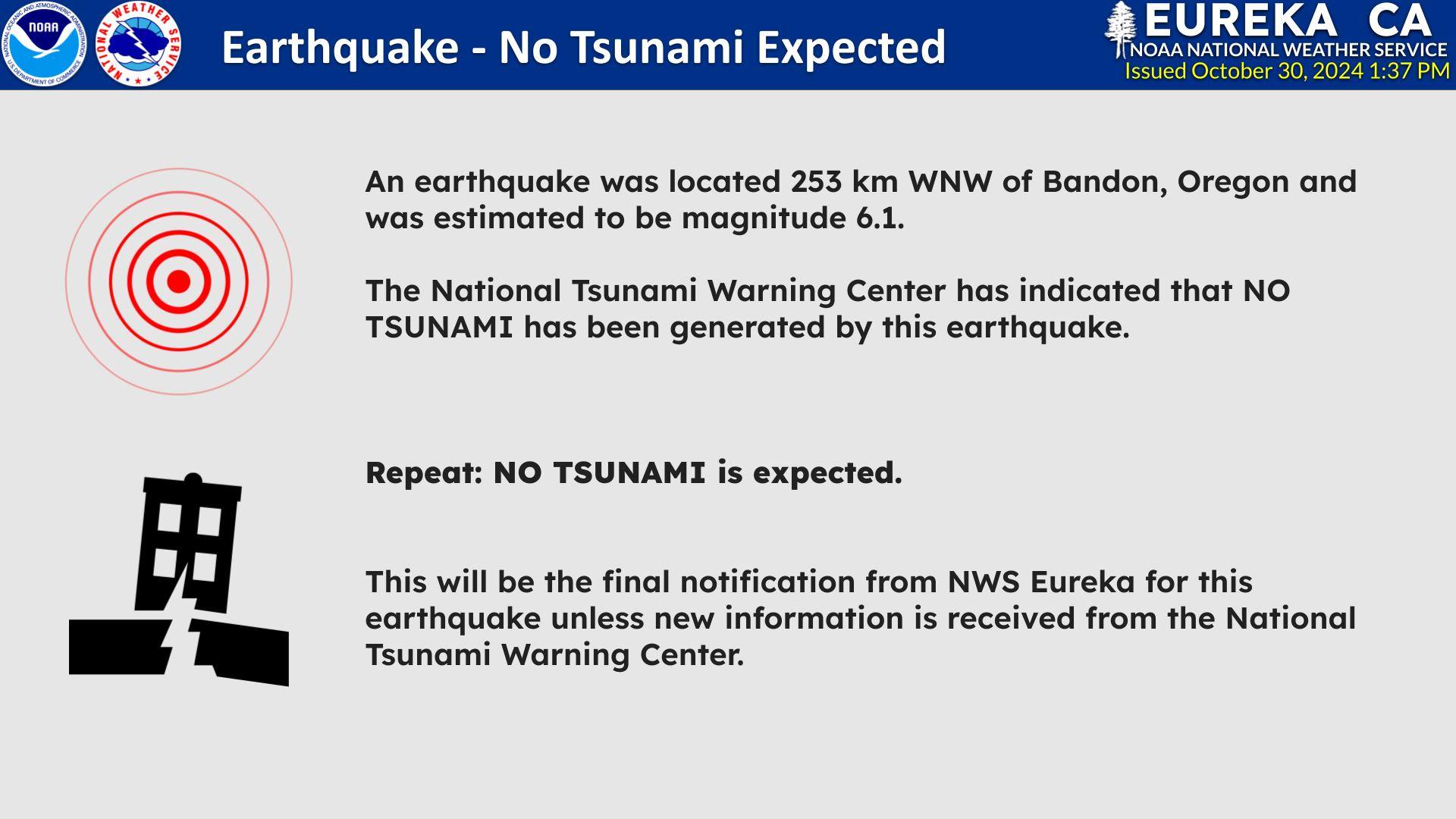
At 1:15 p.m., Wednesday a 6.1-magnitude earthquake struck roughly 253 kilometers off the coast, northwest of Bandon, Oregon, according to the United States Geological Survey (USGS).
The National Tsunami Warning Center has confirmed there’s no threat of a tsunami to the Humboldt County area (or to Oregon, for that matter).
Go about your lives. This is not the thing that will end us all.
Adult fall-run Chinook salmon congregate near the Nimbus Hatchery Fish Ladder on the American River in Sacramento County, on Oct. 15, 2012. Photo by Carl Costas, California Department of Water Resources.
Farmers can estimate the size of a harvest months in advance by counting the blossoms on their trees. Similarly, salmon fishers can cast an eye into the future by counting spawning fish in a river. Fishery managers are doing that now in the Sacramento River and its tributaries, and what they’re seeing could be a bad sign for next year.
The low count of returning adult salmon, made by the federally operated Coleman National Fish Hatchery, is preliminary, with several weeks left in the natural spawning period for the Sacramento Valley’s fall-run Chinook, backbone of the state’s salmon fishing economy.
There is even some possible good news in the numbers — a large percentage of immature Chinook, called “jacks.” This demographic slice of the salmon population can be a predictive indicator of ocean abundance for the coming season, and it could be a sign there are more fish in the ocean than many expected — though officials say it’s too early to say.
Overall, the unwelcome numbers, mirroring similar figures from last year, are alarming to people who fish, for they portend the possible continuation of the two-year-and-counting statewide ban on salmon fishing, imposed in 2023 following a weak spawning season.
Already, the loss of revenue from the fishery shutdown has devastated the coastal fishing fleet, which is still waiting for $20 million in federal funds allocated for disaster relief early this year.
R.J. Waldron, who took recreational anglers salmon fishing on his Emeryville charter boat Sundance for more than a decade, recently sold his vessel. The reduced income was too skimpy to pay the overhead costs of owning a boat and renting a slip. He said relief funds, had they been portioned out, would have kept him afloat.
“That would have helped me maintain my boat and basically ride the storm out until we get salmon fishing back — if we get salmon fishing back,” he said.
Sarah Bates, owner of the San Francisco-based commercial vessel The Bounty, said she drew about 90% of her income from Chinook salmon sales prior to the closure and has helped make ends meet by fishing for other species, like black cod, shrimp and rockfish. Others, she said, have been targeting halibut.
Bates said the uncertain outlook has been disorienting for the men and women who shape their lives around a calendar year of fishing seasons and regulations.
“A lot of us feel a little untethered,” she said.
At least six more months may pass before financial relief arrives. Barry Thom, executive director of the Pacific States Marine Fisheries Commission — which has helped facilitate the grant application process — said in an email that the federal funds could be distributed sometime in May and June of 2025.
The odds of whether fishers will be returning to work by then still looks like a tossup. U.S. Fish and Wildlife Service’s Brett Galyean, project leader at the Coleman hatchery, described “really low” numbers of 3- and 4-year-old adult Chinook. As of Oct. 29, his staff had collected 4 million eggs from female fish — less than one-third the hatchery’s target of 14 to 15 million eggs.
The spawning run is drawing toward the end, too, with new arrivals at the hatchery now “slowing down,” according to Galyean.
At several other Central Valley hatcheries operated by the California Department of Fish and Wildlife, facility managers have only just started counting salmon, an official said. This means overall numbers could still mount to promising levels.
The low returns to Coleman, the state’s largest fish hatchery, reflect a long-term decline in Chinook salmon numbers regionwide. As many as 2 million adult Chinook historically spawned in the Central Valley’s rivers, and the fish were a keystone feature of marine and inland ecosystems.
“If you kill all the baby salmon, three years later you don’t have adult salmon.” — Barry Nelson, policy representative, Golden State Salmon Association
The industrialization of the landscape to produce gold, water, cities, and crops has sent salmon runs tumbling. While the Central Valley’s fish hatcheries — built last century to augment the wild stocks — release millions of baby Chinook each year, populations have dropped below fishable levels.
In 2022 officials counted just 69,000 adult fall-run Chinook in the entire Sacramento Valley, with a moderate improvement last year. In the mainstem of the Sacramento River alone, a key spawning destination, annual returns have dropped below 4,000 adults — down from an average of almost 60,000 each year from 1990 to 2009.
What ails California’s salmon is perennially debated. Water users lean on explanations such as invasive species, reduced floodplain habitat, and climate change. Fishery advocates often stress the importance of water, especially quantity and temperature.
Bates said the Central Valley needs more aggressive floodplain restoration to provide feeding and refuge habitat for small fish, but that sufficient water is the key.
“It’s the water — there’s no way around it,” Bates said. “The water conditions in the Sacramento River and the Delta no longer support juvenile salmon migrating downstream.”
Sometimes, the outflow from Lake Shasta and into the Sacramento River during the spawning season is just a few degrees too warm — conditions that can abort millions of eggs and newly born fish and has become a recurring problem in recent years. Hot weather has played a role, though environmentalists say negligent management of the reservoir — especially failure to keep its water sufficiently deep into the late summer — is just as problematic.
As the young salmon migrate downstream, they face such perils as low flows, high temperatures, water pumps and predators. Thiamine deficiency, a relatively new and emerging ecological hiccup connected to the marine food web, has also impacted Chinook salmon. Climate change is a long-term threat.
Barry Nelson, policy representative for the Golden State Salmon Association, believes the main reason for the Sacramento’s salmon collapse has been inadequate river conditions downstream of Shasta, and low smolt survival.
“We sterilized the Sacramento River,” he said. “We killed almost all the fish, and rule number one in fisheries management is, if you kill all the baby salmon, three years later you don’t have adult salmon.”
###
CalMatters.org is a nonprofit, nonpartisan media venture explaining California policies and politics.
The California State University (CSU) has partnered with the Riverside County Office of Education to offer the first-ever direct admission pilot for the CSU system. Eligible students at every public high school in Riverside County will soon be offered direct admission to the CSU for the Fall 2025 term, before they even apply.
Qualifying high school seniors in Riverside County—those on track to meet college preparatory courses (A-G requirements)—are being offered immediate, conditional admission to 10 CSU campuses by way of a brochure mailed to their home address. Students will then use the CaliforniaColleges.edu platform to select their preferred CSU campuses, with official acceptance letters to be sent directly from the universities.
“This partnership is Humboldt’s first-ever direct admissions program, and we are excited to offer this opportunity for California students to pursue a polytechnic education amidst the redwoods,” says Chrissy Holliday, vice president of Enrollment Management & Student Success at Cal Poly Humboldt. “We hope to expand direct admissions to other districts across California, leveraging what we learn from this effort, and the power of the California Colleges platform and data partnerships. This is just one way we are rising to meet the needs of our state, in preparing students for their chosen careers and a lifetime of success.”
Cal Poly Humboldt joins Channel Islands, Chico, East Bay, Maritime Academy, Monterey Bay, San Bernardino, San Francisco, San Marcos, and Sonoma that will offer direct admission. Riverside students may apply to other CSUs not on the direct admissions list. If a student applies to an impacted program or campus, additional criteria may be required for admission.
Humboldt has a long history of drawing students from Southern California, with 28% of our Fall 2024 students coming from the region. In keeping with Humboldt’s purpose to provide access to higher education, the University saw the percentage of first-generation students increase to 42% of new student enrollments, while Pell grant recipients climbed to 39% of its new student population.
“We are grateful for this ground-breaking partnership with the CSU to expand access to a world-class college education for our diverse and talented students in Riverside County,” said Riverside County Superintendent of Schools, Dr. Edwin Gomez. “As one of the fastest growing regions in California, the need for college-educated professionals will continue to soar, and this partnership will remove barriers to higher education, welcoming more college-ready students to the CSU system through this innovative direct admission program.”
After direct-admitted students submit their applications, they must continue to meet the A-G requirements and graduate from high school. Once receiving official acceptance from their university of choice, students must confirm their intent to enroll by the campus deadline and complete any additional enrollment steps such as attending orientation, paying tuition fees, and providing final transcripts or other documentation. Students are also encouraged to apply for financial aid by submitting a Free Application for Federal Student Aid (FAFSA) or California Dream Act Application (CADAA) as soon as possible, and no later than the California deadline, which has historically been March 2.
“We are excited to provide a direct pathway to higher education for thousands of high school students across Riverside County,” said April Grommo, CSU assistant vice chancellor of Strategic Enrollment Management. “We want students to know that the door to college opportunity is open to them, and to help relieve some of the stress and uncertainty about applying for college. Riverside County is an excellent location for this first-ever program for the CSU, as it is ethnically and economically representative of the diversity of California, and many of the students the CSU is so proud to serve.”
Eligible students and families can visit calstate.edu/rcoe for more information.