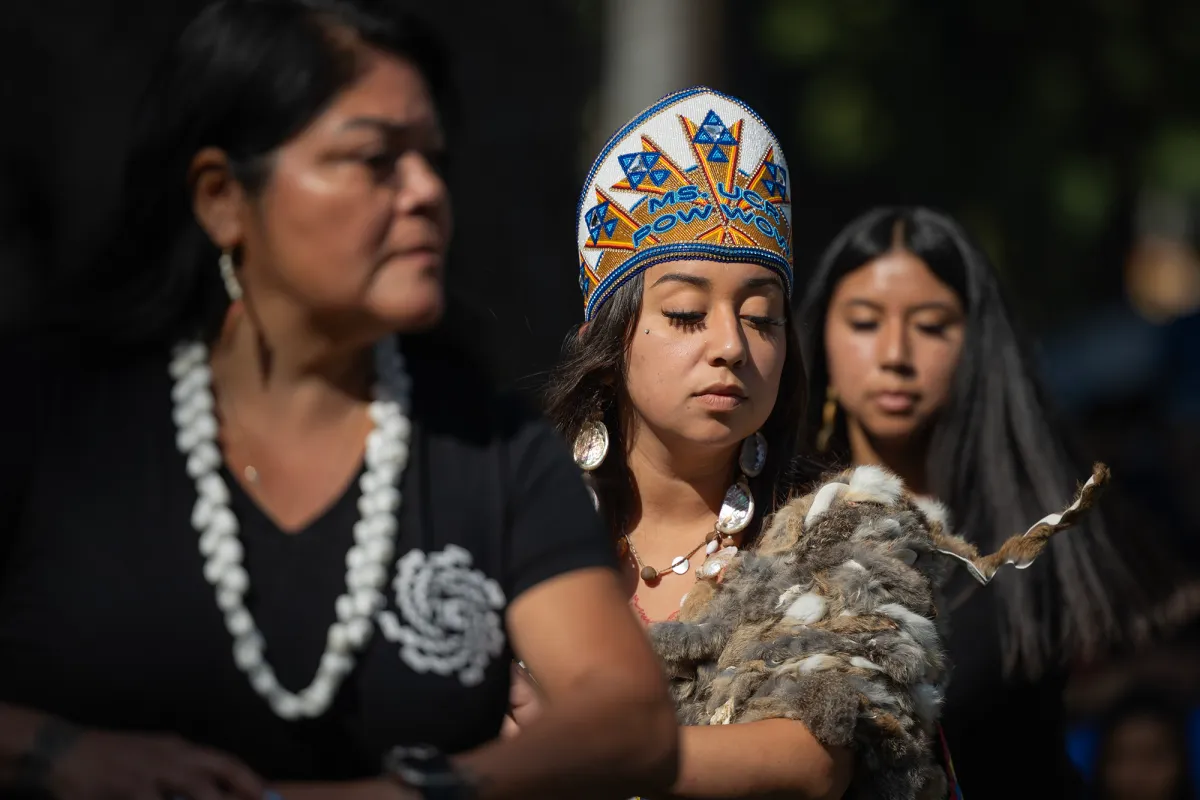
Ms. UCR Powwow Princess 2023-24, Tishmal Herrera, dances at a performance during Native American Celebration Day at the state Capitol in Sacramento on Sept. 22, 2023. Photo by Miguel Gutierrez Jr., CalMatters
In the 1860s, an armed militia swept into the historic land of the Serrano people in the San Bernardino mountains and went on a killing spree, attempting to slaughter the entire tribe. A tribal leader named Santos Manuel led the surviving 30 members to safety in a nearby valley.
Now, Manuel’s great-great grandson has ensured that every K-12 student in California will learn the story of the Serrano people and other California native tribes who endured atrocities during the Spanish colonial and Gold Rush eras in California history.
“The hope is that students learn the true history of California, the horror and the genocide, but also the resiliency of the Indian people,” said Assemblymember James Ramos, a descendent of Manuel who authored a bill requiring schools to teach about the mistreatment and perspectives of Native Californians in social studies classes.
“It’s time that the voices of California’s first people drive the educational process, especially when the subject is our ways, our people, our history,” said Ramos, who lives on the San Manuel Indian reservation in San Bernardino County and is the first Native Californian to serve in the state Legislature.
Gov. Gavin Newsom signed the bill in September. It goes into effect Jan. 1.
Expanding fourth grade history curriculum
The new law will be most relevant to fourth-graders when they study California history, exploring the stories of California missions, the discovery of gold and statehood — all of which had a profound impact on the indigenous people who’d lived in the region for at least 20,000 years.
The current fourth grade history curriculum covers the plight of Native Californians but it’s only recommended, not required. As a result, lessons vary across school districts, with some students getting scant information – or lessons focused largely on the missions. Under Ramos’ law, lessons on the mistreatment of Native Californians will be mandatory. Some of the information may also be covered in California’s new ethnic studies requirement for high school students, which goes into effect in fall 2025.
Tribal leaders said they were pleased with the bill, but hope students learn more about Native California history than just the tragedies. Ideally, they said, students should be learning the full breadth of Native history and culture: learning basket techniques in art class, reading Native authors in literature class, studying Native healing practices in health and science classes, and learning Native approaches to environmentalism, politics and economics throughout the entire curriculum.
They’d also like to see schools develop relationships with local tribes, inviting members in to teach the tribe’s history, language and traditions. Students should learn at least some phrases in the local indigenous language, and the school should promote Native culture at every opportunity, they said.
“These stories matter for all Californians,” said William Bauer, a history professor at UC Riverside who specializes in Native Californian studies and is a member of the Round Valley tribe. “I’d hope kids leave school with the idea that California Indians have survived and thrived.”
“The hope is that students learn the true history of California, the horror and the genocide, but also the resiliency of the Indian people.” — Assemblymember James Ramos, Democrat from San Bernardino
Shannon Rivers, manager of the nonprofit Indigenous Education Now, a Los Angeles advocacy group, said the bill is much needed, but schools also need to do a better job specifically serving Native students, many of whom are struggling.
Native students lag behind the state average in nearly every measurement, including attendance, graduation rates, math and literacy scores and discipline. One solution, Rivers said, is to create special programs for Native students that focus on their history, language and traditions, which could boost students’ interest in school and help make curriculum more relevant to their lives. His group is currently working with Los Angeles Unified on such a plan.
“It’s important we do this, so Native students have a better understanding of who they are,” said Rivers, a member of the Akimel O’otham tribe in Arizona. “Although the challenge with all these initiatives is that Native people are not monolithic. They’re incredibly diverse, especially in California.”
Disease, enslavement, killing
When Spanish missionaries arrived in the late 1700s, at least 300,000 people lived among an estimated 200 tribes scattered in every part of California, making it one of the most densely populated and diverse regions in North America.
But Native numbers began to decline with the arrival of Spanish missionaries, who brought diseases for which Natives had no immunity, including smallpox, malaria and diphtheria. The Spanish also introduced crops and livestock that altered the landscape and created food shortages for tribes. Thousands of native people died when they became enslaved or imprisoned at the missions, where they were forced to work in the fields and convert to Catholicism.
But the most violent period followed the discovery of gold in the Sierra foothills in the mid-1800s. Settlers, private militias and the U.S. troops carried out massacres across California, with the intent of exterminating the Native population. By 1900, only about 16,000 Native Californians remained, many living in small groups away from their original homeland.
First: An illustration of Native Americans belonging to the Ohlone, which lived along the coast of California, stretching from San Francisco Bay to the lower Salinas Valley. This image is a reproduction of a painting by George H. Langsdorff done in 1806. Last: Four Mono native women sit outside of a bark hut. Bark huts were traditionally built for winter habitation and provided protection from rain, snow and wind. Images via the California State Library
Over the next century, the population gradually rebounded and Native people nurtured their culture and traditions, despite being subject to abuse at government-run boarding schools, discrimination, and legal fights over land ownership. By 2020, there were about 1.4 million Californians who identified as at least part Native American, according to the U.S. Census.
The violent history may be difficult to digest, especially for younger children, but schools should find thoughtful, sensitive ways to impart the full story of Native Americans in California, said Joely Proudfit, head of the Native American studies department at Cal State San Marcos.
“The history of California is tragic. It’s brutal. It’s violent. Genocide occurred here,” said Proudfit, who is both Payómkawichum and Tongva, tribes that are indigenous to Southern California. “We need to be honest about our history, so maybe we’ll have some compassion and empathy with what’s happening in today’s world.”
“We need to be honest about our history, so maybe we’ll have some compassion and empathy with what’s happening in today’s world.” — Joely Proudfit, head of the Native American studies department at Cal State San Marcos
She said that high-quality teacher training will be key in making Ramos’ bill a success. Even though the bill does not come with funding, she said the state should set aside money to help teachers learn the material and find effective ways to present it. Currently, Proudfit helps run a nonprofit called California Indian Education for All that provides free and low-cost training for teachers on how to teach about the history, culture and contributions of Native Caifornians. But the task should not rely solely on volunteers, she said.
“A state like ours, with its rich diversity of tribes, is going to need millions upon millions of dollars to create quality curriculum,” Proudfit said. “Asking cultural knowledge-keepers and professionally trained educators to continue to do these things for free is not appropriate. It’s a cultural taxation.”
‘Innocent bystanders’
In San Bernardino County, where Ramos’ family has lived for hundreds, if not thousands of years, the story of the 1860s massacre remains fresh. According to documents provided by the San Bernardino Historical and Pioneer Society, the Serrano tribe did not provoke the attack, “they really were innocent bystanders,” said Lyn Killian, a librarian with the historical society.
Four young Paiute Indians from Utah, who had come west with a wagon train, became involved in a tit-for-tat skirmish with some local cowboys that resulted in several deaths and, according to local historians, the Piutes burning a sawmill. For revenge, an armed posse stormed into the Serrano village — even though the Serranos were not involved in the fighting — and chased the inhabitants to Chimney Rock, near Lucerne Valley.
Assemblymember James C. Ramos’ great-great-grandfather, Santos Manuel. Photo courtesy of Assemblymember James C. Ramos
“Despite their cover in the rocks the Indians were wiped out,” according to a 1966 report by a local historian in the San Bernardino Sun-Telegram newspaper. “Posse men went on to destroy the nearby Indian village, even killing women and children. … The peaceful Serrano had taken no part in the mill burning but they were driven from their ancestral home nonetheless.”
After the bloodshed, the remaining members of the tribe moved around the valley, pushed further and further east as more settlers arrived. In 1891, the federal government granted them a reservation and recognized their sovereignty. Last year, the San Manuel tribe had about 200 members, a casino, resort and charity that provides scholarships, after-school programs, housing assistance, environmental restoration, arts and music programs and support for other tribes, among other causes.
“This history is still very much real to all of us, all California Indian people,” Ramos said. “With this bill, we have a chance to share the true accounts of what happened to us. And also that we’re still here, even though we were almost wiped off this earth. I sit now in the state Legislature with Serrano and Cahuilla blood in my veins. … That’s a story people should know.”
###
CalMatters.org is a nonprofit, nonpartisan media venture explaining California policies and politics.
Richard Paul Etcheverry passed away peacefully on June 14, 2024, at
the age of 97 in Roseburg, Ore. He was born on August 2, 1926, in San
Mateo, Calif. He attended St. Matthews Elementary School and San
Mateo High School until his senior year, when he transferred to
Commerce High School in San Francisco, where he graduated six months
early in February 1944. After graduating high school, he enlisted in
the Navy at age 17 instead of being drafted into the Army at age 18.
Richard served in the Navy during World War II serving in the Pacific
Theater and was honorably discharged in June 1946.
After returning home from the war Richard embarked on his career in
Real Estate with the State of California Division of Tax Deeded Lands
in Sacramento. While working, he attended night school for two years
at UC California to earn his certificate in Real Estate Practice,
Law, and Appraisal. His work with Tax Deeded Lands required much
travel throughout the state of California. He decided when his oldest
daughter was school age to settle down, so she could attend school on
a regular basis. Richard then went to work in Redwood City as a title
officer.
In 1967 Richard wanted a different lifestyle away from the crowded
Bay Area and moved to Ettersburg in Humboldt County to follow his
dream of sheep ranching. He soon found out the sheep ranch didn’t
provide the income he expected and went to work as a title officer in
Eureka, where he worked until 1980. He then decided to work closer to
home and took a job as a bookkeeper at Whitethorn Construction until
he retired in 1989. In addition to bookkeeping, he helped with real
estate transactions.
After retirement Richard moved back to Eureka, where he enjoyed the
company of friends at Humboldt Senior Center and for several years
was a member of Goldenaires, singing at several local venues during
the holidays. Richard loved to plan and map out many road trips, many
of them for more than a month at a time. He traveled by car all over
the United States sightseeing, hiking, and exploring each
destination. He traveled to Europe, by himself at almost 93 years
old, making many friends along the way.
IN MEMORY OF: He was preceded in death by: Mother, Margaret Meyer
Greer; Father, Walter Etcheverry, Sr; brother, William (Sonny)
Etcheverry; brother, Walter J. Etcheverry; companion, Barbara Denny;
granddaughter, Misty Cooper; son-in-law, Ray Lindberg.
SURVIVING CHILDREN: He is survived by his six daughters: Margaret
(Joe) Spatafore, Teresa Lindberg, Yvonne Moffett, Giselle Espinoza,
Celeste Etcheverry (Scott Greenhow), and Mary Cooper. Companion
children: Donna (Bill) Hollenshade, Diane (Jim) Cralle.
SURVIVING GRANDCHILDREN AND GREAT-GRANDCHILDREN: Joey Spatafore,
Tricia (Mike) Rodriguez, Crystal (Jan) Dieffenbach, Stacie (Paul)
Cabral, Nicolas Carpenter, Anthony Espinoza, Heather Espinoza, Martin
Cooper, Anthony Boyd, Jon (Jamie) Boyd, Ben Boyd. Great
Grandchildren: Kayla Rodriguez, Amber Dieffenbach, Emily Dieffenbach,
Breanna Uyeno, Brandon Uyeno, Otto Boyd, Taylor Boyd, Hunter Boyd,
Ryan Cabral, Mariah Cabral. Great Great Granddaughter: Penelope
Uyeno.
Graveside service will be held at Oceanview Cemetery, Eureka, on
October 19, 2024, at 10 a.m.
###
The obituary above was submitted on behalf of Richard Etcheverry’s loved ones. The Lost Coast Outpost runs obituaries of Humboldt County residents at no charge. See guidelines here. Email news@lostcoastoutpost.com.
Shirley Lorraine Dillon was born April 25, 1950, in Scotia. She was the fourth born of five children and was raised in Fortuna, where she was a Campfire Girl and graduated from Fortuna High. She grew up in a loving household surrounded by faith, traditional family values and lots of laughter.
As a teenager, her parents owned the Ruth Lake Marina, where she spent her summers working with her younger brother, Denny. In 1969 she married Lynn Dillon and became a permanent resident of Mad River, devoting an immense amount of her life to the community. She was an active member of several churches, where she coordinated Christmas pageants and taught Sunday school. She was an EMT, EMT 2 and dispatcher for STAR for over 40 years. She dispatched on the Mad River district for the US Forest Service during lightning events, where she was known as “Mom.” She volunteered at the Trinity County Fair, working in the Homestead and other exhibit buildings; organizing and distributing commodities to the community for over 15 years; volunteering with the local 4-H club by going on camping trips and making the best maple bars for their annual dessert auction. Shirley would also dedicate her time at the school by coming down to the classrooms and reading to the kids, while still being able to make her own family a priority and being there for them whenever they needed a helping hand or an ear to listen.
Shirley was widely known for her generosity, which could easily be seen through her baking. Anyone who knew her knew that she made the best donuts in the county. She also made many extravagant wedding cakes for couples over the years.
Shirley is survived by her loving husband, Lynn Dillon; her children, Julie Morss (Tommy), Jay Dillon (Heather), and Jeanette Rolff; her cherished grandchildren, Briana Lofing-Rolff, Rex Rolff, Kaitlynn Arroyo, Karly Dillon, Jerrad Morss, and Mariah Garlinghouse; and her great-grandchildren, Timberlyn Morss, Gavin Lofing, Phoebe Lofing, Addison Arroyo, and Jameson Rolff. She is also survived by her brother Ted Hulbert, his wife Rosalie, and their sons Greg and David; her sister Dorothy Sinjem, her husband John, and their children Jennifer and Jeff.; her sister Barbara Munz and her son Joe; her brother Dennis Hulbert, his wife Marque, and their daughter Jennai. As well as an endless number of dear friends far and wide. Shirley was preceded in death by her parents Dan and Nita Hulbert, her brother-in-law Jim Munz, her nephews Chris and John Munz, her granddaughter Tommilyn and her grandson Riley Young.
She passed away on August 28, 2024, in Redding. She lived a life marked by devotion to her family, her faith, and her community. A memorial service will be held at 12 p.m. on October 19 at Ruth Community Church, where family, friends, and community members will gather to celebrate her life and legacy. It will be followed by a potluck. Please coordinate with Briana (707) 572-8779, with what side, salad or dessert you’d like to bring.
###
The obituary above was submitted on behalf of Shirley Dillon’s loved ones. The Lost Coast Outpost runs obituaries of Humboldt County residents at no charge. See guidelines here. Email news@lostcoastoutpost.com.
A few of the many “Yes on F” mailers and the only two known “No on F” mailers to date.
###
The City of Eureka today received some detailed information from a state housing official about the potential implications of Measure F, aka “The Eureka Housing for All and Downtown Vitality Initiative.”
In a letter to Mayor Kim Bergel and the city council, Melinda Coy, chief of the Proactive Housing Accountability Unit of the California Department of Housing and Community Development (HCD), says that if the measure passes next month, it would not be allowed to take immediate effect.
In fact, because it aims to alter the housing element of the city’s general plan, HCD would need to review those changes to ensure “substantial compliance” with state regulations. The city would need to submit a draft of the changes to HCD at least 60 days prior to adoption, and the state would then scrutinize them to see if they pass muster.
If you’re still a little fuzzy on exactly what Measure F aims to do, here’s a quick summary. It would:
Create an “Off-street Public Parking Overlay Designation” on 21 city-owned parking lots, limiting their use to public parking, bicycle parking or high-density residential development. However, any new housing projects on those sites would need to be built atop the existing ground-level parking, with no reduction in the number of spots, and additional parking spaces may be required for new residents. (Six approved and in-progress housing development projects that have received tens of millions of dollars in funding would not meet these parking requirements.)
Rezone the former Jacobs Middle School campus property to allow a wide range of additional land uses, including high-density residential for at least 40 percent of the ground area, plus medium- and low-density housing, public and quasi-public uses and a variety of commercial uses. (Worth noting that the land is owned by Eureka City Schools, which is in negotiations to sell a portion of the property to the California Highway Patrol.)
Amend the city’s housing element accordingly.
Coy’s letter mostly deals with that last provision, and while she doesn’t come right out and say that Measure F could totally mess up the city’s compliance with state housing law, she does recount the years of collaboration between Eureka and HCD to ensure that the city fulfills its obligation to “affirmatively further fair housing.”
Eureka has been assigned a Regional Housing Needs Allocation (RHNA) of 952 units, meaning it must have specific plans to accommodate that many new housing units, 378 of which must be for lower-income households. Eureka’s met that obligation in part by declaring a collection of city-owned parking lots “surplus” and making plans to develop housing projects there. The city’s adopted housing element was certified as compliant with state housing laws in November of 2022.
But Measure F would amend the city’s “sites inventory,” forcing Eureka to remove those parking lot parcels from its housing element. And while Measure F would allow for the potential of more housing development at the Jacobs site, the state might not green-light the restrictions it would enact on housing development downtown.
Coy explains that, in reviewing the changes Measure F would implement, HCD would check to make sure the newly proposed housing sites are suitable and available for housing development within the planning period. The agency would also check to ensure the city’s modified housing element doesn’t constrain housing development or inhibit compliance with other state housing laws, including “minimum parking limitations within one-half mile of public transit.”
This is a key detail, because one of Measure F’s major provisions is the parking limitations it would apply to those 21 city-owned parking lot parcels — most if not all of which are within a half mile of public transit. In other words, there’s no guarantee that the state would sign off on a housing element that’s been modified the way Measure F describes.
And if the city’s housing element is deemed non-compliant with state housing law, it could have dire consequences, Coy warns, “including ineligibility or delay in receiving certain state funds, referral to the California Office of the Attorney General (AGO), court-imposed financial penalties, the loss of local land use authority to a court-appointed agent, and the application of the ‘builder’s remedy.’”
The city could also face financial penalties, “such as a minimum of $10,000 per month and associated attorney costs … for any action brought by the AGO or HCD to enforce the adoption of housing element revisions.”
The city could also lose its “Prohousing Designation,” which allows Eureka to access certain funding opportunities and be more competitive for others, including money from housing, community development and infrastructure programs.
###
Meanwhile, the most expensive ballot measure in Eureka history just keeps getting pricier thanks to a wide open checkbook from Security National Properties Holding Company, the real estate loan servicing firm founded by semi-local tycoon Robin P. Arkley, II.
On Monday, the “Yes on F” campaign reported its largest single campaign contribution to date: $363,517.11. With this latest cash infusion, the so-called “Housing for All and Downtown Vitality Initiative” has now raised $1,587,554, with all but $600 of that coming directly from Security National.
To put that amount into perspective, if Eureka voters turn out in roughly the same numbers as they did during the last presidential election then Security National will have spent about $131 per voter. And that’s if you don’t include the company’s $650,000 purchase of the parking lot in front of City Hall, which remains barricaded to prevent anyone from parking there.
Meanwhile, the “No on F” campaign also reported a new donation: $1,000 from the SEIU Local 2015 PAC. That brings the campaign’s total to $20,537, or about 1.2 percent of what Security National has raised.
A standoff between pro-Palestine and pro-Israel protestors at Cal Poly Humboldt climaxed Monday with a man throwing paint at the pro-Israel activists.
The protests, held October 7 in the UC quad in the middle of campus, started at around 11 a.m. About six people were set up at a table with signs saying they were Jewish or Israeli, and inviting people to talk to them about the Oct. 7, 2023 Hamas attacks on Israel. About 10 were with the pro-Palestine group. Over the next two hours, that number would swell to about 20 people.
By about 12:30, the pro-Palestine demonstrators were chanting, waving flags and beating a set of bongos when a man wearing a yellow hoodie with a pot full of red liquid showed up. He started using a soup ladle to paint a circle-A “anarchy” symbol on the pavement, then began to fling the liquid at the pro-Israel activists, splattering several of them. People from the pro-Israel crowd were also subjected to name-calling.
“This represents the blood of Palestinian martyrs, and the blood of students when the cops fucking beat trans[gender] indigenous people last semester!” he said. “The school is trying to erase colonial violence, and we won’t let them!”
He left soon afterwards. The pro-Israel group cleared out at around 3 p.m., and the last of the pro-Palestine group were gone from the quad by about 6 p.m.
The University Police Department does not show a call for service around this time on the quad, though they did show up for a report of an assault at 4 p.m. Classes in Siemens Hall were moved.
Kira Trinity, one of the activists hit with liquid, said she could get some of it off in the sink, though the shirt she was wearing is ruined. Trinity, a Humboldt alumnus, was there with the “HumJews” organization a campus club to try to share her views on the Israeli occupation of Gaza. When the Palestinian protestors started waving their flags, she left to get her Israeli flag. When she returned, the paint-thrower got her and several of the people she was with. [CORRECTION: “HumJews” is an Instagram account; it is not related to the campus club Trinity was there to support.]
Trinity believes the liquid was likely a kind of watered-down acrylic mixture.
Community member Oren Nahshon was with HumJews recording the altercation on several cameras in an attempt to document any ill will towards them. Much of his camera equipment was hit with the liquid, as well as all of his clothing. Nahshon said people encouraged the liquid thrower to target him.
“One of them got very close to me and started barking like a dog,” Nahshon said. “He told [the guy with the paint] ‘Don’t waste the paint on the floor, throw it on him.’ So he sprayed the paint on me three times in a row…I’m very happy I was there, because if that’s how they behaved in front of a camera, I’m sure that if the camera was not there, whoever was there talking could have been hurt.”
At least one person has filed a police report. Cal Poly Humboldt sent out a press release yesterday asking for information.
Political graffiti is becoming an expensive problem for Humboldt. In an email obtained by the Outpost, Director of Facilities Maintenance Travis Fleming claimed it costs over $1,000 every day to clean graffiti, and on one day alone there were 20 complaints filed about Middle East-related messages.
Trinity hopes that the perpetrator gets jail time, and Nahshon said he wants their identity exposed, but on the pro-Palestine side opinions are very different.
Pro-Palestine activist Jack McCann was protesting in the quad Monday while the man was throwing paint. He doesn’t think the thrower did anything wrong.
“I am not going to condemn someone who does paint, especially when you know we are trying to call attention to the much more significantly horrific crimes that have been committed and are currently being committed,” McCann said. “You know, a little bit of spilled paint doesn’t seem like that big of a deal in comparison to potentially hundreds of thousands of civilians that have been slaughtered over the past year.”
McCann said though the Jewish people in the quad did not personally kill anyone in Gaza, he thinks they are complicit because they he believes they are advocating genocide. McCann does not sympathize with them, paint or no paint. [UPDATE, 4:53 p.m.: McCann just called the Outpost with a clarification: He said that he believes that everyone is complicit, not just the Jewish people on the quad that day.]
“I do have a message for the police, but also for anyone helping the police try to find this person,” McCann said. “That is: Rest in piss.”
Insults and actions like that are what make students like Trinity feel unsafe on campus. She compared the experience to being a Jew forced to wear the star of David by the Nazis.
“This was a traumatic experience,” Trinity said. “We’re there to spread peace and understanding and kindness, and what we got was hate crimes.”
Cal Poly Humboldt has not yet responded to a request for comment.
Just before noon, when everything was peaceful. Photo: Dezmond Remington.
This morning, a bomb threat was reported at Eureka High School. The Eureka Police Department (ED) responded promptly and conducted a thorough investigation. A student of interest was identified and detained and there is an ongoing investigation.
As a precaution, all students and staff were safely evacuated during the investigation. We are pleased to report that everyone is safe, and regular school operations have since resumed.
We understand the frustration some parents and guardians may feel about not being notified immediately. Please know that the safety of our students and staff is always our top priority. We share updates and information as soon as it is safe to do so.
We appreciate the quick response from EPD and the cooperation of our students and staff during this incident. The safety and well-being of our school community are always our foremost concern.
Thank you for your continued support.
Sincerely,
Rob Standish, Principal Eureka High School
On 10- 8-2024, at approximately 4:30 in the afternoon, officers from the Arcata Police Department observed smoke rising from the center of the Arcata Plaza. When officers investigated, they determined a man had started a barbecue, set up a pop-up and stated he intended to sell food at the location.
The subject was, advised by officers that Arcata Municipal Code prohibited the erecting of structures on the plaza, open flame on the plaza, or selling prepared foods without proper permitting. Officers requested the subject, take down the structure and cease his operations.
The officers returned a few minutes later and observed that the subject was continuing his activities. The man was advised that he was going to receive a citation for the continued municipal code violations and requested the man identify himself.
The man later identified as Michael Steelman, 21 of Arcata, refused to provide identification or his name to the officers. Officers further advised Steelman that if he refused to identify himself, he could be arrested. After numerous requests, Steelman became increasingly agitated despite the officer’s attempt to de-escalate by explaining repeatedly if he would provide his name, he would simply receive a citation.
Mr. Steelman continued to refuse to provide his name, at which time officers advised Mr. Steelman he was being placed under arrest. Upon attempting to take Mr. Steelman in custody, he violently resisted, and a struggle ensued. Ultimately Mr. Steelman was placed under arrest and booked into Humboldt County Jail on the following charges.
PC 69 -Obstruct/resist officer (Felony)
148(A)1PC- Obstruct/resist officer (Misdemeanor)
148.9(A) PC- False Identification to a Police Officer