The Eureka location of Redwood Coast PACE (a Program of All-inclusive Care for the Elderly), on California Street. Humboldt County has the only rural PACE program in California. | Photo by Ryan Burns. All other photos courtesy Humboldt Senior Resource Center.
###
If you live in Humboldt County, you’re probably accustomed to people complaining about the quality and availability of health care. But that’s not what you’ll get when you talk to 71-year-old Eureka resident Jane Mitchell. She has nothing but praise for the wraparound services she receives through Redwood Coast PACE.
“If PACE wasn’t here, I doubt I’d still be alive,” Mitchell said in a recent phone interview.
PACE, which stands for “Program of All-inclusive Care for the Elderly,” is a nationwide model of care designed to help people “age in place” rather than move into nursing homes. There are 177 PACE organizations operating in 33 states and the District of Columbia, but Redwood Coast PACE, which is celebrating its 10th anniversary this month, is the only rural PACE program in the state.
Its success was by no means a given, but after opening with just two participants in 2014, the program, operated though Humboldt Senior Resource Center (HSRC), has gone on to serve more than 650 older adults over the past decade. (It currently serves 318 participants per month.) HSRC opened a second Adult Day Health & Redwood Coast PACE Center in Fortuna in 2020, and a third location, including a day center and rehab facilities, will soon open on the Mad River Community Hospital campus in Arcata.
For participants — a term the program’s care providers prefer to “patients” — the coordinated care they receive can literally be a life saver.
“PACE has increased my lifespan, I think, by at least 20 years,” Mitchell said. “Maybe longer.”
Until about two years ago, Mitchell was suffering from a variety of serious health issues, including limited mobility due to injuries from an old a car accident, plus diabetes and high blood pressure, which led to a series of strokes. She’d tried and failed to lose weight and was mostly confined to a wheelchair, but Mitchell’s granddaughter, who worked at PACE, urged her to enroll in the program rather than continue with the nurse practitioner who’d been her primary care provider.
“She didn’t like the way I was being cared for, and she can be rather persuasive in her own way,” Mitchell said. Her granddaughter has two kids of her own, and she wants Mitchell to have time to bond with them.
PACE serves people age 55 and older who require a nursing home-level of care but who wish to remain living at home or in the community. Licensed and regulated by the Centers for Medicare & Medicaid Services (CMS) and the California Department of Health Care Services, Redwood Coast PACE employs an interdisciplinary team of “care partners,” including physicians, nurses and nurse practitioners, social workers, a dietician, physical and occupational therapists and more. For qualifying participants, 100 percent of PACE’s services are covered by Medi-Cal and Medicare.
Mitchell followed her granddaughter’s advice and now has a team of people who help manage her care. She said she’s lost 40 pounds in the last six months. Her diabetes is well under control, and through a combination of medications her blood pressure has gone way down. With help from a physical therapist, Mitchell is also walking again and only needs her electric wheelchair for longer journeys.
“I feel happy that I’m being cared for,” Mitchell said, “so much so that I’m telling all of my friends that are 55 and older, ‘Go to PACE. If you really want to be taken care of, go to PACE.’”
She credits PACE with giving her the chance to know her great-grandchildren. She has now convinced both her husband and her brother to join PACE.
“I can be very persuasive as well,” she said.
Redwood Coast PACE participants and care partners enjoying an outing.
###
The Outpost recently sat down with Redwood Coast PACE Director Barbara LaHaie and Medical Director Dr. Jennifer Heidmann to talk about why the program has been so successful here in Humboldt County. And in a separate interview we spoke with Humboldt Senior Resource Center CEO Melissa Hooven, who described the program’s development and explained the ways it differs from most medical care in America.
“It was quite a leap of faith for the people that brought this program into our community,” said Heidmann, who joined the organization a few months before the program opened its doors. “It’s not an easy task to start a PACE program, and it takes a lot of organization and courage to do it in a rural area in particular.”
Hooven said the idea to bring a PACE program to Humboldt County arose from various stakeholders in the community, including her predecessor Joyce Hayes, who worked with HSRC for 28 years.
“When Joyce was going around the community and doing presentations to stakeholders, we all thought, ‘We don’t think this is gonna work — like, this is wild,’” Hooven recalled.
But the stakeholders pushed forward, navigating all the regulatory hurdles required to implement the new model, and with support from the region’s state representatives the program launched in September of 2014.
LaHaie, who spent nine years working for the Humboldt County Department of Health and Human Services (and who considered staying there through retirement), joined the Redwood Coast PACE team about eight and a half years ago. When she started, she said, there were 72 participants, and administrators said they’d need to reach 100 to break even.
“And that was true,” LaHaie said. “When we got to 100 we started to be able to spread those costs over [the whole group].”
All care is coordinated through PACE, which serves as both provider and insurer.
“We have someone who makes all the appointments for the participants,” LaHaie said. “We have a driver that comes and picks them up and takes them there. We have an in-home care [team] that works for us as well. They’ve got their meals. I mean, who wouldn’t want this kind of medical care?”
Hooven agrees. “We in the PACE world refer to it as the model of care that everyone should have,” she said. “It’s incredible. When you’re referred to the program you go through the enrollment process and all of a sudden you have a team of people supporting you … from your intake team to your social workers, physical therapy, occupational therapy, so you have full rehab.”
Plus there’s a primary care physician, a nursing team, a day center with a gym and a range of social activities, such as bingo, cooking demonstrations, on-site meals, exercise classes and field trips.
“It’s just a phenomenal program that I think is working in our area because of the unique challenges that we have here,” Hooven said. “We manage whole-person care. We’re responsible for their medications, making sure they get to specialty services. Sometimes that means we have to fly them out of the area to get the care that they need.”
PACE participants dressed as witches for a meal at the day center.
###
Research has validated claims that PACE programs are not only a superior model of health care when it comes to patient outcomes; they’re also more cost-effective for the state and federal government.
PACE programs receive a set amount monthly from Medicare and Medicaid, and those monthly payments are 15 percent lower, on average, than Medicaid would typically pay for low-income seniors, according to the National PACE Association.
“Part of the reason the PACE program in general is popular on both sides of the [political] aisle is that, ultimately, it saves money for the system because people are not having to get their primary care in the ER as much,” Heidmann said. “And there are no really long stays in the hospital because of [having] nowhere to go afterwards.”
Studies have shown that PACE programs reduce hospitalizations, emergency room visits and nursing home stays. A recent New York Times report notes that participants survive longer than similar patients in less comprehensive programs. Plus, research shows that
PACE participants report higher levels of satisfaction with their care and
experience better overall quality of life.
“We look at health as holistic,” Dr. Heidmann said. “It’s not just the diseases you have or the treatments or tests that you’re getting … it’s [about] what matters most to you and what supports you need to be able to live your life fully as you age.”
Geraldine Moon, a 58-year-old Arcata resident and Redwood Coast PACE participant, told the Outpost that she was forced to use a four-wheeled walker to get around before coming to PACE but now gets around without it.
“And then the medical people are really super nice, too,” she said. “They helped me adjust my medicine and things like that. … But everybody’s there to help us, and I really like that. They really enjoy their work, and they really want to help us. And, see, I’ve been to places where I know that that person doesn’t want to help, and I don’t understand why they’re at that job. You know what I mean? But everybody at PACE loves their job.”
Moon likes to socialize and play bingo, and she can do both at Redwood Coast PACE. She’s looking forward to the new location opening in Arcata.
“They helped me mentally, physically, emotionally — about every way there is,” she said.
PACE participants observe a cooking demonstration.
###
LaHaie said she often hears from family members of PACE participants who say they were on the verge of quitting their job so they had enough time to care for an elder in their lives. But once they find Redwood Coast PACE they know their family member has someone to help them get dressed and showered, take them to medical appointments, etc.
“They’ll say, ‘Now I know I have someone to do that so I can spend time with my husband or kids … I have a little bit less pressure and stress in my life,’” LaHaie said.
Heidmann said she also sees transformation occur among participants who come in with little or no family or friends, people suffering from loneliness and who “probably have had a lot of trauma in their life.”
Over time, as such people participate in the program, receiving personalized care and socializing with peers, they “actually develop a sense of trust and self-love and community” Heismann said. “I’ve seen people come in really not okay — not acting appropriately, angry at the world — who transformed into excited to come to the day center. … So I think community is a huge, a huge part of transformation here as well.”
She pointed out that U.S. Surgeon General Dr. Vivek Murthy last year declared a national loneliness and social isolation epidemic, warning that the mortality impacts of such conditions are on par with daily cigarette smoking and worse than obesity.
“During the pandemic, PACE participants were much less likely to die than people who share the same characteristics … in nursing facilities or congregate living,” Heidmann said. “Heads kind of turned toward PACE nationally during the pandemic because of that.”
Tending a succulents garden.
###
A major challenge for many rural health care providers, including those here on the North Coast, has been the difficulty in hiring and retaining health care professionals. Hooven said that there are certainly times when Redwood Coast PACE is affected by such problems, forcing them to resort to hiring traveling nurses (aka “locums”).
But this model of care has proven attractive to providers as well as participants.
“The kind of care we provide is intriguing to professionals in the medical space because it’s not a hospital” or other setting where people are often tempted to move from place to place, Hooven said. “And I think we have been fortunate to havepeople who are like, ‘Oh, I want to try this.’ Or a lot of times it’s peer-to-peer referrals.”
The program employs roughly 70 people in its in-home care team, which travels to participants’ residences and helps them for two hours, four hours, even up to eight hours.
“Sometimes it’s just helping them to do laundry, helping them prepare food, helping them with medication, things like that,” Hooven said. “It can [also] be social work, behavioral health, nursing and primary care physicians.”
Offering everything from nutrition guidance and preventative care to dental, vision and mental health services, Redwood Coast PACE routinely rates around a 90 percent satisfaction rate among both participants and caregivers, LaHaie said.
Public and political calls for universal health care or even just a public health insurance option have diminished significantly since 2020, but LaHaie would like to see the PACE model expand beyond senior citizens.
“I have a vision for it being the model of care for all ages, but also all incomes,” she said.
Redwood Coast PACE participants enjoying a bubble rave.
Lee
Earnest Astorino November
25, 1947 – August 3, 2024
Lee
Earnest Astorino peacefully passed away on August 3, 2024, surrounded
by dear friends whom he cherished as family, following a brief
illness. His departure has left an irreplaceable void in the hearts
of those who were fortunate enough to know him.
Born
on November 25, 1947, in Manhattan Beach, California, Lee was the
younger of two children. From his earliest days, he had a natural
charisma that drew people to him, and he cherished every friendship
he formed. Lee had an incredible gift of remembering those who
crossed his path, always greeting them with warmth and kindness. A
man of profound moral integrity, his heart was as clear and generous
as it was steadfast.
Lee
spent his early years in the sunshine of Manhattan Beach, raised in a
loving home by parents who were both educators. During his high
school years at Mira Costa High School, Lee immersed himself in drama
and choir, two passions that remained central to his life. After
graduation, Lee proudly served his country in the Marine Corps,
completing a tour of duty in the Vietnam War.
His
love for the theater never wavered, and it was while volunteering at
a local playhouse that Lee’s life changed forever. At a pre-show
cocktail party, he met Robert, the man who would become the love of
his life. Together, they shared a love story filled with devotion,
joy, and laughter that spanned decades.
In
1986, Lee, Robert and their two beloved dogs, Killer and Princess,
moved to their “temporary” home in Eureka while planning to
build their dream house. Although that house never came to be, they
created something far greater — a home filled with love, friendship
and lasting memories.
Lee’s
diverse talents and interests were reflected in his life. He loved
cars, co-owned an appliance store with his brother, and ran his own
gardening service. Anyone lucky enough to attend one of his tea
parties could witness his passion for gardening firsthand. He loved
taking long walks, working out in his home gym and playing Pinochle.
Lee and Robert’s annual Christmas Open House was a hallmark of their
life together, with elaborate decorations and joyful celebrations for
over a decade.
Around
1993, Lee began working at Etter’s Victorian Glass, specializing in
picture framing. For approximately 22 years, he worked alongside Bill
Etter, enjoying every moment of crafting art for his community. After
Bill’s passing, Lee purchased the frame shop and continued to
nurture its legacy until his last days.
A
man of deep commitment to his loved ones, Lee experienced one of his
happiest moments on October 13, 2013, when he and Robert exchanged
vows in front of their closest friends — a day that will forever
remain etched in their hearts.
Beyond
his personal passions, Lee was devoted to his community. He was
actively involved in the Masonic fraternity and proudly served as
Master of Ferndale Lodge #193 F&AM. He held many offices in the
Order of the Eastern Star, serving as Worthy Patron in both Ferndale
Chapter #23 and Camellia-Star #63. Lee also belonged to the Northern
Valley of Scottish Rite Masons, was a dedicated leader in the Order
of the DeMolay and served as Rainbow Dad in Humboldt Assembly #216
International Order of Rainbow for Girls.
Through
these organizations, Lee was honored with many accolades, including
the prestigious Hiram Award (Freemasons), the Service Award (Order of
the Eastern Star), Knight Commander of the Court of Honor (Scottish
Rite Masons) and the Degree of Chevalier (Order of the DeMolay).
Lee’s life exemplified service to others—he was known for his
honesty, fairness, kindness and commitment to his community.
Lee
was also active in the town of Ferndale, his church and with hospice
care. A dedicated volunteer, he cherished his role as a docent at the
Ferndale Museum, sharing his love for the town’s rich history.
Preceded
in death by his father Lawrence Astorino, his mother Patricia
(Jellison) Astorino, his brother Michael Astorino and his husband
Robert Schorer, Lee is survived by a few cousins, beloved in-laws,
nieces and nephews, and countless friends who were, in every sense,
his family.
A
celebration of Lee’s extraordinary life will be held Sunday,
September 29
at
2:00 PM at the Ferndale Veterans Memorial Building in Ferndale, CA.
Please join us in celebrating this extraordinary man. In lieu of
flowers, please consider donating to the Ferndale Museum in
remembrance of Lee.
Lee
Earnest Astorino will be truly missed by all who had the honor of
knowing him, but his spirit of kindness, love and unwavering
dedication to others will live on forever in our hearts.
###
The obituary above was submitted on behalf of Mary Edwards’ loved ones. The Lost Coast Outpost runs obituaries of Humboldt County residents at no charge. See guidelines here.
There’s an alphabet soup of measures on the ballot this November as
school districts, firefighters, and the Humboldt County Board of
Supervisors scrap for cash in these trying times. Below is a quick
rundown on all of them, plus links to the measures as they’re
written and impartial analyses from various government attorneys.
Firefighting taxes
Measure
D
Kneeland
Fire District wants to establish a new tax on landowners in the
Kneeland Fire Protection District to fund their fire prevention and
fighting efforts. They also want to funnel some of that money into a
reserve fund. The tax is annual and flat-rate, ranging from $100 a
year for vacant lots and $300 a year for commercial lots, for an
annual total of roughly $58,000. Homeowners of single-family
residential parcels will pay $180. Lots next to one another owned by
the same entity will be charged a slightly reduced rate. Landowners
who make what the U.S. Department of Housing and Urban Development
calls “very low” or “poverty level” income can apply for an
exemption. If approved by two-thirds of voters, the tax will be
imposed July 1, 2025.
The
Humboldt County Counsel impartial analysis says that this measure
violates two Government Code Sections, as the measure doesn’t
specify that the proceeds from these taxes have to be used only on
fire services and it doesn’t establish a special account to deposit
them into.
Look
at the measure here.
Read the impartial analysis here.
Measure
E
Another
special tax to fund firefighting efforts, this time in the Peninsula
Community Service District. The total annual yield will be roughly
$33,000. The tax ranges from $30 a year on unimproved property to
$910 a year for improved industrial land and retail spaces.
Homeowners of single-family residential parcels will pay $155 a year.
If approved by two-thirds of voters, the tax will be collected from
2025 to 2031.
Read
the measure here.
Read the impartial analysis here.
Measure
M
If
passed, the Arcata Fire Protection District would be allowed to
increase its appropriations limit for the next four years — the
amount it could budget and spend every year. It needs a simple
majority to pass.
Voters
will decide if they want to continue paying a parcel tax that
benefits the Arcata School District. It’s an extension of a tax
approved by voters in 2016, which expires at the end of June 2026.
The district wants the money to maintain or expand art, music and
dance programs, reduce class sizes, fund “social emotional supports
and programming” for health, address maintenance issues, and
support staffing. The tax is $69 a year per parcel, $10 more than the
current rate. Senior citizens, people receiving Supplementary Social
Security Income, and people receiving disability income who don’t
make more than 250% of the federal poverty limit are exempt. It needs
the approval of two-thirds of voters to pass.
Submitted
by the Redwoods Community College District, this measure would allow
the district to issue bonds up to $120 million, as well as collect a
tax of up to $25 per $100,000 of assessed property value. According
to the district, the last year it will have to collect that tax is
2059. The district wants the money to repair campus facilities,
upgrade disability access, and replace obsolete technology, among
many other things. It needs the support of 55% of total voters from
Humboldt, Del Norte, and Trinity counties to pass.
Another
school bond measure, this one from the Ferndale School District
proposes a maximum of $9.8 million in bonds issued to fund school
repair and building construction, as well as their acquisition or
lease. A property tax of up to $60 per $100,000 of assessed value
will pay for the bonds. The district estimates it will raise $549,000
annually. By the time all of the bonds and interest is paid, the cost
will total about $19.8 million. The measure requires the approval of
55% of voters for it to pass.
This
school bond measure, this time from the Cutten School District, also
for construction and maintenance. $5 million maximum in issued bonds,
with a levy of up to $30 per $100,000 of assessed value on
properties. The district says that it will raise $318,000 annually.
It needs 55% of voters in the district to pass.
A
bond measure benefiting McKinleyville School District. The maximum
amount in bonds proposed is $18.5 million. Proceeds will build new
classrooms, fix roofs, and construct a new stage at McKinleyville
Middle School, as well as fund other projects. A maximum tax of $30
per $100,000 of assessed property value will be levied to pay for the
bonds. The district estimates the bonds will generate $1 million per
year. The total cost to the district, if all bonds are sold, will be
about $37.1 million. 55% of voters need to support it to pass.
This
measure will raise the sales tax in Arcata to 9.25% from 8.5%. All
proceeds from this tax will go into the city’s general fund.
According to the city council, it will help offset a budget deficit
and maintain public spaces and facilities. Additional annual revenue
from the increase will be about $2.6 million. It needs a simple
majority to pass.
Trinidad
currently has a sales tax of 0.75%. If Measure L passes, that sales
tax will live on for another four years, effective April 2025. The
tax generates $175,000 per year to Trinidad’s coffers. Measure L
only needs a simple majority of voters in favor to pass.
Proposed
by the Humboldt County Board of Supervisors, this measure will add a
1% sales tax on all eligible purchases throughout the county. They
estimate the increase will generate $24 million per year for Humboldt
County. Although the language of the measure specifically mentions
deteriorating roads and improving emergency response times, there’s
no binding resolution in there to only use the money to fix the roads
or improve anything. It’s a general tax that can be spent wherever.
It needs a simple majority of Humboldt voters’ support to pass.
Thavisak “Lucky” Syphanthong kicked off his campaign for Eureka City Council last weekend with a big party at Sequoia Park featuring barbecue and performances by traditional Hmong and Laotian dancers. A few brave souls, including the first-time candidate, even got up the courage to sing karaoke. His go-to song? “We Are the Champions” by Queen.
“I chose that song because it was already playing in my head,” Syphanthong said during a sit-down interview with the Outpost this week. “You know, everybody together. We’re not excluding anybody. We, my friends, we are the champions. I think it’s fitting for my campaign.”
Syphanthong, owner of Lucky Star Realty, well-known foodie and local go-getter, announced his campaign for Eureka’s Ward 4 City Council seat at the beginning of last month. The city council seat is currently held by Scott Bauer, who is seeking his second term.
Asked what motivated him to run for city council, Syphanthong said he was inspired by his parents, who immigrated to the United States from Laos in the early 1980s.
“Since a very young age I’ve had this drive to, you know, set a goal and just go for it,” he said. “I think that drive was instilled in me by my parents, who were willing to come to America for a better life after the Vietnam War. They sold everything they owned and snuck out in the middle of the night to get on a raft to cross the Mekong River to get into Thailand. And when they got to the middle of the river, soldiers started shooting at them.”
Syphanthong’s family survived the harrowing journey, and the next morning they were put into a refugee camp. Fortunately, because his parents were married, his family wasn’t separated and assigned to different camps.
“We were stuck in that refugee camp for, like, three or four years before somebody sponsored us,” he recalled. “My parents had a friend in Ohio that belonged to this church. They bought our plane tickets for us … and eventually we decided to move to California. We had a few relatives in Eureka, so we took the bus – I was a little kid and I think by brother was three months old – four days and four nights in the same clothes to get here. My parents barely spoke any English. It was rough.”
After a few months in Eureka, his mother found a job at a local sewing company. His father had a difficult time finding employment, but eventually secured a position at Yakima.
Around that time, Syphanthong started at Lafayette Elementary and transferred to South Bay Elementary and Middle School when his parents bought their first home on Humboldt Hill. By the time he was in third grade, he was fluent in English. “I learned to speak English by watching Paddington Bear and Sesame Street,” he laughed. “Of course, I learned by being immersed in class as well.”
After graduating from high school, Syphanthong went through the engineering program at then-Humboldt State University and decided to pursue a second major in English with the ambition of writing a book about his family’s journey to the United States. Shortly after graduation, he took an abrupt turn and went into real estate.
“When my parents started investing in property, I was translating between them and the agent,” Syphanthong explained. “So, I’m like, ‘I can do this. Why not?’ I studied and got my broker’s license and started Lucky Star Realty in 2006.”
His family bought up some property in Crescent City. That’s when he met his wife, Bao. “I closed two deals that year,” he joked, adding that he and Bao now have four children – two girls and two boys – each 2.5 years apart.
As Syphanthong described his upbringing and the sacrifices his parents made to ensure he and his brother had a good life, his eyes welled up with tears. “My parents didn’t really have time for me when I was growing up because they were working 12-hour days,” he said. “That’s why we’re so involved in our school system, because we want what’s best for them and we want to be there.”
Syphanthong has held numerous board positions with the Ridgewood-Cutten Student Foundation and has served on several other boards, including the Boys and Girls Clubs of the Redwoods and the NorCal Laos Foundation. He was elected president of the Rotary Club of Eureka just a few months ago.
After moving from Cutten to a house in the Fourth Ward that he had previously managed, Syphanthong learned the city council seat would be up for grabs during the November election.
“For the last 20 years or so I’ve wanted to run for a public office,” he said. “I’ve always been interested in local government and politics. You know, one of the mottos of Rotary is ‘service above self,’ and I’ve been living that model ever since I got involved.”
Syphanthong’s campaign focuses on two keywords: safety and family.
“‘Safety’ means taking care of our firefighters, our police department, you know, making sure they’re well funded and that they have the equipment and everything they need,” he explained. “And ‘family’ means making sure local families have well-paying jobs and [access to] family recreation activities, like sports for kids. … Anything in that sense that helps the family unit, including affordable housing.”
While on the topic of housing, I asked Syphanthong about his stance on Measure F, the so-called “Housing for All and Downtown Vitality” initiative, which, if passed, would halt several planned or in-progress affordable housing developments on four city-owned parking lots downtown.
Syphanthong hesitated for a moment, choosing his words carefully.
“I’ve studied the measure and looked at both arguments for and against. I’ve also looked at what the Eureka city attorney has predicted as the outcome of the measure and the letter from the California Housing Defense Fund, but I’m still doing my research,” he said. “I have friends in both camps, you know? I think [the proponents] have good intentions for the measure because they’re looking out for small businesses … but the other dilemma is that Eureka needs to build affordable housing and the only way is infill.”
He waffled on it a bit, acknowledging both sides of the issue, but ultimately said, “At this point, I think it’s going to be a no [on Measure F] for me.”
While discussing housing, Syphanthong brought up the city’s Vacant Building Ordinance, which was narrowly passed by Eureka City Council earlier this month. He expressed the same concerns that Councilmember Bauer, his opponent, had mentioned during the council’s discussion on the ordinance, including the need for more data.
“It feels like the city is just pushing [this ordinance] through to fine property owners,” Syphanthong said, adding that he would have voted against it if he was on the city council. “I mean, if a building owner is maintaining the property and landscaping, not making a nuisance, why are you going to force them to rent it out? Look at the economy. You can’t force one building owner to bring businesses to Eureka and fill that spot. … I think [the ordinance] encroaches on their rights.”
There are exceptions written into the ordinance. For example, building owners looking to rent, sell or lease their property “in good faith” are exempt from the fine, as well as those with a permit to renovate or demolish the building. Even so, Syphanthong felt staff should have done more research before bringing the item to the city council.
Asked about issues specific to Eureka’s Fourth Ward, Syphanthong said he had talked to several people in his neighborhood who expressed safety concerns about the city’s Bay to Zoo Trail.
“I know that the city is really gung-ho on pushing the trails to connect our city and turn it into a more bike-friendly city. I support it, but I think we need to consider how our neighborhoods and businesses will be affected,” he explained. “If we put a trail behind a neighborhood, maybe we should have some kind of unofficial person that would patrol the trail. I just know people are concerned for their safety.”
All told, Syphanthong said he’s excited about representing the entire community, not just the Fourth Ward.
“I love Eureka,” he said. “I might live in the Fourth Ward, but it just happened that way. I love Eureka as a whole city. And if I’m elected to represent the Fourth Ward, I’d be really grateful for that.”
Syphanthong’s still working on his campaign website but, in the meantime, you can learn more on his Facebook page, Lucky for Ward 4. Election Day is Nov. 5.
On 9/18/2024 at 11:09 A.M., units from the Arcata Fire District,
Blue Lake Fire, Samoa Fire, Humboldt Bay Fire, Cal Fire, and Humboldt County
Sheriff’s Office were dispatched to a reported residential structure fire at the 600 Block
of Montana Road in McKinleyville.
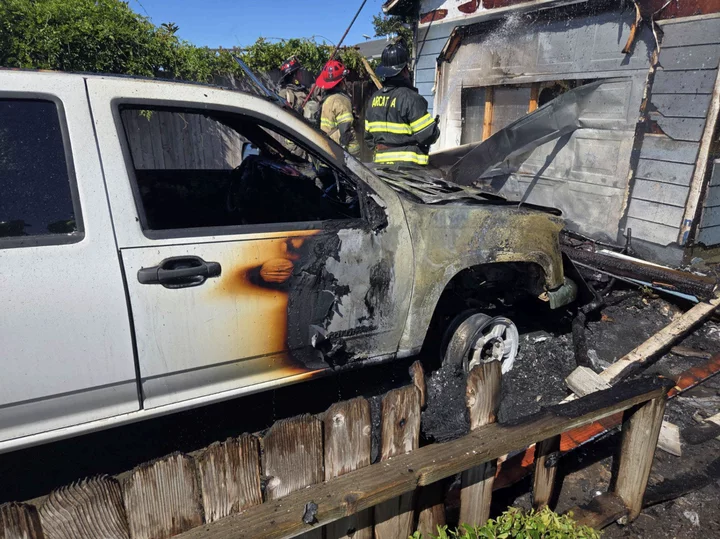
The first arriving Arcata Fire units found a single-family residence with flames on the
exterior that were starting to spread inside. They also found fire on the exterior of a
nearby house and a pick truck fully engulfed in flames. Arcata Fire personnel were told
that there were still occupants in the residence that may need rescue. Arcata Fire
personnel contacted a resident inside who was unaware of the fire and assisted them
from the structure. Humboldt County Sheriff’s Deputies entered the residence and
confirmed that all other occupants and animals were out of the house. Arcata Fire
personnel attacked the fire and extinguished fire on both houses and the pickup truck
within ten minutes. Additional Arcata Fire personnel and Arcata-Mad River Ambulance
personnel arrived on scene to assess the occupants of the residence who advised they
were uninjured. Blue Lake Fire and Humboldt Bay Fire personnel arrived on scene and
assisted with complete extinguishment of hot spots. Additionally, Arcata Fire District’s
Volunteer Logistics Unit responded to provide support on scene.
Arcata Fire personnel conducted an investigation into the cause of the fire. It was
determined that the fire originated at the vehicle and spread to the two houses. The
cause remains under investigation at this time. Damage to both houses and the vehicle
is estimated at $30,000.
Arcata Fire wants to thank the Humboldt County Sheriff’s Office for their assistance.
Their secondary search of the residence allowed fire resources to focus on
extinguishment of the fire, reducing risk to additional victims and minimizing damage to
both structures.
This incident is an excellent example of many agencies working together for the benefit
of all communities.
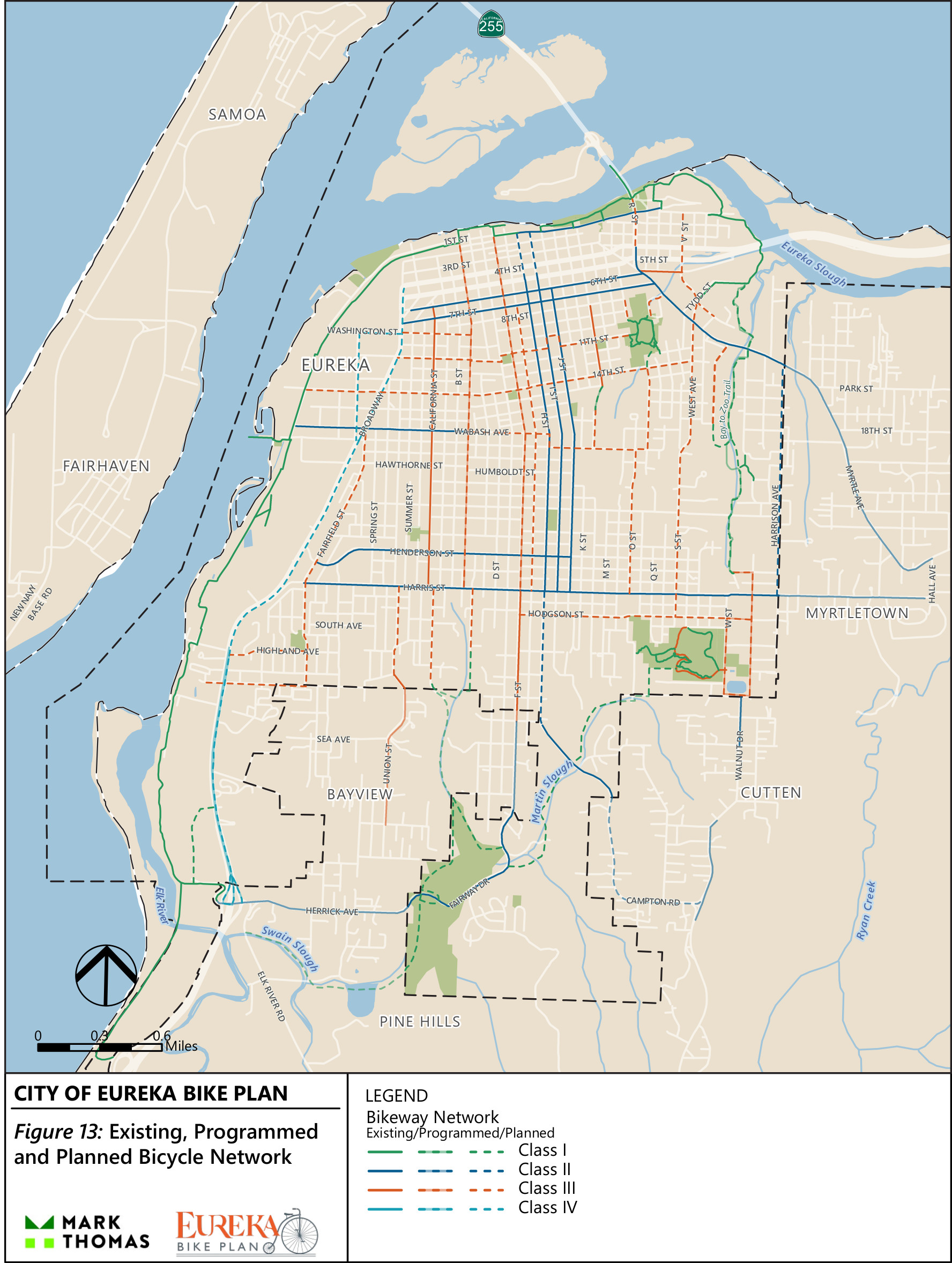
The Eureka City Council last night unanimously put its seal of approval on a 518-page document meant to shepherd the city away from the present state of its streets, toward a more bike-friendly future.
Page 26 of the Bike Plan shows a map of “existing, planned and programmed” bicycle-friendly improvements to city streets. Click to enlarge.
The Eureka Bike Plan, as it’s called — get the document here — contains a whole slew of different improvements all across the city. Its goal is to make the city safely navigable for bikes.
Some of this work has been done recently, and more is on the near horizon. For instance, the city’s “C Street Bicycle Boulevard” project, which will alter C Street’s design to prevent people from using it as a north-south car corridor, has already been funded, and work is scheduled to begin next year.
But the plan — which was worked out in collaboration with the Mark Thomas consulting firm — looks even further into the future, imagining north-south and east-west bike lanes, trails and other amenities reaching almost every part of the city.
Why the need for a such a plan? Well, if the goal is to build a network, rather than just a bike path here and there for recreational purposes, it helps to have an idea of that network in mind.
But also an on-paper plan helps get things done in a million other ways. Consultant Paul Martin of the Mark Thomas firm told the council that among other things, a comprehensive document like this is of great help when the city is looking for funding opportunities.
“When we advance our transportation planning studies, the name of the game, frankly, is money, and how we can position the agency for grant success,” he said.
Paul Martin.
As became clear during public comment, the city considers the plan a “living document” subject to change, rather than a set of hard goals with hard timelines.
Rick Knapp, president of the Humboldt Bay Bicycle Commuters’ Association, told the council that while the plan was an “impressive document,” its full content — including appendices detailing potential costs — wasn’t available until five days ago.
“I just wonder whether it’s appropriate for the city to adopt this tonight when nobody really got to see it,” Knapp said. “So that’s kind of an open question to you: Is five days from the time you sent out an email to some people enough time?”
But city staff assured the council that the document is easy to amend in response to changing circumstances and evolving technology, and that seemed to be enough to sway a couple of questions councilmembers had about timing. The document was approved on a 5-0 vote.
###
At
the end of last night’s meeting, City Manager Miles Slattery gave
the council an update on the EaRTH Center, the big downtown
development on Third Street between G and H streets that, if and when
it’s ever built, will house a big apartment complex over a regional
transit hub run by the Humboldt Transit Authority.
The
EaRTH Center project has undergone a few changes since it was first
approved by the council two
and a half years ago. Cal Poly Humboldt, an early partner, has
bailed out, as has the original developer. Early
this summer, the city cut a new deal with local development firm
Danco Builders to take over the project.
Slattery
told the council that city staff is still meeting with Danco and the
Humboldt Transit Authority every week or two, and that they’re
finalizing plans for the space. He said that it’s looking like
they’ll setting on something like 55 new low-income
units
for the complex, and
that there should be a proposal before the city’s Design Review
Committee before too long.
Mayor
Kim Bergel asked Slattery, for the public’s benefit, to clarify
what he meant by “low-income” housing. He assured her that these
apartments, along with other downtown parking-lot con, were for
“working people.”
“We
have people who work for the city who
have full-time jobs who
could qualify for that [low-income
apartment],” Slattery said. [Ed.
note:The
Outpost
ran a really clear explainer on this a while back. Here it is, in case you missed it.]
The
EaRTH Center is one of the developments targeted by Measure
F, which seeks to stop the conversion of city-owned downtown
parking lots into housing.
Pink hues adorn the horizon as the sun rises on a nondescript parking lot at Long Beach City College. The lot is quiet but not empty, with the same gray asphalt and slightly faded white lines as any other one on campus. But from 10 p.m. to 7 a.m., it is much more than a place to park.
The lot is a designated area for Long Beach City College’s Safe Parking Program, an initiative from the college’s Basic Needs Center that offers safe overnight parking for students and connects them to resources like showers and Wi-Fi. The program was created to address a particular student demographic: homeless students living in their cars.
A report from the Community College League of California found that 2 out of 3 of the state’s community college students struggle to meet their basic needs and almost 3 out of 5 are housing insecure.
To help these students, multiple legislative measures have tried to create safe parking options similar to Long Beach City College’s. The most recent effort was Assembly Bill 1818. Introduced by Assemblymember Corey Jackson early this year, the bill would have required the California Community College and California State University systems to create pilot programs to provide safe overnight parking for students living in their cars.
“Parking lot homeless programs are a best practice that’s been used throughout the nation; churches have done it, cities have done it, it’s time for colleges to step up and do it too,” Jackson said.
The bill was killed in the appropriations committee on Aug. 16, but would have required the California State University to select five campuses to participate in the pilot program; the California Community College chancellor would have had to select 20. The pilot program would have lasted through 2028.
The appropriations committee, which assesses the financial viability of a bill, estimated establishing pilot programs across the Cal State system would cost around $500,000 as well as an additional $2.25 million in annual costs. For the California Community Colleges, the committee estimated between $91,500 and $112,00 in one-time costs and $10 million to $13 million in annual costs for the duration of the program.
Justin Mendez, coordinator of Long Beach City College’s Basic Needs Program, oversees the safe parking program and said those estimates sound high, although he acknowledges that costs will vary from campus to campus. Long Beach City College has been able to fund their program for less than the committee’s estimated costs by working collaboratively with other departments and using existing contracts.
While the bill had garnered support from organizations like the California Faculty Association and the Student Senate for California Community Colleges, several community college districts and the California State University system opposed it. Some of their concerns include liability risk and cost. They also argue that providing secure overnight parking is not a permanent solution.
Letitia Clark, chief communications officer for the South Orange County Community College District, said the district has been investing in programs that support basic needs, including housing, as well as exploring building housing on campus as part of their facilities master plan.
“We don’t want any mandates or anything that would take away from that, and especially with an alternative that we actually don’t think is safe and really provides a good quality of life for our students,” Clark said.
Mendez at Long Beach City College acknowledges that overnight parking is not a housing solution.
“We’re not in the understanding that providing our students a safe place to park is providing them housing,” Mendez said, adding that the program is just one of the many resources available for students facing housing insecurity. However, overnight parking provides an immediate safe space while students are connected to longer term housing.
Providing holistic support
Started in 2021, the program has evolved over the years. The lot is now located next to the college’s campus safety building, which has allowed Long Beach City College to cut down on the nearly $500,000 they spent the first two years hiring an outside security company. Students have access to the bathroom in the campus safety building throughout the night and can access the locker room showers from 6 a.m. to 9 a.m. at the nearby school stadium.
Being next to the campus safety building means overnight security officers and parking employees periodically check in on the lot as part of their routine rounds. Mendez said that despite there not being 24/7 surveillance there haven’t been any safety issues.
The lot has 15 parking spots reserved for safe parking participants from 8 p.m. to 7 a.m. although the program can have around 30 folks enrolled at a time. Mendez said they rarely have issues with capacity because students use the resource to varying degrees — some enroll as a backup because they are at risk of losing their housing, others may only need a night or two while they wait to relocate.
Students in the Safe Parking Program need to be enrolled in the primary terms of fall and spring. However, they can continue using the program during summer and winter without being enrolled during those terms. They must also be independent; service animals are allowed but students can’t be living in their vehicle with family or have dependents.
These eligibility requirements have evolved as Mendez and his team assess what is realistic and better serves students. Originally, the program required students to have their vehicles registered and an up-to-date license but now that is something the college assists them with.
Once enrolled in the program, students receive a welcome packet, sign a liability release form and are connected with a case manager to find long-term housing, whether that be through one of the college’s community partners or elsewhere.
For the 2022-23 academic year, the program had a total of 24 students. Twelve of them found transitional or permanent housing. For fall 2023, 21 students enrolled in the program, two obtained permanent housing and 19 of them continued into spring 2024.
The community has also been supportive of the program. Mendez said that since it started, the program receives donations of blankets, gift cards, hygiene kits and other necessities.
“All we need is a place to park overnight.” — Brad Butterfield, president of the Alternative Living Club, Cal Poly Humboldt
Elliot Stern, the president of Saddleback College, spoke against AB 1818 during a Senate committee hearing, arguing that colleges need to get students out of their cars and into their basic needs centers so their needs can be “addressed holistically.”
At Long Beach City College, students access the parking program through the basic needs center and its online request form. What began as a COVID-19 emergency aid application has continued to be a useful one-stop-shop application for students seeking help.
“For all of our basic needs efforts, we always take a wide scope and try to cast the widest net we can,” Mendez said.
The survey asks whether students are facing housing insecurity, which could mean they are struggling to pay rent or have to move frequently, or if they are homelessness, meaning they don’t have a permanent place to live. If they answer yes to either, the survey then asks if they’re sleeping in their vehicle, couch surfing, staying in hotels or borrowing a room.
Through this data, the Basic Needs team can directly connect students with specific resources. For students who self-identify as living in their cars, the outreach coordinator then refers them to the Safe Parking Program.
When students aren’t allowed to park
AB 1818 was inspired by the experiences of students attending campuses without overnight parking. The bill originated as a response to Cal Poly Humboldt evicting students living in their vehicles.
On Oct. 25, 2023, Cal Poly Humboldt students received a mass announcement stating that the university would begin enforcing a parking policy it had previously overlooked and would be evicting students who were found sleeping in their vehicles overnight.
One of those students was Caleb Chen, a second-year public sociology graduate student. He applied to Humboldt in late June of last year and knew finding housing would be difficult. After doing some research, he learned about the university’s alternative living community and figured it would be feasible to live out of his van.
Chen was in the graduate lounge with a friend when they both got the email.
“Oh, the jig is up,” his friend told him.
The eviction announcement said allowing students to sleep in their cars was “unsanitary” and “unsafe” — terminology that not only made students feel dehumanized but also something they considered inaccurate.
First: Brad Butterfield standing inside his RV. Photo by Alexandra Hootnick for CalMatters
Brad Butterfield, president of the Alternative Living Club, a school club created by Humboldt students living in their cars to form a community and advocate for establishing a mail service, said the administration brought up similar sanitation concerns when they pitched the idea of a safe parking program on campus.
“We don’t need, nor ever asked for, bathrooms, showers or security,” said Butterfield, a journalism senior. “All we need is a place to park overnight.”
Butterfield lives in an RV, which has a built-in bathroom. He has a membership at a local gym and showers there. For students without RV’s, Chen said there still are bathrooms on campus that are open 24/7 and that most undergraduate students shower in the school gym.
“It’s really difficult to be pretty much told that you can’t exist,” Butterfield said. “We weren’t causing any harm. We all kept a really low profile.”
Butterfield said that at the time of the evictions, 25 to 30 students were living in their cars. Some lived in discrete vehicles like SUVs while others lived in RVs like him.
The email announcement stated that campus officers had received calls from members of the community “expressing fear and frustration about the situation.”
“There were never any issues between the vehicle dwellers on campus,” Butterfield said. “Not between us as a community and certainly not between us and the campus community at large.”
Brad Butterfield checks the top of his RV for leaks in Arcata on Aug. 24, 2024. Due to the high cost of education, Butterfield lived in his vehicle on campus at the California State Polytechnic University, Humboldt until the university prohibited students from doing so in the fall of 2023. Now, Butterfield parks in the city of Arcata, which requires he move his vehicle every 72 hours or receive a ticket. Photo by Alexandra Hootnick for CalMatters
According to Butterfield, it was quite the contrary. He said some students had told him they felt safer knowing there were students in the parking lot at night who could call the police if anyone was trying to break into their car — something the group had done in the past.
The stigma around homelessness is something that Mendez from Long Beach City College has been fighting since the beginning of the safe parking program. He said the staff have a student-centered approach and are mindful of treating students with dignity.
“There’s all of these negative stereotypes about what a homeless person is instead of realizing that these college students are coming here to be successful. They’re coming here to work on their long-term goals and help themselves and their families,” Mendez said. “I think that level of dignity has made the biggest impact beyond the actual connection of housing partners.”
The mischaracterization of homeless students is what ended a 2019 bill that was also advocating for safe parking. Assembly Bill 302 was introduced by Assemblymember Marc Berman, and would have required community college campuses to allow overnight access to parking, bathroom and shower facilities for students living in their cars.
The bill made it to the appropriations committee where it underwent significant amendments that Berman said “watered down the bill” and “treated homeless community college students like pedophiles” by placing restrictions for campuses within a certain distance from elementary schools.
“It was really unfortunate and damaging in terms of stigmatizing homeless students. And so, because of a lot of those reasons, we decided to stop the bill from moving forward and work on other solutions to the issue,” Berman said. He later drafted Assembly Bill 132, which successfully passed and required every California Community College to establish a basic needs center and hire a basic needs coordinator.
In 2020, another student tried starting a pilot overnight parking program at his campus. Grayson Peters, now a UCLA alumni, was a founder of UCLA Safe Parking and came across similar arguments from his administration at the time.
He said UCLA administrators told him allowing students to live in their cars and park overnight was “fundamentally unsafe.” Peters said that while he agrees with the statement, the alternative can be even more dangerous for students.
“Students are actively sleeping on unsecured city streets a few blocks over, without the benefit of university guards or university facilities or the student gym nearby to go to the restroom in the middle of the night if they need to,” Peters said. “The status quo is more unsafe than the solution we’re proposing.”
Butterfield and his partner have experienced that risk. After being evicted, they tried to find safe places to park around the city. But Arcata has a 72-hour parking limit, which meant they had to relocate every three days. Butterfield said the Arcata police have harassed them multiple times.
“It feels like we’re constantly trying to outrun the police because they keep wanting us to move from here to there to here to there,” Butterfield said.
Cal State Humboldt referred students to a safe parking program run by a local nonprofit organization, but that program ended this summer.
Stephanie Goldman, the associate director of the Student Senate for California Community Colleges, said data shows that a student’s proximity to campus can affect their academic outcomes.
“[Safe parking] is not only giving them a safer option, but an option that is conducive to them reaching their goals,” Goldman said.
Such was the case for Chen in Humboldt, who, before the eviction, was doing much better academically because the commute time was so short and he didn’t have to stress about where he would spend the night.
Chen spent the remainder of the semester and the following one at a local public parking lot. He now lives in a studio apartment he can afford because of loans and scholarships and is splitting rent with his partner who moved up to Humboldt.
Caleb Chen stands in the parking lot where he lived in his van at the California State Polytechnic University, Humboldt in Arcata on August 24, 2024. Due to the high cost of housing and education, some students at the university lived in their vehicles on campus, prior to the university prohibiting them from doing so in the fall of 2023. Chen, a sociology graduate student, said that finding affordable housing near the university is challenging, and only possible for him this year after moving in with his partner and receiving a fellowship that can be applied towards rent. Photo by Alexandra Hootnick for CalMatters
“When that announcement happened in November, it was just a wrench into a lot of people’s livelihoods let alone academic success,” Chen said.
Jackson said he was disappointed that the bill was “mischaracterized” by the educational systems as encouraging students to live in their cars as opposed to more effective interventions. Moving forward, now that the legislature is on a break until January, Jackson said he will be scheduling a meeting with the Cal State and California Community Colleges chancellors to see if “there’s ways that we can still get this done.” If not, he will be reintroducing the bill next year.
The Student Senate for the Community Colleges said they will continue to advocate for student basics needs including securing funding for dorms.
Jetaun Stevens, a senior staff attorney with the nonprofit law firm Public Advocates, said she hopes the bill returns with a greater coalition behind it. She said that while AB 1818 was mostly sponsored by the author, working with advocacy organizations who can co-sponsor the bill would help bring forward student stories and amplify the potential impact of the bill.
“Oftentimes it does take [bills] that are somewhat controversial quite a few times before they make it across the finish line,” Stevens said.
###
Briana Mendez-Padilla is a fellow with the College Journalism Network, a collaboration between CalMatters and student journalists from across California. CalMatters higher education coverage is supported by a grant from the College Futures Foundation.
CalMatters.org is a nonprofit, nonpartisan media venture explaining California policies and politics.