The final phase of grief for a deceased industrial operation?
The auction.
The Los Angeles-based liquidator Tauber-Arons, Inc. recently announced that it will be conducting a “MASSIVE” auction of the fixed assets of Mad River Sun Valley Floral Farms, the deceased bulb giant that graced the Arcata Bottoms for several decades.
Industrial liquidation auctions were common on the Humboldt County scene around the turn of the century, during the timber industry’s precipitous decline, but this must be the first significant one we’ve seen in a while. Basically, it’s a manufacturing estate sale.
If you’re new to this world, know that you’ll likely be bidding against people who make their livings buying stuff on the cheap from sales like this, then selling it for a profit. Good luck!
I can’t remember why we didn’t say hello, but now it is time to
say goodbye. We are coming to the end, for now, of the Outpost’s
acquaintance with the wonderful talents of Gillen Tener Martin
and Jacquelyn Opalach, both of whom will soon be going back to
school.
Martin – proud
daughter of Blue Lake – is leaving us today to return to her
journalism studies at the prestigious Institut
d’études politiques de Paris (“SciencesPo”),
alma mater of Marcel
Proust, Christian Dior and every president of France since 1981.
Read
Martin’s
LoCO
bibliography here.
What her professeurs will
make of it we cannot tell.
Opalach – a
McKinleyville native and an Outpost
returnee, having done a tour of duty with us during the pandemic –
is, thankfully, still with
us for another couple of weeks. But Cal Poly Humboldt is beckoning
her back, siren-like, for one final semester, and we’re not going
to go so far as to chain
her to her chair.
Opalach’s
entire Outpost output,
dating back to September 2020, can be found here.
Here’s a strange
coincidence … or maybe not so strange, when you think about it:
Both Martin and Opalach were, in their day, editors of the Arcata High
Pepperbox, which is one of
the very few high school student newspapers left in Humboldt County,
and one of the best in all the land.
Jacquelyn and Gillen have been the greatest — smart, funny, charming, hard-working. If you ever get the chance to hire them, do so.
Farewell for now! Remember: You’re
paying your schools, but we paid you.
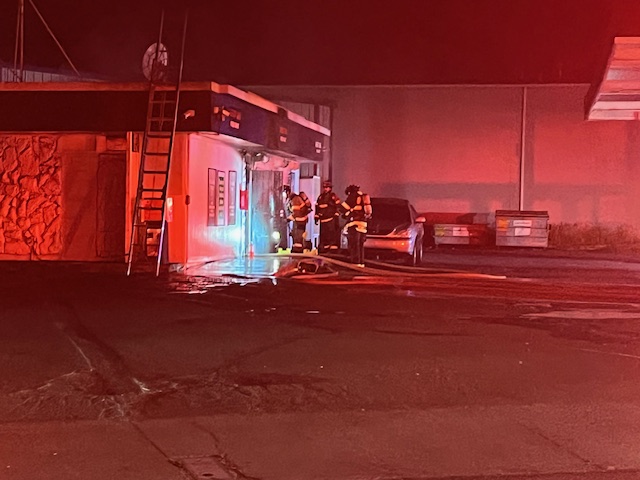
Firefighters respond to a structure fire at Great Gas in Eureka. Photos: Humboldt Bay Fire
###
Press release from Humboldt Bay Fire:
At 0340 hrs on August 16, 2024, Humboldt Bay Fire responded to a reported Structure
Fire at a convenience store and gas station on the 1400 block of Broadway. Humboldt
Bay Fire responded with 1 Truck, 3 Engines and 1 Chief Officer. The first arriving
company found heavy black smoke pushing from inside the convenience store. One
occupant had escaped the fire prior to fire personnel arriving on scene. The occupant had
minor injuries.
Fire Crews quickly went to work extinguishing the fire, treating the injured occupant,
removing smoke from the building and searching the building for other occupants as the
fire was extinguished. There were no further civilian injuries and no Firefighter injuries.
The building sustained minor damage and the property value estimated to be saved is
$400,000 and contents estimated to be saved is $3,000. Property damage is estimated at
$50,000 and the loss of contents is estimated at $15,000. The cause of the fire is under
investigation.
A total of 13 Firefighters and 1 Volunteer Support unit responded to this incident. HBF
would also like to thank the Eureka Police Department, City Ambulance, and Pacific Gas
& Electric who also assisted in stabilizing the incident.
Humboldt Bay Fire reminds the community to yield to emergency vehicles and avoid
driving through emergency scenes by taking alternative routes around the incident. This
leads to greater safety for all drivers and emergency personnel working at scene.
Supporters of the state’s reparations bills celebrate as the measures survived the Legislature’s suspense file hearings at the Capitol Annex Swing Space in Sacramento on Aug. 15, 2024. Photo by Fred Greaves for CalMatters.
California lawmakers yesterday weeded out hundreds of pricey proposals, including notable ones on crime and technology.
As they culled about one-third of 830 bills, legislative committees killed one that aimed to prohibit broadband providers from charging more or offering slower Internet service in low-income areas, and another to bar law enforcement agencies from relying solely on facial recognition to arrest or search suspects.
The committees also held several Republican crime bills, including one aimed at adding stricter reviews before the statereleases sexually violent predators. That prompted the author, Senate GOP leader Brian Jones of San Diego, to state that Assembly Democratic leaders are “now complicit in helping the Newsom Administration protect these predators over families.”
But other high-profile bills survived yesterday’s hearings — much to the relief of some advocates who have spent years fighting for their causes.
Chris Lodgson, an organizer with the Coalition for a Just and Equitable California, said he barely slept all night in nervous anticipation. He and a handful of others from the Bay Area and Stockton came attended the Assembly hearing to watch the outcomes of three reparations bills, including Senate Bill 1403 by Inglewood Democratic Sen. Steve Bradford, which establishes the California American Freedmen Affairs Agency.
As each of their bills came up in the fast-paced readout, the organizers gripped hands, sighed in relief — and, after all three bills survived — some burst into tears.
Lodgson said the bills represented an historic moment: “For reparations to be effective, sustainable and successful, we not only need to keep the focus specifically on this uniquely American community of descendants, we need new institutions, new resources and new ideas. Today, we move one step closer to that reality.”
That’s similar to the 32% held of the 1,009 bills in the May suspense file hearings. But it’s higher than the 25% average over the last decade, according to lobbyist Chris Micheli.
Members of the Senate Appropriations Committee hold a suspense file hearing at the Capitol Annex Swing Space in Sacramento, on Aug. 15, 2024. Photo by Fred Greaves fo CalMatters
Assembly Appropriations Chairperson Buffy Wicks, a Democrat from Oakland, started off the hearing with that reminder: In June, Gov. Gavin Newsom and the Legislature came to a budget agreement that closed a $47 billion shortfall for next year. Wicks said the budget situation “weighed heavy” on the committee.
Required community colleges and California State Universities to provide safe parking spots for homeless students who live in their cars.
One of the most closely watched bills — to require Google and Meta to pay publishers for using news content — was sent to the Senate rules committee. That gives bill author Wicks, supporters and the opponents — a powerful coalition of tech companies — more time to negotiate.
The more than 500 bills that did get through still must win final approval before the Legislature adjourns Aug. 31 to reach Newsom’s desk. The cost of bills he signs into law will be accounted for in the governor’s January budget proposal.
While the governor’s office did not comment on the suspense file, his office pointed to his July 18 veto message on AB 1272 — a bill that would have required the State Water Resources Control Board to adopt guidelines for diversion and water use: “It is important to remain disciplined when considering bills with significant fiscal implications that are not included in the budget.”
###
CalMatters reporter Briana Mendez-Padilla contributed to this story.
CalMatters.org is a nonprofit, nonpartisan media venture explaining California policies and politics.
Kathleen Ellen Kelly Burgh was born in San Francisco on April 15,
1940. She went home to the Lordon
July 30, 2024, due to complications from a fall. She was 84 years
old. To friends and relatives, she was known as “Kathleen,”
“Kit,” “Kathy” or “Kitty.” For 69 years she was a Eureka
resident and faithful parishioner of St. Bernard’s Catholic Church.
Kit’s parents moved to Seattle, Washington, and then to Eureka when
she was 15. She graduated from St. Bernard’s High School and
attended Humboldt State College. At 23, she
married the love of her life, Richard Burgh, and settled down to
create and nurture what was most important to her: a healthy, loving
family.
Life-long friend Genie Wood describes her as sparkling. “She’s
always had beautiful hands and she used them well making jewelry. We
read every cook book in print together.” She liked to sew outfits
for her family; try new recipes from her cookbook collection; and
indulge in handmade crafts like ceramics and beading. For decades,
she gifted her creations to family and friends. Kit spent an entire
year hand-stitching a gorgeous quilt as her sister’s wedding gift.
Her life was about “being there” for everyone she loved. She was
talkative and outgoing, considering everyone a potential new friend.
Kathy had a beautiful walk of faith.
She is survived by Richard, her (hard-working), devoted husband of 60years; her daughter, Julie Burgh, who has provided loving
care for both of her parents for decades; her daughter, Kelly, and
husband Paul Brochard, and their three children: Thomas; Christian;
and Laura; and her sister, Pat Whittemore.
Kit successfully fulfilled her lifelong dream, leaving a family who
is profoundly blessed by her life and will always love her deeply.
Funeral arrangements were made with great care and respect by Sanders
Funeral Home.
###
The obituary above was submitted on behalf of Kit Burgh’s loved ones. The Lost Coast Outpost runs obituaries of Humboldt County residents at no charge. See guidelines here.
As of Thursday afternoon, the Boise Fire burning south of Orleans has burned over 10,205 acres. The fire, which ignited on Aug. 9, remains zero percent contained.
In a virtual Q&A with fire officials this afternoon, Operations Section Chief Heather McRae said fire crews have made “really good progress” on the fire, establishing direct lines on the northern edge of the fire along Antenna Ridge. Incident Command’s “number one priority” is keeping the fire away from Orleans, she said.
Screenshot from Q&A.
“Crews have been focusing their efforts today in that area, getting that line good and mopped up along the top of Antenna Ridge Road,” McRae said, gesturing to the map with a plastic skeleton hand. “When the fire did go through there, some trees came down. So, we do have some fallers in there falling trees to make sure that the crews can continue to access that area safely.”
Growth has slowed on the eastern edge of the fire along Salmon River Road near Horn Creek Gap. However, there is “still some potential for that edge to grow,” McRae said.
“[Growth] is at a slow, slow pace right now,” she continued. “We have an old dozer line that was put in during the Red Salmon Complex, and that dozer line has been reopened. We have crews in there prepping that line tonight. They’re looking at utilizing a drone to go in there and do some aerial ignition. That will allow fire that is lit directly along that line to back down into that drainage, and that will become our new containment line.”
Adrienne Freeman, a public information officer for California Team 10, said the incident command team is “going to be extremely conservative” about establishing containment lines before they’ve been tested.
“Pretty much everybody on this team has been in this environment for decades, and we know how unforgiving it can be,” she said. “We are not going to put containment on the map until we know that our lines have been tested and we are confident that they are absolutely going to hold. … We’re just being extra careful and conservative about how we call it.”
Speaking to concerns about fire retardant contaminating the water supply for residents of Pearch Creek, Freeman said fire crews and community liaisons are “taking all the necessary steps to ensure that the water supply is safe.”
“We also understand that this community has seen a lot of retardant in places that maybe aren’t strategic … and I just want to assure you that we’re being extremely thoughtful about the use of retardant,” she said. “And it’s not just water systems, there are other cultural [areas] out there that we want to make sure we’re avoiding with retardant.”
There are 22 crews, 16 engines, five helicopters and two dozers assigned to the fire. There have been no reports of firefighter injuries.
Check out the 2024 Boise Fire Facebook page for more information. A video of this afternoon’s Q&A can be found here.
###
The Boise Fire as of this afternoon. The squares are satellite-detected hotspots: Red squares were detected within the last six hours, orange within the last 12 and yellow within the last 24.
Jim Hight was trying to quit weed and alcohol when he moved to Humboldt in 1996.
It was the heyday of the black market Green Rush, and as a newcomer he saw (sniffed?) temptation around every corner.
“In those days, you couldn’t walk around Arcata without smelling the grow houses – which triggered a lot of cravings for me,” Hight told the Outpost in a phone interview.
Now nearly 24 years sober with the help of 12-step programs, he has immortalized his struggles in Jonah, a character in his debut novel: Moon Over Humboldt.
Jonah is a recognizable archetype from Humboldt’s recent past. A young Earth First!-er type fresh up from the Bay to save Mother Earth, the curtain opens on his endeavoring to stay off the pot amidst an Arcata scene rife with mystery-source wafts and generous buddies. Enter Bill, a lifelong logger whose son struggles with methamphetamine addiction, and Jonah’s black-and-white worldview evolves.
Hight said that the inspiration for the two main characters, who hold predictably divergent opinions on best practices for forest management, came when he was on the bus between Arcata and Eureka.
“It was raining like heck, the windshield wipers were slopping back and forth … Driver’s going 45 or whatever,” he remembered. “And there were two people talking about the rain, different generations, young, mid-20s, and 50 or whatever.”
As the older passenger (seemingly more experienced with the North Coast wet) reassured the younger, recalling bad floods of years past, Hight said that Bill and Jonah began to take shape in his mind.
“I was yearning for a story of connection between people who are divided and polarized,” he said.
The social cleavages Moon Over Humboldt explores are familiar terrain for Hight. As a former staff writer for the North Coast Journal, a job he described as “getting paid to get a master’s degree in Humboldt County,” exemplars of local culture and opinion were his bread-and-butter subjects for years. As the book’s “about the author” blurb states, our area’s real-life characters – “loggers and forest defenders, fishermen and scientists, ranchers and dairy farmers, small-town mayors and tribal leaders, county sheriffs and cannabis growers” – fascinated the former Southern California city boy.
“I interviewed people on all sides of the timber controversies, and came to really respect and appreciate them,” Hight said. “People who thought clear cutting was the right thing to do and had done it for years or generations, and then people who thought it was decimating the countryside and causing flooding and exterminating species and stuff … That conflict narrative led me to imagine the characters in Moon Over Humboldt, who are totally divided.”
“But once they meet and start getting to know each other through the 12-step programs, they find that not only do they have a lot in common, but they actually really need each other in ways they don’t understand,” he continued.
As Bill and Jonah’s stories unfold over the course of a wet winter, Hight introduces readers to other personalities that may strike a familiar chord in Humboldt hearts and minds: Mike Doyle, the kind-hearted, large-bodied environmental center director; Owl, the pacifist-environmentalist; King, a retired rodeo cowboy with a ranch down Shively way … the list goes on.
To sociable readers who were around in Y2K Humboldt, some characters may ring of real people. Hight specifically shouts out Tim McKay of the Northcoast Environmental Center and Bill Boak of Boak Logging – men who “modeled courtesy and respect for their ideological opponents” – in the book’s closing gratitudes.
And for those more interested in places than faces, landmarks such as the Orick Peanut or the tree at J & 10th in Arcata bolster Hight’s realistic worldbuilding. Hight said that working on Moon Over Humboldt became a way to vicariously visit the places he missed after he and his wife fled the mold that was causing her health issues in 2018.
“It was a great joy to just drop myself into downtown Arcata, or a foggy evening in Eureka,” said Hight, who now lives in Colorado.
For readers attuned to recent history, Moon Over Humboldt’s place in time may be perplexing: The characters’ Timber Wars stances feel more Redwood Summer (1990) than the post-smartphone, pre-Willits bypass/marijuana legalization moment the story depicts.
But by condensing decades of cultural reference points, Hight creates a present rich with the past – a backdrop of diverse attitudes and happenings coexisting outside their own timelines as an amalgamation of the colorful histories that have landed Humboldt where we are today.
“The book is not what you call historical fiction. It’s not. It’s fiction, fiction,” he said, adding that the book is ostensibly set around 2010.
The tensions in Hight’s literary version of the North Coast universe (old-timer vs. newcomer, earth vs. economy, New Age vs. Christian) ultimately set the stage for the story’s central themes: addiction, how it’s experienced both by those suffering and those who love them, and recovery.
“This is where I got sober, this is where I turned my life around,” Hight said of his decision to set the book in Humboldt.
While the author made clear to the Outpost that he does not claim membership in any particular 12-step fellowship (keeping with the programs’ tradition of anonymity), Hight’s words in and on the book show how valuable the steps have been in his life.
And as his characters search for the strength of forces outside themselves, the power of the programs’ community – and of Humboldt’s – surfaces.
“I’ve never read fiction about the 12 steps that didn’t sound like bullshit,” reads one review in the “praise” section of the book cover. “This is no bullshit – 100% on the money.”
It is no bullshit: Moon Over Humboldt is clearly written by a journalist and recovering addict who has collected real stories of temptation, regret and redemption for recreation as fiction.
But in the repackaging process, Hight also seemingly slipped in touches of the extraordinary.
For instance, both Bill and Jonah come off as men with above-average social graces, abnormal self-awareness and superhuman self-reflective abilities – as men who react to hard stuff with empathy and compassion when their real-life counterparts might let insecurity take the wheel.
As Hight explained, his characters act like the man he wants to be.
“In that regard, they may be a little unrealistic, but as a fiction writer you can make people more heroic than they might be in real life,” he said.
The combination of Hight’s believable world and relatable yet aspirational characters is what makes the book such a tear-jerker of a page-turner.
“Jimbo, I used to like you, but now that you’ve managed to make me get all choked up and cry, I’m not so sure about that,” wrote local logger and long-time Alcoholics Anonymous sponsor Mike Hess in Moon Over Humboldt praise.
Especially in an age when societal divisions and hard truths of addiction are rising to our community’s surface, it’s dang moving (and fun) to read about a world that sounds a lot like ours full of people as good as we could hope to be.
Hight will be in town at the end of this month to perform readings from, sign, sell and chat Moon Over Humboldt. Catch him at the Fortuna Library on Wednesday, Aug. 28 at 6:30 p.m., the McKinleyville Library on Thursday, Aug. 29 at 4 p.m., Northtown Books on Aug. 29 at 6:30 p.m. and Eureka Books on Friday, Aug. 30 from 5:30-8:30 p.m.
(The Eureka Books appearance will not include a reading – just chatting, signing and selling for that one.)
Information on local 12-step programs can be found here.






 Members of the Senate Appropriations Committee hold a suspense file hearing at the Capitol Annex Swing Space in Sacramento, on Aug. 15, 2024. Photo by Fred Greaves fo CalMatters


