

High Court Blocks Anti-Tax Measure From California Ballot
Alexei Koseff / Thursday, June 20, 2024 @ 10:14 a.m. / Sacramento
The California Supreme Court sided with Gov. Gavin Newsom and Democratic leaders in the Legislature on the constitutionality of a sweeping anti-tax measure, ruling today that it cannot go before voters in November.
The business community-sponsored initiative, formally known as the Taxpayer Protection and Government Accountability Act, broadly aims to make it more challenging to raise taxes in California, including by requiring the Legislature to seek approval from the voters for any new or higher state tax.
Newsom and legislative leaders sued last fall to stop the measure, arguing that it amounts to an illegal attempt to revise the California Constitution and would impair essential government functions.
In a unanimous decision, the Supreme Court agreed, ordering Secretary of State Shirley Weber to refrain from taking any steps to place the initiative on the Nov. 5 ballot.
The proposed changes “are within the electorate’s prerogative to enact,” Justice Goodwin Liu wrote, “but because those changes would substantially alter our basic plan of government, the proposal cannot be enacted by initiative.”
Proponents, led by the California Business Roundtable, introduced the initiative to crack down on what they contend are loopholes created by legislators and court rulings that weakened previous voter-approved tax accountability measures and allowed an unelected administrative bureaucracy to flourish. It has been heavily supported by the real estate industry and a private ambulance company, which frequently battle local governments over taxes, fees and assessments to fund public services.
The measure would also increase the margin to pass a voter-initiated special tax at the local level, to two-thirds from a simple majority; restrict how officials can calculate the cost of fees that fund public services and programs; and reclassify some of those charges as taxes.
These changes could upend the operation of California government at every level, prohibiting administrative agencies from setting levies and requiring the Legislature or local governments to turn to the voters to adjust them. Cities, counties and the unions that represent their employees have raised alarms that the initiative would blow a hole in their budgets, threatening their ability to provide essential services.
Opponents argued in court during a hearing last month that, rather than simply amending tax law in the state constitution, this amounted to a fundamental restructuring of how government operates — a more substantial change that can only be proposed by a two-thirds vote of the Legislature or through a constitutional convention. The initiative’s proponents countered that the power of the legislative branch has always been shared with the public and urged the justices not to intervene in a political conflict that should be settled by voters.
Democratic lawmakers had already placed a competing measure on the November ballot designed to undermine the California Business Roundtable initiative.
The legislative measure flips the California Business Roundtable’s own higher standards around, requiring any changes to the threshold for approving state and local taxes pass by that same margin. So if voters adopt it, the tax initiative would need to secure two-thirds support from the electorate to become law, rather than a simple majority, a high hurdle for a statewide ballot measure.
###
CalMatters.org is a nonprofit, nonpartisan media venture explaining California policies and politics.
BOOKED
Yesterday: 10 felonies, 12 misdemeanors, 0 infractions
JUDGED
Humboldt County Superior Court Calendar: Today
CHP REPORTS
Church Ave / Sutter Rd (HM office): Trfc Collision-Unkn Inj
Poppy Dr / Sherwood Rd (HM office): Closure of a Road
ELSEWHERE
RHBB: Ousted ER Doctor Runs for the Hospital Board That Pushed Him Out
RHBB: Eureka Public Outreach Shows ‘Tension’ Between Owning and Renting
RHBB: Ukiah Drops Annexation Push After Public Pushback
County of Humboldt Meetings: Behavioral Health Board - SUD/Dual Recovery Committee - Sept. 10, 2026
Could AI Reject Your Resume? California Tries to Prevent a New Kind of Discrimination
Khari Johnson / Thursday, June 20, 2024 @ 7:08 a.m. / Sacramento

Illustration by Adriana Heldiz, CalMatters; iStock
California regulators are moving to restrict how employers can use artificial intelligence to screen workers and job applicants — warning that using AI to measure tone of voice, facial expressions and reaction times may run afoul of the law.
The draft regulations say that if companies use automated systems to limit or prioritize applicants based on pregnancy, national origin, religion or criminal history, that’s discrimination.
Members of the public have until July 18 to comment on the proposed rules. After that, regulators in the California Civil Rights Department may amend and will eventually approve them, subject to final review by an administrative law judge, capping off a process that began three years ago.
The rules govern so-called “automated decision systems” — artificial intelligence and other computerized processes, including quizzes, games, resume screening, and even advertising placement. The regulations say using such systems to analyze physical characteristics or reaction times may constitute illegal discrimination. The systems may not be used at all, the new rules say, if they have an “adverse impact” on candidates based on certain protected characteristics.
The draft rules also require companies that sell predictive services to employers to keep records for four years in order to respond to discrimination claims.
A crackdown is necessary in part because while businesses want to automate parts of the hiring process, “this new technology can obscure responsibility and make it harder to discern who’s responsible when a person is subjected to discriminatory decision-making,” said Ken Wang, a policy associate with the California Employment Lawyers Association.
The draft regulations make it clear that third-party service providers are agents of the employer and hold employers responsible.
The California Civil Rights Department started exploring how algorithms, a type of automated decision system, can impact job opportunities and automate discrimination in the workplace in April 2021. Back then, Autistic People of Color Fund founder Lydia X. Z. Brown warned the agency about the harm that hiring algorithms can inflict on people with disabilities. Brown told CalMatters that whether the new draft rules will offer meaningful protection depends on how they’re put in place and enforced.
Researchers, advocates and journalists have amassed a body of evidence that AI models can automate discrimination, including in the workplace. Last month, the American Civil Liberties Union filed a complaint with the Federal Trade Commission alleging that resume screening software made by the company Aon discriminates against people based on race and disability despite the company’s claim that its AI is “bias free.” An evaluation of leading artificial intelligence firm OpenAI’s GPT-3.5 technology found that the large language model can exhibit racial bias when used to automatically sift through the resumes of job applicants. Though the company uses filters to prevent the language model from producing toxic language, internal tests of GPT-3 also surfaced race, gender, and religious bias.
“This new technology can obscure responsibility.”
— Ken Wang, policy associate with the California Employment Lawyers Association
Protecting people from automated bias understandably attracts a lot of attention, but sometimes hiring software that’s marketed as smart makes dumb decisions. Wearing glasses or a headscarf or having a bookshelf in the background of a video job interview can skew personality predictions, according to an investigative report by German public broadcast station Bayerischer Rundfunk. So can the font a job applicant chooses when submitting a resume, according to researchers at New York University.
California’s proposed regulations are the latest in a series of initiatives aimed at protecting workers against businesses using harmful forms of AI.
In 2021, New York City lawmakers passed a law to protect job applicants from algorithmic discrimination in hiring, although researchers from Cornell University and Consumer Reports recently concluded that the law has been ineffective. And in 2022, the Equal Employment Opportunity Commission and the U.S. Justice Department clarified that employers must comply with the Americans with Disabilities Act when using automation during hiring.
The California Privacy Protection Agency, meanwhile, is considering draft rules that, among other things, define what information employers can collect on contractors, job applicants, and workers, allowing them to see what data employers collect and to opt-out from such collection or request human review.
Pending legislation would further empower the source of the draft revisions, the California Civil Rights Department. Assembly Bill 2930 would allow the department to demand impact assessments from businesses and state agencies that use AI in order to protect against automated discrimination.
Outside of government, union leaders now increasingly argue that rank-and-file workers should be able to weigh in on the effectiveness and harms of AI in order to protect the public. Labor representatives have had conversations with California officials about specific projects as they experiment with how to use AI.
###
CalMatters.org is a nonprofit, nonpartisan media venture explaining California policies and politics.
This Giant Freshwater Fish — North America’s Largest — Gains California Protection
Rachel Becker / Thursday, June 20, 2024 @ 7:04 a.m. / Sacramento

White sturgeon. Photo: Oregon Department of Fish and Wildlife. Public domain, via Wikimedia.
Killed by algae blooms and dwindling from dams and droughts, the largest freshwater fish in North America is at risk in California. On Wednesday, wildlife officials took the first major step toward protecting it under the state’s Endangered Species Act.
White sturgeon, which can live longer than 100 years, historically reached more than 20 feet long and weighing almost a ton. Facing an array of threats, this shark-like, bottom-feeding fish with rows of bony plates, whisker-like sensors and no teeth has declined — and their numbers will likely continue to drop.
California’s Fish and Game Commission unanimously approved white sturgeon as a candidate for listing, which launches a review by the Department of Fish and Wildlife to evaluate whether it is in enough danger to warrant being declared threatened or endangered. The review is expected to take at least a year.
In the meantime, the fish will be protected under the California Endangered Species Act until the commission makes a final decision whether to list it as threatened or endangered. Harming or “taking” a species with any kind of project — such as water diversions — or activity such as fishing is “prohibited for candidate species the same as if it was fully listed,” said Steve Gonzalez, a spokesperson for the fish and wildlife agency. Permits and exemptions, however, can be granted in certain situations, he said.
The decision comes in response to a petition filed by a coalition of environmental groups and the California Sportfishing Protection Alliance for the species to be listed. They await a verdict on a federal petition, as well.
“This is an ancient lineage … they’ve withstood everything that Mother Nature had to throw at them, which makes it particularly poignant that they’re having trouble surviving us,” Jon Rosenfield, science director of San Francisco Baykeeper, one of the four groups that led the petition, told commissioners Wednesday.
California’s wild white sturgeon migrate between San Francisco Bay and the rivers of the Central Valley, largely the Sacramento River. They successfully reproduce only every six to seven years — typically during wetter years when more water flows out of the Delta.
Back-to-back algal blooms in the San Francisco and San Pablo bays killed large numbers of sturgeon during the past two summers. Nearly 870 carcasses were recovered in the summer of 2022, and at least 15 last summer. Experts believe thousands more likely died and sank to the bottom of the bays.
Overfishing for sturgeon eggs — caviar — and smoked fish drove the species to near-extirpation in California by the turn of the 20th century. For more than 100 years, commercial fishing of white sturgeon has been banned.

In this photo from the 1980s, an angler pulls a large white sturgeon aboard his boat in San Francisco Bay. Under current restrictions, recreational fishing of the fish is limited to one fish per year no longer than 4 feet long. Photo via the National Oceanic and Atmospheric Association.
California’s emergency rules for the recreation fishery, adopted in 2023, already reduced the maximum size limit of harvested fish from 5 feet to 4 feet, and cut the annual catch total from three fish to one.
Now the sturgeon’s temporary status as a candidate for listing will ban recreational fishing, unless the commission later grants an exemption sought by fishing groups.
Without an exemption, the decision “has the potential to cause irreparable damage (to) the business and recreational anglers who fish for White Sturgeon in California’s coastal, Delta, and inland waters,” fishing groups wrote in a letter in early June. “Recreational angling is not the cause of concern to the health of this fishery. Instead, this fishery is suffering from the mismanagement of our precious and limited water supplies.”
Many aquaculturists who farm domesticated sturgeon for caviar and meat raised concerns at the meeting, and commissioners reassured them that the regulation would not affect them. Indoor-farmed white sturgeon are included on lists of fish that experts consider sustainable and recommend for consumption.
Environmental groups said that without more protection, the fish will become even more imperiled as climate change squeezes water supplies, fishing continues and major projects planned for the region, such as the Delta tunnel, deplete more freshwater flows.
The die-offs during the past two summers “exacerbated…an already unsustainable level of fishery exploitation of White Sturgeon into a crisis situation,” wildlife staff wrote in a report for the Fish and Game commissioners. “In order to protect the surviving population of White Sturgeon and maintain a recreational fishery into the future, immediate steps were necessary.”
Sturgeon ancestors date back to the Cretaceous Period more than 120 million years ago, making them the most prehistoric and primitive of all bony fish. Instead of teeth, they have a long snout like a vacuum cleaner used to scrounge for bottom-dwelling shellfish, worms and mall fish to swallow whole. Today the largest ones grow to 10 feet and 400 pounds.
The rivers of the Central Valley, primarily the Sacramento River system, are among the few places where white sturgeon reproduce in the wild. Others include the Fraser River in British Columbia and the lower Columbia River in Oregon and Washington.
Their numbers in California are dropping, plummeting from a historical abundance of 200,000 harvestable fish to a recent five-year average of about 33,000, according to the Fish and Wildlife department.
The threats are many: Over the centuries, the Sacramento and San Joaquin River watersheds and San Francisco Bay have been fundamentally replumbed. Now water diversions for farms, cities and hydropower sap flows and dams limit migration. Pumping kills fish; introduced predators eat the young. Contaminants taint the waterways and poachers illegally harvest wild fish for their eggs.
A coalition representing water users in the Delta contested data pointing to long-term declines but commissioners dismissed that concern.
The Department of Water Resources, which operates the major water project funneling water south from Northern California rivers, will now need to apply to the state wildlife agency for a “take” permit for operations and fish screens at pumping facilities.
“We’ve already begun that process in anticipation of the candidacy being reached today,” said Lenny Grimaldo, environmental director of the State Water Project. He said the project takes “takes relatively low numbers of white sturgeon in any given year.”
State officials working on the proposed Delta tunnel project also are evaluating impacts to white sturgeon and plan to investigate how sturgeon respond to fish screens and river flows, Grimaldo said.
Before yesterday, white sturgeon were considered a “species of special concern” — meaning it had no protection but that continued population or habitat declines could qualify it as threatened or endangered. Green sturgeon, California’s other sturgeon species, are already listed as threatened under federal law.
Chris Schutes, executive director of the California Sportfishing Protection Alliance, one of the organizations that signed the petition, said it was a difficult decision to call for more protection.
He said California’s sport and commercial fishing industries are already reeling from the cancellation of salmon fishing for the second year in a row. Losing the ability to fish for white sturgeon adds to the burden.
“Many party boat skippers feel it’s going to affect them — that people won’t want to fish, if there’s not some chance that they can take a fish home,” Schutes said.
Still, he added, the goal is to get ahead of population declines before it’s too late to reverse them.
“Sometimes, I think we only see crises in retrospect, when we should have seen them sooner. And I think that we’re at that point — and it’s time to do something.”
###
CalMatters.org is a nonprofit, nonpartisan media venture explaining California policies and politics.
OBITUARY: Clarice (Elaine) Vogt, 1925-2024
LoCO Staff / Thursday, June 20, 2024 @ 6:56 a.m. / Obits

On June 1, 2024 Elaine Vogt passed peacefully in her home In McKinleyville, surrounded by family and loved ones.
She was born September 20, 1935 to William (Heartford) Pearl and Ada Pearl near Fresno. Her greatest passion of her life was her family. She married Earl Lee Vogt on the 2nd of September 1950. She had a busy life raising their five children — Mickey, Randy, Janice, Carol and Lee — in Westhaven. Elaine excitingly took up cake decorating so she could make both of her daughters’ wedding cakes. She then became the cake baker of the family. Fishing was an enjoyable pastime for her. She loved volunteering at Hospice and at the Clearlake Senior Center. As Elaine got older her favorite pastimes were reading, working crossword puzzles which kept her mind sharp. She also enjoyed crocheting. She loved to set in her favorite chair and watch the hummingbirds feed and play in the water fountain. Her warm easy smile and infectious laugh will be missed by many.
Elaine was preceded in death by her husband Earl, her oldest son Mickey and youngest son Lee. She was also preceded by two great-grandchildren, Trinten and Austin and great-great-granddaughter Makala.
Elaine is survived by son Randy Vogt and wife Lori; daughter Carol Grimes; daughter Janice Velez and husband Henry; grandchildren Heather Leroy, Colby Vogt, Kathryn Winkelman, Jamie Cooper, Jason Price, Joshua Seddon, Nathan Grimes, Lorisha Scott, Earl Vogt. She was also survived by 22 great grandchildren and five great-great grandchildren.
The family asks in lieu of flowers please donate to
Hospice of Humboldt
3327 Timber Fall Court
Eureka CA 95501
###
The obituary above was submitted on behalf of Clarice Vogt’s loved ones. The Lost Coast Outpost runs obituaries of Humboldt County residents at no charge. See guidelines here.
Eureka Council Rebels Against City Attorney’s Summary of the ‘Housing for All’ Initiative, Special Meeting Called Monday to Resolve the Question
Isabella Vanderheiden / Wednesday, June 19, 2024 @ 4:43 p.m. / Local Government
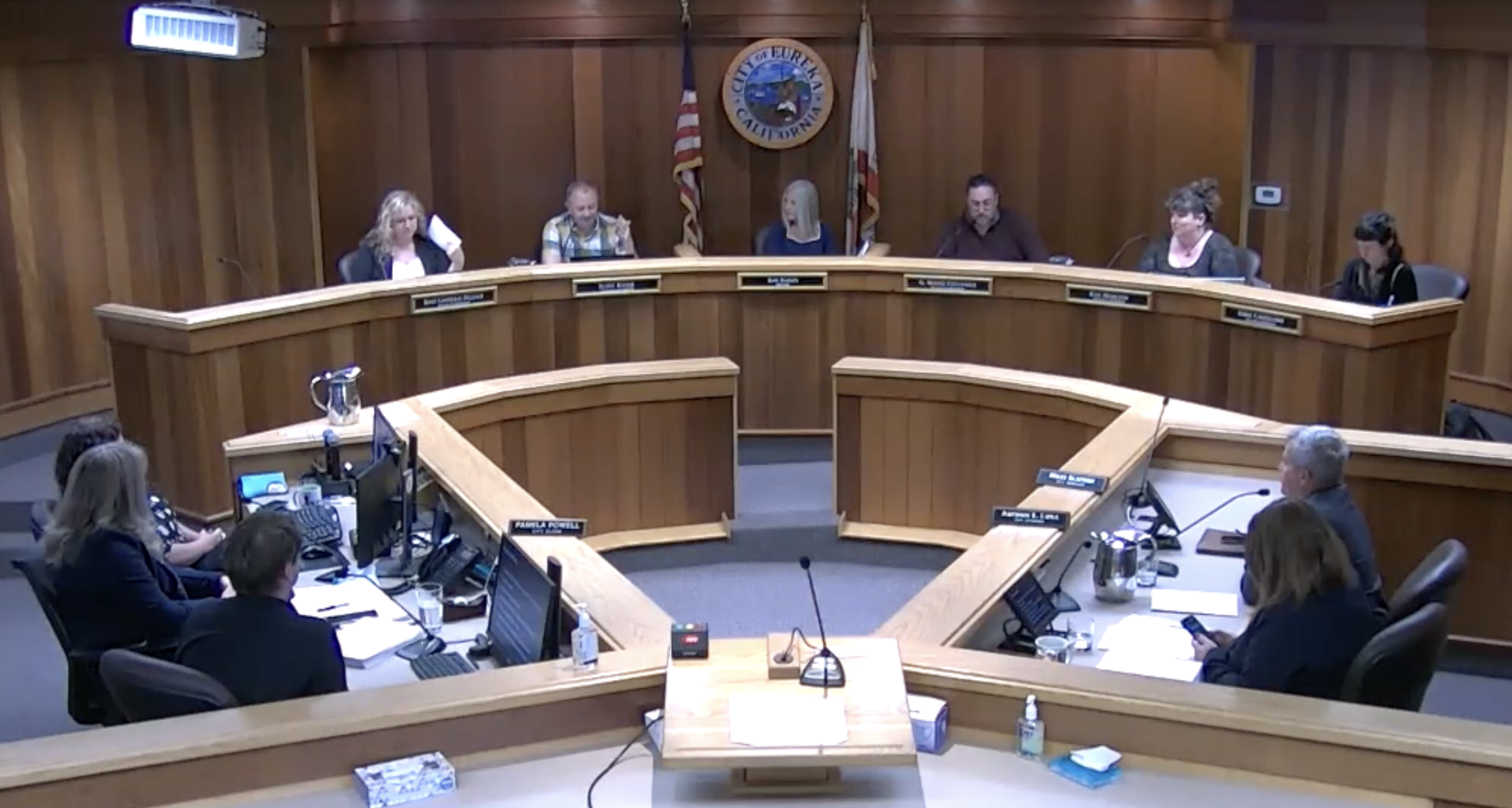
Screenshot of Tuesday’s Eureka Council meeting.
###
At the next municipal election on Nov. 5, Eureka voters will be asked whether or not they want to approve the “Housing for All and Downtown Vitality” initiative, a controversial ballot measure that seeks to stop housing development on city-owned downtown parking lots. How exactly that question will be phrased is still up in the air.
At this week’s regular meeting, the Eureka City Council reviewed the proposed text of the ballot question, which is limited to 75 words, and tried to come up with language that would more accurately convey the intent of the initiative while maintaining neutrality.
Eureka City Attorney Autumn Luna informed the council that Brad Johnson, an attorney representing the proponents of the ballot measure, known as the Citizens for a Better Eureka, had asked the city to change the wording of the ballot question after the council’s agenda was published. (The original wording can be found here, under Section 2.) In the spirit of compromise, Luna said staff granted the request and crafted the following question:
Shall the measure amending Eureka’s General Plan, creating an overlay designation for downtown City lots that limits those lots, with exceptions, to parking and high-density housing, and creating an overlay for the former Jacobs Middle School site, allowing housing, public, quasi-public, and commercial uses, with at least 40% of non-public use area dedicated to high-density housing, subject to review for consistency with state law, by the California Department of Housing and Community Development, be adopted?
Councilmember Leslie Castellano noted that she is “very familiar” with the “Housing for All” initiative, but said she found the ballot question “a little confusing.”
“For instance, it slightly misconstrues the nature of the ballot initiative in terms of limiting the lots with exceptions to parking and high-density housing,” she said. “I mean, it mandates parking if high-density housing is built, which is different than limiting it with exceptions to parking and high-density housing. I just feel like that’s actually an important distinction.”
Luna emphasized how difficult it is to incorporate every aspect of a 19-page ballot initiative into a 75-word question, noting that the question is meant to capture the “spirit of the initiative.”
“We’ve done lots of workshopping internally, and we’ve also taken comment externally from the proponents’ attorney,” she said. “It is such a long initiative, it is very complicated to incorporate all of the different pieces, and that can never be done in 75 words. … If you were to ask 10 different people about what the question should be, you would get 1,000 different answers.”
Castellano expressed concern that the proposed question was “neutral to the point of misinforming the public,” reiterating that the question doesn’t address the requirement for parking if high-density housing is built.
“I hear you, but I think that it really would matter whether you were asking a proponent of the initiative or an opponent of the initiative what the point of the initiative is,” Luna said. “And so therein lies the complexity for us as a city to put a ballot question in front of the voters that doesn’t insert our feeling about it. … We’ve really tried to do the best we can with 75 words, and keeping in mind that neutrality is really important here.”
Councilmember Kati Moulton echoed Castellano’s concerns, adding that the question should clearly state the parking requirement, which is the “crux” of the initiative.
“It doesn’t say [what] makes this kind of a big deal to development,” Moulton said. “That point, I think, is one, why people like it, and two, why people don’t like it. People want that same number of parking spaces to be downtown no matter what gets built there, or people don’t want development that’s required to have expensive parking garages underneath it. I think that’s the crux when it comes to the downtown lots.”
Moulton proposed an amendment to the ballot question but said it would require the “California Department of Housing and Community Development” to be abbreviated. Luna advised against the proposal.
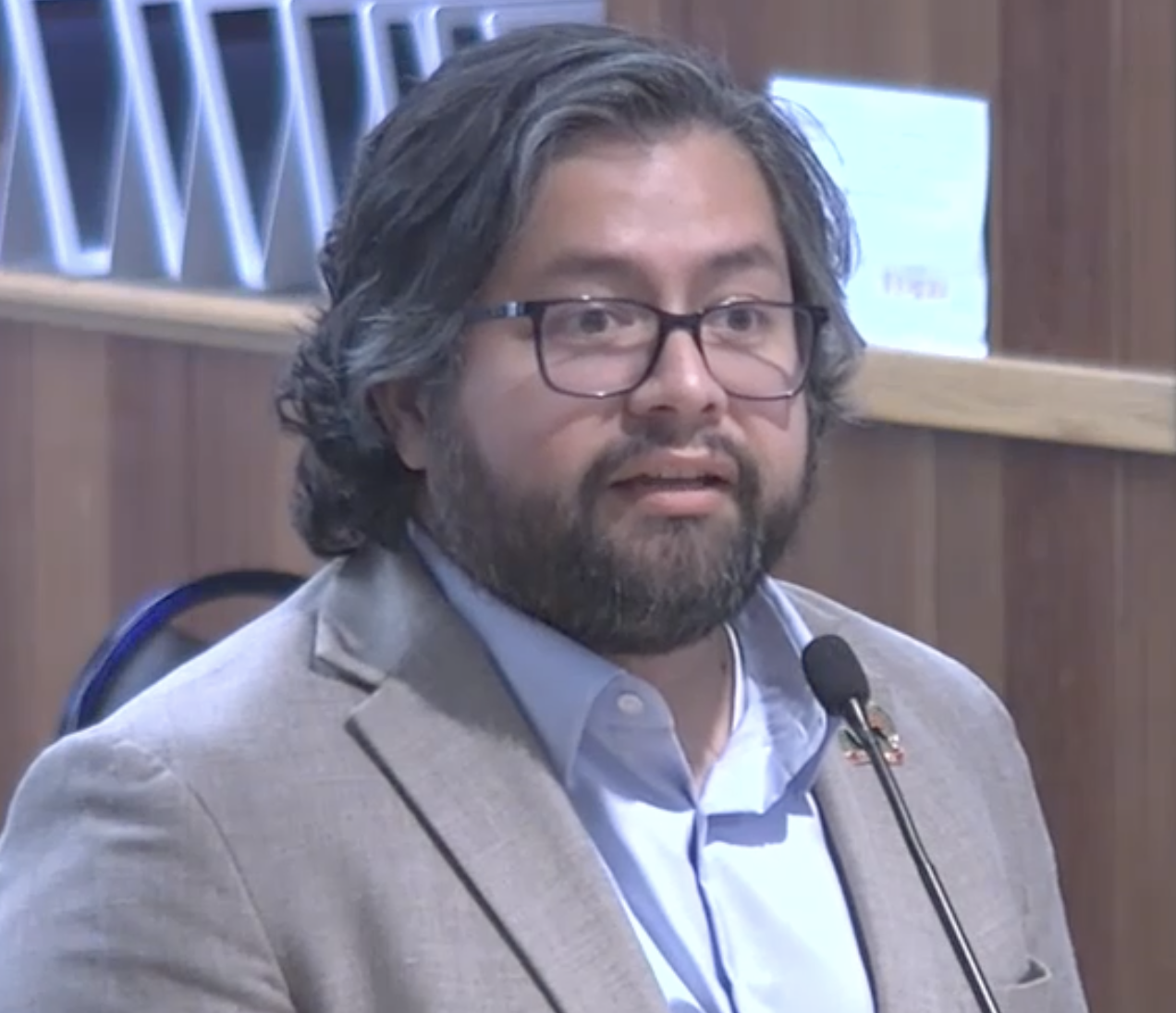
Cervantes | Screenshot
Humboldt County Registrar of Voters Juan Pablo Cervantes, who was in the audience, urged the city council to avoid “whip[ping] something up on the fly” due to the threat of litigation. “I would caution developing the ballot label without your city attorney kind of leading that front,” he added.
Councilmember Scott Bauer praised staff for crafting a “perfectly balanced” question that allows voters to make their own determination. “This is the least biased way to put what is being proposed on the ballot,” he said. “I think it’s well done. Whether we feel a certain way or not about it, it is what it is and it’s going to require people to review what they think the truth is.”
Councilmember Renee Contreras-DeLoach agreed with Bauer and Cervantes, adding that the council should rely on Luna’s expertise.
After a bit of additional discussion, the council voted 4-1, with Bauer dissenting, to revisit the subject during a special meeting on Monday, June 24. Bauer cannot attend the meeting due to a scheduling conflict.
###
What else happened at Tuesday’s meeting?
- The city council also unanimously approved the city’s budget for the 2024-25 fiscal year, which begins on July 1.
- The city council unanimously approved amendments to the city’s Ranked-Choice Voting Ordinance. For the first time in the city’s history, Eureka voters will rank council and mayoral candidates in order of preference (first, second, third, etc.) on their ballots in a system known as ranked-choice voting. The amendments approved at Tuesday’s meeting clarified areas of the city’s ordinance that were “silent” or lacked proper description. During the council’s discussion, Luna assured the council that they could make additional amendments to the ordinance in the future to address issues that may come up during the General Election in November.
- The city council also received a report from Eureka Police Chief Brian Stephens on staffing challenges at the department. Currently, EPD has 48 allocated police officer positions, including 19 patrol officers, four patrol sergeants, four detectives, three CSET (Community Safety Engagement Team) officers, one school resource officer, one drug task force agent and administrative staff. Six soon-to-be officers are in the police academy and five others are going through background checks with the city. Chief Stephens said EPD is trying to pull in new recruits but it is an ongoing challenge because many applicants do not rise to the department’s standards. “I am not just willing to lower the standards of our department and for our community just to fill seats in a car,” he said.
California Public Utilities Commission Expected to Reject AT&T’s Proposal to Discontinue Landline Services at This Week’s Meeting
Isabella Vanderheiden / Wednesday, June 19, 2024 @ 8 a.m. / Infrastructure
###
At its monthly meeting on Thursday, the California Public Utilities Commission (CPUC) is expected to issue a decision on AT&T’s proposal to disconnect landline services for thousands – likely hundreds of thousands – of California customers.
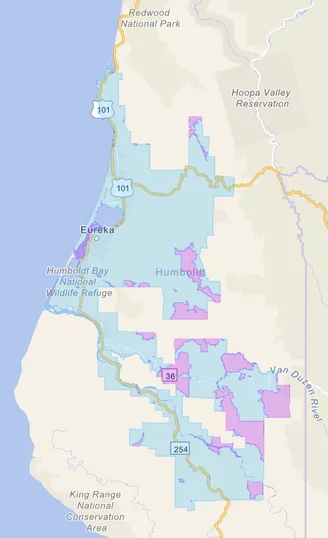
Blue shaded sections represent the territory AT&T seeks to withdraw from as a COLR. Screenshot.
At the beginning of this year, AT&T California applied to remove its status as a Carrier of Last Resort (COLR), which requires the telecommunications giant to provide analog telephone service, or “plain old telephone service,” to residential and business customers. If the application is approved, AT&T will no longer be required to provide landline services in certain areas of Humboldt County, including much of Arcata, Eureka, Fortuna, McKinleyville, Rio Dell, Trinidad and smaller communities along Highway 101 and State Route 299.
AT&T argues that the “outdated” COLR obligation has forced it to “wastefully operate and maintain two duplicative networks: one, an antiquated, narrowband network with an ever-dwindling base of subscribers, and the other, a forward-looking, fiber and wireless broadband network,” as stated in the executive summary of the application.
Elected officials, including state Sen. Mike McGuire, and concerned customers have spoken out against the “dangerous” proposal, fearing it could leave vulnerable residents without reliable phone service.
Last month, the CPUC issued a statement indicating it would reject the proposal due to AT&T’s “fail[ure] to demonstrate the availability of replacement providers [that would be] willing and able to serve as COLR.”
“As the designated COLR, AT&T plays a pivotal role in providing reliable telephone service to communities across the state,” the May 10 statement argues. “Despite AT&T’s contention that providers of voice alternatives to landline service – such as VoIP [Voice over Internet Protocol] or mobile wireless services – can fill the gap, the CPUC found AT&T did not meet the requirements for COLR withdrawal.”
The CPUC received over 5,000 virtually submitted public comments in response to the proposal, many of which “highlighted the unreliability of voice alternatives such as mobile wireless or VoIP,” according to the CPUC.
“With the proposal to dismiss AT&T’s withdrawal request, the CPUC reaffirms its commitment to safeguarding access to essential services and maintaining regulatory oversight of the telecommunications industry,” the statement continues. “Importantly, COLR rules are technology-neutral and do not distinguish between voice services offered (such as Plain Old Telephone Service (POTS), commonly known as landline service, or VoIP), and do not prevent AT&T from retiring copper facilities or from investing in fiber or other facilities/technologies to improve its network.”
AT&T will have a chance to defend its position at the CPUC’s meeting on Thursday. A copy of the proposed resolution can be found here.
A California Senior Lost $700K to Scammers. Now She’s Asking the State to Slow Bank Transfers
Ryan Sabalow / Wednesday, June 19, 2024 @ 7:12 a.m. / Sacramento
Alice Lin’s husband died, and she found herself alone and caring for a disabled son. Then two years ago, the 81-year-old Alhambra woman said she started getting texts from a stranger on a messaging app.
Over the course of a series of friendly chats, he convinced her to wire $720,000 — her entire life savings — to a cryptocurrency app.So she did – in seven separate in-person transactions at her local bank over three weeks. Her life savings disappeared, along with the man who scammed her. For a time, she said she contemplated suicide. But then she got angry – at her bank.
“Despite many red, red flags, my bank failed to consider that I might be a victim of elder fraud,” Lin told the California Assembly’s Banking and Finance Committee this week. “And they did not even contact my daughter, who is the joint account holder on the account.”
In the months since, Lin started working with Consumer Attorneys of California to sponsor Senate Bill 278, a measure aimed at preventing elder fraud scams like the one that drained Lin’s investment accounts.
The bill, by Napa Democratic Sen. Bill Dodd, would require that financial institutions delay transactions of more than $5,000 by at least three days if they “reasonably” suspect an elderly person is a victim of fraud. Banks would be required to train their employees to spot red flags, such as an unusually large and sudden transaction. Banks would also have to take steps to inform an elderly customer’s designated “emergency financial contact” or joint account holder – someone like Lin’s daughter – of a suspected fraudulent transaction.
“Elder financial abuse is everywhere,” Dodd told the banking committee. “Losses exceed $23 billion annually. Once a senior falls prey to financial fraud, they may never recover.”Dodd’s bill passed the Senate this spring with support from every prominent senior advocacy group in California, including the AARP. The measure originally faced intense opposition from the state’s banking and business lobbies, though they’ve since softened their stance after the bill was recently amended.
The financial institutions cite worries that they’d be forced into defacto conservatorships that would give them too much control over an elderly customer’s finances. The restrictions would also limit how quickly customers get their cash for legitimate expenses.
It was a concern shared by Roseville Republican Sen. Roger Niello who cast the lone “no” vote when the bill was before the Senate’s judiciary committee last month.“As the bill exists now, it seems to me we run the risk of more conflict between seniors and their financial institutions than we do limiting elder abuse,” said Niello, who used the opportunity to give Dodd, 68, a good-natured ribbing about his age.
“I want you to know you don’t look a day over 90,” said Niello, who is 76 and the third-oldest member of the Legislature.
Dodd told the Assembly committee that the bill has been amended to limit the liability banks could face “when they do the right thing to protect elderly people, their customers.”
 State Sen. Bill Dodd speaks during the first day of session at the state Capitol in Sacramento on Jan. 3, 2024. Photo by Fred Greaves for CalMatters
That eased some of the concerns from the 13 financial and business groups, including the California Chamber of Commerce, that are listed as opponents to Dodd’s bill.
“We think what’s in front of us right now, while it’s going to be a heavy lift for credit unions, the good outweighs the work that’s going to go in there,” Robert Wilson, a lobbyist with the California Credit Union League, told the banking committee this week. “This is going to protect seniors.”
Wilson and other bankers remain leery of how Dodd’s measure would be enforced – a matter that Dodd says will get cleared up by the time the bill reaches the Assembly Judiciary Committee next week.
###
CalMatters.org is a nonprofit, nonpartisan media venture explaining California policies and politics.


