Press release from the Humboldt County Sheriff’s Office:
On Sunday, Sept. 17, 2023, an officer involved shooting occurred in Hoopa involving the California Highway Patrol (CHP). The California Department of Justice (DOJ) is leading this investigation pursuant to California Assembly Bill 1506.
This incident update (#3) is to provide additional information regarding this investigation. In alignment with the Humboldt County Critical Incident Response Team’s (CIRT) transparency protocol, this update provides the name of the California Highway Patrol officer involved, the name of the decedent and autopsy result.
California Highway Patrol Officer: Neil Johnson, Willow Creek Resident Post Officer
Decedent: William Burrell Nelson, age 43, of Hoopa, CA. Cause of death: Gunshot wound to the chest.
Upon completion of the investigation, the CA DOJ will submit its findings to Attorney General Rob Bonta for a determination. To protect the integrity of this investigation, no additional information will be released until this has been completed. For questions related to this investigation, please contact the California Department of Justice Office of Public Affairs at 202-514-2007.
As Rex Bohn seeks his fourth term representing the First District on the Humboldt County Board of Supervisors, he has yet to face a serious challenge at the ballot box — judging by the results, anyway.
When first elected in 2012 he defeated his nearest rival, former Wiyot tribal chair Cheryl Seidner, by a margin of more than two-to-one. Four years later Bohn ran unopposed, garnering more than 92 percent of the vote.
Last time around, in 2020, would-be challenger Allen McCloskey abandoned his campaign in the wake of an Outpost investigation into allegations of fraud, perjury and embezzlement. Stepping into the ensuing void was former KHUM DJ (and ex-colleague of mine) Cliff Berkowitz, but his campaign faltered, thanks in part to an unfortunate gaffe before the Times-Standard‘s editorial board, and he lost to Bohn in another landslide.
Enter Gordon Clatworthy.
Bohn’s latest challenger, a 40-year-old former Coast Guardsman, is a filmmaker, the founder and executive producer at Weird Howard, a production company focused on “Lovecraftian horror films,” of which it has produced one short, 2017’s Lovecraftia: Crafting Lovecraft, with another project listed in pre-production, with a scheduled release in 2025.
Clatworthy also co-hosts a recurring local event called Paranormal Open Mic, which resembles a live comedy podcast, of sorts, with audience interaction and rambling conversations about the mythos and lore of Bigfoot, ghosts, Lovecraftian monsters and the like.
The Outpost’s first interview with Clatworthy, conducted on Sept. 1, was a bit of a mess, by his own admission. He hadn’t slept well the night before and, after we’d finished, said he felt like he was “screwing this up.” Shortly thereafter, he offered this declaration:
“I’m also the first gay reptilian running for office.”
Huh?
“You know,” he said, deadpan, “the reptilian alien people that control the world. No, I’m just kidding.”
A couple weeks later, when I asked him for a campaign photo, he expressed interest in trying the interview again.
The second interview, conducted yesterday, ended when Clatworthy left in the midst of an awkward impasse as I tried (and mostly failed) to extract specifics about some insinuations and secondhand allegations he’d voiced regarding Bohn’s alleged corruption and criminality.
Both interviews, presented chronologically below, have been edited a bit for length.
###
Clatworthy: I had to [run]. I had to do it.
Lost Coast Outpost: Tell me why.
I couldn’t run last time because I was dealing with cancer. That’s actually how I got out of the Coast Guard. I had cancer so had to retire early.
Wow. Are you comfortable saying what kind of cancer?
Non-Hodgkin’s lymphoma. … It’s in remission. It’s something that I’m probably never going to be fully cured of, but, you know, it is what it is. … I seem to be in the clear right now, so I’m going to take this opportunity and do what I can for the community.
Where did you grow up?
Well, my mom was in the Navy, so I’m kind of a military brat. But my dad was also a merchant marine, so I grew up around boats, around the ocean. … I’ve been all over the world.
I joined the Coast Guard because I knew I wanted to help people but I wasn’t sure how. I guess I could have been a paramedic or a firefighter or a police officer, but luckily I got to do all three in the Coast Guard.
I served for about 14 and a half years, and I also did some reserve time as well. … I was really proud of the work that I did. I’ve saved lives. I’ve pulled people out of the water. I’ve stopped fires on boats. I helped feed and clothe migrants who were leaving their countries because of the corruption. And I did a lot of good, and I feel good about the work that I did. …
As soon as I moved out here [to Humboldt County], I was like, “This is where it’s at. These are my people.” … I wanted to just stay in this area. I bought my house through the VA housing loan. I knew I wanted to put roots down here. …
What do you like about here?
I love the people. … There are a lot of people that really care and are really passionate. And there’s a lot of acceptance and love here.
So you are a filmmaker? Tell me about that.
While I was stationed here I also volunteered for the [Humboldt-Del Norte] Film Commission. I used to do short films and stuff on the East Coast. When I moved here, I wanted to take it a little bit more professionally. … Up here I’ve worked on a bunch of different films and television stuff. I host a paranormal show. We host it live at the Crisp Lounge [in Eureka].
Does filmmaking pay the bills?
It helps.
Do you have any other side gigs?
Um, I’m a writer. I’m not going to go into detail. [Pause.] Yeah, I do side gigs and stuff. Some ghost writing.
Aside from not wanting [Bohn] to run unopposed, why did you choose to run?
The Coast Guard has to cross-train [its members]. Everybody has to wear different hats. So I was a food service officer; I was a purchasing agent; I managed millions of dollars worth of funds; and there is stringent oversight with any funding for a unit. And looking through the county’s audits that we’ve had, it seems that there’s not a lot of oversight. …
The county runs on different trust funds. And the [outside] auditors have all said the same thing, that we need to combine the trust funds so that there’s more oversight and we can get a higher return on the money that’s in these funds. …
When you have wire transfers going out where we don’t know where that money is going, we don’t know who’s spending it, we don’t know anything about that — that should cause many red flags. …
I think one estimate was that there was over $55 million missing from our funds. That can pay for housing. … That goes to pay people like the in-home health care people, and they haven’t had a raise in years, and the raises are put forward by the Board of Supervisors. … [Note: Baseline wages for IHSS workers are funded by state and federal sources, though the county sometimes approves supplemental payments, which can come from the General Fund.]
Some of the stuff you’re talking about is controlled by the auditor-controller, who is independently elected.
One of the things that came up in the studies was that the county supervisors actually do have access to those funds and help with the audits and help with the financial institutions there. So, like, you have people elected that take care of it, but if you have other people that have access that aren’t accounting for where this money is going, then there’s no control over it. … You’re spending tax dollars, and we are not getting representation for where those tax dollars are going. So that is literally taxation without representation, and we fought a war about that, I’m pretty sure.
“That is literally taxation without representation, and we fought a war about that, I’m pretty sure.”
So are you advocating for supervisors to have more control over [county finances]? Because I think a lot of the delineation of duties is established in the state constitution.
I think what we need to do first is definitely get our finances in order. And that requires hiring more accountants. We should probably have a forensic accountant go through and try to find where the $55 million went.
Do you have a reference or a link to that study?
I will try to find it.
[Clatworthy later texted to say his source was a comment that County Administrative Officer Elishia Hayes made in June of 2022. Her exact quote was, “We don’t know if we have $30 million in the bank or if we’re negative $30 million in the bank.” This remark, addressed to county supervisors during a meeting, was made in the context of delinquent fiscal reporting by then-Auditor-Controller Karen Paz Dominguez. It was a description of flying blind, financially, rather than an assertion that tens of millions of dollars had gone missing. Current Auditor-Controller Cheryl Dillingham tells the Outpost that the county’s fiscal reporting was two years in arrears at the time, whereas now, “most of FY 2022-23 is posted, providing more clarity.”]
Can you tell me about your own experience handling budgets and managing people?
I was the food service officer [in the Coast Guard], and we have control over our inventory management — I was a purchasing agent for, at one point, almost four units. … So there’s a lot of oversight when it comes to that. Every purchase that you make has to be approved. …
So, yeah, we need to hire more accountants. We need to put funds together to get rid of paper timecards. How are we still doing that? It’s the 21st Century. Are you kidding me? … We need to really reevaluate our spending countywide before we can move forward with any kind of project. …
Yeah, um, look. It’s up to voters to vote on repealing the HCRI.
It hasn’t even passed yet, though.
It hasn’t even passed yet. And it’s a terrible piece of legislation. And it’s costing taxpayers money for enforcement. …
So, back to how the Coast Guard works, right? There are 40,000 Coast Guardsmen, which is less than the NYPD. We have a huge area of responsibility, and we have the smallest military budget. So what we have to do is we have to kind of pick and choose our battles. …
So you have the Sheriff’s Office, which, they have to work on enforcement from all these out-of-compliance businesses. But when I say out-of-compliance businesses, I’m really talking about weed. We have a mom and pop [grocery] store that, you know, forgets to renew their seller’s license. We don’t have the police knock down the door, hold everybody hostage while they take all the milk and dump it all out, right? But we’re doing that to our weed growers. It’s bad optics, because any damage to the property done by the police is the responsibility of the property owners. Any pets or animals that they deem out of control … .
I think the vast majority of cannabis [enforcement] happens in the Planning and Building department. The Sheriff’s Office primarily handles illegal grows. Are you referring to legal or illegal cannabis?
Look, what becomes illegal? If somebody loses their license or they don’t renew it in time or they’re trying to pass their business down to their kid and we limit the number of licenses available, then they become illegal grows. And then you’re taking resources away from where the sheriff should be, which is helping to eliminate crime, helping do patrols and helping to be the Andy Griffith that they want to be.
But, again, I think the permitting issues are mostly handled by the Planning and Building Department, not the Sheriff’s Office.
But the supervisors put forward what laws are going to be — I mean, because they’re both executive and legislative branches of the county government. So, you know, if we can use our influence to say, “Let’s stay away from private property and maybe work on just all the problems that we have with crime,” we don’t have to worry about raising the police budget because that’s, like — there are two ways to fight crime, right? You can keep increasing the police budget over and over until we have tanks on the streets and drones in the sky, or you can take away some of the enforcement that they’re doing now, so that they can focus on things that they need to do.
What would you take away?
I would take away their enforcement of grows. Like 70 percent of all the grows in Humboldt County are permitted, they are in compliance with any rules that are coming or will come.
Where’s that stat from?
That stat is from the HCRI website. [Note: We didn’t find it there.] So they’re telling us right on the site that, “Hey, most people are in compliance.” Like, you might have 30 percent that don’t have the proper road? Like, you have to have a Class Four road to have a valid permit? But is the county going to go out and repave all the roads to make them in compliance? Is the county going to spend the money? No, they’re asking the families to spend the money to build their own roads.
I think the argument for that is that cannabis farms … should be built where infrastructure already exists.
Are the smaller grows going to be like — they’re not constantly bringing new weed to market. Some of these places, if they’re big enough, they’re gonna build their own road. But, you know, you have these grows up in the hills, these mom and pop grows that have very limited ways to even get things out. …That’s really who this is affecting most, is the small farmer.
So are you saying you would loosen the current regulations —
Yeah!
… to allow —
Yeah! We don’t need helicopters coming down. We don’t need the police driving $3,000 weed eaters into the road to knock on somebody’s door and pull up plants….
You wrote [in the comments section of] our site, “Repeal or heavily pull back on the disastrous HCRI.” But since it’s a citizens initiative, if it passes it can only be repealed or modified by the voters.
Yeah, get out and vote and repeal it.
You mean not pass it?
Yeah, not pass it. Thank you. Sorry. I was working on like two hours of sleep. I didn’t realize that as soon as I posted my 501 everybody was — my phone hasn’t even stopped going off with people … everybody has reached out but they’re like, “We do not want to Bohn in office. Whatever you do, just stop him.”
You touched a little bit on homelessness. What would you do as a county supervisor to address that issue?
Well, first we have to get our finances under order. We have to figure out where we stand as a county. Is there a surplus? Is there a deficit? You know, we’ve already put forward votes in 2012 … Measure Q? Or, I can’t remember. The point-five —
Measure Z, yes. We’ve already put that forward. We’ve already increased taxes. We don’t need to increase more taxes. We need to understand what we have — fundamentally understand where we’re at. … Then we can see what we could do.
Cal Poly Humboldt said they’re shutting down their student housing. There was a big — they have to do … . you know, the “Cal Poly Homeless”?
Yeah, they weren’t shutting down housing. They need more housing.
They do need more housing, but they have to build more and they don’t have enough. So they were originally going to put, they were originally going to put students on housing barges.
Yeah, so doing some research, you can buy or you can get barges that hold 120 people with full kitchens, recreation rooms. We have the space on the bay for it. If we have homeless people, they need to be able to access help. They need to have access to resources in the county. So homeless people pile up in places [where] there are resources that they need to go to. And if we want them moved they’re going to have to have better transportation, which means helping buses.
So are you saying that you think a barge might be a place to house the homeless?
It’s great for temporary housing. It can last for a while, but it’s not a permanent solution. In 2018 the supervisors passed the Housing Trust Fund and Homelessness Solutions Committee. And the study said that they needed like 200 to 600 low-income houses built … and we’ve built like six since then. What we have concentrated on is high-income and middle-income housing. … So we’re obviously caring more about the richest people in the county instead of the poorest people.
That’s driven largely by market forces, right?
Well, yeah, it’s certainly market forces, but our tax dollars are going in to help drive investment in those sections. We are completely ignoring the biggest problems, and I think it’s because some of the elected officials don’t believe in the potential of the unhoused.
“We are completely ignoring the biggest problems, and I think it’s because some of the elected officials don’t believe in the potential of the unhoused.”
So what would you do as a county supervisor to address that?
We need to invest in Section Eight housing. We need to invest in rent control … .
Section Eight, I think that’s a federal program.
It is a federal program but Yerba County —
Yuba?
Yuba County works together with federal, state and local jurisdictions and they all came together to try to help build housing. It’s called the 14Forward Program. It works if you get other agencies involved. So we need to get other agencies when we need to communicate because we’re all in this together. And it doesn’t just affect you know, the most rural parts of Humboldt County. It affects the cities of Eureka, Arcata, McKinleyville, Fortuna, Ferndale. Everybody has to deal with homelessness, and it’s impacting everybody. And we need to find solutions and we need to work together to get housing built fast, even if it’s just temporary housing. …
And the more agencies we can get working on this the faster we can turn this county around. Because what we’re doing is tantamount to gentrification. If we’re just investing in the most lucrative markets without taking care of the average citizens — one in five people in Humboldt County live at or below the poverty line. One in five! That’s people’s moms, it’s people’s grandmas.
Turning to port development real quickly: [In your introductory statement posted to Facebook] it sounded like you are interested in making Humboldt more of a shipping destination.
No, we have cruise ships that are coming here. They’re coming to our docks that are completely empty. The people getting off the ships have to walk how far to shopping?
So would you look to develop more cruise ship traffic here?
I think that would be the best. I think people need to come here. I think the tourism industry would do really well here. I mean, we’ve already established that we’re going to have windmills off the coast. Can we build those with wave breaks? Can we make it easier for people to get into Humboldt County so we can get cruise ships in here? Because, you know, anything north of Cape Mendocino, you’re gonna get really choppy water. And you’re getting water that comes down from the Aleutian Islands of Alaska.
Oh, is choppy water preventing cruise ships from coming here?
It gets pretty choppy out there. I’ve served in the Coast Guard. It’s pretty rough. I’ve only gotten seasick in two places. One was off the coast of Florida during a hurricane, and here. So, yeah, it’s rough here. …
But we do need to look at the future of shipping, which is, like, wind powered or, um, more green ships, shipping coming in? And they’re not going to be able to carry the giant cargo and that the big ships can, but they’re going to be more carbon friendly. And if we could design ports for smaller, carbon-friendly vessels to bring goods directly into Humboldt then we don’t have to worry about tearing up Richardson Grove to get trucks in here.
But that’s a wish, and right now the biggest thing is the finance issues.
Just one last question: You said health care could use more tax dollars. How would you accomplish that as a supervisor?
There was another county that did an investment in their not-for-profit health care agencies. So we have a few here, like Open Door Clinic. If we could invest so that we could have more services available to local residents? Because right now, I had to drive six hours to go to San Francisco for dental. That’s ridiculous.
We need investment in health care and we have an aging population. The supervisors are in charge of, like, raising hourly wages on a lot of different health care-related groups already. … We need to invest more into it, and we need to start paying health care workers a living wage.
###
When I interviewed Clatworthy again yesterday, he brought notecards, which he referred to periodically, and he reiterated his desire to help people, particularly by addressing the county’s affordable housing needs. We asked how he’d address that as supervisor.
Clatworthy: I guess the best way to go about doing it would be to follow some of the examples of some other counties that have had success utilizing certificates of participation [a type of financing that local governments sometimes use to acquire real property].
So if we use county assets as equity to build housing and we combine that equity with match funding grants …
Lost Coast Outpost: So the county would build its own housing to sell?
No, I think it should be county-owned. … Because when private firms build housing, they only have to use 30 percent of that to be low-income or medium-low-income housing, where if it was county owned, or it was managed by a new county organization, we would be able to keep it 100 percent rent-controlled, low income housing.
Would the county then act as property manager on those units?
Yeah. The county would have to hire its own people to run the county assets. … Some counties I’ve heard of had some success with [this approach]. … It happens all over the world. … It happens in counties across California. …
[Humboldt County] can work with the City of Eureka, the City of Arcata. We could put things in McKinleyville, Fortuna, Garberville, Ferndale, and it could be co-managed by the county or by the cities. But it has to be government-owned. That’s the only way that we can actually get 100 percent of the housing that we will be building to be rent controlled.
Going back to cannabis, I got the impression last time we talked that you want to change the current regulations.
I think we could probably go a little lax on some of them. But, you know, I have to talk more to some of the local farmers, and they’ve already been screwed over enough by the county that they don’t want to even talk to anybody running [for office].
[He transitioned to addressing phone and internet connectivity issues in Southern Humboldt.]
The best thing that [SoHum residents] could probably do is start their own cooperative, community-owned broadband network, and as a county supervisor I would do as much as I could to support that — you know, find grants and help with that, because it’s a mess down there.
You said maybe go a bit lax on some of the [cannabis] regulations. Would you want to repeal parts of the existing regulations?
Right now, cost is one of the big factors for a lot of farmers. As I said before, one in five people in Humboldt County is living below the poverty line, and a good portion of those people live or work on those farms. And these are people that are struggling since legalization to choose between getting gas in their car or buying milk.
Isn’t that largely because of issues beyond Humboldt County, in the statewide marketplace?
It is statewide marketplace, but here’s the thing: [If the federal government changes cannabis’s status] from Schedule I to [a] Schedule III [substance], Humboldt County would be allowed to export all through the United States … and if we formed our own Humboldt County community co-op and all the permanent farms were allowed to sell under the Humboldt County brand, it would bring an influx of money, because Humboldt County is known worldwide.
But, again, any part of the current regulations that you would want to change?
Oh, I know they’re having issues with PG&E, and I know that there’s a limit to how many generators they can run. … I think we need to work with farmers to find out exactly the issues that they’re having.
We talked last time about port development, and the initial statement that you posted to your Facebook page gave me the impression that you wanted to work on developing Humboldt Bay into more of a shipping port.
When people say shipping port, they normally think giant tankers coming in, like, loaded up with with all kinds of crazy ins and outs. No. … We have a cruise ship coming in later this week. What does the port there look like? Is it friendly to cruise ships? Like, we do Friday Night Markets here. Why not move the markets there when the cruise ships come in, so that people can come off, buy local, get kind of a taste of what Humboldt is like and not have to travel all over the place to, you know, like, let’s let’s be more welcoming.
Okay, so you weren’t talking necessarily about infrastructure development so much as hospitality.
Yeah, hospitality. Let’s go with hospitality.
Okay. Are there any specific votes that [Bohn] has made that you disagreed with or that you would have done differently?
Oh, I don’t want to get into his voting record. There are a lot of things Rex has done that I would disagree with.
Such as?
I’m not gonna get into that.
Well, you’re running to replace him. Why don’t you want to talk about where you disagree with him?
Because — alright. Um, how do I put this in a very delicate way?
[He sat with his hands folded, index fingers pressed against his lips, for about 15 seconds.]
I just believe he hasn’t done — I gotta be very careful.
Careful about what?
I think Rex has the best intentions for the community without the best focus on the community. I’ll leave it at that.
Okay. Do you have any examples?
Nope.
Okay, um …
The investigation is ongoing.
Oh, what’s the investigation?
Don’t worry about it.
“Don’t worry about it.”
Yeah. [He waved his arm as if swatting away a pesky fly.] I’m just, I think there are a lot of things that go on in the county that probably need some more oversight.
Such as?
I’m not gonna — no comment.
What are you doing here, man? I don’t understand what this is.
Like, I don’t want … . [Sigh.]
I assume you’re serious.
I am serious. I’m very serious.
And you want to run for this position.
I do want to run for this position.
Why are you being so cagey?
Because there are things that are going on … that … there should probably be … . Give me a second. Let me think about this.
[He stood up and walked toward an office window. After a few seconds, he continued.]
There are things that I don’t want … . But, I’m looking into some things that are happening.
You’re investigating.
I’m investigating some things.
Okay …
And [long pause]. Okay. Alright. Lemme … . While I was collecting signatures, which I have gotten more than enough to get on the ballot … I’ve gotten a lot of support from people in the county that have told me things that … warrant … getting looked at.
Okay …
So I am doing a Freedom of Information [Act] request right now through the county site. I want to believe that everything is on the up and up, that things are being done with the best interests of the county … um, in mind. But, you’ve got to trust but you also have to verify. So I’m doing my own little verification.
Some of the things I’ve heard … from people … are … pretty bad … maybe illegal. And … I don’t know …
Are these things to do with Rex?
Yeah, it’s things to do with … yeah, they, they’ve mentioned Supervisor Rex multiple times and given me multiple instances, uh, sent me articles, sent me news clippings, sent me emails from, from people that have specifically talked about things that he has done.
I’m just … I’m trying to look at this the way our readers are going to look at it, and this sounds like you’re making dark insinuations about possible illegal activity. That’s why —
I’m trying to, like … I don’t want to come out and [sigh] yeah. That’s why, that’s why I’m being cagey. Cuz I don’t want to come out and make insinuations about what the county has or hasn’t been doing correctly,
But you have.
But I guess I have.
###
We went around in this circle for a bit longer. While Clatworthy granted that rumors and accusations can be blown out of proportion and insisted that he wants to give everybody the benefit of the doubt, he again alleged that there is “possible corruption going on.”
He’d shown up to our interview more than 20 minutes before our scheduled time, explaining that he may need to leave earlier than expected. As I pressed him for the specifics of his investigation, he pulled out his cell phone and tapped at it a couple times.
“Anyway,” he remarked, “like I said, I had another thing to do. I wish I could go [into] more detail. I will have more detail and I will reach out to you when things become more transparent.”
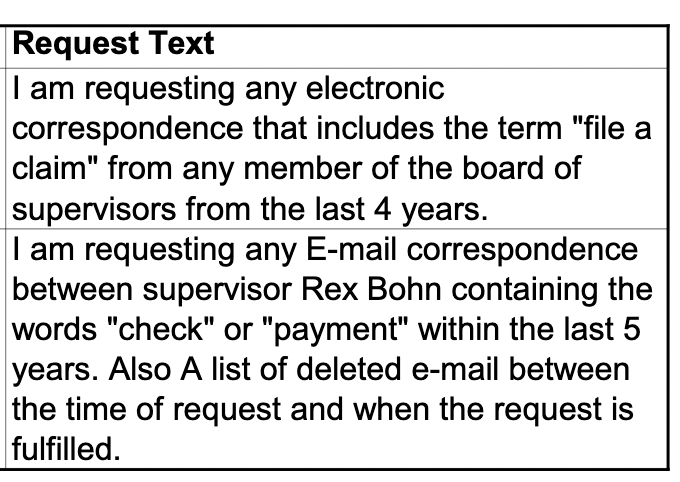
We later asked him if he would share what he’d asked for in his Public Records Act requests and he replied that he will, but only after they’ve been fulfilled. However, since such requests are themselves public record, we submitted our own PRA. Here’s a screenshot of Clatworthy’s requests, both of which were submitted early last week:
Before our second interview wrapped up, Clatworthy took one more lap around the rhetorical mud pit, saying he didn’t want to imply that anyone was corrupt until he could come forward with evidence to say, “‘Hey, right here, this is a sign of corruption’ or ‘This is a sign of money laundering’ or ‘embezzlement.’”
Money laundering? Embezzlement?
“Yeah,” he said. “All kinds of people have said things to me about this stuff, and I don’t … I don’t feel like it’s appropriate … .”
I pointed out that he was, at present, bringing those insinuations up during an interview with a reporter.
“Yeah, do with that … do with that what you will,” he said, “but, personally, I don’t have anything substantial to … to bring anything up with that. Alright? That’s it. That’s all I can say. Unfortunately, I do have to go.”
Redwood National and State Parks plans to conduct a series of prescribed burns this fall in the prairies and oak woodlands of the Bald Hills east of Orick, California. The prescribed fire season in the parks begins in early October as weather conditions permit.
This year fire will be used as a management tool in eight specific burn units in the Bald Hills: Eastside, Upper Dolason, Lower Dolason, Child’s Hill, Lower Elk Camp, Pigpen, Tick Prairie, and South Boundary. The eight units combined are approximately 1,422 acres.
For thousands of years, Yurok, Tolowa, Chilula, and Hupa people managed prairies, oak woodlands, and some coastal areas that are now within the parks with periodic fire to keep them cleared. Intentional burning provided grazing and hunting areas for elk and deer, maintained important resources like tanoak trees and various basket weaving materials, kept trail and travel corridors open, and lessened the prevalence of parasites like ticks in the prairies. Early European Americans who later ranched these same lands continued the practice of broadcast burning until it was outlawed by the state in the 1930s. Since then, many of the prairies and oak woodlands have become encroached with Douglas fir and other conifers which can eventually eliminate these important plant communities.
The park’s 2021 Fire Management Plan provides for the use of fire to restore natural and cultural processes, manage exotic plants and conifers encroaching into prairie and oak woodland plant communities, and to educate the public about the role of fire in the parks. The parks have successfully used prescribed fires to achieve these objectives since the early 1980s.
If you are in the parks over the next couple of months, there will likely be additional activity and equipment on and near Bald Hills Road. Smoke may linger on the roadways and traffic control may be in place. Please be cautious for your safety as well as the safety of the fire crews working on the prescribed burns.
For further information, please contact Bryan Boatman at (707) 496-0258.
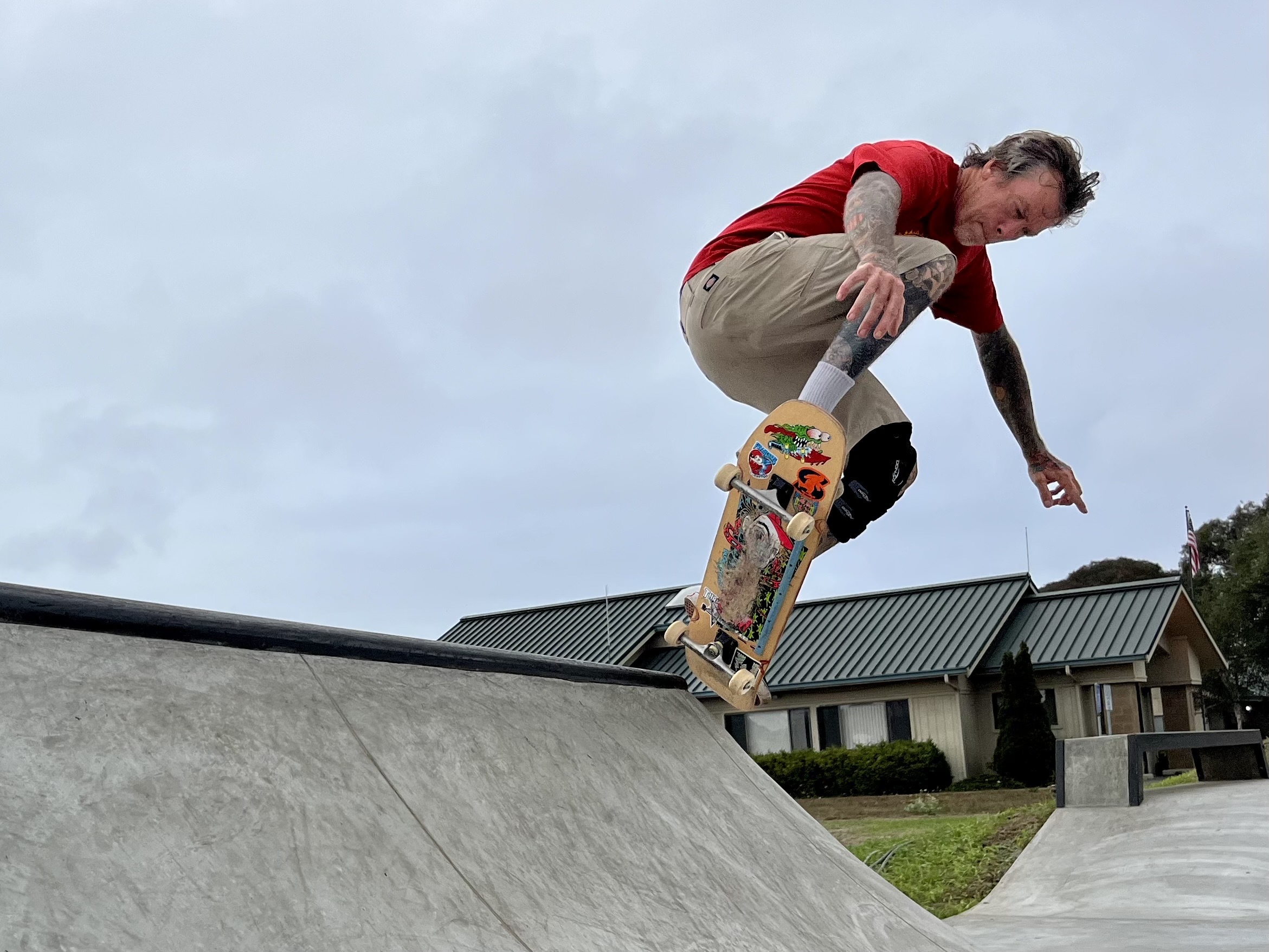
Local skater Sam Cunningham shedding the fresh concrete at McKinleyville Skate Park | Photos: Stephanie McGeary
###
For Ciara Torres, a longtime resident of McKinleyville, helping get a skatepark built in her hometown holds special meaning, because she is helping realize a dream of her late grandmother, who started fundraising for the skatepark more than two decades ago.
“It all started 23 years ago, with my grandmother wanting to put a skatepark in because my brother and cousins got in trouble for skateboarding in the Safeway parking lot, and my grandma was like, ‘Well, where are they supposed to skate?’” Torres told the Outpost in a recent interview. “Anytime something made her mad, she did something about it.”
Well, it may have taken a little bit longer than hoped, but the skatepark (or, at least, part of it) has finally been built next to Pierson Park and McKinleyville skaters now have some smooth concrete to legally skate on.
Torres’ grandma, Pat Hassen, who passed away in 2011, helped start the McKinleyville Skatepark Committee in 2000 and began organizing and raising money for the park. Hassen stepped away from the efforts when her husband got sick in 2009, and Charlie Caldwell took over and the park became a project of the Humboldt Skate Collective.
Torres started getting involved in the project a couple of years ago, after moving back to McKinleyville. Like many Humboldt-raised people, Torres left to pursue school and work and had lived away from Humboldt for a while, but returned during COVID when she was given the option to work remotely. She knew right away that she wanted to spend her free time helping the efforts toward building the skatepark that the community had been waiting on for so many years. “I came back here and this was the first thing I wanted to do, was get this skatepark up and running,” Torres said.
When she started attending the Humboldt Skate Collective meetings, Torres joined forces with Martin Fusek, a local skater and Humboldt Skatepark Collective board member, who was also very passionate about the McKinleyville Skatepark project. Like Torres, Fusek grew up in McKinleyville and remembers how long the skatepark efforts had been in the works. Like Torres’ brother and cousins, as a teen Fusek would also get busted by the police for skating in parking lots and other places it wasn’t permitted. He and his friends would sometimes ride their bikes or hitchhike all the way to Arcata just to use the skatepark there.
“Having grown up here and not having any place to skate, it pushed us into places where we wouldn’t be seen and we’d do weird, bad shit,” Fusek told the Outpost in front of the McKinleyville skatepark. “If we had a place like this to hang out, we would have spent our whole day here.”
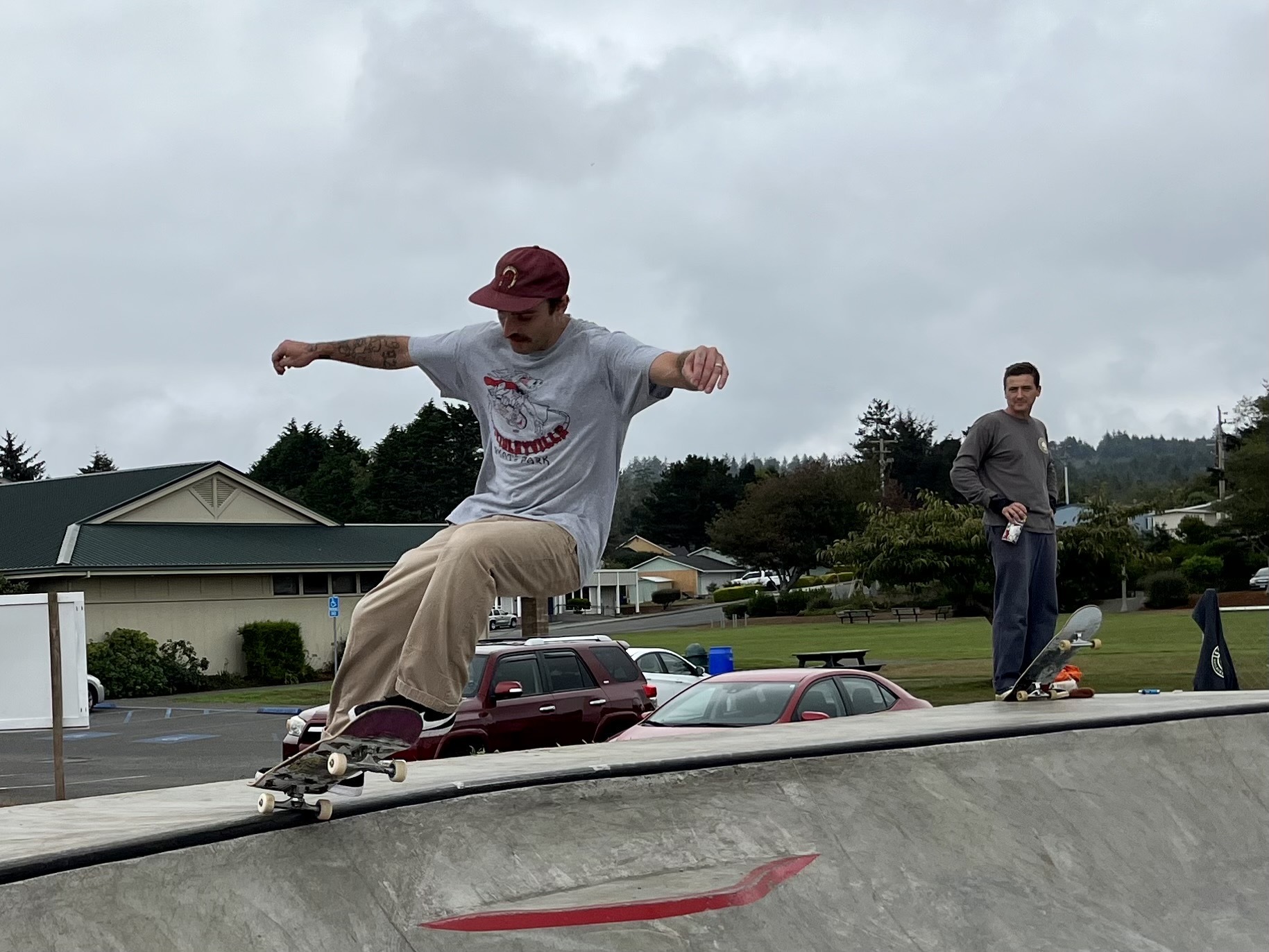
Colin Crespino skates as Martin Fusek looks on
In the earlier days of the planning, Fusek said he would attend meetings, but eventually went off to do school and other life things. Fusek recently started getting involved again and he, Torres and other folks started kicking the process into high gear over the last couple of years.
Though the McKinleyville skatepark was a big focus of the collective, Fusek said, there are also a lot of other projects and areas that the collective needed to focus on, and Fusek and Torres felt like this was part of why the McKinleyville skatepark was taking so long.
“The only way we were able to get this going was to sort of branch off from the collective, and start having our own more focused meetings, because the Humboldt Skate collective is working on skate parks all throughout the county,” Fusek said.
With the help of Caldwell, the team was able to secure the county’s approval of the project and raise enough money to build a portion of the park. Throughout the years, and from a combination of merch sales, private donations and grants, the collective had accrued more than $120,000 for the project and started working with Richard Conklin of Evergreen Skateparks Primary Concrete to design the park. By this point, the original skatepark plans were pretty outdated, Fusek said, so they asked the planner to make them more modern and the end result was a 20,000 square foot park with two bowls, multiple ledges, stairs, rails and other fun skatepark features.
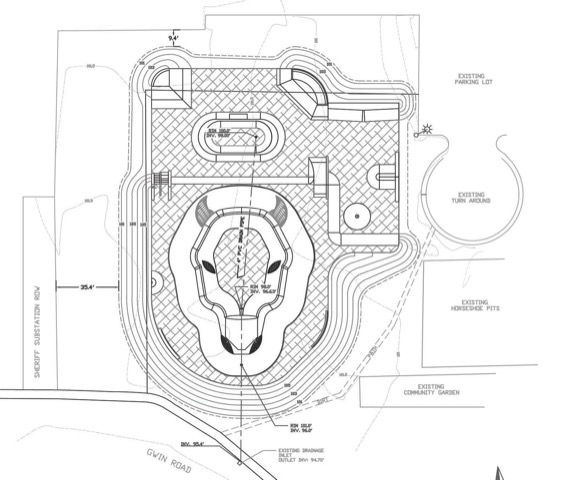
Above: the full park design sketch. Below: Rendering of the full park design. Images provide by Ciara Torres
The full project was estimated to cost around $1 million, which was a lot more money than the collective had accrued. But the builder said that the money the collective did have would be enough to complete a small section of the park, so the collective decided to roll out the park in phases.
Construction of phase 1, which is 4,000 square feet of concrete, began in early August and was completed on Aug. 30. Fusek said that the project impressively was completed right on time and right on budget. Though they were initially going to wait a while longer to open the park to the public, they decided that the wait had been long enough and the first section of the park is now open and skaters have already been taking full advantage of the new spot.
Fusek and Torres said that the collective decided to build a part of the park sooner, rather than waiting until the entire build could be funded, not only so that skaters would have a place to start using immediately, but also to help people see that the project is making progress and that the money that has already been raised is going to good use.
“It helps let the community know that we’re doing something with the money that we’ve spent the last 20 years raising,” Torres said.
Now to celebrate the completion of the first phase of the McKinleyville Skatepark, the group is holding a grand opening celebration on Saturday, Oct. 7, featuring skate contests, live music, food, beer and a raffle that will include cool prizes like skateboards and more. All proceeds from the event will go toward the completion of the remainder of the skatepark.
Grand opening flyer
With a long way to go for reaching the $1 million it will take to complete the entire project, Torres and Fusek couldn’t say exactly when the rest of the park will be built. But the collective has applied for another large state grant and, if it is awarded, Fusek said, construction on the rest of the park could start as soon as next summer.
In the meantime, the smaller version of the park is there for the skatin’ and people of all ages have already been taking advantage of the new spot. The park is very accessible, with no fence and bright lighting that allows it to be used in the dark. Originally, the MSCD wanted to build a fence, but Fusek and Torres said they wanted to keep the park more open and inviting. There are no official rules posted for the park yet, but Fusek and Torres said that they plan to install signs with rules on safety and proper skatepark etiquette. The park also happens to be right next to the Fire Department and across the street from a Humboldt County Sheriff’s Office station, which Fusek says will help if there are any injuries at the park, and will help deter crime like drugs or graffiti.
With only two other outdoor skateparks in Humboldt, the Arcata Skate Park and the Eureka Skate Park, Fusek said that opening the park in McKinleyville is a big deal for skaters that live in the area to finally have a closer option and he’s excited to see that people are already using it and hopes that people will come out to the grand opening to celebrate this long-awaited project.
“So many people here were little kids when we started raising money for it and now it’s finally here,” Fusek said.
Roberta F. Page was born on March 5, 1931 and passed away June 25, 2023 at Providence St. Joseph Hospital in Eureka.
She lived a very long and happy life. She attended Hydesville Elementary School, Fortuna High School and graduated from Fort Bragg High School in 1949.
She met Cecil J. Page after he completed his service in U.S. Navy during WWII. They were married July 2, 1949 and raised two children, Denise Page Seelye and Cecil Gary Page.
Mom began her career as a bookkeeper with Crocker National Bank in Scotia and ended her career as the Manager of the same bank, which was Bank of Loleta then.
During her life time she volunteered and was a member of many community organizations. Her favorites were being the Historical Commissioner for the city of Fortuna, and holding a membership with the Sequoia Bridge Club, as well as the Good Sam Club.
She is survived by her daughter Denise her and daughters, Stephanie Saunderson (Kyle) and daughter Kathleen Seelye (partner Tony Shiffman); son Gary Page and his daughters Sarah Ruff (Nic) and Nicole Page (partner Will Edgins) and Gary’s son Matthew Page; great-grandchildren, Page and Raylon Ruff, Aubree and Lillian Saunderson, Natalie Edgins and Christopher Schiffman; niece Gloria Boyer, nephews Jerry Bushnell and Richard (Bobbie) Stone and numerous great-nieces and nephews.
###
The obituary above was submitted on behalf of Roberta Page’s loved ones. The Lost Coast Outpost runs obituaries of Humboldt County residents at no charge. See guidelines here. Email news@lostcoastoutpost.com.
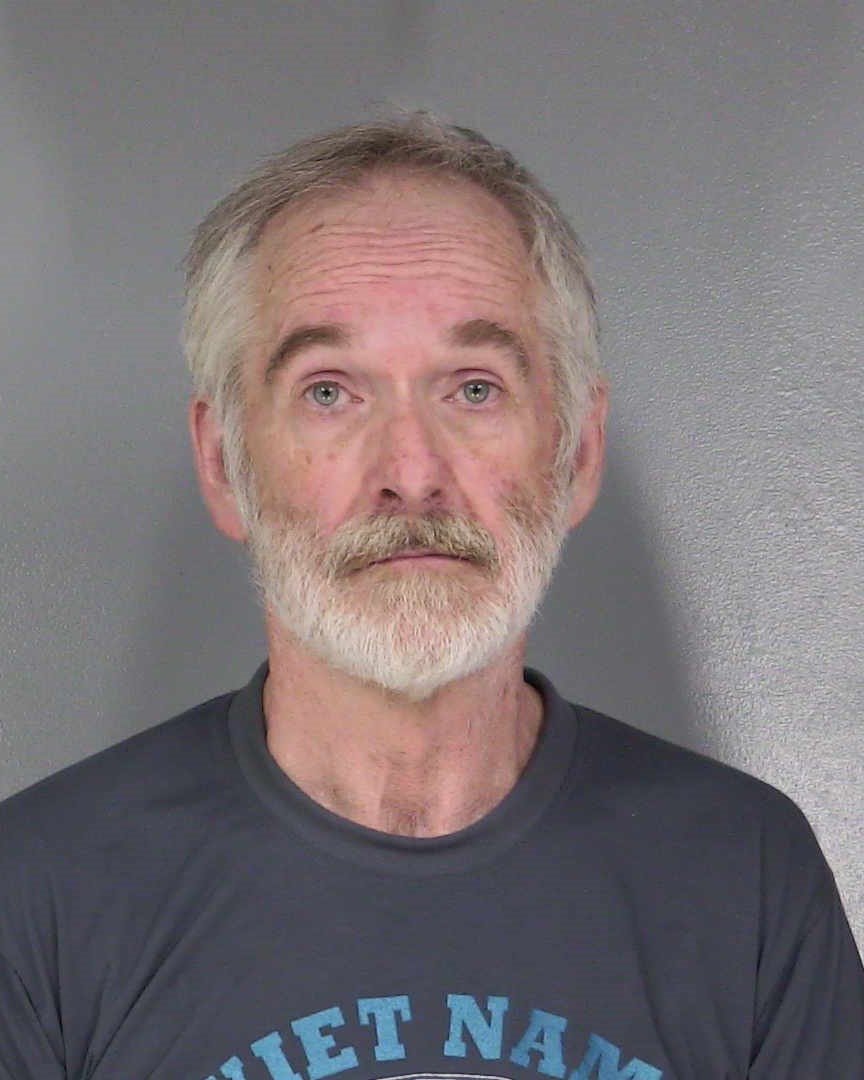
On September 22, 2023 at approximately 11:20 p.m., The Eureka Police Department
(EPD) received a call for Shots Fired from a residence in the 4000 block of Campton
Road. The Reporting Party stated Richard Kuhnel (69 years old of Eureka) was yelling
and firing multiple gunshots from the second story of the residence.
EPD officers responded to the scene and made phone contact with Kuhnel. EPD
requested the assistance of the Humboldt County Crisis Negotiations Team (CNT) as
Kuhnel had barricaded himself in his attic and was refusing to leave the residence. EPD
Detectives were summoned to the scene and authored an arrest warrant for Kuhnel
and a search warrant for the residence. CNT members negotiated with Kuhnel until
7:00 a.m. on September 23, 2023, when he exited the residence and was taken into
custody without incident.
The search warrant was executed on the residence. During the investigation it was
discovered that Kuhnel had fired seventeen (17) rounds during this incident. The
investigation revealed rounds were fired out of the residence through the second story
windows as well as into the walls inside the residence. Detectives recovered evidence
that included shell casings and the handgun used during the shooting. Additional
firearms and ammunition were located and seized during the investigation.
Kuhnel was transported to St. Joseph Hospital for medical clearance, for a medical issue
not related to the incident, and later booked into the Humboldt County Correctional
Facility for a violation of PC 246.3(a), Discharging a firearm in a gross and negligent
manner.
The Eureka Police Department would like to thank the Humboldt County Sheriff’s
Office, the CNT team members, and the Fortuna Police Department for their assistance
with the peaceful resolution of this incident.
Press release from the Humboldt County Sheriff’s Office:
On Sept. 23, 2023, at about 11:52 a.m., Humboldt County Sheriff’s deputies were dispatched to a business on the 900 block of U.S. Highway 101 near Cooks Valley for the report of a road rage incident.
Deputies contacted two victims at the business. The victims told deputies that while driving northbound on Highway 101, a pickup truck began to tailgate them. When the truck reportedly attempted to pass the victims’ vehicle, the victims made an insulting gesture at the truck’s driver. The driver of the vehicle then reportedly got behind the victims’ vehicle, tailgating it to the business where both vehicles stopped. The suspect reportedly exited his vehicle then began yelling and threatening to kill the victims. He then fled the area driving northbound on Highway 101. The victims were able to capture a photo of the vehicle and its license plate.
Deputies located the vehicle traveling on Highway 101 approximately one mile south of Benbow and conducted a traffic stop. The driver of the vehicle was identified as 61-year-old Jody Shannon Collins. Collins was arrested and booked into the Humboldt County Correctional Facility on charges of criminal threats (PC 422(a)).
According to AAA Foundation for Traffic Safety’s 2019 data, nearly 80 percent of drivers expressed significant anger, aggression or road rage behind the wheel at least once in the previous 30 days. Aggressive driving includes tailgating, cutting in front of another driver and then slowing down, running red lights, weaving in and out of traffic, changing lanes without signaling, blocking cars attempting to pass or change lanes, and using headlights or brakes to “punish” other drivers. Aggressive actions such as tailgating, erratic lane changing, or illegal passing have been found to be a factor in up to 56 percent of fatal crashes. While you can’t control other’s emotional responses, you can avoid road rage incidents by managing your behavior and response.
Follow the rules of the road:
Maintain adequate following distance.
Use turn signals.
Allow others to merge.
Use your high beams responsibly.
Tap your horn if you must (but no long blasts with accompanying hand gestures).
Be considerate in parking lots. Park in one spot, not across multiple spaces. Be careful not to hit cars next to you with your door.
Remain calm and courteous.
Dealing with Confrontation:
Avoid eye contact with angry drivers.
Don’t respond to aggression with aggression.
If you feel you are at risk, drive to a public place such as a police station, hospital or fire station.
When you park, allow room so you can pull out safely if someone approaches you aggressively.
Use your horn to attract attention but remain in your locked vehicle.
If you are confronted, stay as calm and courteous as possible.
If you feel threatened, call 911.
Anyone with information about this case or related criminal activity is encouraged to call the Humboldt County Sheriff’s Office at (707) 445-7251 or the Sheriff’s Office Crime Tip line at (707) 268-2539.