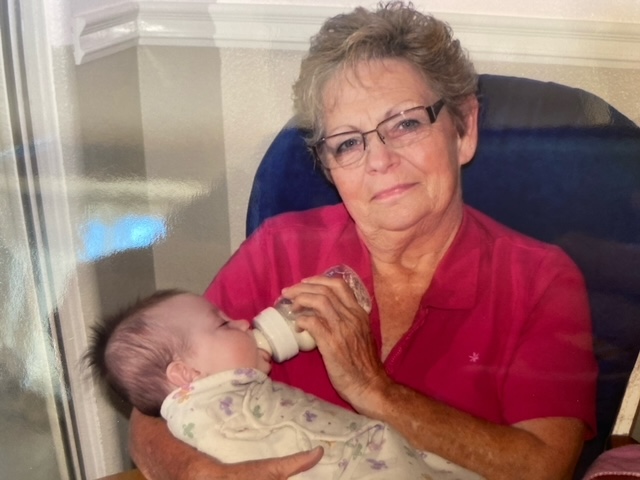
Linda
Lou Walker was born on January 22, 1946 to Beverly and
Gordan Ashcraft, in Red Bluff. She passed away March 29, 2024, after
a short battle with cancer, holding her husband Melvin Walker and son
Albert Kutzkey’s hands at The Hospice House in Eureka.
Linda
is survived by her loving husband Mel, son Albert and his wife
Deborah and granddaughter Aundie, her daughter Bernadette Speth,
husband Blair and grandchildren Allison and Sierra, stepdaughter
Leslie Westpremi, husband John and grandchildren Wyatt & Kayla,
stepdaughter Laurie Hill, husband Steve and grandchildren Emily &
Neel, stepson Jeff Walker and her sisters Judy Amrein and Karen Logan
and brother Dale Ashcraft.
Linda
grew up in Little Shasta Valley and attended Yreka High School. She
lived in various places in California and did a variety of jobs,
including being a fuel truck driver for a helicopter. Linda moved to
Arcata, and that is where she met Mel Walker and they were married
October 1999. They have lived in Blue Lake for over 25 years.
Linda
was a fun spirited soul who had many passions. She had incredible
artistic skills and talents and loved painting, sewing, macrame and
jewelry making. She enjoyed camping, being outdoors, puzzles and
reading. She especially loved working outside with all her beautiful
flowers and watching all the hummingbirds zipping in and out of her
flower garden!
Linda
was known to be a “tell it like it is” person. She cared so
deeply for the people around her and made an impact on many lives.
She will be forever missed by so many. Until we meet again …
Many
special thanks to Hospice for their tremendous support to Linda and
her family.
###
The obituary above was submitted on behalf of Linda Walker’s loved ones. The Lost Coast Outpost runs obituaries of Humboldt County residents at no charge. See guidelines here.
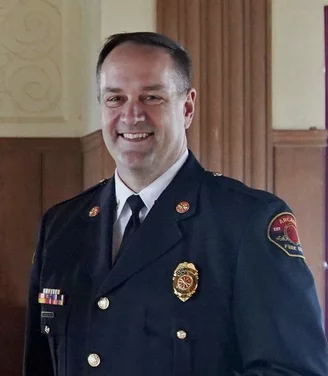
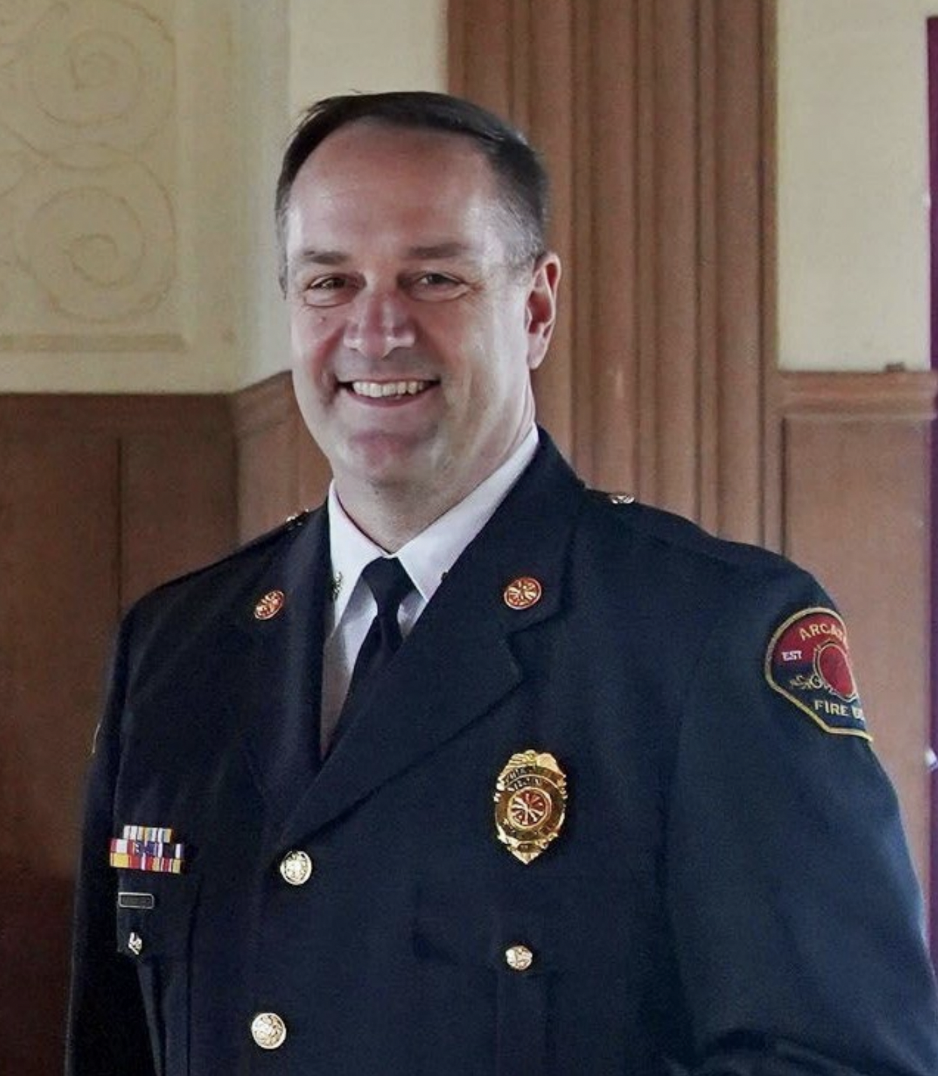
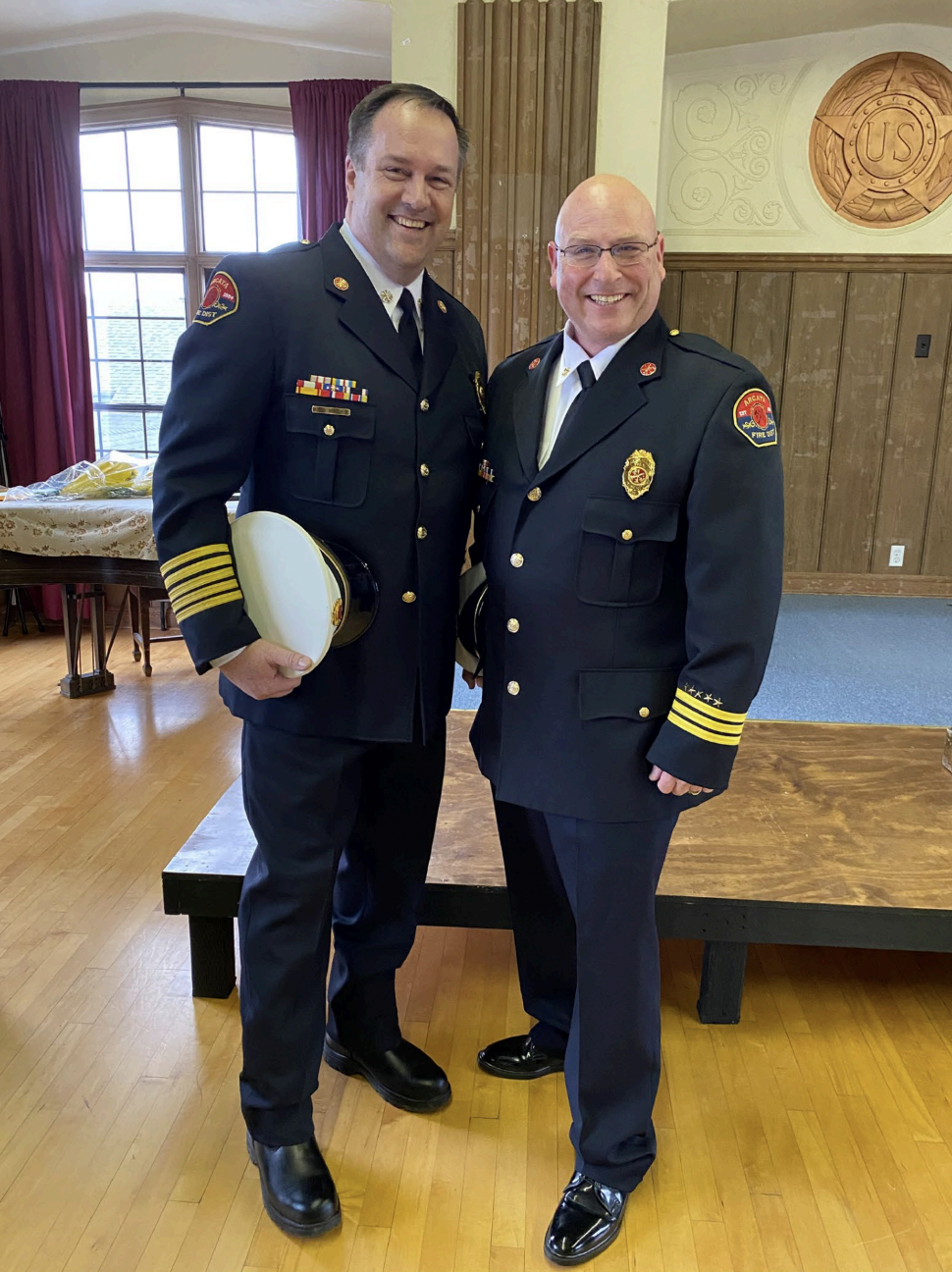
Arcata Fire District Fire Chief Justin McDonald has announced his retirement beginning June 26, 2024.
Chief McDonald’s retirement marks the end of an era for the Arcata Fire District after three
decades of dedicated service. His journey from volunteer firefighter to Fire Chief is a testament
to his passion and commitment to serving the community. McDonald’s family ties to the district
and his personal dedication have left an indelible mark on the organization.
“It has been a gift to be part of the fire service and this organization. I am extremely proud of the
men and women of Arcata Fire District who do amazing work and serve the people of Humboldt
County with both passion and compassion. The past 30 years I have spent in the fire service
have transformed my life, and I have no regrets,” McDonald said.
Under his leadership, the Arcata Fire District has thrived, providing essential services to over
36,000 residents in the greater Arcata area. McDonald’s emphasis on collaboration and
resource management has ensured the safety and well-being of both firefighters and the public.
“Since starting as a volunteer firefighter over 30 years ago, Justin has shown outstanding
commitment and dedication to the Arcata Fire District and its citizens. He has our gratitude and
appreciation for his devotion to the duties and obligations he has faithfully fulfilled,” said retired
Fire Chief Dave White – who hired McDonald when he became a full-time firefighter.
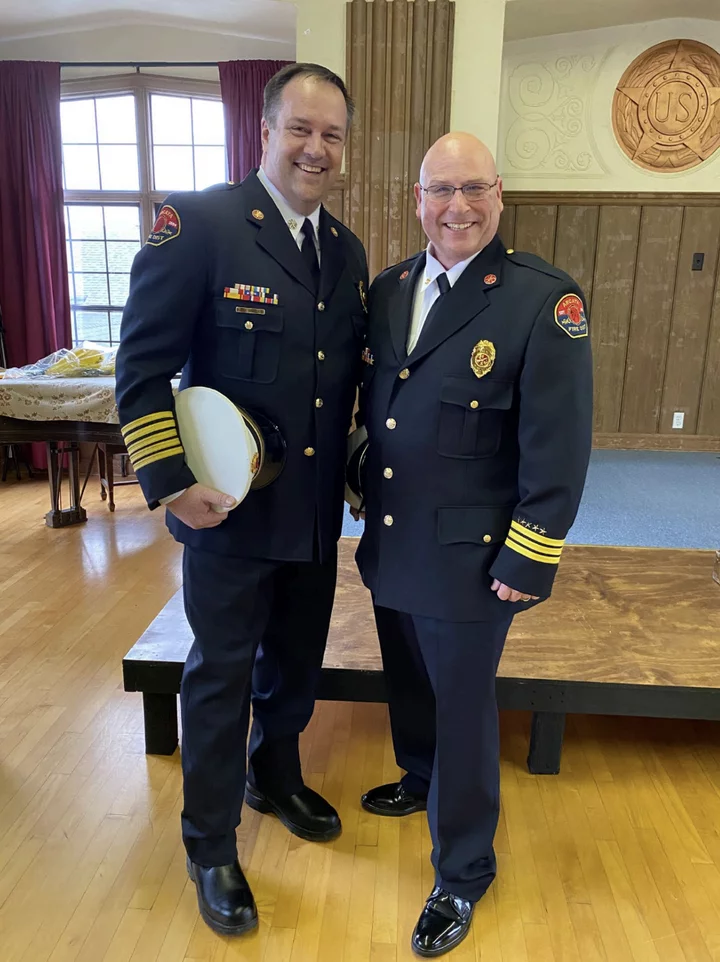
Chief Justin McDonald and Assistant Chief Chris Emmons
The board’s selection of Deputy Chief Chris Emmons as the next Fire Chief speaks to
McDonald’s commitment to succession planning within the organization. With almost 32 years of
experience in the fire service, Emmons will undoubtedly continue McDonald’s tradition of
excellence, guided by the example set by his predecessor.
As McDonald prepares to step down, his colleagues and community members reflect on his
remarkable career with admiration and gratitude. His unwavering dedication and steadfast
leadership have left an enduring legacy of excellence within the Arcata Fire District.
“As a member of the board of directors for the Arcata Fire District for nearly four years now, I
can truly say it has been a pleasure to work with Chief McDonald. He helped shepherd the
district through some fairly dark times when funding was inadequate, and the district was losing
experienced firefighters to other fire agencies. He has been at the forefront of modernizing the
district and preparing for a future where our community has an increased population, taller
buildings and the threat of longer fire seasons. Because of the communities passing of Measure
F, Chief McDonald’s dogged determination as well as his ability to work with the Arcata
Professional Firefighters Local 4981 and the board, the fire district is better now than when he
was made chief. Chief McDonald’s ability to manage crises big and small, as well as plan for the
future even in times of budgetary uncertainty will be greatly missed.
On the upside, Chief McDonald has promoted and hired highly capable Chief Officers that will
most certainly continue to serve this
community proudly,” said Arcata Fire Board Director Blaine
Maynor.
Arcata Fire Board Director Nicole Johnson said, “Through decades of steadfast leadership and
unwavering commitment, Chief McDonald has shaped a legacy of excellence that will continue
to inspire generations of firefighters. His dedication to duty and passion for service will forever
remain a beacon of strength within our department.”
Press release from the Calfire Humboldt-Del Norte Unit:
The California Department of Forestry and Fire Protection (CAL FIRE)
Humboldt – Del Norte Unit has announced effective at 6:00 AM, May 1st, 2024, all hazard reduction burning
will require a permit in the State Responsibility Areas of Humboldt and Del Norte Counties. A North Coast
Unified Air Quality Management District (NCUAQMD) burn permit is required any time you burn vegetation.
NCUAQMD burn permits can be obtained online at www.ncuaqmd.org, or in person at 707 L Street, Eureka
(M-F 9am to Noon and 1pm to 4pm). For more information contact the NCUAQMD by calling (707) 443-3093.
CAL FIRE burn permits must now be obtained online at https://burnpermit.fire.ca.gov/. Applicants
can access the website to obtain a burn permit which involves watching a short educational video and
submitting an application. The process provides the necessary information needed to conduct the burn safely,
while minimizing the chance for fire escape. Permits must be in possession either by printed copy or digitally.
Permits are valid beginning May 1st of each year and require annual renewal. Permits are issued free of
charge.
Property owners conducting hazard reduction burning are responsible for checking the burn day status with
the NCUAQMD:
Burn Day Information Line:
(707) 443-7665, or
(866) 287-6329 (or 866-BURNDAY)
Burn Zone information is listed on NCUAQMD permit.
Hazard Reduction Guidelines are listed on the CAL FIRE permit and must be followed at all times.
As a reminder, always have a minimum 10-foot clearance down to bare mineral soil around all burn piles,
have a shovel and a water source available, and an adult present during burning. Failure to follow these
simple precautions may result in a citation and fines. For further information regarding residential burning or
other fire safety tips visit your local CAL FIRE Station or go to www.readyforwildfire.org.
Detail of a Humboldt County watershed planning map.
###
A trio of local environmental groups is accusing the county of abandoning its legal obligation to fully assess the impacts of the local cannabis industry on groundwater, wildfire risk, streams, rivers and more.
In a letter submitted yesterday to the Board of Supervisors, the Planning Commission and Planning and Building Director John Ford, leaders of the three groups – Northcoast Environmental Center, Citizens for a Sustainable Humboldt and the Environmental Protection Information Center – say the county must formally ask regulatory agencies to collect and report more data so that the county can comply with a resolution it passed nearly four years ago.
That resolution, No. 18-43, established watershed-specific caps on the number of permits and acres the county can approve for commercial cannabis cultivation, plus an overall cap of 3,500 permits and 1,205 acres. It says the county must conduct an annual review of those limits at noticed public meetings of the Board of Supervisors. Such hearings have never been held.
The letter says that the county, as the lead agency in charge of regulating the industry here in Humboldt, needs to request more information from state and federal agencies including the California State Water Resources Control Board, the California Department of Fish and Wildlife, the Bureau of Land Management and the U.S. Forest Service.
Without that data, the letter says, regulators lack “a robust understanding of the cumulative impacts of industrial cannabis cultivation in each watershed and sub-watershed.”
Asked via email to respond to the allegation that the county has failed to comply with Resolution No. 18-43, Ford offered a brief response that more or less confirmed that to be the case, though the reply implicates other agencies along with the county.
“There has not been adequate reporting as discussed in Resolution 18-43,” Ford wrote in an email.
Below is the full text of the letter, which was sent ahead of next week’s supes’ meeting, at which the board is expected to discuss related issues.
Re: Watershed Analysis / Data Collection & Reporting / Humboldt County Cannabis Ordinance 2.0
To the Humboldt County Board of Supervisors, Humboldt County Planning Commission, and Director Ford:
The County is not following its own Resolution 18-43 and FEIR.
We seek immediate action: the lead agency—the Humboldt County Planning Department—must formally request that watershed monitoring, data collection, and analyses be performed by the appropriate California State and Federal agencies. These include the State Water Board, NCRWQCB, CDFW, CDF, BLM and USFS.
Fulfillment of this request, with necessary reporting in combination with disclosure of data already collected by the County, shall allow for a robust understanding of the cumulative impacts of industrial cannabis cultivation in each watershed and subwatershed. It will make clear the true, on-the-ground environmental and community carrying capacities and parameters… and begin to realize the legal obligations and responsibilities committed to by the County, which have been abandoned.
This formal analysis will inform realistic environmental guidelines, regulations, and other policy, including that for permit allocation and enforcement. It should include:
Data on roads and traffic, for accurate assessment of impacts to rural infrastructure, public safety, increased burden on first responders, and enhanced risk of wildfire.
Data from watershed and subwatershed studies and analyses, including temporal monitoring data on stream flow and water quality (e.g. nutrients, temperature, bacteria, sediment, etc.).
Data regarding impacts of groundwater extraction on surface waters, springs, and seeps.
Data measuring the scope of industrial level noise and high wattage lights, to assess impacts on wildlife and communities.
Detailed maps of permitted and pending permit sites—showing pending, active, and lapsed permit location—original and expanded cultivation areas and types, energy sources/generators, water sources/locations, streams and rivers, and roads.
This formal data collection and analysis must be accompanied by reporting at annual public hearings to assess and implement potential caps on cultivation acreage based on real information, as stated in the 2018 Resolution 18-43*…which have never occurred.
In addition to a formal request by the lead agency for this watershed monitoring and data collection, we urge you to develop a specific action plan for implementing its public availability and discussion.
Sincerely,
Larry Glass, President of the Board of Directors Northcoast Environmental Center (NEC) (707) 822-6918 nec@yournec.org
Mary Gaterud, President of the Board of Directors Citizens for a Sustainable Humboldt (CSH) (707) 845-2199 marygaterud@gmail.com
Tom Wheeler,
Executive Director Environmental Protection Information Center (EPIC) (707) 822-7711 epic@wildcalifornia.com
*As per Resolution 18-43: “—analysis of the condition of these planning watersheds, including review of water flow data and applicable studies or information prepared by the following state and local agencies: California Department of Fish & Wildlife, North Coast Regional Water Quality Control Board, State Water Resources Control Board, and the Department of Forestry and Fire Protection…”
“Following the establishment of a countywide cap on the total number of permits and acreage of cultivation that may be approved, beginning in May of 2019, the Board of Supervisors agrees to conduct an annual review of the limits and prescribed distribution of permitting and acreage allowances found in the above table. Review shall occur at noticed public hearings held during a meeting of the Board Supervisors, during which the Board shall receive and consider a report providing an update on local permitting efforts.”
“—detailing the number and status of all applications received, permits approved, compliance agreements that have been executed, and code enforcement actions undertaken by the Department. Law enforcement or other relevant officials from local and state agencies shall be contacted and invited to provide and present input and information to be considered by the Board during annual review. After holding a public hearing and considering all information and testimony received, the Board may choose to establish new caps on acreage and permits as well as change their distribution within watersheds.”
Through a unanimous vote (with one member absent), the Arcata City Council
directed staff to adhere to the Superior Court of California’s
ruling that flying the Earth Flag at the
top of City flag poles is against the state law and to reorder the
flags to place the national flag at
the top, followed by the state flag.
On Nov. 8, 2022 by a
vote of 3,051 to 2,781, the voters of Arcata passed a ballot measure
that read:
It shall be the
official policy and practice of the City of Arcata to fly the Earth flag at the top of all city-owned
flagpoles, above the flag of the United States of America and the
California flag, and any other flags
that the city may choose to display.
On Dec. 14, 2022 the
Council certified the election results and unanimously passed the
following motion:
“As decided by the
will of the people, the City Council will uphold Measure M and
concurrently seek judicial
resolution to determine if the Measure violates State or Federal
Law.”
To place the motion
in context then-Mayor Schaefer shared:
We wanted to honor
the important ballot initiative process and the will of our voters.
To that end, staff
rearranged the flags this morning. Simultaneously we recognized that
the vote had a very small margin,
many people including the City Attorney’s independent analysis
concluded that the measure was
incongruent with State Code. Many residents have expressed their concerns over the
potential cost to defend the measure from an outside lawsuit. To
address these concerns the City
Council has initiated a court action to efficiently review the ballot
initiative and to assist the
City in resolving the questions of its legality in relation to state
flag code.
The council chose to seek a judicial ruling for several
reasons that include:
1. The City
Attorney’s Impartial Analysis which outlined in part:
The City of Arcata
is a “general law” city, organized as provided in the California Government Code. As
a general law city, Arcata is subject to all constraints imposed by California law. At
least two California statutes govern the manner in which a general
law city is required to
fly multiple flags when a city chooses to fly them together on a
single flagpole. These laws
require a general law city to always fly the United States flag at
the top of the flagpole
with no other flag above it.
2. The City had
received inquiries from local and out of area individuals and groups
who indicated they were
looking into legal remedies to “overturn” the City’s ballot
measure. To attempt to keep
the proceedings amicable and focused on the analysis of the law the Council took the
initiative to minimize costs and maintain a straightforward review of
the law.
The court process
was by design cordial, but the courts may only take up a matter that
is in conflict. There must
be 2 sides for the court to consider. Both “sides” agreed to seek
the most efficient process
for the court’s consideration whereby each “side” presented
briefings for the court to consider.
As stated in the court documents there were no pertinent facts in
dispute. This was simply a request
to the courts to offer clarity as to whether the City is prohibited
from or allowed/obligated to
comply with Measure M based on the fact of law.
On April 3, the
Superior Court of California issued its decision in the case the City
filed regarding Measure M,
the Arcata Ballot Initiative that directed the City to fly the earth
flag at the top of each City
owned pole. The court determined that Measure M is not enforceable
because it conflicts with state
law. In reaching this conclusion, the court considered three
questions:
1. Whether state law
requires general law cities like Arcata to fly the national flag
above all other flags, when
flown on a single flag pole.
2. Whether voters in
a general law city like Arcata can exempt the City from complying with mandatory state
law; and
3. Whether Measure M
is an expression of the collective speech of the City’s voters such that they have a
free speech right which cannot be abridged by state law.
In answering the
first question, the court found that Government Code section 436
mandates that no other flag can be
flown higher than the national flag on a City-owned flagpole, if only
one flagpole is used.
The court determined that the phrase “position of first honor”
means at the highest location on
the flagpole.
Second, the court
found that the initiative power did not empower the voters of Arcata
to exempt the City from
mandatory state law. While in many instances the voters of the City
can amend, revoke or enact
municipal ordinances, they cannot alter state law, nor can they
excuse the City from complying with
state law.
Third, the court
found that because Measure M compelled the City to “speak” by
displaying the Earth Flag on the
City’s flag poles, it constitutes government speech which is
outside the purview of the First Amendment. The court noted that the
City speaking is different from the rights of
individuals to speak.
After considering
each of the above questions, the court issued the following orders:
“The City has a
duty as a general law city to comply with Government Code section 436
and Military and
Veterans Code section 617, by flying the national flag at the top of
its flag poles, followed by the
state flag;”
“Measure M
violates Government Code section 436 and Military and Veterans Code
section 617 and hence is not
enforceable …”
Based on this
decision, and as the court expressly notes, state law requires the
City to remove the Earth Flag from the
top of its flag poles and place the national flag at the top,
followed by the state flag. Measure
M is not enforceable because it is contrary to state law and the City
will be out of compliance
with state law if it continues to fly the Earth Flag at the top of
its flag poles.
The City of Arcata
thanks all the interested parties for their patience and
contributions on this matter. For
questions, please contact the City Manager’s Office at (707) 822-5953.
A homeless encampment along the riverbed in San Diego on March 23, 2024. Photo by Kristian Carreon for CalMatters
The U.S. Supreme Court is about to hear the biggest case about homelessness in decades, and it seems like everyone in California has an opinion.
At issue: whether and under what conditions cities can fine or arrest people for camping in public spaces. The ruling will have nationwide implications for how local leaders manage homeless encampments.
Where does Gov. Gavin Newsom stand on that issue? What about the leaders of California’s major cities? Our law enforcement agencies? Homelessness experts? How about President Joe Biden’s administration?
Good questions! The good news is we can actually answer that. Many people and organizations have filed amicus briefs to the Supreme Court for the case, which means they’ve written out their opinion and submitted it in writing to the Justices for them to consider.
Read on to find out where many of the most important stakeholders in the homelessness crisis stand on homeless encampments.
What’s at stake in these Supreme Court arguments
The case, Johnson v. Grants Pass, stems from a 2018 lawsuit challenging an ordinance approved by the small city in Southern Oregon that essentially made it illegal for homeless residents to camp on all public property throughout the city.
The U.S. Supreme Court will hear oral arguments in the case Monday, to determine if the ordinance violates the 8th Amendment’s ban on cruel and unusual punishment to penalize someone for camping if they have nowhere else to go.
“This is the most important Supreme Court case about homelessness in at least 40 years, and the results will be tremendous,” Jesse Rabinowitz, communications and campaign director of the National Homelessness Law Center, said during a media call.
The Ninth Circuit Court of Appeals already has ruled in the Grants Pass case, and in a prior case (Martin v. Boise) that cities cannot punish someone for camping if that person has no other shelter. Grants Pass has asked the Supreme Court to overturn both prior rulings.
Since the Ninth Circuit first weighed in, numerous California cities have been sued over their efforts to remove homeless camps. Judges have delayed or halted efforts in several places, including San Francisco, Sacramento, Chico and San Rafael. On Tuesday, California Democrats voted to kill a bill that would have prohibited encampments near schools and other areas statewide.
More than three dozen elected officials and organizations have weighed in on the Grants Pass case.
“This is the most important Supreme Court case about homelessness in at least 40 years, and the results will be tremendous.” — Jesse Rabinowitz, communications and campaign director, National Homelessness Law Center
Taking the pro-enforcement side
Those on this side argue that by restricting the enforcement of anti-camping ordinances, the courts have made it impossible for cities to lessen the harm encampments do to neighborhoods. They also argue the prior rulings — which they want overturned — are confusing and too hard to follow.
California State Sheriffs’ Association and California Police Chiefs Association: Local governments now have little or no power to enforce rules when it comes to homeless residents, “leading to an explosion of encampments throughout the state of California.”
California State Association of Counties and League of California Cities: The courts have become “micromanagers” of homelessness policy. Those decisions instead should be left up to cities and counties.
California Republican Reps. Kevin Kiley of Rocklin, Doug LaMalfa of Yuba City, Tom McClintock of El Dorado Hills, Jay Obernolte of Hesperla and Darrell Issa of Temecula: “Statistics demonstrate that homeless encampments and crime go hand-in-hand,” and therefore the Ninth Circuit rulings have made it practically impossible for cities to combat crime.
Venice Stakeholders Association: The rulings have created an “extreme imbalance between the rights of the homeless and those of Venice’s residents and business owners” who have to deal with encampments near their homes and businesses.
Office of the San Diego County District Attorney: San Diego recently passed an ordinance banning homeless encampments near schools, shelters and transit hubs and in parks, and, if shelter is available, on public sidewalks. The recent Ninth Circuit rulings “create uncertainty about the validity of the ordinance as a whole.”
California Chamber of Commerce: Employers have trouble hiring and keeping employees, and attracting customers, when their business is near a homeless encampment.
Cicero Institute: The Cicero Institute, a public policy organization, drafted model anti-camping legislation that has been adopted in states including Texas and Utah. “Several jurisdictions have made great progress by enforcing public camping bans.”
Siding with homeless residents: Banning camping is inhumane
These groups and individuals support court rulings that limit enforcement of anti-camping ordinances. They argue punishing someone for camping when there isn’t enough shelter available — as is the case in most California cities — is wrong.
California Democratic Reps. Ro Khanna of Fremont, Barbara Lee of Oakland and Linda Sanchez of Whittier: “Punishing human beings for existing when they have nowhere safe to rest is not only unconstitutional, it is also the least effective and most costly response a city can choose.”
American Psychiatric Association and the National Alliance on Mental Illness: For unhoused people with severe mental illness, being approached by police for violating a camping ban could turn into a deadly altercation. People with untreated mental illness are 16 times more likely to be killed by law enforcement than those without a mental illness.
National Homelessness Law Center: The Grants Pass ordinance is just as morally and legally wrong as Jim Crow Laws and “anti-Okie” laws that discriminated against refugees migrating into California during the Dust Bowl.
57 social scientists who have published research on homelessness: Research shows that punishing people for camping negatively impacts their physical and mental health, exacerbates the spread of disease and prolongs homelessness by making it harder for them to get out of debt, find jobs and access housing and other services.
American Civil Liberties Union: The Grants Pass ordinance punishes people for “unavoidable, life-sustaining, and fundamentally human acts.”
National Coalition of Men: The court should consider whether Grants Pass is discriminating against a protected class by targeting unsheltered homeless people in its anti-camping ordinance.
Taking neither side: A middle-of-the-road approach
Homelessness policy is a hyper-emotional, intensely polarizing issue, and by siding with neither party in the Grants Pass case, those in this group are attempting to occupy the political middle-ground. They don’t want to be seen as supporters of “criminalizing homelessness.” But they also don’t want to be seen as too soft on enforcement.
They say it’s wrong to prohibit camping everywhere in a city if a person has nowhere else to sleep. But they also want cities to have more freedom to clear camps and enforce camping bans.
Gov. Gavin Newsom: Local courts are blocking “common-sense” efforts to clear encampments. “There is no compassion in stepping over people in the streets, and there is no dignity in allowing people to die in dangerous, fire-prone encampments. Hindering cities’ efforts to help their unhoused populations is as inhumane as it is unworkable.”
City of Los Angeles: “The city does not support efforts to criminalize people who are experiencing involuntary homelessness. However, the City does have a paramount interest in its ability to protect public health and safety.”
City of San Francisco and Mayor London Breed: The Supreme Court should not allow cities to ban camping everywhere, at all times, in all public spaces. “Doing so could not only be cruel and unusual, but it would also create perverse incentives to force unhoused individuals to migrate to jurisdictions like San Francisco that do not do so.” San Francisco is currently under a court order that prevents the city from enforcing its anti-camping ordinances.
President Joe Biden’s administration: A person should not be criminalized because they are homeless. But “broad and burdensome” injunctions issued by some district courts limit cities’ abilities to respond to encampments.
###
CalMatters.org is a nonprofit, nonpartisan media venture explaining California policies and politics.
Calvin “Bubby” Lavern Sand, Jr. passed away April 14, 2024 at St. Joseph Hospital in Eureka at the age of 73. Calvin was born September 2, 1950 at St. Joseph Hospital in Eureka to Calvin Lavern Sand Sr. and Lucy Vitta Wilkinson Sand Walker.
He lived in Humboldt County all of his life with the exception of when he served in the United States Army for a tour in Viet Nam from 1968 to 1971 at which time he was honorably discharged. Bubby joined and served in the National Guard in Eureka from 1972 to 1975.
Bubby started his 33 year career in the lumber industry in 1972. During his career he worked at Arcata Redwood Company. He attained the highest standards of grading redwood and fir lumber and throughout his career maintained the highest standards of grading.
At a young age Bubby started playing little league baseball and continued through high school playing a sport he loved. He was a lifelong New York Yankees fan. After high school and in his adult years Bubby played fast and slow pitch softball. Bubby was a great hitter, in fact, when he was up at bat you always heard the other team say “Back up, Bubby’s at bat”. He was a double threat, as well as hitting the ball the distance, he was fast around the bases. He was always in friendly competition with his younger brother Billy “Pee Wee” Sand to see who could hit the furthest and run the fastest. The Sand boys liked to compete.
Bubby was a very kindhearted and loving man. Always helping family members in need and never judging anyone or their situation. Everyone that got the pleasure of knowing him understands the great man that he was.
He loved his sons Corey and Casey with all his heart. Bubby was heartbroken when he lost his youngest Casey in 2003. He was the absolute best grandpa to many grandchildren. He was such a proud grandpa and loved going to all his grand children’s sporting events, graduations, and weddings. The friends of his grandchildren often called him Grandpa Bubby.
In 2022 Bubby helped support his best little buddy Izaiah Couch-Sand (Nephew) by entering a guardianship. Bubby loved being able to help support Izaiah by taking him to school, shopping, Tribal Events, and anything else Izaiah needed.
Bubby was an enrolled member of the Bear River Band of the Rohnerville Rancheria. He loved being part of the Tribe and went to as many gatherings and tribal functions as he could. Although Bubby had many nieces and nephews everyone regardless of relation called him “Uncle Bubby.”
To Bubby family was everything. He was known to call family members every day to check in and see how things were going and let you know how he was doing. He was the best brother, dad, grandpa, great grandpa, and uncle a family could ask for. We are all blessed to have had him in our lives and he will be missed by all of those that knew and loved him.
He is preceded in death by Calvin Lavern Sand, Sr. (Father), Lucy Vitta Wilkinson Sand Walker (Mother), William “Billy” Sand (Brother), Sheila Alcantar (Sister), Casey Sand (Son), Tony Sand (Nephew), and many aunts and uncles.
He is survived by his son Calvin “Corey” Lavern Sand III, his six grandchildren Maryah Greer (Morgan), Makenzie Sand, Mason Sand, Hunter Sand (Gina), Hayden Sand, Hallie Sand, his great-grandchildren Elizabeth and Sophia Sand and two more on the way this year, his sisters Shay Freeman (Wendell), Marlena Barrow (Russ), and brother Dennis Sand (Norma) and many nieces, nephews, and cousins.
There will be a family and friend viewing at Sanders Funeral Home 1835 E Street, Eureka CA, 95501 from 1 p.m. to 4 p.m. on Friday April 19, 2024. The family invites all that knew and loved Bubby to swing by and say your farewells.
The family will be having a celebration of life later in the year.