

OBITUARY: Shirley Ann (Tolley) Pontoni, 1940-2026
LoCO Staff / Monday, June 8 @ 6:56 a.m. / Obits

Born August 15, 1940 at home in Perryville, Arkansas to Agnes and Clinton Tolley, the second of four children, Shirley died at home in Arcata on May 29, 2026 with the family present.
Shirley’s family came to California during World War II, when her father worked in the shipyards. Following the war they came to Humboldt County, where timber work was plentiful, settling in Crannell. Her father became a timber faller for Hammond Lumber Company and she loved the very rural yet close knit company town atmosphere that Crannell provided. She spoke frequently of swimming in the cold waters of Little River. The Crannell residents were like one large blended family and all remained friends throughout her life.
Education began at Trinidad Elementary, followed by Arcata High School, graduating in 1958. She was an excellent athlete while in high school, earning her athletic letter each of her four years. Following high school she briefly attended Humboldt State College and then moved to Redwood City for work.
In 1963 she married Dennis Pontoni, who she had met while attending high school. Following the marriage to Dennis, which culminated with her passing, she returned to Arcata, where they purchased their home in Sunny Brae. At this time she also re-enrolled at Humboldt State, which was about to become a University, and graduated with a degree in education.
Shirley then began a 27-year career teaching in the Arcata School District — first at Stewart School, and finishing at Sunny Brae. She had an amazing memory/recollection of all her former students and enjoyed contact with many during her retirement years.
Staying active during retirement, she developed an interest in “rocks” and joined the Humboldt Gem and Mineral Society. She chaired their annual show in Eureka for a couple years and was the club treasurer for seven more. While physically able, she loved the club field trips to various parts of Nevada, Oregon and Northern California. Meeting new people was always easy for Shirley, and many of the club members have become close family friends. In retirement she (we) also traveled to any activity in which a grandchild was involved (soccer, dancing, plays, karate, softball, cheer, little league, equestrian, school graduations, band and volleyball).
Shirley was pre-deceased by her mother and father, Agnes and Clinton Tolley, sister Cleta Tolley, brother Bert Tolley, mother and father-in-law Mabel and John Pontoni, and brother and sister-in-law Ray and Pamela Rassbach. She is survived by husband Dennis Pontoni, of 62 years, sons Brett, Bart, Brad (Carolyn), and Byron(Julie), sister Donna(Russ) Daley, grandchildren Kaelin, Asteria, Brooklyn (John), Kyla, Maci, and Bailey-Jean, nieces Dawn (Dave) Pimsner and Hayden, nephews Justin(Miriam) Daley, Riley, Carter, Becker, Sean, Chad, and Shane Rassbach. Also many cousins from her maternal and paternal families.
As a family we will remember her fierce love and loyalty to all of us. Her smile was beautiful. We are sincere in the belief that she knew of our love in return.
We request any donations be made to Hospice of Humboldt (thanks to them for their tremendous support), Humboldt Gem and Mineral Society, or the charity of your choice. Shirley, we love you, may you rest in peace. Family will be having a private service at a later date.
###
The obituary above was submitted on behalf of Shirley Pontoni’s family. The Lost Coast Outpost runs obituaries of Humboldt County residents at no charge. See guidelines here. Email news@lostcoastoutpost.com.
BOOKED
Yesterday: 10 felonies, 14 misdemeanors, 0 infractions
JUDGED
Humboldt County Superior Court Calendar: Yesterday
CHP REPORTS
No current incidents
ELSEWHERE
RHBB: CDFW Announces Angling Closure at Mouth of the Klamath River
RHBB: Humboldt Bay Area Plan Planning Commission Workshop on Thursday, Sept. 3
OBITUARY: Shirley Renee Walsh, 1955-2026
LoCO Staff / Monday, June 8 @ 6:56 a.m. / Obits

Shirley Renee Walsh (née Zukowski) entered into the eternal arms of her Savior on Tuesday, May 19, 2026, following complications from an aneurysm. Shirley was born on August 3, 1955. At the age of four, she was adopted within the family by Frank and Darlene Zukowski. She spent her childhood years alongside her siblings, Brook, Todd, and Scotty, in Forks and Olympia, Washington, where she loved riding her horses, Blaze and Chico, and spending summers picking strawberries in the local fields. Shirley graduated from Forks High School and later worked as a waitress at the Evergreen Inn.
At 19 years old, Shirley was set up on a blind date with Larry Walsh at the Puyallup County Fair. Larry and Shirley quickly fell in love and were married on April 3, 1974. Soon after, they moved to Humboldt County, where they settled into small-town life in Fortuna.
Shirley had a deep love for animals and a particularly soft spot for those in need. One day, after felling trees in the woods, Larry discovered two orphaned raccoons and brought them home knowing they would not survive on their own. Shirley lovingly nursed the raccoons, Thelma and Louise, back to health. The mischievous pair became beloved companions, following Shirley throughout the house and getting into all kinds of trouble before eventually being released back into the wild. Around that same time, Larry and Shirley welcomed their firstborn son, Michael, followed in the years ahead by daughters Rachael and Crystal.
For many years, Shirley worked as a waitress at The Village Pantry in Fortuna. She loved being around people and built loyal friendships with customers, some of whom regularly drove from Arcata just to visit her. Her warmth, kindness, and genuine care for others left a lasting impression on those who knew her.
Shirley was also a familiar presence in local churches throughout the community. During these years, however, the severity of her mental illness began to profoundly affect her life and the lives of those who loved her. Like many families navigating mental illness during a time when resources were limited, especially in Humboldt County, the Walsh family endured both instability and stigma. Despite these challenges, Larry remained a steadfast and devoted husband and father. Even when others encouraged him to walk away, he remained committed to the vows he made to Shirley and sacrificed greatly to ensure she received the care she needed.
Above all else, Shirley loved being a mother. She deeply loved each of her children and regularly reminded them how proud she was of them. During the years she was able to stay home with her children, she poured herself into their lives and instilled in them a steadfast faith in Jesus that would sustain them in the years to come. Though the family often faced misunderstanding and judgment because of Shirley’s illness, her children remain proud of the strength, compassion, and resilience that emerged through those hardships. As Genesis 50:20 says, “You meant evil against me, but God meant it for good.”
Shirley loved to sing and worship Jesus, and the home was often filled with Maranatha! worship music, TBN preachers, and the familiar Sunday afternoon voice of Pastor Jack Hayford. During her more stable years, she enjoyed the ordinary but meaningful rhythms of motherhood: shuttling the kids to activities, spending summers at Swimmers Delight and Moonstone Beach, attending the Humboldt County Fair, and shopping during the Bayshore Mall’s heyday.
Tragedy struck the Walsh family when Larry passed away in 2003. His death profoundly changed the course of Shirley’s life over the next two decades. In her later years, Shirley made her home in Modesto, where she was blessed to live in a safe and caring community that provided her with consistent support and compassionate care.
Shirley is survived by her children: Michael (Heather) Walsh, Rachael (Cheyne) Jackson, and Crystal (Robert) Ralston; her grandchildren Emma Walsh, Elizabeth Walsh, Philip Jackson and Samuel Ralston; her siblings Brook (Peter) Derrwaldt, Todd Zukowski and Scotty Zukowski; and her stepfather, Thomas Anderson, along with many nieces, nephews, aunts, uncles, cousins and extended members of the Walsh family.
She was preceded in death by her husband, Lawrence Edward Walsh; her mother, Darlene Anderson; her biological mother, LaDonna Crisswell; and many beloved grandparents, aunts and uncles who went before her.
While Shirley’s loss is deeply felt here on earth, her family rejoices in knowing that her mind and body have been made whole by her Savior and Healer. She no longer carries the burdens of illness, shame or stigma, but is clothed in dignity and peace. Just days before her passing, Shirley was able to meet her newest grandson, Samuel. The smile and joy she expressed while holding him will remain a treasured memory for her family and reflects the joy with which they believe she was received into heaven. Her children were able to be by her side during these final precious and beautiful moments together.
In lieu of flowers, the family requests that donations be made to a memorial page that has been set up in Shirley’s honor at the National Alliance on Mental Illness (NAMI) at this link. NAMI provides invaluable support for individuals, families, and caregivers navigating mental illness.
The family would also like to express their deep gratitude to Kelli Schwartz at the Humboldt County Department of Health and Human Services for her diligent care and advocacy for Shirley over more than two decades, as well as the devoted staff and caregivers at Davis Guest Home in Salida, California.
A celebration of Shirley’s life will be held on Friday, July 24, 2026, at 11 a.m. at Wood Street Chapel in Fortuna with a light reception to follow. A graveside service will be held at Ocean View Cemetery in Eureka on July 24 at 2 p.m.
###
The obituary above was submitted on behalf of Shirley Walsh’s family. The Lost Coast Outpost runs obituaries of Humboldt County residents at no charge. See guidelines here. Email news@lostcoastoutpost.com.
TO YOUR WEALTH: Reaching for the Stars — What to Know About the SpaceX IPO
Brandon Stockman / Sunday, June 7 @ 7 a.m. / Money
The IPO of Elon Musk’s SpaceX, ticker symbol likely SPCX, has investors hoping that investment returns reach the stars.
It is crackin’ up to be the largest IPO of all time, and the media is going to be flooded with interviews and marketing in the weeks to come before it likely starts trading on Friday, June 12th.
Reuters reports that the SpaceX IPO price will be $135 a share, and Bloomberg reports that the company has “already received orders for more than the shares available.” But that’s not necessarily where it will open. Supply and demand will move the price the moment trading begins.
The Average Joe retail investor will have unprecedented access to the shares. Morningstar, a leading investment research firm, highlights that while “[m]ost IPOs allocate between 5% and 10% of shares to individual investors”, SpaceX has “decided to reserve up to 30% of its IPO shares” for them. Of course, the institutions are there too. The Wall Street Journal points out that indexes like the Nasdaq will pick up shares sooner than normal, but the S&P 500 will take much longer because it is not bending its rules to fast track its inclusion.
SpaceX is not only democratizing IPOs, but it also has galactic goals. Its mission pushes even farther, reaching spiritual and religious heights: “Our mission is to build the systems and technologies necessary to make life multiplanetary, to understand the true nature of the universe, and to extend the light of consciousness to the stars.” (1)
Wowzers.
While the narrator of Star Trek spoke of space as the final frontier, this company tells their investors that space “represents the largest economic frontier in human history.” (2) They believe that they have “identified the largest actionable total addressable market (“TAM”) in human history”, clocking in at $28.5 trillion. (3)
Due to the limitations of Earth, they “must build infrastructure and industries in space, expanding human capabilities to improve life on Earth and to establish life beyond.” (4) Mr. Musk is serious about this, as his compensation increases when the company establishes “a permanent human colony on Mars with at least one million inhabitants.” (5)
SpaceX isn’t just starships. It’s artificial intelligence (Grok, designed as a “truth-seeking AI model”) (6), internet services (Starlink), and social media (X, the renamed Twitter, now owned by xAI — which itself became a SpaceX subsidiary earlier this year). The company frames all these businesses and more under the infrastructure of space, connectivity and AI.
Even if some balk at the highfalutin mission and market, the bullish argument for the company may launch if it achieves some of its aims.
When you own this company, you may own the future in the stars and a wave of new possibilities for humanity, but you also carry the potential for frightful content. For example, some of the AI — which itself is both a gift of technological breakthrough and has some grim implications for our humanity — has “Spicy” outputs “that present heightened risks, including reputational harm, the generation of potentially explicit content and misinformation or deceptive outputs, potential nonconsensual or exploitative imagery, intellectual property infringement, or content that could be viewed as exploitative, harmful, harassing, abusive or discriminatory.” (7)
I don’t tell people whether to buy, sell or hold stocks over the Internet, but here is some research when considering SpaceX specifically and IPOs in general.
According to Jay Ritter’s work at Warrington College of Business, since the 1980s, IPOs tend to pop big on day one and moderate over the first year. While IPOs spike an average of 18.9% on day one, the average one-year return is only 5.6%.
More recently, the numbers are worse over the first year. Since 2011 the one-day pop is 23%, and the one-year return is -1.7%. Probably the biggest concern for the short to medium term investor is that even after three years, IPOs have underperformed the overall market by more than 20%.
Translation: most of the time, one would have had a better 3-year performance buying a boring broad stock market index fund on the first day the IPO traded than buying the flashy IPO itself.
If you want all the details, here is Ritter’s chart (8):

But this is not the average sized IPO, one might say. This is set to be the biggest ever.
What does history show about how some of the biggest IPOs have performed over the first year? It’s not good.
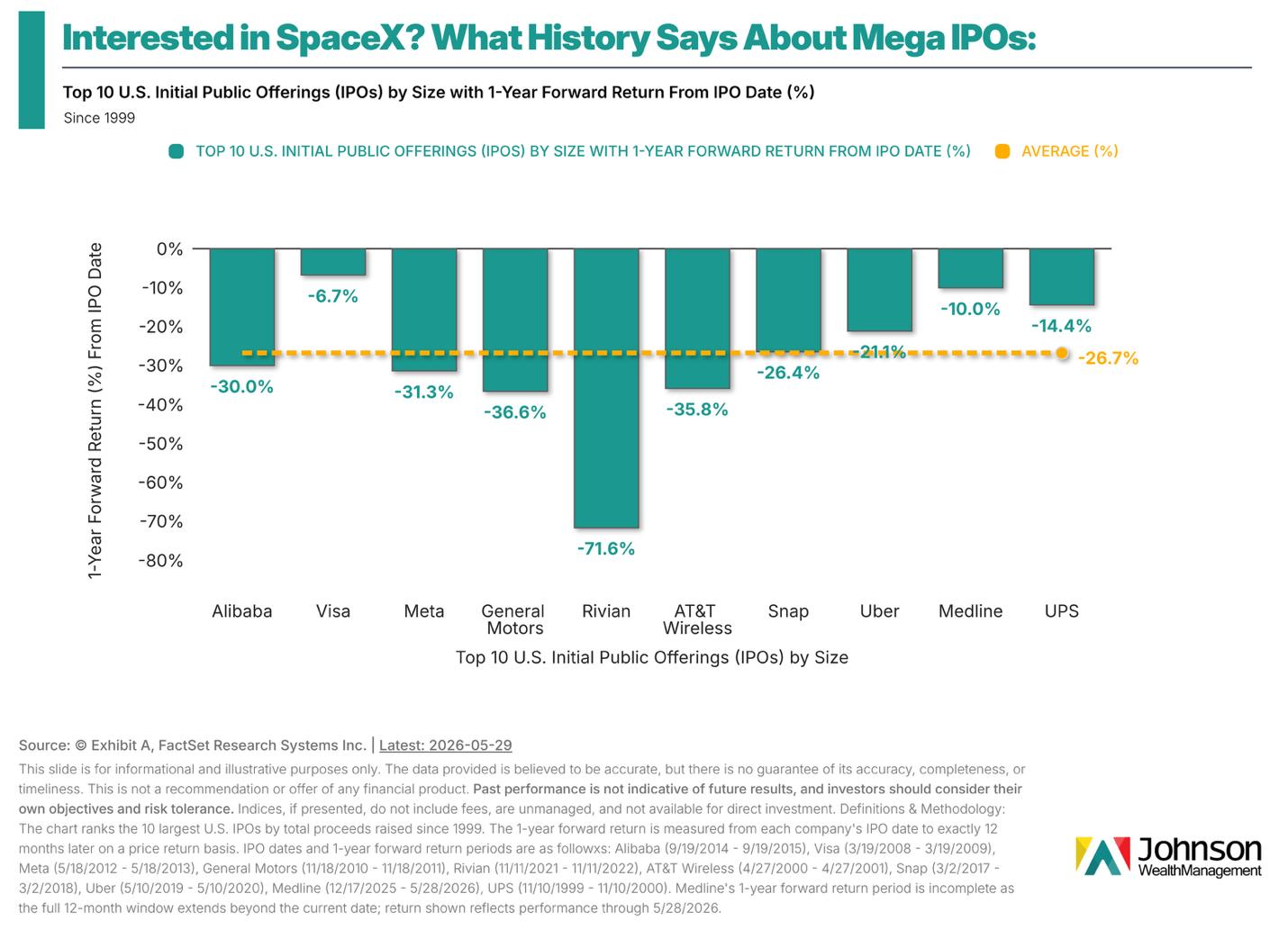
The top 10 US IPOs by size have averaged a decline of 26.8% over the first year. The best performing one, Visa, was still down 6.7% in its initial year.
This does not mean that this will occur for SpaceX, but it does put a cautionary tale on the hype.
Don’t get me wrong. Some of those stocks have turned out quite well over the longer term: Meta (Facebook) and Visa in particular. It’s another reminder of something I’ve written about before: timeframe is a critical part of any investment decision.

That said, investors should gear up for big swings in price for Musk’s space company. One writer picked up by Morningstar noted that: “The critical amplifier is float — at about 3.3%, where Tesla sees 10.0%-15.0% swings on milestone slips, we expect SpaceX to experience 20.0%-30.0% moves on equivalent catalysts.” (9) Are you the kind of investor who can handle potentially massive volatility?
Is the possible valuation of the company at $1.75 trillion worth it? According to Braden Dennis & Ryan Henderson, if you strip away all costs and taxes and focus just on its core profitability, it will trade at more than 300 times EBITDA, which is significantly greater than similarly sized companies like Meta (Facebook), Taiwan Semiconductor, and Amazon. (10) And guess what? As of June 5th, 2026, betting markets like Polymarket think the valuation may be even higher than that by the time it stops trading on IPO day. (11)

One of the biggest concerns for an early investor on IPO day (not an early investor pre-IPO; they are happier than clams and will be quite pleased to endorse it in the media), is that the day they start buying is not the entirety of shares that will be on the market within the year. There is a risk of dilution. A few writers point to this problem:
Assuming that the $86.25bn gets successfully allocated [an extraordinary amount of stock for underwriters to place at the beginning], the market absorption is still not done. A wall of supply is coming from those insiders that bought SpaceX at a fraction of the price.
The S-1 makes clear that Musk (approximately 42% economic interest - with 85% of voting power via super-voting Class B shares) is subject to a normal lock-up but a lot of SpaceX insider stock joins the free float remarkably quickly.
“Early Release Eligible Shares” have not been quantified in the draft S-1 but the lock-up schedule and triggers are set out below and I have seen estimates that 80-90% of the non-Founder shares will be freely tradeable by November. (12)
What might SpaceX do to Musk’s other company — Tesla? Interestingly, there have been whisperings about a potential merger between the two. If the IPO doesn’t go well, might they merge? Does it make sense to put both companies under one roof either way? After all, SpaceX has already purchased hundreds of millions of dollars of Tesla products like Megapack and Cybertruck. (13) Or might they thrive independently and benefit one another?
Here’s what matters. I don’t do market predictions. And with the cautions above, remember that fundamentals don’t always drive price, especially with a celebrity CEO like Elon, who people tend to love or hate.
NYU finance professor Aswath Damodaran, who values the company about a half trillion dollars below its expected price, says, “No matter what your views are about the SpaceX IPO, positive or negative, there is no denying that this company is a loaded bet on the AI and Elon Musk, and while that may concern some, there are others who will look at Musk’s track record with Tesla and feel the odds are in their favor.” (14)
The question you should be asking is probably not what this company will do or not do on the first day or first year of trading, but how this company or any other investment fits into your overall financial plan.
We do not believe investors should be asking what will help you get rich quick, but what will help you live and leave a legacy.
We may indeed reach the stars through corporations like SpaceX. The stock may give stellar returns to its shareholders. But make sure you don’t reach so high that you see stars from taking a risk you can’t afford to take.
###
Brandon Stockman has been a Wealth Advisor licensed with the Series 7 and 66 since the Great Financial Crisis of 2008. He has the privilege of helping manage accounts throughout the United States and works in the Fortuna office of Johnson Wealth Management. You can sign up for his weekly newsletter on investing and financial education or subscribe to his YouTube channel. Securities and advisory services offered through Prospera Financial Services, Inc. | Member FINRA, SIPC. This should not be considered tax, legal, or investment advice. Past performance is no guarantee of future results.
###
Sources:
1.
SpaceX’s S-1 SEC Document, page 1. Accessed
online.
2.
SpaceX’s S-1 SEC Document, page 2. Accessed
online.
3.
SpaceX’s S-1 SEC Document, page 11. Accessed
online.
4.
SpaceX’s S-1 SEC Document, page 75. Accessed
online.
5.
SpaceX’s S-1 SEC Document, page 235. Accessed
online.
6.
SpaceX’s S-1 SEC Document, page 4. Accessed
online.
7.
SpaceX’s S-1 SEC Document, page 30. Accessed
online.
8.
The chart and the data in the above few paragraphs is from “Initial
Public Offering Updated Statistics” (May 18, 2026), page 78.
Accessed
online.
9.
“Does SpaceX’s Sky-High Valuation Make Sense?” (March 9, 2026).
Accessed
online.
10.
“SpaceX: Here’s What You Get For $1.75 Trillion” (May 24, 2026).
Accessed
online.
11.
“SpaceX IPO Closing Market Cap” (May 28, 2026). Accessed
online.
12.
“The Physics of SpaceX” (May 24, 2026). Accessed
online.
13.
SpaceX’s S-1 SEC Document, page F-56. Accessed
online.
14.
“Revisiting the SpaceX Valuation: A Post-Prospectus Update!”,
June 4, 2026. Accessed
online.
LIT BIT: A Chapter from Darkness in the Redwoods, a New Murder Mystery From Former Times-Standard Sports Reporter Neil Tarpey
Neil Tarpey / Sunday, June 7 @ 7 a.m. / Fiction
Find below: An excerpt from Darkness in the Redwoods, a just-released detective novel from local writer Neil Tarpey.
Darkness in the Redwoods is available for purchase at: Booklegger and Eureka Books in Old Town; Pacific Paper in Henderson Center; Blake’s Books in McKinleyville; and online at Lulu.com.
Tarpey and fellow crime author David Lee — a Lit Bit alumnus — will read from their work at the Morris Graves Museum on Sunday, July 26, from 1-3 p.m.
Are you a Humboldt County writer who has written a book? Or a writer who has written a book about Humboldt County? You should share an excerpt with LoCO Lit Bit! Hit us up at news@lostcoastoutpost.com, and put “Lit Bit” in the subject line.
###
Detective Naomi Marren

Dark, swift-moving clouds dump rain as I drive us from Coleman Road to Valley West in north Arcata to interview Dennis Rigazzi. Greg Mayfield called him a real dick and Fran Anderson said he’s mean. Our dispatcher confirms the name and address of his business, Mueller’s German Auto Repairs.
After we park by the curb on Franklin Lane in front of Mueller’s, we walk past two BMW’s, a Mercedes-Benz and an old gray Volkswagen van in a small parking lot and into the open side-by-side bays. A black Porsche is parked in one bay. In the other, a white Audi with its engine idling rests eight-feet off the ground on a lift rack. Two men in dirty blue coveralls stand beneath the Audi, looking up at its undercarriage.
Kevin and I stop about six feet away so we didn’t intrude in their work space. I flip the hood of my rain jacket back down.
“Which one of you is Dennis Rigazzi?” I ask.
The taller man turns to us. “Who wants to know?”
He has angular cheekbones, a face that hasn’t seen a razor for several days, and a red scorpion tattooed on half his neck. He’s wearing a Raiders cap and holding a long flashlight in his right hand whose knuckles have a purple-gray bruise.
“North Valley PD. I’m Detective Naomi Marren and this is Inspector Kevin Valken.”
“Got some ID?”
We show our badges but he barely glances at them.
“You’re Dennis Rigazzi?” I ask.
“That’d be me.”
“We need to ask you some questions, sir.”
“Can we do this another time? I’m kinda busy.”
“No, we can’t. Why don’t we step into your office?”
“Shit. What is it this time? Unpaid parking tickets? A broken taillight?”
Rigazzi exhales and glares at me. He spits on the oil-stained concrete floor. I keep my eyes on the long flashlight in his right hand as he slowly taps it on his left palm.
“Your stupidity killed my only brother. You harassed him for spousal abuse. Spousal abuse? Tina was the one throwing shit around the kitchen. That bitch gets a restraining order because isn’t the woman always right? Leo got jail time. Lost his job and the kids. Then Tina married the lonely hearts neighbor who played the banjo. Leo got depressed and hung himself. All because of your fucking incompetence.”
He spits on the floor again and scowls at Kevin.
“Don’t you have something better to do, like chasing some real bad boys?”
Rigazzi’s starting to piss me off. Maybe it’s all the rain we’ve been having. Maybe I just don’t like his red scorpion tattoo. Or maybe because he’s acting like an asshole.
He passes the flashlight to the shorter man with a brown ponytail and black glasses.
“See if you can find the damn rattle while I deal with these so-called public servants.”
Rigazzi leads Kevin and myself into his office. Overhead tube lights illuminate the room. A gray metal desk stands in the middle, a swivel chair behind it. A stack of paperwork overflows a two-tier in-box. Auto parts, repair manuals and three empty pizza boxes clutter the desk. The air stinks of stale sweat. A yellow plastic chair is off to the side. A wall calendar shows a big-breasted woman in a string bikini sitting on the hood of a Mercedes Benz. Rigazzi plops down behind the desk and motions toward the yellow plastic chair.
“Make yourself comfy, Ma’am.”
“It’s Detective Marren, Mr. Rigazzi. Drop the fucking attitude.”
I decide to stay standing near the office door.
Kevin sits in the plastic chair and stares at Rigazzi. The mechanic glances at Kevin, smirks, and folds his arms.
“If you own this place, how come it’s called Mueller’s and not Rigazzi’s?” I ask.
“Because when Old Man Mueller retired he agreed to sell it to me, provided I kept the same name. I think it’s good for business.”
“That’s right,” I say. “If you gave it your name you’d probably lose business.”
Rigazzi’s face flashes red, but he doesn’t reply.
I point at the blue-yellow swelling on his right hand.
“How’d you get that bruise?”
“A wrench slipped while I was working on an engine. Shit like that happens round here.”
He burps loudly and grins.
“Where were you Tuesday night from 10 o’clock until about 1 am?” I ask.
Rigazzi looks out at the rain peppering the rectangular office window and yawns.
“You’re talking what, two nights ago? Let me think.”
He leans back in the swivel chair and stares at me.
“Tuesday, yeah, I was here by myself until about seven, working on my car brakes. Then I drove home, had a few whiskeys and crashed.”
“Can anyone vouch for you?”
“Nope. I was here by myself. Went home by myself. Live by myself. Drank by myself. So, no, nobody can vouch for me.”
“And home is the yellow house where Coleman Road runs into Brookfield?”
He frowns, maybe wondering why I’m interested in where he lives.
“Tell me, Mr. Rigazzi, how well do you know your other neighbors?”
“I’m in the auto repair business so I notice what cars they drive. But no, we don’t exchange Christmas presents.”
“Speaking of vehicles, a Nissan Sentra went over the embankment on the other side of Brookfield near your house the other day. Do you know anything about that?”
“Nope. But I noticed the yellow-and-black crime scene tape so I figured there must have been an accident.”
He starts drumming his fingers on the desk.
“And one of your neighbors told us you threatened her when she was walking her dog.”
“Ah, shit, is that what this is all about? That old biddy Anderson? You’re here because I told her not to let her little yapping dog take a dump on my property?”
He frowns at Kevin and says, “Cat got your tongue? You’re gonna sit there and let her ask all the questions?”
Kevin can tell I’m getting on Rigazzi’s nerves, so at first he says nothing. Then he says, “Yes I am, and I suggest you answer all of Detective Marren’s questions.”
Rigazzi folds his arms across his chest and grimaces.
“How well do you know Judge O’Malley down at the end of Coleman?”
“Santa Claus? What about him?”
“You had any problems, or court dealings, with the judge?”
“Nope, but Leo did.”
The clatter of a tool hitting concrete interrupts the conversation. Rigazzi stands up and looks towards the bay where the mechanic is working on the Audi.
“Say, are we about done? I’ve got work to do.”
“A few more questions and we’ll let you get back to work,” I tell him.
Rigazzi glowers at me and sits back down.
“Do you own any handguns?” I ask.
“Sure. So do lots of people,” he sneers. “The Second amendment gives us that right.”
“What kind of handguns?”
“I’ve got three. A Glock 9mm, a .44 Magnum, and a Ruger Bearcat .22.”
“Where do you keep them?”
“In a safe at home.” His eyes narrow. “Say, what the hell’s going on?”
###
Neil Tarpey, a New York native, has lived in Humboldt County for coming up on 50 years. A former sports writer for the Times-Standard, Neil has previously published a collection of flash fiction. Learn more about him at his website.
THE ECONEWS REPORT: Get to Know River Otters!
The EcoNews Report / Saturday, June 6 @ 10 a.m. / Environment

Otter! Image: (c) Nancy Spruance, some rights reserved (CC BY-NC-ND)
###
How well do you know river otters? They are cute (obviously). But did you know they are carnivores? They are the apex predator of our local watersheds, hunting on fish, crustaceans, and even waterfowl! Otter experts Charlotte Norman and Gina Culver join the program to talk about the diets of local otters and their complex social lives.
###
HUMBOLDT HISTORY: The Proceedings of The Bachelor Girls’ Sewing Club
Harriet Tracy DeLong / Saturday, June 6 @ 7:30 a.m. / History

The Bachelor Girls would sometimes enjoy a bit of sport, in this case tennis, prior to their usual luncheon meeting. Photo via the Humboldt Historian.
###
On April 17, 1953, 18 women gathered at the Congregational Church parlors at Eighth and G streets in Eureka to celebrate their Golden Jubilee luncheon. With much hilarity they convened around the luncheon table in the same room where they had formed the club more than 50 years earlier. The table was decorated with red camellias and golden primroses. The dinner was prepared for these veterans of the Bachelor Girls by the Young Mothers’ Club of the Church. Much had changed in these women’s lives and they felt it appropriate to celebrate those changes and remember the events of the last 50 years.
Many had broken their vows and had married, yet they continued to meet once a month, sometimes with a full compliment of members, sometimes with only a few in attendance.
The charter members, carefully recorded in the minutes book, included: Susie Pasco, Edna Rogers, Lizzie Simpson, Hattie Tracy, Helen Davis, Edith Rogers, Josephine Stinson, Ethel McClellan, Harriet Woods, Mabel Frame, Annie Woodcock, Clearie Sembower, Alice Way and Grace T. Brown.
The original Bachelor Girls were members of the Eureka Congregational Church Choir, slightly bored with life and looking for something more exciting than school to enliven their lives. Temporarily, they elected Alice Way as president, Grace T. Brown, secretary, and Hattie F. Tracy, treasurer. Meetings were designated to be held every month.
Their vows included the promise that they would never marry; a fine of $5 would be imposed on anyone who broke that vow. No idlers would be allowed. Their time would be spent on needlework. Ten cents, payable in advance, were the dues, 25 cents was the initiation fee. The dues never changed.
At their first meeting they admitted three more members to their club: Hattie Chapman, Ethel Tracy and Louise Hannah. At this meeting they also changed the names of their officers. The president was to be called Most High & Mighty Presiding Spinster, the secretary became Most Honorable Penholder, and the treasurer, Most Trustworthy Moneybags. Four more officers were added to the list: Stariana Protector, Grand Quizzer, Strenuous Estoquer and Dummy.
Initiation rituals were grand affairs. They included the “Vow,” the chant, “Red and yellow, catch a fellow,” and a quiz especially designed for each member. For instance, in the instance of candidate Bessie Weatherby, the following “accusation” was made: “The parrot says the owl saw the candidate out walking with Ernest Pape the other Sunday.”
Confession: “It is true.”
Accusation: “The parrot says the owl knows that the candidate doesn’t come to Sunday School so often since Mr. Gordon left.”
Confession: “Not true.”
Candidate: “The parrot says that the owl knows that the candidate winked at Mr. Albee in the laboratory during physics.”
Confession: “Not true.”
These initiation rites went on and on until the whole club was duly admitted to the Bachelor Girls’ Sewing Club. The girls then turned to their needlework until it was time for a dessert of cake and lemonade.
So progressed the meetings of the Bachelor Girls. New members were admitted while others drifted away. They decided that, all total, 30 members would be admitted to the Bachelor Girls.
Since there were not enough Congregational girls to fill that compliment. others were invited to join, mostly Episcopalians and Presbyterians. But the core of the group remained the same. They worked hard at their sewing to earn money to donate to such worthy projects as the mortgage on the church, the Armenian Relief Fund and to church bazaars.
The marriage of a Bachelor Girl was of intense interest. Each time someone announced her engagement, the gentleman in question gave a $5 gold piece to the treasury, and the young lady was honored with a particularly spectacular luncheon.
Food and talk and trips to visit those girls who had set up housekeeping on their own was the order of the day. Only one member left the country permanently — Alice Way Bell, their first president, moved to Lancaster, England. She kept up a lively correspondence with the girls and in return the girls sent her boxes of much needed clothes and food, during and after World War II.
As the years slipped away, the Bachelor Girls continued their monthly meetings. Occasionally a new baby would appear to be admired and given the status of Bachelor Girl Child. While their first meetings were held at the church, as new members were initiated, they found it preferable to meet at the member’s home. As an adopted Bachelor Girl Child, I distinctly remember delicious meals prepared by Alice Ross Moxon at her ranch in the Arcata Bottoms, and by Alice Dinsmore at Dinsmore Lodge. Another favorite spot for the girls when they first formed the club was a trip out to “Forest Park” (now known as Sequoia Park) on the “cars.” At one time Alice Moxon and Belle Minor lived at Samoa, which entailed exciting trips on the Antelope to play on the beach and eat simple fried chicken lunches.
As they become older, the girls dispensed with luncheons in their homes and began to explore the newest restaurants in town, and, incidentally, gave up needlework and turned their attention to a “gabfest” and food.
They fully enjoyed their luncheons at Weatherby’s, Walt’s and the Flakey Doughnut Shop. They would then adjourn to a member’s home for more gossip and perhaps a bite of dessert.
The Bachelor Girls continued to meet regularly until May 1968. It was then that Clearie Sembower Reed brought me the minutes books and photographs. “You take them,” she said. “Maybe someday you can write a story about us for the Humboldt Historian …”
###
The piece above was printed in the March-April 1988 issue of the Humboldt Historian, a journal of the Humboldt County Historical Society. It is reprinted here with permission. The Humboldt County Historical Society is a nonprofit organization devoted to archiving, preserving and sharing Humboldt County’s rich history. You can become a member and receive a year’s worth of new issues of The Humboldt Historian at this link.
Bill That Would Make State Agencies Consider Tribes During Water Policy Decisions Passes State Assembly
Sage Alexander / Friday, June 5 @ 3:33 p.m. / Environment , Tribes

Key battlegrounds for water rights include the Scott and Shasta watersheds, tributaries to the Klamath. A Shasta River Water Association Irrigation Canal. | Image from a 2016 environmental assessment by the U.S. Bureau of Reclamation.
An Assembly Bill sponsored by the Karuk Tribe, which seeks to expand consultation between state water agencies and tribes during water policy decisions, passed through the California Assembly last week.
The Karuk Tribe says the bill could help address historic inequities by giving tribes a seat at the table.
The vote was 57 in support and 23 members refusing to vote, including every Republican in the Assembly and three Democrats.
If signed into law, Assembly Bill 2218 would declare, as statewide policy, recognition of “the inequities regarding access to, and control over, water caused by state-sanctioned acts of termination, removal, and assimilation inflicted upon all California Native American tribes.”
It would also have the Legislature formally acknowledge and apologize for over a century of state-sanctioned policies that harmed Native Americans.
A key provision of the bill is requiring consultation with tribes when certain water policies are revisited by state agencies. The State Water Board, when investigating the basis of a water right, would need to consult with a California Native American tribe whose ancestral territory includes the water body, when requested.
There are some existing tribal consultation policies, but the Karuk Tribe says they aren’t airtight, legally.
Craig Tucker, a policy consultant for the Karuk Tribe, said current relevant State Water Board policies stem from executive order, and are susceptible to litigation.
“What we’re doing is providing a legislative backstop to those policies, and so [the bill] strengthens those existing policies,” he said.
He thinks there’s still room for state agencies to involve tribes in decision making.
The bill also more broadly calls for historic inequities to be addressed through financial assistance, protection of tribal water uses, consultation on water projects, plans, and policies, plus incorporation of Indigenous knowledge to restore and protect ecosystems.
State agencies like the State Water Board, Regional Water Quality Control Boards, the Natural Resources Agency, the Delta Stewardship Council and the Office of Land Use and Climate Innovation would implement this policy.
The Karuk Tribe and the Shingle Springs Band of Miwok Indians (another co-sponsor of the bill headquartered in El Dorado County) said this change would bolster tribal rights, stewardship and justice in a press release.
“Tribal Leaders recognize that California’s water rights system, based on the ‘first in time, first in right’ principle, purposefully disenfranchised the original water users,” said Russell “Buster” Attebery, chairman of the Karuk Tribe in a prepared statement.
“This resulted in California Tribes losing access to their water, traditional foods and culture. We believe that healthy rivers and restored fisheries are inseparable from Tribal equity in water governance,” he said.
Tucker said despite the Karuk Tribe’s advocacy for more water in rivers, there are places with inadequate water for fisheries.
For example, he pointed to the Scott and Shasta rivers, both key tributaries to the Klamath that have hosted water battles between agricultural users and those pushing for flows for fish.
“Currently the Water Board is setting flow requirements on the Scott and Shasta, and we want every legal right to be fully involved in the process,” he said.
The bill would also have the Legislature apologize for policies that led to Indigenous groups across the state losing access to land and water.
“The state historically sanctioned over one century of depredations and prejudicial policies against California Native Americans, including removal from ancestral land. The Legislature apologizes on behalf of the citizens of the state to all California Native Americans for the violence, mistreatment, and neglect inflicted upon them,” the bill reads.
The state has moved to apologize to the Indigenous people of California before. In 2019 Governor Gavin Newsom issued an executive order apoligzing for violence, maltreatment and neglect. A separate Assembly Bill introduced this year calls for a similar apology from the Legislature, which agreed to pay bounties for the heads of Native Americans in the 1850s.

“AB2218 simply acknowledges what we all know to be true, what we have already understood. It creates a space at the table for the future,” Frankie Myers, former Vice-chair of the Yurok Tribe, speaking in support of the bill at an April hearing.
According to AB2218’s author, San Jose Democrat Ash Kalra, the bill will address past state policy harms through meaningful measures “including protection of tribal water uses and consultation on water projects, plans, and policies,” according to his prepared statement in the press release.
The bill is co-authored by Democrat Chris Rogers, who represents the North Coast.
A joint press release from the Karuk Tribe and the Shingle Springs Band of Miwok Indians pointed to continued barriers to accessing and controlling ancestral lands, water rights, and cultural resources.
The tribes say historic redistribution of water has reduced or eliminated access to healthy traditional food sources such as smelt, salmon, freshwater mussels and freshwater plants. Lack of flows also prevent cultural, spiritual and subsistence practices, the press release said.
If signed into law, the bill will come with a financial cost to the state, amid estimated General Fund structural deficits of around $35 billion per year in the 2027-28 fiscal year.
The Assembly Appropriations Committee estimates $5.3 million for about 21 new staff to serve as dedicated tribal coordinators within the Regional Water Boards and in the State Water Board′s major programs to better coordinate with tribes, with additional unknown contracting dollars.
Other state agencies estimated added costs for staff and possibly for grants, intended to be used for tribal participation in policy decisions.
Two associations that represent water organizations across the state, California Municipal Utilities Association and Association of California Water Agencies, oppose the bill, along with the California Farm Bureau and California Chamber Of Commerce.
In comments submitted to the Assembly, opponents criticized the bill as vague or difficult to implement, without clear standards for agencies to put in place.
A spread of environmental organizations have noted their support for the bill, which awaits assignment to committee in the Senate.
“This bill doesn’t right all the wrongs of the past, but it’s a step in the right direction,” said Tucker.


