

OBITUARY: Edmond ‘Tooter’ Ray Thompson, 1951-2023
LoCO Staff / Wednesday, May 24, 2023 @ 6:56 a.m. / Obits

Edmond “Tooter” Ray Thompson
June 15, 1951 - April 17, 2023
On April 17, 2023 at 1:30 p.m. we had to bid farewell to our loving husband, father, grandfather, uncle, and friend Edmond Ray Thompson (better Known as “Tooter”). Tooter passed away peacefully surrounded by family at Providence St. Joseph Hospital in Eureka.
Tooter was born on June 15, 1951 in Ouachita, Louisiana and he moved to McKinleyville at the age of 3 with his mother and four siblings. He spent most of his childhood hunting, fishing, skating and riding bikes with friends. In 1970 at around age 19 he began working for Simpson Timber Company pulling green chain until eventually operating a forklift; which remained his position until he retired at the age of 62 in June of 2013.
Through a majority of his adult life Tooter spent his time away from work hanging at the local bars acting somewhat rowdy with his brothers and pals brawling with any and all who came knocking for trouble. He also enjoyed fishing the ocean very much for halibut, lingcod, rockfish, salmon, etc… pretty much if you can name it he liked to catch it. He would even make a few trips to Alaska to chase the halibut and salmon of the last frontier. Tooter was also very passionate about hunting each season: stomping through the woods or driving through the hills with his son, nephews, and pal Danny searching for that next buck to fill the freezer. In his later years these drives would come to be his favorite pastime and he loved every minute he spent off the grid just searching for wildlife.
In 1979 Tooters daughter Toni was born. Then in 1980 he married the love of his life, his wife Tina, and his son Jared was born in 1989. Soon after the birth of his son his rowdy ways mellowed and he focused on spending time with family and teaching his son those life lessons that his son still uses to this day.
Tooter was preceded in death by his mother Adele, sister Olafey, and four brothers Hilton, Connie, Morris, and Donald. He is survived in death his brother Wayne, his three sisters Wander, Gloria, and Imagene, his wife Tina, son Jared, Daughter Toni, Granddaughters Meghan, Nicole, and Krista, and multiple nephews nieces in laws and many, many friend around the county and afar. If you knew Tooter his friends were his family as well.
There will be a small celebration of life potluck at the Moose Lodge in McKinleyville on June 10, 2023 from 2 p.m.-4 p.m. in the picnic area in the back. All are welcome so come pay your respects, bid your farewell, and have a good time remembering Tooter for the wonderful person he truly was.
###
The obituary above was submitted on behalf of Tooter Thompson’s loved ones. The Lost Coast Outpost runs obituaries of Humboldt County residents at no charge. See guidelines here. Email news@lostcoastoutpost.com.
BOOKED
Yesterday: 9 felonies, 9 misdemeanors, 0 infractions
JUDGED
Humboldt County Superior Court Calendar: Today
CHP REPORTS
Us101 S / Herrick Ave Ofr (HM office): Assist with Construction
ELSEWHERE
RHBB: Brr! Storm System to Bring Heavy Rain and Lower Snow Levels Across Northwest California
RHBB: Snowpack in Klamath National Forest Well Below Average After Dry Winter Start
RHBB: Major Roadwork Scheduled Friday February 13 through Thursday, February 19
RHBB: Six Rivers National Forest Hiring Seasonal Recreation Workers
OBITUARY: Fred A. Zak, 1949-2023
LoCO Staff / Wednesday, May 24, 2023 @ 6:56 a.m. / Obits

Fred A. Zak was born in Eureka
on June 12, 1949. He passed away in Eureka on May 11.
He grew up in Eureka, in the neighborhood around 16th and S streets with lifelong friends Jeff Nissen and Dave Ball, enjoying all kinds of sports, especially home run derby whiffle ball, duck hunting along with a few more mischievous activities. He attended Franklin Elementary, Eureka Junior and Senior High Schools, graduating in 1968.
Fred excelled in football and track in high school, where he is remembered for his speed and sure hands as a wide receiver and running the hurdles in track. He went on to play football at CR. He then attended Humboldt, studying environmental health.
During this period of his life, he took time off from studies to work in Lake Tahoe and to move to Green Bay, Wisconsin to experience the cold winters, which he loved, and his favorite team, the Packers. After a couple of years, he returned to the west coast, settling in Portland where he completed an environmental health and safety degree. This led to a job as a health and safety inspector at the Hanford Nuclear Site in Richland, Wash. This was the site of the first full scale plutonium production reactor in the world, and the source of the plutonium used in the first atomic bomb. Fred was involved in the largest environmental cleanup ever undertaken, which is still in progress.
After 10 years of exposure to the hazards at Hanford, Fred moved on to Monroe, Wash. for a job as a safety inspector at the Monroe Correctional Complex, one of the largest prisons in Washington. Fred worked there until he retired in 2017, at which time he returned to Eureka, purchasing his childhood home, where he lived the rest of his life.
Fred never married. He leaves behind a niece, April Hicks and her husband Steve in Boise, Idaho and several lifelong friends, including Jeff Nissen, Larry Matson and Dane Hart, who cared for him in his struggles with cancer over the last couple of years. Fred was preceded in death by his parents, Geri and Tony Zak, his sister Debbie and his stepbrothers, Joe and Jim.
Fred will be remembered as a loyal friend who would do anything for you and a stubborn, determined nature that allowed him to stick to his guns in all situations. You can almost imagine the stories this will lead to when friends gather to celebrate his life over a couple of beers.
###
The obituary above was submitted on behalf of Fred Zak’s loved ones. The Lost Coast Outpost runs obituaries of Humboldt County residents at no charge. See guidelines here. Email news@lostcoastoutpost.com.
HUMBOLDT TODAY with John Kennedy O’Connor | May 23, 2023
LoCO Staff / Tuesday, May 23, 2023 @ 4:58 p.m. / Humboldt Today
Click play above, and stand by …
… for news!
ADDITIONAL READING:
- Hey, Where Did Our Bird E-Scooters Go? Struggling Company Has Flown From Eureka, Fortuna
- Murray Road 76 Station Held Up at Gunpoint Just After Midnight, Sheriff’s Office Says; Deputies Seeking Heavyset Male Captured on Security Cam
- BREAKING: Mad River Hospital Announces That It’s Looking to Sell to SoCal-Based Hospital Company
- Swain Slough Bridge Closure
- Del Norte Supes to Consider Agreement With Klamath River Renewal Corporation; Sediment Following Dam Removal Still A Concern
- BEAR CUBS: The Zoo Now Has Two New, ‘Non-Releasable’ Bear Cubs Gracing the New Bear Habitat
Hey, Where Did Our Bird E-Scooters Go? Struggling Company Has Flown From Eureka, Fortuna.
Ryan Burns / Tuesday, May 23, 2023 @ 1:07 p.m. / Transportation
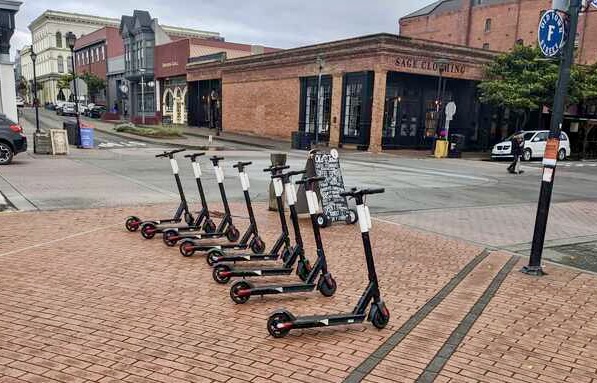
A flock of Bird e-scooters parked in Old Town last year. | Photo by Hank Sims.
###

It must have been the springtime chirping of so many real birds that made us finally notice the absence of their two-wheeled namesake — the fleet of Bird electric scooters that migrated into Fortuna in late 2021 and into Eureka a few months later.
For a while there, Outpost employees and other residents could be seen zipping around Old Town on the app-activated devices, twisting the handlebar accelerator to reach the scooters’ max speed of 15 miles per hour on our daily commutes — or maybe just a joyride.
The scooters were scattered all over the sidewalks … until they weren’t. We emailed the company to ask what happened, and in response we got a prepared statement confirming that they’ve flown the coop.
“Unfortunately, we do not see an immediate path to supporting our near-term requirements for building an enduring business in Eureka,” Bird Government Partnerships Manager Garrett Gronowski says in the statement. “As a result, we will be removing our operations in the community.”
Same applies in Fortuna, he said.
The Santa Monica-based “shared micromobility company” experienced a meteoric rise, reaching a billion-dollar “unicorn” valuation within a year of launching, and eventually partnering with more than 300 cities worldwide. When Bird scooters arrived in Fortuna mid-pandemic, the company billed its devices as “a naturally socially distanced way to get around.”
In a presentation to the Eureka City Council last April a Bird rep said, “Our mission is to improve the quality of life in cities by reducing traffic congestion, improving air quality and providing affordable and reliable alternative transportation options.”
Alas, like many Silicon Valley phenomenons before it, the company’s fortunes reversed nearly as quickly. In 2022, after admitting that it had overstated revenue for more than two years, Bird laid off nearly a quarter of its employees as it faced the prospect of bankruptcy, or even going out of business altogether.
In recent months Bird has pulled its scooters out of numerous cities, including San Francisco.
Eureka City Manager Miles Slattery said he saw the writing on the wall months ago, but he’s nonetheless disappointed about the loss of an eco-friendly transportation option for city residents. A bike-sharing company that briefly partnered with the city has also gone away.
“We need to find a vendor that’s going to be good for everybody,” Slattery said, referring to neighboring communities and their residents … . “We need to find a solution for the whole region so you can utilize the [Bay Trail] and have that consistency.
Slattery said city staff will continue to work with the City of Arcata and the County of Humboldt in an effort to develop more clean transportation options.
(PHOTOS) Murray Road 76 Station Held Up at Gunpoint Just After Midnight, Sheriff’s Office Says; Deputies Seeking Heavyset Male Captured on Security Cam
LoCO Staff / Tuesday, May 23, 2023 @ 11:10 a.m. / Crime

Photos: HCSO.
Press release from the Humboldt County Sheriff’s Office:
On May 23, 2023, at about 12:28 a.m., Humboldt County Sheriff’s deputies were dispatched to a business on the 1000 block of Murray Road in McKinleyville for the report of an armed robbery.
According to an employee of the business, an unknown male suspect reportedly entered the business and brandished a firearm at the employee, demanding cash. The suspect then fled the store on foot.
The suspect is described as a heavyset male, approximately 5’8” to 5’10” tall, last seen wearing a blue hooded Carhart jacket, dark pants and a red bandana over his face.
This case is still under investigation. Anyone with information about this case or the identity and whereabouts of the suspect is encouraged to call the Humboldt County Sheriff’s Office at (707) 445-7251 or the Sheriff’s Office Crime Tip line at (707) 268-2539, reference case number 202302378.

BEAR CUBS: The Zoo Now Has Two New, ‘Non-Releasable’ Bear Cubs Gracing the New Bear Habitat
LoCO Staff / Tuesday, May 23, 2023 @ 10:14 a.m. / Wildlife

Oak (left) and Tule. Photos courtesy Sequoia Park Zoo.
Press release from the Sequoia Park Zoo:
In partnership with the California Department of Fish and Wildlife (CDFW) and Lake Tahoe Wildlife Care (LTWC), the Sequoia Park Zoo is excited to announce that two non-releasable bear cubs, currently known as “Oak” and “Tule”, have officially moved into the Zoo’s new Bear and Coyote habitat. The cubs will not be visible to guests - but might be heard playing behind-the-scenes in the care quarters - while they become acclimated to their new home. Animal care staff will monitor the health and comfort of the cubs over the next month, a standard practice among zoos, before introducing them to visitors. Guests can expect to start seeing the cubs in late June.
Oak and Tule were rescued by Lake Tahoe Wildlife Care in Spring 2022 and have grown up and bonded together during their year-long rehabilitation. Oak weighed 6.5 lbs when she was found orphaned in Oak Run, California, in early May 2022. Unfortunately, Oak never displayed the appropriate fear response to humans, despite the best efforts of her care team to prepare her for life in the wild.
Tule (pronounced Too-Lee) was only weeks old when he was found in April 2022 on the Tule River Nation Reservation. The local community spent several days searching for his mother but were unable to locate her, and the Tule River Tribal Police Department transported him to LTWC for rehabilitation. Tule’s initial exam revealed that he weighed only 3.7 lbs and had a variety of health issues. Veterinary staff consulted with specialists from around the world about his unique case. Although most of his health issues are resolved, tests and medical exams determined that Tule’s coat will not regrow, which is essential for him to survive in the wild. Due to their conditions, CDFW determined that both cubs were non-releasable.
Oak and Tule were the first orphaned bear cubs admitted to LTWC in the Spring 2022 season. On the LTWC webcam, they have often been seen wrestling, chasing, and socializing with each other. We thank Lake Tahoe Wildlife Care for their hard work and dedication to Oak and Tule, and we are deeply grateful to Bear River Band of the Rohnerville Rancheria for their generous support of the new habitat. The Sequoia Park Zoo looks forward to fostering Oak and Tule’s continued friendship and growth and sharing their stories with our guests.
Every year, the state of California must find homes for a small population of animals that are deemed non-releasable. Facilities like the Sequoia Park Zoo play an important role in providing permanent homes for non-releasable animals and creating educational opportunities to learn about conserving and living with wildlife.
Oak and Tule goofing around in their former home at Lake Tahoe Wildlife Care.
Newsom Changes Course, Now Wants More Student Housing Money Sooner
Mikhail Zinshteyn / Tuesday, May 23, 2023 @ 7:43 a.m. / Sacramento

Student housing across The Little Lake at the University of California Merced campus on Nov. 4, 2022. Photo by Larry Valenzuela, CalMatters/CatchLight Local
Starting in 2021, California took more of an interest in constructing affordable student housing. Since then it’s been a roller coaster ride.
Gov. Gavin Newsom and lawmakers last year agreed to distribute $4 billion to the state’s three higher education systems with a mix of loans and grants through 2024-25 — which would add at least 20,000 beds at affordable rents. Fast forward to January 2023 and California’s facing a then-$22.5 billion deficit, and his administration wanted to delay some of the money by at least a year.
Now, with his revised May budget, Newsom wants to restore some of the money he wanted delayed. But other housing funds would still be delayed. In that time, the state budget hole has grown to $31.5 billion.
Here’s the latest on what you need to know about a pot of $4 billion.
What is this pot of $4 billion?
Well technically it’s two pots, or two pots nested within one larger pot.
Pot one is roughly $2.2 billion in grants for University of California, California State University and California Community Colleges.
Pot two is $1.8 billion in loans for the same systems.
So what’s new?
Newsom this month found a new way to fund pot one, overruling his January plan to delay $250 million in state grants to build dorms with low rents.
The move would mean the University of California and California State University get all the grant money they were promised without delay in 2023-24, while community colleges would receive all but $95 million and the rest the following year.
But Newsom still wants to delay by a year $1.8 billion in affordable student housing loans for campuses — that’s pot two.
What were the original plans for the $4 billion?
The money is the total of two programs — pots one and two — that were birthed in the last two years of state budgets.
The state’s interest in student housing is new, a response to the hundreds of thousands of college students in desperate pursuit of affordable homes. The supersized down payment on more affordable beds underscores the changing attitudes about college affordability and what the government’s role should be in helping students cover not just tuition, but the total cost of attending school — including housing.
While the UC and CSU have historically self-financed their own student housing, this money is designed to help the campuses provide students less expensive housing.
So far, about $1.4 billion in grants has been doled out to the systems — all part of the 2022 state budget. Last year’s budget promised another $750 million in housing grants to the UC, CSU and community colleges in the spending plan due in June.
Annual rent for dorm beds built with these grant dollars will be 15% of a county’s “area median income” — so about $800 a month in Los Angeles.
Also in last year’s budget deal was a plan to distribute zero-interest loans to the UC, CSU and community colleges in 2023-24 and 2024-25 totaling $1.8 billion.
The idea is that the campuses take the money, build affordable dorms — though what affordable means isn’t yet defined — and then repay the debt over time with student rent. Eventually, the pot is refilled, allowing the state to underwrite future campus construction for student, staff and faculty housing.
What happened between January and May?
With a then-projected state deficit of $22.5 billion, Newsom started off the budget negotiating season in January by proposing to delay the timeline of the 2022-23 budget deal with lawmakers. Rather than issuing $750 million in grants for 2023-24, the governor wanted to instead send $500 million this fiscal year and the remaining $250 million next fiscal year.
He also proposed stalling the zero-interest loan program by sending the campuses no money in 2023-24 and instead distributing the loan dollars in the subsequent two years.
But in his May revision to the budget, Newsom pursued a different tack that simultaneously frees the state from $1.1 billion in immediate financial obligation and sends all the housing grant money to the UC and CSU that last year’s budget deal promised, without delay.
Under the new plan, the UC and CSU would issue bonds to cover their entire share of the housing grant — both the amount they got for 2022-23 and the sum they were promised for 2023-24 — for a total of $1.1 billion.
The final price tag will be 1.4 times the cost of the projects than had the state supplied the money upfront.
California would cover the debt the UC and CSU would absorb, which the governor’s administration estimates to be about $30 million annually for the UC and $45 million for the CSU. The UC told members of the Assembly May 16 that if interest rates on borrowing rise, the UC would need to come back to lawmakers to get more than $30 million a year.While the bond route gives the state fiscal breathing room now, an analyst with the Legislative Analyst’s Office told senators last week that the final price tag will be 1.4 times the cost of the projects than had the state supplied the money upfront. The added costs are due to ongoing interest payments, adjusted for inflation. More UC and Cal State debt also eats into their ability to borrow for other projects. Still, the analyst called the debt-finance approach “reasonable.”
Will the loan program be funded this coming year?
The governor still wants the revolving loan program delayed by a year, something repeatedly rejected by lawmakers, including Assemblymember Kevin McCarty, a Democrat from Sacramento and chairperson of the budget subcommittee on education.
“We know if we’re going to get to the number one issue we talked about earlier, enrollment growth, we need the student housing to get there,” he said May 16. “We’ll be working of course with the administration and hope to come to a conclusion that allows us to not delay the student housing revolving loan fund.”
Nothing about the grant program’s required ultra-low rents would change. Nor would this shift in financing delay construction projects for student housing, UC and Newsom administration officials have said.
Seija Virtanen, a UC government relations senior official, said at a May 16 Assembly hearing that the UC is on track to enroll 8,000 new California undergraduates this fall, nearly double the 4,200 the system projected in March. While that responds to lawmaker pressure to have the UC educate more Californians after it kept its in-state student population flat this year, the enrollment growth underscores the system’s need to generate more housing as it pursues an aggressive expansion plan.
Lack of consensus over community college housing grants
The governor’s May plan for the housing grants ensures the community colleges get 50% of total money disbursed between 2022 and 2024, while Cal State gets 30% and UC receives 20%.
That breakdown has privately frustrated UC officials, who’ve implied the system, not the community colleges, have the experience to build student housing, a point previously echoed by legislative analysts.
A UC official told lawmakers in May that because the system received $389 million out of the total $437 million promised, the UC can only afford to develop one of the six new construction projects it submitted to lawmakers for review. Lawmakers would likely pick the projects the UC and Cal State could fund with the remaining dollars in upcoming budget bill language, a Newsom finance official wrote to CalMatters.
Diminishing what community colleges receive in housing dollars has been a theme in this year’s budget talks.
Most recently, a legislative analyst recently told senators that she recommends no new money goes to the community colleges for student housing. “For the community college projects, we recommend not doing any projects at this time, revisiting down the road,” Jennifer Pacella, deputy legislative analyst at the Legislative Analyst’s Office, said at a Senate hearing May 17. She said the state could distribute housing vouchers or other aid to students in need instead.
The senators present weren’t persuaded.
“It’s a strain when we have students competing with families to try to get access to the very small percentage of affordable housing we have across the state and particularly in places like L.A.,” said Sen. Lola Smallwood-Cuevas, a Democrat from Los Angeles.
Pacella also cautioned that her team predicts less overall state revenue than the governor’s office, meaning steeper cuts may be on the horizon anyway.
The community college system, for its part, has defended the allocation as important for their students, who are generally poorer than UC and CSU students, and also in dire need of housing. The state enrolls more community college students than those at the UC and CSU combined.
###
CalMatters.org is a nonprofit, nonpartisan media venture explaining California policies and politics.


